
Apostles Anglican Church
Fr. John A. Roop
Hands and Hearts: A Homily On the Canaanite Woman
(Isa 56:1-8, Ps 67, Rom 11:13-24, Matt 15:21-28)
“O woman, great is your faith! Be it done for you as you desire” (Matt 15:28b).
In the Name of the Father, and of the Son, and of the Holy Spirit. Amen.
This whole thing with the Canaanite woman started some time before with an accusation scantily cloaked as a question. It’s there in St. Matthew’s Gospel immediately before today’s reading. Now, you would think that by this point in his ministry Jesus’ skeptics and opponents would know better; putting Jesus to the test never ended well for any of them. Even his answers, such as they were, were rarely directed to the questions posed but rather to the hearts of those who posed the questions, often revealing the pride and hypocrisy so carefully hidden there. Still, they came. Still, they asked.
1 Then Pharisees and scribes came to Jesus from Jerusalem and said, 2 “Why do your disciples break the tradition of the elders? For they do not wash their hands when they eat” (John 15:1-2).
The Pharisees and scribes come at Jesus with a two-pronged attack, questioning first his affiliation and loyalty and second his purity.
Whose side are you on? they want to know from Jesus. Are you a Republican, a Democrat, or an Independent? Are you a Conservative, a Liberal, or a Centrist? Are you a Baptist, a Methodist, or a Catholic? Do you use the 1928 Prayer Book, the 1979 Prayer Book, or the 2019 Prayer Book? Are you this? Do you do that? The questions and divisions can be multiplied ad nauseum. For these Pharisees and scribes the divisions ran along these lines: Are you with us Pharisees and scribes, or with the Sadducees, or with the Essenes, or with a new messianic faction of your own making — something else altogether? Whose side are you on? Where does your loyalty lie? The litmus test of affiliation and loyalty they apply here is conformity to the tradition of the elders, a defining characteristic of the Pharisees and scribes. So they test Jesus: why do your disciples break the tradition of the elders?

We must now speak of Torah. Let us think of Torah — the Law, the teachings — as a fence that kept Israel from plunging off a precipice into covenant unfaithfulness. The Torah kept Israel away from the edge of spiritual and national disaster. Of course, one might reason that the farther from the edge the better. Perhaps we should build a second fence that keeps Israel from coming even as close to the edge as Torah allows. That would be safer, better, wouldn’t it? And, if a second fence, why not a third, a fourth even? And so it goes. Generation by generation newer, safer, more distant fences are built, the traditions of the elders accrue, until for the Pharisees and scribes keeping the traditions of the elders becomes synonymous with keeping the Torah itself. To break the tradition of the elders — to hop a fence, even one very distant from the edge marked by Torah — is to flaunt Torah, to be unfaithful to the covenant, to disaffiliate from the people of God as the Pharisees and scribes define the people of God, to exhibit disloyalty to Israel and to the God of Israel. And so, the Pharisees and scribes came to Jesus from Jerusalem and said, “Why do your disciples break the tradition of the elders?”

In all fairness, Jesus and his disciples did seem to sit a bit loose on the tradition. They consorted with tax collectors and sinners. They routinely skirted the Sabbath prohibition against work: Jesus healed on the Sabbath and told former paralytics to take up their beds and walk; the disciples plucked grain, threshed it in their hands, and ate it. Jesus acted very much as if he were Lord of the Sabbath; in fact, he even said so (see Matt 12:1-14). The Pharisees and scribes could have pointed to any of these infractions against the tradition — maybe fairly so — but they seized on something else entirely: your disciples do not wash their hands when they eat.

Now, let’s be clear; this has nothing to do with hygiene. It’s not mom or dad telling the kids to wash up before dinner. This is a matter of ritual purity, which means that, to the Pharisees and scribes, it is a matter of covenant faithfulness.
Here is why purity is so important: purity is the answer to the question of how the holy God of Israel can live among his less than holy people, first in the tabernacle and later in the temple. Purity lay at the heart of the sacrificial system including the great Day of Atonement rituals in which the tabernacle (or temple), the altar, the camp, and the people were purified with the sprinkling of blood. Much of the daily life of Israel was oriented toward purity: don’t touch this, don’t eat that, don’t go there, don’t do that; it is all there in the Torah. And, the remedy for infraction of the purity laws? Often, a ritual washing of body and clothes was required followed by a waiting period, just until the beginning of a new day at sundown. Then, what was impure regained its purity.
But, generation by generation, new fences of purity were built, new traditions of washings added. Eating bread? Hands must be washed, dirty or not: first a cup of water poured over the left hand, then a cup over the right — up to the wrists — followed by an elevation of both hands, a brief drip-dry, a blessing — Blessed are You Lord our God, King of the universe, Who has sanctified us with his commandments and commanded us on the washing of hands. — and finally a thorough drying with a towel. Without this ritual of purity, how could one dare to take bread into his hands and pronounce the blessing over it:
Blessed are You, Lord our God, King of the Universe, Who brings forth bread from the earth.
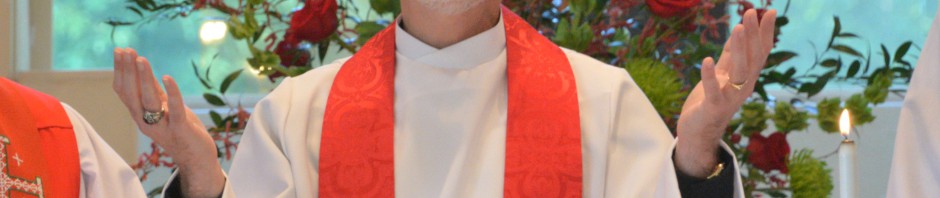
Lest we think this ritual overly fastidious, lest we approach near to mocking, notice the last act of our priests before approaching the altar for the Eucharist today. It is called the lavabo: the washing. It is part of the great Tradition observed by Orthodox, Roman Catholic, and Anglican clergy. Amongst Anglicans, the deacon pours water over the priest’s hands for a ritual cleansing before the priest takes the bread into his hands and blesses it. If I were to see an Anglican Eucharist celebrated without the lavabo, I might well ask the priest afterwards — if I were feeling a bit curmudgeonly that day — Why do you not wash your hands before taking the bread and blessing it? And just so — only more so — the Pharisees and scribes asked Jesus, “Why do your disciples break the tradition of the elders? For they do not wash their hands when they eat.”

We don’t have time to fully parse Jesus’ response, I’m afraid. But, this much we must say, and this much must do for now. If, without being flippant, I may couch Jesus’ answer in words familiar from The Princess Bride: You keep washing your hands; I do not think it does what you think it does. The Pharisees and scribes were treating this ritual washing as sacramental, as an outward and visible sign of an inner and hidden grace, as the means by which one attained purity toward God, as if the washing of hands made one pure before God, and as if failing to wash one’s hands made, or left, one impure. Not so. Even if one eats bread with unwashed, “impure” hands, it is of no grave consequence. Eat, digest, eliminate: no harm, no foul, no impurity. What goes into the mouth doesn’t render one impure. Hear Jesus on this.
18 “But what comes out of the mouth proceeds from the heart, and this defiles a person. 19 For out of the heart come evil thoughts, murder, adultery, sexual immorality, theft, false witness, slander. 20 These are what defile a person. But to eat with unwashed hands does not defile anyone” (Matt 15:18-20).
Purity is about the heart, not about the hands. Did the disciples get it? Did they understand? No, not by a long shot as the next episode in this story makes clear — that whole thing with the Canaanite woman.
But, before that, one other notion about purity is needed if we are to get the story right. Ritual purity had a geographical or geometrical component about it; think of it as concentric circles of purity. You get the notion by looking at the Temple. The Holy of Holies is the smallest, inner circle, the purest of the pure. Only the High Priest is allowed in that circle, and that only once each year after careful cleansing. Moving outward, we enter the Court of the Priests, where the sacrifices were offered; as the name implies, it was restricted to priests who also had to purify themselves with ritual washings. Next was the Court of Israel, reserved for Jewish men as they participated in the religious ceremonies. The Jewish women came next; they were restricted to the Court of Women. Lastly — outermost — came the Court of the Gentiles — the great mass of the “unwashed” — where people of many nations could gather to pray. This was also the commercial center of the Temple, the court Jesus cleansed before his final Passover because it had become a den of thieves instead of a house of prayer. So much for purity in that court. Here’s the point of this Temple geography: the nearer one was to approach God, the purer one had to be. And some people couldn’t approach at all; some people were perpetually impure.

I’ll spare sensitive ears — you can read all the details in Deuteronomy 23:1-6 — but eunuchs were not allowed in the assembly. Nor were those born of illicit unions, not even their eighth great grandchildren. And don’t get me started on Moabites and Ammonites. It was fine to hold a grudge there; even for ten generations they are banned from the assembly. No amount of hand washing will make a eunuch ritually pure or cleanse a tainted bloodline: you can’t wash the Moabite off of yourself. Some people, so it seems, are perpetually unclean, perpetually distanced from God.
Now, back to the story. After his encounter with the Pharisees and scribes, after making clear that purity is a matter of the heart and not of the hands, Jesus takes his disciples into the district of Tyre and Sidon: into Gentile territory, into pagan territory, into an impure land filled with impure people. So the Pharisees and scribes thought. So Jesus’ disciples thought.
22 And behold, a Canaanite woman from that region came out and was crying, “Have mercy on me, O Lord, Son of David; my daughter is severely oppressed by a demon” (Matt 15:22).
There is nothing subtle in St. Matthew’s account: this is a Canaanite woman — certainly a gentile, likely an idol worshipper, absolutely unclean. And her daughter? Even worse than the mother: she is demonized. All of this is ritual impurity painted upon an enormous canvas for all to see. And the disciples saw it.
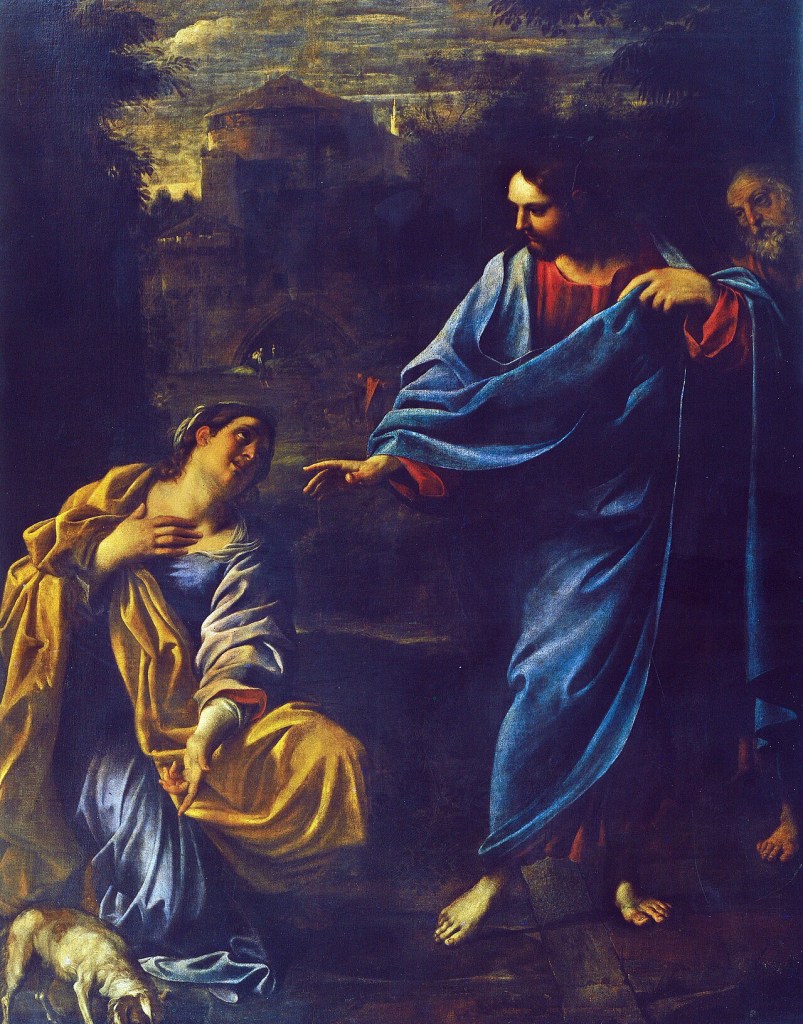
Jesus kept silent. We see him use silence to great effect on other occasions, as well. When challenged by the Pharisees and scribes to condemn the woman taken in adultery, Jesus at first said nothing; he just bent down and scribbled in the sand. And, in his own trial, when the chief priests and elders accused him before Pilate, Jesus gave no answer. Here? His silence gives his disciples a beat, a moment to think, to process what they’ve seen and heard recently. Did they understand about the washing of hands and the thoughts of the heart? Do they know where purity lies?
23b And his disciples came and begged him, saying, “Send her away, for she is crying out after us” (Matt 15:23b).
Bless them. They were slow of heart to understand. So, in his mercy to everyone, Jesus continues the lesson because this is important. This has to do with the in-breaking of the kingdom of God in his very person.
24 He answered, “I was sent only to the lost sheep of the house of Israel.” 25 But she came and knelt before him, saying, “Lord, help me” (Matt 1524-25).
Still, Jesus pushes back once more, answering her as the Pharisees and the scribes would do, as his own disciples would do.
26b “It is not right to take the children’s bread and throw it to the dogs.” 27 She said, “Yes, Lord, yet even the dogs eat the crumbs that fall from their masters’ table” (Matt 15:26b-27).

We can’t know this, but I like to imagine Jesus looking at his disciples with raised eyebrows as if posing the question: “Do you get it now?” Purity is a matter of the heart, not a matter of the washing of hands or the bloodline. Do you still not understand?
28 Then Jesus answered her, “O woman, great is your faith! Be it done for you as you desire.” And her daughter was healed instantly (Matt 15:28).
It is crucial for the disciples to understand this. It is faith that matters, faith like this gentile woman had. Yes, Jesus was sent to the lost sheep of the house of Israel as he said. But the disciples will be sent — Jesus will send them — to make disciples of all nations, baptizing them in the name of the Father and of the Son and of the Holy Spirit (see Matt 28:19). They will be his witnesses in Jerusalem — yes — in all Judea — of course — but also in Samaria and to the ends of the earth (see Acts 1:8). The disciples must grasp this truth: there is no impurity that can separate one whose heart is filled with this faith from the love of God which is ours in Christ Jesus our Lord. It is this Canaanite woman and all those like her then and now and in whatever generations may come that Isaiah foresaw.
3 Let not the foreigner who has joined himself to the Lord say,
“The Lord will surely separate me from his people”;
and let not the eunuch say,
“Behold, I am a dry tree.”
4 For thus says the Lord:
“To the eunuchs who keep my Sabbaths,
who choose the things that please me
and hold fast my covenant,
5 I will give in my house and within my walls
a monument and a name
better than sons and daughters;
I will give them an everlasting name
that shall not be cut off.
6 “And the foreigners who join themselves to the Lord,
to minister to him, to love the name of the Lord,
and to be his servants,
everyone who keeps the Sabbath and does not profane it,
and holds fast my covenant—
7 these I will bring to my holy mountain,
and make them joyful in my house of prayer;
their burnt offerings and their sacrifices
will be accepted on my altar;
for my house shall be called a house of prayer
for all peoples.”
8 The Lord God,
who gathers the outcasts of Israel, declares,
“I will gather yet others to him
besides those already gathered” (Isa 56:3-8).
All these promises of God find their yes in Christ Jesus (see 2 Cor 1:20). That is the story. That is the Gospel.
Beyond rejoicing in the purifying and redeeming power of faith in our Lord Jesus, beyond exulting in the inclusive love of God that draws those from every family, language, people and nation into his kingdom through such faith, what are we to do with this story? Where are the Pharisees and scribes and disciples and Canaanite women among us?
Well, I would have made a good Pharisee; I still do. I like being right, and if pointing out that others are in the wrong highlights my own self-righteousness, well then, so be it. Are there those — like the Moabites and the Canaanite woman — that I consider so unclean, so impure that I count them intrinsically cut off from God, inherently beyond the reach of redemption? I would never say that! But, it’s what’s in my heart that matters. And my heart can be deceitful. Of whom am I suspicious without real reason? Toward whom am I dismissive without real consideration? To whom do I feel superior without shame at my own pride? Whose sins do I hold ever before me — and before them — without lamenting my own? From whom have I withheld forgiveness — because they are clearly unworthy of it — all while expecting God to forgive me my trespasses? Lord, have mercy. If not watchful, if not repentant, I can be a Pharisee washing my hands and saying my blessings and sending away Canaanite women whose great faith beggars my own.
I would have made a good Pharisee — I still do — but I want to be a good Canaanite woman. I want a faith like hers: humble, audacious, persistent. I want a faith that drives me to my knees before Jesus so that he may cleanse me of all impurity, a faith that is not presumptuous, not certain of its own righteousness, but certain only of Jesus whose character is always to have mercy. I want a faith content with the crumbs from the master’s table. I want my sinful body to be made clean by his body, and my soul to be washed through his most precious blood (see The Prayer of Humble Access, BCP 2019, p. 135). I want to evermore dwell in him and he in me. I want to hear one day — please, God — “Great is your faith! Be it done for you as you desire.”
Amen.


