

Apostles Anglican Church
Fr. John A. Roop
Just As He Was: Lectio Divina on Mark 4:35-41
(Isaiah 3, Psalm 106:1-12, Mark 4:35-5:20)
Collect
Set us free, loving Father, from the bondage of our sins, and in your goodness and mercy give us the liberty of that abundant life which you have made known to us in our Savior Jesus Christ; who lives and reigns with you, in the unity of the Holy Spirit, one God, now and for ever. Amen.
36 And leaving the crowd, they took him with them in the boat, just as he was (Mark 4:35-36).
In the Name of the Father, and of the Son, and of the Holy Spirit. Amen.
Lectio Divina, sacred reading, is a means of engaging a holy text not for study or analysis, but for encountering the Lord in and through the written word. Both ways of reading are essential: study keeps lectio divina from going off the rails into fantasy and delusion, and lectio divina keeps the text from becoming irrelevant or dead.
Lectio divina has been a Christian practice likely from the first Christian engagement with the Scriptures. Origen practiced it in the second century. Saint Ambrose taught it to St. Augustine in the fourth century. Saint Benedict made it, along with the chanting of the Psalms, a cornerstone of his monastic rule. But, it was Guigo II, a Carthusian monk in the twelfth century who standardized the practice into four movements which he described as four rungs on the ladder leading from earth to heaven: lectio, meditatio, oratio, contemplatio or reading, meditation, prayer, and contemplation.
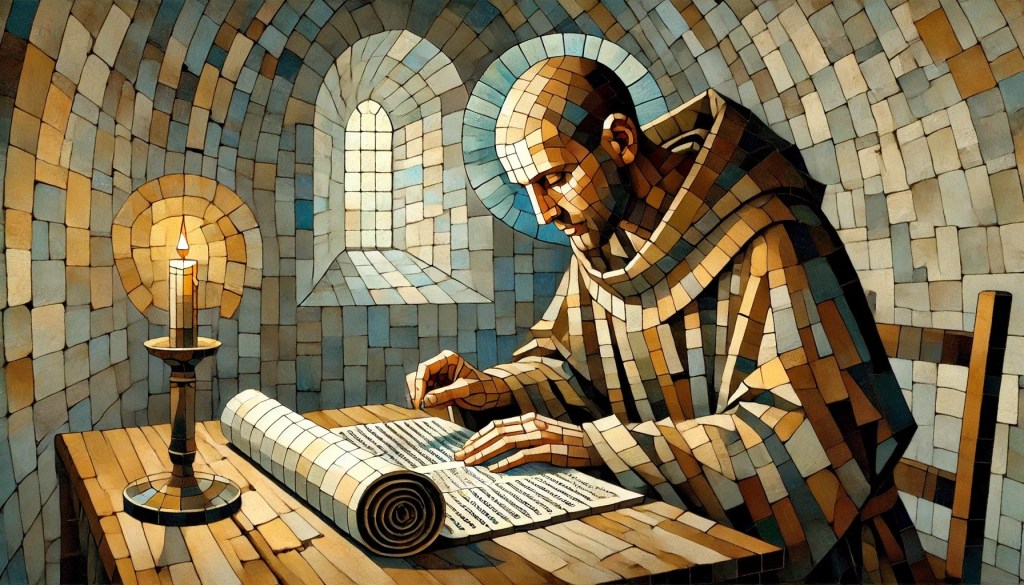
In the first movement, lectio/reading, you simply read the text slowly, preferably aloud, and repeatedly, perhaps three times, listening for a word or phrase or image to emerge from the text as God’s particular word for you on this day, in this particular reading of the Scripture.
In the next movement, meditatio/meditation, you ruminate, you mull over the given word, not so much analyzing it but turning it over, looking at it from different angles, pondering it, savoring it, letting its meanings and implications wash over you.
Meditatio leads into oratio/prayer in which you engage with God based upon the text and your meditations on it. Perhaps you are led into a prayer of repentance or intercession or thanksgiving or praise; prayer takes many forms. But, just as God communicates with you through the Scripture, you respond to God through the same text.
The final movement or rung on the ladder is contemplatio, contemplation, which is a deep participation, a union with God. Strictly speaking, contemplation is not a thing we do or can do; if it comes, it is entirely a gift from God. At best, we can ready ourselves for it through the previous movements, and by sitting silently and receptively before the Lord during this final movement.

The Gospels provide abundant source material for lectio divina; the text from Mark today is a case in point. As I read it several times in preparation for this homily — in other words, as I stepped onto the first rung of lectio — a particular phrase kept forcing its way through to my attention. Here are the first two verses of the account:
35 On that day, when evening had come, he said to them, “Let us go across to the other side.” 36 And leaving the crowd, they took him with them in the boat, just as he was (Mark 4:35-36).
They took him with them in the boat, just as he was. That’s the phrase: just as he was. I have no idea why that phrase seemed important; at first glance it seems just like filler, like a toss away line. I’ve read it many times before and paid it no mind. Just as he was: somehow, though, it seemed important this time.
So, I began to mull it over: meditatio. Let’s hear it again in context.
35 On that day, when evening had come, he said to them, “Let us go across to the other side.” 36 And leaving the crowd, they took him with them in the boat, just as he was (Mark 4:35-36).
They took him with them just as he was on that day, when evening had come. Evening — the end of the day. What had he been doing all day that led up to this? Earlier in the chapter — earlier in the day — we find Jesus teaching the crowds. When I was young my Dad gave me a sound piece of advice: “Son, you need to get a good education because you’re too lazy to work a real job.” As a boy he had worked a farm. As a young man he had poured molten steel at the Knoxville Iron Company — hard, hot, dangerous work. He knew what it was like to be tired at the end of the day. In my second career, I taught high school. I don’t know if he would have counted that as a “real job,” but I know that I was often exhausted at the end of the day, too, both mentally from making a thousand decisions in real time and physically from standing on my feet all day. My shoulder hurt from writing on the board all day, and I was often hoarse from talking. Ask any good teacher: teaching can wear you out.

So, Jesus had been teaching all day. Though the text doesn’t mention it specifically, it wouldn’t surprise me if he had been healing, too. Was he tired? Well, it was his idea to cross to the other side of the Sea of Galilee just to get away from the crowds. And, when he got into the boat, he fellasleep so soundly that even a violent storm didn’t wake him. So, yes; he was exhausted.
They took him with them in the boat, just as he was: worn out, wanting to get away from the crowds for awhile, spent and needing to recharge. What picture does this paint of Jesus? Here’s a man with the same human limitations that all of us face: fatigue, hunger, disappointment, fear. Just as he was meant, to some extent, just as they were, and just as we are. This points toward another scene of Jesus worn out, utterly spent, asleep — Jesus being lowered from the cross and laid in a tomb. There is just a hint of Good Friday in this story. And that might suggest that we are in for a resurrection of sorts, too. And, we are.
When I hear the words just as he was, I think of the words as-is. Those words generally come as something of a warning. When you purchase an item as-is, it generally means the sale is final, the product comes with no warranty, and if there are hidden flaws, well, you bought it and its your problem. As-is is the equivalent of the Latin phrase caveat emptor, let the buyer beware. You generally only buy something as-is if it’s the last one available or if it is heavily discounted. The disciples took Jesus into the boat just as he was, as-is, we might say. For better or for worse, with apparent limitations, and with much of the truth about him hidden from their eyes, they took him just as he was. Was he their last hope available? Peter says as much in John 6 when other disciples are leaving Jesus. Peter says essentially, “We have nowhere else to go.” Did the disciples get a good deal? Well, Jesus certainly wasn’t heavily discounted; they paid dearly to be his disciples. But, the rest of the story shows that they did, indeed, get far more than they thought. As-is turned out quite alright.

So here Jesus is, just as he was, passed out from exhaustion in the stern of the boat when a violent storm breaks on them, violent enough that seasoned fishermen, some of whom were very familiar with this body of water, fear they are perishing. They wake Jesus, probably with some pretty forceful shaking and loud shouting: “Teacher, do you not care that we are perishing?” And here is another word that emerges from the text: teacher. Not Lord. Not even rabbi, master. Just Διδάσκαλε, teacher. That is how they thought of Jesus at this point in his ministry, at this moment in the boat: teacher — the task he had most recently been doing. As-is, remember, just as he was. But that is about to change.
I don’t know how you paint the mental picture of what happens next. The text simply says this:
39 And he awoke and rebuked the wind and said to the sea, “Peace! Be still!” And the wind ceased, and there was a great calm (Mark 4:39).
Was the scene dramatic? Did Jesus stand up erect in the heaving boat with legs spread widely to keep his balance, stretch out his hands toward the waves, look upward to heaven and shout over the wind, “Peace! Be still!” Or, did he just speak a quiet word without flair and without even getting up from his pallet? It doesn’t really matter or Mark would have told us. But, the event itself matters immensely, because it is a signpost pointing toward the resurrection.
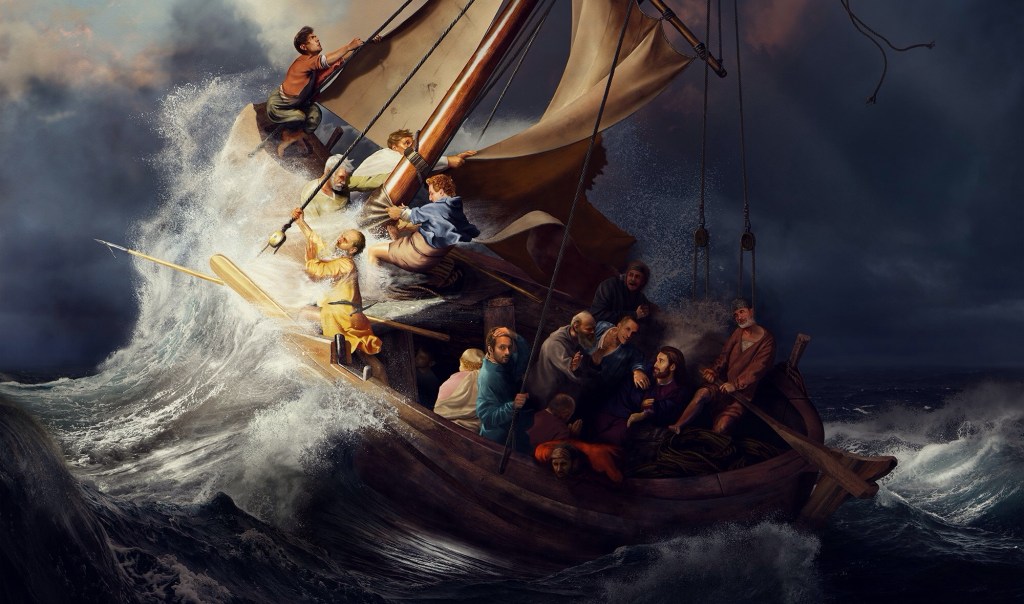
The Jews were not seafarers. While they might venture out on the lake — from the sheer necessity of making a living from it — they did so tentatively, knowing that death might catch them unawares at any moment. They avoided the true sea, the Mediterranean, whenever they could. In their symbolic worldview, the sea was the enemy. It was the haunt of the fallen, evil powers who sought only to destroy. The sea was chaos itself. And that was more than merely symbolic; the depths were the domain of dark, chaotic, hostile spiritual powers who were just waiting an opportune time to unleash their fury. There is a hint of that in the creation account in Genesis 1:
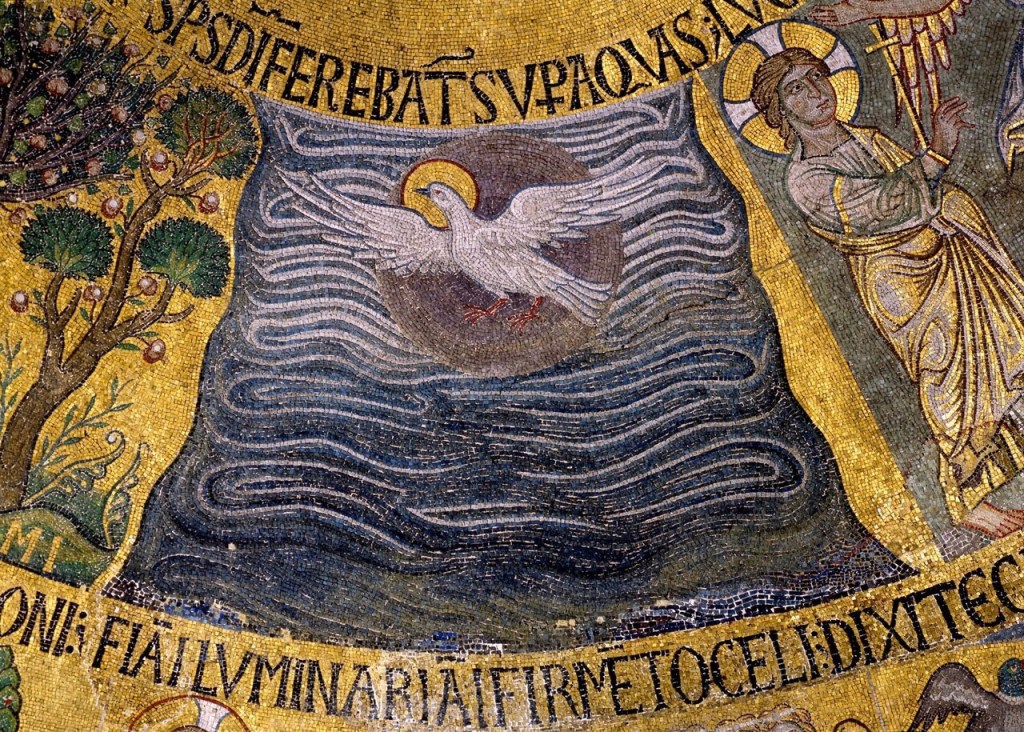
1 In the beginning, God created the heavens and the earth. 2 The earth was without form and void, and darkness was over the face of the deep. And the Spirit of God was hovering over the face of the waters (Gen 1:1-2).
The earth is tohu wa bohu in Hebrew, formless and void, covered with water and darkness. But, the Spirit of God is moving over the waters, exercising dominion over the waters, and bringing light to bear, order from chaos, and life. Only God has power over the dark forces present in the waters.
So, when we read this story of the storm through the eyes of the disciples — and through Mark’s eyes — we see the storm as the unleashing of chaos against Jesus and his disciples. We see in the storm and the sea the evil powers conspiring to destroy Jesus and the disciples before he completes his work on Calvary. We see death and hell stalking him and unleashing their fury against him. And we see Jesus, with just a word, bring them all to heel as he would one day in the not so distant future, when by his death and resurrection, he trampled down death by death and said, “Peace! Be still.” over the whole of creation. This story of the quieting of the storm is a resurrection story, a story of the defeat of the dark powers by God himself. The whole world was perishing in the furious onslaught of the fallen powers just as the disciples were perishing in the storm. Jesus was utterly spent and sleeping in the tomb just as he slept in the stern of the boat. But, when Jesus woke — there’s the resurrection! — he rebuked the fallen powers and spoke a word of peace. And just like God in creation, he brought order and life out of the chaos and death of the waters.
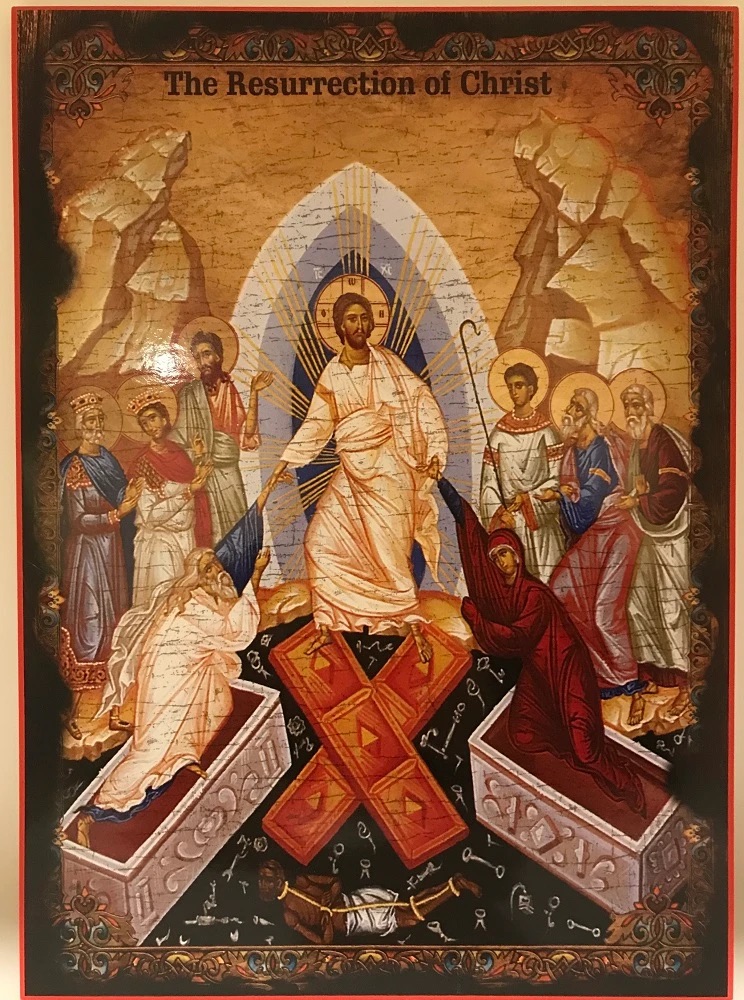
This is not just a nature miracle, Jesus exercising a bit of power over some aspect of creation. It is a clash of powers, with Jesus demonstrating sovereignty over all creation and over the dark forces that have usurped it and who seek to undo and destroy it. This is a signpost pointing toward the resurrection and even beyond it when Jesus says to his disciples, “All authority in heaven and on earth has been given to me” (Matt 28:18). How much of this the disciples in the boat with Jesus that evening understood is an open question. But, they had seen the sign and it made them wonder. Listen to how Mark closes this particular story:
41 And they were filled with great fear and said to one another, “Who then is this, that even the wind and the sea obey him” (Mark 4:41).
The way Mark tells this story is a beautiful bit of literary theology. Notice how he “bookends” the tale. It starts here: “They took him with them in the boat, just as he was.” It ends in a very different place: “Who is this, then, that even the wind and the sea obey him?” They took someone familiar to them into the boat, someone they understood and were comfortable with: a teacher, worn out from a day with the crowds, wanting to get away for awhile and rest. They took him just as he was only to learn that he was much more than what they thought, that he was sovereign over nature and the dark powers lurking behind it, sovereign in a way that only God is sovereign.
This transformation of Jesus in their eyes reminds me of the Paschal (Easter) Homily of St. John Chrysostom:
Hell took a body, and discovered God.
It took earth, and encountered Heaven.
It took what it saw, and was overcome by what it did not see.
These same words, with just a bit of editing, could be said about the disciples.
They took a worn out, exhausted body, and discovered the sovereign God.
They took to the sea, and encountered hell and Heaven.
They took him just as he was, and were overcome by what they saw him to be.
The disciples took Jesus into the boat just as he was at the end of this long, tiring day only to be overcome by what he was from before the foundations of the world and will be now and unto the ages of ages.
And then, brilliantly, Mark throws the disciples’ question right back to us, and we have to answer it for ourselves: “Who then is this, that even the wind and the sea obey him?” That is Mark’s literary and theological genius. Now that we have done the work of lectio and meditatio together, this question beckons us to climb the third rung, oratio, to go in prayer to the one who is sovereign over wind and wave and death and chaos and hell and all things, to whom be the glory now and for ever. Amen.


