Apostles Anglican Church
Fr. John A. Roop
Healing Prayer, Lesson 3: Praying for the Sick
The Lord be with you.
And with your spirit.
Let us pray.
Let your merciful ears, O Lord, be open to the prayers of your humble servants; and, that we may receive what we ask, teach us by your Holy Spirit to ask only those things that are pleasing to you; through Jesus Christ our Lord, who with you and the same Spirit lives and reigns for ever and ever. Amen (BCP 2019, p. 617).
Introduction
We pray for the sick: very fervently for those nearest us, but also for those at some remove — your friend’s uncle Bob’s son-in-law, for example. We pray in different settings and contexts: in our daily prayers, as part of a church prayer ministry, face-to-face with the sick or miles away from them, in hospitals or nursing homes or sitting alone in a park or at home with a cup of tea. We pray for individuals — for Irene who is having surgery tomorrow — and for whole groups of people — for all those battling cancer, perhaps. We pray for life to be spared, for pain to be eased, for function to be restored. We pray when a positive outcome seems almost certain and we pray when hope seems almost certainly lost. We pray when we are pretty sure that we have discerned rightly how to pray, and we pray in ignorance, trusting in the Holy Spirit to groan out a prayer in us. We pray because we are asked to pray, because we are compelled to pray, because our Lord taught us to pray. We pray because we love.
We pray as we can, that is, we pray from the heart, not trying to conceal our true desires from the Lord, but offering them up to him as our five loaves and two fishes, to use as he wills. But, we also want to move toward praying with mind and heart renewed by the Holy Spirit, asking those things which we know to be in accordance with God’s will. That is itself a matter of prayer, which is the essence of the collect we began with. Listen to it again.
Let your merciful ears, O Lord, be open to the prayers of your humble servants; and, that we may receive what we ask, teach us by your Holy Spirit to ask only those things that are pleasing to you; through Jesus Christ our Lord, who with you and the same Spirit lives and reigns for ever and ever. Amen (BCP 2019, p. 617).
Teach us by the Holy Spirit to pray as we should. So, prayer is more than a form of self-expression, more than catharsis, more than telling God what we want or what he should do in any given situation. It is a way of agreeing with and joining with God in the exercise of his will so that we are formed by the act of praying and so that we can see God’s will being done in answer to our prayers.
Prayer in Scripture
It is important that we ground our understanding and practice of healing prayer in Scripture. As we turn there for examples that might inform our own prayers, I want to consider prayer broadly. On the surface, some of these example may not at first look like prayer, but I think they all have formative power.
Bring the Sick Person To Jesus: The Friends of the Paralytic
Let’s start with a miracle of healing in Luke’s Gospel.
17 On one of those days, as he was teaching, Pharisees and teachers of the law were sitting there, who had come from every village of Galilee and Judea and from Jerusalem. And the power of the Lord was with him to heal. 18 And behold, some men were bringing on a bed a man who was paralyzed, and they were seeking to bring him in and lay him before Jesus, 19 but finding no way to bring him in, because of the crowd, they went up on the roof and let him down with his bed through the tiles into the midst before Jesus. 20 And when he saw their faith, he said, “Man, your sins are forgiven you.” 21 And the scribes and the Pharisees began to question, saying, “Who is this who speaks blasphemies? Who can forgive sins but God alone?” 22 When Jesus perceived their thoughts, he answered them, “Why do you question in your hearts? 23 Which is easier, to say, ‘Your sins are forgiven you,’ or to say, ‘Rise and walk’? 24 But that you may know that the Son of Man has authority on earth to forgive sins”—he said to the man who was paralyzed—“I say to you, rise, pick up your bed and go home.” 25 And immediately he rose up before them and picked up what he had been lying on and went home, glorifying God. 26 And amazement seized them all, and they glorified God and were filled with awe, saying, “We have seen extraordinary things today” (Luke 5:17-26).
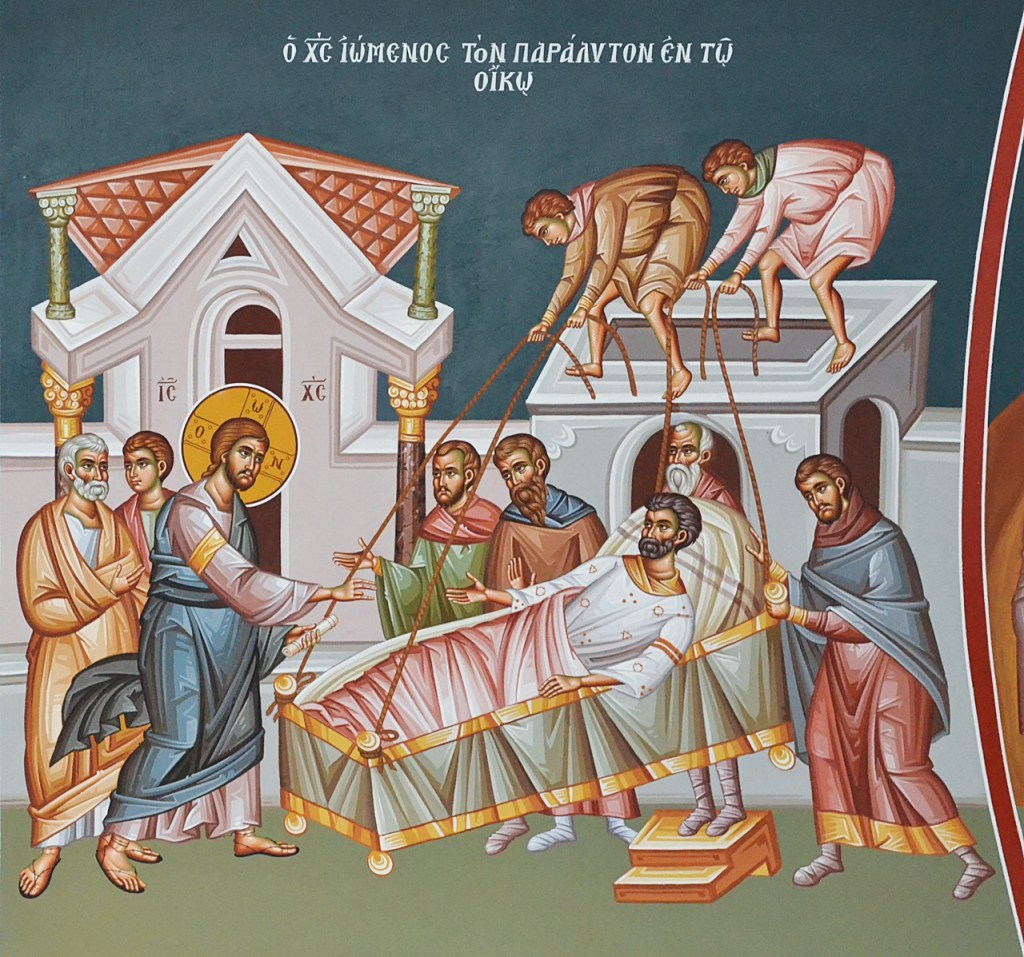
I believe this is an account of healing prayer, one of the most basic and important accounts, in fact. Where is the prayer in the story? “They were seeking to bring him in and lay him before Jesus.” That was the heart of prayer in this account, and I think it is the heart of all healing prayer. We seek to bring the person in need to Jesus and to lay that person before him. If you question whether you have a gift of healing prayer, if you doubt your adequacy, simply ask yourself, “Can I bring this person to Jesus? Can I hold this person in the presence of the Lord?” C. S. Lewis wrote somewhere — probably in Letters to Malcolm Chiefly On Prayer — that he sometimes knelt in prayer and simply pictured the person for whom he was praying, pictured him without words. That was his way of lowering the paralytic into the Lord’s presence. Healing prayer is, at its most basic level, bringing the sick person to Jesus in whatever way we can.
The Prayer of Presence and Silence: Job’s Friends
Related to that is an Old Testament account from Job, a book that explores the limits of human understanding of illness, suffering, healing, and the sovereignty of God.
11 Now when Job’s three friends heard of all this evil that had come upon him, they came each from his own place, Eliphaz the Temanite, Bildad the Shuhite, and Zophar the Naamathite. They made an appointment together to come to show him sympathy and comfort him. 12 And when they saw him from a distance, they did not recognize him. And they raised their voices and wept, and they tore their robes and sprinkled dust on their heads toward heaven. 13 And they sat with him on the ground seven days and seven nights, and no one spoke a word to him, for they saw that his suffering was very great (Job 2:11-13).

In the story of the paralytic, the friends brought the man to Jesus; that was the heart of their prayer. But, sometimes we must do just the opposite; we must bring Jesus to the person. Like Job’s friends, we show up, members of the body of Christ mediating the very presence of Christ. We weep with the one who is suffering. We put our hands over our mouths lest like Job’s friends we end up saying something untrue, or untimely, or unhelpful. Sometimes it is more beneficial to talk to God about our friend than to talk to our friend about God. Sometimes the best prayer is simply to be there, to listen, to be silent. This is the prayer of presence, and it is healing prayer, too.
The Prayer of Simplicity: The Wedding at Cana and the Prayer of Mary and Martha
Now, on to two of my favorite prayers in Scripture: favorite in that they are foundational for my understanding and practice of healing prayer, though on the surface they may not even seem to be prayers at all.
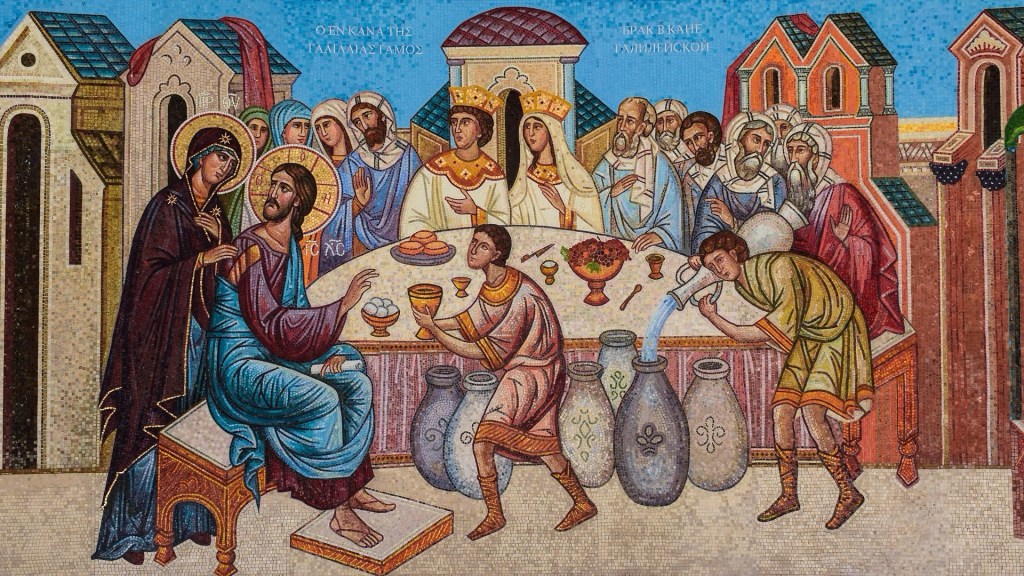
The first of these prayers comes from the first of Jesus’ seven signs in the Gospel of John — a wedding prayer of sorts at the very beginning of Jesus’ ministry.
1 On the third day there was a wedding at Cana in Galilee, and the mother of Jesus was there. 2 Jesus also was invited to the wedding with his disciples. 3 When the wine ran out, the mother of Jesus said to him, “They have no wine.” 4 And Jesus said to her, “Woman, what does this have to do with me? My hour has not yet come.” 5 His mother said to the servants, “Do whatever he tells you” (John 2:1-5)
The second prayer, also from the Gospel of John, comes near the end of Jesus’ ministry, the last of John’s seven signs — a funeral prayer of sorts, at least a healing prayer.
1 Now a certain man was ill, Lazarus of Bethany, the village of Mary and her sister Martha. 2 It was Mary who anointed the Lord with ointment and wiped his feet with her hair, whose brother Lazarus was ill. 3 So the sisters sent to him, saying, “Lord, he whom you love is ill” (John 11:1-3).

Two prayers, two sentences: “They have no wine,” and “Lord, he whom you love is ill.”
What do these two prayers have in common? What can they teach us?
They are short. They are to the point. They don’t offer God advice or presume that we know what is best. Their brevity, their simplicity proclaim good news: God knows the need, God cares, God is trustworthy to do what is best. Our prayers don’t have to be eloquent or lengthy or insightful.
There are many prayers in the BCP that reflect this same simplicity and trust. One that I use frequently is collect 52. FOR THOSE WE LOVE.
Almighty God, we entrust all who are dear to us [especially _____] to your never-failing care and love, for this life and the life to come, knowing that you are doing for them better things than we can desire or pray for; through Jesus Christ our Lord. Amen (BCP 2019, p.662).
This prayer reminds me that I don’t have to know exactly what to pray for, because I trust God to do better things than I can desire or pray for. It is enough for me to entrust the one I love to Almighty God. Imagine this as a healing prayer.
Or, consider the collect we were praying all last week.
Almighty and everlasting God, you are always more ready to hear that we to pray, and to give more than we either desire or deserve: Pour down upon us the abundance of your mercy, forgiving us those things of which our conscience is afraid, and giving us those good things for which we are not worthy to ask, except through the merits and mediation of Jesus Christ our Savior; who lives and reigns with you and the Holy Spirit, one God, for ever and ever. Amen (BCP 2019, p. 618).
Again, we are acknowledging our trust in God who will give more than we desire or deserve. So, we content ourselves with asking for mercy and forgiveness. Again, this can serve as a good model for healing prayer.
Another example of such a direct prayer of trust and simplicity is found in the story of Bartimaeus.
46 And they came to Jericho. And as he was leaving Jericho with his disciples and a great crowd, Bartimaeus, a blind beggar, the son of Timaeus, was sitting by the roadside. 47 And when he heard that it was Jesus of Nazareth, he began to cry out and say, “Jesus, Son of David, have mercy on me!” 48 And many rebuked him, telling him to be silent. But he cried out all the more, “Son of David, have mercy on me!” 49 And Jesus stopped and said, “Call him.” And they called the blind man, saying to him, “Take heart. Get up; he is calling you.” 50 And throwing off his cloak, he sprang up and came to Jesus. 51 And Jesus said to him, “What do you want me to do for you?” And the blind man said to him, “Rabbi, let me recover my sight.” 52 And Jesus said to him, “Go your way; your faith has made you well.” And immediately he recovered his sight and followed him on the way (Mark 10:46-52).

You might recognize Bartimaeus’s cry/prayer as the core of the Jesus Prayer so favored in the Orthodox Church: Lord, Jesus Christ, Son of God, have mercy on me, a sinner.” That prayer actually combines elements of Bartimaeus’s prayer with that of the tax collector in the temple. But, it is another helpful healing prayer: Lord Jesus Christ, Son of God, have mercy on [N]. That was enough, prayed fervently, to effect the healing of Bartimaeus, because Jesus does have mercy.
There is something else important in this account. What does Jesus ask? “What do you want me to do for you?” That seems, on the surface, to be a foolish question to ask a blind man. But it is really important because the obvious need is not always the deepest need, the real need. Remember the paralytic lowered through the roof? On the surface he needed physical healing to be able to walk. But, Jesus recognized the deeper need and first addressed his sin. Only then did he move to physical healing. I find it a good practice to ask a person what they want Jesus to do for them, what they want me to pray for. That simple question can bring things into better focus and promote some self-examination.
The Prayer of Desire, Surrender, and Discernment
Once I have asked someone what they would like me to pray for, I will typically pray as requested: physical healing, ease of pain, successful surgery, smooth recovery. That is the prayer of desire. But, it is important to unite that with the prayer of surrender. This is the witness of our Lord.
39 And he came out and went, as was his custom, to the Mount of Olives, and the disciples followed him. 40 And when he came to the place, he said to them, “Pray that you may not enter into temptation.” 41 And he withdrew from them about a stone’s throw, and knelt down and prayed, 42 saying, “Father, if you are willing, remove this cup from me. Nevertheless, not my will, but yours, be done.” 43 And there appeared to him an angel from heaven, strengthening him (Luke 22:39-43).

The prayer of desire is to remove the cup. But that transitions into the prayer of surrender: nevertheless, your will be done. We are told that this dual prayer took place three times at which point it seems that Jesus felt confident of the course ahead. We see something very like that play out in St. Paul’s life, as well.
7 So to keep me from becoming conceited because of the surpassing greatness of the revelations, a thorn was given me in the flesh, a messenger of Satan to harass me, to keep me from becoming conceited. 8 Three times I pleaded with the Lord about this, that it should leave me. 9 But he said to me, “My grace is sufficient for you, for my power is made perfect in weakness.” Therefore I will boast all the more gladly of my weaknesses, so that the power of Christ may rest upon me. 10 For the sake of Christ, then, I am content with weaknesses, insults, hardships, persecutions, and calamities. For when I am weak, then I am strong (2 Cor 12:7-10).
Is this the answer Paul wanted? Well, no and yes. It wasn’t what his flesh desired, but it is what he willed. And, I think that is always the proper attitude of our hearts as expressed in our prayers for ourselves or for other. Here is what we really think we want Lord, but only if it is your will. And so, not our will, but yours be done.
This kind of prayer is also a prayer of discernment. I may not know what God’s will is in a given circumstance. It is perfectly reasonable to pray for what I want or what the person asking for prayer wants, provided it is not obviously contrary to God’s will. But then, in asking for God’s will to be done, I am actually entering into discernment. Benedictine Sr. Joan Chittister expressed this notion: The will of God is what remains after you have prayed without ceasing and tried without stint to change it. Jesus prayed to be spared the cross, but he was crucified. That was the will of God. Paul prayed to be healed, but he was not. That was the will of God. I assume that neither person perfectly knew the will of God until he saw how his prayers were answered. Prayer became discernment for them, as it can do for us.
Tied in with this, and somewhat at tension with it, is the issue of persistence in prayer.
1 And he told them a parable to the effect that they ought always to pray and not lose heart. 2 He said, “In a certain city there was a judge who neither feared God nor respected man. 3 And there was a widow in that city who kept coming to him and saying, ‘Give me justice against my adversary.’ 4 For a while he refused, but afterward he said to himself, ‘Though I neither fear God nor respect man, 5 yet because this widow keeps bothering me, I will give her justice, so that she will not beat me down by her continual coming.’ ” 6 And the Lord said, “Hear what the unrighteous judge says. 7 And will not God give justice to his elect, who cry to him day and night? Will he delay long over them? 8 I tell you, he will give justice to them speedily. Nevertheless, when the Son of Man comes, will he find faith on earth” (Luke 18:1-8)?
We have to be careful with this parable. It is based on the assumption that the widow was asking for what was clearly right — justice against her adversary — and that the judge was at fault for delaying the verdict. So, the key points of the parable are these: (1) God is not like the judge in the parable; he will answer his people readily, so that (2) we can pray and not lose heart. So, persistence in prayer for us is not trying to beat God down, to get God to do something we want that he doesn’t particularly want to do. It is an expression of our hope in a faithful God. We pray until God answers or until it becomes clear that this is not the right prayer any longer or that it is not my prayer any longer.
Most of us have experienced this tension. It sometimes goes like this. A friend is seriously ill and many have been praying for healing for months. During that time our friend has continued to decline and is nearing death. We still know that God has the power to heal our friend; that is not a question. But God has also given no indication that healing is his will. Given that, we might conclude it is time to change the nature of our prayer to align with our discernment of the trajectory of the illness. It is not an act of faithlessness to do so. It is neither resignation nor despair. It is honoring what we believe to be the will of God. So, the Book of Common Prayer gives us this prayer for a sick person when there is little hope of recovery.
O Father of mercies and God of all comfort, our only help in time of need; We fly to you for aid on behalf of this your servant, here lying in great weakness of body. Look graciously upon him, O Lord; that as he outwardly fades away, you would strengthen him inwardly with your grace and Holy Spirit. Give him true repentance for all the errors of his life, and steadfast faith in your Son Jesus; that his sins may be done away by your mercy, and his pardon sealed in heaven; through your Son Jesus Christ, our Lord and Savior. Amen (BCP 2019, pp. 233-234).
We are persistent in prayer, as Jesus encourages us in the parable, but the nature of the prayer has changed in response to our changed discernment of God’s will.
The Book of Common Prayer
We have looked at a few principles of healing prayer from Scripture. Now, I’d like to look at the prayer resources available to us in The Book of Common Prayer (BCP 2019, pp. 231-235).
ADDITIONAL PRAYERS
FOR A SICK PERSON
O Father of mercies and God of all comfort, our only help in time of need: We humbly beseech you to behold, visit, and relieve your sick servant N. for whom our prayers are desired. Look upon him with the eyes of your mercy; comfort him with a sense of your goodness; preserve him from the temptations of the enemy; and give him patience under his affliction. In your good time, restore him to health, and enable him to lead the remainder of his life in your fear, and to your glory; and grant that finally he may dwell with you in life everlasting; through Jesus Christ our Lord. Amen.
FOR RECOVERY FROM SICKNESS
O God, the strength of the weak and the comfort of sufferers: Mercifully accept our prayers, and grant to your servant N. the help of your power, that his sickness may be turned into health, and our sorrow into joy; through Jesus Christ our Lord. Amen.
or this
O God of heavenly powers, by the might of your command you drive away from our bodies all sickness and infirmity: Be present in your goodness with your servant N., that his weakness may be banished and his strength restored; and that, his health being renewed, he may bless your holy Name; through Jesus Christ our Lord. Amen.
FOR A SICK CHILD
Heavenly Father, watch with us over your child N., and grant that he may be restored to that perfect health which it is yours alone to give; through Jesus Christ our Lord. Amen.
or this
Lord Jesus Christ, Good Shepherd of the sheep, you gather the lambs in your arms and carry them in your bosom: We commend to your loving care this child N. Relieve his pain, guard him from all danger, restore to him your gifts of gladness and strength, and raise him up to a life of service to you. Hear us, we pray, for your dear Name’s sake. Amen.
BEFORE AN OPERATION
Almighty God, our heavenly Father, graciously comfort your servant N. in his suffering, and bless the means used for his cure. Though at times he may be afraid, fill his heart with confidence that he may yet put his trust in you; through Jesus Christ our Lord. Amen.
FOR STRENGTH AND CONFIDENCE
Heavenly Father, giver of life and health: Comfort and relieve your sick servant N., and give your power of healing to those
who minister to his needs, that he may be strengthened in his weakness and have confidence in your loving care; through Jesus Christ our Lord. Amen.
FOR THE SANCTIFICATION OF ILLNESS
Sanctify, O Lord, the sickness of your servant N., that the sense of his weakness may add strength to his faith and seriousness to his repentance; and grant that he may live with you in everlastinglife; through Jesus Christ our Lord. Amen.
FOR HEALTH OF BODY AND SOUL
May God the Father bless you, God the Son heal you, God the Holy Spirit give you strength. May God the holy and undivided Trinity guard your body, save your soul, and bring you safely to his heavenly country; where he lives and reigns for ever and ever. Amen.
THANKSGIVING FOR A BEGINNING OF RECOVERY
O Lord, your compassions never fail, and your mercies are new every morning: We give you thanks for giving our brother N. both relief from pain and hope of health renewed. Continue in him, we pray, the good work you have begun; that he, daily increasing in bodily strength, and rejoicing in your goodness, may so order his life that he may always think and do those things that please you; through Jesus Christ our Lord. Amen.
FOR A SICK PERSON WHEN THERE IS LITTLE HOPE OF RECOVERY
O Father of mercies and God of all comfort, our only help in time of need; We fly to you for aid on behalf of this your servant, here lying in great weakness of body. Look graciously upon him, O Lord; that as he outwardly fades away, you would strengthen him inwardly with your grace and Holy Spirit. Give him true repentance for all the errors of his life, and steadfastfaith in your Son Jesus; that his sins may be done away by your mercy, and his pardon sealed in heaven; through your Son Jesus Christ, our Lord and Savior. Amen.
PRAYERS FOR USE BY A SICK PERSON
FOR TRUST IN GOD
O God, the source of all health: So fill my heart with faith in your love, that with calm expectancy I may make room for your power to possess me, and gracefully accept your healing; through Jesus Christ our Lord. Amen.
IN PAIN
Lord Jesus Christ, by your patience in suffering you hallowed earthly pain and gave us the example of obedience to your Father’s will: Be near me in my time of weakness and pain; sustain me by your grace, that my strength and courage may not fail; heal me according to your will; and help me always to believe that what happens to me here is of little account if you hold me in eternal life, my Lord and my God. Amen.
A PRAYER WHEN TAKING MEDICINE
Almighty God, in your goodness you created the earth and all its elements, and have given us skill to make medicines that heal and relieve our pain. All healing comes from you, and in you I put my trust. Grant that this medication may, in your mercy, give comfort and bring healing to my body; through Jesus Christ our Lord. Amen.
FOR SLEEP
O heavenly Father, you give your children sleep for the refreshing of soul and body: Grant me this gift, I pray; keep me in that perfect peace which you have promised to those whose minds are fixed on you; and give me such a sense of your presence, that in the hours of silence I may enjoy the blessed assurance of your love; through Jesus Christ our Lord. Amen.
IN THE MORNING
This is another day, O Lord. I know not what it will bring forth, but make me ready, Lord, for whatever it may be. If I am to stand up, help me to stand bravely. If I am to sit still, help me to sit quietly. If I am to lie low, help me to do it patiently. And if I am to do nothing, help me to do it gallantly. Make these words more than words, and give me the Spirit of Jesus. Amen.
SCRIPTURES FOR USE BY A SICK PERSON
For perseverance in suffering: ISAIAH 53, 1 PETER 2:21-25, 1 THESSALONIANS 5:16-24, 2 CORINTHIANS 12:7-10, ROMANS 8:18-39
For hope for healing: 2 KINGS 5:1- 14, JAMES 5:13-20,LUKE 5:12-26, LUKE 13:10-17, ACTS 3:1-10
For the hope of eternity: LUKE 2:25-35, JOHN 14, 1 CORINTHIANS 15:42-58, 2 CORINTHIANS 4:7-18, 1 THESSALONIANS 4:13-18
Questions and Answers
Closing Prayer
The Lord be with you.
And with your spirit.
Let us pray.
O Almighty God, you pour out on all who desire it the spirit of grace and of supplication: Deliver us, when we draw near to you, from coldness of heart and wanderings of mind, that with steadfast thoughts and kindled affections we may worship you in spirit and in truth; through Jesus Christ our Lord. Amen (BCP 2019, p. 647).


Both of my daughters have experienced severe financial problems (present and recent past). I prayed (am praying) long and hard for provision for them. When this clearly wasn’t what God had in mind; I changed to praying for strength, wisdom and perseverance. These times of financial hardship have borne fruit in greater faith and perseverance in them and shown me more about praying in God’s will.