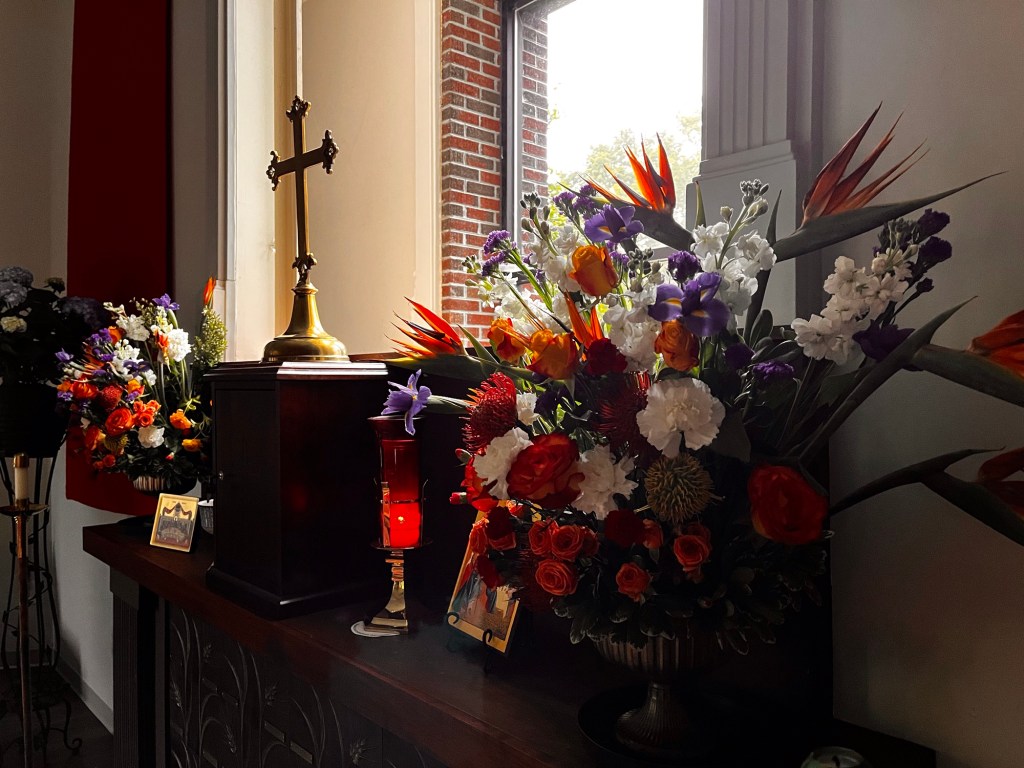
I had vivid and strange dreams throughout much of the night: demons, exorcisms, that sort of thing. They were not particularly disturbing — much less so than my typical “anxiety” dream of being late for my last college final and then realizing that I haven’t been to that class all semester and have no idea where the class meets. That’s a real tangled sheets, cold sweat experience, that is. No, I woke as normal though my wife tells me I coughed a bit through the night.
When I arrived at church this morning and began the readings for Morning Prayer it was with a certain anticipation. In Advent each year we spend a goodly amount of time in Sirach (Ecclesiasticus) which is among my favorite books in the wisdom literature corpus. I opened to chapter 34 as appointed for the day and read:
1 A man of no understanding has vain and false hopes, and dreams give wings to fools. 2 As one who catches at a shadow and pursues the wind, so is he who gives heed to dreams. 3 The vision of dreams is this against that, the likeness of a face confronting a face. 4 From an unclean thing what will be made clean? And from something false what will be true? 5 Divinations and omens and dreams are folly, and like a woman in travail the mind has fancies. 6 Unless they are sent from the Most High as a visitation, do not give your mind to them. 7 For dreams have deceived many, and those who put their hope in them have failed. 8 Without such deceptions the law will be fulfilled, and wisdom is made perfect in truthful lips (Sirach 34:1-8, RSV).
Dreams: do not give your mind to them lest you be a man of no understanding, a fool, for they are shadows and wind, follies and fancies. Unless. Unless they are sent from the Most High as a visitation, as say with Joseph or Daniel or St. Joseph the husband of the Blessed Virgin Mary or St. Paul or St. John the elder. Then, pay attention; wake up and act.
How do we tell the difference between dreams of the brain and dreams of the mind/heart, between biological/psychological phenomena and spiritual revelation? That was the question Sirach posed me this morning. And while I have no definitive answers, I have some tentative ones inspired by the saints and Church Fathers.
If a dream rightly convicts me of sin and leads me to repentance, I should consider it as a visitation from the Most High. A movement toward needed and genuine repentance is a true work of the Spirit and it can come in many forms, including dreams.
If a dream conduces toward greater faith, hope, and love for God and neighbor, I should welcome it as a consolation from God.
Conversely, if a dream disturbs me for no good reason — see above — I should simply reject it, put it out of mind, and move on.
If a dream challenges and diminishes faith, hope, and love, if it suggests a path contrary to Scripture or the teachings of the Church, then it categorically is not a visitation from the Lord and must be rejected.
I suspect the vast majority of dreams, many of which are simply forgotten, have no spiritual significance at all. But, some have had and some do have, and those that lead us along the right way to God are a gift of sleep.
I have amended The Great Litany with a few additions for my personal use. Because so many seem to struggle with sleep, I have adopted this from Compline:
To guide us waking and guard us sleeping, that awake we may watch with Christ, and asleep we may rest in peace, We beseech you to hear us, good Lord.
The Lord be with you. And with your spirit. Let us pray.
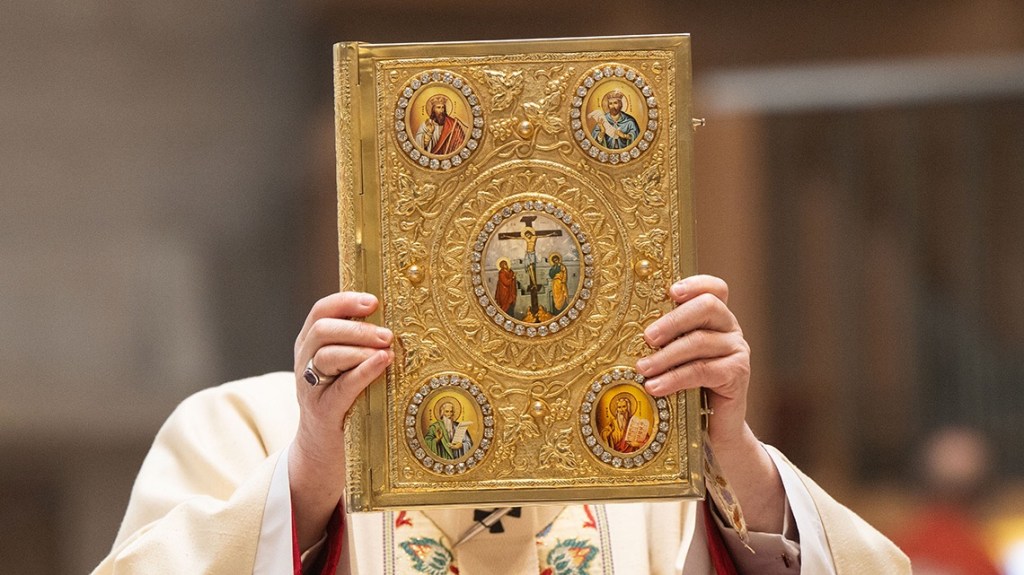
Blessed Lord, who caused all Holy Scriptures to be written for our learning: Grant us so to hear them, read, mark, learn, and inwardly digest them, that by patience and the comfort of you holy Word we may embrace and ever hold fast the blessed hope of everlasting life, which you have given us in our Savior Jesus Christ; who lives and reigns with you and the Holy Spirit, one God, for ever and ever. Amen.

Moonshiners and Banjo Players
I can trace both my paternal and maternal family lines back two generations only; I know my grandparents’ names on both sides. Beyond that, my heritage is a blank to me. From a photograph I know there are moonshiners and banjo players in the Roop mix — poor Appalachian farmers eking out a living from creek bottom soil. My brother has done some work on the Roop family tree and can go back several generations earlier — I’m not certain how many — but I have never been sufficiently interested to pursue it. In non-tribal cultures and in self-made man societies, genealogies don’t really count for much.
But, in the Ancient Near East, family, clan, tribe — these were everything. The idea of an impoverished, two generational memory like mine would have been laughably pathetic, an amnesia of monumental proportions. The opening of St. Matthew’s Gospel — the book of the genealogy of Jesus Christ, son of David, son of Abraham — which is boring to us, might well have riveted the attention of its early Jewish readers. And, it is actually important to all of us, whether we can link names with stories or not. The overall form and structure of the genealogy is significant. Let’s take a look at it in Matthew 1.
The first verse tells the whole story in outline by linking three names: Jesus Christ, though Christ is not a name but a title; David; and Abraham: The book of the genealogy of Jesus Christ, the son of David, the son of Abraham (Matt 1:1). What can we say in summary about each?
Abraham: the founding Patriarch, the initial recipient of the covenant. God promised Abraham a people/nation and a land and also promised that through Abraham and his seed — and note that seed is singular (Gal 3:16) as St. Paul insists — all the nations of the earth would be blessed.
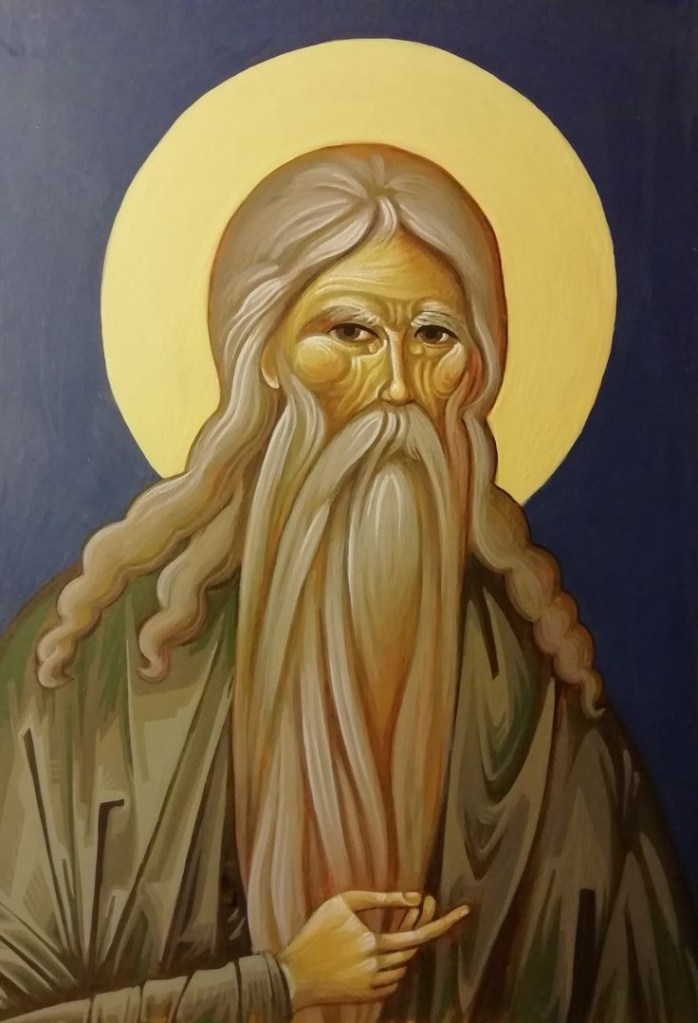
Abraham
David: the great King of Israel. God promised David a house, an everlasting dynasty that would rule over the people of Abraham forever and to which the nations of the earth would join themselves.
Jesus (Christ): the one in whom and through whom both the Abrahamic and Davidic covenants would be fulfilled.
These three — Abraham, David, and Jesus Christ — along with one historical event — the deportation of Judah to Babylon — give a threefold structural backbone to the genealogy: from Abraham to David, from David to the deportation, from the deportation to Jesus Christ. Matthew closes the genealogy with an important and explicit summary of this structure:
17 So all the generations from Abraham to David were fourteen generations, and from David to the deportation to Babylon fourteen generations, and from the deportation to Babylon to the Christ fourteen generations (Matt 1:17).
If it seems like this division of the genealogy into three, fourteen generation sections is miraculous, well, I’m sorry; it’s not. It is artificial; it is intentional, carefully crafted and symbolic. There are many generations that St. Matthew simply leaves out to create the three times fourteen scheme because he is far less interested in a full accounting of people than in a full accounting of the story. We have to do a little arithmetic and numerology to see what’s going on. The structure is significant in at least two ways.
First, we need to know that many languages — Old Testament Hebrew among them — used letters for numbers: aleph for one, bet for two, gimel for three and so on. But, it can work in the other direction too: numbers can be substituted for the letters in words so that words can then have their own numerical values. That is true in Greek, also, and it seems to be what lies behind the number 666 in Revelation. The numerical value of the name Nero is 666. I mention this bit of numerology (gematria) because it has significance for our understanding of St. Matthew’s genealogy of Jesus. Remember it is divided into three sets of fourteen generations. Fourteen in the numerical value of the name David. So, the genealogy provides a drumbeat through its threefold division: David, David, David. And what’s the point of this? Jesus is a king like David; he is David’s son and heir. The Gospel according to St. Matthew insists on the kingship of Jesus from the very opening page. But, there is more.
David = 14
Here’s a little arithmetic; three fourteens is the same as six sevens. What do we know about the number seven as it is used in Scripture? Seven is, in some sense, God’s number, a number signifying perfection, at least in the sense of completion. Do you recall some occurrences of seven in Scripture and in church tradition?
Seven days of creation
Sabbath Day
Sabbath Year
Jubilee (50th year following the seventh sabbath year)
Seven signs in St. John’s Gospel
Sevens in Revelation: Churches, Seals, Trumpets, Angels, Plagues, Bowls
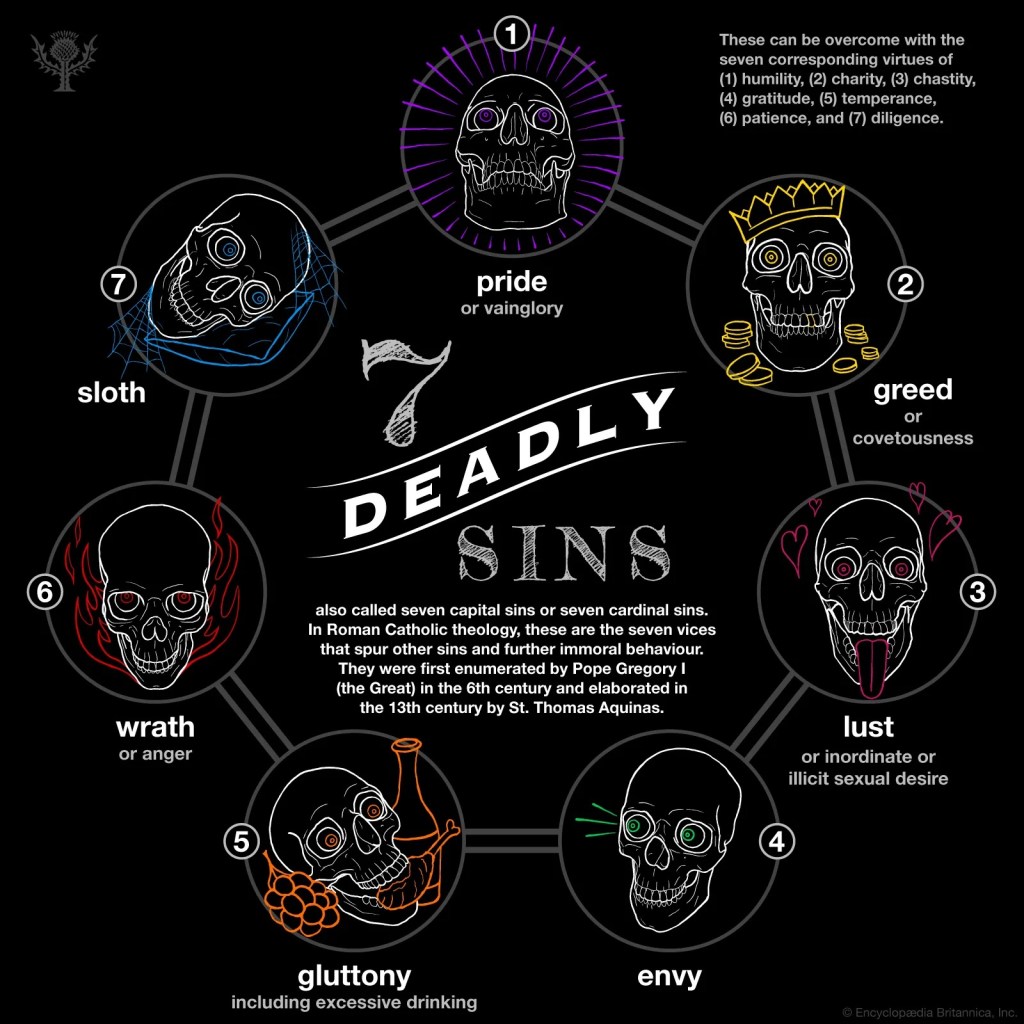
Seven deadly sins and the seven virtues (four cardinal — prudence, justice, fortitude, temperance — and three theological — faith, hope, love.)
So, if seven symbolizes perfection and completion, what would six mean? It is the number of man, because man was created on the sixth day. It is a symbol of the reach or limit of human effort; man works for six days and then rests. No human effort is needed on the seventh day; all things are in God’s hands. Six is, ironically, both a symbol of incompleteness (human effort is always incomplete) and a signpost pointing toward completeness in God, that is, a completion that depends not on man’s effort alone, but upon the work of God.
Now, back to Matthew’s genealogy: does the scheme of six sevens make better sense? All of man’s effort from Abraham until Jesus has left the great story of redemption incomplete, unfinished. It is the best man has been able to do, but it is not enough. Then Jesus inaugurates the seventh seven, a Jubilee of sorts, God taking over to complete what man alone could not do: bring the story of redemption, to its fulfillment. So, Matthew is stating through the structure of his genealogy that Jesus is the culmination of history, that God’s work finds it completion, its perfection, in and through him: not Abraham, not David, but the new King, the complete King, Jesus.
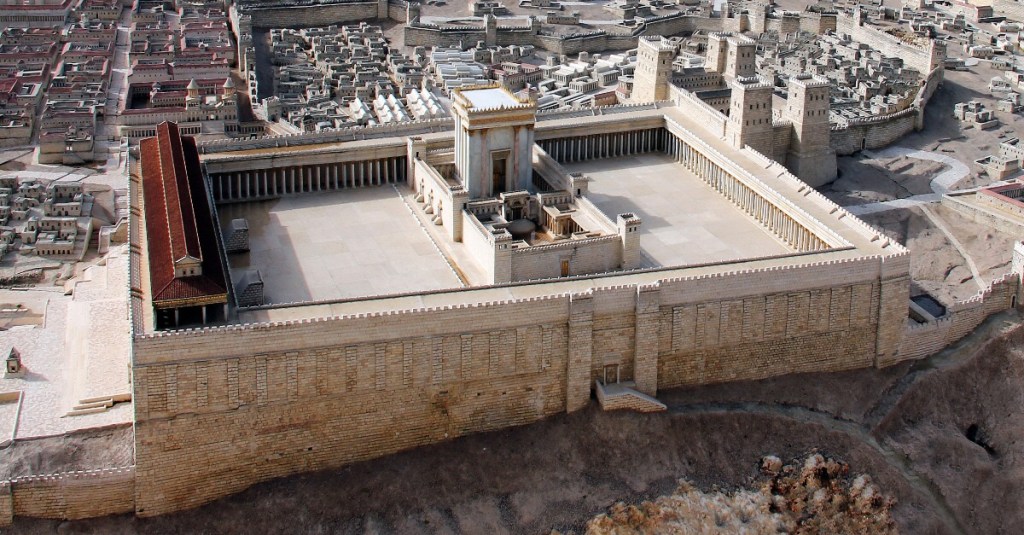
Now, one last observation on the genealogy. It starts at an impossibly low point, with an old man and his barren wife who are promised a land and offspring as numberless as the stars. And, contrary to the “laws of nature” it happens. The trajectory of the story is upward, and it reaches its zenith with David: a land, a people, and a great king. But, in the very next generation, the story starts its downward trend. Solomon is not as faithful as David and the united kingdom is near civil war at his death. That dissolution is realized in his son’s reign and the kingdom is divided, never to reunite again historically and politically. The next milestone in the genealogy is the deportation to Babylon; the kingdom is lost and the dynasty of David apparently ends. And, even though a remnant of Judah returns fifty years or so later, the kingdom is not truly reestablished, in part because the rebuilt temple is devoid of the presence of God. If we imagine this whole story as a tree, Abraham is the sapling, David the mature tree, and the deportation and following is the stump of the felled tree. And that leads us to the next seven in the genealogy, Jesus the Christ, and also to our text from Isaiah 11.
The Seventh Seven
I’d like you to take a few minutes at your tables to read through the text; perhaps one person could read it aloud to the group. Then discuss what stands out to you given the background that we examined from St. Matthew’s genealogy.
1 There shall come forth a shoot from the stump of Jesse, and a branch from his roots shall bear fruit.
2 And the Spirit of the Lord shall rest upon him, the Spirit of wisdom and understanding, the Spirit of counsel and might, the Spirit of knowledge and the fear of the Lord.
3 And his delight shall be in the fear of the Lord. He shall not judge by what his eyes see, or decide disputes by what his ears hear,
4 but with righteousness he shall judge the poor, and decide with equity for the meek of the earth; and he shall strike the earth with the rod of his mouth, and with the breath of his lips he shall kill the wicked.
5 Righteousness shall be the belt of his waist, and faithfulness the belt of his loins.
6 The wolf shall dwell with the lamb, and the leopard shall lie down with the young goat, and the calf and the lion and the fattened calf together; and a little child shall lead them.
7 The cow and the bear shall graze; their young shall lie down together; and the lion shall eat straw like the ox.
8 The nursing child shall play over the hole of the cobra, and the weaned child shall put his hand on the adder’s den.
9 They shall not hurt or destroy in all my holy mountain; for the earth shall be full of the knowledge of the Lord as the waters cover the sea.
10 In that day the root of Jesse, who shall stand as a signal for the peoples—of him shall the nations inquire, and his resting place shall be glorious (Isa 11:1-10).
[Discuss what the groups noticed.]
So, Isaiah begins with the recognition that the tree of Judah has been felled and that only a stump remains, the stump of Jesse, David’s father. But Isaiah sees a new shoot — which will become a fruit bearing branch — coming from the stump. It is through this shoot that the story will begin again and reach its perfection/completion.
And why/how will this shoot succeed where David’s story had failed? Because it will not be merely a human effort, but the work of the Lord as evidenced by the Spirit of the Lord resting upon the branch. Remember, in St. Matthew’s genealogy this is the seventh seven, the fullness of the Lord’s work. Isaiah makes clear that the shoot/branch is a Spiritually filled person — a “him,” so our language going forward will reflect that.
It is worth some time to discuss the Spirit of the Lord in verses 2 and 3a. There is something a bit hidden in our English translations of these verses that is a bit clearer in the Greek version of the Old Testament. Notice how the Spirit of the Lord is described:
Spirit of wisdom and understanding
Spirit of counsel and might
Spirit of knowledge and the fear of the Lord.
But, in the next verse, the phrase “the fear of the Lord is repeated.” In Greek, that is distinguished from the previous “fear of the Lord;” it would best be translated as the spirit of piety or godliness. Now, let’s count these spirits, or virtues of grace as they are sometimes called: wisdom, understanding, counsel, might, knowledge, fear of the Lord, piety/godliness — seven spiritual virtues. Once again we see the number seven. And what would it mean here? That the shoot from the stump of Jesse will have the fullness, the perfection, of the Spirit and the full complement of the virtues of grace. Everyone before was spiritually incomplete; this one will be spiritually perfect, fully equipped for the work he is to accomplish.
Before going on in the text, I want to consider how this plays out sacramentally in the Church, specifically in the sacrament of Confirmation. Listen to this description ofConfirmation from the BCP 2019:
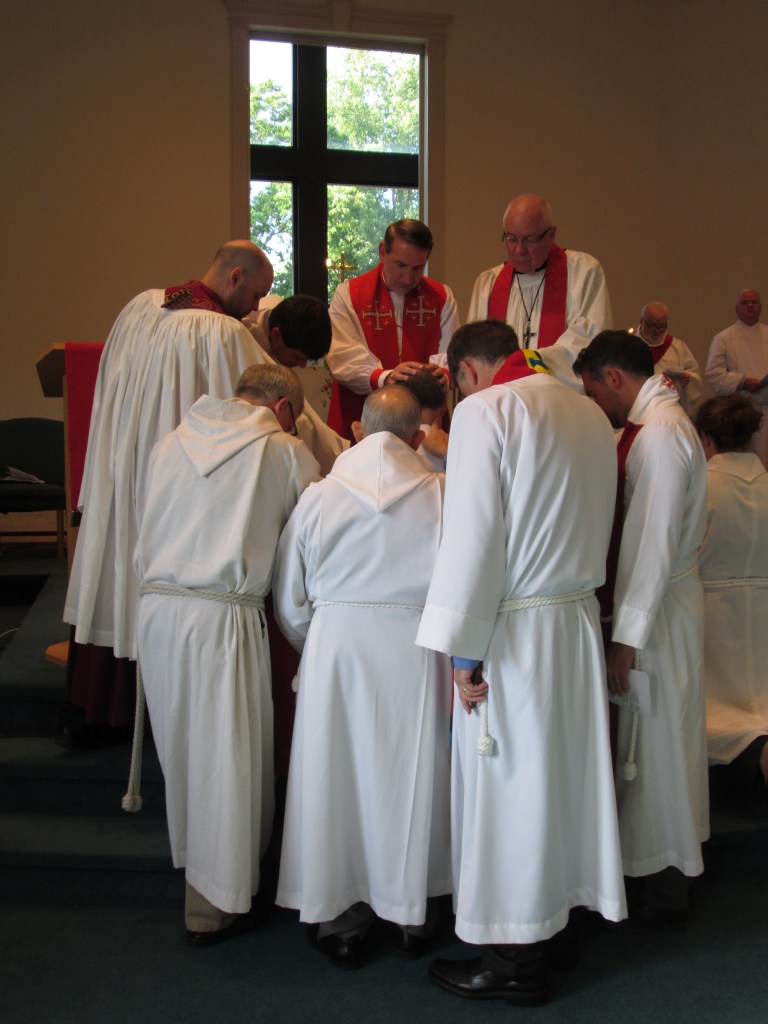
In Confirmation, through the Bishop’s laying on of hands and prayer for daily increase in the Holy Spirit, God strengthens the believer for Christian life in the service of Christ and his kingdom. Grace is God’s gift, and we pray that he will pour out his Holy Spirit on those who have already been made his children by adoption and grace in Baptism (BCP 2019, p. 174).
The Christian cannot rightly engage in the service of Christ and his kingdom without the grace of the Holy Spirit. Now, listen to the prayer that the bishop offers:
Almighty and everlasting God we beseech you to strengthen these your servants for witness and ministry through the power of your Holy Spirit. Daily increase in them your manifold virtues of grace: the spirit of wisdom and understanding, the spirit of counsel and might, the spirit of knowledge and true godliness, and the spirit of holy fear, now and for ever. Amen (BCP 2019, p. 178).
Did you catch it? The bishop prays for each confirmand to receive the same fullness of the Holy Spirit — the same sevenfold virtues of grace — that Isaiah attributes to the shoot from the stump of Jesse. And that is because our work, too, must be the work of the Lord if it is to carry the story forward. We are still living in the seventh seven generation of Jesus, and we are carrying on his work in the same power of the Spirit that filled him. This is the theology of the sacrament of Confirmation and shows how it fits into the story of redemption.
Now, what is the work for which the shoot of Jesse is filled with the Spirit? Look at verses 3 – 5. This is the work of a king. This is how a righteous king governs the people of God and ultimately governs the world. Not to get too political, and not at all partisan: this is the high standard to which we must hold our elected officials accountable. They will fail, yes, because they are not the shoot from the stump of Jesse; we must remind them of that, too, because they all too often have grandiose visions of their own importance and power. But, this is the standard we must continually point them toward.
What are the characteristics of such governance? What would characterize our political/social life under such a ruler? What does the text say?
He will not judge or act based upon polls or pundits (what his eyes see or his ears hear) but rather by righteousness — not by what is expedient or advantageous, but rather by what is right. For that he will need the Spirit of wisdom and understanding. And notice in verse 4 the particular judgment given on behalf of the poor and the meek, the ones who have long been denied righteous judgment. The criteria for “success” of a ruler is not whether the rich are getting richer and the powerful are gaining more influence and reduced restrictions on the exercise of their power, but rather on whether the poor are being lifted up and cared for and whether the meek are able to come out of the shadows and live.
This kind of care, this kind of social justice, requires strength from the king/governor, because there will be pushback from the rich and the powerful, from those who have great vested interest in maintaining the status quo. Notice the end of verse 4: “he will strike the earth with the rod of his mouth, and with the breath of his lips he shall kill the wicked.” There is nothing soft here. Those who resolutely oppose true justice will be destroyed; they will not be allowed to subvert righteousness. For this kind of strength, the ruler will need the Spirit of counsel and might. Might without counsel is subject to abuse. Counsel without might is prey to futility.
To summarize all this, Isaiah uses two words in verse 5 to describe the characteristics of this ruler and his kingdom: righteousness (justice) and faithfulness. Faithfulness to what? To God, to the covenant, to his vocation, to the people. This is what we look for in part from our leaders, and what we are promised in full from the shoot from the stump of Jesse. This was the longing of Israel, and it is reflected in many of the Psalms, Psalm 72 being a prime example. Listen to the words and see if you notice familiar themes.
[Read Psalm 72]
It’s all there, isn’t it? Righteous judgment, defense and vindication of the poor and justice for them, punishment for wrongdoers, flourishing for the righteous. This is the King Israel longed for, the one Isaiah says is coming. This is the King we say has already come in Jesus.
But it won’t be just the social order that is transformed by the king; the created order will be renewed, as well. Look at verses 6-9. Nature, which is often now “red of tooth and claw” will be healed of the ancient enmities, the need to prey on others for one’s own survival. This is more than mere peace; it is shalom, a putting to rights of all that has been corrupted so that all things are in harmony and all things can flourish.
The Peaceable Kingdom by Edward Hicks
This is exactly what St. Paul points toward in Romans 8:
18 For I consider that the sufferings of this present time are not worth comparing with the glory that is to be revealed to us. 19 For the creation waits with eager longing for the revealing of the sons of God. 20 For the creation was subjected to futility, not willingly, but because of him who subjected it, in hope 21 that the creation itself will be set free from its bondage to corruption and obtain the freedom of the glory of the children of God. 22 For we know that the whole creation has been groaning together in the pains of childbirth until now. 23 And not only the creation, but we ourselves, who have the firstfruits of the Spirit, groan inwardly as we wait eagerly for adoption as sons, the redemption of our bodies. 24 For in this hope we were saved. Now hope that is seen is not hope. For who hopes for what he sees? 25 But if we hope for what we do not see, we wait for it with patience (Rom 8:18-25).
This is still in the future; it is still our hope. And that raises a question. If Jesus is the shoot from the stump of Jesse who will bring about social justice, peace, and renewal of creation, do we see any evidence of that already among his people — not complete, of course, but some signposts pointing in the right direction? Has Jesus made any difference?
[Discuss]
Historian Tom Holland — himself a non-believer — attributes all that is best in Western culture to the influence of Jesus Christ. So many of the things we take for granted were unheard of even in the highest of the ancient cultures, Greek and Roman: the equality and dignity of all men; the God-given and therefore unalienable rights of life, liberty, and the pursuit of happiness; the responsibility of a society to care for the weakest among them; freedom governed by responsibility; the rule of law and not of sheer power; and so on. There is a direct line from Isaiah through Jesus Christ to these fundamental principles which are outworkings of the Gospel. So, as we perhaps too often say, there is an already-not yet character to the prophet’s words, to the Gospel, to the Church, and to the world. The great renewal has begun, but it is not yet complete. We, please God, model it in the Church to show what is possible and what is intended. We work it out in the world in our own vocations. We pray for it with groaning too deep for words, and we hope for it with faith. That is the nature of Advent, this period of waiting and watching and working between the first advent of the shoot from the stump of Jesse and the second advent of the King of Glory.
Advent with Isaiah: Session 1 — Plays and Symphonies Isaiah 2:1-5
The Lord be with you. And with your spirit. Let us pray.
Blessed Lord, who caused all Holy Scriptures to be written for our learning: Grant us so to hear them, read, mark, learn, and inwardly digest them, that by patience and the comfort of your holy Word we may embrace and ever hold fast the blessed hope of everlasting life, which you have given us in our Savior Jesus Christ; who lives and reigns with you and the Holy Spirit, one God, for ever and ever. Amen.
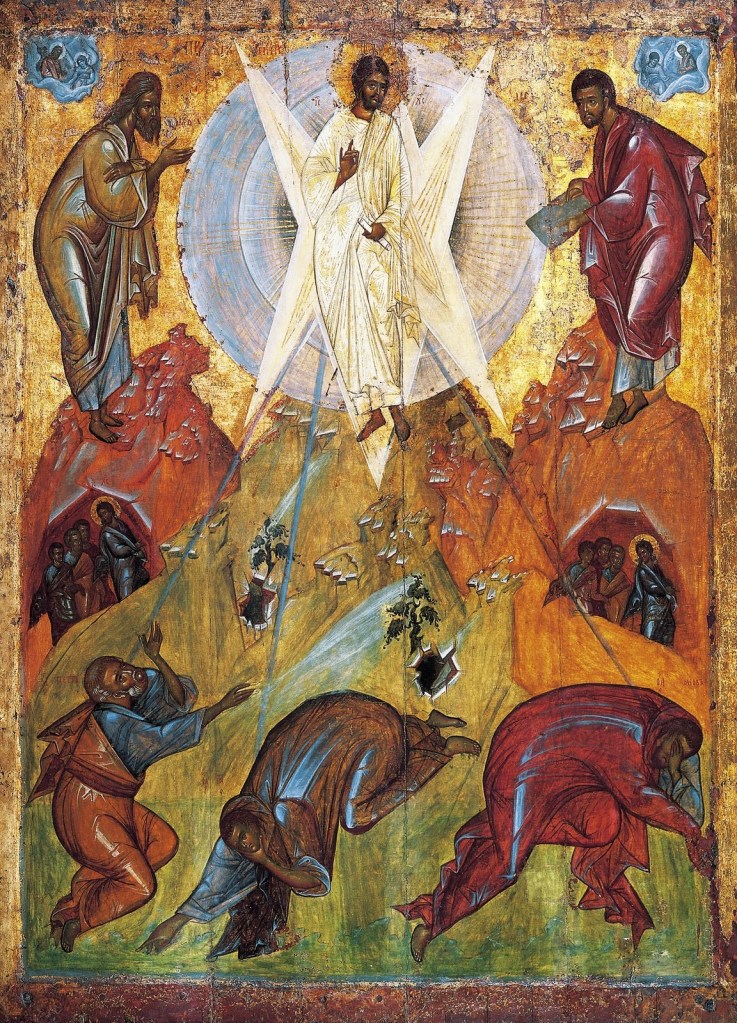
Two Convictions Astrophysicist Carl Sagan wrote: “If you wish to make an apple pie from scratch, you must first invent the universe.” He meant that most of the constituent elements in apples and flour and sugar were forged in ancient stars that exploded and scattered those elements abroad with some of them making up this planet we call earth. So, you have to have a universe of ancient stars before you can bake an apple.
The same holds true with household repairs. You can never do the job you started until you finish another one before it.
And the same is true when teaching a class. We are here to discuss Advent with Isaiah. But, to do that, I find that we must first go back far earlier than Isaiah and work our way forward. We’ll “create” the universe of Scripture and then we’ll bake a delicious pie.
I want start with two hermeneutical convictions — convictions about how we find meaning in Scripture. The two aren’t separate; they are more like the two sides of a single coin, but I’ll pull them apart to make them clear.
Conviction 1: Jesus makes precisely what sense he makes only in the context of the whole story of Scripture. Without the Hebrew scriptures, Jesus makes no sense.
Conviction 2: The story of Scripture makes what sense it makes only when read through the lens of Jesus. Without Jesus, the Hebrew scriptures make no sense.
I know this has a sort of chicken-and-egg quandary about it: you can understanding Jesus only when you understand the story of Scripture, and you can understand the story of Scripture only when you understand Jesus. So, which comes first? Where do you break into the circle? N. T. Wright talks about a cartoon showing a chicken and an egg talking. One says to the other: “Well, can we just stop asking? We’re both here now, so what does it matter?” Yes, you need the Hebrew Scriptures to understand Jesus and you need Jesus to understand the Hebrew Scriptures, but they’re both here now. Read them together and you won’t go wrong. Separate them, and theological disaster is certain.
These two convictions — that you can understand Jesus only when you understand the story of Scripture, and that you can understand the story of Scripture only when you understand Jesus — come from Jesus himself and from Scripture itself. We’ll look at two places this appears, one from Jesus and one from St. Paul.
On the Road to Emmaus
Let’s start with a well-beloved event narrated by St. Luke, a post-resurrection appearance of Jesus.
13 That very day two of them were going to a village named Emmaus, about seven miles from Jerusalem, 14 and they were talking with each other about all these things that had happened. 15 While they were talking and discussing together, Jesus himself drew near and went with them. 16 But their eyes were kept from recognizing him. 17 And he said to them, “What is this conversation that you are holding with each other as you walk?” And they stood still, looking sad. 18 Then one of them, named Cleopas, answered him, “Are you the only visitor to Jerusalem who does not know the things that have happened there in these days?” 19 And he said to them, “What things?” And they said to him, “Concerning Jesus of Nazareth, a man who was a prophet mighty in deed and word before God and all the people, 20 and how our chief priests and rulers delivered him up to be condemned to death, and crucified him. 21 But we had hoped that he was the one to redeem Israel. Yes, and besides all this, it is now the third day since these things happened. 22 Moreover, some women of our company amazed us. They were at the tomb early in the morning, 23 and when they did not find his body, they came back saying that they had even seen a vision of angels, who said that he was alive. 24 Some of those who were with us went to the tomb and found it just as the women had said, but him they did not see.” 25 And he said to them, “O foolish ones, and slow of heart to believe all that the prophets have spoken! 26 Was it not necessary that the Christ should suffer these things and enter into his glory?” 27 And beginning with Moses and all the Prophets, he interpreted to them in all the Scriptures the things concerning himself (Luke 24:13-27, ESV throughout unless otherwise noted).
The two on the road to Emmaus, Cleopas and his companion, are confused about the events surrounding Jesus; his crucifixion has thrown their hopes into disillusionment, and the reports of angels, a missing body, and claims of resurrection have muddled things even further. And what does the “stranger” with them do? He opens to them the Scriptures beginning with Moses (the Pentateuch) and the Prophets and shows them that the events surrounding Jesus make what sense they make, only in the context of the whole story of Scripture. Rightly understand Scripture and you will rightly understand Jesus. Or said negatively: if you don’t understand Scripture, you will not understand Jesus.
The Veil Lifted
St. Paul was commissioned by Jesus specifically to be the Apostle to the Gentiles. Yet, Paul never flagged in his concern for his fellow Judeans. His practice and his mantra were the same: to the Jews first and also to the Greeks. So, he agonized over the ongoing rejection of Jesus by most of his fellow Jews, and he pondered why that might be so. You can read Romans 9-11 for a detailed exposition of this. But it isn’t only in Romans; listen to these words from 2 Corinthians:
12 Since we have such a hope, we are very bold, 13 not like Moses, who would put a veil over his face so that the Israelites might not gaze at the outcome of what was being brought to an end. 14 But their minds were hardened. For to this day, when they read the old covenant, that same veil remains unlifted, because only through Christ is it taken away. 15 Yes, to this day whenever Moses is read a veil lies over their hearts. 16 But when one turns to the Lord, the veil is removed. 17 Now the Lord is the Spirit, and where the Spirit of the Lord is, there is freedom. 18 And we all, with unveiled face, beholding the glory of the Lord, are being transformed into the same image from one degree of glory to another. For this comes from the Lord who is the Spirit (2 Cor 3:12-18).
St. Paul says his fellow Jews cannot read and understand their own Scriptures because their minds are hardened and their hearts veiled. It is only when one turns to the Lord Jesus that the veil is lifted and the Scriptures make sense. You can only understand the Scriptures through the lens of Jesus.
So, there you have my two convictions about Scripture from Scripture itself.
Conviction 1: Jesus makes precisely what sense he makes only in the context of the whole story of Scripture. Without the Hebrew scriptures, Jesus makes no sense.
Conviction 2: The story of Scripture makes what sense it makes only when read through the lens of Jesus. Without Jesus, the Hebrew scriptures make no sense.
In Advent, it is fitting to begin with Conviction 1, to ask these questions: What is the whole story of Scripture in which Jesus makes sense? How might Jesus have told the story to his companions on the way to Emmaus?
The Story of Scripture: A Drama in Five Acts
Up until now, I have assumed something that many people — both Christian and non-Christian — do not necessarily take for granted: that Scripture is a coherent narrative that tells a single story, though that story is complex and multigenerational and multidimensional. Scripture is a grand, sweeping drama with Jesus at its climax. The Bible isn’t always considered that way. Some see it as a rule book or perhaps as an instructional manual; look things up as needed — a sort of ancient moral and religious YouTube. Some see it as a collection of ancient myths or moralistic fables. Some see no pattern or coherence in it at all. But for us, it is a narrative — the narrative — the drama of God and man.
Because it is a drama, many find it helpful to consider it as a play with various acts. There are many ways to divide the narrative, but I find the way often used by N. T. Wright to be straightforward and helpful. He describes the narrative as a play in five acts:
ACT I: Creation
ACT II: Fall
ACT III: Israel
ACT IV: Jesus
ACT V: Church
Today, I want us to consider the first three acts — Creation, Fall, and Israel — especially in relationship to Jesus.
ACT I: Creation
God created everything that is; for us that is a given starting point. But why? Why did God create at all? Here is how St. Paul might answer that question:
15 He is the image of the invisible God, the firstborn of all creation. 16 For by him all things were created, in heaven and on earth, visible and invisible, whether thrones or dominions or rulers or authorities—all things were created through him and for him (Col 1:15-16).
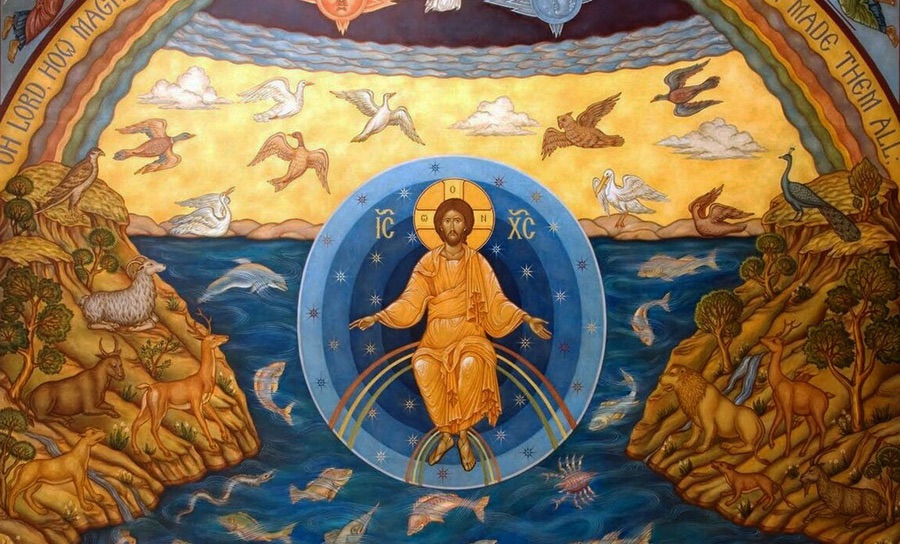
Creation — physical and spiritual, visible and invisible — is for Christ. Creation is to the glory of the Son of God; it shows forth his praise. And what of man in creation? What is man’s unique purpose? We — male and female — are to bear the image and the likeness of God, not least by being God’s vicegerent, his authorized representative on earth to act on his behalf as priest, prophet, and king. There is even more here. Paradise/Eden was the place of overlap of heaven and earth, the place where God dwelt among his people. It was to expand outward into the world as Adam and Eve, and later their offspring, subdued and tended creation so that God’s kingdom on earth might be as God’s kingdom in heaven. And that points us toward Christ who came announcing that, in and through his presence, the Kingdom of Heaven was at hand, that in him and through him God was once again dwelling with men.
The Church Fathers thought of Adam and Eve as innocent but not yet as perfect. When I say not perfect, I don’t mean flawed or deficient; I mean not complete, just as a baby or infant is not yet perfect. Think innocent and immature and you get the picture. A baby has much growth ahead of it: much to learn, many skills to develop. This is a distinction the Church makes between the image and likeness of God. We are made in the image of God in that we are rational beings who have the spiritual capacity to bear the likeness of the Son of God. Some of you may remember the instant cameras of the 1960s. Snap a photo and the undeveloped film shoots out the back, a blank, black negative. The image is already there on the film. But, over the next several seconds the likeness begins to form and show as chemicals react. Image and likeness: man was made in the image of God with the intent that man would mature into the likeness of the Son. So, this means that man, formed for Christ, made in the image of God, was intended to grow into Christlikeness and to point all creation — in heaven and on earth — toward Christ. I might say that this is still true: that baptism — new birth, new creation — renews the image of God in man and that man is intended to grow from there into the perfect image of Christlikeness.
ACT II: Fall
We do not know how long man persisted in his state of innocence, that is, in obedience to God and in fulfillment of his vocation. But that did not last. We need not rehearse all the details of what we call “the Fall,” though we should be clear about its consequences. How did man and creation change through the Fall? Man became subject to death, sin, and the fallen powers. Man lost his original innocence and squandered his vocation. Creation itself was subjected to futility; it is out of joint, subjected to the ravages of entropy — the wearing out and running down of all things.
All of this raises an important question: was Act I a failure, after all — God’s Plan A gone awry? What do you think? The Creation was not a failure. Let me suggest two reasons for that conviction. First, creation perfectly expressed the will of God for something other than God to exist for the glory of the Son; that there is something other than God and that the something is oriented toward God and shows forth, even imperfectly, the glory of the Son rules out failure as the verdict on creation. As for humankind, they are still the image-bearers of God — imperfectly so, but image-bearers nonetheless. They are still signposts — broken signposts as N. T. Wright says — pointing toward the Son. All of creation, even in its fallen state, points achingly toward its telos, toward its proper end. It has lost its way to get there on its own, but the proper end is at least dimly remembered. That raises the question of how to get man and all of creation back on track. It’s time for Act III.
ACT III: Israel
In Act III, God’s calls a man and his wife — harkening back to Adam and Eve — to be the nucleus of a people who would be for God a holy nation, a kingdom of priests. He promised Abraham a people and a place (a land): a people with whom God would dwell and a place in which God’s kingdom — his righteous rule — would be made manifest to all other peoples.
The story of Israel is long and winding. What are some key points in it — considered chronologically?
1. The birth of Isaac and the renewal of the covenant
2. The birth of Jacob and the renewal of the covenant
3. The birth of the Patriarchs
4. Exile in Egypt
5. The Passover and the Exodus (1200s BC — Moses, Exodus, Joshua)
6. The Law
7. The Wilderness experience and the Conquering of the Promised Land
8. The Judges (1100s BC)
9. The United Kingdom: Saul and David (1000s BC)
10. The Divided Kingdom: Solomon, Rehoboam, Jeroboam (900s BC)
11. Various Kings in both Israel and Judah (800s-700s)
12. Fall of Israel/Samaria to Assyria (722 BC)
13. Fall of Judah to Babylon (587 BC)
We could spend many hours filling in details, but it is the grand sweep we are interested in. And, in Advent, we are also interested in the Prophet Isaiah. Where does he appear in the timeline? Well, that is a matter of much debate. We can place the beginning of his ministry during the reign of King Ahaz of Judah (reign c. 736-715 BC). That means that Isaiah began his ministry shortly before the fall of the Northern Kingdom, and he witnessed, at least second hand, its destruction. The end of Isaiah’s ministry is the question. His prophecies include the fall of Judah, the Babylonian captivity, and the return of the exiles to Jerusalem, a period from 587-539 BC. So, Isaiah’s prophecies cover roughly a 200 year period, a very unlikely lifespan. So what are the possibilities most serious considered to explain this?
Many scholars have concluded that the book we call Isaiah is a compilation of similarly themed prophecies from either two or three different prophets. The book is often broken down like this:
Chapters 1-39: Isaiah
Chapters 40-55: Second Isaiah
Chapters 56-66: Third Isaiah
The other major notion is simply that the one Isaiah who began his ministry during Ahaz’s reign was granted a vision of what was to come long beyond his own death, in other words that he was a prophet not only in the sense of one who tells the truth of current events from God’s perspective but also as one who foresees coming events and their spiritual import. I have no problem with either option, but I see no reason to discount a single Isaiah who functioned as a prophet in the fullest sense. Even if we accept three Isaiahs, there is an irreducible element of foretelling if the book is in any way Christological, that is, if it points to Christ, as it surely does.
Now, let me pose the same question about Act III as I did about Act II: was it a failure? The story of Israel — in the Old Testament — ends incompletely and disappointingly. Ten of the twelve tribes have been lost forever, assimilated by other peoples and nations. The two remaining tribes, which are now called the Judeans, are greatly diminished in scope and power; they are occupied by a succession of foreign powers and have no Davidic king as promised. Worse still, God no longer dwells in the midst of them; the Holy of Holies in the rebuilt Temple is empty and their worship is simply a ritual. The promises of the covenant have not been fulfilled. If Israel was to be the solution of man’s fall, it seems like something has gone drastically wrong. So, was Israel a failure, Plan C gone to rack and ruin? Again, I must say no. Israel was not to be the people who would solve the problem of the fall itself, but rather the people through whom God would come to solve the problem himself. Israel was the people through whom the Messiah would come, the Messiah who would deliver all men from sin, death, and slavery to the powers; the Messiah who would inaugurate the Kingdom of God and who would himself be the one in whom God and man would dwell together. So, ultimately, Israel points directly toward Christ and cannot be understood apart from Christ. And, just as clearly, Christ cannot be understood apart from the story contained in the Hebrew Scriptures.
And that brings us around again to our two convictions: Jesus can be understood only in context of the whole of Scripture and the whole of Scripture can be understood only in context of Jesus. The Old Testament — not least Isaiah — points toward Jesus, and Jesus is the climax and fulfillment of the Old Testament.
Isaiah
Now, with this background, we can turn our attention to the text. We will start by taking a few minutes to read Isaiah 1 as the context for the today’s lesson, Isaiah 2:1-5. As you read with your table group, I would like you to consider a few questions:
1. What is the state of Jerusalem and Judah as Isaiah describes it?
2. What is the relationship between worship and social justice?
3. What does God want/expect from the people?
4. What does God plan to do?
It would be helpful to point out some specific verses that lead to your answers.
[Discuss Isaiah 1]
And now — at last — we come to the text for today’s lesson, Isaiah 2:1-5.
1 The word that Isaiah the son of Amoz saw concerning Judah and Jerusalem.
2 It shall come to pass in the latter days that the mountain of the house of the Lord shall be established as the highest of the mountains, and shall be lifted up above the hills; and all the nations shall flow to it,
3 and many peoples shall come, and say: “Come, let us go up to the mountain of the Lord, to the house of the God of Jacob, that he may teach us his ways and that we may walk in his paths.” For out of Zion shall go forth the law, and the word of the Lord from Jerusalem.
4 He shall judge between the nations, and shall decide disputes for many peoples; and they shall beat their swords into plowshares, and their spears into pruning hooks; nation shall not lift up sword against nation, neither shall they learn war anymore.
5 O house of Jacob, come, let us walk in the light of the Lord.
Imagine a composer working on a great symphony. The first three movements are complete, though the third one doesn’t have the typical dancelike motif. Instead, it is somber, and it ends without resolution but with a whispering, whimpering discord. And then, tragedy strikes; the composer dies before finishing the fourth and final movement. But, he has left behind some hints, some notes, a musical theme, which he had planned to develop fully. And these notes are hopeful, upbeat, a glorious fulfillment of all that had gone before. It provides resolution and harmony.
This is a good analogy for the Old Testament, for Acts I through III of the drama of Scripture, if I may mix metaphors from drama to symphony. The story of Israel ends unfinished, on a minor note, with discord and not harmony. Judah is under occupation with no Davidic king on the throne and the temple of God is empty of the presence of God. But, the composer has left behind some notes, a prophetic them which is yet to be fully developed; and it is glorious and hopeful. That is what we get in Isaiah 2:1-5.
Notice in verse 2 that the fulfillment of this vision is yet to come; it is for the latter days. And that should strike a chord with us:
1 Long ago, at many times and in many ways, God spoke to our fathers by the prophets, 2 but in these last days he has spoken to us by his Son, whom he appointed the heir of all things, through whom also he created the world (Heb 1:1-2).
The latter day, the last days, are the days of Acts IV and V of the great drama — the acts of Jesus and the Church. Isaiah sees that the story of Israel is incomplete and will reach its fulfillment only in his future. And what will be the sign of this fulfillment?
…and all the nations shall flow to it,
3 and many peoples shall come, and say: “Come, let us go up to the mountain of the Lord, to the house of the God of Jacob, that he may teach us his ways and that we may walk in his paths.” For out of Zion shall go forth the law, and the word of the Lord from Jerusalem (Is 2:2b-3).
In the latter days, God will no longer be just the God of Abraham, Isaac, and Jacob, but the God of all peoples as was intended from creation. So, this is not only the fulfillment of God’s covenants with Abraham and David, but with Adam and with all creation. And again, this finds its fulfillment only in Jesus, as we sing in the canticle Dignus Es:
Splendor and honor and kingly power* are yours by right, O Lord our God,
For you created everything that is,* and by your will they were created and have their being;
And yours by right, O Lamb that was slain,* for with your blood you have redeemed for God,
From every family, language, people, and nation,* a kingdom of priests to serve our God.
And so, to him who sits upon the throne,* and to Christ the Lamb,
Be worship and praise, dominion and splendor,* for ever and for evermore. Amen (BCP 2019, p. 84).
Now we come to a portion of Isaiah’s prophecy which requires us to modify Wright’s five act play. Remember the outline:
ACT I: Creation
ACT II: Fall
ACT III: Israel
ACT IV: Jesus
ACT V: Church
We need a sixth act: the age to come — the age in which heaven and earth are united (Rev 21, 22) and in which God is all and in all (1 Cor 15:28). Only then will all disputes be resolved, only then will perfect peace reign. That is the last act of the drama, the fourth movement of the unfinished symphony, the fulfillment of all promises in Christ. That is what Isaiah saw in his vision. It is what Jesus’s first Advent set into motion, and what his second Advent will bring to fulfillment.
Eve of Thanksgiving, 26 November 2025 (Deut 8, Ps 65:1-8, James 1:17-27, Matt 6:25-33)
What Do You Say?
IN THE NAME of the Father, and of the Son, and of the Holy Spirit. Amen.
The ritual plays out wherever there are parents with young children. It was on full display just last month on All Saints’ Eve, otherwise know as Halloween, and I’ve seen it several times since in a host of circumstances. Father or mother bends down to eye level with the child and asks the age old question in sing-song voice: “What do you say?” Because we’ve seen it so many times, and because so many of us have asked it as parents ourselves, we know what is expected from the child. There are only two possible answers: “please” if the child wants something or “thank you” if the child has received something.
This training in etiquette, this enculturation in manners, doesn’t stop in the toddler years. We expect our growing children to show proper gratitude for gifts given them on birthdays and at Christmas and on other occasions. And, if those gifts are sent from afar, we might insist that our children write thank you cards or, at the minimum, acknowledge their appreciation with a phone call to their grandparents or godparents or aunts and uncles. Graduation gifts certainly require thank you cards as do wedding shower and baby shower gifts. It is just common courtesy; our parents raised us that way, we raise our own children that way, and we expect our grown children to raise our grandchildren that way. It is such an ingrained part of our cultural experience that few seem to question it. I had given it little thought myself until faced with preaching this Thanksgiving-eve sermon today. And then the question — once it presented itself — seemed obvious: Why do we teach our children to be grateful? The question seems obvious, the answer less so.
At one level I suppose we teach our children to be grateful because we don’t want to be embarrassed by their failure to conform to the social norms of etiquette. Here in the South we fear hearing anyone ever say about our child — behind our backs but loud enough for us to hear of course— “Well, bless her heart, her parents must not have raised her any better.” That is good Southern, two generational judgment probably said with a smile that would wither kudzu. No, we don’t want that. Nor is it simply concern for ourselves; we know our children will fare better themselves if the niceties are observed. Manners grease the skids of social interaction, open closed doors, and crack open doors even more widely open. I wonder how many opportunities I’ve had in life just because my mother taught me to say please and thank you.
That’s the most basic answer to the matter of manners: we express gratitude self-consciously, because it is in our self-interest. But, that’s a bit cynical and hardly satisfying; there has to be more to it than that. And, there is. The ”more” — the real why of gratitude — is found in familiar words from the Eucharistic prayer. That’s not surprising. Eucharist means thanksgiving, and the prayer we offer is called The Great Thanksgiving. So, here are the familiar words I have in mind, beginning with the Sursum Corda, the “lift up your hearts”:
The Lord be with you. And with your spirit. Lift up your hearts. We lift them up to the Lord.
Now, here it is:
Let us give thanks to the Lord our God. It is right to give him thanks and praise.
It is right, our duty and our joy, always and everywhere to give thanks to you, Father Almighty, Creator of heaven and earth (BCP 2019, p. 132).
There is the sacramental answer. Why do we teach our children gratitude? Why do we express it ourselves? Because is it right, because it is our duty, and because it is our joy to give thanks and praise to God. All other gratitude — gratitude expressed to our fellow image-bearers of God for gifts and services and sacrifices — participates in that primary gratitude to God and flows from it. We teach our children to say thank you to the adults in their lives, to their friends, and finally to strangers because we want them to know how properly and fully to show gratitude to God. How can you thank God whom you haven’t seen if you can’t thank your brother and sister whom you have seen, so St. John’s might ask.
Since all gratitude flows downstream from our gratitude to God, let’s start at the source: It is right, our duty and our joy, always and everywhere to give thanks to you, Father Almighty, Creator of heaven and earth.
It is right. Book One of C. S. Lewis’s classic Mere Christianity is entitled “Right and Wrong as a Clue to the Meaning of the Universe.” In it he argues that all people have “in mind some kind of Law or Rule of fair play or morality or whatever you like to call it, about which they really [agree]” (Kindle Edition, p. 3). He calls it the Law of Right and Wrong or the Law of Human Nature. Lewis develops this notion further and shows that the Law of Right and Wrong is both extrinsic — it comes from outside us and its authority lies beyond us — and at the same time intrinsic in that it is fundamental to human nature; while we may rebel against it, we all nonetheless recognize it and our responsibility to it. Cultures and individuals may disagree over some of the details of the Law, but none can escape from it. We may differ on whom we may kill and under what circumstances — war, self-defense, that sort of thing — but no culture and no sane individual would say we may kill whomever we please, whenever we please, for whatever reason we please. We all know that wanton murder violates the Law of Right and Wrong. Anyone who says otherwise is a sociopath or a psychopath lacking some fundamental aspect of humanity.
This means — at the very least — that some behaviors are right and we know them to be right beyond any doubt and beyond any need to justify them. They are moral axioms, convictions we all recognize as true without proof. It’s easy to see this by pairing some examples. Cowardice is wrong, bravery is right. Lying is wrong, truth-telling is right. Faithlessness is wrong, fidelity is right. Abuse is wrong, nurture is right. Deceit is wrong, fair-dealing is right. We could go on constructing these pairs all day. We know right from wrong and have no time to waste with those who might argue to the contrary.
Now, our Eucharistic liturgy recognizes this Law of Nature, too, when it has the priest say to God on behalf of all, “It is right…always and everywhere to give thanks to you, Father Almighty, Creator of heaven and earth.” Gratitude is part of this Law of Nature; we know — again, both extrinsically and intrinsically — that it is right to give thanks to God. In fact, St. Paul sees the failure to give thanks to God as something of a primal sin, the fountain of all evils. He explains this in his letter to the Romans:
18 For the wrath of God is revealed from heaven against all ungodliness and unrighteousness of men, who by their unrighteousness suppress the truth. 19 For what can be known about God is plain to them, because God has shown it to them. 20 For his invisible attributes, namely, his eternal power and divine nature, have been clearly perceived, ever since the creation of the world, in the things that have been made. So they are without excuse. 21 For although they knew God, they did not honor him as God or give thanks to him, but they became futile in their thinking, and their foolish hearts were darkened. 22 Claiming to be wise, they became fools, 23 and exchanged the glory of the immortal God for images resembling mortal man and birds and animals and creeping things (Rom 1:18-23).
The refusal to give thanks to him is the first step on man’s downward spiral into idolatry, lust, sexual immorality, covetousness, malice, envy, murder and all manner of wrongs. So, our liturgy calls us away from that first fateful step of ingratitude by reminding us that it is right always and everywhere to give thanks to God the Father Almighty. And, even as we say it and do it, we know it to be true.
But, our giving thanks to God is right in another sense. It is our right to give him thanks and praise. It is what we were made for as human image-bearers and we, among all creatures, have the unique right to do so. Listen to this excerpt from Psalm 98:
5 Show yourselves joyful in the LORD, all you lands; sing, rejoice, and give thanks.
6 Praise the LORD with the harp; sing with the harp a psalm of thanksgiving.
7 With trumpets also and horns, O show yourselves joyful before the LORD, the King.
8 Let the sea make a noise, and all that is in it, the round world, and those who dwell therein.
9 Let the rivers clasp their hands, and let the hills be joyful together before the LORD, for he has come to judge the earth (BCP 2019, p. 397).
The seas can make a noise, the rivers can figuratively clap their hands, and the hills can be joyful in their fecund beauty. But only man can articulate his gratitude to God. Only man can sing, rejoice, and give thanks in psalms. It is our God-given right to gather up the inarticulate praises of creation and, as priest of creation, to offer those praises to God in words, we who were called into being by the Word of God, we who have been redeemed by the Word of God incarnate. And, because we were made for this, because we were given this unique vocation, it is both our right to do so and our duty to do so. It is our duty always and everywhere to give thanks to God, the Father Almighty.
Whatever else we might say about the sin of our first parents in the Garden, it was a failure to fulfill their vocational duty to give thanks to God their Creator. He had called them into being from nothing. He had given them each a human companion and complement. He had given them a home replete with all necessities and with boundless pleasures as well. He had given them meaningful work to do that participated in and extended his own creative activity. And, he had consented to dwell with them there. But rather than fulfill their duty of gratitude, they strayed into the way of discontent. Rather than fulfill their duty of gratitude, they lusted after the one thing that was forbidden. They failed in their duty to give thanks to God the Creator in the midst of his creation and all creation was subjected to futility. All creation fell from inarticulate praise to inarticulate groaning.
But thanks be to God for the redemption wrought in Jesus Christ our Lord who is even now making all things new. Through his incarnation, life, death, resurrection, and ascension, He has restored to us our priestly vocation and has called us once again to articulate the praise and thanksgiving of a creation that is being renewed in him. It is once again our duty to give thanks to God, the Father Almighty, Creator of heaven and earth. And, because it is a duty that we were made for, a vocation blessing we were given, it is also our joy to give him thanks and praise.
Let us get this straight. God does not need our gratitude. He is not a divine narcissist who, in his insecurity, needs constant affirmation. It is not that God needs our gratitude but that we need to give it: it is our joy always and everywhere to give him thanks and praise. To express our thanksgiving is to make the experience of receiving blessing complete. A blessing without thanksgiving is truncated, diminished. Thanksgiving makes our joy full.
I have mentioned this to some of you before. I want you to know that I know that I am repeating a story, one of the saddest stories I know. Bart Ehrman is a Biblical scholar who along the way lost his Christian faith. He became so focused on the pain and evil in the world, so unable to reconcile that with a good God, that he simply gave up on God altogether. I heard him interviewed once and the host asked an achingly good question: Having left your faith behind, is there anything about it you miss? To his credit Ehrman answered yes without hesitation. He explained, and here I will paraphrase his response in the first person:
I have had a good and beautiful life and I am filled with a profound sense of gratitude for it. But, without God, I have no one to thank, no one to whom it makes sense to express that gratitude.
This is a direct quote from Ehrman’s blog:
So when I’m “thankful” for the circumstances I was born into in the mid 50s in America, for excellent health, for a positive disposition, for talents I inherited, for good intelligence — Whom do I thank (www.ehrmanblog.org/thanksgiving-2019/)?
And that lack of someone to thank leaves the blessing incomplete, strips the experience of its full joy. That’s what Ehrman acknowledged in one unguarded moment, in one interview.
But we know whom to thank. And we know that it is our joy always and everywhere to give thanks and praise to God, the Father Almighty, Creator of heaven and earth. We know that God accepts our thanksgiving not from any divine need to be praised, but rather from his will to increase our joy.
So, why do we teach our children to be grateful? Because we want to bring them here around the altar where they will find their fulfillment. Because we want to train them to join in the Great Thanksgiving. Because it is right, our duty and our joy always and everywhere to give thanks to God the Father Almighty, Creator of heaven and earth. So we teach them to say “thank you” for little gifts given, for little services rendered, for the every day acts of kindness and generosity that fill their lives, so they will not be tongue-tied when standing in the presence of the Lord. So we set aside one day each year in a sort of secular liturgy of Thanksgiving so that we may hallow every day by holy acts of Thanksgiving. We can give thanks at family tables tomorrow because we have first given thanks at this family Table whenever we gather for Eucharist.
The Lord be with you. And with your spirit. Lift up your hearts. We lift them up to the Lord. Let us give thanks to the Lord our God. It is right to give him thanks and praise.
It is right, our duty and our joy, always and everywhere to give thanks to you, Father Almighty, Creator of heaven and earth. Amen.
All Saints’ Day, 1 November 2025 The Holy, Hot Mess Horde (Ecclesiasticus 44:1-14, Psalm 149, Ephesians 1:11-23, Luke 6:20-36)
Collect Almighty God, you have knit together your elect in one communion and fellowship in the mystical Body of your Son: Give us grace so to follow your blessed saints in all virtuous and godly living, that we may come to those ineffable joys that you have prepared for those who truly love you; through Jesus Christ our Lord, who with you and the Holy Spirit lives and reigns, one God, in glory everlasting. Amen.
IN THE NAME of the Father, and of the Son, and of the Holy Spirit. Amen.
Archbishop Thomas Cranmer
Well, my friends, let’s take a journey together in the Wayback Machine, all the way back to 1544, to England. In 1544, Thomas Cranmer, Archbishop of Canterbury of the recently independent Church in England, published his first English language liturgy for the Church. It was the prayer we now call The Great Litany, and it became a cornerstone of the Book of Common Prayer, appearing in every edition since. It was not a fully original creation — more a compilation of ancient and contemporaneous litanies — but it was nonetheless classic Cranmer. The Archbishop began the prayer with an invocation of God:
O God, the father of heaven, have mercy upon us miserable sinners.
O God, the son, redeemer of the world: have mercy upon us miserable sinners.
O God the holy ghost, proceeding from the father and the son: have mercy upon us miserable sinners.
O holy, blessed, and glorious trinity, three persons and one God: have mercy upon us miserable sinners.
You might recognize the general form of that invocation from The Great Litany in our own Book of Common Prayer 2019: a little different wording, yes, but the same trinitarian structure and content.
Following immediately upon this invocation in The Great Litany of 1544 is another: an invocation of the saints.
O holy virgin Mary, mother of God our Saviour Jesus Christ. Pray for us.
All holy Angels and Archangels and all holy orders of blessed spirits. Pray for us.
All holy patriarchs, and Prophets, Apostles, Martyrs, Confessors, and Virgins, and all the blessed company of heaven: Pray for us.
At this point, I would expect an audible gasp from you. An invocation of saints?! In the Anglican Church?! Lord, have mercy upon us miserable sinners. Reformed Anglicans are aghast that such an invocation ever once defiled our otherwise beautiful litany. Anglo-Catholics are aghast that such an invocation was ever removed from our otherwise beautiful litany. All Anglicans are aghast over something, it seems.
But, the invocation of saints was removed, and quickly. Five years after the debut of The Great Litany, the first Book of Common Prayer was published and its use mandated; 1549 it was. And the invocation of saints had already been excised from The Great Litany, never to appear again. Whether Cranmer’s theology had radically changed in those five years or whether, with the passing of Henry VIII, Cranmer’s true theology was given more free rein than before, or whether he had gotten his writing hand smacked by his more Reformed contemporaries, I will leave for historians to debate. Regardless, the invocation of saints was gone forever. Just a few years later, with the publication of The Thirty-Nine Articles of Religion of 1571, the invocation of saints was not only absent — it was repudiated:
XXII. OF PURGATORY
The Romish Doctrine concerning Purgatory, Pardons, Worshipping, and Adoration, as well of Images as of Reliques, and also Invocation of Saints, is a fond thing vainly invented, and grounded upon no warranty of Scripture, but rather repugnant to the Word of God.
In a mere twenty-seven years the Church in England had gone from invoking the saints to pray for us to rejecting such an invocation as fond (foolish), vain (empty), biblically groundless, and even repugnant to Scripture. Such was the Anglican theological whiplash in the early years.
Why this “saintly” history lesson? Simply to show you that historically Anglicans have sat rather uncomfortably with the saints. We seem a bit muddled about how to regard them, about their purpose, about what intercourse — if any — we have with them and they with us. They are not unlike the cousin whom you feel obligated to invite to the family Thanksgiving dinner but who you really hope will have other plans.
We do have saints’ feast days on our liturgical calendar. The Blessed Virgin Mary has a day along with each of the Apostles, sans Judas but with Matthias and Paul. Stephen, the first Christian martyr is there, along with Mark and Barnabas and Joseph and John the Baptist and Mary Magdalene. The collects for these feast days generally focus on a characteristic of the given saint and ask the Lord that it might also be manifest in us. The saints are presented less as active participants in the ongoing economy of salvation and more as exemplars of the faith whose spiritual heroics we are to emulate. That seems to be the thrust of the collect for All Saints’ Day, as well: “Give us grace so to follow your blessed saints in all virtuous and godly living,” we implore God. We talk to God about the saints, but we don’t ask the saints to talk to God about us — at least not publicly in our common prayer.
I think Scripture hints at more than this pedagogical role for the saints, more than just teaching us how to live; but these are only hints, nothing to fashion a detailed doctrine around. The great Tradition of the Church insists on a significantly greater role, not only of mediation but also of intervention, based in part upon the Church’s experience with the saints. Make of that what you will; in Anglicanism it is not an article of faith required of any man as requisite or necessary to salvation (see Article VI, BCP 2019, p. 773).
As a good Anglican preacher — and note that “good” modifies Anglican and not necessarily preacher — I will stick with Scripture this evening and say what I know to be true rather than what I think may be true.
Let’s start here: look around; take a good look around. Embarrass the people behind you by turning around and staring at them. Some of these your fellow-parishioners may be or may become famous men and women, appointed great glory and majesty from the Lord — men and women who will leave a name, so that their praises are declared throughout generations (Sirach 44:1-8). Some will never be widely known, though their lives likely will have impact far beyond what they can begin to imagine; your life, too. Though their names will probably never appear in a liturgical calendar with an appointed feast day, these are the saints that Scripture knows: exceptionally ordinary and ordinarily exceptional men and women and children who have been baptized into the Lord Jesus Christ, who have been filled with the Holy Spirit, who are living lives of repentance and who are contending for the faith once delivered to the saints. These are the saints you see. These are the saints you are surrounded by. These are the saints you are stuck with. These are the saints you are blessed with. This is the Church: the nursery of saints, the school of saints, the proving-ground of saints, the hospital of saints, the temple of saints, the glory of saints.
Saints at Apostles Anglican Church
Saint Paul’s greeting in his first canonical letter to the Corinthians tells their story:
1 Paul, called by the will of God to be an apostle of Christ Jesus, and our brother Sosthenes,
2 To the church of God that is in Corinth, to those sanctified in Christ Jesus, called to be saints together with those who in every place call upon the name of our Lord Jesus Christ, both their Lord and ours:
3 Grace to you and peace from God our Father and the Lord Jesus Christ (1 Cor 1:1-3, ESV throughout unless otherwise noted).
I wish I had a white board and some colored dry erase markers to make visible and clear some of the subtleties in these verses; I’ll do the best I can to describe them without visual aids.
In verse 1 Paul identifies himself as a “called” apostle: called by the will of God and sent out on mission for Christ Jesus. He parallels that in verse 2 by identifying his readers/hearers as “called” saints, implying that they, too, have been called by the will of God and sanctified in Christ Jesus. Not only those residing in Corinth, but all those in every place — and let’s add here “in every time” — who call upon the name of our Lord Jesus Christ: in other words, you and all these saints sitting around you here, all those saints who have gone before into the presence of God, all those saints who are yet to be so long as Christ tarries. These are the ones who have been sanctified, who are being sanctified, who will be sanctified — by the Holy Spirit, in Christ Jesus. And though you almost pick up the resonance in English, it is perfectly clear in St. Paul’s Greek: sanctified and saint come from the same root word; sanctified means “saint-ified” to coin a term, and both saint and sanctified pertain to holiness, to being set apart for God’s use and glory. Saints are not perfected masterpieces but are works in progress, the joint work of God and man, sometimes work in the very rough first stages of saint-ification.
Now, I’m not telling you anything new here: the saints in Corinth to whom St. Paul wrote were a hot mess. They were more tribal and fractious than even our politicians. Imagine your brothers and sisters here at Apostles forming constituencies around certain priests and dismissing others as second or third-tier. Imagine law suits breaking out between your brothers and sisters who every Sunday morning kneel at the same altar rail and share the same Body and Blood of Christ. Imagine open sexual immorality in the parish that is both paraded and accepted as a sign of advanced spirituality. Imagine everyone here insisting on displaying his/her own spiritual gifts in worship, leading to envy and chaos and inhibiting rather than fostering worship. Imagine our people holding grudges and refusing to forgive one another. Imagine gossip and rebellion against authority. Imagine modern day idolatry. Well, if you can image these things — and please, God, may they never be here among us — then you can imagine the state of the church of God that was in Corinth. You can imagine those in the church, those who, as Paul writes, are sanctified in Christ Jesus, called to be saints together with those who in every place call upon the name of our Lord Jesus Christ, both their Lord and ours. I don’t believe St. Paul wrote that sarcastically, ironically, or tongue-in-cheek, but rather with faith, with confidence, in the power of God and the grace of the Holy Spirit to actually make these people, in Christ, what he had called them to be: saints. And Paul was not ashamed to be numbered among them.
So, whatever else we may mean by “saint,” our definition must be broad enough to include these people — and those around you, and you, and me — in that holy, hot mess horde. Let us praise famous men and women, as Sirach exhorts, for their heroic holiness: yes. But let us not forget the ordinary saints, the hidden saints, whose flaws are so obvious to us but whose holy struggles are known only to themselves and God. Let us not forget our brothers and sisters who are fighting holy battles that we may never know. But neither let us make the definition of saint so broad that it becomes meaningless, that it includes all and sundry without distinction. Remember the excommunication at the heart of 1 Corinthians (1 Cor 5); no man practicing incest, no man arrogantly refusing correction, no man repudiating repentance has any place at the Table of the Lord, any place in the fellowship of the saints. He is to be turned over to Satan for the destruction of his fleshly behavior that his spirit might be saved. The church is to purge the evil one from among them; notice how St. Paul no longer referred to such a one as a saint, but as “the evil person.” St. Paul also reminds the saints in Rome that identity as saints and saintly conduct belong together:
6 [God] will render to each one according to his works: 7 to those who by patience in well-doing seek for glory and honor and immortality, he will give eternal life; 8 but for those who are self-seeking and do not obey the truth, but obey unrighteousness, there will be wrath and fury (Rom 2:6-8).
So, we dare not presume on our sainthood. I know a man who once earned a black belt in karate. For the past thirty years, though, he has not trained or maintained his skills. It would be presumptuous for him to call himself a “black belt” now; he has a black belt hanging in his closet, but he no longer is a black belt. And, if he presumed to be one now, the result might be disastrous. So, too, we dare not presume on our sainthood. Rather, we press into it: further up, further in as C. S. Lewis might say. We train. We discipline ourselves. We lay aside all that holds us back from fulfilling our identity. We do that by taking our place in the Church. There are no saints apart from the Church because there are no saints apart from Christ.
Now, contrary to what I told you earlier, I am going to say something that I don’t know with absolute certainty, but rather something I believe rather passionately. There are few saints apart from the parish; that is, there are few saints apart from a local worshiping, serving, repenting community of fellow believers striving and praying their way into Christlikeness, hermits notwithstanding. It is in the parish that one is birthed into sainthood at baptism, nourished into sainthood on Word and Sacrament, equipped for sainthood in teaching and correction, empowered for sainthood in confirmation, disciplined for sainthood in service, prayed into sainthood in the common prayer of the daily offices, absolved into sainthood in confession, anointed into sainthood in illness, buried into sainthood to the strains of “Alleluia! Alleluia! Alleluia!”
Do you want to progress in sainthood? And, we shouldn’t answer too quickly, too glibly. Do you want to progress in sainthood? Then, stay in the parish until you are hurt by someone there. Where better to learn to forgive? Stay in the parish until you hurt someone there and must ask their forgiveness. Where better to learn humility? Stay in the parish until you don’t get your own way. Where better to learn submission? Stay in the parish when you think the preaching is too long or too boring, or when the music is too traditional or too modern, or when the budget is not quite to your liking, or when your program doesn’t get off the ground. Where better to learn to love, to learn to wash the feet of others? You’ve heard it said that it takes a village to raise a baby. Perhaps: it certainly helps, at any rate. But, I think it is patently true that it takes a parish to raise a saint.
Becoming a saint is hard. St. Paul knew that and acknowledged it to the Corinthians:
24 Do you not know that in a race all the runners run, but only one receives the prize? So run that you may obtain it. 25 Every athlete exercises self-control in all things. They do it to receive a perishable wreath, but we an imperishable. 26 So I do not run aimlessly; I do not box as one beating the air. 27 But I discipline my body and keep it under control, lest after preaching to others I myself should be disqualified (1 Cor 9:24-27).
I do not box as one beating the air.
It is sobering — isn’t it? — to hear St. Paul describe his struggle toward sainthood, to hear him acknowledge the possibility that he might, in the end, fall short. Do not be discouraged or dismayed by that. Rather, take that as the half-time locker room pep talk of a coach whose team has the potential for a great victory but who, at the moment, needs to dig down deeply into their training and strengthen their resolve.
But the same St. Paul who wrote this cautionary exhortation also wrote this about our sainthood, which is, at its heart, simply being caught up into God’s grand drama of creation and redemption in and through our Lord Jesus:
3 Blessed be the God and Father of our Lord Jesus Christ, who has blessed us in Christ with every spiritual blessing in the heavenly places, 4 even as he chose us in him before the foundation of the world, that we should be holy and blameless before him. In love 5 he predestined us for adoption to himself as sons through Jesus Christ, according to the purpose of his will, 6 to the praise of his glorious grace, with which he has blessed us in the Beloved. 7 In him we have redemption through his blood, the forgiveness of our trespasses, according to the riches of his grace, 8 which he lavished upon us, in all wisdom and insight 9 making known to us the mystery of his will, according to his purpose, which he set forth in Christ 10 as a plan for the fullness of time, to unite all things in him, things in heaven and things on earth.
11 In him we have obtained an inheritance, having been predestined according to the purpose of him who works all things according to the counsel of his will, 12 so that we who were the first to hope in Christ might be to the praise of his glory. 13 In him you also, when you heard the word of truth, the gospel of your salvation, and believed in him, were sealed with the promised Holy Spirit, 14 who is the guarantee of our inheritance until we acquire possession of it, to the praise of his glory (Eph 1:3-14).
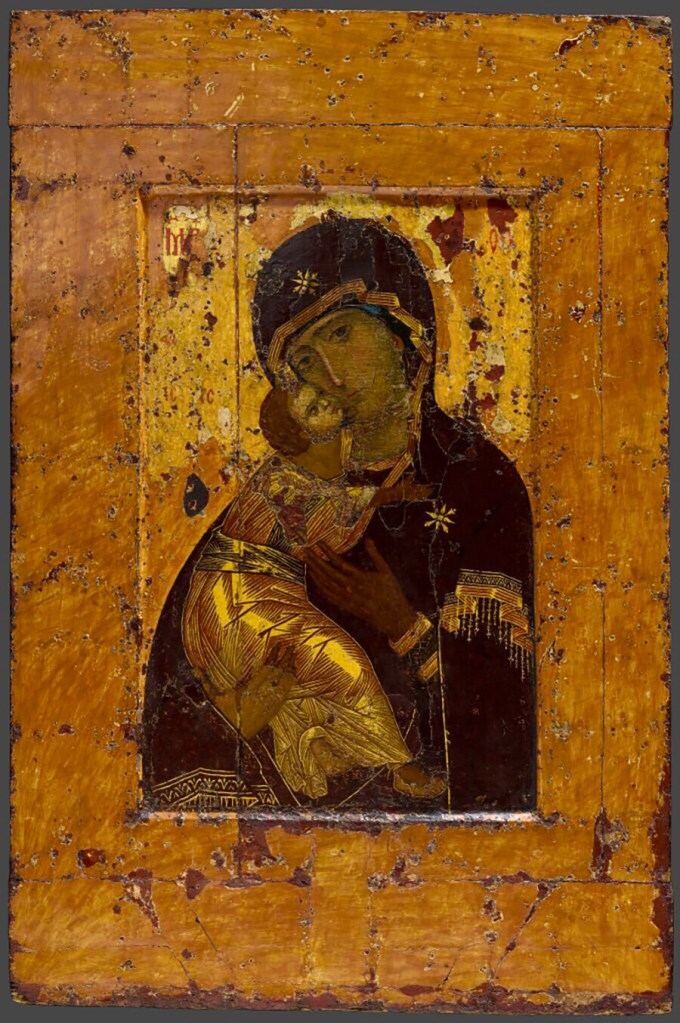
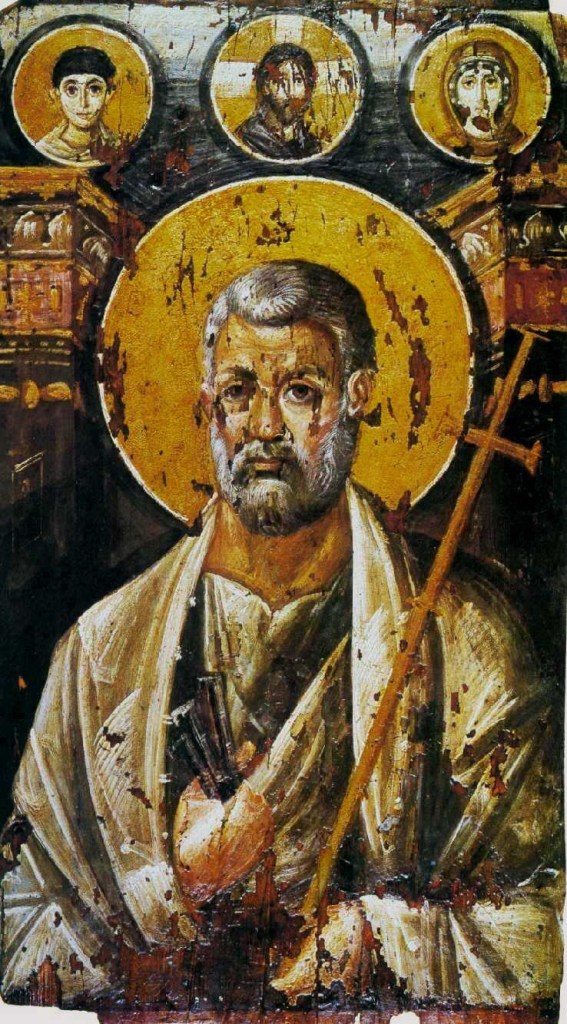
There is sainthood: being chosen by God to be holy and blameless, being predestined to be God’s son through Jesus Christ, being redeemed and forgiven through Christ’s blood, being sealed by the Holy Spirit as a guarantee of the fullness to come, being caught up into God’s plan to unite all things in Christ to the praise of his glory. I venerate the great saints of the past and of blessed memory, and their icons adorn my office and my home: the Blessed Virgin Mary, John the Forerunner, Peter and Paul, our guardian angels, George, John the Theologian, and others. But we are no less saints than they. St. Paul didn’t write to those luminaries on those icons, but to ordinary saints like you and me, saints struggling to be faithful, pressing on toward the goal for the prize of the upward call of God in Christ Jesus (see Phil 3:14), to whom, with the Father and the Holy Spirit, be honor and glory — in the saints — now and for ever. Amen.

This Is the Message: A Homily on 1 John 3:11-24 (2 Kings 6, Ps 75, 1 John 3:11-4:6)
Collect O God, our refuge and strength, true source of all godliness: Graciously hear the devout prayers of your Church, and grant that those things which we ask faithfully, we may obtain effectually, through Jesus Christ our Lord, who lives and reigns with you and the Holy Spirit, one God, now and for ever. Amen.
In the name of the Father, and of the Son, and of the Holy Spirit. Amen.
In its two thousand year history, the Orthodox Church has formally recognized only three — perhaps four — theologians. The most recent, Saint Symeon the New Theologian, died in 1022. Today, in the post-Enlightenment West, we tend to use the term theologian quite loosely to mean someone who has made an academic study of God and of things religious, to mean someone who knows many facts about what others throughout history have thought and said about God. By that definition, even an atheist can be a theologian, and there are, indeed, some who are. But not so in the Eastern Church. Amongst the Orthodox, a theologian is not one who knows about God, but rather one who knows God — in and through Christ — directly, immediately by encounter and fellowship and revelation, through prayer and purity of heart.
St. Symeon the New Theologian
The first of those recognized by the Church as theologian is St. John the Evangelist, the beloved disciple of our Lord. It is easy to see how he fits the Orthodox definition of theologian, or perhaps how the definition was formulated around him. Did he know God directly by encounter and fellowship?
St. John the Theologian
Listen to the opening of his first epistle:
1 That which was from the beginning, which we have heard, which we have seen with our eyes, which we looked upon and have touched with our hands, concerning the word of life— 2 the life was made manifest, and we have seen it, and testify to it and proclaim to you the eternal life, which was with the Father and was made manifest to us— 3 that which we have seen and heard we proclaim also to you, so that you too may have fellowship with us; and indeed our fellowship is with the Father and with his Son Jesus Christ (1 John 1:1-3, ESV throughout unless otherwise noted).
St. John knew God incarnate by sight, by touch, by hearing.
Did he know God by revelation through prayer? Listen to the opening of The Apocalypse:
1 The revelation of Jesus Christ, which God gave him to show to his servants the things that must soon take place. He made it known by sending his angel to his servant John, 2 who bore witness to the word of God and to the testimony of Jesus Christ, even to all that he saw (Rev 1:1-2).
St. John says that this revelation, this vision, occurred when he was in the Spirit on the Lord’s Day, almost certainly in a time of prayer and worship, perhaps Eucharistic worship. Certainly, St. John knew God by revelation and through prayer.
So, yes, St. John is the archetypal theologian in the true sense. That shines through in his writings: in the fourth Gospel; in his three epistles, most clearly in the first of them; and in The Revelation.
There are common themes that emerge from St. John’s encounters with God the Father, the Son, and the Holy Spirit; amongst them these three are prominent: life, light, and love. He introduces two of these themes in the prologue of his Gospel:
1 In the beginning was the Word, and the Word was with God, and the Word was God. 2 He was in the beginning with God. 3 All things were made through him, and without him was not any thing made that was made. 4 In him was life, and the life was the light of men. 5 The light shines in the darkness, and the darkness has not overcome it (John 1:1-5, emphasis added).
The third theme comes in Jesus’ discourse with Nicodemus:
16 “For God so loved the world, that he gave his only Son, that whoever believes in him should not perish but have eternal life (John 3:16, emphasis added).
Christ Pantokrator, St. George Greek Orthodox Church, Knoxville, TN
Light, life, and love: these three lie at the heart of St. John’s theology because they are what he saw in God incarnate. For St. Paul it is faith, hope, and love; for St. John the Theologian, it is life, light, and love.
There are implied dichotomies in St. John’s theology. He writes:
5 This is the message we have heard from him and proclaim to you, that God is light, and in him is no darkness at all (1 John 1:5).
St. John didn’t write, but could have: “in him is no darkness at all; in him is no — whatever the opposite of love is — at all.” But, such negative conditions do exist, and St. John knew it. They are there in his Gospel, in his epistles, in The Revelation. Jesus came as light into a world shrouded in darkness. Jesus came as life into a death-impregnated world. Jesus came as love into a world twisted by hatred, envy, and indifference. He came to conquer the powers of darkness, death, and hate. He came to redeem us from slavery to darkness, death, and hate. He came to shine light into our darkness, to lead us out of death into eternal life, to teach us and empower us to love God and our neighbor. And that brings us to our text today, 1 John 3:11-24.
11 For this is the message that you have heard from the beginning, that we should love one another. 12 We should not be like Cain, who was of the evil one and murdered his brother. And why did he murder him? Because his own deeds were evil and his brother’s righteous. 13 Do not be surprised, brothers, that the world hates you. 14 We know that we have passed out of death into life, because we love the brothers. Whoever does not love abides in death. 15 Everyone who hates his brother is a murderer, and you know that no murderer has eternal life abiding in him (1 John 3:11-15).
Here, St. John plunges us headlong into the heart of the great conflict. We are commanded to love in a world that will reciprocate with hatred and violence. We are to live — to proclaim resurrection — in a world headed toward the grave. And the inevitable result of our decision to love and to live is a conflict that, by all outward evidence, we will loose. Evil will seem to win because we will be hated and we will be killed. Our very righteousness will provoke the world to murder. We see that with Jesus and in every previous generation throughout history flowing backward all the way to Cain.
From the beginning, St. John writes — from creation — we have heard the message that we should love one another, with the implication that Cain knew this commandment, as well. So, why did he violate the commandment and murder his brother? St. John gives two, tantalizing answers: (1) Cain was of the evil one, and (2) Abel’s righteousness shone a light on Cain’s evil. I don’t know fully what it means that Cain was of the evil one, but the language is evocative of more than a passing acquaintance. By comparison, one cannot be of Christ casually, without firm resolve and commitment, without living the way of Christ. I suspect the same is true here of Cain, that he was, at his core, resolutely opposed to all things righteous, that he was aligned with the evil one, that he is the archetype and father of those whom St. Paul describes in Romans 1, those who although they knew God, did not honor him as God or give thanks to him but became futile in their thinking and darkened in their hearts (see Rom 1:18 ff). And when evil is shone as evil by the presence of righteousness, evil strikes back to destroy the good.
So, St. John writes, we should not be surprised when the same happens to us, when the world hates us. And, again, in the short term, it may look like the world is winning the conflict between evil and righteousness. But that is a myopic view, a near-sighted distortion of the truth. It is the righteous who have passed through death, passed out of death, into life. St. John writes this: We know that we have passed out of death into life, because we love the brothers. Whoever does not love abides in death (1 John 3:14). Our love for one another is the evidence that we are not like Cain: of the evil one and thus subject to death. Hate is evidence of death; love is evidence of life.
But, what kind of love is St. John writing about? What does it mean to love the brothers? — and when both St. John and I say “brothers” we mean “brothers and sisters.” St. John points to Jesus as the example:
16 By this we know love, that he laid down his life for us, and we ought to lay down our lives for the brothers (1 John 3:16).
That is a high standard of love — laying down your life for someone. If we take that concretely, then none of us here have ever loved our brothers, and it is likely that none of us here will ever be called to do. So, St. John makes it clear that we lay down our lives not only only by dying physically, but rather by dying to self, by sacrificing for the good of the brothers:
17 But if anyone has the world’s goods and sees his brother in need, yet closes his heart against him, how does God’s love abide in him? 18 Little children, let us not love in word or talk but in deed and in truth (1 John 3:17-18).
This is very down to earth. If you see a brother who has a real and substantial need, and you have resources but refuse to help him, then you don’t have God’s love in you. You have not passed from death to life; you are still in darkness. Imagine a relatively affluent church having some poorer members who are routinely forced to choose between housing and medicine because they can’t afford both. If the church has the resources and chooses not to help, it would be hard to say that God’s love abides there. The heart of that church is hardened. Now, apply that to the individual members of the church, folk like you and me. If I can help a brother in true need and choose not to, then I am, at best, loving in word and talk, but not in truth. But, if I do help, that is the evidence that I love in truth. If I do help, that is reassurance before God that my heart is not closed.
This matter of the heart is crucial. There are many spiritual illnesses of the heart, illnesses that run the gamut from hardness of heart to excessive scrupulosity, from a refusal to open the heart in love at all to despair that whatever is done in love is never enough to please God. Those with the former illness — hardness of heart — feel no remorse for the good they could have and should have done but did not do, and the latter — those suffering from scrupulosity — feel guilt for the good they have done, that it is somehow not enough, never enough. God will prod the former and reassure the latter. Here is how St. John says it:
19 By this we shall know that we are of the truth and reassure our heart before him; 20 for whenever our heart condemns us, God is greater than our heart, and he knows everything. 21 Beloved, if our heart does not condemn us, we have confidence before God (1 John 3:19-21).
And, because as the prophet Jeremiah says, the heart is deceitful above all things, we pray with the Psalmist that God will reveal our hearts to us, lest we delude ourselves:
23 Search me, O God, and know my heart; try me and examine my thoughts.
24 Look well if there be any way of wickedness in me, and lead me in the way everlasting (Ps 139:23-24, BCP 2019, p. 456).
St. John says that, if our hearts are pure, if we are keeping God’s commandments and doing what pleases him, then God will honor our prayers and give us what we ask for:
22 and whatever we ask we receive from him, because we keep his commandments and do what pleases him. 23 And this is his commandment, that we believe in the name of his Son Jesus Christ and love one another, just as he has commanded us. 24 Whoever keeps his commandments abides in God, and God in him. And by this we know that he abides in us, by the Spirit whom he has given us (1 John 3:22-24).
This is not a blank check, not least because our hearts are not wholly pure and because we do not perfectly follow the commandments to love God with all our heart and soul and mind and to love our neighbor — and our brother — as ourselves. For me this promise is aspirational. The more I purify my heart — the Lord being my helper — and the more I love in deed and not in word only, the more my heart and mind will be aligned with God’s will, so that what I ask of him will be pleasing to him and granted by him. The key is the commandment he has given us: to believe in the name of his Son Jesus Christ and to love one another, just as he has commanded us.
I close with a word from Tertullian, a second and third century Christian apologist who offered a description of early Christian worship and life. After discussing many characteristics that set Christians apart from the surrounding culture, he closes with this:
But it is mainly the deeds of a love so noble that lead many to put a brand upon us. See, they say, how they love one another, for they themselves are animated by mutual hatred. See, they say about us, how they are ready even to die for one another (Tertullian, Apology, Chapter XXXIX).
Please God, may that be said of the Church in this and every age. Amen.
We meet together as an assembly and congregation, that, offering up prayer to God as with united force, we may wrestle with Him in our supplications. This violence God delights in (Tertullian, The Apology, Chapter XXXIX).
This excerpt comes from a description of early Christian worship by Quintus Septimius Florens Tertullianus (c. 155 – 220 AD) — Tertullian — a second and third century Christian apologist from Carthage, modern day Tunisia in Northern Africa. He was one of the earliest theologians, if not the first, to think and write in Latin, and is thus often considered the founder of Western theology. A caution is in order. While the Church honors his early writings, it is more circumspect regarding Tertullian himself and it eschews his later thought. The early, Orthodox theologian was seduced by the heretical Montanist movement and ended his life outside — informally if not formally — the catholic Church. The Apology is among his early works and is sure and safe ground.
Tertullian
The language of the excerpt is strange and wonderful to my ears. In the description of prayer we find this intriguing troika of descriptors: force, wrestling, violence. This hearkens back to the puzzling language of our Lord:
From the days of John the Baptist until now the kingdom of heaven has suffered violence, and the violent take it by force (Matt 11:12, ESV unless otherwise noted).
Even before this, there is the image of Jacob wrestling with God — violence as prayer, prayer as violence: Let me go. Not until you bless me.
24 And Jacob was left alone. And a man wrestled with him until the breaking of the day. 25 When the man saw that he did not prevail against Jacob, he touched his hip socket, and Jacob’s hip was put out of joint as he wrestled with him. 26 Then he said, “Let me go, for the day has broken.” But Jacob said, “I will not let you go unless you bless me.” 27 And he said to him, “What is your name?” And he said, “Jacob.” 28 Then he said, “Your name shall no longer be called Jacob, but Israel, for you have striven with God and with men, and have prevailed.” 29 Then Jacob asked him, “Please tell me your name.” But he said, “Why is it that you ask my name?” And there he blessed him (Gen 32:24-29).
Jacob Wrestling With an Angel
Certainly, the grappling of Jesus in the Garden — unto the sweating of blood — stands as the ultimate example of forceful, violent prayer.
Gethsemani Abbey: Jesus Praying in Gethsemane
Today, we seem more likely to encounter centering prayer for making us whole rather than violent prayer for wresting blessing from God: prayer for “making us” but not for “breaking us,” prayer of sweetness and light but not prayer of wounding and martyrdom. Who or what teaches us to pray with force, with wrestling, with violence? The Psalms will teach us if we are faithful to their discipline, day in and day out, year by year. The Church Fathers will teach us if we submit to apprenticeship with them. But, it is perhaps the fallenness, the brokenness, the suffering of the world that is our best mentor: the hardships and losses of life, the headlong stumbles into sin, the heart-shattering abandonments and betrayals of friends-turned-enemies, the doctor’s diagnosis, the two o’clock in the morning worries and fears. And the cry is wrung from our lips and our hearts, “I will not let you go until you bless me!” from which we may limp away wounded but having seen God face to face.
I am an Anglican, and Anglicans do not “do” force and wrestling and violence in prayer, at least not in public. It simply is not done; it is not proper. But, I cannot help but wonder what might happen if the Prayers of the People just once turned into an all-out, no-holds-barred wrestling match with God Almighty, an encounter turned violent because we were praying as if our lives depend on it, which, of course, they really do. And not our lives only, but the life of the world.
The Problem for the Rich Is the Poor : A Homily On James 5 (1 Kings 15:1-30, Psalm 5, James 5)
Collect O merciful Lord, grant to your faithful people pardon and peace, that we may be cleansed from all our sins and serve you with a quiet mind; through Jesus Christ our Lord, who lives and reigns with you and the Holy Spirit, one God, now and for ever. Amen.
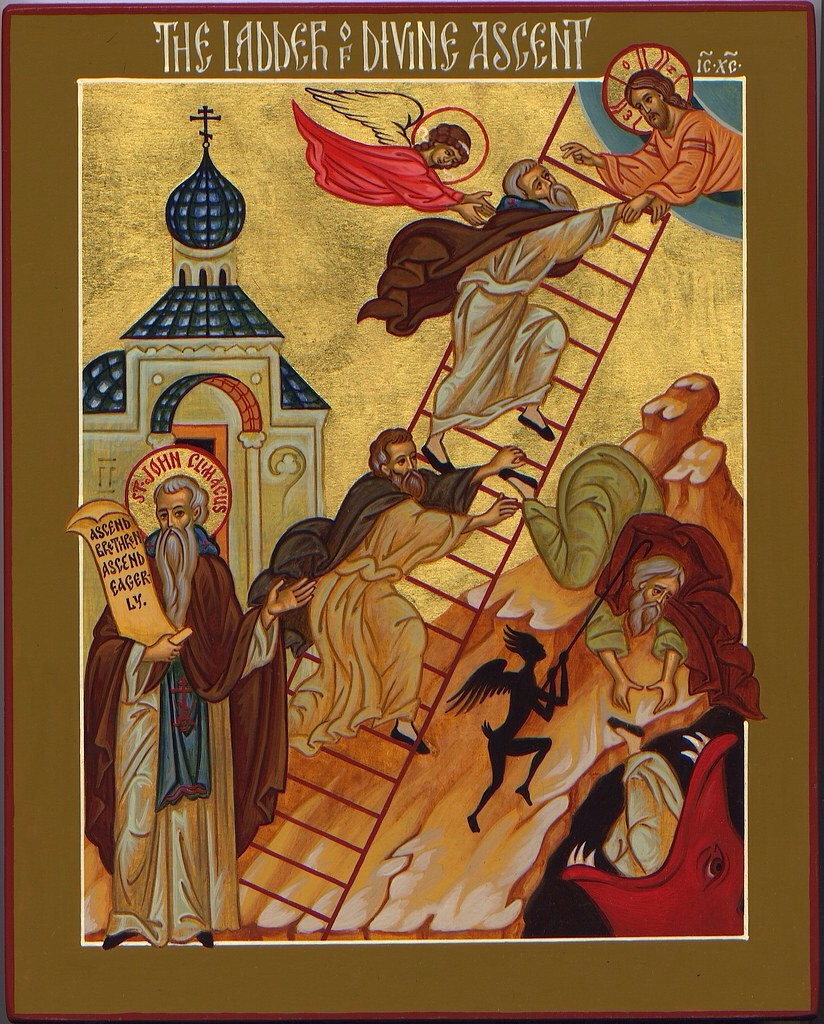
In the Name of the Father, and of the Son, and of the Holy Spirit.Amen.
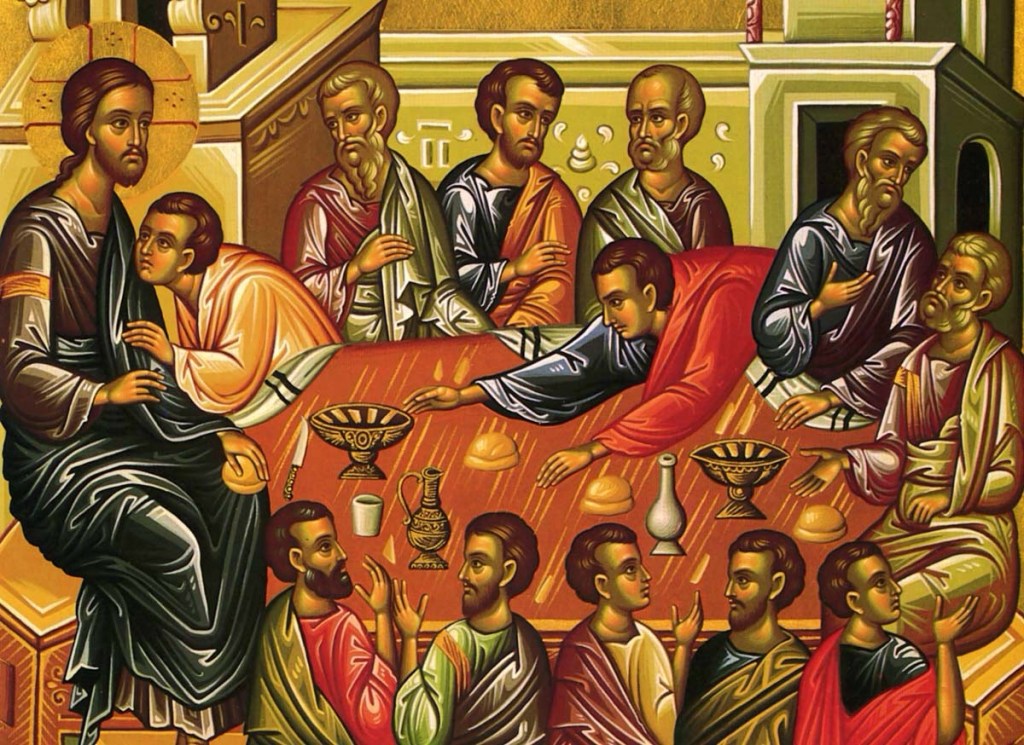
I am now at that age where I generally preface every story with the disclaimer: “Now, if I’ve told you this before, please stop me.” I don’t want to be one of those old guys who runs out of stories before they run out of years. The problem is, I am going to tell you a story you’ve heard before. Fr. Jack told a version of it two Sundays past. I told a version of just last Sunday. This repetition is not our choice. We follow the lectionary and the lectionary is hammering this point home because Jesus and all of Scripture hammer this point home. So, here we go again.
We often speak of people groups as if they are monolithic, as if all the members of a group are essentially identical and interchangeable; if you’ve seen one, you’ve seen them all. We know that’s no true. We know that in any group there are common features and great variability. But it is easy and convenient to minimize the differences and to maximize the commonalities so that we can, for good or ill, speak of the whole group.
We speak of the homeless. Depending on who is speaking, all the homeless are either helpless victims of a neglectful or oppressive social structure or else lazy, shiftless products of their own irresponsible choices. We speak of immigrants. Depending on who is speaking, immigrants are the very backbone of American exceptionalism — what made America great to start with — or else violent, drug-dealing abusers of the largesse of this country. We speak of political parties as if all our compatriots are saints struggling mightily to drag this land back from the brink of destruction and our opponents are demons hauling us kicking and screaming into the maw of the abyss. And we all know this is all nonsense and yet we all do it to greater or lesser degrees. Lord, have mercy on us and forgive us this foolishness.
But, even Scripture does this from time to time — generalizes a group while admitting of some exceptions. All Moabites are bad, except for Ruth; Ruth is fine. Ninevites all deserve destruction; but even their animals repented in sackcloth at the preaching of Jonah, so there’s that in their favor. Samaritans are scum, and yet that one Samaritan was the hero of Jesus’ most famous parable.
It is the same with the rich in Scripture. As a group, they are generally warned or castigated if not condemned outright. They are probably up to something shifty that is very good for them and very bad for the common folk. But, as with other groups, there are exceptions; Lydia and Barnabas, maybe Philemon, come to mind as among the few righteous rich.
So, what is it that makes the rich so suspect in Scripture, so likely to hear the word “Woe!” shouted in their general direction? The problem for the rich is the poor. God had instituted a social policy in the Law that would largely mitigate poverty. There were gleaning laws that allowed the poor man access to the rich man’s over-abundance. There were laws of manumission that freed Hebrew economic slaves in the seventh year of servitude. There was a general economic reset every fiftieth year in which all property reverted to its hereditary owners. All of these laws kept the power and the greed of the rich in check and ensured that the rich could not forever prosper at the expense of the poor. But the law, as far as we can tell, was never observed in full. That the rich had not followed the law, that there were the destitute among them, is the indictment against the rich. There were no woes for the righteous rich — cautions, yes, but no condemnation — but judgment aplenty for the covetous and miserly rich.
And that brings us to James who has nothing good to say about the rich. Let’s consider James 5:1-6.
1 Come now, you rich, weep and howl for the miseries that are coming upon you. 2 Your riches have rotted and your garments are moth-eaten. 3 Your gold and silver have corroded, and their corrosion will be evidence against you and will eat your flesh like fire. You have laid up treasure in the last days. 4 Behold, the wages of the laborers who mowed your fields, which you kept back by fraud, are crying out against you, and the cries of the harvesters have reached the ears of the Lord of hosts. 5 You have lived on the earth in luxury and in self-indulgence. You have fattened your hearts in a day of slaughter. 6 You have condemned and murdered the righteous person. He does not resist you (James 5:1-6).
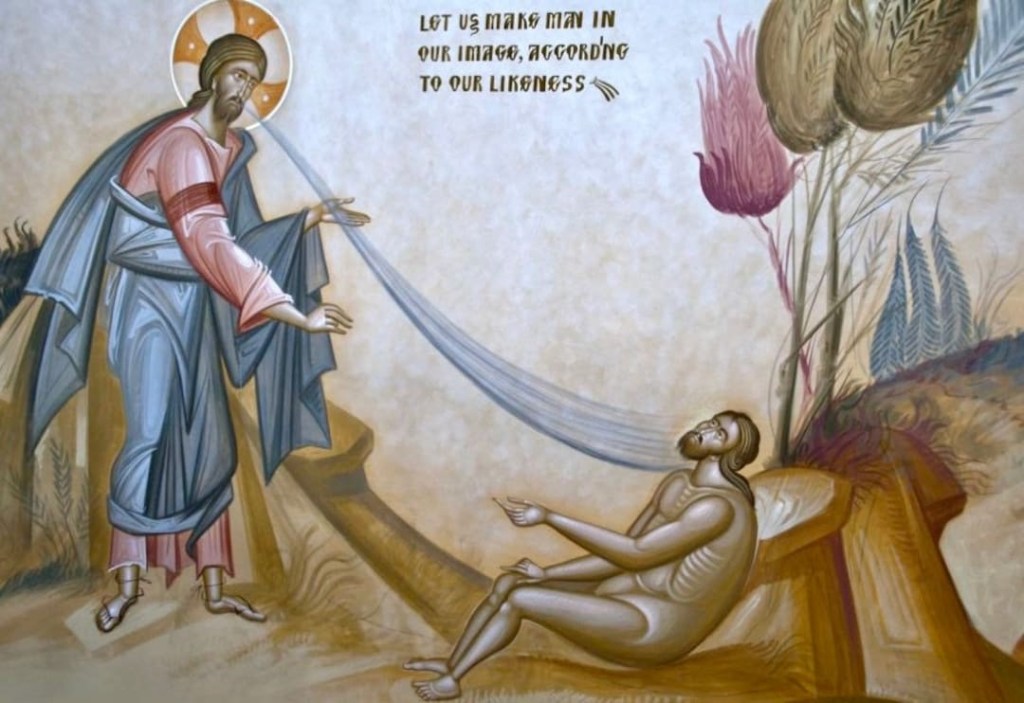

Harsh. Let’s look carefully at the text to see the specific charges against the rich. In verses 2 and 3 the problem is hoarding, specifically the hoarding of wealth: clothes, gold, silver — treasures in general. These rich do not use their wealth to make themselves happy — note the deterioration of their goods, the rottenness and corrosion — nor do they use their wealth to alleviate the suffering of the poor. They simply hoard it as testimony against them of their greed. These rich were surely the inspiration of Dickens’ Ebenezer Scrooge and his business partner Jacob Marley, men who made and hoarded money solely for the sake of making and hoarding money, good men of business. Marley realized only too late that, “Mankind was my business. The common welfare was my business; charity, mercy, forbearance, benevolence, were all my business.”
Jacob Marley
The rich are condemned because God had intended — had commanded them — to be a flowing stream of economic righteousness, but they had instead dammed up the stream to create a private reservoir of luxury solely for themselves. As St. Basil the Great (330-379) wrote:
When someone steals a person’s clothes, we call him a thief. Should we not give the same name to one who could clothe the naked and does not? The bread in your cupboard belongs to the hungry; the coat hanging unused in your closet belongs to those who need it; the shoes rotting in your closet to the one who has no shoes. The money which you hoard belongs to the poor.
St. Basil the Great
But, James’s charge against the rich is actually worse than mere hoarding. They are hoarding not what they had rightly earned, but rather stolen wealth, wages fraudulently withheld from the poor. Look at verses 4-6.
4 Behold, the wages of the laborers who mowed your fields, which you kept back by fraud, are crying out against you, and the cries of the harvesters have reached the ears of the Lord of hosts. 5 You have lived on the earth in luxury and in self-indulgence. You have fattened your hearts in a day of slaughter. 6 You have condemned and murdered the righteous person. He does not resist you (James 5:4-6).
Not us — certainly not! But what about a society or a business or an individual that accrues wealth by routinely underpaying those who can least afford to be underpaid? What about my barista friends at a local café who have to work two jobs simply to have adequate food and clothing and who are praying that they do not get sick because neither job offers health insurance? What about the itinerate farm workers — the pickers — the immigrants who go from field to field doing back-breaking work for a mere pittance, and then are demonized for being here at all? What about the single adult, with no children, working full time for minimum wage in Knox County, TN? The minimum hourly wage is $7.25. The hourly poverty wage is $7.52. The minimum living wage is $23.30, four and a half times the minimum wage. Read James 5:4-6 again, and see if there is not just a little discomfort, a little concern that our society might have gone awry and might, Lord have mercy, be ripe for judgment. Then read the whole of Revelation 18. To be clear, I do not not know the solution. This is where we need Christian, Gospel-shaped politicians and businessmen and sociologists and a host of other professions to bring their expertise to bear to begin implementing the Kingdom of God vision.
Given this abuse by the rich, what are the poor to do? A better question might be, What can the poor do? because poverty also implies a certain powerlessness. James says this in verses 7-11; it may be a general instruction to everyone, but it certainly applies to the poor in this context:
7 Be patient, therefore, brothers, until the coming of the Lord. See how the farmer waits for the precious fruit of the earth, being patient about it, until it receives the early and the late rains. 8 You also, be patient. Establish your hearts, for the coming of the Lord is at hand. 9 Do not grumble against one another, brothers, so that you may not be judged; behold, the Judge is standing at the door. 10 As an example of suffering and patience, brothers, take the prophets who spoke in the name of the Lord. 11 Behold, we consider those blessed who remained steadfast. You have heard of the steadfastness of Job, and you have seen the purpose of the Lord, how the Lord is compassionate and merciful (James 5:7-11).
The ultimate remedy for poverty and the suffering it causes is the coming of the righteous judge who will put all things to rights. In the meantime, the poor, the abused, the suffering are to be patient, to guard their own hearts from bitterness and grumbling, to remember that the Lord sees and knows their plight and is compassionate and merciful. It seems perhaps too little, but both our Lord and his brother James assure the poor that there is blessing for them in what they are called patiently to endure, that their poverty is not the end of their story. We have to be careful here not to mistake James’s call for the poor to be patient for permission for us who are not poor to be negligent in our responsibility. Remember Matthew 25 and the corporal acts of mercy incumbent upon all Christians: feed the hungry; give drink to the thirsty; shelter the homeless; visit the sick and those in prison; bury the dead; give alms to the poor. That is how we can avoid the miseries that are coming upon the heedless rich on that day when the first are last and the last are first.
One more word about patience: we can mistake patience for passivity, for simply biding time and doing nothing. That is more akin to sloth, one of the deadly sins; but it is not Christian patience. Patience is a Christian discipline that must be exercised. Patience is a Christian virtue that must be practiced until it become second nature. Patience is a fruit of the Spirit that must be cultivated. Patience is not passivity; it is askesis, discipline that transforms one into the likeness of Christ. James mentions a key to moving beyond passivity and into askesis:
13 Is anyone among you suffering? Let him pray (James 5:13a).
For what are the suffering poor to pray? Well, that brings us back to the Sermon on the Mount, as James so often does. Hear Jesus:
44 “But I say to you, Love your enemies and pray for those who persecute you, 45 so that you may be sons of your Father who is in heaven” (Matt 5:44-45).
And again, in the words Jesus taught us all to pray:
11 “Give us this day our daily bread” (Matt 6:11).
In the midst of their patient, prayerful suffering, there comes this word from Jesus, a call to trust:
25 “Therefore I tell you, do not be anxious about your life, what you will eat or what you will drink, nor about your body, what you will put on. Is not life more than food, and the body more than clothing? 26 Look at the birds of the air: they neither sow nor reap nor gather into barns, and yet your heavenly Father feeds them. Are you not of more value than they? 27 And which of you by being anxious can add a single hour to his span of life? 28 And why are you anxious about clothing? Consider the lilies of the field, how they grow: they neither toil nor spin, 29 yet I tell you, even Solomon in all his glory was not arrayed like one of these. 30 But if God so clothes the grass of the field, which today is alive and tomorrow is thrown into the oven, will he not much more clothe you, O you of little faith? 31 Therefore do not be anxious, saying, ‘What shall we eat?’ or ‘What shall we drink?’ or ‘What shall we wear?’ 32 For the Gentiles seek after all these things, and your heavenly Father knows that you need them all. 33 But seek first the kingdom of God and his righteousness, and all these things will be added to you.
34 “Therefore do not be anxious about tomorrow, for tomorrow will be anxious for itself. Sufficient for the day is its own trouble” (Matt 6:25-34).
Those are comforting words to those of us who already have adequate food and drink and clothes, for whom the anxiety over basic necessities is largely foreign. But it is a holy challenge, a holy discipline for those in real need — a struggle toward virtue. Generosity, faithful stewardship, active compassion: these are James’s call to the rich, to those with resources. Patience, prayer, trust: these are James’s call to the poor, to those suffering need. There is something for each of us to do here.
Of course, those of us with resources should also pray, because none of us have enough to remedy societal poverty. A good prayer to start with might be the conclusion of the suffrages from Morning Prayer, words I used last Sunday. May these words be our prayer and our call to action:
Let not the needy, O Lord, be forgotten; Nor the hope of the poor be taken away. Create in us clean hearts, O God; And take not your Holy Spirit from us (BCP 2019, p. 22).
There may, in other words, have been a different kind of vacuum into which the Jesus message made its way. It was not so much a matter of people giving up an old “religion” and then finding a new one. Nor was it explicable as dissatisfaction with existing philosophies and the discovery of the new one that Paul was teaching. Rather, people who were used to one kind of political reality, albeit with its own history and variations, were glimpsing a vision of a larger united though diverse world — and then, as they looked around them, they were discovering at the same time that Rome, after all, could not really deliver on its promises. When the new communities spoke of a different Kyrios (Lord), one whose sovereignty was gained through humility and suffering rather than wealth and conquest, many must have found that attractive, not simply for what we would call “religious” reasons, but precisely for what they might call “political” ones. This looked like something real rather than the smoke and mirrors of imperial rhetoric (N. T. Wright, Paul: A Biography, HarperOne (2018), p. 423).
And what of this creature, this mote of a bee? For what flower is it and it alone crafted? To what task of service and praise has it been called? Why is it at all? Certainly not of necessity, but of — what? — the exuberance of the Creator, His sheer joy in the making from least to greatest?
And what of the hand upon which the bee pauses and rests? For what purpose is it — and perhaps it alone — crafted? To what task of service and praise has it been called, to what vocation? Why is it at all? Neither of necessity nor happenstance but of — what? — the providence of the Creator, His grace in giving, his image-bearing energies expressing his ineffable essence?
That this hand may serve and praise at least in part as this bee does in full!