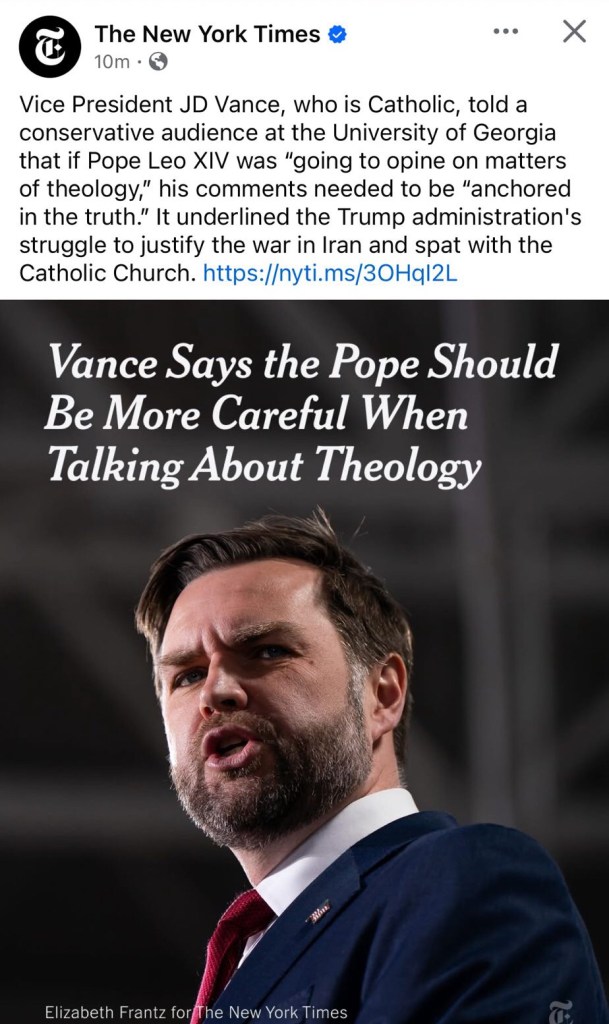
That one can be drastically wrong, fundamentally right, and profoundly confused in very short order is manifest in Vice President Vance’s comment above: if Pope Leo is going to opine on theology, his comments need to be anchored in the truth.
What is wrong with the statement? Theology is a word spoken about God. And a word spoken about God is never merely a matter of opinion; it is not something on which one opines like the superiority of Ham ‘n Goodies lemon cookies over their chocolate chip cookies. Theology is not a matter of one’s personal preference, one’s private notions, one’s individual experience. Theology is public and corporate. It is a word about God, for God’s sake, and it is true or false or else so ignorant and convoluted as to be meaningless. But it is not merely an opinion. If a statement begins, “Well, in my opinion,” rest assured that no theology follows.
In the truest sense, theology is not even merely a word about God; it is a word from God. Jesus is the only perfect theologian, though the Church has recognized a handful of other true theologians: saints graced with the vision of God, with a revelation of the truth of God beyond reason and certainly beyond opinion. Only three saints are formally designated as Theologians by the Orthodox Church: St. John the Theologian, St. Gregory the Theologian, and St. Symeon the New Theologian. There are others — Eastern and Western — who “do” theology, who think about God, who speak — hopefully — wisely and truly of God. These others may be right or wrong in certain of their statements, but they are not promoting their own opinions. They are making truth claims about God. Or they should be, because theology is a matter of truth.
Why is this important? Because theology is not a hobby. Because there is not my theological truth and your theological truth with no arbiter between them. Theology is a fact claim adjudicated by the Church. If, in my opinion, Jesus did not rise bodily from the dead, then I am simply wrong; I have expressed an opinion, but I have not done theology, because I have not spoken the truth about God. If I go further and insist that it is theology, then I am no longer just in error; I am a heretic.
Now, this is where Mr. Vance is right: theology must be anchored in the truth. And this is also where he is confused: one does not generally opine about the truth. There is no need to. That the statement “I do not really believe in gravity” is foolish can be seen if only one imagines such an opinionated person accelerating over the edge of a cliff — sans rope or parachute! — at 9.8 m/s^2. Truth asserts itself at the ground, opinion be damned.
Here is the upshot of Mr. Vance’s statement as I read it, based not on this single statement, but on several he has made recently. Reader be advised: this is my opinion and I may be wrong. The Pope has his opinion on the moral basis for war and the White House has its opinion. Since this is a political and not a religious matter, perhaps (certainly) the Pope should keep his opinion to himself and let the politicians handle political matters. The problems with this are myriad, but perhaps the most obvious is simple: war is a moral issue to which the Church must address itself and to which it has addressed itself. The greatest minds and saints in the Western Church have prayerfully and prudently sought the will of God in such matters for over 1700 years. The Pope is the inheritor and guardian of that theology. Or, we can take the opinion of the White House. Our current President has no understanding of or appreciation for the Gospel and has the theological acumen of a toddler in Sunday School playing with flannel graph figures. Our vice president has been a Roman Catholic for less than a decade but feels justified in a public critique of the Pope’s theology. He may opine, but he is not doing theology.
You might — might — make a reasonable case that the Pope should not insert himself into the political affairs of a sovereign nation, even if there is theology involved. I am an Anglican priest, and my Anglican patrimony is based upon that assertion. But, even here there is a fine distinction between saying “That’s just the Pope’s opinion” and “The Pope’s opinion does not determine the political policies of a sovereign nation.” When the Pope speaks theological truth recognized by the one, holy, catholic and apostolic Church, that is not an opinion. Do with it what you will, but dismiss it at your own peril.


