Poet George Herbert wrote, “Love is that liquor sweet and most divine, / Which my God feels as blood; but I, as wine!”
“There is an old understanding about monastic life that endures from the Middle Ages,” Brother Aberic once told me. “People use to say, and monks used to say — you can find this in the early writings of Merton — that a monk is a man who has retired from the secular world in order to focus single-heartedly on saving his soul. Well, it’s no wonder people once envied and resented us!”
“So, that’s definitely not the case now? There are no brothers here in the abbey who would look at it that way?” I asked.
“There had better not be. But no, I’m sure there are not.”
“Why are you sure?”
“Because you can lose your soul inside these walls just as easily as you can on the outside. We’re here because we feel that our calling is to these vows, to this way of life, and that this way of life is one way to help the world. Our prayers, our teachings, our place of respite, are intended to be a salve for others, but also a voice to God on behalf of others who may not have found that voice for themselves, yet” (Jon M. Sweeney, Cloister Talks: Learning From My Friends The Monks, Brazos Press (2009), p. 77).
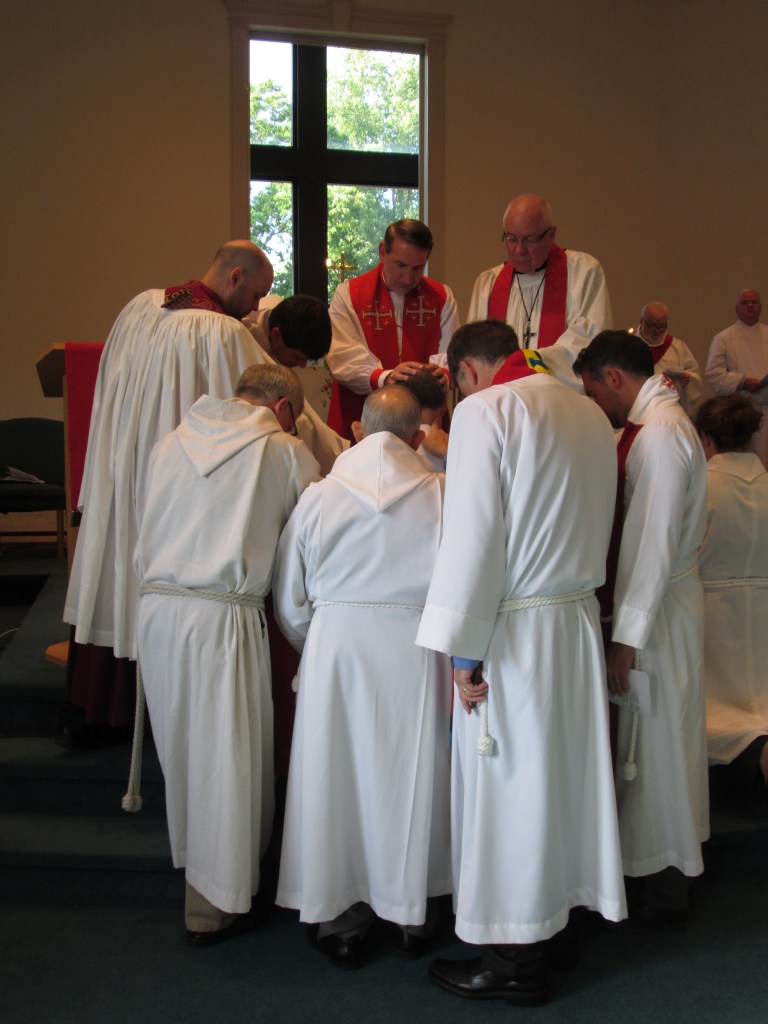
Seven years ago this day, I preached the ordination sermon of a good and faithful priest. Modesty — his, not mine — forbids naming him. As I reflected on his ministry this morning, as I gave thanks for him and for his ministry, I re-read that sermon and pondered the ordination vows both he and I took four years apart to the month. Is the priestly vocation, the priestly life, hard or easy? burden or blessing? selfless or selfish? I do not know if those questions are sensible one. Certainly, some of the dichotomies are false. I think of the priestly vocation as inevitable in this sense: those who are truly called to it could no more refuse it than they could refuse oxygen. It is not predestination that I have in mind, not, at least, as many of my Reformed brother think of it. But it is election of a sort. A priest is a man who choice by choice, prayer by prayer, has become the sort of person who could not possibly refuse the call when it comes. It is both freely chosen and irresistible. I don’t say this as a matter of theology, but as a matter of the heart, as a matter of personal experience.
I wonder what those not called think about those of us who are? The true answer is probably “nothing,” or at least “not often.” But, when they do — perhaps when we have come to the hospital with oil and prayers or when we baptize their children or bury their dead — what do they think? That we priests have a life of exceptional holiness? It is not uniquely so, if at all. On the bell curve of holiness, there are priests in both tails and most cluster around the mean, I suppose. It is probably quite a normal distribution, if holiness is a thing to be measured at all. Do they think that priests have a special “in” with God, a fast track to divinity? Sorry, not so. We slog along a steep and twisty and slippery road like everyone else. To paraphrase Brother Alberic in the quote above, “You can lose your soul with a collar on just as easily as you can with a polo shirt.”
What separates a priest from others is simply this: his vows. What Brother Alberic said about monks, I would say about priests:
“We’re here because we feel that our calling is to these vows, to this way of life, and that this way of life is one way to help the world. Our prayers, our teachings, our place of respite, are intended to be a salve for others, but also a voice to God on behalf of others who may not have found that voice for themselves, yet.”
We are priests for the sake of the world. The altar at which we serve is the heart of the world where God’s sacrificial love in Christ is made manifest for all to see. And, while our prayers are of no greater worth than those of others, they do help sustain the world.
I might say, also, that we are priests because that is the arena to which God has called us for the salvation of our own souls. It is in the priestly ministry that I recognize my own weakness and my utter dependence on grace. It is in the priestly ministry that I am convicted of the depth of my sin and my utter dependence on mercy. It is in the priestly ministry that I see my own selfishness and most clearly hear the call to spend and be spent for the Gospel. The priesthood is the arena to which some are called to battle the world, the flesh, and the devil for the salvation of their souls. It is neither better nor worse than others, just different, just our own.


 First Blessings