Session 3: Exile and Return

Apostles Anglican Church
Fr. John A. Roop
Advent with Isaiah: Session 3 — Exile and Return
The Lord be with you.
And with your spirit.
Let us pray.
O Lord Jesus Christ, you sent your messengers the prophets to preach repentance and prepare the way for our salvation: Grant that the ministers and stewards of your mysteries may likewise make ready your way, by turning the hearts of the disobedient toward the wisdom of the just, that at your second coming to judge the world, we may be found a people acceptable in your sight; for with the Father and the Holy Spirit you live and reign, one God, now and for ever. Amen.
The Falls of Man
We are used to speaking of the fall of man as if it were a singular event, one and done. But, Scripture — the first eleven chapters of Genesis — and the tradition of the Church recognize three falls with very different consequences.
Genesis 3: Primal Disobedience

There are many consequences of the sin of Adam and Eve — pain in childbirth and the difficulty of work in a resistant creation — but none more significant than death: in the day you eat of it [the tree of the knowledge of good and evil] you shall surely die (Gen 2:17). It was through this first fall that death entered Eden and man became subject to corruption.
Genesis 4: Fratricide

Nowhere in the account of Adam and Eve is sin mentioned explicitly. That enters the story in the second fall, Cain’s murder of Abel. After the Lord rejects Cain’s sacrifice, while Cain is still sulking and nursing his anger, The Lord said to him:
“Why are you angry, and why has your face fallen? 7 If you do well, will you not be accepted: And if you do not do well, sin is crouching at the door. Its desire is contrary to you, but you must rule over it” (Gen 4:6-7).
The language here would have been clearer and more evocative to Ancient Near Eastern (ANE) readers than to us. Sin was personified as a crouching demon coming up from the underworld and out into our world through cracks in the earth. The implication is that Cain’s wrong choice has the power to release sin into the world in a way it had not been before. So, the consequence of Cain’s fratricide — the second fall of man — is the ubiquity of sin and human slavery to it.
Genesis 11: The Tower of Babel

Throughout Scripture, and in much of the ANE literature, the dwelling places of the gods are associated with mountains or high places; Eden itself is often pictured as a garden on a mountain. It was on high places and in gardens or groves of trees that pagan temples were built and sacrifices were offered. That is the context for Genesis 11 and the building of the Tower of Babel. The people are building a ziggurat, an artificial mountain on which to worship God. It was an attempt to reach God, to bring God down to them, to manipulate and control God through their ritual worship. Though the people started the project with a common language that made coordinated effort possible, God confused that language creating different people groups which he scattered over the face of the earth. This is the origin of the nations, and a consequence of the third fall.
But, there is likely more to it than this. There are hints in Scripture and in the tradition that God assigned to each nation a governing angel with God himself choosing Israel as his own. In the Song of Moses just before his death we find:
8 When the Most High gave to the nations their inheritance, when he divided mankind, he fixed the borders of the peoples according to the number of the sons of God.
9 But the Lord’s portion is his people, Jacob his allotted heritage (Deut 32:8-9).
In the book of Daniel, we read of the princes of the kingdoms of Persia and Greece who are engaged in spiritual battles with the archangel Michael. These are often understood as the angels who were given charge over those nations — angels that abandoned their God-given governance and accepted worship as gods themselves. So, one of the consequences of the third fall of man at Babel was dominion of the fallen powers over the peoples of the earth.
So there we have the three falls of man and their different consequences: death, slavery to sin, and the dominion of the fallen powers over the nations and people of the earth. But, in each of the falls, there is also a common consequence, a repeated theme whenever man refuses a relationship of righteousness with God. At the end of the story of Adam and Eve’s disobedience, what happens to them? They are sent into exile out of the garden. After Cain’s murder of Abel, what is his punishment? He was driven away from the presence of the Lord — a fugitive and a wanderer on the face of the earth — and he settled in the land of Nod, east of Eden. And at the tower of Babel? The people were dispersed over the face of all the earth. The common theme in all the falls is exile.

We may not make much of this, but exile was considered tantamount to spiritual death; to be driven away from the presence of God was to die. In the Church age — in St. Paul’s time and in ours — that is why excommunication is the ultimate rebuke of sin. It is exile away from God in the Sacraments and in the worshiping Body of Christ, and is therefore, if prolonged, the path to death. To be clear, the purpose of excommunication is not death, but rather repentance and restoration. But if repentance is refused, the sinner has left the path of life and is walking the way of death. Psalm 1 and Jesus’ own Sermon on the Mount make it clear that there are only two ways: one of righteousness and fruitfulness and one of sin, exile, and destruction.
This is why the ultimate punishment for God’s people in the Old Testament was exile. We’ve seen that in the accounts of the falls of man in Genesis. Moving on in the story, Joseph was sold into slavery away from his people and his God. The children of the Patriarchs were exiles in Egypt and endured a sort of living death in slavery. The generation of the Exodus was exiled to wandering outside the promised land for their disobedience and all the adults, save Joshua and Caleb, died there. The northern kingdom, Israel/Ephraim, was taken into exile by Assyria and ceased to be a people — the death of ten of the twelve tribes. And Judah will be only a hundred fifty years or so behind Israel. Babylon, in wave after wave of invasions, will capture Judah and Jerusalem and carry the best of the land into exile.
With this background, we come to Isaiah, specifically to Isaiah 35.
Isaiah and Exile
The scope of Isaiah’s vision is sweeping. Historically, it spans the events of some two centuries: from before the destruction of the northern kingdom of Israel/Ephraim in 722 B.C., to the fall of Jerusalem in 587 B.C., through the subsequent exile in Babylon and the beginning of the repatriation to Jerusalem in 538 B.C. As I mentioned in our first session, this has led some scholars to postulate the work of three prophets collected in a book under the single name of Isaiah. Other scholars are content to accept a single man named Isaiah living before the Assyrian exile of Israel and speaking prophetically of the future events. It makes little difference to me; it is message and not the messenger that matters most. But the point of this is clear: Isaiah covers tumultuous events related to exile. Exile is the ultimate judgment of God upon his people. It is the consequence of sin, the judgment of death, and the enslavement to the fallen and foreign powers. It is the three falls of man writ large.
While exile is the ultimate judgment, it is not the final word.

Return and renewal: this is what Isaiah sees; this is what is recorded in Isaiah 35. Let’s take a few minutes to read and discuss Isaiah 35 at our tables. Here are some questions for your consideration:
1. What stands out to you as particularly significant?
2. What is God’s role in the return from exile? What is the people’s role?
3. How did this vision “play out” historically for Judah?
4. Are there any New Testament (Gospel) resonances with the text?
5. What meaning does the text have for us, not least when we find ourselves in self-imposed exile?
Isaiah 35
1 The wilderness and the dry land shall be glad;
the desert shall rejoice and blossom like the crocus;
2 it shall blossom abundantly
and rejoice with joy and singing.
The glory of Lebanon shall be given to it,
the majesty of Carmel and Sharon [This is beginning to look like the renewal of creation].
They shall see the glory of the Lord,
the majesty of our God.
3 Strengthen the weak hands,
and make firm the feeble knees.
4 Say to those who have an anxious heart,
“Be strong; fear not!
Behold, your God
will come with vengeance,
with the recompense of God
He will come and save you [What form does the vengeance of God take? Cf Rom 8:1-4].”
5 Then the eyes of the blind shall be opened,
and the ears of the deaf unstopped;
6 then shall the lame man leap like a deer,
and the tongue of the mute sing for joy [Cf Luke 7:18-23].
For waters break forth in the wilderness,
and streams in the desert;
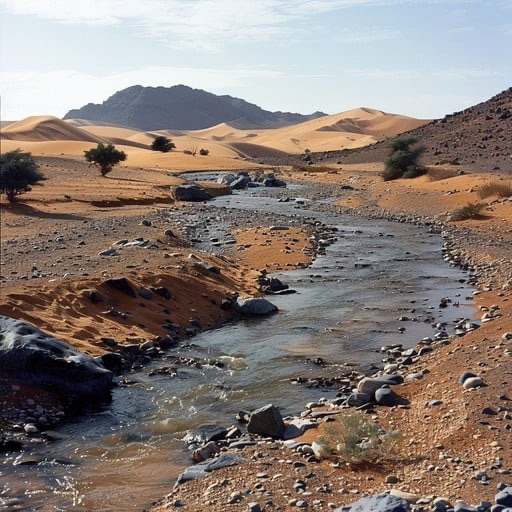
7 the burning sand shall become a pool,
and the thirsty ground springs of water;
in the haunt of jackals, where they lie down,
the grass shall become reeds and rushes.
8 And a highway shall be there,
and it shall be called the Way of Holiness;
the unclean shall not pass over it.
It shall belong to those who walk on the way;
even if they are fools, they shall not go astray.
9 No lion shall be there,
nor shall any ravenous beast come up on it;
they shall not be found there,
but the redeemed shall walk there.
10 And the ransomed of the Lord shall return
and come to Zion with singing;
everlasting joy shall be upon their heads;
they shall obtain gladness and joy,
and sorrow and sighing shall flee away [Cf Ps 137 and Psalm 126].
[Discuss]
Some of the Judean exiles returned from Babylon starting around 538 B.C. In fits and starts, over the next several decades, they rebuilt the walls of Jerusalem and restored a semblance of the temple, nothing near as grand as in Solomon’s day, but a serviceable temple nonetheless. And yet, this vision that Isaiah had for the end of exile was not realized. The prophets who were among the returned exiles — notably Haggai and Zechariah — noticed this and attributed the lack of blessing and fulfillment to the people’s continuing iniquity and lack of true piety. This indictment by Haggai is typical.

1 In the second year of Darius the king, in the sixth month, on the first day of the month, the word of the Lord came by the hand of Haggai the prophet to Zerubbabel the son of Shealtiel, governor of Judah, and to Joshua the son of Jehozadak, the high priest: 2 “Thus says the Lord of hosts: These people say the time has not yet come to rebuild the house of the Lord.” 3 Then the word of the Lord came by the hand of Haggai the prophet, 4 “Is it a time for you yourselves to dwell in your paneled houses, while this house lies in ruins? 5 Now, therefore, thus says the Lord of hosts: Consider your ways. 6 You have sown much, and harvested little. You eat, but you never have enough; you drink, but you never have your fill. You clothe yourselves, but no one is warm. And he who earns wages does so to put them into a bag with holes.
7 “Thus says the Lord of hosts: Consider your ways. 8 Go up to the hills and bring wood and build the house, that I may take pleasure in it and that I may be glorified, says the Lord. 9 You looked for much, and behold, it came to little. And when you brought it home, I blew it away. Why? declares the Lord of hosts. Because of my house that lies in ruins, while each of you busies himself with his own house. 10 Therefore the heavens above you have withheld the dew, and the earth has withheld its produce. 11 And I have called for a drought on the land and the hills, on the grain, the new wine, the oil, on what the ground brings forth, on man and beast, and on all their labors” (Hag 1:1-11).
The geographical exile is over for these repatriated Judeans. But the real exile — the separation from God — is far from over. The vision of Isaiah is still just a vision. The exile will not end, the vision will not be realized, until the fall and its consequences are dealt with once and for all: sin, death, and domination by the powers. But Judah is not up to the task; it never was. Israel/Judah was always intended to be the people not by whom but through whom God would act to defeat sin, death, and dominion by the fallen powers. Remember what we read earlier in Isaiah 35:
4 Say to those who have an anxious heart,
“Be strong; fear not!
Behold, your God
will come with vengeance,
with the recompense of God
He will come and save you.
Behold, your God will come. He will come and save you. And that points us toward Advent: toward the incarnation of God the Son — God with us — who will come with vengeance toward sin, death, and dominion by the fallen powers but with mercy toward those who are subject to these powers. The Son incarnate is the new Adam who will restore man and renew creation.

That is what St. Paul says in Romans:
6 For while we were still weak, at the right time Christ died for the ungodly. 7 For one will scarcely die for a righteous person—though perhaps for a good person one would dare even to die— 8 but God shows his love for us in that while we were still sinners, Christ died for us. 9 Since, therefore, we have now been justified by his blood, much more shall we be saved by him from the wrath of God. 10 For if while we were enemies we were reconciled to God by the death of his Son, much more, now that we are reconciled, shall we be saved by his life. 11 More than that, we also rejoice in God through our Lord Jesus Christ, through whom we have now received reconciliation.
12 Therefore, just as sin came into the world through one man, and death through sin, and so death spread to all men because all sinned— 13 for sin indeed was in the world before the law was given, but sin is not counted where there is no law. 14 Yet death reigned from Adam to Moses, even over those whose sinning was not like the transgression of Adam, who was a type of the one who was to come.
15 But the free gift is not like the trespass. For if many died through one man’s trespass, much more have the grace of God and the free gift by the grace of that one man Jesus Christ abounded for many. 16 And the free gift is not like the result of that one man’s sin. For the judgment following one trespass brought condemnation, but the free gift following many trespasses brought justification. 17 For if, because of one man’s trespass, death reigned through that one man, much more will those who receive the abundance of grace and the free gift of righteousness reign in life through the one man Jesus Christ.
18 Therefore, as one trespass led to condemnation for all men, so one act of righteousness leads to justification and life for all men (Rom 5:6-18).
And there it is: the beginning of the end of exile through the defeat of sin, death, and the powers. Isaiah’s vision isn’t yet complete — there is much more to come — but it is truly and finally well begun, the work of God accomplished through the obedience of a man, his incarnate Son.
That brings us to the second sense of this Advent season. Yes, we place ourselves with the repatriated Judeans and look forward to the coming — to the Advent — of the Messiah who would fulfill Isaiah’s vision. But, Isaiah’s vision is still not complete though the Messiah has come. As Christians, we speak of this situation as inaugurated eschatology; that is, we are in the beginning of the last days — the renewal has started, but it is not yet complete. So, we are awaiting the second Advent of the Messiah, the second coming of the Lord Jesus, at which time Isaiah’s vision will be perfectly fulfilled as we read in Revelation 21 and 22. At that time, death, sin, and the dominion of the powers will be not only defeated — that happened at the death resurrection, and ascension of Jesus — but also eliminated entirely, old tales long forgotten. So, we still wait with longing; that is the nature of Advent. And we still say, as in Morning Prayer:
Our King and Savior nows draws near;
O come, let us adore Him.


