The Parable of the Good Samaritan

The Parables in the Gospel of St. Luke
Fr. John A. Roop

Lesson 2: The Good Samaritan (Luke 10:25-37)

The Lord be with you.
And with your spirit.

Let us pray.

Almighty and eternal God, so draw our hearts to thee, so guide our minds, so fill our imaginations, so control our wills, that we may be wholly thine, utterly dedicated to thee; and then use us, we pray thee, as thou wilt, and always to thy glory and the welfare of thy people; through our Lord and Savior Jesus Christ. Amen (BCP 2019, p. 668, traditional language).

On almost any ranking of most well known and most beloved parables, I suspect that the Parable of the Good Samaritan would appear near the top, jockeying with the Prodigal Son for first and second place. It has transcended its original context, first century Jewish culture, and even Christian culture to become part of the Western ethos, even among non-Christians. It speaks to the deeply human issue of the limits of concern and probes the common human question, To whom are we responsible?

In his classic work of Christian apologetics, Mere Christianity, C. S. Lewis built the case for the existence of a moral law within all people: one we all know but didn’t choose or create, one that comes to us — one that is in us — from “outside” us. As I remember, he uses the example of a man who happens upon a burning home in which people are trapped. He does not know the people. By the standards of culture, he is certainly free to prioritize his own safety over theirs. It is perfectly logical and culturally acceptable for him call for the professionals and then be on his way. And yet, if he learns the next day that a child died in the fire, he will still feel — illogically, perhaps — he will still feel that he should have gone in the house and attempted a rescue, that the limits of his responsibility somehow encompassed those strangers. It is not a stretch to see that as a re-telling of the Parable of the Good Samaritan. The truth of that parable is written deeply within us.

The Parable of the Good Samaritan
Though we are familiar with the broad outlines of the parable, let’s start by listening to it again.

Luke 10:25–37 (ESV): 25 And behold, a lawyer stood up to put him to the test, saying, “Teacher, what shall I do to inherit eternal life?” 26 He said to him, “What is written in the Law? How do you read it?” 27 And he answered, “You shall love the Lord your God with all your heart and with all your soul and with all your strength and with all your mind, and your neighbor as yourself.” 28 And he said to him, “You have answered correctly; do this, and you will live.”

29 But he, desiring to justify himself, said to Jesus, “And who is my neighbor?” 30 Jesus replied, “A man was going down from Jerusalem to Jericho, and he fell among robbers, who stripped him and beat him and departed, leaving him half dead. 31 Now by chance a priest was going down that road, and when he saw him he passed by on the other side. 32 So likewise a Levite, when he came to the place and saw him, passed by on the other side. 33 But a Samaritan, as he journeyed, came to where he was, and when he saw him, he had compassion. 34 He went to him and bound up his wounds, pouring on oil and wine. Then he set him on his own animal and brought him to an inn and took care of him. 35 And the next day he took out two denarii and gave them to the innkeeper, saying, ‘Take care of him, and whatever more you spend, I will repay you when I come back.’ 36 Which of these three, do you think, proved to be a neighbor to the man who fell among the robbers?” 37 He said, “The one who showed him mercy.” And Jesus said to him, “You go, and do likewise.”

Rhetorical Structure
Let’s begin by looking at the rhetorical structure of the interaction between Jesus and the lawyer. If we envision it as a play, there are two acts, each with four scenes. I am indebted to Kenneth Bailey for this structural scheme (Bailey, p. 285). He presents it as two separate dialogues while I present it as two scenes in the same play, but the primary analysis is his.

ACT I

Scene 1: The Lawyer’s Question: Teacher, what shall I do to inherit eternal life?

Scene 2: Jesus’ Question: What is written in the Law? How do you read it?

Scene 3: The Lawyer’s Answer: You shall love the Lord your God with all your heart and with all your soul and with all your strength and with all your mind, and your neighbor as yourself.

Scene 4: Jesus’ Answer: You have answered correctly; do this, and you will live.

ACT II

Scene 1: The Lawyer’s Question: And who is my neighbor?

Scene 2: The Parable and Jesus’ Question: Which of these three, do you think, proved to be a neighbor to the man who fell among the robbers?

Scene 3: The Lawyer’s Answer: The one who showed him mercy.

Scene 4: Jesus’ Answer: You go, and do likewise.

It is a beautifully constructed bit of writing, which shows that Jesus was a profoundly good theologian and orator. We will look more at the Q&A proper in a bit. But, for now, let’s turn our attention to some historical and cultural background.

History and Culture
The account opens with a lawyer standing to ask Jesus a question. We hear “lawyer” and we naturally think “attorney.” But, you know that a Jewish lawyer was not the same as an English barrister or an American attorney. The lawyer (or scribe) has an ancient and venerable heritage in Judaism. As I write this, we have just finished reading the Ezra-Nehemiah accounts in the Daily Office. Ezra was a priest, but he was also a lawyer/scribe. The description of his vocation in Ezra 7:8-11 gives us an appreciation for the nature and work of a Jewish lawyer:

Ezra 7:8–11 (ESV): 8 And Ezra came to Jerusalem in the fifth month, which was in the seventh year of the king. 9 For on the first day of the first month he began to go up from Babylonia, and on the first day of the fifth month he came to Jerusalem, for the good hand of his God was on him. 10 For Ezra had set his heart to study the Law of the Lord, and to do it and to teach his statutes and rules in Israel.

11 This is a copy of the letter that King Artaxerxes gave to Ezra the priest, the scribe, a man learned in matters of the commandments of the Lord and his statutes for Israel….

This is the vocation of a Jewish lawyer: to study the Law of the Lord, and to do it and to teach his statutes and rules in Israel. In the first century there was an additional charge: to help adjudicate religious Law in the Sanhedrin, the great Jewish Council of Elders. Lawyers had voice and vote in the Council.

So, this man who comes to Jesus to ask a question of the Law is himself a recognized expert in the Law. Notice his posture: he stands to ask his question. On this surface, this seems like the appropriately humble approach. Rabbis sat to teach and disciples stood to learn. In behavior this lawyer presents as a student — a genuine inquirer — asking for wisdom from his Rabbi; he even addresses Jesus as Rabbi/Teacher. But his humility is sham. He did not ask a genuine question in order to learn, but rather posed a challenge in order to test Jesus. So, the lawyer is disingenuous from the start. Whether the gathered people knew it or not is uncertain, but Jesus certainly realized the ploy; he had seen it often enough. And that explains the structure of the encounter.

The lawyer poses his question, most likely to trap Jesus in some fine point of the Law. Instead of answering directly, Jesus turns the question back on the lawyer and gives him the chance to show off for the crowd: “What does the Law say? How do you read it?” And the lawyer answers well, giving what was likely a standard answer to such a question. So, Jesus answers the question without answering the question. He commends the lawyer and tell him to do just as he said: “You have answered correctly; do this, and you will live.” The problem is that the lawyer can’t do this perfectly; no one can. A deeper problem is that the lawyer doesn’t even want to; remember, this was a trap and not an honest inquiry.

Jesus has dodged the first bullet, so the lawyer pulls the trigger again with his second question: “And who is my neighbor?” He asked the first question to test/trap Jesus. Why does he ask the second question? To justify himself. I don’t know exactly and fully what that means, but I suspect there are at least two elements at play: (1) to establish his position as an expert in the Law and as the equal or better of this itinerant Rabbi from Nazareth, and (2) to show his own righteousness, i.e., to show that by any reasonable definition of neighbor he was already loving his neighbor as himself.

Before we move on from the lawyer’s question, it might be helpful to try to answer the question — “And who is my neighbor?” — as the lawyer might have done. Suppose Jesus had turned the question around on him immediately as he had done previously and asked: “What does it say in the Law? How do you read it?” The lawyer might have had trouble quoting “chapter-and-verse” but the essence of his answer would have been on the order of “righteous Jews who interpret and live the Law as he does,” in other words, people just like himself: his community, his tribe, his party. It’s not too hard — most of the time — to love people like you. But not them; not the others.

But Jesus doesn’t quite turn the question back to the lawyer — not yet, at least. Instead, Jesus tells the parable and closes it not with an answer — the parable was the answer — but with a question, just like he did in Act I. And notice this, because it is inherent in so many of Jesus’ parables. In Act I Jesus appealed to the Law; in Act II he tells a story and appeals to his own authority. His words take the place of the Law in the sense of fulfilling the Law. This is just like the Sermon on the Mount where Jesus says repeatedly, “You have heard it said (in the Law), but I say to you…”.

Now, before we get into the details of the parable itself, we need to look at a few members of the cast.

Priests you know. Levites assisted the priests. When the Tabernacle was in use, the Levites cared for the physical structure and its utensils and transported it during the movement in the wilderness. During the second temple period (Jesus’ time) the Levites were liturgical singers/musicians, Temple guards, and general assistants to the priests. If you think of them as a blend of deacons, altar guild, vestry, ushers, acolytes, and choir, you won’t be far off. Priests and Levites were the clerical class of Jesus’ day.

The other major player — other than the Jew who is beaten and left for dead — is an unnamed Samaritan. No name is necessary because they are interchangeable; they are all the same, just as Jews were in Nazi Germany. Once you had said Jew, you didn’t need to specify which one; they were all the same. Once you’ve said Samaritan in a story told to a Jewish audience, you didn’t need to say anything more.

But who were they really, and what was the source of enmity between the Jews and the Samaritans? It’s a Hatfield and McCoy like feud story of ancient vintage. It began seven centuries before the telling of the parable, with the destruction and deportation of the northern tribes of Israel (722-721 BC) — whose capital was Samaria — by the Assyrians. It is detailed in 2 Kings 17:24-41 — a long passage, but one worth reading. It documents the standard practice of Assyria once it had conquered a people and taken them into exile. Instead of leaving the land empty, the Assyrians moved other conquered people into it to secure the territory and to work it to pay tribute. As we enter the text, Israel has been conquered and taken into exile by the king of Assyria.

2 Kings 17:24–41 (ESV): 24 And the king of Assyria brought people from Babylon, Cuthah, Avva, Hamath, and Sepharvaim, and placed them in the cities of Samaria instead of the people of Israel. And they took possession of Samaria and lived in its cities. 25 And at the beginning of their dwelling there, they did not fear the Lord. Therefore the Lord sent lions among them, which killed some of them. 26 So the king of Assyria was told, “The nations that you have carried away and placed in the cities of Samaria do not know the law of the god of the land. Therefore he has sent lions among them, and behold, they are killing them, because they do not know the law of the god of the land.” 27 Then the king of Assyria commanded, “Send there one of the priests whom you carried away from there, and let him go and dwell there and teach them the law of the god of the land.” 28 So one of the priests whom they had carried away from Samaria came and lived in Bethel and taught them how they should fear the Lord.

29 But every nation still made gods of its own and put them in the shrines of the high places that the Samaritans had made, every nation in the cities in which they lived. 30 The men of Babylon made Succoth-benoth, the men of Cuth made Nergal, the men of Hamath made Ashima, 31 and the Avvites made Nibhaz and Tartak; and the Sepharvites burned their children in the fire to Adrammelech and Anammelech, the gods of Sepharvaim. 32 They also feared the Lord and appointed from among themselves all sorts of people as priests of the high places, who sacrificed for them in the shrines of the high places. 33 So they feared the Lord but also served their own gods, after the manner of the nations from among whom they had been carried away.

[34 To this day they do according to the former manner. They do not fear the Lord, and they do not follow the statutes or the rules or the law or the commandment that the Lord commanded the children of Jacob, whom he named Israel. 35 The Lord made a covenant with them and commanded them, “You shall not fear other gods or bow yourselves to them or serve them or sacrifice to them, 36 but you shall fear the Lord, who brought you out of the land of Egypt with great power and with an outstretched arm. You shall bow yourselves to him, and to him you shall sacrifice. 37 And the statutes and the rules and the law and the commandment that he wrote for you, you shall always be careful to do. You shall not fear other gods, 38 and you shall not forget the covenant that I have made with you. You shall not fear other gods, 39 but you shall fear the Lord your God, and he will deliver you out of the hand of all your enemies.” 40 However, they would not listen, but they did according to their former manner.]

41 So these nations feared the Lord and also served their carved images. Their children did likewise, and their children’s children—as their fathers did, so they do to this day.

So, who are the Samaritans? Mongrels. Half-bloods. Idolaters. And, to make matters even worse, when Judah returned from Babylonian captivity to rebuild Jerusalem, the Samaritans weren’t there waiting with open arms. First, the Samaritans tried to infiltrate the effort — likely to sabotage it — by pretending to be true Jews. When that didn’t work, they opposed the rebuilding — open and surreptitiously — in every way possible. That account is found in Ezra 4:1-6:

[Ezra 4:1–6 (ESV): 4 Now when the adversaries of Judah and Benjamin heard that the returned exiles were building a temple to the Lord, the God of Israel, 2 they approached Zerubbabel and the heads of fathers’ houses and said to them, “Let us build with you, for we worship your God as you do, and we have been sacrificing to him ever since the days of Esarhaddon king of Assyria who brought us here.” 3 But Zerubbabel, Jeshua, and the rest of the heads of fathers’ houses in Israel said to them, “You have nothing to do with us in building a house to our God; but we alone will build to the Lord, the God of Israel, as King Cyrus the king of Persia has commanded us.”

4 Then the people of the land discouraged the people of Judah and made them afraid to build 5 and bribed counselors against them to frustrate their purpose, all the days of Cyrus king of Persia, even until the reign of Darius king of Persia.

6 And in the reign of Ahasuerus, in the beginning of his reign, they wrote an accusation against the inhabitants of Judah and Jerusalem.]

So, not just mongrels and half-bloods, but ancient, idolatrous enemies. The Jews hated the Samaritans and the Samaritans hated the Jews — Hatfields and McCoys — and each group thought itself righteous.

Now, we can enter the parable.

Parable of the Good Samaritan
An unnamed man was going down from Jerusalem to Jericho. Even though he is unnamed, he is not unidentified; we know everything we need to know about him. If he is going down from Jerusalem (Jerusalem is on a mountain, so leaving Jerusalem is always going down), if he is going down from Jerusalem, he is a Jew. At least that would be the common presumption of those hearing the story.

It was then a rough and dangerous road, and to travel it alone was a bit foolhardy. So, none of Jesus’ listeners would have been surprised at the man’s fate: beaten, robbed, stripped, left for dead. Now, enter the cast of main characters: a priest and a Levite. They both see their fellow Jew’s predicament, and they both pass by on the other side. There are several justifiable reasons they might behave this way. If the man is dead, they will be rendered ritually impure and unable to fulfill their liturgical duties. But wait: at least in the case of the priest — and it is assumed in the case of the Levite — he is going “down” the road: down, away from Jerusalem, away from any liturgical responsibilities. Fear of ritual impurity cannot explain their action. Perhaps they are just scared. Perhaps the thieves are still in the area waiting for more travelers: best not to linger. After all, they don’t know this man. Why prioritize his welfare over their own? Lewis might have an answer to that objection; it’s the burning house problem. Or it might just be that the wounded man is not one of them, not in their tribe or party: not a member of the family, not a friend, not a priest, not a Levite, maybe not a righteous Jew. In other words, he was not a neighbor as the lawyer defined neighbor. You might not think them particularly noble or hospitable for not stopping, but you can perhaps understand and excuse their actions.

Can we now engage in a bit of speculation? When Jesus said, “But,” indicating that someone else would come down the road, who do you think (1) the lawyer and (2) the people thought that someone would be? And what did they think that someone would do? Well, we can’t know, but it’s interesting to wonder about that.

We do know who actually came next in the story, and we can be almost certain that he came as a surprise: a Samaritan. When the priest and the Levite failed to stop, while we might understand their reasoning, there is still a nagging voice inside that whispers, “Yes, but…”. But the voice is silenced by the Samaritan’s arrival. Boo! Hiss! Of course he won’t stop and no good Jew would even want him to. Better to die with honor that to be saved by a Samaritan — unless you happen to be the one beaten, robbed, stripped, and left for dead. But — Surprise! What’s this Jesus playing at?! — the Samaritan does stop and provide every assistance to the wounded Jew, putting himself at risk and incurring not a little cost. You know the details about the bandaging and the wine and the inn and the money. It is the most amazing surprise ending of an otherwise conventional story.

Now, having told this parable — and presenting it as the true fulfillment of the Law — Jesus asks his question to the lawyer: “Which of these three, do you think, proved to be a neighbor to the man who fell among the robbers?” There is an important twist here that we can’t afford to miss. The lawyer asked Jesus, “And who is my neighbor?” This is a question that seeks to define the limit of neighborliness, that intends to minimize the meaning of neighbor and to determine who falls outside boundary. But, Jesus’ question is different and opposite in intent. If I may paraphrase, Jesus’ question is, Who became a neighbor in the story? Don’t worry about who falls into the limited and limiting category of “your neighbor.” Instead, expand the boundaries of mercy and neighborliness to ask, “To whom may I become a neighbor?” And the parable answers that: to anyone in need, even to my enemy.

The lawyer cannot save face now, even though he tries feebly to do by refusing to say the word Samaritan: “The one who showed him mercy,” is the best he can muster, showing that he got the point of the story but is unwilling to acknowledge its moral claim on him.

Jesus has the final word: “You go, and do likewise.” That is the answer to the original question, “What must I do to inherit eternal life?” because to go and to do likewise is to accept Jesus’ authority and to become his true disciple. Jesus is showing a new way to be Israel and a new way to be human, a way based on showing mercy. That is, I think, the meaning of the parable in its historical and cultural context.

Application
Now that we have a sense of what the parable likely meant to the original audience, we can perhaps safely ask what it should mean to us. What lessons might we draw from it?

Do not let the strictures of nationality, party, tribe, or even enmity limit mercy. Now, lest anyone misunderstand me, I note that in another encounter with a Samaritan — the woman at the well, Photini — Jesus made clear that the Samaritans were wrong about some important matters of worship and that salvation was of the Jews. He did not endorse the errors of the Samaritans; rather, he spoke correcting truth. But, in doing so, he treated the Samaritan woman with dignity and mercy. There are many groups with whose agendas we must disagree: LGBTQ and transgender activists, radical pro-choice advocates, advocates of Wokeism, the virulent new atheists, etc. We must speak truth against these agendas. But we must show mercy to those who are left beaten, robbed, stripped, and dying from the delusion of these false ideologies. The real enemy, the one enemy that we are perhaps allowed to consider an enemy, is Satan and his fallen angels — the robbers in Jesus’ parable.

Having said that, we are not finished. We need to remember what Ken Bailey said about parables: we don’t try to mine them for morals and then leave the parable behind; instead, the parable becomes a house in which we are invited to take up residence and out of whose windows we are to view the world. In other words, whatever our answer to what this parable means for us, that answer is not complete; it is never finished, and we never exhaust the parable. We continue to live in the parable because it continues to shape our worldview and our obedience. We must continually ask, To whom may I become a neighbor? and What would that look like?

Let us pray.

Increase, O God, the spirit of neighborliness among us, that in peril we may uphold one another, in suffering tend to one another, and in homelessness, loneliness, or exile befriend one another. Grant us brave and enduring hearts that we may strengthen one another, until the disciplines and testing of these days are ended, and you again give peace in our time; through Jesus Christ our Lord. Amen (BCP 2019, p. 659).

BIBLIOGRAPHY

Bailey, K.E. (2008). Jesus Through Middle Eastern Eyes. InterVarsity Press.

Posted in Uncategorized | Leave a comment

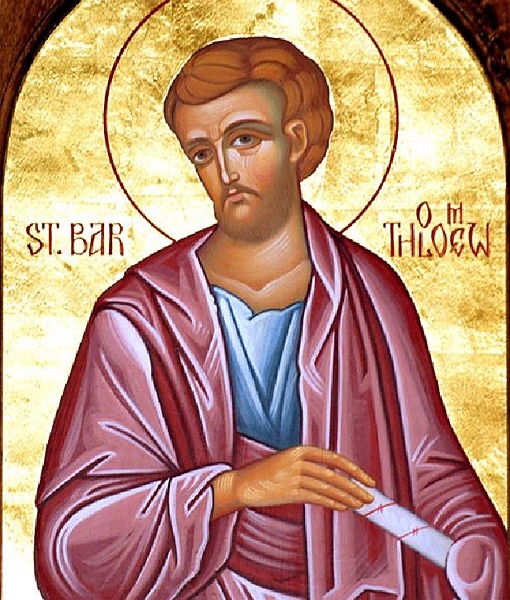
Feast of St. Bartholomew, Apostle

The Feast of Saint Bartholomew the Apostle
(Dt 18:15-18 / Ps 91 / 1 Cor 4:9-15 / Lk 22:24-30)

Collect of Saint Bartholomew the Apostle
Almighty and everlasting God, who gave to your apostle Bartholomew grace truly to believe and to preach your Word: Grant that your Church may love what he believed and preach what he taught; through Jesus Christ our Lord, who lives and reigns with you and the Holy Spirit, one God, for ever and ever. Amen.

In the name of the Father, and of the Son, and of the Holy Spirit. Amen.

ON THE FEAST OF ALL SAINTS each year, the church reads from the Wisdom of Sirach, chapter 44, a passage entitled Hymn in Honor of Our Ancestors. I find it amongst the most beautiful and inspiring of the church’s seasonal readings, a very “human” one that I refer to not infrequently. The passage “divides” thematically midway through, and I will pause between sections to reflect a bit on each part of the text.

Sirach 44:1–15 (NRSVCE): 44 Let us now sing the praises of famous men,
our ancestors in their generations.
2 The Lord apportioned to them great glory,
his majesty from the beginning.
3 There were those who ruled in their kingdoms,
and made a name for themselves by their valor;
those who gave counsel because they were intelligent;
those who spoke in prophetic oracles;
4 those who led the people by their counsels
and by their knowledge of the people’s lore;
they were wise in their words of instruction;
5 those who composed musical tunes,
or put verses in writing;
6 rich men endowed with resources,
living peacefully in their homes—
7 all these were honored in their generations,
and were the pride of their times.
8 Some of them have left behind a name,
so that others declare their praise.

Glorious men: rulers, warriors, counselors, sages, prophets, musicians. Who in the Old Testament might we count among this esteemed fellowship? Joseph must be named — interpreter of dreams and vice-regent of Egypt. Surely David fits the bill, checking many of the boxes: warrior, ruler, musician. So, too, does David’s son Solomon: ruler, sage, man of wealth and renown. Elijah and Elisha, Isaiah, Jeremiah, Ezekiel, Daniel and a host of the prophets must be included. Surely the Patriarchs (Abraham, Isaac, and Jacob), Moses the Law-Giver, and Joshua the Conqueror are among the famous men in our story. These men were honored, some in their generations and all in the generations to come. They have left behind a name so that their praises are declared.

But, there is another set of our ancestors whom we also honor. The Wisdom of Sirach describes them this way.

9 But of others there is no memory;
they have perished as though they had never existed;
they have become as though they had never been born,
they and their children after them.
10 But these also were godly men,
whose righteous deeds have not been forgotten;
11 their wealth will remain with their descendants,
and their inheritance with their children’s children.
12 Their descendants stand by the covenants;
their children also, for their sake.
13 Their offspring will continue forever,
and their glory will never be blotted out.
14 Their bodies are buried in peace,
but their name lives on generation after generation.
15 The assembly declares their wisdom,
and the congregation proclaims their praise.

Two different groups of people: one renowned and honored in their generations, their exploits and accomplishments the stuff of song and legend, and a second one little known or remembered, uncelebrated in their time, though nonetheless known by their children and by God. We sing their praises, too. Most of us fall in this second group. We’re not rulers. We’re not rich or famous. We are, most of us, ordinary folk trying to do our ordinary best in the work that’s been given us to do: in loving our friends and families, in honoring our vows and our vocations, in contributing to our communities, in helping strangers, in living faithfully toward our God. We have not made a name for ourselves beyond our own small circle, if even there. But, our children — in the flesh and in the spirit — will remember us. And, most importantly, God will remember us.

Two groups, the mighty and the ordinary. So, let me ask you: into which group would you put the Twelve, the Apostles of our Lord? Rulers, warriors, counselors, sages, prophets, musicians, the mighty and renowned or the more humble and ordinary folk like you and me? We know what Jesus intended, don’t we? The first clue comes from whom he picked: not the powerful, the rich or the elite, but fishermen, a tax collector, a Zealot and other assorted ordinary folk. Another clue — and more than just a clue — comes from words Jesus spoke to them very near the end of his ministry, on his last night with them, in fact:

Luke 22:24–27 (ESV): 24 A dispute also arose among them, as to which of them was to be regarded as the greatest. 25 And he said to them, “The kings of the Gentiles exercise lordship over them, and those in authority over them are called benefactors. 26 But not so with you. Rather, let the greatest among you become as the youngest, and the leader as one who serves. 27 For who is the greater, one who reclines at table or one who serves? Is it not the one who reclines at table? But I am among you as the one who serves.

Clearly, Jesus didn’t want them to act like the powerful, rich, and elite. To the contrary, he wanted them to be the least, the servants of all. Were they well thought of in their generation, highly esteemed? Hardly: here’s how St. Paul describes the Apostles amongst whose number he counted himself:

1 Corinthians 4:9–13 (ESV): 9 For I think that God has exhibited us apostles as last of all, like men sentenced to death, because we have become a spectacle to the world, to angels, and to men. 10 We are fools for Christ’s sake, but you are wise in Christ. We are weak, but you are strong. You are held in honor, but we in disrepute. 11 To the present hour we hunger and thirst, we are poorly dressed and buffeted and homeless, 12 and we labor, working with our own hands. When reviled, we bless; when persecuted, we endure; 13 when slandered, we entreat. We have become, and are still, like the scum of the world, the refuse of all things.

The scum of the earth: fools, weak, disreputable, hungry and thirsty, poorly dressed, homeless, reviled, persecuted, slandered — that’s how they were considered, how they considered themselves, and how they truly were in their generation. And that brings us to Bartholomew, whose feast the Church celebrates this day.

Far from being renowned in his generation and thereafter, even the Church knows almost nothing about him beyond his inclusion among the Twelve. He never speaks in the Gospels. No faithful deeds, much less any mighty deeds, are attributed to him. He is a cipher, a blank. All that we know is that Jesus chose him near the beginning of his ministry, that he accompanied Jesus throughout his ministry, and that he was still there after the crucifixion and resurrection, sitting in the upper room as Pentecost approached, waiting and praying for something that he could not even imagine. He was among those who cast lots to find a replacement for Judas, and he was there when the Spirit blew that upper room to kingdom come and fire fell from heaven and the firstfruits of the Kingdom of God came on earth as it is in heaven. After that, Bartholomew disappears from the official record.

There are some hints about him in the traditions of the church though — nothing certain, but interesting nonetheless. The book Lesser Feasts and Fasts 2000 has this:

Some sources credit Bartholomew with having written a Gospel, whose existence was known to Jerome and Bede, but which is lost today. There is a tradition that Bartholomew traveled to India, and Eusebius reports that when Pantaenus of Alexandria visited India, between 150 and 200, he found there “the Gospel according to Matthew” in Hebrew, which had been left behind by “Bartholomew, one of the Apostles.”

An ancient tradition maintains that Bartholomew was flayed alive at Albanopolis in Armenia (The Episcopal Church. Lesser Feasts and Fasts 2000 (2001). Church Publishing, Inc. p. 338.).

Even these few traditions are bare-boned: a Gospel by Matthew — not even by Bartholomew himself — just left behind in India and a very brief word about Bartholomew’s martyrdom. Because his martyrdom is placed in Armenia, he is the patron saint of that country and venerated there as the founder of the Armenian Apostolic Church. Also, in what seems to me an ironic and gruesome twist for someone skinned alive, Bartholomew is venerated as the patron saint of bookbinders, tanners (leather workers), and butchers — all vocations that work with skins.

Had the Church asked me about patronage, I would have suggested that Bartholomew would make an excellent patron saint for ordinary people, for all of us who are not rich and powerful, famous and influential, noble and elite. Not for masters, but for servants. Not for the celebrated but for the unknown. Not for the Peters and Pauls and the spiritual giants, but for the Bobs and Bettys who are faithful in their way and in their day. For the ones about whom Paul writes:

1 Corinthians 1:26–31 (ESV): 26 For consider your calling, brothers: not many of you were wise according to worldly standards, not many were powerful, not many were of noble birth. 27 But God chose what is foolish in the world to shame the wise; God chose what is weak in the world to shame the strong; 28 God chose what is low and despised in the world, even things that are not, to bring to nothing things that are, 29 so that no human being might boast in the presence of God. 30 And because of him you are in Christ Jesus, who became to us wisdom from God, righteousness and sanctification and redemption, 31 so that, as it is written, “Let the one who boasts, boast in the Lord.”

Bartholomew was as much an Apostle as Peter was, as James and John were, as Paul would be. He answered Jesus’ call. He proved to be a faithful disciple. He witnessed the crucifixion, the resurrection, and the ascension. He was filled by the Holy Spirit on Pentecost, and he fulfilled Jesus’ commission to go into all the world making disciples, baptizing them in the name of the Father and of the Son and of the Holy Spirit, teaching them to observe all that Jesus had commanded. And, in the moment of decision, he took up his own cross and followed Jesus to death and to life everlasting.

And though we know little about Bartholomew, we are his children in the faith and we honor him, just as Sirach said:

12 Their descendants stand by the covenants;
their children also, for their sake.
13 Their offspring will continue forever,
and their glory will never be blotted out.
14 Their bodies are buried in peace,
but their name lives on generation after generation.
15 The assembly declares their wisdom,
and the congregation proclaims their praise.

This congregation proclaims Bartholomew’s praise along with countless other congregations across the globe today.

In the Gospel text appointed for the feast day, Jesus warned the Apostles against trying to be the greatest by the world’s standard. Instead, they were to be the least and the servants of all. That word was given to the Apostles and surely Bartholomew was there; we know he was because Jesus spoke those words at the Last Supper. It’s crucial that we remember that those words are for us, too; Jesus’ criteria for greatness in the kingdom of God has not changed. Seek the low place, the place of service, not at the head of the table but at the feet of the Master. It is good to recall those things every time we come to the table to eat the same meal that Bartholomew ate on that Passover. But it is equally important that we hear and remember the rest of Jesus’ words, the ones that followed immediately after his instructions about the greatness of lowliness and service:

Luke 22:28–30 (ESV): 28 “You are those who have stayed with me in my trials, 29 and I assign to you, as my Father assigned to me, a kingdom, 30 that you may eat and drink at my table in my kingdom and sit on thrones judging the twelve tribes of Israel.

You and I won’t sit on thrones judging the twelve tribes of Israel; that is reserved for the Apostles, Bartholomew included. But, please God, I want it said about me that I have stayed with Jesus through trials and all. And I do want to eat and drink at his table in his kingdom. I am content to be forgotten in this world, my name barely remembered if at all, if only I can be faithful unto death like Bartholomew. Amen.

Posted in Uncategorized | Leave a comment

Parables in the Gospel According to St. Luke

The Parables in the Gospel of St. Luke
Fr. John A. Roop

Lesson 1: Introduction To Parables

The Lord be with you.
And with your spirit.

Let us pray.

O God, without whose beauty and goodness our souls are unfed, without whose truth our reason withers: Consecrate our lives to your will, giving us such purity of heart, such depth of faith, and such steadfastness of purpose, that in time we may come to think your own thoughts after you; through Jesus Christ our Savior. Amen.

CAN YOU IMAGINE a culture apart from its stories? How could it transmit its history, its values, its aspirations, its fundamental beliefs about itself and the world without stories? How could it draw outsiders into the culture and integrate them? How could it replicate itself in the lives of the next generation? Stories seem fundamental to culture, to what it means to be human.

Why do we like stories so much? They educate us while entertaining us. They move us, allowing us to express our emotions. They appeal to all our senses and imagination, as we immerse ourselves in the story. They create a common bond as we listen to stories together or tell them to one another. They create continuity across generations. They challenge us. It is no wonder then that Jesus used stories to communicate the essence of the Kingdom of God; it is no wonder that he was a master story teller. It is no wonder he was known for his parables.

Over the next few weeks we will give attention to several parables recorded in the Gospel according to St. Luke, a Gospel chock-full of parables, more so than any other Gospel. Some scholars count twenty-eight parables in Luke’s Gospel, though that precise number depends to some degree on what counts as a parable. And that is a good place to start — what does count as a parable? In other words, what is a parable?

The Nature of Parables

QUESTION: What is a parable?

Most of us who went to Sunday School as children have a ready answer: A parable is an earthly story with a heavenly meaning. And that is true, but in the same sense as saying Buckingham Palace is a house is true. It is the official London residence of the Queen of England, so, in that sense, it is a house. But, it is far more, isn’t it? It is the administrative seat of English monarchy, the symbol of the monarchy as the White House is the symbol of the Presidency and the Capitol the symbol of democracy. It is that place toward which the English people look in times of celebration, difficulty, and uncertainty. It is a house, but it is more than just a house.

In the same way, a parable may well be an earthly story with a heavenly meaning, but it is more than just an earthly story with a heavenly meaning.

Jesus, who almost certainly spoke Aramaic as his mother tongue, would have called parables mathelin. Mathelin connotes a figure of speech on the order of a puzzle or a riddle. And what do we do with puzzles and riddles? We puzzle over them; we try to riddle them out. We know there is a meaning there to be discerned; some get it quickly and others of us take a bit longer. But we keep working on it and it keeps working on us until we finally “get it” in a moment of insight. That is the essence of a mathelin: a puzzle or a riddle.

The Aramaic mathelin was translated into Greek as παραβολή, parabolē — parable. Parabolē connotes bringing one thing alongside another. A parable is a teaching aid brought close by a truth to explain and illustrate that truth by way of comparison. Aesop’s Fables are parables in this sense. If I want to illustrate the danger of arrogance and over-confidence and the importance of dogged determination and steady work, I might lay alongside those truths the story of the Tortoise and the Hare. And here we are moving more toward the modern concept of parable: a story that explains or illustrates a great truth. Then it is just a hop, a skip, and a jump to our Sunday School definition: an earthly story with a heavenly meaning.

But, more in keeping with the original meaning of mathelin, the Gospels contain several different forms of the literary type we call parables.

Story: The Rich Fool (Lk 12:13-21)
Notice that this story is given to us in context. We know why Jesus told this parable, to whom, and under what circumstance. Jesus even gives the “moral” of the parable before he tells it.

Proverb: Can the blind lead the blind? (Lk 6:39 ff)

Metaphor: Comparison of a Person To a Fruit Tree (Lk 6:43-45)

Simile: The Mustard Seed and the Leaven (Lk 13:18-21)

Quasi-Allegory: Parable of the Sower (Lk 8:4-15)
This is not a true allegory because not every element of the story is given a particular interpretation/meaning and because the true meaning of the story is greater than and lies beyond the sum of the individual elements. The meaning is not found in the allegorical identifications themselves.

Riddle: Whose Son Is the Christ? (Mt 22:41-46)

So, there are many different types of parables. Can we bring all these forms together under a general definition/description? If you asked me for a general definition of parable I might offer something like this:

A parable is a varied literary device used to illustrate or elucidate a great truth and to provoke a response to that truth.

That latter idea of provocation is particularly important. In the parables, Jesus wasn’t just explaining; he was challenging and provoking his listeners. That is a key element to proper interpretation of many of his parables. Having heard a parable, you are called upon to respond to the reality that the Kingdom of God is at hand in the person of Jesus, and that response typically involves repentance, some kind of deep change.

Before we leave this consideration of the nature of parables, we should hear from Kenneth Bailey from his classic work Jesus Through Middle Eastern Eyes. Bailey was himself a professor of Middle Eastern New Testament Studies and spent four decades living in the Middle East — Egypt, Lebanon, Jerusalem, and Cyprus — where he taught New Testament. He immersed himself in the Middle Eastern cultures and leaned to read Scripture through that lens. He offers an excellent cultural approach to the parables. As to the nature of parables, Bailey considers them to be extended metaphors; here he is concerned primarily with the narrative parables. He writes:

A metaphor communicates in way that rational arguments cannot. Pictures easily trump but do not replace abstract reasoning. A powerful television image communicates meaning that a thousand words cannot express. When used in theology to create meaning, the parable challenges the listener in ways that abstract statements of truth cannot approach. Yet the two are often linked, and both critical to the task of theology.

Theologians often use “illustrations” to infuse energy and clarification into their abstract reflections…A metaphor, however, is not an illustration of an idea; it is a mode of theological discourse. [Author’s note: I might express it this way. A parable is not an illustration of an abstract theological idea; it is its own type of theology. Just as baptism is not a symbol or illustration of new birth but is new birth itself, so parables aren’t primarily illustrations of abstract theological thought; they are themselves theology.]. The metaphor does more than explain meaning, it creates meaning. A parable is an extended metaphor and as such it is not a delivery system for an idea but a house in which the reader/listener is invited to take up residence.

The listener/reader of the parable is encouraged to examine the human predicament through the worldview created by the parable. The casing is all that remains after a shell is fired. It’s only purpose is to drive the shell in the direction of the target. It is easy to think of a parable in the same way and understand it as a good way to “launch” an idea. Once the idea is “on its way” the parable can be discarded. But this is not so. If the parable is a house in which the listener/reader is invited to take up residence, then that person is urged by the parable to look on the world through the windows of that residence (K. E. Bailey, Jesus Through Middle Eastern Eyes (2008, Downers Grove IL: InterVarsity Press), pp. 280-281).

This idea of taking up residence within a parable, of seeing the world through its windows, highlights the importance of cultural reading and of refusing to reduce the parable to a simple moral principle. Parables create thought worlds, and thought worlds are rich and complex.

One last idea about the nature of parables: they are not always verbal literary devices. Jesus frequently used “enacted parables.” What he did told a story in order to illustrate, elucidate, and provoke a response. The raising of Lazarus (How did the Jewish leaders respond?), the Triumphal Entry (How did the crowds responds? The Pharisees?), the cleansing of the Temple (How did the chief priests and scribes respond?), the washing of feet (How did Peter respond?), the Last Supper (How did Judas respond?): these are all parables; they tells stories with deep meanings and challenges, but they tell the stories through actions. We won’t look at these enacted parables specifically in this course, but what we say about verbal parables can also be used to open up these enacted parables.

The next question we might consider is this: Why did Jesus speak in parables?

The Purpose of ParablesJesus was asked that very question by his disciples just after he had spoken the parable of the sower.

Matthew 13:10–17 (ESV): 10 Then the disciples came and said to him, “Why do you speak to them in parables?” 11 And he answered them, “To you it has been given to know the secrets of the kingdom of heaven, but to them it has not been given. 12 For to the one who has, more will be given, and he will have an abundance, but from the one who has not, even what he has will be taken away. 13 This is why I speak to them in parables, because seeing they do not see, and hearing they do not hear, nor do they understand. 14 Indeed, in their case the prophecy of Isaiah is fulfilled that says:

“ ‘ “You will indeed hear but never understand,
and you will indeed see but never perceive.”
15 For this people’s heart has grown dull,
and with their ears they can barely hear,
and their eyes they have closed,
lest they should see with their eyes
and hear with their ears
and understand with their heart
and turn, and I would heal them.’

16 But blessed are your eyes, for they see, and your ears, for they hear. 17 For truly, I say to you, many prophets and righteous people longed to see what you see, and did not see it, and to hear what you hear, and did not hear it.

This sounds as if Jesus is using the parables to be purposely abstruse, to hide meaning from everyone but the inner circle. On closer reading, though, a different picture emerges that goes something like this.

Jesus’ ministry is a puzzle, a riddle — remember the Aramaic mathelin; his ministry is, in itself, an enacted parable. Some people see what he’s doing — the signs and wonders — and hear what he’s saying — “Repent, for the kingdom of heaven is at hand.” — and they “get it,” at least in part. Others remain puzzled, not least because of their spiritual blindness, deafness, and hardness of heart. Jesus’ spoken parables are a way to break through those spiritual illnesses, to sneak behind their defenses. Some will puzzle out these riddles — like Nicodemus did — and become disciples. Some will not. But the idea with the parables is to communicate obliquely, not directly. People are hardened against a direct approach, but it might be possible to infiltrate behind their defenses with stories, and riddles, and puzzles. The purpose is to communicate, not to confuse. Those who needed to “get” the parables got them, sometimes too clearly for their comfort.

It worked just this way with C. S. Lewis. In his case the parables came in the form of Norse myths, which he dearly loved long before he had any “taste” for Christianity. The Norse myths had sneaked behind his rational defenses and moved him in a supra-rational way. Then when his friends Tolkien and Dyson pointed out that everything Lewis loved most in the Norse myths had come true in the Gospel, Lewis was gobsmacked; he realized that the Gospel was true myth and he fell in love with it. Jesus got people thinking about his stories and riddles so that at least some of them would see his stories come alive in his words and deeds. This is, in part, why he spoke in parables.

Amy Jill-Levine, Professor of New Testament and Jewish Studies at Vanderbilt Divinity School, writes this about the mystery and difficulty of parables:

What makes the parables mysterious, or difficult, is that they challenge us to look into the hidden aspects of our own values, our own Ives. They bring to the surface unasked questions, and they reveal the answers we have always known, but refuse to acknowledge. Our reaction to them should be one of resistance rather than acceptance. For our own comfort, we may want to foreclose the meaning rather than allow the parable to open into multiple interpretations. We are probably more comfortable proclaiming a creed than prompting a conversation or pursuing a call.

Religion has been defined as designed to comfort the afflicted and to afflict the comfortable. We do well to think of the parables of Jesus as doing the afflicting. Therefore, if we hear a parable and think, “I really like that” or, worse, fail to take any challenge, we are not listening well enough (Jill-Levine, A. Short Stories by Jesus (2015). Harper One.).

Another very basic and historical reason for parables is simply that Jesus’ culture was an oral, story-telling culture familiar with the literary genre of parables. Parables are memorable; they stick with you and work on you. We may well remember Jesus’ parables long after we have forgotten one of his discourses. They also allow you to say things indirectly that you might not be able to safely say directly, e.g., “Render unto Caesar the things that are Caesar’s and unto God the things that are God’s.”

The Challenge of Reading/Interpreting Parables
Many of the skills needed to read and understand the parables are those common to reading all Biblical literature. But, it is good to review them.

• Read historically: exegesis before hermeneutics. In other words, try — as best you can — to determine how the various groups who first heard the parable would have understood it in their cultural context (exegesis). Only then do we have a chance of rightly applying the parable to our (sometimes) very different situation (hermeneutics). That means some historical background study may well be necessary. Jesus was speaking to various cultural groups: Pharisees, Scribes, Sadducees, Priests, Romans, common people. It is helpful to know the worldview of each of these groups to understand how they would have received a particular parable. Also, Jesus was part of — the fulfillment of — the drama of salvation that is the ancient story from Eden to Calvary, and especially part of the story of Israel. He was speaking out of and into that story. To understand his parables it is necessary to understand the broad sweep of the Biblical narrative/history. Jesus’ parables were often directed to the fulfillment of Israel’s story and to his role as Israel’s Messiah. Do not overlook that and jump too quickly to personal application.

• Consider the events that precipitated the parable. Why did Jesus tell this parable when, how, and to whom he told it? This can often unlock the meaning of the parable. Consider the parable of Dives (the Rich Man) and Lazarus in Luke 16:14, 15a, 19-31. What is the purpose and meaning of this parable?

• Look for the primary meaning of the parable. Yes, there is often an abundance of meaning in the text, but Jesus often told the parables in response to a particular question or issue. And that means there is a primary meaning that must take precedence over everything else we might want to say about the parable. The parable of Dives and Lazarus is a case in point. This is a parable that occurs in two acts, a mini-play, as it were: Act I outside the rich man’s house and Act II in Sheol. I have heard and read discussions of this parable that focus on the geography of the afterlife: Sheol divided into two regions, Hades and Abraham’s Bosom with fire on one side and water on the other with a great abyss between the two. This is the background context for the parable: fair enough. But is it the point of the parable? Was Jesus trying to spell out for the people the exact geography of the afterlife? No; they were already familiar with that. Jesus was using that common worldview to make other points: (1) that our actions in this life have eternal consequences and that mercy matters, (2) that God is just and that he cares for the poor, and (3) that many who reject the calls for justice and mercy in the Law and the Prophets would not be brought to repentance even if someone returned from the dead to warn them. These are the notions Jesus wanted to communicate — not the geography of the afterlife. Look for the primary meaning of the parable and do not be distracted by background context. Think of primary also in terms of sequence — coming first: first the “obvious/plain” meaning and later expanded/nuanced meanings.

• Consider the responses of the various groups who heard the parable. Sometimes these are spelled out, sometimes implied by what we know of the groups. Consider the parable of the Wicked Tenants (Lk 20:9-18) and the response in Lk 20:19-20. Knowing how the scribes and chief priests responded, knowing that they understood that the parable was spoken against them, is the key to properly interpreting the parable.

These are some of the literary “tools” we will use as we explore the parables of Jesus.

I suggested that we should look for the primary meaning of the parable, what the context demands and what the original audience would have heard. It is a matter of focus, of trying not to be so distracted by the peripheral details of the story that you miss the plot. But, having done that, having determined the primary meaning, we should sit with the parable for awhile to give it a chance to work on us, to open out into other meanings and other challenges. Stay with the parable until challenged by it. Remember that parables were not told to just to illustrate or instruct. They we told to provoke response. And that means they are inherently challenging. If you have read a parable and have not been challenged by it, you probably haven’t read it deeply enough. Amy Jill-Levine expresses this well, I think:

Too often we settle for easy interpretations: we should be nice like the Good Samaritan; we will be forgiven, as was the prodigal son; we should pray and not lose heart like the importuning widow. When we seek universal morals from a genre that is designed to surprise, challenge, shake up, or indict and look for a single meaning in a form that opens to multiple interpretations, we are necessarily limiting the parable and, so, ourselves.

If we stop with the easy lessons, good through they may be, we lose the way Jesus’s first followers would have heard the parables, and we lose the genius of Jesus’s teaching. Those followers, like Jesus himself, were Jews, and Jews knew that parables were more than children’s stories or restatements of common knowledge. They knew that parables and the tellers of parables were there to prompt them to see the world in a different way, to challenge, and at times to indict.

We might be better off thinking less about what they “mean” and more about what they can “do”: remind, provoke, refine, confront, disturb…(ibid).

Over the next few weeks, I hope you will find yourselves reminded, provoked, confronted, and disturbed — not my my words, but by Jesus’ words in the parables he told.

The schedule for the class follows.

Session 2: The Good Samaritan (Lk 10:25-37)

Session 3: The “Lost” Parables (Lk 15)

Session 4: The Dishonest Manager (Lk 16:1-9) and The Rich Fool (Lk 12:13-21)

Session 5: Anti-Allegories: The Friend at Midnight (Lk 11:5-13) and the Persistent Widow (Lk 18:1-8)

Posted in Uncategorized | Leave a comment

You Strive To Enter

APOSTLES ANGLICAN CHURCH
Fr. John A. Roop

21 August 2022 — Eleventh Sunday after Pentecost

You Strive To Enter: A Homily on Luke 13:22-30

In the Name of the Father, and of the Son, and of the Holy Spirit. Amen.

A family is huddled together in the pouring rain atop the roof of their home as the flood water rises cutting off any hope of escape. Just then, they see in the distance the Rescue Squad boat approaching, and they all begin to yell, “Save us! Save us!”

In a fiery stump speech, a political candidate tells the gathered crowd that the United States is headed for ruin. “The only thing that can save this country” he says, “is a return to the fundamental values of faith, family, and conservative democracy.”

A big sister is tickling her young brother and he’s laughing so hard that he can barely catch his breath. As his mother walks by he gasps out — through laughter — “Save me, mom! Save me!”

A financial advisor speaks very candidly with his client: “If you want to retire with any sense of security at all, you will have to save more now toward your future retirement.”

A co-worker unexpectedly pitches in to help you with an impending and nearly impossible work deadline. “Thank you. Thank you. You really saved me,” you say.

The evangelist looks searchingly at the crowd and earnestly asks: “Brothers, sisters, are you saved? If you were to die this very night, do you know where you’d spend eternity?”

In the suffrages of Morning Prayer we say:

O Lord, show your mercy upon us;
And grant us your salvation.

O Lord, save your people;
And bless your inheritance
(BCP 2019, pp. 21-22).

The word save in all its various forms has a broad semantic range, a variety of possible meanings determined by context: from rescue to set aside for later use, from temporal aid to eternal destiny, from humorous to deadly serious. If we miss the context, we might easily miss the intended meaning of the word.

Jesus is heading toward Jerusalem: one final time, one final confrontation with all the powers — human and spiritual — arrayed against him. Not that it hasn’t been before, but everything now seems intently focused, serious, weighty, fraught even. Some one in some crowd in some village along the way asks Jesus, “Lord, will those who are saved be few?”

And there it is, that word saved. Of the range of possible meanings, what did this man mean, in this moment, in this context? Miss that, and we might just miss Jesus’ answer. We might unintentionally twist it to mean something other than what the man asked and what Jesus answered.

Fortunately, we don’t have to guess what this man meant; we have the whole history of Israel to tell us. The someone who asked the question was almost certainly a man, a Jewish man, living in the second temple period under Israel’s occupation and domination by Rome. And Rome was just the latest in the long line of Jewish overlords: Assyria, Babylon, Persia, Greece, Rome. We know the nature of Jewish hopes and longings stirring at this time in Israel, not just from the New Testament but from other historical documents as well. We know what this man meant by salvation. It is on display in the Psalms.

1 Let God arise, and let his enemies be scattered;*
let those who hate him also flee before him.

2 As the smoke vanishes, so shall you drive them away;*
and as wax melts before the fire, so let the ungodly perish before the presence of God.

3 But let the righteous be glad and rejoice before God;*
let them also be merry and joyful.

4 O sing unto God, and sing praises unto his Name; magnify him who rides upon the heavens.*
The Lord is his Name; rejoice before him.

5 He is a father of the fatherless and defends the cause of the widows,*
God in his holy habitation.

6 He is the God who gives the solitary a home, and brings the prisoners out of captivity,*
but lets the rebellious dwell in a desert land (BCP 2019, Ps 68:1-6, p. 351).

This is salvation: God arising, scattering his enemies — Rome this time — delivering his people — righteous Israel — out of captivity, establishing his Kingdom in which the righteous rejoice and sing praises, in which the orphans and widows are defended, in which the solitary is given a home.

This man who asked this question on this day knows precisely what salvation looks like: it looks like Kingdom come, it looks like wrongs righted, it looks like enemies scattered, it looks like the righteous vindicated. The question is not what salvation will look like when God arises to deliver his righteous people. The question is, Who will get in on it? The question is the identity of God’s righteous people. The question is whether God’s salvation is for the unwashed masses or for the righteous remnant only. The question is: “Lord, will those who are saved be few?”

There were lots of “special interest groups” in first century Israel who were only too ready to answer this man’s question, most notably the Pharisees, the Zealots, and the Sadducees.

Will those who are saved be few?

Yes, say the Pharisees: few indeed, only the purest of the pure, only those who observe the tiniest minutiae of the Law perfectly, only those who clean the inside of cups and saucers and tithe of mint and cumin, only those who rest on the Sabbath and hound those who don’t — only people like us. As for the tax collectors and sinners, they will find themselves outside the Kingdom, where there will be weeping and gnashing of teeth.

Will those who are saved be few?

Perhaps, say the Zealots: the kingdom belongs to those who study their Torah and sharpen their swords, to those who pray the Psalms and slit Roman throats, to those who will not wait for God to arise but who arise themselves and take the Kingdom by force. As for the collaborators, the sycophants, the spineless, they will find themselves outside the Kingdom, where there will be weeping and gnashing of teeth.

Will those who are saved be few?

Saved? ask the Sadducees. There is no salvation coming, not one that we can depend on. The best we can do is to go along to get along, to carve out a niche — a good life — for ourselves amidst the Roman occupation, to prosper and profit from it and above all to maintain our prominent status in the social order. As for the Pharisees and Zealots, as for the rabble rousing masses, if they are not careful they will anger Rome and get us all thrown out of Rome’s kingdom where there will be weeping and gnashing of teeth.

Will those who are saved be few? How does Jesus answer this man’s question?

Honestly, Jesus doesn’t answer the question — at least not at first. Instead, he redirects it. And, he redirects the man’s attention from external to internal, from others to himself.

Will those who are saved be few? “You strive to enter through the narrow door,” Jesus says to the man and to all those listening. Later in one of the final recorded encounters between Peter and Jesus (John 21:20 ff), Peter asks about the Apostle John’s future. Jesus answers, not unkindly but pointedly, “What is that to you? You follow me.” Jesus’ answer here is the same. Will those who are saved be few? What is that to you? You strive to enter through the narrow door. Don’t worry about the speck in your brother’s eye; you take the log out of your own eye. If you are offering your gift at the altar and remember your brother has something against you, you go and make it right. Less talk about “those people,” less talk about “those others,” less talk about “your brother” or even “your enemy;” you focus on you. You repent. You make amends. You strive to enter the narrow door.

And then Jesus tells this troublesome and unnerving parable.

Luke 13:24–30 (ESV): 24 “Strive to enter through the narrow door. For many, I tell you, will seek to enter and will not be able. 25 When once the master of the house has risen and shut the door, and you begin to stand outside and to knock at the door, saying, ‘Lord, open to us,’ then he will answer you, ‘I do not know where you come from.’ 26 Then you will begin to say, ‘We ate and drank in your presence, and you taught in our streets.’ 27 But he will say, ‘I tell you, I do not know where you come from. Depart from me, all you workers of evil!’ 28 In that place there will be weeping and gnashing of teeth, when you see Abraham and Isaac and Jacob and all the prophets in the kingdom of God but you yourselves cast out. 29 And people will come from east and west, and from north and south, and recline at table in the kingdom of God. 30 And behold, some are last who will be first, and some are first who will be last.”

Now, let’s start by getting a few things straight. Jesus is not speaking to you or to me or to us in this parable. His words are certainly for us; they have meaning for us that we must prayerfully discern. But, they were not spoken to us. They were spoken to some unnamed Jewish man in some unidentified town on Jesus’ way to Jerusalem some two millennia ago. Nor is Jesus’ answer directed to questions we might have: Will just a few make it to heaven? How can I be sure I’m among them? Is it possible that I can do all the right works and believe all the right things and still find myself outside looking in, beating on the door to no avail? Get this: blue is an appropriate answer for the question, What color is the sky?, but a terrible answer for, What day comes after Tuesday? Answers make sense only relative to the questions they address. Jesus answers this man’s question, not ours. And this man wanted to know if the Kingdom of God — the restoration of God’s righteous rule in Israel — was for the masses or for the remnant.

So, in that context, Jesus’ answer means something like this. The Pharisees are placing their hopes in their works of righteousness, their fastidious keeping of the letter of the Law, and their exclusion of everyone not as righteous as themselves from the people of God. Surely, they think, that will ensure their presence in the Kingdom of God. But, no. This agenda will land them outside, knocking on the door. The Zealots are placing their hope in their own power to cast down the mighty from their thrones, to send the rich empty away; surely that agenda will create the Kingdom of God in which they will exercise their authority. But, no. This will land them outside, knocking on the door. The Sadducees are placing their hope in the status quo, keeping their heads down and appeasing their overlords so that they may prosper in this kingdom. But, no. This kingdom will fall and this agenda will land them outside, knocking on the door.

So, Jesus, what I hear you saying is that indeed it will only be a remnant — only the few — who will be saved. No. It will be Abraham and Isaac and Jacob and the prophets and — get this! — multitudes from the east and the west, from the north and the south who will gather for the great Kingdom banquet. Many of the first and foremost who expect to be seated at the head table will not gain admittance; many of those who dare not hope for an invitation will be compelled to come.

And what makes the difference between inside and outside? The text immediately following tells us. Jesus weeps over Jerusalem and says:

Luke 13:34–35 (ESV): 34 O Jerusalem, Jerusalem, the city that kills the prophets and stones those who are sent to it! How often would I have gathered your children together as a hen gathers her brood under her wings, and you were not willing! 35 Behold, your house is forsaken. And I tell you, you will not see me until you say, ‘Blessed is he who comes in the name of the Lord!’ ”

What makes the difference between inside and outside? If I may dare to paraphrase our Lord again:

You were not willing. You had your own kingdom agendas, ones that excluded me. You were not willing to come to me, not willing to let me shelter you from the coming storm. You refused to enter by the narrow door, and now that door is closed. You chose your own darkness where there is weeping and gnashing of teeth rather than the light and joy of my feast. No matter how you knock and seek entrance, the door will not and cannot open because you locked and barred it from outside.

In the idiom of Jesus’ day, weeping and gnashing of teeth connoted sorrow, anger, anguish. But, it also connoted madness. To reject Jesus and his Kingdom invitation was sheer madness and resulted in self-imposed imprisonment in a kingdom of madness. To mix metaphors, this is not a case of someone accidentally missing the boat, but rather of someone who was given a free ticket and luxury transportation to the dock taking a hard and critical look at the ship and saying, “I’d rather not.” There comes a moment when the ship sails and boarding is no longer possible. Or, imagine the family huddled on the roof as the flood water rises telling the men in the Rescue Squad boat, “No thanks. It looks crowded in there.” Sheer madness.

This is, I believe, what the text meant, or should have meant, to those who first heard it and to those who reflected on it in the middle part of the first century leading up to the destruction of the Jerusalem that Jesus wept over. It is a sobering text, and it spoke of the possibility of real loss, of certain loss for those who steadfastly refused to accept Jesus and his agenda, who simply would not go through the narrow door of discipleship.

And what of us? What of today? I said earlier that Jesus’ answer was not given to us and was not intended to address our questions. But, it is for us, and it does enfold some of our questions within it. Perhaps more importantly it prompts us to ask the right questions and even questions us itself.

Will truly upright and moral adherents of other religions really miss out on the Kingdom of God — the good Buddhist, the faithful Muslim, even the ethical and charitable atheist? we want to know. “You strive to enter through the narrow door,” comes the answer. What about those who have never heard of Jesus? Surely they won’t be condemned? “You strive to enter through the narrow door,” comes the answer. Surely, love wins in the end and no one will be able to resist the love, grace, and mercy of God. Surely, if there is a hell, it must be empty? “You strive to enter through the narrow door,” comes the answer.

We cannot say more than Jesus has said, but we also dare not say less than Jesus has said. Real loss is possible. One may exclude oneself from the great Kingdom Banquet through a determined refusal to accept Jesus’ invitation. Some who are confident of admittance on their own terms apart from Jesus will be shocked to find themselves outside in the dark. Some who are allowed in will be shocked — and I think delighted — by some others who are there, by seeing the last made first. And some who are seated at the head table will be shocked that they got in at all. Loss is shockingly tragic. Grace is shockingly wonderful.

Will those who are saved be few? No. In this parable, Jesus speaks of reclining at the table in the Kingdom of God. We find out in Revelation that the table is spread at the marriage supper of the Lamb and that the multitude invited will be from every family, language, people, and nation. St. John saw it in a vision:

Revelation 19:6–9 (ESV): 6 Then I heard what seemed to be the voice of a great multitude, like the roar of many waters and like the sound of mighty peals of thunder, crying out,

“Hallelujah!
For the Lord our God
the Almighty reigns.
7 Let us rejoice and exult
and give him the glory,
for the marriage of the Lamb has come,
and his Bride has made herself ready;
8 it was granted her to clothe herself
with fine linen, bright and pure”—
for the fine linen is the righteous deeds of the saints.

9 And the angel said to me, “Write this: Blessed are those who are invited to the marriage supper of the Lamb.” And he said to me, “These are the true words of God.”

Many — a countless multitude — will recline at this table through the grace of our Lord Jesus Christ, the love of God, and the fellowship of the Holy Spirit. Many, but sadly, not all:

Revelation 22:14–15 (ESV): 14 Blessed are those who wash their robes, so that they may have the right to the tree of life and that they may enter the city by the gates. 15 Outside are the dogs and sorcerers and the sexually immoral and murderers and idolaters, and everyone who loves and practices falsehood.

“Dear Lord,” we start to ask, “will…” and he stops us there. “You strive to enter through the narrow door,” comes the answer. Amen.

Posted in Uncategorized | Leave a comment

An Anglican Theology of Suicide and Hope

The following paper expresses my own convictions about suicide and appropriate pastoral care in the Anglican tradition. I do not speak for my diocese, the Anglican Diocese of the South, nor for its bishop or assisting bishop.

AN ANGLICAN PASTORAL THEOLOGY OF SUICIDE AND HOPE
Fr. John A. Roop
Canon Theologian, Anglican Diocese of the South

I am the resurrection and the life, says the Lord.
Whoever believes in me,
though he die, yet shall he live,
and everyone who lives and believes in me
shall never die
(John 11:25-26, BCP 2019, p. 249).

O God, without whose beauty and goodness our souls are unfed, without whose truth our reason withers: Consecrate our lives to your will, giving us such purity of heart, such depth of faith and such steadfastness of purpose, that in time we may come to think your own thoughts after you; through Jesus Christ our Savior. Amen (Book of Common Prayer 2019, pp. 668-669).

Introduction
The rite of The Burial of the Dead in the Anglican Church in North America’s Book of Common Prayer 2019 (BCP 2019) — and in prior editions — is an exercise in hope: the certain hope of the resurrection of our Lord Jesus Christ by which he “broke the bonds of death, trampling Hell and Satan under his feet” (BCP 2019, p. 133), and the sorrow filled hope for the resurrection of our own beloved dead to the life of the blessed. The former hope is sure and may be known to all. The latter hope is an admixture of light and shadow, faith and wonder, and may be known truly and fully to God alone. There are, of course, signposts pointing toward that hope: baptism, faithfulness, fruit of the Spirit, a life well lived, a race well run, a holy death. But what of the contrary: storms of doubt, a spare harvest, a life of struggle, a stumble at the finish line, a troubled and troublesome death? What then? May we — dare we — continue in hope, pray in hope, commend such a one to the arms of God in hope? What of suicide? Is there hope on the far side of this seemingly most hopeless act?

Following is a brief pastoral reflection on the Church’s historical understanding of suicide with special consideration of the influential thought of St. Augustine of Hippo and St. Thomas Aquinas. Perhaps more than any others, these two theologians have shaped the Western Church’s response to suicide, though it is quite possible that the questions they asked are not our questions, the issues they faced not our issues — at least not fully so. It is, thus, also perhaps the case that these two great saints and thinkers have, through no fault of their own, exerted undue influence on our own pastoral theology of suicide and inadvertently inculcated a spirit of hopelessness in the face of such tragedy.

Since the thought of both St. Augustine and St. Thomas are reflected in the Catechism of the Catholic Church, that document also is germane to this reflection.

Saint Augustine of Hippo (354-430)
St. Augustine penned his classic The City of God early in the 5th century in response to the sack of Rome by the Visigoths in 410 and the public condemnation of Christians as major contributors to the downfall of the Empire. The book includes a brief but influential discussion of suicide, a discussion occasioned largely by the brutal treatment of Christian virgins during the invasion. Though St. Augustine did not express his concern in these terms, his theological analysis of suicide focused on this essential question: Is there any rational Christian moral calculus that would condone, justify, or advocate for suicide? His answer is found in Book 1, Chapters 17 through 27.

St. Augustine considers several possible justifications for suicide. The questions following each chapter heading below are this author’s summary of Augustine’s consideration.

Chapter 17: Of Suicide Committed Through Fear Of Punishment Or Dishonor
May a Christian virgin commit suicide to avoid the certain violence and concomitant dishonor of rape?

Chapter 18: Of The Violence Which May Be Done To The Body By Another’s Lust, While The Mind Remains Inviolate
May a Christian virgin commit suicide to avoid defilement of the body through the lust and sin of another?

Chapter 19: Of Lucretia, Who Put An End To Her Life Because Of The Outrage Done Her
May a Christian virgin violated by rape commit suicide as a act of expiation of shame?

Chapter 22: That Suicide Can Never Be Prompted By Magnanimity
May a Christian commit suicide to avoid the ills of life, the hardships of misfortune, or the loss of honor due to the sins of others?

Chapter 25: That We Should Not Endeavor By Sin To Obviate Sin
May a Christian who is so thoroughly dominated by sinful passions commit suicide to avoid sin?

Chapter 26: That In Certain Peculiar Cases The Examples Of The Saints Are Not To Be Followed
May a Christian commit suicide — put an end to this life — to expedite inheritance of the better life to come?

To all these questions St. Augustine answers no. In a general comment regarding the propriety of suicide under any circumstance, St. Augustine writes:

Chapter 20: That Christians Have No Authority For Committing Suicide In Any Circumstances Whatever
It is not without significance, that in no passage of the holy canonical books there can be found either divine precept or permission to take away our own life, whether for the sake of entering on the enjoyment of immortality, or of shunning, or ridding ourselves of anything whatever. Nay, the law, rightly interpreted, even prohibits suicide where it says, “Thou shalt not kill.”

In summary, for St. Augustine there simply was no rational Christian moral calculus to condone, justify, or advocate for suicide. Suicide is a gravely sinful act in violation of God’s expressed commandment.

Saint Thomas Aquinas (1225-1274)
In his magnum opus Summa Theologiae (Part 2-2, Question 64, Article 5) St. Thomas considers whether it is lawful to kill oneself. After a typically thorough analysis of all positions contrary to his own — in which there is considerable resonance with St. Augustine — he concludes:

I answer that, It is altogether unlawful to kill oneself, for three reasons. First, because everything naturally loves itself, the result being that everything naturally keeps itself in being, and resists corruptions so far as it can. Wherefore suicide is contrary to the inclination of nature, and to charity whereby every man should love himself. Hence suicide is always a mortal sin, as being contrary to the natural law and to charity. Secondly, because every part, as such, belongs to the whole. Now every man is part of the community, and so, as such, he belongs to the community. Hence by killing himself he injures the community, as the Philosopher declares (Ethics. v, 11). Thirdly, because life is God’s gift to man, and is subject to His power, Who kills and makes to live. Hence whoever takes his own life, sins against God, even as he who kills another’s slave, sins against that slave’s master, as he who usurps to himself judgment of a matter not entrusted to him. For it belongs to God alone to pronounce sentence of death and life, according to Dt. 32:39, “I will kill and I will make to live.”

Here, St. Thomas presses beyond St. Augustine: not only is there no moral justification for suicide, but the act itself is always a mortal sin “as being contrary to the natural law and to charity.”

The Catechism of the Catholic Church defines the distinctions between venial and mortal sins explicitly, a distinction not as prominent in Anglican theology, but one essential to this discussion:

1855 Mortal sin destroys charity in the heart of man by a grave violation of God’s law; it turns man away from God, which is his ultimate end and his beatitude, by preferring an inferior good to him.

Venial sin allows charity to subsist, even though it offends and wounds it.

1856 Mortal sin, by attacking the vital principle within us — that is, charity — necessitates a new initiative of God’s mercy and a conversion of heart which is normally accomplished within the setting of the sacrament of reconciliation:

When the will sets itself upon something that is of its nature incompatible with the charity that orients man toward his ultimate end, then the sin is mortal by its very object…whether it contradicts the love of God, such as blasphemy or perjury, or the love of neighbor, such as homicide or adultery…But when the sinner’s will is set upon something that of its nature involves a disorder, but is not opposed to the love of God and neighbor, such as thoughtless chatter or immoderate laughter and the like, such sins are venial.

1857 For a sin to be mortal, three conditions must together be met: “Mortal sin is sin whose object is grave matter,” i.e., matters specified by the Ten Commandments (ref. 1858), “and which is committed with full knowledge and deliberate consent.”

1859 Mortal sin requires full knowledge and complete consent. It presupposes knowledge of the sinful character of the act, of its opposition to God’s law. It also implies a consent sufficiently deliberate to be a personal choice. Feigned ignorance and hardness of heart do not diminish, but rather increase, the voluntary character of sin.

It is not necessary to embrace the whole of Roman Catholic moral theology to note the significance of the three prerequisites for mortal sin to any discussion of suicide; more on this will follow.

Catechism of the Catholic Church
In its discussion of suicide, this catechism draws heavily upon the previously referenced thought of both Saints Augustine and Thomas.

2280 Everyone is responsible for his life before God who has given it to him. It is God who remains the sovereign Master of life. We are obliged to accept life gratefully and preserve it for his honor and the salvation of our souls. We are stewards, not owners, of the life God has entrusted to us. It is not ours to dispose of.

2281 Suicide contradicts the natural inclination of the human being to preserve and perpetuate his life. It is gravely contrary to the just love of self. It likewise offends love of neighbor because it unjustly breaks the ties of solidarity with family, nation, and other human societies to which we continue to have obligations. Suicide is contrary to love for the living God.

Summary
St. Augustine concluded that there is no rational Christian moral calculus to condone, justify, or advocate for suicide. It is, rather, a gravely sinful act in violation of God’s expressed commandment, “Thou shalt not kill.”

Expanding on St. Augustine’s thought, St. Thomas Aquinas condemned suicide as a mortal sin, i.e., as a sin contrary to the natural law and charity.

According to the Catechism of the Catholic Church a mortal sin — a sin whose object is a grave matter, and one committed with full knowledge and complete consent — turns man away from God and necessitates a conversion of heart and a new initiative of God’s mercy generally through the sacrament of reconciliation.

Without imposing the full weight of Roman Catholic moral theology upon Anglicanism, it is not difficult to see this line of reasoning reflected in the following rubric from The Order For the Burial of the Dead in the BCP 1662, the acknowledged “standard for Anglican doctrine and discipline” (BCP 2019, p. 767):

Here is to be noted, that the Office ensuing is not to be used for any that die unbaptized, or excommunicate, or have laid violent hands upon themselves.

The adjoining of perpetrators/victims of suicide to the unbaptized and the excommunicate is particularly significant in view of the catechism in the BCP 1662:

Question.
How many Sacraments hath Christ ordained in his Church?

Answer. Two only, as generally necessary to salvation; that is to say, Baptism, and the Supper of the Lord.

Thus, the suicide is placed in the camp of those who have, through ignorance or conscious choice, separated themselves from the two Sacraments deemed “generally necessary to salvation.”

From this there seems little prima facie room or reason for hope in the face of suicide and little to be offered by way of pastoral care to those impacted by suicide beyond general words of comfort. And yet, a closer reading and consideration of these texts may point a way forward.

Further Reflections
St. Augustine is clear that there exists no rational moral justification for Christian suicide. In fact, that is the overall impression his writing makes upon the reader — just how reasonable it all is, as if he is sitting beside a Christian in discussion or writing to one who is calmly and rationally weighing the ethical pros and cons of committing suicide for one or more of the reasons St. Augustine presents. He presents a theological argument and that presumes a rational interlocutor.

St. Thomas is not only as reasonable as St. Augustine, but is also quite “natural” in pointing out that “everything naturally loves itself” and thus “naturally keeps itself in being.” Hence, suicide is “contrary to the inclination of nature.” This assumes that the one who is contemplating suicide — if, indeed, contemplation applies — is in a “natural” state and not in one terribly unnatural and disordered.

So, the arguments of Saints Augustine and Thomas would seem to apply primarily — and perhaps exclusively — to a reasonable person in possession of natural judgment and balanced in the natural faculties of body, mind, and spirit. For such a one who makes a conscious and deliberate decision to end his/her life with full knowledge of and complete consent to violate God’s commandment, suicide constitutes mortal sin. Perhaps, here, there truly is little room or reason for human hope, though it is God’s hidden judgment that always prevails. In Old Testament parlance, this one has committed a “high handed sin” for which no sacrifice was ordained. One might perhaps hope for God’s mercy, but one could not assume it or place firm confidence in it.

Where might the arguments of Saints Augustine and Thomas be applicable and helpful pastorally? Not a few of our parishioners struggle with progressive diseases of mind and body, diseases which will severely and increasingly diminish their mental and physical capacities. Is it morally sound for such a Christian to plan for “death with dignity,” i.e., for suicide, prior to and in order to obviate the ravages of the disease? This is a rational, moral calculus precisely of the kind addressed by St. Augustine. Suicide in such a case and for such a reason is a grave sin, and the Church must counsel against it, all the while providing Biblical meaning and hope in the face of inevitable decline:

2 Corinthians 4:16–18 (ESV): 16 So we do not lose heart. Though our outer self is wasting away, our inner self is being renewed day by day. 17 For this light momentary affliction is preparing for us an eternal weight of glory beyond all comparison, 18 as we look not to the things that are seen but to the things that are unseen. For the things that are seen are transient, but the things that are unseen are eternal.

Just as Saints Augustine and Thomas proscribe death at one’s own hand, following their reasoning the Church must also proscribe assisted suicide and euthanasia — either the receiving or providing of assistance to end a life.

In summary, Saints Augustine and Thomas are applicable and helpful before the act of suicide in cases where rational moral evaluation and discernment is possible.

But what of the victim/perpetrator of suicide who is not at that moment rational, who is not at that moment in possession of balanced natural faculties of body, mind, and spirit, who is not at that moment acting with full knowledge and consent? What of suicides that British crime dramas describe as “death with the balance of mind disturbed?” In such cases — after the fact — Saints Augustine and Thomas provide little, if any, direction; such is not the context of their arguments. Here the theological ground is less firm, but that is often the case when dealing with hope and not certainty.

What is the nature and content of pastoral care in the face of such suicide? It may be helpful to remember that Psalm 88 is neither excluded from the Psalter nor from the praying lips of the faithful, to remember that sheep wander from the flock and do not come back of their own volition but are always sought by the Shepherd, to remember that Jesus was himself derelict on the cross and plunged head-long fully into the depths of human despair to save us from it. It may be — must be — hopeful to remember that save for blasphemy against the Holy Spirit every sin may be forgiven. It falls to the Church and to the family and friends of the deceased not to judge, but to love, remembering that:

1 Corinthians 13:7 (ESV): 7 Love bears all things, believes all things, hopes all things, endures all things.

Where there is the love of God, there must also be the love of the Church — a love that hopes all things. In recognition of this, the Catechism of the Catholic Church provides this hope:

2282 Grave psychological disturbances, anguish, or grave fear of hardship, suffering, or torture can diminish the responsibility of the one committing suicide.

2283 We should not despair of the eternal salvation of persons who have taken their own lives. By ways known to him alone, God can provide the opportunity for salutary repentance. The Church prays for persons who have taken their own lives.

It is, perhaps, that last statement that is most significant. The Church never assumes the role of Satan, the accuser of the brethren. Rather the Church always assumes the role of Paraclete, the advocate of the brethren and thus always prays in hope.

The Book of Common Prayer 2019, while standing in solidarity with the BCP 1662, no longer contains the prohibition against using the rite of The Burial of the Dead in the case of suicide. Rather, for all those baptized and professing the Christian Faith, the Church prays in hope and commits them into the hands of the One who is the Resurrection and the Life:

Into your hands, O merciful Savior, we commend your servant N. Acknowledge, we humbly beseech you, a sheep of your own fold, a lamb of your own flock, a sinner of your own redeeming. Receive him into the arms of your mercy, into the blessed rest of everlasting peace, and into the glorious company of the saints in light. Amen (BCP 2019, p. 256).

Pastoral Concerns
Family members struggling to come to terms with death by suicide grapple not only with sorrow and perhaps even a sense of guilt and shame, but also with a sometimes barely concealed anxiety about the eternal destiny of their loved one: is paradise lost, or my they yet hope for heaven? Here it may be helpful for the church and the priest to speak with the words of St. Paul:

1 Corinthians 4:1–5 (ESV): 4 This is how one should regard us, as servants of Christ and stewards of the mysteries of God. 2 Moreover, it is required of stewards that they be found faithful. 3 But with me it is a very small thing that I should be judged by you or by any human court. In fact, I do not even judge myself. 4 For I am not aware of anything against myself, but I am not thereby acquitted. It is the Lord who judges me. 5 Therefore do not pronounce judgment before the time, before the Lord comes, who will bring to light the things now hidden in darkness and will disclose the purposes of the heart. Then each one will receive his commendation from God.

It does not fall to the church, much less to any individual, to pronounce judgment about such matters. Rather, the church commits her beloved dead into the hands of God asking our merciful Savior to acknowledge a sheep of his own fold, a lamb of his own flock, a sinner of his own redeeming (see BCP 201, p. 256). We do not judge; we pray, hope, and trust in the One who died and rose again victorious over death.

For the priest, there is the liturgical question of whether, and if so how, to adapt the Burial Office for a suicide. The rubrics point a clear way forward:

This Burial Office is intended for those who have been baptized and profess the Christian Faith. Portions of this Office may be adapted for other circumstances (BPC 2019, p. 248)

The questions are straightforward: (1) Was the deceased baptized? (2) Had he/she publicly professed his/her faith, whether in adult baptism, confirmation, renewal of baptismal vows, or confession of the Creed? (3) Had he/she publicly renounced his/her faith? There is no question about the means of death. If the deceased was baptized and had publicly professed the faith without subsequent renunciation, the Burial Office — the full Office — is appropriate. It is not insignificant that in the early centuries of the church, one who was under penance and thus not allowed to join in the Eucharist was released from his/her penance and restored to full fellowship in a case of critical illness, precisely so that he/she could die in the church.

In more complex and ambiguous cases where the deceased’s state of mind and/or faith is less certain, prayerful discernment by family, priest, and bishop may well be required when considering the Burial Office.

And always, we pray:

Thou, who with thine own mouth hast told us that at midnight the bridegroom shall come: Grant that the cry, “The bridegroom cometh!” may sound evermore in our ears, that so we be never unprepared to meet him, or forgetful of the souls for whom he died, for whom we watch and pray. And save us, O Lord. Amen (BCP 2019, 678).

In the Name of the Father, and of the Son, and of the Holy Spirit. Amen.

BIBLIOGRAPHY

Aquinas, T. Summa Theologiae (Part 202, Question 64, Article 5). https://www.ccel.org/ccel/aquinas/summa.SS_Q64_A5.html (accessed 7/27/2022).

Anglican Church in North America (2019). The Book of Common Prayer. Anglican Liturgy Press.

Church, C. (1997). Catechism of the Catholic Church. Image.

England, C. of. (2011). The Book of Common Prayer. Oxford University Press.

Schaff, P. Nicene and Post-Nicene Fathers 1.2: St. Augustin’s City of God and Christian Doctrine (Catholic Edition). Logos.

Posted in Uncategorized | Leave a comment

Br. Roger of Taizé, Ecumenist and Monk

Brother Roger Schutz (12 May 1915 – 16 Aug 2005)
(Mt 5:1-12 / Ps 133 / Mt 6:25-34 / Mt 7:24-29)

Collect of an Ecumenist
Almighty God, we give you thanks for the ministry of Br. Roger Schutz of Taizé, who labored that the Church of Jesus Christ might be one: Grant that we, instructed by his teaching and example, and knit together in unity by your Spirit, may ever stand firm upon the one foundation, which is Jesus Christ our Lord; who lives and reigns with you, in the unity of the Holy Spirit, one God, now and for ever. Amen.

In the Name of the Father, and of the Son, and of the Holy Spirit. Amen.

Sunday last was the feast day of Roger Schutz, better known as Br. Roger of Taizé. It is likely not a well celebrated feast day in the Church for several reasons. Br. Roger was an ecumenist, an advocate for the one, holy, catholic and Apostolic Church that transcends denominational boundaries; no one group — neither Roman Catholic, Orthodox, Anglican, nor even his own Reformed Church — can lay exclusive claim on him. So, there is no single faith community that champions his memory. Br. Roger is not a canonical saint, nor is he a martyr, though he was murdered during a service of evening prayer in the church at Taizé amidst the community he served as prior. And though he was a noted author and somewhat of a religious “celebrity,” he kept a very low profile and did not seek the spotlight. Consequently, he is not widely known seventeen years after his death, and I doubt his feast is widely observed. But, even though many in the Church have never heard of Roger Schutz, he has had a profound influence on hundreds of thousands of Christians, especially on young Christians, through his writings and most especially through the community he established in Taizé, France.

Roger Schutz was born in Switzerland in 1915, the son of a Swiss pastor and a French mother. He was raised a Calvinist, in the Reformed tradition. As a young child he was deeply influenced by his maternal grandmother who came to live with the family in the aftermath of World War I. She was deeply distressed at the reality of Christians from different denominations and nationalities killing one another in Europe and was devoted to reconciliation. She welcomed into the home those who had been ravaged by the war. Also, though she was a Protestant, she would on occasion go to the Catholic Church to pray, her personal move toward reconciliation. Those two convictions of his grandmother — hospitality and reconciliation — were formative for Roger and played out in his life and ministry.

As a teenager Roger contracted tuberculosis and suffered from the effects of the disease for several years. To aid his recuperation, he spent large amounts of time alone, reading or hiking in the woods. It was during this period of convalescence that he began to discern the call to a monastic life. About that period he wrote:

Those were the years in which I was aware that I was building myself up within. I began to realize that a God of love and compassion cannot be the author of suffering. And I made this discovery as well: it is not prestigious gifts or great talents that enable us to be creators in God. A great inspiration can be born even in times of trial. My illness prepared the future; God’s call was in a certain sense linked to a difficulty, even if I was not yet able to understand how” (Schutz, p.14).

From 1937-1940, Roger attended university to study Reformed theology. While there, he was a leader in the Swiss Student Christian Movement.

In 1940, with World War II looming, Roger, then aged twenty-five, felt the call to serve those suffering from the impact of the conflict. He wrote:

The more a believer wishes to live the absolute call of God, the more he or she has to insert that absolute into human misery (ibid, p. 14).

He bought a house in France, in the town of Taizé, just beyond German occupied territory. There, he and his sister Genevieve hid both Jewish and Christian refugees for about two years until the Germans were tipped off about their activities. Roger and his sister were forced to leave Taizé for their own safety.

About two years later, in the autumn of 1944, Roger returned to Taizé with three other men to establish a monastic community to continue the work of hospitality and reconciliation. On Easter, 1949, seven brothers formally established the monastic community of Taizé, taking monastic vows of “material and spiritual sharing, … celibacy, and … a common life lived in great simplicity” (ibid, p. 15). Roger, now Brother Roger, became the first prior of the community, a position he held until his death in 2005.

To foster the goals of hospitality and reconciliation, the Taizé community was intentionally ecumenical, welcoming Christians of all denominations. The community developed a “style” or pattern of prayer that was easily accessible to people of many languages and cultures. It emphasized the beauty of holy space with candles and icons, silence, prayer, and a contemplative style of music for which Taizé is widely known: simple but rich and easily learned lyrics sung repeatedly as a type of prayer itself. The community became an international pilgrimage site drawing tens of thousands each year. It was particularly attractive to young Christians who readily endured the sometimes primitive accommodations to experience first hand the spirit of Taizé.

Though the community itself was ecumenical — welcoming of all Christians pursuing religious community and reconciliation — it had a unique and somewhat favored relationship with the Roman Catholic Church. Starting in 1958 with a meeting between Br. Roger and Pope John XXIII, Br. Roger had an annual audience with every succeeding pope until his death in 2005. Br. Roger took Holy Communion each morning at a Roman Catholic Mass celebrated at Taizé though he himself remained a Calvinist. This “violation” of Roman Catholic cannon law shows the power of reconciliation and ecumenism found in Br. Roger and at Taizé. Such a spirit has the power to break down barriers, not all at once but over time. A Roman Catholic cardinal even officiated at Br. Roger’s funeral, a mark of the high regard in which the church held the work at Taizé.

In addition to his work of hospitality and reconciliation, Br. Roger was a prolific writer. For the time remaining, I would like to share a few excepts from his books interspersed with songs from Taizé.

ON FAITH

The Simple Desire for God
Right at the depth of the human condition lies the longing for a presence, the silent desire for a communion.

Could a doubt come welling up? The desire for God does not vanish for all that. Four centuries after Christ, a believer wrote down his conviction: “If you desire to know God, you already have faith.” What is important at the outset is not vast knowledge. Time will come when that will be of great value. But it is through the heart, in the depths of themselves, that human beings begin to grasp the mystery of faith. An inner life is developed step by step.

So it becomes clear that faith — trusting in God — is a very simple reality, so simple that everyone could receive it. It is like surging upward again and again, a thousand times, throughout our life and until our very last breath (ibid, p. 52).

Faith Is a Simple Reality
Faith is a simple reality, both for the most uneducated person who cannot even read or write as well as for the most cultivated one. The Russian writer Tolstoy recounts that one day, while taking a walk, he met a peasant, and they had a conversation. The peasant said to Tolstoy, “I live for God.” In four words he expressed the depths of his soul. And Tolstoy said to himself, “I have so much knowledge and culture, and yet I am unable to speak like this peasant.”

Trust in God is not conveyed by means of arguments which want to persuade at all costs and so end up causing anxiety, and even fear. It is first of all in the heart, in the depths of our being, that a Gospel call is received (ibid, p. 55).

The Lord is my light (All songs are taken from Songs and Prayers from Taizé (1991). GIA Publications.)

https://youtu.be/r64gcGMNhDE

ON PRAYER AND PRESENCE

Discover That Christ Is Present
Two of my brothers and I were in Ethiopia one day, during the Advent season. At Christmas, we visited a village of lepers. A woman named Adjebush told us her story. When she found out she had leprosy, her husband left her. Her four sons were fighting in the war; one had been killed, and she had no news of the other. Her little girl was sleeping beside her. Her deepest desire was that her daughter would understand the faith. With both legs amputated, Adjebush could not even go out to beg.

Then she spoke these unexpected words: “I weep inner tears and sometimes outer tears, but I know that Christ is here, standing beside me.” And she began to praise God by lifting up her hands, according to the Coptic Orthodox tradition.

We asked ourselves: Where does she get such trust? We realized that she drew it from the wellspring of prayer. She had let a whole inner life develop within her; she had gone forward in a life of deep communion with God. Adjebush understood that suffering does not come from God. She knew that God was not the author of her misfortunes and trials.

As she kept on praying, she began to comment on our visit to her, and her words turned into a kind of hymn on her lips. She said to God, “It’s Christmas and they came to see me; it’s Christmas and they did not stay home, they came here.”

We were astonished to realize that often we perceive a unique, luminous Gospel insight in people who are totally destitute. All of us would like to be as close to God as that humble Ethiopian Orthodox woman. And all of us, like her, would like to discover in the simplicity of our hearts that Christ is present, close to us (see Mt 28:20b) (ibid, pp. 57-58).

The Beauty of Common Prayer, excerpt
In Taizé … we have discovered that the beauty of a community prayer sung together can allow young people to let the desire for God well up in them, and also to enter into the depths of contemplative waiting.

Nothing is more conducive to a communion with the living God than a meditative common prayer with, as its high point, singing that never ends and that continues in the silence of one’s heart when one is alone again. When the mystery of God becomes tangible through the simple beauty of symbols, when it is not smothered by too many words, then prayer with others, far from exuding monotony and boredom, awakens us to heaven’s joy on earth (ibid, p. 61).

O Lord, Hear my prayer

https://youtu.be/npjgYMt2pHc

ON FORGIVENESS AND JOY

Forgive and Then Forgive Again
You want to follow Christ, and not look back: are you going to make your way through life with a heart that is reconciled, even amid the most crippling tensions?

Suppose people distort your intentions. If you are judged wrongly (Mt 5:11-12) because of Christ, forgive. You will find that you are free, free beyond compare.

Forgive and then forgive again. That is the highest expression of loving (Mt 18:21-22). There you make yours the prayer of Jesus, “Forgive them, they do not know what they are doing” (Lk 23:34).

You forgive not in order to change the other person, but simply to follow Christ.

Consider your neighbors not just at one particular phase of their existence but through all stages of their life.

Strive to be transparent. Have nothing to do with clever maneuvering. Never manipulate another’s conscience, using their anxiety as a lever to force them into your way of thinking.

To be free of temptation, sing Christ’s praises until you are joyful and serene.

His call is to joy, not to gloom.

At every age, forge ahead in faith. Even in days of grayness, his gift of cheerfulness, gaiety even. No lamenting, but at every moment leave everything with him, even your body worn out with fatigue (ibid, pp. 70-71).

Daring to sing to Christ until we are joyful and serene…(see Phil 4:6-7; Eph 5:19). Not with just any kind of joy, but with the joy that comes straight from the wellsprings of the Gospel (ibid, p. 76).

Laudate Dominum

https://youtu.be/mwRMT2_pi9c

We close with the words of a short prayer by Br. Roger (adapted), an aspiration for us all:

O Lord, grant us in all things peace of heart, joy, simplicity and mercy (ibid, p. 113). Amen.

Posted in Uncategorized | 3 Comments

1 Peter 5

The Lord be with you.
And with your spirit.

Let us pray.

Blessed Lord, who caused all Holy Scriptures to be written for our learning: Grant us so to hear them, read, mark, learn, and inwardly digest them, that by patience and the comfort of your Holy Word we may embrace and ever hold fast the blessed hope of everlasting life, which you have given us in our Savior Jesus Christ; who lives and reigns with you and the Holy Spirit, one God, for ever and ever. Amen.

BLESSED BE THE GOD AND FATHER of our Lord Jesus Christ!
According to his great mercy, he has caused us to be born again
to a living hope through the resurrection of Jesus Christ
from the dead (1 Peter 1:3).
Amen.

Introduction
One of the notable trends in postmodern culture and even more so in woke culture is the increasing distrust of institutions, hierarchy, and leadership. Some groups advocate defunding the police because they no longer trust the integrity and impartiality of law enforcement agencies. On 6 January 2021 there was a riot at the Capitol because a group of protesters had lost faith in the electoral system and the institutions of government. Many now view news agencies and outlets as instruments of propaganda, manipulated by powerful self-interests to promote a self-serving misinterpretation of facts. History is being reinterpreted to topple our Founding Fathers from their pedestals and to recast them primarily as white, patriarchal oppressors. Challenges to power and authority at all levels abound: homes, schools, businesses, government. There is a real sense of anarchy bubbling up in postmodern Western society.

But, the dismantling of authority is not the solution to whatever problems there may be; chaos is not preferable to order. We see that clearly in Israel’s history. When Joshua died and there was no successor to provide strong, central leadership, the Hebrew tribal coalition fragmented, chaos ensued, the people did evil in the sight of the Lord, and the individual tribes were conquered by the indigenous peoples of the land. It was only when God raised up a strong leader — a judge — that the people were delivered. However suspicious we may be of authority and hierarchy, it remains necessary. That is true not only in the public sphere, but in the church, as well. It is to the nature of church leadership that Peter turns his attention as he draws his first letter to a close.

Shepherd the Flock of God

1 Peter 5:1–5 (ESV): 5 So I exhort the elders among you, as a fellow elder and a witness of the sufferings of Christ, as well as a partaker in the glory that is going to be revealed: 2 shepherd the flock of God that is among you, exercising oversight, not under compulsion, but willingly, as God would have you; not for shameful gain, but eagerly; 3 not domineering over those in your charge, but being examples to the flock. 4 And when the chief Shepherd appears, you will receive the unfading crown of glory. 5 Likewise, you who are younger, be subject to the elders. Clothe yourselves, all of you, with humility toward one another, for “God opposes the proud but gives grace to the humble.”

Notice that Peter simply begins addressing the elders in the church. He doesn’t explain or justify the existence of this “hierarchy;” that is simply assumed/given as the structure of the local church. This harkens back, in part, to the Jewish roots of the church; eldership was a familiar and venerable institution in Israel. Though it likely precedes this event, the eldership was given some formal structure and authority following the Exodus, when Moses’ father-in-law Jethro visited at Sinai.

Exodus 18:12–27 (ESV): 12 And Jethro, Moses’ father-in-law, brought a burnt offering and sacrifices to God; and Aaron came with all the elders of Israel to eat bread with Moses’ father-in-law before God.

13 The next day Moses sat to judge the people, and the people stood around Moses from morning till evening. 14 When Moses’ father-in-law saw all that he was doing for the people, he said, “What is this that you are doing for the people? Why do you sit alone, and all the people stand around you from morning till evening?” 15 And Moses said to his father-in-law, “Because the people come to me to inquire of God; 16 when they have a dispute, they come to me and I decide between one person and another, and I make them know the statutes of God and his laws.” 17 Moses’ father-in-law said to him, “What you are doing is not good. 18 You and the people with you will certainly wear yourselves out, for the thing is too heavy for you. You are not able to do it alone. 19 Now obey my voice; I will give you advice, and God be with you! You shall represent the people before God and bring their cases to God, 20 and you shall warn them about the statutes and the laws, and make them know the way in which they must walk and what they must do. 21 Moreover, look for able men from all the people, men who fear God, who are trustworthy and hate a bribe, and place such men over the people as chiefs of thousands, of hundreds, of fifties, and of tens. 22 And let them judge the people at all times. Every great matter they shall bring to you, but any small matter they shall decide themselves. So it will be easier for you, and they will bear the burden with you. 23 If you do this, God will direct you, you will be able to endure, and all this people also will go to their place in peace.”

24 So Moses listened to the voice of his father-in-law and did all that he had said. 25 Moses chose able men out of all Israel and made them heads over the people, chiefs of thousands, of hundreds, of fifties, and of tens. 26 And they judged the people at all times. Any hard case they brought to Moses, but any small matter they decided themselves. 27 Then Moses let his father-in-law depart, and he went away to his own country.

Notice the characteristics of these elders: able men who fear God, who are trustworthy and hate a bribe — good criteria for all public leaders! So, elders became a fixture in the culture of Israel: mature, trusted men capable of discernment and impartial judgment. This idea of leadership was retained in the church, so Peter can speak of the elders of the church without the need for extensive explanation. Of course, it was not just Peter who spoke of elders; Paul gave specific instructions to both his protégés Timothy and Titus on nature of eldership:

Titus 1:5–11 (ESV): 5 This is why I left you in Crete, so that you might put what remained into order, and appoint elders in every town as I directed you— 6 if anyone is above reproach, the husband of one wife, and his children are believers and not open to the charge of debauchery or insubordination. 7 For an overseer, as God’s steward, must be above reproach. He must not be arrogant or quick-tempered or a drunkard or violent or greedy for gain, 8 but hospitable, a lover of good, self-controlled, upright, holy, and disciplined. 9 He must hold firm to the trustworthy word as taught, so that he may be able to give instruction in sound doctrine and also to rebuke those who contradict it.

10 For there are many who are insubordinate, empty talkers and deceivers, especially those of the circumcision party. 11 They must be silenced, since they are upsetting whole families by teaching for shameful gain what they ought not to teach.

How would you summarize the primary role/function of the elders in this passage from Paul? In their particular context in Crete, the elders are to teach, preserve, and defend sound doctrine.

Peter would, of course, agree with this rather authoritative role that Paul envisions for elders in Crete, but Peter has a different emphasis in his letter. That might be because he is writing to a largely Jewish church that has a tradition of elders. Here is a comparison between Paul and Peter’s vision for elders:

Paul: Teach, Preserve, Defend

Peter: Shepherd, Oversee, Mentor

I suspect there were particular challenges that a largely Gentile church in Crete faced in terms of order, discipline, morality, and doctrinal fidelity that perhaps Peter’s congregations didn’t struggle with. So, Peter’s vision of elders is arguably more pastoral than Paul’s. Let’s think a bit more about the role Peter envisions.

Shepherd: What does a shepherd do for his sheep?

Oversee: What is implied by the word “oversee” or in the task of oversight?

Mentor: Peter actually says “be an example.” I have presented that as mentorship. What is important about an example or a mentor?

How this ministry of eldership is motivated and performed is important. In fact, there are some disqualifying motivations/characteristics: compulsion, greed, abuse of power. These are all antithetical to pastoral ministry in the church, and each has caused untold trouble to the church throughout the ages.

Peter also has a word for the flock the elders shepherd: you who are younger, be subject to the elders. Peter uses chronological terms here — younger and elder — but to insist on that would be to misread Peter. He is thinking more in terms of spiritual maturity than in terms of age. Only those of spiritual maturity should be appointed as elders over the church so that those under their authority might know them to be trustworthy shepherds, overseers, and mentors. It is then proper for people of all ages to be subject to those spiritually mature elders. Though it’s proper, it is not always easy or natural. To be subject to anyone, even to someone who clearly merits our respect and cooperation, is difficult; it goes against our fallen nature. If it hard to be subject to God, how much more so to men and women like ourselves. It demands that virtue which is the source and summit of all other virtues: humility.

The Desert Fathers valued humility above all other virtues. This tale about the monk Macarius shows its importance:

Macarius was once returning to his cell from the marsh carrying palm leaves. The devil met him by the way, with a sickle, and wanted to run him through with it but he could not. The devil said, ‘Macarius, I suffer a lot of violence from you, for I can’t overcome you. For whatever you do, I do also. If you fast, I eat nothing; if you keep watch, I get no sleep. There is only one quality in which you surpass me.’ Macarius said to him, ‘What is that?’ The devil answered, ‘Your humility; that is why I cannot prevail against you.’

As an aside to this story, note how insidious the devil is. By complimenting Macarius on his humility he tempts the monk to pride, to the loss of humility! The devil has no power over the truly humble and will stop at nothing to attack that person’s humility.

Because humility is so important — and so difficult — it is worth spending some time thinking about this virtue. First, let’s note that humility is a uniquely Judeo-Christian virtue. The Greeks and Romans had no concept of humility as a virtue, as a character trait to be cultivated, to aspire to. Inferiors were humbled, were forced to be and expected to be humble. But not free men. There was no greatness in humility. The root of humility was in the Jewish Law and Prophets; the fruit of it ripened in the Gospels.

Let’s think about what Christian humility is by looking at what humility is not.

It is not thinking of yourself as worthless, though this is sometimes how humility is portrayed even in classical Christian literature. I think the biblical refutation of humility as worthlessness is found in Philippians 2, Paul’s discourse of Christ’s example of humility:

Philippians 2:1–11 (ESV): 2 So if there is any encouragement in Christ, any comfort from love, any participation in the Spirit, any affection and sympathy, 2 complete my joy by being of the same mind, having the same love, being in full accord and of one mind. 3 Do nothing from selfish ambition or conceit, but in humility count others more significant than yourselves. 4 Let each of you look not only to his own interests, but also to the interests of others. 5 Have this mind among yourselves, which is yours in Christ Jesus, 6 who, though he was in the form of God, did not count equality with God a thing to be grasped, 7 but emptied himself, by taking the form of a servant, being born in the likeness of men. 8 And being found in human form, he humbled himself by becoming obedient to the point of death, even death on a cross. 9 Therefore God has highly exalted him and bestowed on him the name that is above every name, 10 so that at the name of Jesus every knee should bow, in heaven and on earth and under the earth, 11 and every tongue confess that Jesus Christ is Lord, to the glory of God the Father.

Let’s start here: Christ was not nothing; he was not worthless. To the contrary, he shared equality with God the Father, the greatest worth of all. The essence of his humility was this: he was willing to relinquish his rightful divine prerogatives for the good of others, to serve others in obedience to the will of God his Father. It think this gets near the heart of humility. It starts with a firm grasp of one’s identity as rooted in and given by God, and then it moves on to relationships: first to God and then to one’s neighbors. In fact, I wonder if Jesus’ Summary of the Law is not also a definition/description of humility:

You shall love the Lord your God with all your heart and with all your soul and with all your mind. This is the first and great commandment. And the second is like it: You shall love your neighbor as yourself (BCP 2019, p. 106).

Because I am the beloved image bearer of God my Father, I can love him above all. Because my neighbor is the beloved image bearer of God our Father, I can love my neighbor as myself. There is no competition, no jockeying for position in humility; it is not based on scarcity, but rather on abundance. It can seek the good of the other with no fear that one’s own good will somehow be diminished. A humility like that must be rooted in a firm understanding of one’s own identity in Christ. So, Peter can insist that, in the church, elders are not domineering and those under their authority are not subversive. Each acts in humility toward the other, for the good of the other, for the good of oneself, and for the common good of the church. And what is the outcome of such relationships of mutual humility?

1 Peter 5:6–7 (ESV): 6 Humble yourselves, therefore, under the mighty hand of God so that at the proper time he may exalt you, 7 casting all your anxieties on him, because he cares for you.

As God the Father exalted Christ for his humility, so too will God exalt you for yours. So you need have no care, no anxiety, no fear of being overlook or forgotten; God cares for you.

The Roaring Lion
Do you remember the Desert Fathers’ story of Macarius and his great humility that we referred to earlier? The devil praises Macarius for his humility hoping thereby to tempt the saint to pride, to destroy his humility. Start cultivating the virtue of humility and you can be guaranteed the attention of the devil. And that is, I think, why Peter turns his attention to that reality at just this point in his letter.

1 Peter 5:8–11 (ESV): 8 Be sober-minded; be watchful. Your adversary the devil prowls around like a roaring lion, seeking someone to devour. 9 Resist him, firm in your faith, knowing that the same kinds of suffering are being experienced by your brotherhood throughout the world. 10 And after you have suffered a little while, the God of all grace, who has called you to his eternal glory in Christ, will himself restore, confirm, strengthen, and establish you. 11 To him be the dominion forever and ever. Amen.

We need to be aware — aware, but not afraid — of this stark reality: we have a spiritual adversary who wants nothing more than to destroy us as an act of rebellion against God. Baptism is enlistment in the hosts/army of God and engagement in a lifelong battle. The Rite of Baptism says as much:

N., receive the sign of the Cross as a token of your new life in Christ, in which you shall not be ashamed to confess the faith of Christ crucified, to fight bravely under his banner against the world, the flesh, and the devil, and to continue as his faithful soldier and servant to the end of your days. Amen (BCP 2019, p. 169).

Peter tells us to resist the devil. How are we to do that — practically?

We are to be firm in the faith. And what does that entail?

Make certain you are immersed — daily — in the Word of God. Truth is a weapon.

Pray always. Make prayer a habit until is becomes as natural as breathing. Use the Daily Office, personal prayer, contemplative prayer, breath prayer — all kinds of prayer.

Utilize the Sacraments of the Church: first and most important the Eucharist, but also confession which brings temptation into the open and deprives it of its power.

Cultivate the virtues: faith, hope, love, humility, wisdom, courage, patience — all the Christian virtues.

Stay in community; resist the foolhardy temptation to “go it alone” spiritually. Even the desert monks typically lived and worshipped in community. Only the most spiritually mature were judged capable of becoming hermits.

Peter also mentions suffering again in this context. Suffering is a tool of the devil because it makes us doubt the sovereignty and love of God. It also makes us feel alone, isolated. And so Peter reminds his readers that the church throughout the world is experiencing the same type of suffering, a suffering which is temporary and which ultimately redounds to our good. In the proper time God will “restore, confirm, strengthen, and establish” his faithful ones. It is really with that promise that Peter closes his letter, that and the reminder that God is sovereign, that his dominion is for ever and ever.

Final Greetings
All that remains in the letter is the closing, or the final greetings, with some familiar and important names. First there is the amanuensis Silvanus, the one who writes Peter’s dictated letter. Silvanus is another form of the name Silas, who was the traveling companion of Paul. Second, Peter mentions Mark, the one-time traveling companion of Paul who left him on the first journey and caused the rift between Paul and Barnabas. This is John Mark, a relative of Peter, and the one who penned the Gospel bearing his name, a Gospel that is considered Peter’s memoir. Peter notes that he writes from Babylon which is the common New Testament term for Rome.

Peter closes his letter — and I’ll close this class — with a blessing of peace:

Ειρήνη ύμΐν πασιν τοΐς έν χριστω.

Peace to all of you who are in Christ.

BLESSED BE THE GOD AND FATHER of our Lord Jesus Christ!
According to his great mercy, he has caused us to be born again
to a living hope through the resurrection of Jesus Christ
from the dead (1 Peter 1:3).

Amen.

Posted in Uncategorized | Leave a comment

1 Peter 4

The following link is to a lesson taught by Deacon Bruce Corrigan at Apostles Anglican Church.

https://drive.google.com/file/d/1PQmckWxBYagf9-kobbCjBgZ5B_wnd8sf/view?usp=drivesdk

Posted in Uncategorized | Leave a comment

1 Peter 3

Icon of St. Peter
by the hand of David Clifton

The Lord be with you.
And with your spirit.

Let us pray.

Blessed Lord, who caused all Holy Scriptures to be written for our learning: Grant us so to hear them, read, mark, learn, and inwardly digest them, that by patience and the comfort of your Holy Word we may embrace and ever hold fast the blessed hope of everlasting life, which you have given us in our Savior Jesus Christ; who lives and reigns with you and the Holy Spirit, one God, for ever and ever. Amen.

BLESSED BE THE GOD AND FATHER of our Lord Jesus Christ!
According to his great mercy, he has caused us to be born again
to a living hope through the resurrection of Jesus Christ
from the dead (1 Peter 1:3).
Amen.

Introduction
The Sermon on the Mount makes no sense:

Blessed are the poor, the hungry, the sad, the despised, the spurned.

Love your enemies, do good to those who hate you, bless those who curse you, pray for those who despise you.

When struck, do not retaliate, but rather open yourself to further abuse.

Give to anyone who asks something from you, even to your enemies.

And so on. The Sermon on the Mount makes no sense…unless you are a disciple of Christ and are convinced that he was God incarnate and now rules over all. To deny his divinity and yet to say that he was a good, moral/ethical teacher is to me one of the most bizarre things I’ve every heard. No! If he was not and is not God, then he was a fool who died for a delusion or else a liar who died for his blasphemy; there is no justification for living the life he proposed apart from his divinity. We try to live according to the Sermon on the Mount not because is it sensible ethical practice, but in spite of the fact that it is not sensible by any earthly standard. We try to live according to the Sermon on the Mount solely because Jesus is Lord and he said this is the way to live. The Sermon “makes sense” only in that context; it makes sense only for Christians.

But, it did something else important in its first-century Jewish context also. It was offered to the am ha’aretz, the poor of the land, those most likely to be abused by the rich and powerful, those for whom these instructions were matters of life and death. These instructions, I think, were intended in part to give these people agency — the ability to act rightly — and dignity. What do you, a Jewish peasant in an occupied land, do when a rich man or a Roman soldier shames you by slapping you in the face? You do not resort to violence, which might well result in your death. Instead, you turn the other cheek — an act of agency and dignity, a refusal to be shamed. You are, after all, a son of Abraham, equal to the rich Jew and elect beyond the imagining of the Roman. It is heaping coals of fire on the head of the rich and powerful; the shame redounding to them. It is precisely what Gandhi and his followers did to shame the British authorities and to free India from colonial rule. What do you do when a poor man asks you for something? You share what you have in solidarity with his plight — an act of agency which brings dignity to both parties. And so on throughout the Sermon. It elevates the disciples of Jesus by giving them a new identity as the blessed of God, by giving meaning — agency and dignity — to their daily suffering, and by promoting praxis that engenders solidarity with their community. Identity, suffering, and praxis: that brings us back to the themes of 1 Peter, which will play out in chapter 3 first in Christian homes, particularly in the marital relationship.

Wives and Husbands
Let’s begin by reading 1 Peter 3:1-7 with this single question in mind: To whom is Peter giving these instructions? It is important to be thorough in our answers to this question.

1 Peter 3:1–7 (ESV): 3 Likewise, wives, be subject to your own husbands, so that even if some do not obey the word, they may be won without a word by the conduct of their wives, 2 when they see your respectful and pure conduct. 3 Do not let your adorning be external—the braiding of hair and the putting on of gold jewelry, or the clothing you wear— 4 but let your adorning be the hidden person of the heart with the imperishable beauty of a gentle and quiet spirit, which in God’s sight is very precious. 5 For this is how the holy women who hoped in God used to adorn themselves, by submitting to their own husbands, 6 as Sarah obeyed Abraham, calling him lord. And you are her children, if you do good and do not fear anything that is frightening.

7 Likewise, husbands, live with your wives in an understanding way, showing honor to the woman as the weaker vessel, since they are heirs with you of the grace of life, so that your prayers may not be hindered.

To whom is Peter addressing these instructions?

First, Peter writes to wives, not to women in general, but to wives. More specifically, he writes to Christian wives, some of whom are in mixed marriages: Christian wife, pagan husband. Second, Peter writes to husbands, specifically to Christian husbands with Christians wives.

So, this is not generic marital and family advice; this is directed to Christians. The context of Christian faith and obedience is the context in which these instructions “make sense.” If you don’t have Jesus as Lord, if you are not striving for life in the kingdom, this teaching well well seem like foolishness. Certainly, it is foolishness to modern, Western culture — which has largely abandoned Christian discipleship — and not just foolishness, but profoundly offensive foolishness.

Let’s begin with Peter’s word to wives: “Likewise, wives, be subject to your own husbands.” What associations do we make with the word “subject”? What does it connote to us?

What does Peter have in mind when he uses the word “subject”? Well, we are not left to wonder; Peter specifies what he has in mind. In 1 Peter 3:2 he specifies that to “be subject” means to “be respectful and to behave purely.” He goes further in 1 Peter 3:5-6 by using Sarah as an example of a wife being subject to her husband. Think about the story of Abraham and Sarah. Do you see Sarah as a doormat or a shrinking violet? Or do you see her as fellow worker with Abraham struggling together with him toward fulfilling the covenant? Sarah is not lost in the story; she is an integral part of God’s redemptive work, precisely by being subject to her husband: respectful and pure. Peter is doing something profoundly important here: he is placing Christian wives into the New Covenant — not on the periphery but in the center — just as Sarah was placed in the Old Covenant, making their marital relationships part of God’s redemptive work in the world. This is the greatest possible elevation of the “status” of a Christian wife.

Peter goes even further. I want to come at this in a roundabout way. What is the image of the “ideal woman” in our culture today? To answer that, you have only to look at the women you see in advertisements, on social media as influencers, as box office stars. Who are these people? They are typically young and beautiful, sophisticated and elite, overtly and often aggressively sexual. They are blandly interchangeable: Madonna in one generation, Beyoncé or Jennifer Lopez or Shakira in another. And, when youth and beauty fade, what happens? The cultural worth of these women diminishes, and we search for a new crop of the young and beautiful. In this disposable culture, worth is external and transitory. It is to this perversion that Peter speaks so powerfully writing to Christian wives. He says, in paraphrase:

You are more than external beauty: braiding of hair, expensive jewelry, luxurious clothes. Your worth and real beauty is internal; it is in the recesses of the pure heart, in the presence of a quiet and gentle spirit. That is imperishable beauty, precious to God.

Can you see, yet again, how Peter elevates the status of wives, by recognizing their true worth and value in God’s redemptive story? The idea that the New Testament or Christianity itself is somehow misogynistic is the farthest thing from the truth; no one in the first century — or in any century since — maintains such a high view of marriage or the Christian wife.

We can envision these instructions working well in a Christian marriage. But, what of a mixed marriage: Christian wife to pagan husband? It may be more difficult for a Christian wife to live as Peter instructs in a mixed marriage, but it is no less important, and no less a matter of the wife’s dignity and agency. In that context, she is called to mission; she becomes an evangelist. Look again at 1 Peter 3:1-2; the behavior of the Christian wife is testimony to her pagan husband and may win him to the faith. Being subject is being radically subversive; it is an act that contrasts the beauty and truth of the Kingdom of God with the shallowness and emptiness of the kingdoms of the world. The woman is not merely a wife, but a witness, and evangelist.

And what of Christian husbands? Peter devotes a single verse to Christian husbands, but it has enormous impact.

7 Likewise, husbands, live with your wives in an understanding way, showing honor to the woman as the weaker vessel, since they are heirs with you of the grace of life, so that your prayers may not be hindered.

Do you sense there any hint of a domineering patriarchy that Christianity is so often accused of promoting? That is simply anathema to the Christian concept of marriage. Husbands, be understanding, i.e., be reasonable, empathetic, and compassionate toward your wives. Husbands, honor your wives as weaker vessels, that is, support, protect, strengthen, encourage, lift up your wives. Husbands, respect your wives’ identity in Christ, their identity that is of equal value as yours, joint heirs as they are in this gracious life. Husbands, pray with and for your wives.

I read recently that one of the great predictors of the success and fruitfulness of any society is the stability of families within it. As goes the family, so goes the culture. That is why Peter’s instructions here were — and are — so important, so foundational to the culture of resident alien Christians in the midst of pagan cultures. That is also why our enemy is currently so focused on the destruction of family: the attacks on sexual and gender norms, the demonization of patriarchy and fatherhood, the interference by the secular state in the care and raising of children. It’s an old story that has come back around with a vengeance. We need to be aware. We need to pattern our families differently as witness to the world.

A Word To All
Thus far Peter has spoken to dichotomous pairs: subjects/citizens and governments, slaves and masters, wives and husbands. While his instructions are specific to each context, there are general principles that apply to all. He summarizes those as he begins to transition to another of his themes;

1 Peter 3:8–12 (ESV): 8 Finally, all of you, have unity of mind, sympathy, brotherly love, a tender heart, and a humble mind. 9 Do not repay evil for evil or reviling for reviling, but on the contrary, bless, for to this you were called, that you may obtain a blessing. 10 For

“Whoever desires to love life
and see good days,
let him keep his tongue from evil
and his lips from speaking deceit;
11 let him turn away from evil and do good;
let him seek peace and pursue it.
12 For the eyes of the Lord are on the righteous,
and his ears are open to their prayer.
But the face of the Lord is against those who do evil.”

The way to navigate all these difficult relationships is to exercise a few fundamental Christian dispositions: unity, sympathy, brotherly love, tenderness, humility. As I wrote this, I was reading a book on the origin, dogmas, and indoctrination of the woke culture (Awake, Not Woke). It was a deeply disturbing book, because the philosophy it analyzes is deeply disturbing. It is a movement that stokes division, placing everyone in one of two categories — oppressed or oppressor. The primary mode of interaction is blame. The most common attitude is suspicion, and the dominant emotions are anger and hatred. It hardens peoples’ hearts against one another. And, it encourages an “arrogance of innocence” in those who consider themselves the oppressed. It is a devilish seed that, planted and firmly rooted, will produce poisonous fruit — is, even now, producing poisonous fruit. It is ugly and cold and hard. How different that is from what Peter offers to groups that are, not infrequently, actually oppressed: unity, sympathy, brotherly love, tenderness, humility. I felt a bit “soiled” and depressed when reading that book. Then I turned to Peter and I felt cleansed and lightened. There is a better way to be human than woke philosophy propounds, a way that allows us to love life and see good days, a way to turn from evil and do good, a way to pursue peace in all our relationships. There is a way of life, and there is a way of death. Peter lays out the way of life for us: unity, sympathy, brotherly love, tenderness, humility.

One last comment about this: look at a list of ethical virtues from the classical cultures, Greek and Roman. You will recognize them: prudence, justice, fortitude, temperance. But something is missing from that classical list: humility. That is a uniquely Christian contribution to virtue that was foreign to even the greatest classical Western civilizations. To put the needs of the other above one’s own, to seek out the lowest place of service, to count others better than oneself: all of that is uniquely Christian and images in us the mind and character of Christ. That, alone, puts us out of step with the dominant culture.

Suffering for Righteousness’ Sake
Peter transitions to his next theme — suffering — with a rhetorical question. I can’t help but think it asks it tongue-in-cheek:

1 Peter 3:13 (ESV): 13 Now who is there to harm you if you are zealous for what is good?

This from a man who was beaten publicly by Jewish authorities, arrested and imprisoned — pending execution — by Herod, forced to flee Jerusalem, and who will finally be executed by Roman authorities — and all for doing good. So, who is there to harm you if you are zealous for what is good? Well, lots of people and institution actually. And Peter knew this. His question is not naïve; it is rhetorical. That he recognizes the reality of persecution is obvious, because he turns his attention to how to deal with it.

1 Peter 3:14–17 (ESV): 14 But even if you should suffer for righteousness’ sake, you will be blessed. Have no fear of them, nor be troubled, 15 but in your hearts honor Christ the Lord as holy, always being prepared to make a defense to anyone who asks you for a reason for the hope that is in you; yet do it with gentleness and respect, 16 having a good conscience, so that, when you are slandered, those who revile your good behavior in Christ may be put to shame. 17 For it is better to suffer for doing good, if that should be God’s will, than for doing evil.

It seems to me that one of the most oft repeated commands in Scripture is “fear not — do not be afraid,” perhaps because fear is such a common human response to threat. If left to your own devices, fear might be the only appropriated response; it prepares you to flee or fight. But, there is a better way precisely because we are not left to our own devices. I don’t know that Peter had Psalm 118 in mind when he wrote this, but he might have done.

PSALM 118
1 Give thanks unto the Lord, for he is gracious;*
his mercy endures for ever.
2 Let Israel now confess that he is gracious,*
that his mercy endures for ever.
3 Let the house of Aaron now confess*
that his mercy endures for ever.
4 Indeed, let those who fear the Lord confess*
that his mercy endures for ever.
5 I called upon the Lord in trouble,*
and the Lord heard me and set me free.
6 The Lord is on my side;*
I will not fear what man can do to me.
7 The Lord takes my side with those who help me;*
therefore shall I look in triumph on my enemies.
8 It is better to trust in the Lord*
than to put any confidence in man.
9 It is better to trust in the Lord*
than to put any confidence in princes.
10 All the nations encompass me,*
but in the Name of the Lord will I cut them off.
11 They hem me in on every side; indeed, they hem me in on every side,*
but in the Name of the Lord will I cut them off.
12 They come about me like bees, and blaze like fire among the thorns,*
but in the Name of the Lord will I cut them off.
13 I was thrust aside so that I almost fell,*
but the Lord was my help.
14 The Lord is my strength and my song,*
and has become my salvation.
15 The voice of joy and deliverance is in the dwellings of the righteous;*
the right hand of the Lord brings mighty things to pass.
16 The right hand of the Lord is exalted;*
the right hand of the Lord brings mighty things to pass.
17 I shall not die, but live,*
and declare the works of the Lord.

The remedy for fear is memory and the trust that comes from it: memory of the Lord’s past faithfulness and trust that he will do likewise in the future. So, Peter says, don’t be afraid or troubled, but rather honor Christ as Lord. For many of us, this will always be a work in progress; worry is a besetting sin. Worry is like weeds in a garden, you don’t just pull them once; you weed over and over again. That is one reason that daily immersion in the Scripture — and particularly in the Psalms — is so important: it is a constant reminder of God’s constant faithfulness.

With persecution there often comes the opportunity for apology, i.e., for providing a defense for one’s actions and beliefs. And, we should be ready to do so. Why do you live the way you do? Why do you believe the things you do? It is important to think through some brief answers to those questions, to have them ready if and when asked. As our thoughts and deeds diverge increasingly from those of the prevailing culture — and that’s clearly happening — having answers ready grows more important. But as important as having answers is the spirit in which we offer them. I’ve noticed a disturbing trend over the past few years. A lot of the people with whom I agree doctrinally alienate me with the manner in which they express themselves. The mind is right, but the heart seems hard and cold. I don’t think it’s the case that defending right doctrine turns you into a jerk, but I see lots of examples of that. That’s not what Peter says: always [be] prepared to make a defense to anyone who asks you for a reason for the hope that is in you; yet do it with gentleness and respect. It is that gentleness and respect that I often see lacking and that I struggle to maintain myself. Here, I editorialize a bit. I think our culture has lost its grasp on truth; it really doesn’t know how to think critically any longer, it doesn’t know how to recognize truth, and it’s not sure that truth really exists. Where we might have appealed to reason before, I think we must appeal more to goodness and beauty now, both in what we say and in how we say it. There is a goodness and beauty to the story we have to tell that surpasses that surpasses the character of every other story; it is winsome, attractive — but only if told in a good and beautiful manner, not shouted, not argued, not used as a bludgeon. So, be prepared with a good and beautiful answer offered in a good and beautiful spirit. That is what we are to do in times of persecution.

Even so, even doing all this, there exists the reality of suffering for the faith. Peter embeds our suffering in the suffering of Christ, and thereby gives it meaning:

1 Peter 3:17–22 (ESV): 17 For it is better to suffer for doing good, if that should be God’s will, than for doing evil.

18 For Christ also suffered once for sins, the righteous for the unrighteous, that he might bring us to God, being put to death in the flesh but made alive in the spirit, 19 in which he went and proclaimed to the spirits in prison, 20 because they formerly did not obey, when God’s patience waited in the days of Noah, while the ark was being prepared, in which a few, that is, eight persons, were brought safely through water. 21 Baptism, which corresponds to this, now saves you, not as a removal of dirt from the body but as an appeal to God for a good conscience, through the resurrection of Jesus Christ, 22 who has gone into heaven and is at the right hand of God, with angels, authorities, and powers having been subjected to him.

For us, this is a strange passage, and it might be hard to understand just what Peter is getting at. But, Jewish readers were familiar with literature that we are not, cultural stories that we don’t share. They would have followed Peter’s train of thought quite naturally, while we have to work to do so. That’s one of the reasons I think Peter was writing to a Jewish “audience;” Gentiles would have needed much more explanation than he provides.

Let me try to summarize Peter’s logic here.

Christ’s suffering — his passion and death — was actually part of his victory, a victory fully realized in his resurrection. Taken together, these events — passion, death, and resurrection — were the proclamation of his vindication over his enemies and the great announcement of the redemption of the world. And, to whom did he first proclaim vindication and redemption? To the spirits in prison from the days of Noah. And, it is right here that we need to draw on the cultural memory of first century Jews. They heard or read, and certainly knew, the stories in the book of Enoch, stories that are referenced a few time in the New Testament literature.

Genesis 6:1-8 speaks of the sins of the sons of God with the daughters of man, resulting in mighty and wicked offspring that filled the world with evil in the generations immediately preceding the flood. These sons of God were fallen angels dedicated to the defilement and destruction of God’s creation. We are left with many questions by this brief account; the book of Enoch fills in the details. Time won’t allow me to explore it in depth here, but there is a brief passage that explains what Peter says. In it, the Archangel Michael is given instructions about the leader of these fallen angels, Samyaza:

To Michael likewise the Lord said, Go and announce his crime to Samyaza, and to the others who are with him, who have been associated with women, that they might be polluted with all their impurity. And when all their son [the mighty men in Genesis 6] shall be slain, when they shall see the perdition of their beloved, bind them for seventy generations underneath the earth, even to the day of judgment, and of consummation, until the judgment, the effect of which will last for ever, be completed.

Then shall they be taken away into the lowest depths of fire in torments; and in confinement shall they be shut up for ever.

This is the judgment of the fallen angels in the days of Noah: their offspring were destroyed in the flood and they themselves were bound pending judgment. These are the spirits in prison from the days of Noah that Peter alludes to. Through his suffering, death, and resurrection, Christ proclaims to them the vindication of God — that God has always been in the right — and Christ proclaims the redemption of the world that those spirits had attempted to defile and destroy. Christ’s suffering, death, and resurrection is the proclamation of the judgment against the fallen power and the proclamation of his victory over them.

Now, we can begin to see what Peter is about. He writes to those who may well face persecution, and he connects their suffering to Christ’s suffering. Here is the point. Their suffering partakes of Christ’s suffering and serves much the same purpose: it proclaims to the powers that be — to the human social and political authorities who are persecutors and to the evil spiritual powers behind them — that Christ was right all along and that he has been vindicated through his suffering and resurrection. Those Christians who suffer are re-presenting in their own bodies the victory of Christ over all the powers; like Christ — through Christ — they, too, are victorious over the powers. And this story implies that, like Samyaza and his companions, the abusive powers are actually bound and awaiting judgment, though they think themselves free and powerful. This gives those who are suffering persecution a broad perspective and a deeper understanding of reality. A flood of judgment is coming, just as in the days of Noah, when the workers of iniquity will be swept away and the earth will be cleansed. But, just as Noah was spared and was saved from the proliferation of evil by the cleansing of the flood waters, so are the followers of Christ saved by the cleansing water of baptism. In baptism we are united with the suffering, death, and resurrection of Christ, and also with his ascension to the right hand of God where all authority has been given to him. This is the meaning behind our suffering. It brings us fully into God’s redemptive story from fall — Genesis — to the renewal of all things — Revelation. It gives meaning to every moment in between.

BLESSED BE THE GOD AND FATHER of our Lord Jesus Christ!
According to his great mercy, he has caused us to be born again
to a living hope through the resurrection of Jesus Christ
from the dead (1 Peter 1:3).

Amen.

Posted in Uncategorized | Leave a comment

And So Dies Christianity

The following post is written from an Anglican, that is, a sacramental, perspective in which the Sacraments play a central role. Much will still be applicable and true for non-sacramental churches.

In the evenings my wife and I watch the occasional British crime drama; currently it is Broadchurch. On the most recent episode there was an interesting — and insightful — give and take between the two primary characters. What follows — though it is in quotes for sake of clarity — is not a verbatim transcript of the dialogue, but it does capture the gist.

“So, you’re not a ‘church person,’ then?”

“No, not really. Oh, you know, midnight mass (on Christmas) and Easter if we remember it.”

“Easter…if you remember it?”

“Well, we’re usually doing Easter egg hunts and that sort of thing — so, yeah, if we remember it.”

“And so dies Christianity.”

The last statement is prophetic — hyperbolic, but prophetic nonetheless. When church becomes something we “do” if we remember it; when church becomes merely a place to have children baptized, weddings blessed, and funerals held; when church becomes merely a sentimental, vestigial remnant of ages past to visit a few times in the year for a few nice pageants (Christmas and Easter), then so dies Christianity, if not throughout the world then certainly in our hearts. When parishioners absent themselves from church during a pandemic and simply do not return because they have “gotten out of the habit,” then so dies Christianity. When travel, work, children’s activities or a nice, relaxing Sunday morning brunch crowd out regular worship in a local church, then so dies Christianity.

Let me say this as gently but forthrightly as I can because Scripture says it forthrightly: church — by which I mean regular attendance and participation in a local worshiping body — is not optional:

Hebrews 10:23–25 (ESV): 23 Let us hold fast the confession of our hope without wavering, for he who promised is faithful. 24 And let us consider how to stir up one another to love and good works, 25 not neglecting to meet together, as is the habit of some, but encouraging one another, and all the more as you see the Day drawing near.

And why is church important? Why can you not simply worship at home or on the water or in the mountains or in any of a thousand places? In one sense, of course, you can indeed worship at any of those places, and it is appropriate to do so. But — this is important — you cannot worship fully in any of those places and you will weaken and perhaps — God forbid! — die spiritually if that becomes your primary means and venue of worship. So, what is lacking there?

The church is where the Word of God is read and proclaimed in the midst of the Body of Christ. Yes, you can and should read Scripture on your own. But St. Peter insists that no prophecy of Scripture is of private interpretation (ref 2 Peter 1:20). To avoid error and misunderstanding, we must read Scripture with the church: not only with our local parish but with the Fathers and Mothers of the faith; with the one, holy, catholic and Apostolic Church spread out through space and time; with the consensus of the faithful. And reading Scripture requires much more than cognitive engagement with the text. St. Francis, so it is said, considered the Bible less a book to be read than a script to be acted. To read is to live; if one does not live Scripture, then one has not truly read Scripture. And where, but in the church, do we first take our place in the grand drama of redemption using the Scriptures as our script?

The church is where the Sacraments are duly administered. Is this important?

John 6:53–58 (ESV): 53 So Jesus said to them, “Truly, truly, I say to you, unless you eat the flesh of the Son of Man and drink his blood, you have no life in you. 54 Whoever feeds on my flesh and drinks my blood has eternal life, and I will raise him up on the last day. 55 For my flesh is true food, and my blood is true drink. 56 Whoever feeds on my flesh and drinks my blood abides in me, and I in him. 57 As the living Father sent me, and I live because of the Father, so whoever feeds on me, he also will live because of me. 58 This is the bread that came down from heaven, not like the bread the fathers ate, and died. Whoever feeds on this bread will live forever.”

Early Christian writers speak of two ways: the way of life and the way of death. To willingly absent oneself from Holy Communion is the way of death. Yes, of course, I know that there are exigencies that preclude one from attending church to receive the Sacrament. Most of these are temporary. But, even when they are lengthy or permanent, the church makes provision to administer the Sacrament to those in need. But simply to disregard the Body and Blood of Christ, to deem it as less important than sleeping in or eating out? May it never be.

And, without arguing over the nature and number of Sacraments, confession and absolution are present in a local church or through the ministry of the local church. We need to kneel — or sit or stand — with our brothers and sisters to confess our sins against God “and our neighbors” so that we might receive absolution and the grace and consolation of his Holy Spirit.

I could go on. Church is where we are formed spiritually through prayer and worship, through learning and service. Church is where we are challenged to live like we actually believe the Sermon on the Mount. Church is where we practice forgiveness and patience. Church is where we receive a much needed infusion of hope. Church is where we fulfill an essential part of the human vocation given Adam and Eve in Eden: to be priests of creation — to gather up the praises of all creation and to present them to God along with our own praise and worship.

“So, you’re not a ‘church person,’ then?”

“No, not really. Oh, you know, midnight mass (on Christmas) and Easter if we remember it.”

“Easter…if you remember it?”

“Well, we’re usually doing Easter egg hunts and that sort of thing — so, yeah, if we remember it.”

“And so dies Christianity.”

Posted in Uncategorized | 1 Comment