1 Peter 2

APOSTLES ANGLICAN CHURCH
Fr. John A. Roop

1 PETER 2

The Lord be with you.
And with your spirit.

Let us pray.

Blessed Lord, who caused all Holy Scriptures to be written for our learning: Grant us so to hear them, read, mark, learn, and inwardly digest them, that by patience and the comfort of your Holy Word we may embrace and ever hold fast the blessed hope of everlasting life, which you have given us in our Savior Jesus Christ; who lives and reigns with you and the Holy Spirit, one God, for ever and ever. Amen.

BLESSED BE THE GOD AND FATHER of our Lord Jesus Christ!
According to his great mercy, he has caused us to be born again
to a living hope through the resurrection of Jesus Christ
from the dead (1 Peter 1:3).
Amen.

Introduction
In our first session, I suggested that there are three major themes that frame the letter of 1 Peter: identity, suffering, and praxis — who we are in Christ; the reality of, proper response to, and meaning behind Christian suffering; and the private and public practice of our faith as we live as resident aliens in any given culture. While the letter isn’t limited to just these themes, they are helpful as an organizing structure for our study, and we’ll continue to use them. That means that we won’t do a verse-by-verse exegesis of 1 Peter, but rather a theme-by-theme approach.

Identity
Take a few minutes to read 1 Peter 2:1-12 to notice/mark Peter’s descriptions/characteristics of Christian identity.

I noticed these:

• Living stones

• Spiritual house

• Holy priesthood

• Chosen race

• Royal priesthood

• Holy nation

• God’s people

• Sojourners and exiles

Living stones
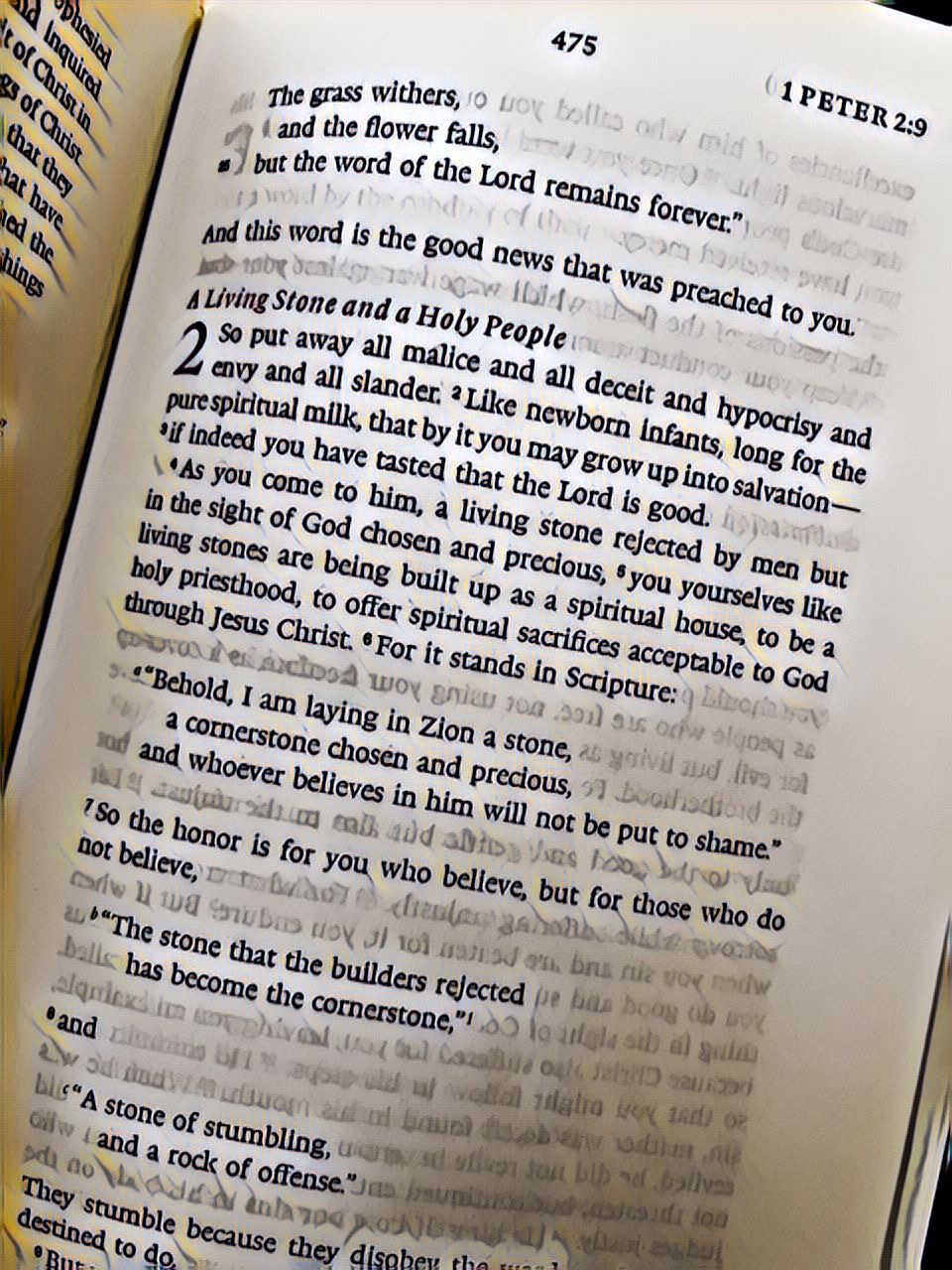
Here Peter draws on imagery in the messianic Psalm 118 — which I commend to you in its entirety — and in Isaiah 28:14ff, which identifies the Lord’s anointed, Jesus, as a stone, a cornerstone chosen and precious. In 1 Peter 2:4, Peter actually goes beyond the Old Testament texts to characterize this Messianic stone as “living.” And he says that, as Christ is a living cornerstone, we are also living stones being built into a spiritual house. That presents us a strange image: a living stone. What might Peter have had in mind with that image? Why might he have made that addition to the Old Testament text? What sense does “living” stone make?

The age after the fall — after the fall and before Christ — was an age characterized by and dominated by death; with two, possibly three, exceptions everyone from Adam to Christ died. But it is not so in this last age, this age of Christ’s reign. This is the age in which death has been trampled down by Christ’s death and in which life is given the final word. Death is undone; all that is dead will be made alive. Peter seems to go further — at least metaphorically — to suggest that all that was inanimate before, might be animated by the life and Spirit of Christ; an inanimate stone might become, in Christ, a living stone. This is very likely hyperbole, metaphor, but it shows the life giving power of Jesus’ death and resurrection to renew the entire created order. C. S. Lewis expressed a similar notion when he made all the animals in Narnia to be talking animals. For those who finally rejected Aslan, the consequence was to lose the power of speech, to become less than what they were made for. In new creation, I don’t know if rocks will actually be animate beings, but that is not really Peter’s point. He is simply saying that the resurrected life of Christ permeates everything, that it conquers death, and that the life of Christ is in us; if Christ is a living stone — because Christ is a living stone — then we too are living stones. Life reigns in us; life animates us in ways we cannot even begin to imagine.

Spiritual house
The living stones have a purpose: to become a spiritual house. When Peter says “you yourselves like living stones are being built up as a spiritual house,” he is speaking not in the singular, but in the plural — to the whole church; “all y’all” are being built into a spiritual house. Our faith is personal, but never private; it is essentially corporate — not “you” singular, but “you” plural. When Jewish readers heard the words “spiritual house,” what would they likely have thought of? I suspect they thought of the Temple. So, what Peter implies is that his readers are stones imbued with the very life of Christ, being built up into a living temple for the presence of the Lord, with Jesus himself being the cornerstone of that temple. If this is temple imagery, what else do you need to have a functioning temple? You need priests, which brings us to the next mark of our identity.

Holy Priesthood/Royal Priesthood
If Peter was writing primarily to Jews, then they would have been very familiar with the institution of the priesthood. In your reading of the Old Testament, you have frequently encountered priests, as well; you know who they were and what they did. What were the functions of the Aaronic priesthood? What was the priesthood to do, to accomplish?

• To offer sacrifices

• To instruct the people in the Law

• To represent God before the people and the people before God

• To discern the will of God

I want to focus on just two of these roles: the sacrificial and the representative functions of the priesthood. I want to show how these roles form the context of, and how they are fulfilled in and by, the Eucharist.

First, let’s consider sacrifices. There were, broadly speaking, two categories of offerings under the Mosaic Law: sin offerings and peace offerings. The reality is more complicated and nuanced than this and there are subcategories of each, but the two-fold division is a reasonable way to think about offerings. Sin offerings dealt with the guilt of the people; they cleansed the people, the tabernacle/temple, and the land of defilement — the residual taint of sin — so that the Lord would not “break out” against the people or the land and destroy either. The sacrifice of the sin offering was primarily dedicated to God; the blood was applied to the altar and poured out at its base and the fat and kidneys were burned on the altar. In some other cases, the carcass was burned outside the camp. In some cases the priest — but never the people — was given a portion of the holy offering to consume in the tabernacle or temple precincts. In contrast, the peace offering had nothing to do with sin, but rather with worship. The general category of peace offering included two specific forms: the thanksgiving offering and the vow offering. God had preserved you through some great difficulty or had blessed you richly or you are simply overcome with his goodness and beauty and mercy and you want to express your appreciation and devotion; that is the thanksgiving offering. Or, you want to make a special vow of piety and devotion, e.g., a temporary Nazirite vow. Such a vow warranted a vow offering. The essence of these offerings was a fellowship meal; part of the offering was burned on the altar (God’s part), part was given to the priests to eat, and part was given to the person making the offering to eat: God, priests, and people feasting/communing together in a thanksgiving offering meal.

So, this is the context into which Peter writes, telling the people that they are now a holy and royal priesthood. In what sense is that true, particularly in terms of the sacrificial function? I want to suggest just one aspect of Christian sacrificial priesthood: we are priests in and through the Eucharist. First — and this is important — Christ is the fulfillment/end of sacrifice for sin; no other sacrifice for sin is needed, and no other sacrifice for sin is possible. Hear these words from the Eucharistic liturgy:

All praise and glory is yours, O God our Heavenly Father, for in your tender mercy, you gave your only Son Jesus Christ to suffer death upon the Cross for our redemption, He made there, by his one oblation of himself once offered, a full, perfect, and sufficient sacrifice, oblation, and satisfaction, for the sins of the whole world; and he instituted, and in his Holy Gospel commanded us to continue, a perpetual memory of his precious death and sacrifice, until his coming again (BCP 2019, p. 116).

This part of the liturgy make clear that Christ’s death is the final sin offering. We do not offer that again on the altar. But, we do re-present that and participate in it by faith and sacrament in the Eucharist. That is part of our priestly function on behalf of the whole world. But now the language of the liturgy changes:

So now, O merciful Father, in your great goodness, we ask you to bless and sanctify, with your Word and Holy Spirit, these gifts of bread and wine, that we, receiving them according to your Son our Savior Jesus Christ’s holy institution, in remembrance of his death and passion, may be partakers of his most blessed Body and Blood (BCP 2019, p. 116).

Here we move from sin offering, which the people never ate, to thanksgiving offering which was a meal of fellowship between God and his people. The language that follows in the liturgy is explicit:

And we earnestly desire your fatherly goodness mercifully to accept this, our sacrifice of praise and thanksgiving (italics added); asking you to grant that, by the merits and death of your Son Jesus Christ, and through faith in his Blood, we and your whole Church may obtain forgiveness our our sins and all other benefits of his passion (BCP 2019, p. 117).

Jesus offers himself for the sin of the whole world and we come to remember, to participate, and to thank God precisely in the fellowship meal; this is the fullness of the priesthood and it is largely what constitutes God’s people as a holy and royal priesthood.

And there is one last offering made in the Eucharist, one made individually but on behalf of the whole body. It has the nature of a vow of fealty.

And here we offer and present to you, O Lord, ourselves, our souls and bodies, to be a reasonable, holy and living sacrifice (BCP 2019, p. 117).

The Eucharist is above all that which constitutes us as a priesthood; it is our participation in both types of offerings: the sin offering made once for all by Christ and re-presented in the Eucharist and the thanksgiving and vow offerings we make each time we participate in the sacrificial meal of bread and wine, Body and Blood.

The second aspect of our priesthood is representation: representing God to the people and the people to God. How do we represent God to the people? The words of the General Thanksgiving summarize this well:

And, we pray, give us such and awareness of your mercies, that with truly thankful hearts we may show forth your praise, not only with our lips, but in our lives, by giving up our selves to your service, and by walking before you in holiness and righteousness all our days (BCP 2019, p. 25).

Lips and lives: what we say and what we do — in holiness and righteousness — in the sight of the people; that is the essence of how we represent God to his people. That moves us toward one of Peter’s other major themes: praxis, particularly in terms of our public behavior. More of that in a moment.

How do we represent the people before God? One of the most basic ways is through our prayers, which brings us again to the Eucharist. The Eucharistic liturgy always includes the Prayers of the People which are also truly “Prayers for the People by the People.” Various forms of these prayers are allowed, “provided the following concerns are included:”

The universal Church, the clergy and people

The mission of the Church

The nation and all in authority

The peoples of the world

The local community

Those who suffer and those in any need or trouble

Thankful remembrance of the faithful departed and of all the blessings of our lives (BCP 2019, p. 140).

The lion’s share of our prayers are directed toward representing the people before God. The Eucharist is not the totality of our priesthood, but it is the summit and source of it, bringing together all the major functions of our priesthood. The Eucharist is that which proclaims our Christian identity most fully. And here, we’ll leave the theme of identity and move toward Peter’s other themes of suffering and praxis.

Praxis and Suffering
Christians were often suspect in the communities where they resided as aliens. They were considered as atheists because they did not worship the local gods or the gods of the empire. This was a matter of local and national security; fail to worship the gods and they might visit disaster on the people. In this sense, the Christians’ failure to uphold their civic obligations was tantamount to anarchy. That is probably not the primary reason behind Peter’s instructions on the relationship between Church and state, but it is the context for it. He says as much in 1 Peter 2:15:

1 Peter 2:15 (ESV): 15 For this is the will of God, that by doing good you should put to silence the ignorance of foolish people.

Christians were not atheists and were not then — and should not now be — anarchists. And that should be clear in their relationship with governmental authority. Here is how Peter expresses it:

1 Peter 2:13–17 (ESV): 13 Be subject for the Lord’s sake to every human institution, whether it be to the emperor as supreme, 14 or to governors as sent by him to punish those who do evil and to praise those who do good. 15 For this is the will of God, that by doing good you should put to silence the ignorance of foolish people. 16 Live as people who are free, not using your freedom as a cover-up for evil, but living as servants of God. 17 Honor everyone. Love the brotherhood. Fear God. Honor the emperor.

This is a challenging passage, especially for those who have suffered abuse at the hands of government or who view government as largely incompetent or self-serving. My best friend has moved from thinking the United States government is simply incompetent to thinking it is positively evil. And yet, we are told to be subject to the governmental authorities. We may have to grapple with this a bit. Let’s start here with a question: What is God’s purpose for government?

I might suggest these answers:

• To promote order instead of chaos in the public realm

• To promote justice for all

• To ensure the welfare of all

• To protect the public

I think of these as the minimal standards of godly government. Peter summarizes all this by saying that governors are sent “by [God] to punish those who do evil and to praise those who do good.” That is the context for Peter’s instructions to his readers; he presumes godly government. But, governments that do not do these things are not godly governments. Here is the principle that I think the whole of Scripture endorses: we must be in submission to the authority of the government to the extent that it serves its God-ordained functions. When it fails to do so, we may be forced to disobey the authorities and to speak prophetically to them. Scripture gives multiple examples of this principle.

The Egyptian government — pharaoh — was not a godly government, and God called Moses to oppose it. Elijah opposed the wicked rule of Ahab and Jezebel. When Nebuchadnezzar required all people to bow down to his image, Shadrach, Meshach, and Abednego refused. When Daniel was ordered to pray to no one but King Darius, he paid no attention to the injunction, but continued to offer his daily prayers to God. When the Apostles were ordered by the authorities to speak no longer in the name of Jesus they answered that they must obey God rather than the authorities. Scripture’s teaching is consistent: when governments and their authorities exceed their mandate or fail to serve their godly functions, they do not have the blank check of our obedience. Peter’s instructions must be taken as part of that whole ethos. To the greatest extent possible, Christians must be subject to every human, governmental institution and authority, in so far as doing so does not violate godly justice and our supreme devotion and obedience to God. In principle, I think this much is clear. In practice, it is not so clear. We will sometimes reach different conclusions on the limits of submission to government; decisions require prayer, and corporate discernment. But, this much is also clear; even when we disagree with government, Christians must not act as hate-filled agents of anarchy.

I’d like to use two examples of this from within my lifetime — one positive and one negative. You are free to disagree with these examples, but they do point out the distinctions I’m trying to draw.

Martin Luther King, Jr. was a prophetic voice against the government sanctioned injustice perpetrated against blacks in our country. He was pointing out precisely where the government was not serving its godly function. He did so through non-violent protest and not through hate-fueled anarchy. That seems to me in keeping with the whole of Scripture and the assumed context of Peter’s instructions.

In contrast, the January 6 insurrectionists at the Capitol — those who violently stormed and occupied the Capitol — were not acting in a Christian manner and were in violation of the whole of Scripture including Peter’s instructions here. They did not silence the false accusations of non-Christians against our faith, but rather brought the faith into disrepute. Theirs was an act of tribalistic, hate-filled, anarchy. No one can rightly claim to act as they did in the name of Christ.

Most of us will not find ourselves caught up in either of those extremes, though increasingly it may be difficult to support and obey our government as it moves farther away from godly justice and embraces iniquity. So, what is the “bottom line?” To the greatest extent possible, obey the government. Also, pay your taxes; that is most likely what the word “honor” in 1 Peter 2:17 refers to.

Now, let’s move from one challenging topic to the next. I’d like to start with a thought experiment. Imagine if Pope Francis were to publish an encyclical calling on all Roman Catholics — in fact, on all Christians — to immediately stop using combustion engine (fossil fuel) cars. What do you suppose would be the response? We do not inhabit a thought world — a way of looking at and imagining the world — in which such a thing is even conceivable. We lack the necessary infrastructure, not to mention the financial resources necessary to make the switch in the near term. But suppose that Pope Francis is truly convinced that this is a moral/theological issue and that, as Christians, we simply must end our use of fossil fuels. What might he do? Well, it seems to me that he would need to begin constructing a new thought world, one in which fossil fuels play no part. He would need to deepen — and more thoroughly explain — the Church’s theology of creational stewardship and our responsibility to tend the earth rather than to exploit it. He would need to call upon experts — particularly those who share the Church’s vision — to begin working out the details of infrastructure and finance. This is a long-term process and would certainly not be complete in his lifetime and probably not in the lifetime of his successor. But it is a reasonable starting place. And he would need to do one more thing; he would need to sketch out a vision of what the meantime looks like, of how to live responsibly in the present — with the use of carbon fuels — even as we envision and plan for a different future.

Now, let’s place ourselves mentally in the first century Roman Empire. Imagine Peter or Paul writing a letter calling upon all Christian slave owners to immediately set their slaves free. What do you suppose would have been the response? I think the Christians would have been incredulous, because they did not inhabit a thought world where that was conceivable. They lacked the infrastructure; the slaves did much of the work. They lacked the financial resources to pay for labor and the slaves lacked the financial resources to set up independent, free lives. But, suppose that Peter and Paul thought that this was an important moral/theological issue, and that slavery — particularly Christian masters owning Christian slaves — had to go. What could they do? Well, they could begin to inculcate a new thought world in which slavery no longer had a place. They could emphasize the spiritual equality in Christ of masters and slaves. They could insist that masters and slaves gather around the same Eucharistic table. They could call on some owners to release some slaves, as a signpost pointing forward to a new reality. And all of this is precisely what Paul did. He planted the seeds for the end of Christian slavery. But, they would need to do one more thing; they would need to sketch out a vision of what the meantime looks like, of how to live responsibly in the present — within the system of slavery — even as the first century Christians began to envision and plan for a different future.

It is this last task that Peter engages in this letter: the meantime task. He doesn’t address slave owners; Paul does, but Peter doesn’t. I wish he had, but we take the text we’re given. But Peter does something equally radical; he gives slaves dignity and agency by embedding their story in the story of Christ. Let’s read the text.

1 Peter 2:18–25 (ESV): 18 Servants, be subject to your masters with all respect, not only to the good and gentle but also to the unjust. 19 For this is a gracious thing, when, mindful of God, one endures sorrows while suffering unjustly. 20 For what credit is it if, when you sin and are beaten for it, you endure? But if when you do good and suffer for it you endure, this is a gracious thing in the sight of God. 21 For to this you have been called, because Christ also suffered for you, leaving you an example, so that you might follow in his steps. 22 He committed no sin, neither was deceit found in his mouth. 23 When he was reviled, he did not revile in return; when he suffered, he did not threaten, but continued entrusting himself to him who judges justly. 24 He himself bore our sins in his body on the tree, that we might die to sin and live to righteousness. By his wounds you have been healed. 25 For you were straying like sheep, but have now returned to the Shepherd and Overseer of your souls.

Peter writes into a world where some, perhaps many, of his Cristian brothers and sisters are slaves; many of them would be slaves of non-Christian masters. And that would not change anytime soon. So, what are they to do in the meantime? Actually, let’s focus first on what they are not to do. They are not to rebel. They are not to be disobedient. They are not to be haughty or disrespectful. They are to be subject to their masters and respectful of them: not only of the just and kind masters, but of the unjust and harsh masters.

It is difficult for us to look at those instructions objectively because of our national history with slavery. These words were used against Christian slaves by nominally Christian slave owners to justify cruel mistreatment of their black brothers in Christ. These words were used for domination and control. And that is a blasphemous misreading of the text. Far from subjugating slaves, Peter was giving them agency and dignity in this text. He recognizes the reality of unjust suffering inflicted upon these slaves. He doesn’t minimize it; he transforms it by embedding it in Christ’s story.

The train of thought goes like this. To the slave: be subject to your master and do nothing but good for him. It may be that, even so, he will be harsh to you unjustly and you will suffer. If so, God counts this a gracious thing; it brings favor with God, precisely because it follows the example of Christ. Your suffering bears witness to Christ’s suffering and is a proclamation of the Gospel. As Peter will say later (1 Peter 4:13), such righteous suffering is a share in Christ’s suffering. As Christ’s suffering was redemptive for the world, so too the slaves’ righteous suffering endured in the name of Christ and for his sake is redemptive. And that is agency, dignity, and meaning in the meantime until slavery is a relic of the past.

To do a full survey of slavery in both the Old and New Testaments is beyond the scope of this class in 1, 2 Peter, though it would be a very worthwhile study. If you simply take this instruction out of the context of the whole as many radical race theorists and despisers of Christianity tend to do, you will certainly miss what Peter is trying to do: to create a new identity for slaves in which they are evangelists and partakers of Christ’s redemptive suffering for the redemption of the world. This is elevation and not suppression. This is one of several Old and New Testament seeds that will blossom into freedom as a new thought world is created in which slavery has no part. This understanding derives from Peter’s themes of identity, suffering, and praxis which is to him the core of the Christian experience of being resident aliens in a fallen world.

The Lord be with you.
And with your spirit.

Let us pray.

Almighty God, you have chosen and called your people to be living stones, built into a spiritual house in which a holy priesthood might worship you in Spirit and truth, interceding on behalf of the world: Grant us so to live as chosen exiles in this world that all peoples and nations might see your glory and offer themselves to you as living sacrifices, holy and acceptable; through Jesus Christ our Lord, who lives and reigns with you, one God, now and for ever. Amen.

Posted in Uncategorized | Leave a comment

1 Peter 1

APOSTLES ANGLICAN CHURCH

1 PETER 1
Fr. John A. Roop

The Lord be with you.
And with your spirit.

Let us pray.

Blessed Lord, who caused all Holy Scriptures to be written for our learning: Grant us so to hear them, read, mark, learn, and inwardly digest them, that by patience and the comfort of your Holy Word we may embrace and ever hold fast the blessed hope of everlasting life, which you have given us in our Savior Jesus Christ; who lives and reigns with you and the Holy Spirit, one God, for ever and ever. Amen.

BLESSED BE THE GOD AND FATHER of our Lord Jesus Christ!
According to his great mercy, he has caused us to be born again
to a living hope through the resurrection of Jesus Christ
from the dead (1 Peter 1:3).
Amen.

Introduction

In our generation we have seen too many immigration and refugee crises: people forced to leave their homes due to war, persecution, economic hardship, natural disaster, criminal violence, and people displaced internally by similar causes — still in their land, but not in their homes and villages. I suspect that such people experience cultural disorientation, a profound sense of “otherness.” The same is almost certainly true for minority groups within a given society, e.g., African-Americans in the Jim Crow south, Israeli Arabs in Jerusalem, Muslims in post-911 America, Jews in almost every place at almost any time. How do you navigate being “other” in your own home?

There are several options; the two must basic are withdrawal or assimilation.

In withdrawal, the minority seeks to create an enclave of its own culture within the majority culture and to live, as much as possible, within that enclave. You can see this in Manhattan with China Town, Little Italy, Korea Town and in Miami with Little Havana, Little Haiti, and Little Moscow. In Brooklyn, the Hasidic Jews have built a well-defined community among the hipsters of Williamsburg; you see much the same with the Amish in Pennsylvania.

The other most basic option is assimilation, the “tamping down” of differences and the embrace of the prevailing culture. Try to move to the suburbs, try to speak the language, try to blend in. Change your name from José to Joe or from Miryam to Mary. Learn to cook and eat the most common dishes of the majority culture. Go along to get along. This is the American concept of the great melting pot.

Now, suppose your otherness isn’t somehow forced on you; suppose it isn’t a matter of ethnic identity, for example. Suppose it’s chosen. Let’s consider Acts 2, the account of the first Christian Pentecost, as an example.

Acts 2:1–12 (ESV): When the day of Pentecost arrived, they were all together in one place. 2 And suddenly there came from heaven a sound like a mighty rushing wind, and it filled the entire house where they were sitting. 3 And divided tongues as of fire appeared to them and rested on each one of them. 4 And they were all filled with the Holy Spirit and began to speak in other tongues as the Spirit gave them utterance.

5 Now there were dwelling in Jerusalem Jews, devout men from every nation under heaven. 6 And at this sound the multitude came together, and they were bewildered, because each one was hearing them speak in his own language. 7 And they were amazed and astonished, saying, “Are not all these who are speaking Galileans? 8 And how is it that we hear, each of us in his own native language? 9 Parthians and Medes and Elamites and residents of Mesopotamia, Judea and Cappadocia, Pontus and Asia, 10 Phrygia and Pamphylia, Egypt and the parts of Libya belonging to Cyrene, and visitors from Rome, 11 both Jews and proselytes, Cretans and Arabians—we hear them telling in our own tongues the mighty works of God.” 12 And all were amazed and perplexed, saying to one another, “What does this mean?”

The end of this account is the conversion and baptism of three thousand people — people who will return, after the feast is over, to Cappadocia, Pontus, Asia, and many other regions. But, they will not return as they left; they are now Christians. They will return as “other,” as a minority among the prevailing religious cultures. The pressing question for them is how to navigate their chosen “otherness”?

I mentioned the two most basic options a minority culture has vis-à-vis the majority culture: withdrawal or assimilation. For these new “Pentecostal” Christians and for the Christians to whom Peter is writing, neither withdrawal nor assimilation are viable options. Peter — actually Jesus — calls them to something different and, I suspect, something much more difficult: witness. They are called to retain their unique identity while remaining in and participating with the majority culture to the greatest extent possible as a witness to that culture of the availability of a better, truer way of living. Light shining in the darkness, a city on a hill, yeast hidden in a measure of dough, sheep among wolves: pick your biblical metaphor; it all comes down to a matter of witness.

This call to witness presents many challenges and raises many questions.

How is it possible to resist enculturation, to avoid being formed in the image of the predominant culture? This is the issue of IDENTITY.

What is the proper response to the suspicion, the shunning, the opposition of the prevailing culture? This is the issue of SUFFERING.

What is the proper way to navigate the ins-and-outs of daily life — the occupations and relationships — that intersect with those in the majority culture? This is the issue of PRAXIS, of the practical living-out of our faith in our homes, communities, places of work, and in the broader culture.

There are many more challenges, of course, but these few are very significant: identity, suffering, and praxis. Do we experience these same challenges? Well, ask these questions:

Is our culture trying to form us in its own image? What are its tools? This is the issue of identity.

Is it getting more costly to be an orthodox Christian and to espouse publicly the traditional Christian faith? What are some of the costs of doing so? This is the issue of suffering.

Is it difficult to live as a Christian in our families, in our schools, in our places of work, in our communities, in our politics? What are some of challenges we face? This is the issue of praxis.

Peter’s two letters address these particular challenges, and some others. What he says to his readers he says to us, because we face similar difficulties. The remedy is to know (1) who we are and who God is, (2) the inevitability of and the proper response to suffering, and (3) the nature and necessity of proper living: identity, suffering, and praxis.

Greeting (1 Peter 1:1-2)

1 Peter 1:1–2 (ESV): 1 Peter, an apostle of Jesus Christ,

To those who are elect exiles of the Dispersion in Pontus, Galatia, Cappadocia, Asia, and Bithynia, 2 according to the foreknowledge of God the Father, in the sanctification of the Spirit, for obedience to Jesus Christ and for sprinkling with his blood:

May grace and peace be multiplied to you.

The author identifies himself as Peter, an Apostle of Jesus Christ. Some modern scholars have questioned this for various reasons: the high quality of the Greek text which would seem to be inconsistent with an uneducated fisherman, the historical context of the letter which would seem more in keeping with a date subsequent to Peter’s death, the lack of specific references to and anecdotes about Jesus. None of this casts serious doubts about the authorship of the letter; the consensus of the early Church, including such noted Fathers as Irenaeus, Tertullian, and Clement of Alexandria attests to Petrine authorship. I will take that as given throughout our reading.

To whom was Peter writing? Again, there is some debate here as to whether his primary audience was Jewish or Gentile. I think the weight of the circumstantial evidence points toward a primarily Jewish readership. First, Peter was the apostle to the Jews in contrast to Paul the apostle to the Gentiles. Second there is Peter’s language in the greeting: to those who are elect exiles of the Dispersion. This is typical Jewish language. From the time of the deportations to Assyria and Babylon, the Dispersion was the common term to refer to those Jews living either by compulsion or choice in Gentile territory as contrasted with those Jews living in Israel. Peter uses this language as a double entendre — which we’ll consider in just a minute — but it seems to imply a Jewish readership. Third, I find the overlap between 1 Peter 1 and Acts 2:8-10 interesting. Those gathered in Jerusalem and mentioned in Acts 2 were among the Jewish Diaspora re-gathered at the Temple to celebrate the Feast of Shavuot (Pentecost). That Peter mentions many of the same regions in 1 Peter is suggestive of the same group of people.

So, I take it as given that this letter is (1) from the Apostle Simon Peter, (2) writing to a primarily Jewish Christian audience scattered throughout Asia Minor.

Now, back to the double entendre with “elect exiles of the Dispersion.” Peter “baptizes” this historically Jewish language to make it apply to Christians; in other words, he shows how the Jewish experience is now fulfilled in the Christian experience. It is the Christians who are now the true exiles dispersed throughout the world: spiritual resident aliens, citizens of the Kingdom of God residing temporarily among the kingdoms of the world. This is the thought behind another early Christian writing, an anonymous mid second century letter written to a non-believer Diognetus. It contains this rightly famous description of Christians, which, I think, is the perfect commentary on Peter’s language.

Christians are indistinguishable from other men either by nationality, language or customs. They do not inhabit separate cities of their own, or speak a strange dialect, or follow some outlandish way of life. Their teaching is not based upon reveries inspired by the curiosity of men. Unlike some other people, they champion no purely human doctrine. With regard to dress, food and manner of life in general, they follow the customs of whatever city they happen to be living in, whether it is Greek or foreign.

And yet there is something extraordinary about their lives. They live in their own countries as though they were only passing through. They play their full role as citizens, but labor under all the disabilities of aliens. Any country can be their homeland, but for them their homeland, wherever it may be, is a foreign country. Like others, they marry and have children, but they do not expose them. They share their meals, but not their wives. They live in the flesh, but they are not governed by the desires of the flesh. They pass their days upon earth, but they are citizens of heaven. Obedient to the laws, they yet live on a level that transcends the law.

Christians love all men, but all men persecute them. Condemned because they are not understood, they are put to death, but raised to life again. They live in poverty, but enrich many; they are totally destitute, but possess an abundance of everything. They suffer dishonor, but that is their glory. They are defamed, but vindicated. A blessing is their answer to abuse, deference their response to insult. For the good they do they receive the punishment of malefactors, but even then they rejoice, as though receiving the gift of life. They are attacked by the Jews as aliens, they are persecuted by the Greeks, yet no one can explain the reason for this hatred.

To speak in general terms, we may say that the Christian is to the world what the soul is to the body. As the soul is present in every part of the body, while remaining distinct from it, so Christians are found in all the cities of the world, but cannot be identified with the world.

This is the “fleshed out” version of Peter’s succinct description of Christians as elect exiles of the Dispersion. And it applies equally to us as to Peter’s audience, as to the Christians in the Letter to Diognetus. As Christians we are elect exiles — or as Stanley Hauerwas and William Willimon translated the phrase, “resident aliens” — wherever we live: living there, but not fully at home there. If we do feel fully at home, there is a problem.

Peter wants his readers to know that they are not forgotten by God as they find themselves scattered throughout Asia Minor. He calls them the “elect” and notes that everything is transpiring according to the foreknowledge of God. There are challenges to our understanding of these words and phrases because we are children of the Reformation. Whenever we hear of election and foreknowledge we may be distracted by the Reformation debates over God’s sovereignty and personal predestination. But Peter wasn’t a Calvinist or an Arminian; those were not his debates. At the most basic level Peter is simply saying that as God chose the Jews instrumentally under the Old Covenant so now God has chosen the Christians instrumentally under the New Covenant to bring salvation to the world. And, dispersing them throughout the world was part of God’s plan. God is not surprised nor are his elect at the mercy of the powers. God is sovereign, and God is at work.

Born Again to a Living Hope (1 Peter 1:3-12)
In this section, Peter introduces two of the major themes of the letter: identity and suffering.

1 Peter 1:3–12 (ESV): 3 Blessed be the God and Father of our Lord Jesus Christ! According to his great mercy, he has caused us to be born again to a living hope through the resurrection of Jesus Christ from the dead, 4 to an inheritance that is imperishable, undefiled, and unfading, kept in heaven for you, 5 who by God’s power are being guarded through faith for a salvation ready to be revealed in the last time. 6 In this you rejoice, though now for a little while, if necessary, you have been grieved by various trials, 7 so that the tested genuineness of your faith—more precious than gold that perishes though it is tested by fire—may be found to result in praise and glory and honor at the revelation of Jesus Christ. 8 Though you have not seen him, you love him. Though you do not now see him, you believe in him and rejoice with joy that is inexpressible and filled with glory, 9 obtaining the outcome of your faith, the salvation of your souls.

10 Concerning this salvation, the prophets who prophesied about the grace that was to be yours searched and inquired carefully, 11 inquiring what person or time the Spirit of Christ in them was indicating when he predicted the sufferings of Christ and the subsequent glories. 12 It was revealed to them that they were serving not themselves but you, in the things that have now been announced to you through those who preached the good news to you by the Holy Spirit sent from heaven, things into which angels long to look.

I have never been a geographical exile, but I can imagine that the challenges to identity are immense. I was briefly in India and even surrounded by very kind and welcoming Christian brothers and sisters, the sense of “otherness” was palpable. I love Indian food and was delighted to eat it in its natural environment, but I was so happy one morning midway through the trip to have bacon and eggs, a real taste of home.

Peter writes to Kingdom of God people scattered among the kingdoms of the world. It is important that they remember and retain their spiritual “otherness” while also participating in and working for the welfare of the place and people among whom they dwell.

Our identity is given to us in and by birth; we are not naturalized citizens of the Kingdom of God, but rather citizens by birth (v. 3). In our baptism we are born again of water and Spirit. From that time onward, certain marks and privileges of Kingdom identity are ours: living hope, imperishable inheritance kept in heaven, God’s power securing our salvation.

__________________________

EXCURSUS: Kept in Heaven

The language that Peter uses about an inheritance kept in heaven for us can be misleading and merits a closer look. There has been a pervasive trend in Western Christianity toward a certain Platonic Gnosticism that views the soul as trapped within the body simply waiting for the day of its release. After death the soul will make its way to heaven there to dwell eternally with God. In this view, the imperishable inheritance kept in heaven is to be enjoyed there throughout eternity. The trouble with this view should be obvious: it entirely ignores the resurrection of the body!

The true vision of Christian eschatology is the return of Christ, the resurrection of the body, and the joining of heaven and earth — the heavenly New Jerusalem descending to earth. The inheritance that Peter mentions is kept in heaven for us now against that great day when heaven and earth are joined and we, in our resurrection bodies, receive our heaven-kept inheritance in the renewed heaven and earth.

__________________________

Now all of this — identity and inheritance — sounds (and is) wonderful, but the immediate situation on the ground sometimes looks quite different. In the present there is suffering. In the present our earthly inheritance — land, home, money — is certainly perishable and can be taken by the powers-that-be. In the present our physical and emotional welfare are far from secure. Peter feels it necessary to deal with the issue of suffering because it is a present reality to his readers.

I find it instructive that earlier generations of Christians who faced far more suffering than most of us will ever do, agonized far less about it than we do. Theodicy — the problem of why an all good and all powerful God allows suffering — is more a modern philosophical and theological problem than an ancient one. It is based on a few faulty assumptions: that we shouldn’t suffer, that suffering is devoid of meaning and purpose, and that suffering questions the character of God — either his power or his goodness.

Among modern Western analyses of suffering, that of Victor Frankl looms large. Frankl was an Austrian psychiatrist imprisoned for three years in German concentration camps for his Jewish heritage. He discover that dealing with the indignities and suffering of the camps was largely a matter of finding meaning within the suffering. He wrote the following in his classic work Man’s Search for Meaning.

We who lived in concentration camps can remember the men who walked through the huts comforting others, giving away their last piece of bread. They may have been few in number, but they offer sufficient proof that everything can be taken from a man but one thing: the last of the human freedoms — to choose one’s attitude in any given set of circumstances, to choose one’s own way. …in the final analysis it becomes clear that the sort of person the prisoner became was the result of an inner decision, and not the result of camp influences alone. Fundamentally, therefore, any man can, even under such circumstances, decide what shall become of him — mentally and spiritually. …the way they bore their suffering was a genuine inner achievement. It is this spiritual freedom — which cannot be taken away — that makes life meaningful and purposeful.

If there is a meaning in life at all, then there must be a meaning in suffering. Suffering is an ineradicable part of life, even as fate and death. Without suffering and death human life cannot be complete.

The way in which a man accepts his fate and all the suffering it entails, the way in which he takes up his cross, gives him ample opportunity — even under the most difficult circumstances — to add a deeper meaning to his life (Frankl. Man’s Search For Meaning).

This whole passage is worth careful consideration, but two important points present themselves in the context of 1 Peter.

1. One freedom cannot be taken from man: his ability to choose his attitude in any given set of circumstances, Frankl writes. Notice how Peter expresses a similar notion: he praises his readers because in the midst of their suffering they love the Lord, they believe in Him, and they rejoice.

2. If there is a meaning in life at all, then there must be a meaning in suffering, says Frankl. Peter begins to provide a meaning for Christian suffering in vss. 6-9. Suffering is a testing of faith that refines and strengthens it so that its true worth might be revealed at the coming of Christ and might redound to his praise, glory, and honor — and theirs, I think — and might lead finally to their salvation. Suffering, though inflicted by evil men, is an instrument of salvation in the hands of a loving God. It is not without purpose or meaning. In that realization, it is possible even to rejoice.

I want to note two other matters, one from Frankl and one from a bit later in 1 Peter.

First, remember that Frankl was Jewish. It is profoundly moving to me, as a Christian, that when he wants to point to the depths of human suffering he describes it as a man taking up his cross. The novelist Chaim Potok did a similar thing in his book My Name Is Asher Lev. Asher is a Chasidic Jew and a painter. When he brings his art to bear on Jewish suffering, when he wants to plumb the absolute depths of Jewish suffering, he finds that he must paint the crucifixion of Jesus.

Second, I want to connect this to something Peter writes later in chapter 4.

1 Peter 4:12–13 (ESV): 12 Beloved, do not be surprised at the fiery trial when it comes upon you to test you, as though something strange were happening to you. 13 But rejoice insofar as you share Christ’s sufferings, that you may also rejoice and be glad when his glory is revealed.

Note what Peter says: if you are suffering for the faith, you are sharing in Christ’s sufferings. That is why carrying the cross, why the crucifixion is the appropriate image for all Christian suffering. On the cross, Christ plumbed the depths of human suffering for us, so that in the depths of our suffering we might see its redemptive meaning in the cross. This, to me, is central for coming to grips with the meaning of Christian suffering: Christ’s suffering was redemptive; it was for the salvation of the world. If my suffering is a share in his, then my suffering is, in some way that transcends language, also redemptive not only for myself but for the world. Paul speaks of Christians as having a ministry of reconciliation; Peter implies — and I think more than implies — that our suffering is part of that ministry of reconciliation.

Called to Be Holy (1 Peter 1:13-25)
Thus far Peter has introduced two of the major themes of the letter: identity and suffering. Now he touches on the third: praxis, the practical living-out of our faith in our homes, communities, places of work, and in the broader culture.

1 Peter 1:13–25 (ESV): 13 Therefore, preparing your minds for action, and being sober-minded, set your hope fully on the grace that will be brought to you at the revelation of Jesus Christ. 14 As obedient children, do not be conformed to the passions of your former ignorance, 15 but as he who called you is holy, you also be holy in all your conduct, 16 since it is written, “You shall be holy, for I am holy.” 17 And if you call on him as Father who judges impartially according to each one’s deeds, conduct yourselves with fear throughout the time of your exile, 18 knowing that you were ransomed from the futile ways inherited from your forefathers, not with perishable things such as silver or gold, 19 but with the precious blood of Christ, like that of a lamb without blemish or spot. 20 He was foreknown before the foundation of the world but was made manifest in the last times for the sake of you 21 who through him are believers in God, who raised him from the dead and gave him glory, so that your faith and hope are in God.

22 Having purified your souls by your obedience to the truth for a sincere brotherly love, love one another earnestly from a pure heart, 23 since you have been born again, not of perishable seed but of imperishable, through the living and abiding word of God; 24 for

“All flesh is like grass
and all its glory like the flower of grass.
The grass withers,
and the flower falls,
25 but the word of the Lord remains forever.”

And this word is the good news that was preached to you.

The theological basis and imperative for all Christian praxis lies in the command, “You shall be holy, for I am holy.” This is not new with Peter; he likely is making an allusion to Leviticus 19:1-2:

Leviticus 19:1–2 (ESV): 19 And the Lord spoke to Moses, saying, 2 “Speak to all the congregation of the people of Israel and say to them, You shall be holy, for I the Lord your God am holy.

That is important because it means that holiness is no free-floating theological concept that we can fill with meaning as we will; rather, holiness is a characteristic of God and he alone can reveal to us what it means. At its most basic, “holy” denotes something that is set apart: something that is elevated above the common and profane, something unique and distinct. Peter writes that formerly his readers were ignorantly conformed to the passions of this world; now they are to be holy, i.e., elevated above the passions, distinct from the world, set apart for God and his use. Holiness is not an abstract concept; Peter — following the lead of God in Leviticus — presents holiness in very concrete, practical terms. What does it mean to be holy as God is holy? Let’s read a bit more of the Leviticus passage.

Leviticus 19:1–18 (ESV): 19 And the Lord spoke to Moses, saying, 2 “Speak to all the congregation of the people of Israel and say to them, You shall be holy, for I the Lord your God am holy. 3 Every one of you shall revere his mother and his father, and you shall keep my Sabbaths: I am the Lord your God. 4 Do not turn to idols or make for yourselves any gods of cast metal: I am the Lord your God.

5 “When you offer a sacrifice of peace offerings to the Lord, you shall offer it so that you may be accepted. 6 It shall be eaten the same day you offer it or on the day after, and anything left over until the third day shall be burned up with fire. 7 If it is eaten at all on the third day, it is tainted; it will not be accepted, 8 and everyone who eats it shall bear his iniquity, because he has profaned what is holy to the Lord, and that person shall be cut off from his people.

9 “When you reap the harvest of your land, you shall not reap your field right up to its edge, neither shall you gather the gleanings after your harvest. 10 And you shall not strip your vineyard bare, neither shall you gather the fallen grapes of your vineyard. You shall leave them for the poor and for the sojourner: I am the Lord your God.

11 “You shall not steal; you shall not deal falsely; you shall not lie to one another. 12 You shall not swear by my name falsely, and so profane the name of your God: I am the Lord.

13 “You shall not oppress your neighbor or rob him. The wages of a hired worker shall not remain with you all night until the morning. 14 You shall not curse the deaf or put a stumbling block before the blind, but you shall fear your God: I am the Lord.

15 “You shall do no injustice in court. You shall not be partial to the poor or defer to the great, but in righteousness shall you judge your neighbor. 16 You shall not go around as a slanderer among your people, and you shall not stand up against the life of your neighbor: I am the Lord.

17 “You shall not hate your brother in your heart, but you shall reason frankly with your neighbor, lest you incur sin because of him. 18 You shall not take vengeance or bear a grudge against the sons of your own people, but you shall love your neighbor as yourself: I am the Lord.

Honor your father and mother. Remember the Sabbath day. Don’t make or worship idols. Offer proper sacrifices to the Lord. Provide for the poor and the sojourner. Don’t steal. Don’t lie. Don’t oppress your neighbor. Pay your hired workers promptly. Don’t take advantage of those weaker than yourself. And so it goes, holiness as a matter of praxis/conduct. Peter sums all this up by saying, “love one another earnestly from a pure heart.” He will expand on this in coming chapters, but this is the essence of how we are to live holy lives. We can do this because we “were ransomed from the futile ways inherited from [our] forefathers, not with perishable things such as silver or gold, 19 but with the precious blood of Christ, like that of a lamb without blemish or spot” (1 Peter 1:18b-19). And that bring us full circle to identity. Our holiness must be rooted in our new identity which is rooted in the saving work of Christ.

So it is that in this opening chapter Peter presents the three themes that he will develop throughout his letter: the nature of Christian identity, the reality and meaning of Christian suffering, and the necessity of Christian praxis both in the home and in the public realm.

The Lord be with you.
And with your spirit.

Let us pray.

Almighty God, Father of a holy people from every family, language, people, and nation now living as elect exiles in this world: establish our identity, we pray, in Christ alone; strengthen us to suffer for him as may be, and always with joy; and grant that, by our obedience and holiness of life we may shine forth his glory in the world; through the same Jesus Christ our Lord who lives and reigns with you and the Holy Spirit, one God, now and for ever. Amen.
Posted in Uncategorized | Leave a comment

Last Things: A Homily on 2 Timothy 3

In the Name of the Father, and of the Son, and of the Holy Spirit. Amen.

I START TODAY BY REMINDING YOU OF, or perhaps introducing you to, a five dollar theological term: not because it is fancy, and certainly not so you can impress people by using it, but because it is important and because you will often hear it in theological discussions or stumble across it in biblical literature and commentaries. The word is eschatological. You might encounter it in other grammatical forms — eschaton or eschatology — but they all denote the same thing: last things or final things.

I mention it today because our epistle text, 2 Timothy 3 — perhaps among the last canonical texts that St. Paul wrote — is an eschatological text. Its theme is last things/final things, two last things in particular: the last days and the last/final word.

St. Paul introduces his eschatological theme with these words:

2 Timothy 3:1 (ESV): 3 But understand this, that in the last days there will come times of difficulty.

In the last days. I don’t know what you hear when you hear that phrase. For some it may conjure images of Left Behind theology with Rapture and Tribulation and Armageddon. For others it may invoke a distant and hazy future, something always “out there” and beyond us. In Western Christianity, the last days is an ambiguous phrase, ill-defined, subject to private interpretations of Scripture and the daily news. But, Paul was a Jew in the Second Temple period. For Paul and his Jewish compatriots — especially Pharisees like himself — the last days had a well-defined meaning. All of history — by which they meant past, present, and future — all of history could be divided into just two ages: the present age and the age to come, i.e., the last days. The demarcation between the two, the point of boundary and transition, was the appearance of the Messiah. The last days were the Messianic age in which all the trials of the present age would be resolved, all the wrongs of the present age put to rights. In the last days the Kingdom of God would be established: an age of God’s righteous rule mediated through the Messiah; an age in which Israel would be purified, elevated, and delivered from exile; an age in which the knowledge of the glory of God would fill the whole world as the waters cover the sea; an age in which the righteous — including the resurrected righteous dead — would be rewarded and the unrighteous punished or destroyed. The last days would be a golden age, a Jewish utopia. This was Paul’s basic understanding of the last day, but he had re-centered this understanding on Christ. And that required some revision to the standard notions.

Paul agreed that the transition point between the ages was the appearance of the Messiah; for Paul, Jesus of Nazareth was that Messiah. So, perhaps at Jesus’ birth, but certainly from the time of his resurrection and ascension, the last days had dawned. That means that Paul and Timothy were, and that we are, living in the last days: not awaiting it in some dim and distant future, but living in it right now. But that raises an important question: if the last days are to be a utopian era of the righteous rule of God when all things wrong are put to rights, then how can Paul say, “In the last days there will come times of difficulty”? If the Messiah has taken his rule and the Kingdom of God is now on earth as it is in heaven, why is the world in such a sad state? It is precisely at this point that Paul re-envisions the last days in a uniquely Christian manner. Paul makes the theological move from eschatology to inaugurated eschatology. In and through Jesus Christ the last days have been inaugurated — they have begun — but they have not yet been completed. You have likely heard of the New Testament tension between the already and the not yet; this is a perfect case in point. We already live in the last days, but they are not yet complete. A simple way to say it is that we live at the beginning of the end, at the first of the last days. All shall be well because we are in the last days. All is not yet well because we are only in the first of the last days. So, we should expect difficulty in the meantime, in the midst of the last days.

Now, while this goes beyond the scope of the text, I need to address some last days, Kingdom of God issues. We do not build the Kingdom of God by our own efforts throughout these last days; Kingdom building is God’s work. Our calling, our work, is to live as citizens of the Kingdom of God in the midst of the kingdoms of the world and to bear witness to God and his Kingdom. We are to do justice, to love mercy, to walk humbly with our God. We are to love the Lord our God will all our heart, with all our soul, and with all our mind, and to love our neighbor as ourselves. We are to proclaim the good news that God so loved the world that he gave his only-begotten Son that whoever believes in him might not perish but might have eternal life. We are to be a holy people as God is a holy God. We are to be the prophets, priests, and kings of new creation: proclaiming the Gospel, representing God to the people and the people to God, ruling over — bringing Godly order to — our vocational areas of expertise and influence. God will take all that, bless it, break and multiply it, and give it away for the reconciliation of the world to Him. It will be some of the “raw materials” through which He builds the Kingdom. But, it will not happen as straightforward, unimpeded human progress toward utopia. That was the false hope of the enlightenment and of modernity. No; instead Paul says, “In the last days will come times of difficulty.”

2 Timothy 3:2–5 (ESV): 2 For people will be lovers of self, lovers of money, proud, arrogant, abusive, disobedient to their parents, ungrateful, unholy, 3 heartless, unappeasable, slanderous, without self-control, brutal, not loving good, 4 treacherous, reckless, swollen with conceit, lovers of pleasure rather than lovers of God, 5 having the appearance of godliness, but denying its power. Avoid such people.

Paul goes on to say:

2 Timothy 3:12–13 (ESV): 12 Indeed, all who desire to live a godly life in Christ Jesus will be persecuted, 13 while evil people and impostors will go on from bad to worse, deceiving and being deceived.

Does St. Paul’s description of humanity in the last days, humanity apart from Jesus Christ, ring true to your experience: selfish, greedy, proud, violent, heartless, slanderous, reckless, sensual, spiritual-but-not-religious? This is to be expected throughout the last days; this is the fallen world in opposition to Christ. This is the diminished image bearers of God enslaved by the passions. It must not be so among us. But, tragically, it too often is. We have purveyors of the prosperity gospel, a false gospel which is a thinly veiled appeal to greed, pride, and sensuality. Let’s get this straight: all who promise health, wealth, and prosperity as expressions of God’s will and pleasure in these last days are false prophets, having only the appearance of godliness. We have sexual predators, narcissists, and power mongers wearing robes and collars and suits and ties, leading churches while grooming their victims of sexual, emotional, and spiritual abuse. Let’s get this straight: they are wolves and not shepherds, feeding on the flock instead of tending it. We have those who are advocates for the current disorder and delusions of our culture, particularly gender issues, divisive approaches to race, support for abortion. Let’s get this straight: they are blind guides leading the blind, and both will fall into the ditch.

Frankly, it is easy to be lured into following these false gospels. How do we become aware of these problems among us? How to we come to understand them for what they are and know from whom they come? How do we take proper action to reject and oppose them? For all that we need the last word, the final word, the authoritative word. Paul writes:

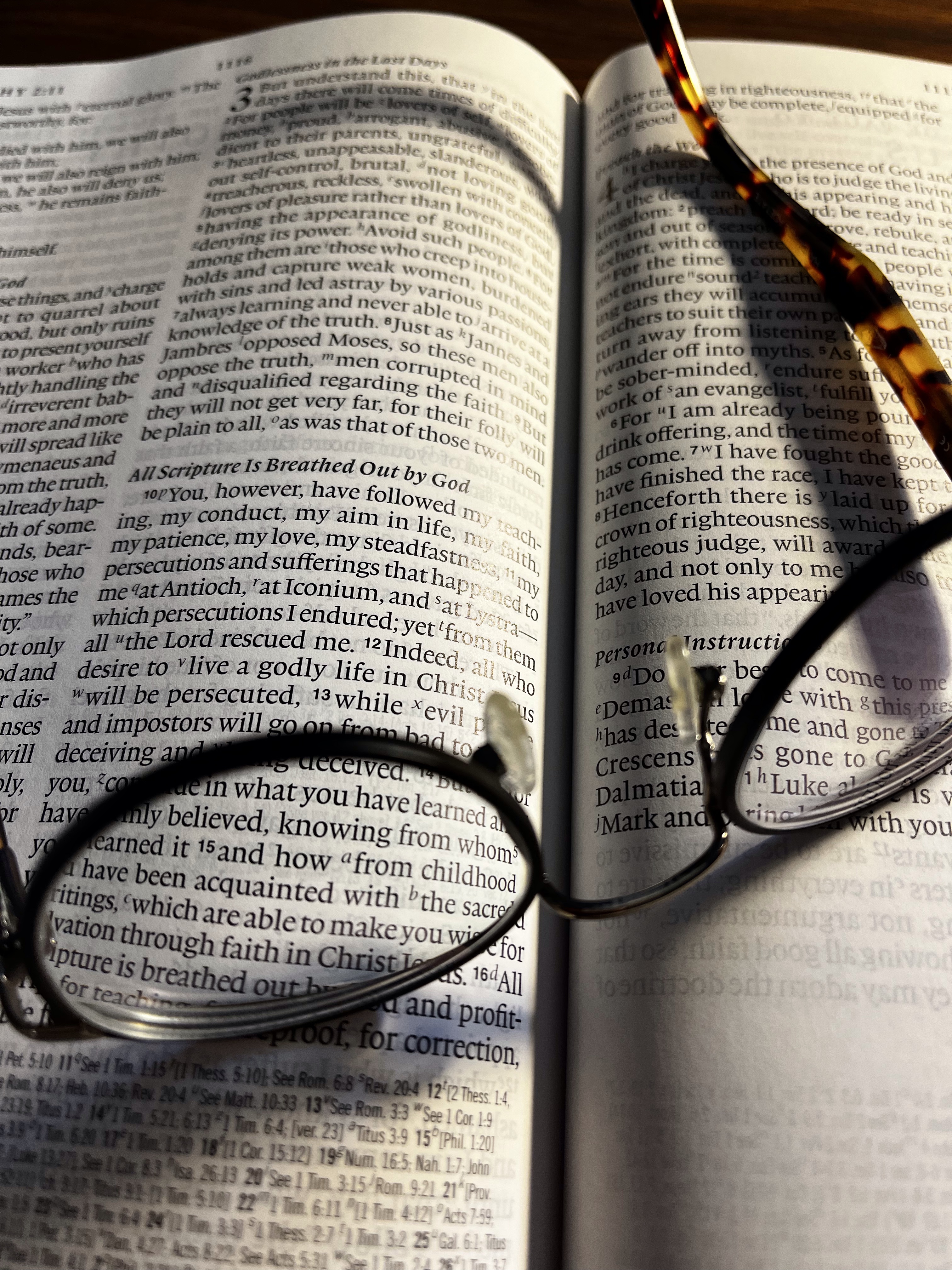
2 Timothy 3:14–4:5 (ESV): 14 But as for you, continue in what you have learned and have firmly believed, knowing from whom you learned it 15 and how from childhood you have been acquainted with the sacred writings, which are able to make you wise for salvation through faith in Christ Jesus. 16 All Scripture is breathed out by God and profitable for teaching, for reproof, for correction, and for training in righteousness, 17 that the man of God may be complete, equipped for every good work.

4:1 I charge you in the presence of God and of Christ Jesus, who is to judge the living and the dead, and by his appearing and his kingdom: 2 preach the word; be ready in season and out of season; reprove, rebuke, and exhort, with complete patience and teaching. 3 For the time is coming when people will not endure sound teaching, but having itching ears they will accumulate for themselves teachers to suit their own passions, 4 and will turn away from listening to the truth and wander off into myths. 5 As for you, always be sober-minded, endure suffering, do the work of an evangelist, fulfill your ministry.

In the beginning was the Word, the logos, the divine Son and second person of the Trinity. Strictly speaking, Jesus — the incarnate logos — is himself the final word, the perfect self-expression of God which no other word needs to clarify or correct. But, Paul insists that Scripture is also a final word — derivative of the divine logos, yes, but a final word nonetheless; Scripture is the written word that mediates to us the living Word, Jesus Christ. It shares the truth and authority of Christ because it is breathed out by God. And that is evocative language. Adam was given life in the Garden through the breath of God which made him a living soul and an image-bearer of God. Jesus breathed on the disciples gathered in the upper room and in doing so bestowed on them the indwelling Holy Spirit. Paul wants us to understand that we find life in the Scriptures, that we are re-formed into the image of God through the Scriptures, that the Scriptures are the work and tool of the Holy Spirit. Strictly speaking, the Scripture is not authoritative in and of itself. Jesus says that all authority in heaven and on earth is given to him. But, he delegates authority: to Scripture, to the Church which is his body, and to his faithful ones. It is this secondary, delegated authority of Scripture to which Paul appeals. It is this delegated authority that makes Scripture profitable/useful for teaching, for reproof, for correction, for training in righteousness, for equipping the saints for service. It is this delegated authority of Scripture which makes one wise for salvation through Jesus Christ.

So, Paul exhorts Timothy to preach the word in season and out of season; to reprove, rebuke, and exhort, and always with complete patience. It falls to some of us to exercise this pastoral ministry; it falls to all of us to receive this pastoral ministry. In these last days, more perhaps than ever, we need the final Word — Jesus Christ — mediated to us through the final word of Scripture.

But Paul’s exhortation doesn’t stand alone, no text of Scripture does. We also need to hear Peter say:

2 Peter 1:19–21 (ESV): 19 And we have the prophetic word more fully confirmed, to which you will do well to pay attention as to a lamp shining in a dark place, until the day dawns and the morning star rises in your hearts, 20 knowing this first of all, that no prophecy of Scripture comes from someone’s own interpretation. 21 For no prophecy was ever produced by the will of man, but men spoke from God as they were carried along by the Holy Spirit.

The Reformation rightly emphasized the delegated authority of Scripture and rightly insisted that every Christian must have access to Scripture in his/her native tongue. But, too many sons and daughters of the Reformation have wrongly assumed this emphasis to mean that Scripture is a matter of private interpretation, that truth may be reliably discerned by the individual pouring over the Scriptures alone. In dethroning one Pope, the Reformation inadvertently enthroned countless others. Scripture did not originate with the will of man, and no prophecy (no telling forth) of Scripture is a matter of one’s own interpretation. Rather, we read Scripture in company with the Church, with the Great Tradition that spans time and space. We seek in Scripture that truth which has been believed everywhere, always, and by all. The final word is the consistent word spoken by the consensus of the faithful.

So, let me give a final word in summary. In these last day in which we find ourselves, difficult times will come. This is simply the beginning of the end which will not be realized until Jesus returns to make all things new. In these last days, we need a final word to re-orient us, to re-make us. That final word is Jesus, the perfect icon of God. But that living final Word is mediated to us in Scripture, the living and active word written, interpreted, and applied by the Holy Spirit. So, as good Anglicans, we pray:

Blessed Lord, who caused all Holy Scriptures to be written for our learning: Grant us so to hear them, read, mark, learn, and inwardly digest them, that by patience and the comfort of your Holy Word, we may embrace and ever hold fast the blessed hope of everlasting life, which you have given us in our Savior Jesus Christ; who lives and reigns with you and the Holy Spirit, one God, for ever and ever. Amen.

Posted in Uncategorized | 1 Comment

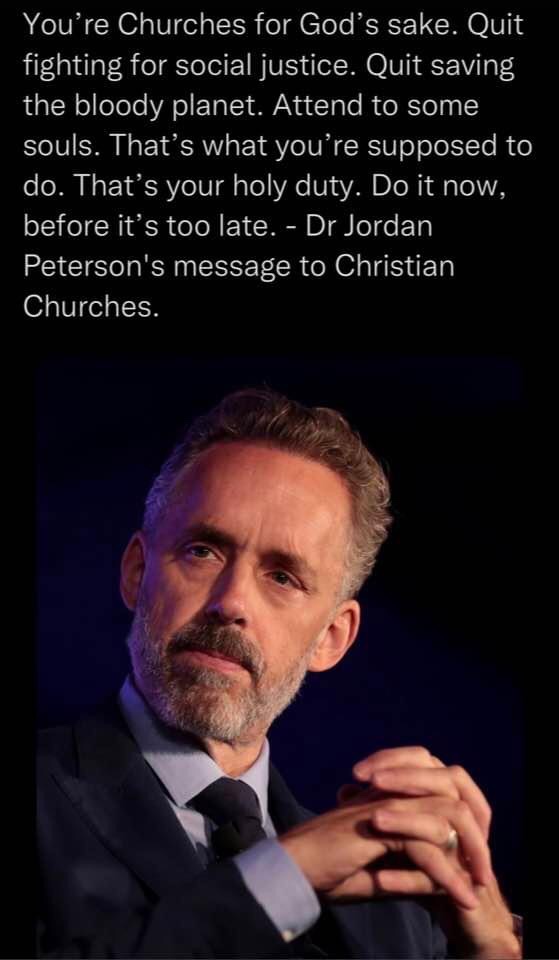
The Gospel According to Jordan Peterson

A sense of embattlement can make for some strange alliances. Some good and faithful Christians, feeling pressed by “woke” culture, CRT, social justice movements, gender and transgender legislation, are willing to make pacts with nearly anyone who shares their traditional, conservative values. And that concerns me.

Jordan Peterson is a case in point, and the quote presented shows the problem. The first and most obvious concern is that Dr. Peterson is, at best, an agnostic with an affinity for the Christian story; but he is not a Christian. That the Church should take its mandate, its marching orders from him, is prima facie questionable if not disloyal to the true head of the Church. It smacks of hubris for someone outside the Church to declare the nature of the Church’s mission and how that mission is to be accomplished — particularly when he/she does not understand that mission.

“Quit fighting for social justice,” Peterson demands. With what as the Christian alternative, I wonder: being content with social injustice, being unconcerned about and indifferent to social justice, abandoning the body politic to its own baser instincts with no prophetic voice calling it to repentance and pointing toward a better way? The consistent witness of Scripture is that God cares deeply for the poor, the widows, the orphans, the strangers — those most at risk and on the margins of society. God himself is their defender, not least through the Law he gave to Israel, a law that mandated social justice — adequate care — for these and other imperiled groups. The prophets consistently called God’s people in both Israel and Judah to repentance for two major transgressions: idolatry and social injustice. My strong suspicion is that the two sins are inextricably linked one to another. “Quit fighting for social justice?” Hardly, if the Church wants to be faithful to God. What we cannot do, though, is to embrace our culture’s definition of social justice nor its means for giving it birth. It is God’s definition of social justice to which the Church must be committed, and it is by means of the Gospel — God’s people living and proclaiming the Gospel — that justice will spring forth here and there, now and then.

“Quit saving the bloody planet,” Peterson says. Does he mean the planet that God created and called good, the planet over which he gave Adam and Eve stewardship, the planet whose rocks and streams, whose mountains and valleys, whose trees and stones God created to praise Him? That planet? And, what is the Christian alternative: to pollute without concern, to mine and drill and harvest with no care for future generations, to make pristine water undrinkable and air in cities unbreathable? We Anglicans — and others — regularly say or sing one the great canticles of the Church, “Benedicite, Omnia Opera Domini (A Song of Creation).” One of the stanzas makes the point eloquently:

Let the earth glorify the Lord,
praise him and highly exalt him for ever.
Glorify the Lord, O mountains and hills,
and all that grows upon the earth,
praise him and highly exalt him for ever.
Glorify the Lord, O springs of water, seas, and streams,
O whales and all that move in the water.
All birds of the air, glorify the Lord,
praise him and highly exalt him for ever.
Glorify the Lord, O beasts of the wild,
and all you flocks and herds.
O men and women everywhere, glorify the Lord,
praise him and highly exalt him for ever.

“Quit saving the bloody planet?” Then what will glorify the Lord with us? The Church must take up once again the human mandate given to Adam and Eve to steward creation, to rule over it — not in a domineering and usurious manner, but as God’s viceroys — so that at least outposts of Eden may be seen.

“Attend to some souls,” Peterson directs our attention. Yes and no. As it stands, the whole of Peterson’s exhortation is a Platonic or neo-Gnostic misunderstanding of the Gospel focused on disembodied souls. But, that is not the Gospel. The Gospel is the proclamation that, in and through the birth, death, resurrection, and ascension of Jesus Christ the Kingdom of God has been inaugurated on earth as in heaven, the proclamation that all the powers of death and hell have been defeated, that God will finally put to rights all that is wrong with the cosmos, and that all people are invited to become part of new creation — the union of heaven and earth when New Jerusalem descends from heaven to earth. This is not about disembodied souls being fitted for and one day snatched off to heaven, but rather about the bodily resurrection of the righteous to the life of the ages in a redeemed and new creation. “Attend to some souls?” Not quite. Attend to flesh and blood image bearers of God. Proclaim the full Gospel of Jesus Christ who took on flesh and blood to redeem flesh and blood and who even now bears our humanity eternally before the Father.

Peterson seems concerned — whether his concern is real or not I cannot say — that the Church and its mission will be co-opted and compromised by what he deems to be the worst elements of “woke” culture. But his remedy would simply co-opt and compromise the Church in his own image. Better simply to proclaim the full Gospel that certainly includes Godly social justice, Godly stewardship of creation, and the salvation of our souls and bodies through Jesus Christ our Lord.

Posted in Uncategorized | 1 Comment

Questions and Challenges: Part 5

“And why does it [the Bible] include stoning, torture, murder, burning, slavery, homophobia, bigotry, and chauvinism?”

I don’t remember how old she was, but I distinctly remember telling my daughter that she was now old enough to create problems that I couldn’t solve for her. No more easy daddy-to-the-rescue: she would henceforth have to bear the consequences of her own actions. I hoped it would be a sobering warning — not that my daughter was a hellion! — and one that would forestall potentially careless behavior and ill-considered choices. That is one of the very difficult coming-of-age lessons that many of us learn the hard way.

Something akin to that scenario plays out in the opening chapters of Genesis:

Genesis 2:15–17 (ESV): 15 The Lord God took the man and put him in the garden of Eden to work it and keep it. 16 And the Lord God commanded the man, saying, “You may surely eat of every tree of the garden, 17 but of the tree of the knowledge of good and evil you shall not eat, for in the day that you eat of it you shall surely die.”

The Lord God has placed Adam in Paradise with a single proscription and a warning; if you eat of the tree of the knowledge of good and evil, you will bear the consequence — and the consequence is death. Of course, you know how the story goes. First Eve and then Adam ate, and God confirmed the consequences:

Genesis 3:16–19 (ESV): 16 To the woman he said,
“I will surely multiply your pain in childbearing;
in pain you shall bring forth children.
Your desire shall be contrary to your husband,
but he shall rule over you.”

17 And to Adam he said,
“Because you have listened to the voice of your wife
and have eaten of the tree
of which I commanded you,
‘You shall not eat of it,’
cursed is the ground because of you;
in pain you shall eat of it all the days of your life;
18 thorns and thistles it shall bring forth for you;
and you shall eat the plants of the field.
19 By the sweat of your face
you shall eat bread,
till you return to the ground,
for out of it you were taken;
for you are dust,
and to dust you shall return.”

That Adam’s actions not only had consequences for himself but for all his offspring is painfully evident in the following chapters of Genesis and in the whole of human history. None of us is immune to those consequences. The theological term for this is original sin or ancestral sin. We are born oriented away from God and our own actions take us farther in the wrong direction. And we suffer grave consequences as a result. We do terrible things to one another. Stoning, torture, murder, burning, slavery, bigotry, and chauvinism the meme mentions, but there are so many more evils we inflict upon one another: deceit, slander, sexual and emotional abuse, war, genocide — the list is endless. My interlocutor wants to know why the Bible includes these things? Because they are the leitmotif of human history. The Bible is full of sin and misery because it is telling the human story and because humans are full of sin and misery.

The problem is actually far worse than the meme reckons. The Bible is also full of fire and flood, drought and famine, storm and plague — a host of what we call “natural disasters.” But, they are far from natural, far from how God designed nature to function for the benefit and blessing of man. No, these too are consequences of our actions; our sin threw nature out of joint, subjected it to randomness, entropy, chaos, and vanity. Our sins still do. The Bible reflects the brutal reality we created and are still creating.

The singer Michael Card summarized the situation painfully well: “We were intended to wake up in a garden; instead we find ourselves in a sin-impregnated world.”

Is this what the meme had in mind? Probably not. Given its overall tone, I suspect the real question lies more nearly along these lines: Why does God allow — and sometimes even mandate — stoning, torture, murder, burning, slavery, homophobia, bigotry, and chauvinism? If so, the meme attempts unfairly and unreasonable to shift the blame from man to God. None of these evils existed in Paradise; all of them resulted from human sin.

While it is a fool’s errand to attempt to justify the ways of God to man, I would like to address of few of these “charges” against the Bible and ultimately against God.

Our legal system — indeed I suspect every legal system — mandates punishment for crimes against persons and property. The most basic mandates of any social hierarchy are to maintain order and to protect the members of the group, and these punishments are intended to deter infractions. Some cultures employ mediation and reconciliation; others opt for fines, incarceration, and, in extreme cases, capital punishment. In these capital cases, various societies have devised clever means for dispatching the offender: the gallows, the guillotine, the firing squad, the electric chair, the lethal injection. Likewise, the Law of Moses mandated punishment for sin; all crimes were also considered sins against God. The worst of these punishments was stoning. While it may seem particularly brutal to us, it differs only in kind but not in degree from more modern methods: dead is dead. On rare occasions, after an offender was stoned, the body was also burned. This was probably a symbolic cleansing by fire of the residue/taint of sin left behind by the offense committed. As to torture, there simply was no explicit torture mandated in or allowed by the Law unless one considers lex talionis (eye for eye and tooth for tooth) torture. I do not. Lex talionis was given not primarily for retributive purposes but rather for protective purposes. It limited the revenge that one could exact for a wrong done. A man blinded in one eye could not by way of retribution kill his offender. Far from sanctioning torture, lex talionis was a major step toward loving your neighbor as yourself.

It is true that slavery was allowed under the Mosaic Law. But again, the Law regulated the practice in ways unknown in surrounding cultures and limited the power of the slave owner over the slave. This is true certainly because God cared for enslaved peoples, but also certainly because the Hebrews had themselves been enslaved. That memory is a constant drumbeat throughout the Law and the Prophets. Consequently, when, because of poverty, a Hebrew sold himself into servitude to another Hebrew, the slave was never considered as property; he was permitted the option of going free after a maximum of six years of servitude. Nor was he to be freed empty handed. The former master was required to provide sufficient material resources for the slave to establish himself as a free man. So yes, slavery was a historical reality, even in Israel. But, if you were forced into slavery by war or poverty, best to be a slave in Israel where God had mandated protections for slaves. Those interested can read more about the slave code in Exodus, Leviticus, and Deuteronomy. A final word about slavery is in order. Slavery was also part of New Testament culture. Neither Jesus nor his disciples directly condemned it. But, Jesus planted the seeds, and Paul watered them, that led to the abolition of slavery among Christians and largely throughout the Western world. They created a though world in which Christian slavery was no longer tenable.

I have not yet addressed the issue of homophobia for this simple reason: I reject the charge. The word as most frequently used connotes hatred or animosity toward homosexuals, and I do not find that in Scripture. The Bible does proscribe homosexual relationships — both gay and lesbian — in no uncertain terms. But the Bible also proscribes a variety of heterosexual behaviors as well: premarital sexual relationships, adultery, incest. God created and designed man — male and female — for human, sexual intimacy, but intimacy within certain bounds that promote human flourishing — the bounds of life-long, monogamous, heterosexual marriage. Christians have no phobia — what a stupid and ill-suited term! — toward those who violate those bounds and certainly no hatred. But, we cannot approve, accept, or promote the behavior as something that promotes human flourishing. I am not dieselphobic. I do not hate someone who puts diesel fuel in a car with a gasoline engine. But I could not promote the practice as appropriate for the design of the vehicle; it will not promote automotive flourishing, and will, in fact, lead to destruction. This is not, as it may appear to be, a foolish analogy. The Creator alone has the knowledge and right to specify the parameters of human flourishing. He has made explicit that homosexual relations fall outside those parameters. You may choose to put diesel in your Honda Civic, but it will not run well or run long. To tell you that is not an act of hatred, but of concern.

And lastly, chauvinism. This non-specific term is difficult to address because I do not know precisely the charge being leveled against Scripture. My assumption is that the meme is deriding the Bible for male chauvinism — a typical charge — that is, for misogyny. I would ask my interlocutor to read the Bible again carefully to note the prominent role of women in both the Old and New Testaments, not least the fact that when God chose to unite his divinity with our humanity he did so by being born of a woman. It is beyond question that no human — other than our incarnate Lord Jesus — is as central to our faith as is the Blessed Virgin Mary. That is hardly chauvinistic. Further, it is simply a historical fact that Christianity grew so rapidly in the first few centuries of the common era in large part because it appealed to the poor, to slaves, and to women because of the high regard in which these normally disenfranchised groups was held in the Christian community. Far from oppressing women, the New Testament — and, yes, Paul — actually elevated the status of women in the church over their status in the surrounding cultures.

“And why does it [the Bible] include stoning, torture, murder, burning, slavery, homophobia, bigotry, and chauvinism?”

Well, we have made a mess of God’s good creation. God is in the process of redeeming man and restoring creation. But, it is a long game, not least because he desires to use fallen men and women — redeemed humans struggling toward holiness — as his agents of renewal. Our prayers, our work, our love can make and have made a difference in the world.

A final word as I bring the series to a close. I have found that many people reject the Bible and level these meme-like charges against it based upon a child’s level of familiarity and understanding. Perhaps they attended church in their youth, learned a few Bible stories, and then drifted away from the church in their adolescence or young adulthood. Then, without a serious, adult study of Scripture they attack it as something childish and even morally deficient. My challenge to them would be to put the memes away and engage in a serious, reflective, open minded, prolonged study of the Bible. I suspect that, at the end of such study, even if they have not embraced the faith, they would at least have developed a greater appreciation and respect for the Biblical perspective.

Posted in Uncategorized | Leave a comment

Questions and Challenges: Part 4

“And why is it [the Bible] open to so many interpretations?”

Recently, the United States Supreme Court threw a lighted match on the woodpile of established legal precedent and kindled a wildfire of public outrage on one hand and public celebration on the other. For fifty years the Roe v Wade decision had guaranteed the constitutional right of women to have access to legal abortion. The current Court (2021-2022 term) determined that it predecessor had decided the matter wrongly, that previous Justices had misinterpreted the United States Constitution. In 1973, seven Justices struck down a Texas law banning abortion; two Justices dissented. In 2022, that original ruling was overturned by a 6-3 majority. Not to bore you with math, but that means, taking the two decisions together, eight Justices determined that the Constitution does not guarantee the right to abortion and ten determined that the Constitution does enshrine that right. The Justices are pretty even divided over contradictory interpretations of the Constitution.

My point here is not to debate abortion rights, but rather to raise this question: How can eighteen expert jurists, spread over fifty years, reach such contradictory interpretations of the same relatively brief and straightforward document? Does the explanation lie with the jurists, with the Constitution, or perhaps at the intersection of the two?

The meme to which this series of articles responds poses the question/challenge:

And why is it [the Bible] open to so many different interpretations?

Clearly, that question could be posed to the Constitution, to almost any set of statistical data, to modern song lyrics, to essentially any complex act of human communication. The Bible is far from unique in admitting of multiple and disparate interpretations. I suspect the real intent of the meme’s question is more along these lines: Why couldn’t God communicate more clearly? The simplest answer to that — and I don’t mean this flippantly — is that God is communicating with humans. And not just any humans, but fallen humans with diminished powers of perception, reason, and holiness. Shakespeare wrote, “The fault, dear Brutus, is not in our stars, but in ourselves.” Something very like that obtains here.

The Supreme Court Justices do not come tabula rasa to their deliberations, but rather as full human beings formed uniquely by life experiences, by education, by philosophical leanings, by faith convictions, and by a host of other known and hidden factors. Try as they might to lay these aside to make objective deliberations, it simply is not possible. They are subjects and not objects; hence their every decision is inherently subjective. That is not wrong; it is simply the reality we must face.

The same is true when we approach Scripture. We have been formed, and that formation becomes the lens through which we read the text. We are no more objective than are the Supreme Court Justices; we, too, interpret the text subjectively in multiple ways and reach split decisions.

So, the real question is not why the Bible is open to so many different interpretations. The more important issue is how better to read the Bible so that our interpretations converge toward a consensus of the faithful. Perhaps I can offer a few suggestions.

If you were to go to a university book store and peruse a graduate text on quantum mechanics, you likely wound not expect to understand it immediately and fully. The author is expert enough to have had a text published, and the author, editor, and reviewers certainly endeavored to make the text as clear as possible, and yet you still likely will not understand it. The problem lies not with the text but with the reader. You simply do not have the prerequisite knowledge to understand this complex topic. To those who do, I apologize; but surely you can image a topic in which this same analogy obtains. If you want to understand quantum mechanics generally and this text specifically, you must devote yourself to study, preferably with mentors, for years. That makes sense, doesn’t it?

And yet, with no prerequisite study, with no training, people pick up a Bible and expect/demand everything to be clear. Let’s get this straight: Scripture is not a simple text; to attempt to understand God and his ways is certainly as challenging as attempting to master quantum mechanics! It requires work and study. That should not come as a surprise, though it seems to scandalize many. The real surprise, the real “scandal” is the extent to which God has condescended to make himself and his word transparent to the simple, which is to say all of us. It actually is possible for the untrained, for unlearned, for the casual reader to garner much truth from the pages of Scripture. The Bible, at least much of it, presents as a story, and we are inherently story-making beings. In the story we see people as we are, people with the same hopes and fears and dreams and desires that we have, engaging with the divine. And we understand much of that deep in our bones. We hear Jesus’ parables and, even if we don’t perceive all the nuance there, we are amazed at the depth of love and forgiveness the father shows the prodigal son and we rightly intuit something of God’s love for us. We hear Jesus, unjustly crucified, say, “Father, forgive them for they do not know what they are doing,” and our amazement is a form of understanding. So, as Augustine heard the child singing, I too say, “Take and read.” Much will be clear.

But, if we want to follow the complex structure of say Romans — or most any of St. Paul’s epistles for that matter — we must study diligently both the Old and New Testaments, not just their content but their cultural contexts, as well. Some among us must study the original languages of the texts and bring that knowledge to bear on issues of translation. This does not mean that one must attend seminary to read the Bible. But it does mean that one must take the Bible seriously and devote time and attention to read it well. It means that one must utilize available resources, e.g., commentaries and educational programs at church. We are blessed to live in a period when so many of these resources are readily — and often freely — available.

Now, I certainly don’t want to discourage anyone from simply picking up the Bible; God forbid. Nor do I wish to imply that mental acuity and specialized learning are the non-negotiables required for proper Biblical interpretation. I am simply saying that a dilettante is less likely to read the Bible well than is a dedicated life-long student of Scripture. Oftentimes, the problem with interpretation lies not on the pages of Scripture, but on the far side of them with the reader.

But, another contrasting point must be made, as well. The purpose of reading Scripture is not primarily to “know” the Bible, but rather to know the Lord of the Bible: not primarily to understand Scripture, but to stand under the authority of the Lord mediated through Scripture. The expertly trained Biblical scholar in the academy who is not also a faithful disciple, has less understanding of Scripture than the humble, semi-literate saint who devotes himself/herself to faithful obedience. Jesus said that the pure in heart — not the elevated in mind — will be blessed to see the Lord. It is good to be a scholar; it is essential to be a saint. It is said of St. Francis that he viewed the Bible not as a book to be read, but as a script to be acted. In looking for right interpretations of Scripture, look to the saints; better still, dedicate yourself to becoming one.

Now, for a few brief practical guidelines.

Read the Bible with the Church: with your local parish/congregation, certainly, but also with the catholic (universal) Church spread across the world and extending across time. No Scripture is subject to private interpretation, Peter tells us. We must read, study, pray, and worship with the Church. May I be blunt? If your parish/congregation is not devoted to the consistent public reading and teaching of the whole of Scripture in conversation with all the generations of the faithful gone before, you need to find another church. Don’t settle for warmed-over, pseudo-Christian, pop-psychology, self-help lectures, no matter how charismatic the minister. Demand Scripture or leave.

And note that I said the whole of Scripture. The Bible is in conversation with itself, one part expounding another, one part providing essential background for another. Read the whole of Scripture in a regular, disciplined way. There are several lectionaries that make this possible. There are one-year and two year Bibles and chronological Bibles. A friend once told me that it is the verses that you haven’t underlined in your Bible that may be the most important. It may be the books you haven’t read that make all the difference.

Read Scripture through the lens of the Church’s rule of faith, the Nicene Creed. For some seventeen hundred years, this creed has been the non-negotiable summary of the essentials of the Christian faith used by the Church universal. If your private interpretation of Scripture contradicts this rule of faith, then your private interpretation of Scripture in in error, by which I mean it is heterodox and outside the boundaries of the consensus fidelium, the consensus of the faithful. Let the Creed guide your interpretation.

Along this same line, let the Vincentian Canon be a filter for your interpretations. St. Vincent of Lérin, a fifth century monk, was concerned about distinguishing between true and false teaching. He developed a threefold test; the truth is likeliest to be found in that which has been believed everywhere, always, and by all: ubiquity, universality, and unanimity. If an interpretation is isolated to a particular geographical or cultural region, if it is novel, if it is greatly disputed, it is not likely to be correct. This is not a perfect tool, but it is a very good one.

There is so much more to be said, but I must stop somewhere. Still, I would be remiss if I failed to mention this: read Scripture on your knees. By that I mean “soak” your reading in prayer. Ask the Holy Spirit — the true Author and Interpreter of Scripture — to purify your heart, enlighten your mind, strengthen your resolve, and glory Christ in you. Also, read the Bible in conjunction with the Sacraments. From its earliest days, the worship of the Church included the reading, preaching, and teaching of Scripture and the celebration of Holy Eucharist (Communion, the Lord’s Supper, the Mass). These two necessarily belong together.

Why is the Bible open to so many different interpretations? Because it is a complex word delivered into the hands of fallen human beings. And yet, Scripture always has and always will transcend all our limitations to draw people beyond the written word to Jesus the living Word who is the source of life.

Posted in Uncategorized | Leave a comment

Questions and Challenges: Part 3

“And why does it [the Bible] have so many inaccuracies and inconsistencies?

I am not a rector, the priest-in-charge of a parish. But, throughout my life and in a few churches I have been in positions of spiritual leadership with a certain limited authority. It is not uncommon for such a figure to receive a complaint from a parishioner/congregant followed by this or similar statement of emphasis, “And you know, I’m not the only one who feels this way. There are several others, and I speak for them, too.” As far as I am concerned — God help me — there is only one proper response to such a thing: “Well, trot them out so I can deal with their specific complaints one-by-one and face to face.” There is no real place in the church for nameless others and generic complaints. It is impossible to effectively address either.

I feel that same way with the challenge before me in this post: “And why does it [the Bible] have so many inaccuracies and inconsistencies?” To this I want to respond, “Well, trot them out so I can deal with them one-by-one, specifically and not generically.” This complaint, as it stands, lacks the courage of its convictions. It is not possible to refute such a general and baseless charge. And yet, I must say something about it, I think.

I remember the impeachment trial of President Bill Clinton and his infamous statement, “Well, it depends on what the meaning of “is” is.” Oh, Bill: if you have to parse the language that precisely, you might just as well admit that the charge against you is true. What I am about to do might seem similar, but I think it is not at all the same. The charge stands that the Bible contains “many inaccuracies and inconsistencies,” to which I’m afraid I must respond, “ Well, it depends on what you mean by inaccuracies and inconsistencies.”

Let me explain by way of example. The opening line of Charles Dickens’ great novel A Tale of Two Cities reads:

It was the best of times, it was the worst of times, it was the age of wisdom, it was the age of foolishness, it was the epoch of belief, it was the epoch of incredulity, it was the season of Life, it was the season of Darkness, it was the spring of hope, it was the winter of despair, we had everything before us, we had nothing before us, we were all going direct to Heaven, we were all going direct the other way — in short, the period was so far like the present period, that some of its noisiest authorities insisted on its being received, for good or for evil in the superlative degree of comparison only.

Well, Charles, which it it? Pick a side. Can you image a single sentence more crammed full of inaccuracies and inconsistencies? And yet, we do not count this as such because we recognize the form as a beautiful literary device used to great effect by the author to tell a single truth; it was an age of hyperbole, the best and worst of everything co-mingled and co-existing. Only an illiterate would accuse Dickens of authoring inaccuracies and inconsistencies. But, many Biblical critics fall into just this unfortunate habit. By failing to appreciate and understand the Biblical text for what it is — its various literary, theological, and historical forms — they find inaccuracies and inconsistencies where there are none, where, in fact, there is great truth.

Let’s consider the Gospels, for example. If you assume that these are documentary style historical records in the modern sense — what a reporter with camera and microphone would have seen and heard had one been present — then you will find inaccuracies and inconsistencies. But, history of that kind is a modern literary form unknown to the four evangelists and their historical contemporaries. For them, for much for much of human history, written and oral history was an agenda-driven recounting of events. Don’t misunderstand: the events were not fictitious, were not made up of whole cloth. But, neither were they simply reported “objectively.” They were edited, arranged, interconnected to achieve a purpose. St. John says as much; he lays his cards on the table near the end of his Gospel:

John 20:30–31 (ESV): 30 Now Jesus did many other signs in the presence of the disciples, which are not written in this book; 31 but these are written so that you may believe that Jesus is the Christ, the Son of God, and that by believing you may have life in his name.

John, probably an old man when he writes this, has reflected on the events surrounding Jesus for an entire lifetime, has woven them into worship and prayer and faithful service, has based his life on them. And now he tells them in a unique, theologically reflective way that he prays will conduce to faith in his readers. In doing so, he pens a narrative that looks very different from the other three Gospels, the Synoptics (same view). Careful readers will notice the differences. One, in particular, stands out to me. John seems to place the death of Jesus a full day before the authors of the Synoptics. Why? To make the death of Jesus coincide with the sacrifice of the Passover lambs at the Temple, to show the blood of Jesus as that which averts death, to show the death of Jesus as the beginning of God’s new exodus and liberation of his people. John is not making a chronological statement but rather a theological one. This is not an inconsistency or inaccuracy because John never intended to give his readers a precise timeline of events; he is giving his readers something much more important — the deeply theological meaning/truth of the events. Bible critics will point to this as a problem; Christians accept it as a gift.

There are other differences even amongst the Synoptic Gospels. The Sermon on the Mount in Matthew becomes the Sermon on the Plain in Luke. And, the text of the Beatitudes and the Lord’s Prayer differ in the two Gospels. If you are of a mind to, you can explain away these differences: surely, Jesus had a basic “stump speech,” a standard “ready-to-hand” sermon and prayer that he taught throughout Galilee, adapting them as necessary for the people and the places. But really, why try to account for the differences at all, as if they actually are inconsistencies and inaccuracies? That is is give far too much credence to a baseless, generic charge against Scripture. They are simply different tellings of a common, received tradition adapted to the purpose of the author and the needs of his readers: nothing more or less, and certainly nothing compromising or nefarious. The different accounts of the events of Resurrection (Easter) morning fall in this same category. It is difficult to reconstruct a specific timeline and dramatis personae — who was there, when and where. That is not the point of the story. Something so unexpected, so radical, frankly so unbelievable has occurred that you cannot image a polished, connect-the-dots recounting of it. Only a somewhat breathless, slightly askew narrative can even begin to do justice to the wonder of this inbreaking of the Kingdom of God. This is theological literature — by God! — and not some humdrum “just the facts, ma’am.” If you still want to insist that these differences constitute inconsistencies and inaccuracies, I can only suggest that you learn the art of story telling and then get back with me. Also, read some real theology while you’re at it.

Without the plaintiff coming forward to identify specific inconsistencies and inaccuracies, this is perhaps the best I can do by way of defense and rebuttal. Actually, I can think of several other examples of supposed contradictions that are usually hauled out to debunk the Bible. I could mention them and address them, but why should I do the plaintiff’s work for him? No, if he has specific charges to make, he must trot them out himself.

Now, I am going to say something that might shock some of you. Here I express my own opinion and you are free to disagree. I would not be bothered by minor, real, factual errors in the Bible. Suppose, for example, that a chronicler made a mistake in the order of succession of two Israelite kings. Would such a thing invalidate Scripture? I think not. Remember that, as with most everything God does in relation to the world, there is dual agency at play: God and man as co-workers to achieve God’s will. For some reason that I don’t fully understand, this is the way that God chooses to work. He condescends to unite us — our gifts and our flaws — to himself and to grant us the dignity of working with and for him. And — no surprise — humans are not perfect; we make mistakes. The human co-authors of Scripture were not exceptions. Please don’t let this scandalize you; I offer it as a personal conviction and you are free to reject it. But, I would ask you to consider this. Read the Gospels. Read the Acts of the Apostles. Read Galatians, especially chapter two. Ask yourself this: were the apostles inerrant? Peter, Paul, James, John were terribly flawed individuals. And yet they were faithful. And yet, God did not hesitate to put the Church into their hands. There is an old saying that God draws straight with crooked lines. The whole of Scripture shows that to be true. The apostles made some real blunders and were not thereby invalidated or cast aside as useless. Can we possibly grant the same grace to the authors of Scripture?

Well, whatever you think about that, here is what we can say with certainty about the Scriptures: it is the book that God has given us, the book that God wants us to have, the book through which the Holy Spirit works for us and for our salvation. Paul says it best, and we really need to say nothing beyond this:

2 Timothy 3:14–17 (ESV): 14 But as for you, continue in what you have learned and have firmly believed, knowing from whom you learned it 15 and how from childhood you have been acquainted with the sacred writings, which are able to make you wise for salvation through faith in Christ Jesus. 16 All Scripture is breathed out by God and profitable for teaching, for reproof, for correction, and for training in righteousness, 17 that the man of God may be complete, equipped for every good work.

And that is why my faith would not be shaken if an interlocutor could produce a real, factual error in Scripture, a minor slip of the author’s pen. The sacred writings — as we have them and not in some imagined pristine form — are able to make us wise for salvation through faith in Jesus Christ. That is their purpose.

Posted in Uncategorized | Leave a comment

Questions and Challenges: Part 2

“And why are there so many versions of it (the Bible)?”

(Please refer to the previous post, https://firstblessings.blog/2022/07/08/questions-and-challenges-part-1/, for the origin and context of this “project.”)

If you want to read the Koran, you must learn Arabic, the language in which that sacred text was/is written. An English translation of the Koran is just that, a translation and not the Koran itself. For Islam, truth is language specific and translation inevitably entails diminishment and distortion.

Not so in Christianity, not since the first public Gospel proclamation on Pentecost. The scene is dramatic. The disciples of the Lord were all gathered in one place on that day when the Holy Spirit rushed upon them with the sound of a violent wind and appeared upon them in divided tongues like fire. And they began to speak in other languages. Divided tongues and other languages is suggestive and symbolic of what happens next. St. Luke continues the story:

Acts 2:5–12 (ESV): 5 Now there were dwelling in Jerusalem Jews, devout men from every nation under heaven. 6 And at this sound the multitude came together, and they were bewildered, because each one was hearing them speak in his own language. 7 And they were amazed and astonished, saying, “Are not all these who are speaking Galileans? 8 And how is it that we hear, each of us in his own native language? 9 Parthians and Medes and Elamites and residents of Mesopotamia, Judea and Cappadocia, Pontus and Asia, 10 Phrygia and Pamphylia, Egypt and the parts of Libya belonging to Cyrene, and visitors from Rome, 11 both Jews and proselytes, Cretans and Arabians—we hear them telling in our own tongues the mighty works of God.” 12 And all were amazed and perplexed, saying to one another, “What does this mean?”

Peter then explains what it means, and it means more than he explains. But one implication is clear: the Gospel is for all people in all languages. Unlike the Koran, the Gospel truth is not language specific. Translation is not only possible; it is God ordained. That conviction is a hallmark of the Reformation with its insistence that all people must have access to Holy Scripture in their own language and that public worship must be conducted in the common tongue.

And that brings us inevitably to the challenges of interpretation, the translation of a sacred text from the source language (the language in which it was written) into the target language (the language of the reader). I am no expert on this, but I can speak to it in general terms that should address the relevant challenge.

Those of you who are bilingual, or perhaps multilingual, will understand that each language has its own patterns and forms, that individual words have a fullness and richness in one tongue that are not perfectly conveyed in another. That doesn’t make accurate translation impossible; it makes it challenging. And it makes multiple good and accurate translations both possible and inevitable.

Perhaps a brief example will help. You may know that the New Testament was written in Koine Greek, not the Greek of the academy, but the common Greek of the marketplace. There are a few words of Aramaic in the New Testament, but the number is vanishingly small and need not concern us. Consider the first verse of the Gospel according to St. John:

En archē ēn ho logos, kai ho logos ēn pros ton theon, kai theos ēn ho logos.

Suppose we attempt a word-for-word translation from Greek into English. We run into difficulties almost immediately:

In beginning…

In beginning. But, wait; that doesn’t sound right in English. We would say in the beginning. The Greek lacks the definite article the. Should the translator insert it or not? Let’s continue.

In (the) beginning was the logos…

Logos is a richly textured and philosophically complex term. It can mean something as straightforward as word. But it also contains connotations of character, order, pattern, even goal/purpose. So, how is the translator to choose?

The whole of John’s Prologue, John 1:1-18, is a clear allusion to the creation account in Genesis 1; John is providing a Christ-centered retelling of creation. How did God create? By speaking the word: let there be. Since the word was God’s “instrument” of creation and since John insists that all things were created through Christ the logos, translating logos as word makes the essential connection that John intended. So, a reasonable and faithful translation of John 1:1 begins:

In (the) beginning was the word…

We will stop our translation exercise here, but you see that it is a challenging process, that choices must be made, and that different choice are both possible and reasonable. Some translators adopt a philosophy known as formal equivalence, in which they attempt to retain as much of the structure of the source language as possible. These produce accurate and faithful translations, though they read a bit awkwardly and stilted in English. The New American Standard Bible is an example of this translation philosophy. Other translators opt for dynamic equivalence, a more thought-for-thought translation. In this method, the primary questions are (1) What did the author wish to communicate in the source language? and (2) How might that best be expressed in the target language? These also produce accurate and faithful translations with this “advantage”: they read well as an English text. The New Revised Standard Version is an example of this method, though some think it carries the philosophy a bit far. Again, though I am not an expert on this topic either, it seems to me that American Sign Language (ASL) provides a good example of dynamic equivalence. As I understand it, an ASL interpreter does not sign each word the speaker says, but rather communicates each thought in sign. And that means that two equally proficient sign language interpreters might well communicate oral speech differently, though each would communicate it well and accurately.

So, why are there (so many) different versions? The most basic answer is that Christians believe that Scripture must be translated into the languages of all the people. Since translation is a complex and challenging task requiring many choices, it is inevitable that slightly different versions result. It is worth noting that most translations — certainly those that are most widely used in the church and in the academy — are performed by committees of expert linguists and theologians who take the task most seriously. Frankly, most any of the modern translations so prepared are good and reliable. Better still, the serious reader will use multiple translations, ideally ones representing the best of each translation philosophy. And, if you can learn Hebrew and Greek, more’s the better.

There is another matter that contributes to the multiplicity of versions: study Bibles and “niche” Bibles. A study Bible contains explanatory notes, cross-references, maps, charts, etc., all designed to provide context and deeper understanding for the reader. There are Roman Catholic Study Bibles and Reformation Study Bibles. There are literary, theological, and chronological Study Bible. The list is almost endless. These versions do not change the Biblical text, but they do provide interpretations of it. And none of these interpretations is without theological bias. This presents a caveat emptor situation; let the buy beware. Simply be aware that the study notes are just that, notes and not inspired Scripture. Again, it is best to consult multiple Study Bibles and commentaries with different theological perspectives. “Niche” Bibles — and that is my term for them — are Bibles targeted for a particular demographic: women, men, police, military, nurses, teachers, etc. These Bible frequently have additional devotional reflections/materials geared toward the demographic. It is tempting to see this simply as a marketing strategy, but that is, perhaps, uncharitable. As long as the reader realizes that the devotional materials are not Scripture, there is little potential harm and perhaps significant possibility for good.

So, yes, there are several versions of the Bible available. Is this a challenge to the integrity of Scripture? I do not think so; rather, I think it is an indication of the seriousness with which translators take their vocation. It is, also, a benefit to the church in providing a richness and depth to the English biblical corpus that no single translation could provide.

Lastly, and very briefly, I should mention that the majority of English language translations are based on a mere handful of source language manuscripts which present an exceptional level of agreement among themselves. The most frequent variations in these manuscripts concern word order, e.g. Christ Jesus versus Jesus Christ, or alternate spellings of words on the order of colour versus color. Significant differences that impact theological interpretation are exceptionally rare. This means that we have a reliable source language texts from which to do the work of translation. Even though we have no original manuscripts, the copies evince a profound dedication of Christian scribes and scholars in preserving the accuracy of the original texts.

In summary, we should not be concerned about the availability of various translations; this is a strength and not a weakness.

Posted in Uncategorized | Leave a comment

Questions and Challenges: Part 1

In nearly three decades of teaching mathematics I found that the very best and the very worst students tended to ask the same question: When are we ever going to use this? From the best students this was an honest inquiry, a seeking to make connections with prior learning, to anticipate extensions to future learning, and to seek applications of principles and techniques. It was a joy to answer their question. From the worst students this was less an honest question and more a challenge: Why are you wasting our time with this totally useless nonsense? There was no joy in answering their challenge, nor was it really possible to do. It wasn’t a question and they weren’t looking for an answer. My default response was, I’m afraid, as unsatisfactory as their challenge: you probably won’t, but you never can tell.

Recently, on an Anglican Facebook page, a commenter posted this meme:

QUESTIONS FOR BIBLE BELIEVERS
If an omniscient, omnipotent, perfect being is the mastermind behind the Bible, then why does the book reflect only the culture, science, history, literature, technology, morals, and values of the era in which it was written? And why are there so many versions of it? And why does it have so many inaccuracies and inconsistencies? And why is it open to so many different interpretations? And why does it include stoning, torture, murder, burning, slavery, homophobia, bigotry, and chauvinism? And why would anyone have to ask so many questions about the Bible if it’s supposed to be the go-to source for truth and the ultimate instruction book for morality? Anyone?

These are not questions; they are challenges. They are not intended to promote discussion or to seek reasonable answers; they are intended to mock and disrupt. I know this because I rather foolishly attempted to engage in discussion with the person who posted the meme. It was to no avail. I suspected it probably wouldn’t be, but you never can tell.

Still, behind some of those challenges lurk real and legitimate questions — questions that many honest searchers have and, if they will admit it, questions that trouble many faithful Christians. I would like to try to formulate some answers — not final ones, but steps pointing in the right direction which others may fruitfully explore further.

But, there is a preliminary matter to address. Every teacher has experienced this: a good student asks a genuine question, but one which is so confused as to be unanswerable. “Given that this square has a circular radius of 4, what color will next Tuesday be?” The presuppositions behind the question are so confused and the question is so poorly formulated that no answer is possible. Good teachers help students clarify their questions: “What you really mean to ask is…”. So, before attempting to answer some of the challenges in the meme, I will need to re-formulate them as clear, legitimate questions. Shall we begin?

CHALLENGE 1: If an omniscient, omnipotent, perfect being is the mastermind behind the Bible, then why does the book reflect only the culture, science, history, literature, technology, morals, and values of the era in which it was written?

I propose that the heart of this challenge lies in the following question. In other words, What you really mean to ask…

QUESTION 1: Why is the Bible so particular to a people and its culture?

All human writers and all human readers are inescapably situated within a particular culture. There is no tale without a teller and no context for the tale without a culture. This is true even when science fiction authors create new worlds and new cultures. There must be sufficient intersection between our culture and the alien culture for us to identify, in at least some limited sense, with it. Otherwise the story lacks coherence and meaning. All communication is inescapably culturally conditioned; that cultural embeddedness is, indeed, essential to communication. There simply is no possible context-free, culturally unmoored way to communicate.

You may object that the Author of Scripture, not being human, is not so culturally bound. True enough, but we the readers are. So, for the sake of meaningful communication, the Author has condescended to communicate with us in a culturally specific manner that we can understand. So, it is perfectly reasonable that the Bible would reflect the culture of its human authors and its human readers; it simply could not be otherwise. Interestingly, NASA scientists confronted this same issue when they launched Voyager 1 and 2 satellites into interstellar space. The satellites carried golden records intended to communicate essentials of our world and species to whomever might encounter the probes in the future. The contents of those records are culturally particular, and the scientists are depending on there existing sufficient cultural overlap for “alien” cultures to make sense of the contents (see https://voyager.jpl.nasa.gov/golden-record/). There simply is no escaping the cultural nature of communication.

Culture provides a necessary context for communication, but that cultural context is not necessarily the content of the communication. Do we find “primitive” science and technology in the Bible? Yes. But that should concern us only if the Author’s purpose in the Bible were to teach science and technology. And that is simply not the case. These cultural matters form the context for the communication, but not the content of it. We understand this and accept it without question or concern in other great literature. Shakespeare presumes a certain scientific and technological worldview that differs from ours. And yet the meaning of his plays is not found there nor is it hampered by the presence of the cultural elements. Shakespeare is culturally particular in form, but his meaning transcends cultural boundaries to speak to the deepest part of the human spirit. All great literature does this; in fact, that is the definition of great literature. The Bible does this, as well. In speaking of the bronze sea, a large round basin in the temple where priests cleansed themselves for the sacrificial rituals, the Bible provides dimensions that approximate pi as 3. Well, we know today that pi is an irrational transcendental number and not an integer. “Ah, error in the Bible!” the skeptics cry. Well, not so unless God was trying to teach mathematics in the text. Yes, the first temple Jews thought pi was around 3. How does that impact the true meaning of the text — the necessity for symbolic spiritual cleansing before approaching a holy God? God was not giving us a mathematics lesson in the text. Good readers distinguish between context and content.

Let’s push this even a bit farther than did the original challenge. What about the creation story in Genesis? Isn’t it just a retelling of other ancient near eastern (ANE) creation myths. Hasn’t it been thoroughly debunked by Science? I capitalized Science because those who use it as a bludgeon against the Bible most often deify and worship it. So, as a matter or respect….

Yes, the Biblical creation story shares much in common with other ANE creation myths. Why would we think that strange or disqualifying? If I wish to communicate the meaning of creation to a people familiar with other creation stories, it seems to make sense to use a cultural form which they will immediately recognize. What is important is not the similarities of Genesis with other ANE creation myths but the differences. YHWH speaks creation into existence; it does not emerge spontaneously as the result of a cosmic battle. Biblical creation is ex nihilo; it comes from nothing but the will and word of God and not from the blood and carcass of a defeated god. God creates man from love and to love, not from a need for creatures to serve and feed him. So, yes, the Author of Scripture used and subverted a mythical form familiar to the readers to communicate these, and other, great and new truths.

What I say next will be controversial to many, but I do not shy from it, and, in fact, I insist on it. The creation account in Genesis makes no scientific claims. A scientific claim is one that can be repeatedly tested and verified/refuted using the scientific method, a method which developed only some four hundred years ago. To impose science on Genesis is destructively anachronistic. The purpose of Genesis is not to present or explicate a scientific understanding of God’s process of creation, but rather God’s purpose in creation. The Bible is a theological story, not a science text. There is a particular structure to the Biblical creation accounts that presents creation as the construction of a cosmic temple in which God would dwell with his people, a people who would be priests in the temple as well as prophets to and kings over creation. That is not science. That is a meaning and purpose which science cannot supply and cannot refute.

The original challenge found fault that the Bible presented only the morals and values of the culture from which it came. I can only surmise my interlocutor has never read the Bible or compared it with other ANE cultures. The Bible continually challenges the morals and values of the surrounding cultures by providing God’s people a blueprint for holiness, for being set apart by their worship and laws. Anyone who doesn’t recognize the superiority of the Mosaic Law over other ANE moral/ethical systems has failed to read ANE cultural history.

Lastly, the Bible is so culturally particular because it is the record of a particular people called and created by God to be his instrument through whom he would make himself known to the nations and ultimately redeem the world. The Bible is more than but not less than the story of a particular people and their experience with the God who called them into being and revealed Himself to them in a covenant relationship. God was not absent from other peoples and cultures, but he made himself particularly present to and known by the Jews. So, of course, the Bible would be specific to that culture while ultimately transcending it with a message for all peoples.

The fact that the Bible perdures, that its truth and influence have transcended its original culture to permeate many cultures, makes me think its Author chose wisely to present it in its particular cultural context.

This is not a complete answer to the challenge by any means. But, I hope it will show that one may indeed meet the challenge; there is no need to shrink from it. And I hope it will encourage you to take this farther than I have, to think it through more clearly than I have. I will address other challenges in future posts.

Posted in Uncategorized | 1 Comment

The Whys and Hows of Confession

Following is the transcript of a video presentation on the “basics” of the Anglican Rite of Reconciliation prepared for Apostles Anglican Church.

Confession. What images, what thoughts, what concerns, what questions arise when you think about the Rite of Confession? Do you picture a dimly lit church with a confessional booth in which an old man in a black robe leans in and listens intently through a lattice screen separating him from the penitent? Do you think of arbitrary penances: say thirty Hail Marys or ten Our Fathers? Are you concerned that confession is a “Catholic thing” that heirs of the Reformation have no business fooling around with? Do you question the need for confession to a priest: can’t you just confess directly to God and be forgiven?

In the next few minutes I hope to deal with these matters and more by giving you the Anglican understanding and perspective on the nature and use of sacramental confession. By sacramental confession I mean the same as the older term auricular confession: personal confession spoken out loud in private to a priest or bishop. The Rite of Confession in the Prayer Book is the liturgy that provides structure and words to the penitent and to the priest.

Let’s begin with the two most fundamental questions. Why do I need to confess to a priest? Can’t I just confess directly to God and be forgiven? Let me answer simply and directly; then I want to backtrack and nuance those answers a bit. First, no one must confess to a priest, ever. Second, everyone may confess directly to God and be forgiven, provided the confession is made with sincere repentance and true faith.

Now, let me backtrack and nuance those answers with a Gospel story, the raising of Lazarus. I’ll pick up the story midway through, with Jesus, the sisters, and several friends and townsfolk standing at the sealed tomb.

John 11:38–44 (ESV): 38 Then Jesus, deeply moved again, came to the tomb. It was a cave, and a stone lay against it. 39 Jesus said, “Take away the stone.” Martha, the sister of the dead man, said to him, “Lord, by this time there will be an odor, for he has been dead four days.” 40 Jesus said to her, “Did I not tell you that if you believed you would see the glory of God?” 41 So they took away the stone. And Jesus lifted up his eyes and said, “Father, I thank you that you have heard me. 42 I knew that you always hear me, but I said this on account of the people standing around, that they may believe that you sent me.” 43 When he had said these things, he cried out with a loud voice, “Lazarus, come out.” 44 The man who had died came out, his hands and feet bound with linen strips, and his face wrapped with a cloth. Jesus said to them, “Unbind him, and let him go.”

Likely from the beginning of Jesus’ prayer, but certainly from the moment Jesus called Lazarus out of the grave, death was defeated and Lazarus was alive. But notice how death and the grave still clung to Lazarus as he stumbled out of the cave: his hands and feet were still bound with the grave clothes and his face was still wrapped with a cloth — alive but still bearing the remnants of death, still hobbled by that which the Lord had already defeated. Have you ever noticed and thought about what happens next in the story? Jesus commanded those standing around — perhaps his sisters or friends — to unbind Lazarus and let him go. Jesus gave Lazarus life, but other human agents unbound him from the remnants of death.

This story is not just a declaration of Jesus’ power over death, particularly as he approaches his own death. It is also a potent image of sin and forgiveness. From the moment a penitent truly repents of sin and asks God for forgiveness, he/she is freed from sin. And yet, sometimes — often, my experience tells me — the remnants of sin cling to the person like grave clothes: doubts regarding the reality of forgiveness, shame, ongoing temptation. In such a case, Jesus calls other humans — priests — alongside the penitent to release him/her of these remnants of sin. It is about this that The Exhortation before Holy Communion speaks:

If you have come here today with a troubled conscience, and you need help and counsel, come to me, or to some other Priest, and confess your sins, that you may receive godly counsel, direction, and absolution. To do so will both satisfy your conscience and remove any scruples or doubt (BCP 2019, p. 148).

That priests are authorized by Christ to absolve a penitent is clear from Scripture (ref. Mt 16:17ff and John 20:21-23), from the Great Tradition of the Church, and from the Anglican Ordinal in which the Bishop prayers over the priest ordinand:

Receive the Holy Spirit for the office and work of a Priest in the Church of God, now committed to you by the imposition of our hands. If you forgive the sins of anyone, they are forgiven. If you withhold forgiveness from anyone, it is withheld (BCP 2019, p. 493).

So, to summarize, no one must confess to a priest to be forgiven, but many find the practice helpful. I suspect most would do, if they availed themselves of the rite.

But, let’s move beyond absolution, as important as it is. Confession is an opportunity for one to receive pastoral “counsel, direction, and comfort” (BCP 2019, p. 223). Suppose one is struggling regularly with a particular temptation. The wisdom of the Church tells us that temptation and sin breed in secrecy and in darkness, but wither in the open and in the light. It is helpful to confess temptation before it progresses to sin. This not only weakens the power of the temptation, but allows the priest to provide pastoral counsel and direction in overcoming the temptation going forward. That alone provides powerful justification for a regular practice of confession.

As to whether confession is a “catholic thing,” rest assured that it most certainly is! Catholic simply means “universal,” something that belongs to the whole Church throughout space and time. The most ancient and traditional expressions of the Church — Orthodox, Roman Catholic, and Anglican — all practice sacramental confession. Confession has been part of the Anglican Church from the very first Book of Common Prayer in 1549. It is a catholic thing in the true sense of the word.

Images of a dimply lit church and a confessional booth? Perhaps in some parishes, but certainly not here. If you come for confession it will likely be in the nave or in one of our prayer rooms, private but certainly not intimidating. You may sit or kneel and the priest will sit near you: no lattice screen, just two sinners sitting together in the presence of God to seek his mercy, one authorized to speaks words of absolution, but two sinners nonetheless. The rite itself is simple and straightforward. You can find it in the Book of Common Prayer 2019, pages 223-224, and it would be helpful to read through it before a first confession. If it is a first confession, the priest will likely talk you through the process before you begin so there are no surprises and no worries about “doing it right.” But, just so you will know, there are a few things actually required to “do it right,” to make a good confession:

• A spiritual inventory of sins based perhaps on the Ten Commandments, Jesus’ Summary of the Law, or a list of the Cardinal Sins. If you are unsure about how to conduct such a spiritual inventory, a priest can provide you some helpful resources before your first confession.

• Confession, i.e., a recognition and acknowledgment of sin without excuse or blame of others.

• Contrition/Repentance, i.e., true Godly sorrow.

• Restitution, as possible, i.e., making the injured party as whole as possible.

• Amendment of life, i.e, a plan and commitment to resist the sin going forward.

May I give an example? Suppose a penitent comes to me and confesses theft of some petty cash from his place of employment. Clearly, he is contrite. But, before pronouncing absolution, I would need to know if he has made restitution, if he has returned all the money he had stolen. If not, I could not pronounce absolution just yet; he must first make restitution and then return for absolution. And, I would want to know if this theft had been a one time lapse or a pattern of behavior. If a pattern, we would need to discuss steps to address amendment of life, i.e., means for conquering such temptation in the future. What that looks like differs from situation to situation, but amendment of life is an essential element of a good confession and of good pastoral care. Throughout all of this, it is important to bear in mind that the priest is never an accuser of the penitent, but always an advocate for the penitent before God. As for penance, my experience is that nothing arbitrary is imposed; rather, any suggested or required actions are directed toward liberating the penitent from further sin. For example, penance for someone addicted to pornography might well be joining a twelve-step or similar program to combat the addiction. The Rite of Confession is considered a Rite of Healing in the Anglican Church — not punitive, but liberating.

It is also important to know that the contents of a confession are confidential. Priests talk about the “seal of the confessional;” what is said in the confessional stays in the confessional. According to the Book of Common Prayer 2019, “The secrecy of a confession is morally binding for the confessor and is not to be broken” (BCP 2019, p. 222). A priest may not reveal the contents of a confession, period, no exceptions.

My own experience as both a penitent and a confessor agrees with what Frederica Mathews-Green writes about confession. Everyone going to confession — especially for the first time — says, “I hate confession.” Everyone coming out says, “I love confession.” Confession offers a tangible — incarnational — way of knowing beyond doubt that you have been forgiven and a way of receiving the wise counsel of the Church to grow in Christlikeness.

Anglicans are known to say about confession: “All may, none must, some should.” That is a cute, typically via media saying. But nearer the truth is this: many should. If you still have questions about confession, please see me or one of our other priests. Or, simply make an appointment for confession. You will be blessed by the experience.

Posted in Uncategorized | Leave a comment