Apostles Anglican Church
Fr. John A. Roop
Healing Prayer, Lesson 1: The Disposition of God and the Nature of Suffering
The Lord be with you.
And with your spirit.
Let us pray.
O Almighty God, from whom every good prayer cometh, and who pourest out on all who desire it the spirit of grace and supplication: Deliver us, when we draw nigh to thee, from coldness of heart and wanderings of mind, that with steadfast thoughts and kindled affection we may worship thee in spirit and in truth, through Jesus Christ our Lord. Amen (The 1662 Book of Common Prayer International Edition).
Prologue
A friend is sick and asks you to pray for her, right then and there. You know the church has a Midweek Eucharist and Healing Service and you’re wondering what that is all about. Your Bible Study group has been praying for a relative of one of its members for months now — for healing — but the person is getting weaker and weaker and death seems imminent. Why hasn’t God answered these fervent prayers? You have some interest in one of the prayer ministries at Apostles but perhaps don’t feel adequate or gifted for such prayer. Or, you just have more questions than answers about prayer generally and healing prayer specifically.
Then you are in the right place. In this class, we are going to tackle some of the difficult issues surrounding healing prayer, first and foremost from a Biblical and theological perspective, but also as keepers of the Anglican tradition. We will start with some foundational principles of healing prayer and move toward the actual practice of it. By the end of the class, I hope we will understand better why we are praying for healing, what we are to prayer for, and how to live with the great mystery of such prayer. In the end, the purpose of all this is the same as that of Apostles mission statement: to know, love, and worship God — Father, Son, and Holy Spirit — and to be his disciples in the world.
Introduction
I hope you will allow me a moment of personal reflection as we begin.
When I was ordained to the priesthood eleven years ago now, this parish presented me with a most beautiful and meaningful gift: an oil stock. It is one of the tools of the trade for priests, as are a chalice, paten, Bible, Prayer Book, and various vestments. In a functional sense, an oil stock is simply a small, cylindrical container which holds a piece of cotton ball saturated with holy oil, most often with oleum infirmorum, the oil of the sick. The priest uses it for anointing the sick and the dying. He dips his thumb into the oil stock, and with the oil makes the sign of the cross on the forehead of the person in need of healing. And the priest prays. Prayer, anointing, laying on of hands: these are the outward and visible signs of the inner and hidden sacramental grace of the priest’s healing ministry.
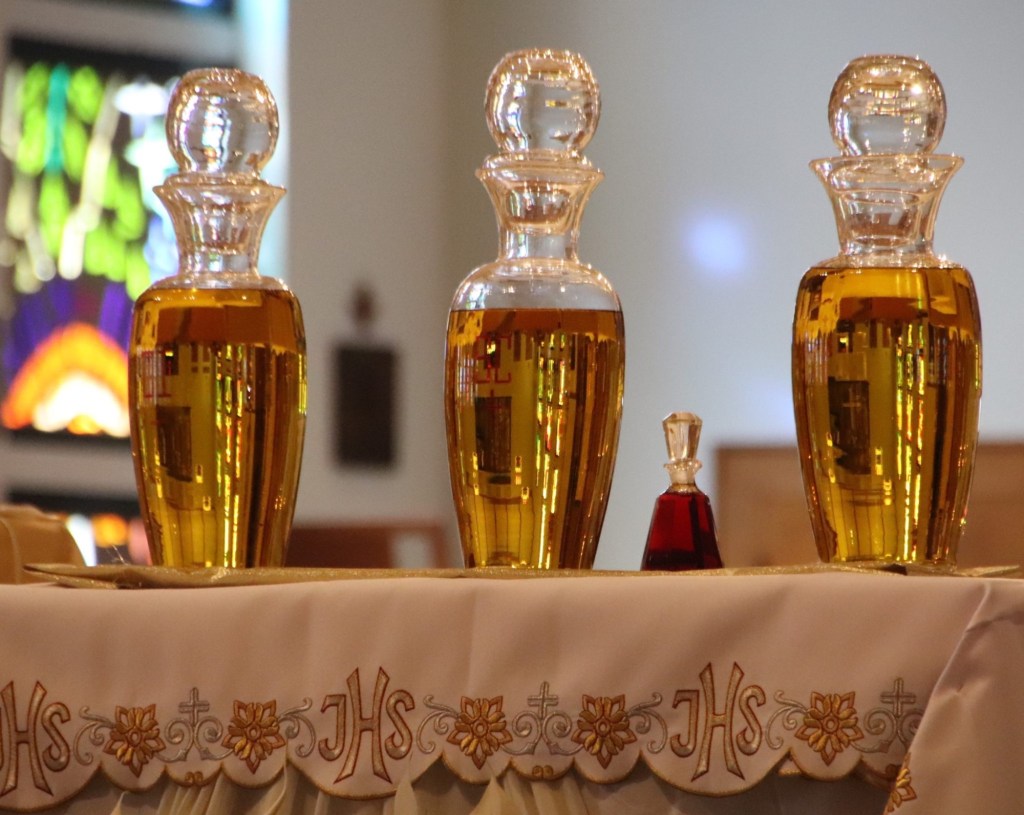
The oil that is used has been consecrated by the bishop with this or a similar prayer:
Almighty God, you have taught us in your holy Word to pray for the sick and anoint them with oil, that they may recover their bodily health: Hear us, we pray, and sanctify this Oil of the Sick. Grant that those who will be anointed with it may receive healing of body and mind, and strengthening of spirit, through Christ our Lord. Amen (ACNA Book of Occasional Serviced, proposed).
This prayer alludes to a well known scripture, James 5:13-16.
13 Is anyone among you suffering? Let him pray. Is anyone cheerful? Let him sing praise. 14 Is anyone among you sick? Let him call for the elders of the church, and let them pray over him, anointing him with oil in the name of the Lord. 15 And the prayer of faith will save the one who is sick, and the Lord will raise him up. And if he has committed sins, he will be forgiven. 16 Therefore, confess your sins to one another and pray for one another, that you may be healed. The prayer of a righteous person has great power as it is working (James 5:13-16).
I’ve carried this oil stock with me to most every area hospital, to emergency rooms and surgical centers and doctors’ offices, to rehab facilities, to nursing homes and to private homes, to healing services here on Wednesdays, and to private moments of prayer in the St. Mary Magdalene Chapel or in my office. I’ve used it to anoint the one dying and the one in labor: once in the same hospital room, on the same day, only minutes apart. This oil stock is to me a faithful companion and a companion for the faithful.
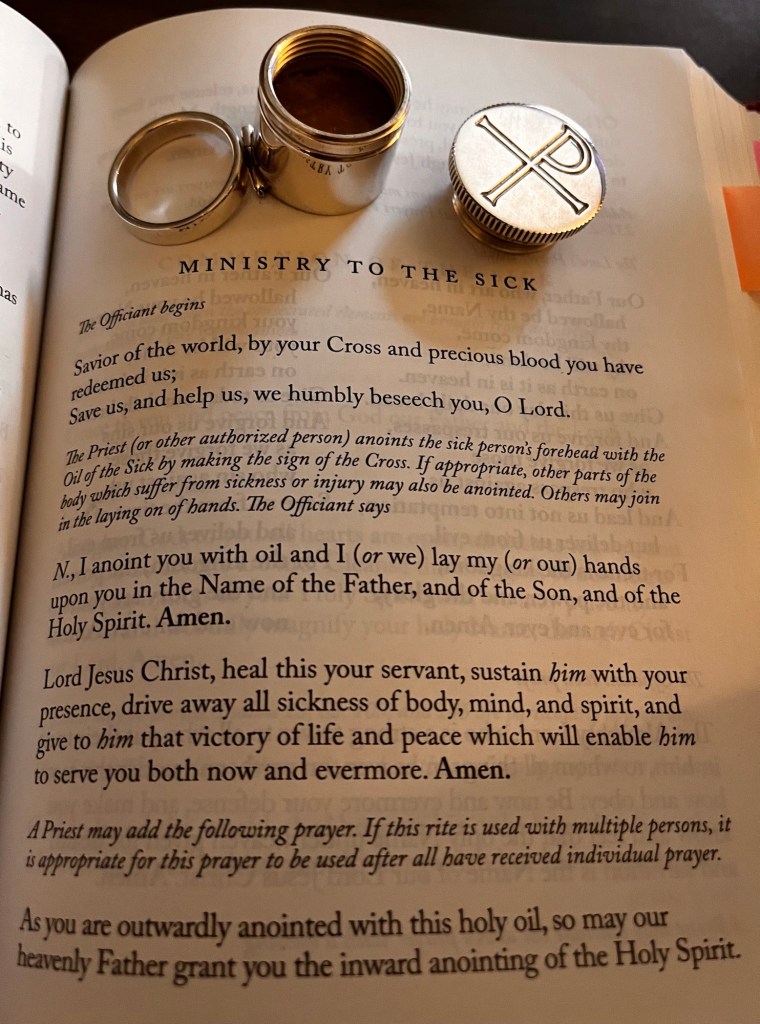
In presenting me the oil stock as an ordination gift, the parish was asking something of me in return — not of me as an individual, but of me as a priest: to be an agent, a sacramental instrument, of God’s healing grace. I don’t think any parishioners expected then or expect now for me to heal as Jesus and his apostles did, to simply say, “Your faith has made you whole,” or “in the name of Jesus be healed,” and so to affect miraculous cures at will. I long for that gift as I suspect most priests do, but God, in his wisdom, has not given it to me. But the parish does and rightly should expect me to minister the sacramental rites of healing given to the Church for the Church, so that God may work through those rites according to his will. And God does work through the form and matter, the words and actions and material of the sacrament of healing; I’ve seen it. He works through them to change lives, to heal people, and sometimes to accomplish bodily cures— but only sometimes to accomplish bodily cures. And that raises questions, not least for us priests. Why was this person healed and not that person? Is it always appropriate to pray for physical healing? If my faith were stronger, if my heart were purer, would my prayers be more effective and would more people be healed? Why must good, faithful people — the people of God — suffer so much? Where is God in all of this and what does it mean to trust him? I’m sure you’ve asked some or all of these questions. You likely have additional questions, as do I, but these are common ones. At the best of times they challenge us. Right in the midst of suffering — our own or that of someone we love — is not the best of times. It is hard to do good theology in the midst of emotional and physical pain. These things are best thought through beforehand, before the difficult times come or before they come again.
That is the purpose of this class: to think through the difficult questions of the nature of God and man; the meaning of suffering; the nature of prayer for the sick; and the Church’s role in care for the sick, the dying, and those who grieve. We will not answer all these questions, but we can bring to bear on them the wisdom of the Church as found in Scripture and in the great Tradition as we have received it. That’s why we are here.
Where should we start? Since we must start somewhere, it seems best to start at the beginning.
The Disposition of God
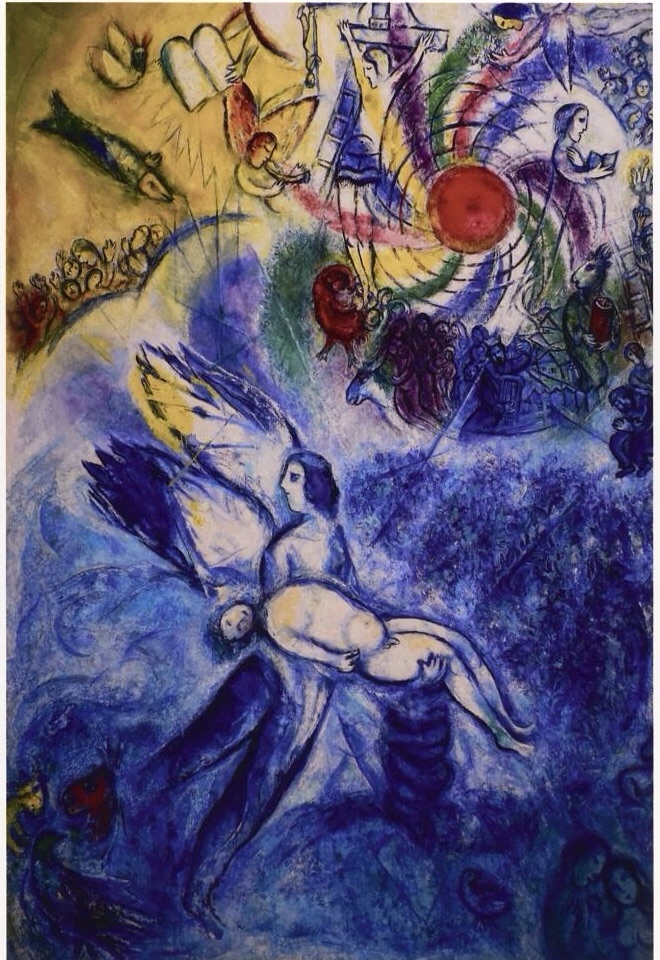
1 In the beginning, God created the heavens and the earth. 2 The earth was without form and void, and darkness was over the face of the deep. And the Spirit of God was hovering over the face of the waters.
3 And God said, “Let there be light,” and there was light (Gen 1:1-3).
Let’s lay these first three verses of Genesis alongside the first three verses of the Gospel according to St John.
1 In the beginning was the Word, and the Word was with God, and the Word was God. 2 He was in the beginning with God. 3 All things were made through him, and without him was not any thing made that was made (John 1:1-3).
Taken together these accounts answer several basic questions about the creation of the cosmos, both spiritual and corporeal.
Who? God — the Father — in union and cooperation with God the Word — the Son — and God the Holy Spirit.
What? The creation of the cosmos — matter, space, time, life — of all that is not God.
When? In the beginning: not the beginning of God, but the beginning of everything else.
Where? This one is more difficult, because “where” — cosmic geography and location — is part of what God created. Whether it is meaningful to talk about “where” before the act of creation is questionable. Perhaps we are forced to answer: in the mind of God first and then into geography.
So, to some extent we have the who, what, when, and where of creation. But we are still lacking an important piece of information, one particularly germane to our topic. Why? Why did God create anything at all? And, more to the point, why did God create human beings?
St. Paul can help us here.
22 So Paul, standing in the midst of the Areopagus, said: “Men of Athens, I perceive that in every way you are very religious. 23 For as I passed along and observed the objects of your worship, I found also an altar with this inscription: ‘To the unknown god.’ What therefore you worship as unknown, this I proclaim to you. 24 The God who made the world and everything in it, being Lord of heaven and earth, does not live in temples made by man, 25 nor is he served by human hands, as though he needed anything, since he himself gives to all mankind life and breath and everything (Act 17:22-25).
Two important points emerge from this part of St. Paul’s address on Mars’ Hill. First, God needs nothing external to himself; there is no lack in God. We acknowledge that truth each week at the offertory:
Yours, O Lord, is the greatness, and the power, and the glory, and the victory, and the majesty: for everything in heaven and on earth is yours; yours is the kingdom, O Lord, and you are exalted as Head above all. All things come from you, O Lord,
And of your own have we given you (BCP 2019, p. 131).
God did not create the cosmos or humankind to fill any void in the divine communion of the Trinity. God did not create us to serve him: to feed his “body” or his “ego.” We are superfluous, completely unnecessary: not unimportant, just nonessential. Second, life, breath — everything — is a gift from God. Our existence, and the spiritual and material creation that supports it, is gratuitous, is freely given by God. And this leads us toward an answer to the “why” of creation. The Catechism of the Catholic Church explains the “why” this way:
293 Scripture and Tradition never cease to teach and celebrate this fundamental truth: “The world was made for the glory of God.” St. Bonaventure explains that God created all things “not to increase his glory, but to show it forth and to communicate it,” for God has no other reason for creating than his love and goodness (emphasis added): “Creatures came into existence when the key of love opened his hand.” The First Vatican Council explains:
This one, true God, of his own goodness and “almighty power,” not for increasing his own beatitude, nor for attaining his perfection, but in order to manifest this perfection through the benefits which he bestows on creatures, with absolute freedom of counsel “and from the beginning of time, made out of nothing both orders of creatures, the spiritual and the corporeal….” (Catechism of the Catholic Church (Second Edition), Doubleday (1995), p. 86).
This gets us to the answer: “God has no other reason for creating than his love and goodness.” The answer to Why? is love. The love of God is expansive and creative. It generates that which is not God solely that it might be the recipient of God’s love and the manifestation of God’s glory. You exist because God loves you. I’ll go further; the cosmos exists because God loves you. This notion is essential for everything that follows:
God’s unfailing disposition toward us and all that he has made is love.
God’s love is not sentimentality or indulgence but rather a resolute commitment to do that which he knows to be best for us, which commitment shows forth God’s own glory. St. Thomas Aquinas defined love as willing the good of the other. God wills our good, and only our good.
In his love for us, God gave humankind a vocation: to be fruitful and multiply, to fill the world, to subdue the world and have dominion over it. Yes, that is what Adam and Eve were given to do, but there is something even more fundamental, more existential than that: not what they were to do, but what they were to be, and, by extension, what we are to be.
26 Then God said, “Let us make man in our image, after our likeness” (Gen 1:26a).
That is who humankind is to be, the image-bearers of God. It is who we are, the every essence of our being. What is the image of God in man? It is the imprint of God’s character on us that makes us uniquely human and that sets us apart from mere matter and even from all other non-human living beings. Some identify the image of God as reason and will, but it is more than that. It is everything in us that enables us to become partakers of the divine nature (cf 2 Pet 1:4). It is the image of God within us that guides us toward our telos — our purpose — of Christlikeness.
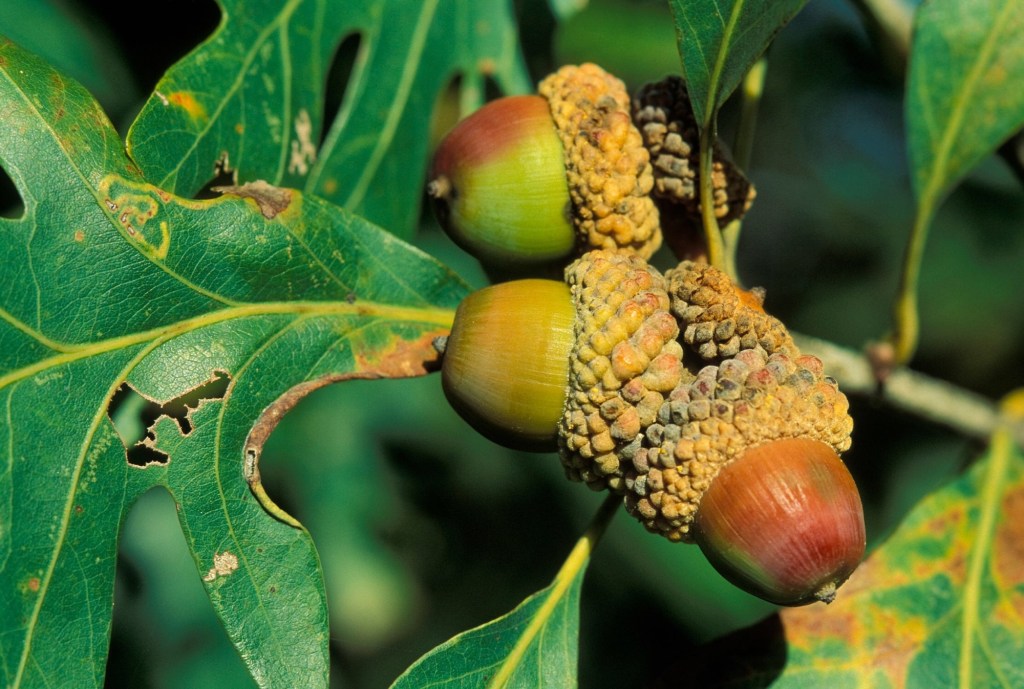
The Church Fathers distinguish between image and likeness: let us make man in our image, after our likeness. (Whether that distinction is actually inherent in the Genesis text or is the product of the Church’s prayer, reflection, and experience is an open question. But we have received this wisdom and it aligns with the sacred story.) Humankind is created in the image of God and that cannot be eradicated; if it were erased, then what is left would not be human. So, we are created in the image of God, but we are intended to grow, to mature into Christlikeness. Let me offer an analogy. An acorn bears within it the image of an oak tree and not a pine tree or a maple tree. But, the acorn must grow, must mature, to actually achieve the likeness of an oak tree. Likeness is the telos — the goal, the end — of image. In that sense, we must become what we have been created to be. And that is, in part, what the rest of creation is for: to provide the raw materials, the challenges, the context for our maturation into Christlikeness. St. Ignatius of Loyola expresses it this way in the First Principle and Foundation of his Spiritual Exercises:
The other things on the face of the earth are created for man to help him in attaining the end for which he is created.
Accordingly, God gave Adam and Eve a law — do not eat of the tree of the knowledge of good and evil — not least because learning obedience was essential for maturing into Christlikeness. God gave Adam and Eve a vocation — be fruitful, fill the earth, bring order to it and tend it — not least because cultivating these vocational characteristics of God was essential for maturing into Christlikeness. The world in which Adam and Eve lived was created to support their purpose of growing into Christlikeness. From what we can infer, that seems to have been a relatively frictionless process compared to what we experience now. Adam had work to do, yes, but it wasn’t difficult and futile and by the sweat of his brow. Eve had children to bear, yes, but apparently it was to be without the physical pain of labor. The pair had a relationship — should we call it a marriage? — a relationship to tend, but there was to be no rivalry, no discord in it; they were helpmates. And all of this was created by God to mature Adam and Eve into Christlikeness. Both spiritual and corporeal creation were designed to bring humankind to Christlikeness, and all as an expression of God’s love.
The Effects of the Fall: Changed Means and Consistent End
The next major event in this story is what we call the Fall. Our first parents were deceived by the serpent. They were still immature, and rather than simply trusting and obeying God, they got out ahead of themselves, struck out on their own, and were led astray. And consequently much changed in humankind and in the created order.
A world that had been hospitable became, at best, ambivalent and, at worst, hostile. Creation is still beautiful, but it is also dangerous. The world still supplies our needs, but not without friction; work is hard and frustrating and often unfruitful. We still have the ability and the impetus to be fruitful and multiply, but the whole process is messy and complicated and painful. Our bodies are wonders of intricate complexity and order, but they also wear out and break down and at some point just stop working entirely; we get old, we get sick, we die. We are subject to and often governed by passions that rage within us: pride, envy, anger, sloth, avarice, gluttony, lust. We long to worship God but we create idols instead. We are sick in body; our flesh is corruptible. We are sick in soul; we have illnesses of the heart: ignorance of God, forgetfulness of God, hardness of heart. The image of God within us has not been eradicated, or else we would have ceased to be human. But we are turned away from God and turned inward on ourselves so that achieving likeness is beyond our ability.
But, some things have not changed. God’s disposition of love towards us remains constant. God loved humankind before the Fall and God loves humankind still. God’s purpose for humankind has not changed; it is still our telos, or goal, to grow into Christlikeness, to become partakers of the divine nature, to be the people of God. This is another essential notion for everything that follows:
Our purpose in life is to mature into God’s likeness by growing into Christlikeness. That is the end for which humans were made in the beginning; it is still the end even in our fallen state, though it is now beyond our unaided ability due especially to the passions and to the illnesses of heart and soul which wage war against us.
The path toward Christlikeness is the way of repentance, of dying to self not once but over and over again, minute by minute, choice by choice. We can do that only in the power of the Holy Spirit, only by cooperating with the God who loves us.

These notions — that God’s disposition toward us is love, that we are to grow into the likeness of Christ, and that the way we must grow after the fall is continual repentance — are essential and, I think, relatively noncontroversial; these notions are part of classical Christian doctrine. But, there is an implication of these dogmas that is equally orthodox, but perhaps harder to embrace. Here’s the logic of it.
Out of love God created a world to support humankind in its growth toward Christlikeness. (You likely will need to sit with that statement in prayer and reflection for a bit; it is critical and densely packed. But we have to move on.)
The Fall did not alter God’s intent, though the path to Christlikeness is different now. Originally, the path was simple faithfulness and obedience; now, it is the path of repentance.
Now, here is the idea that follows from these premises; an idea that might present some challenge.
The fallen world — one in which there is evil, uncertainty, danger, futility, pain, suffering, death — is still an expression of God’s love for us, because it is the world that aids us in repentance and promotes healing of the illnesses of the heart and soul. That means that the challenges that we face due to ancestral sin are not so much punishment as loving correction and medicine for the soul. We suffer in this world because suffering, rightly embraced and rightly used, drives us to repentance — drives us to God — and repentance leads us to Christlikeness, and Christlikeness is the end for which we were created out of love.
Listen to Scripture on this.
1 Therefore, since we have been justified by faith, we have peace with God through our Lord Jesus Christ. 2 Through him we have also obtained access by faith into this grace in which we stand, and we rejoice in hope of the glory of God. 3 Not only that, but we rejoice in our sufferings, knowing that suffering produces endurance, 4 and endurance produces character, and character produces hope, 5 and hope does not put us to shame, because God’s love has been poured into our hearts through the Holy Spirit who has been given to us (Rom 5:1-5).
1 Therefore, since we are surrounded by so great a cloud of witnesses, let us also lay aside every weight, and sin which clings so closely, and let us run with endurance the race that is set before us, 2 looking to Jesus, the founder and perfecter of our faith, who for the joy that was set before him endured the cross, despising the shame, and is seated at the right hand of the throne of God.
3 Consider him who endured from sinners such hostility against himself, so that you may not grow weary or fainthearted. 4 In your struggle against sin you have not yet resisted to the point of shedding your blood. 5 And have you forgotten the exhortation that addresses you as sons?
“My son, do not regard lightly the discipline of the Lord,
nor be weary when reproved by him.
6 For the Lord disciplines the one he loves,
and chastises every son whom he receives.”
7 It is for discipline that you have to endure. God is treating you as sons. For what son is there whom his father does not discipline? 8 If you are left without discipline, in which all have participated, then you are illegitimate children and not sons. 9 Besides this, we have had earthly fathers who disciplined us and we respected them. Shall we not much more be subject to the Father of spirits and live? 10 For they disciplined us for a short time as it seemed best to them, but he disciplines us for our good, that we may share his holiness. 11 For the moment all discipline seems painful rather than pleasant, but later it yields the peaceful fruit of righteousness to those who have been trained by it (Heb 12:1-11).
None of this is to deny the presence of evil in the word or the pain and difficulty of suffering. It is, however, to insist that none of this should cause us to question the love of God for us. It is to insist that none of this is without meaning or purpose. It is to insist that God can and will — with our cooperation — use all of this to foster our repentance, to nourish our growth into Christlikeness, and to bring us into fellowship with the divine nature. It is to insist that our understanding of illness and suffering must be focused through this lens. All of this changes our relationship with suffering and must inform the prayers we offer for ourselves and others.
God’s gift of a “frictionless” world to our first parents before the Fall was an expression of his love; it was the proper arena in which they might grow into Christlikeness. God’s gift of a messy, difficult, and painful world to us — to the heirs of the Fall — is also an expression of his love; it is the proper arena in which for us to cultivate repentance, which is now the only way to Christlikeness.
To be human in a fallen world is to suffer. To be Christian in a fallen world is to suffer in Christ, for the sake of repentance, toward the end for which we were made: to be formed into the likeness of God, that is, into Christlikeness. All humans suffer. Only Christians can see suffering for what it is, can rightly use for what it is intended to be and to do, and can glorify God in it, for it, and through it.
Discussion
In the time remaining, I invite you to talk about these matters with those at your table. As a conversation starter, I suggest these questions:
1. What idea did you find most challenging in the lesson?
2. What idea did you find most compelling?
3. What idea did you find most comforting?
4. What follow up question would you most like to ask? See if your neighbors can answer it.
Also, I would like you consider the Prayer for One’s Enemies by Bp. Nicolai Velimirovich. He wrote this following his internment and release from a German concentration camp. He wrote it about very real, flesh and blood enemies. But, I think it pertains equally well to our consideration of health and sickness, of ease and suffering. We consider health and ease to be our friends, sickness and suffering to be our enemies. If so, perhaps we should take Bp. Nicolai’s prayer to heart.
The Lord be with you.
And with your spirit.
Let us pray.
O God, whose days are without end, and whose mercies cannot be numbered; Make us, we beseech thee, deeply sensible of the shortness and uncertainty of human life; and let thy Holy Spirit lead us in holiness and righteousness, all our days: that, when we shall have served thee in our generation, we may be gathered unto our fathers, having the testimony of a good conscience; in the communion of the Catholic Church; in the confidence of a certain faith; in the comfort of a reasonable, religious, and holy hope; in favour with thee our God, and in perfect charity with the world. All which we ask through Jesus Christ our Lord. Amen (BCP 1928, pp. 316-317).
Handout
A Prayer for One’s Enemies (St Nicolai Velimirovich)
Bless my enemies, O Lord. Even I bless them and do not curse them.
Enemies have driven me into Thy embrace more than friends have.
Friends have bound me to earth, enemies have loosed me from earth and have demolished all my aspirations in the world.
Enemies have made me a stranger in worldly realms and an extraneous inhabitant of the world.
Just as a hunted animal finds safer shelter than an unhunted animal does, so have I, persecuted by enemies, found the safest sanctuary, having ensconced myself beneath Thy tabernacle, where neither friends nor enemies can slay my soul.
Bless my enemies, O Lord. Even I bless them and do not curse them.
They, rather than I, have confessed my sins before the world.
They have punished me, whenever I have hesitated to punish myself.
They have tormented me, whenever I have tried to flee torments.
They have scolded me, whenever I have flattered myself They have spat upon me, whenever I have filled myself with arrogance.
Bless my enemies, O Lord. Even I bless them and do not curse them.
Whenever I have made myself wise, they have called me foolish.
Whenever I have made myself mighty, they have mocked me as though I were a dwarf.
Whenever I have wanted to lead people, they have shoved me into the background.
Whenever I have rushed to enrich myself, they have prevented me with an iron hand.
Whenever I thought that I would sleep peacefully, they have wakened me from sleep.
Whenever I have tried to build a home for a long and tranquil life,they have demolished it and driven me out.
Truly, enemies have cut me loose from the world and have stretched out my hands to the hem of Thy garment.
Bless my enemies, O Lord. Even I bless them and do not curse them.
Bless them and multiply them; multiply them and make them even more bitterly against me:
so that my fleeing to Thee may have no return;
so that all hope in men may be scattered like cobwebs;
so that absolute serenity may begin to reign in my soul;
so that my heart may become the grave of my two evil twins: arrogance and anger;
so that I might amass all my treasure in heaven;
ah, so that I may for once be freed from self deception, which has entangled me in the dreadful web of illusory life.
Enemies have taught me to know what hardly anyone knows, that a person has no enemies in the world except himself.
One hates his enemies only when he fails to realize that they are not enemies, but cruel friends.
It is truly difficult for me to say who has done me more good and who has done me more evil in the world: friends or enemies.
Therefore bless, O Lord, both my friends and my enemies.
A slave curses enemies, for he does not understand.
But a son blesses them, for he understands. For a son knows that his enemies cannot touch his life. Therefore he freely steps among them and prays to God for them.
Bless my enemies, O Lord. Even I bless them and do not curse them.
Amen.


