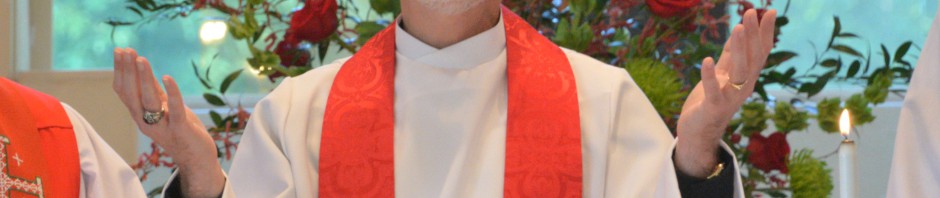
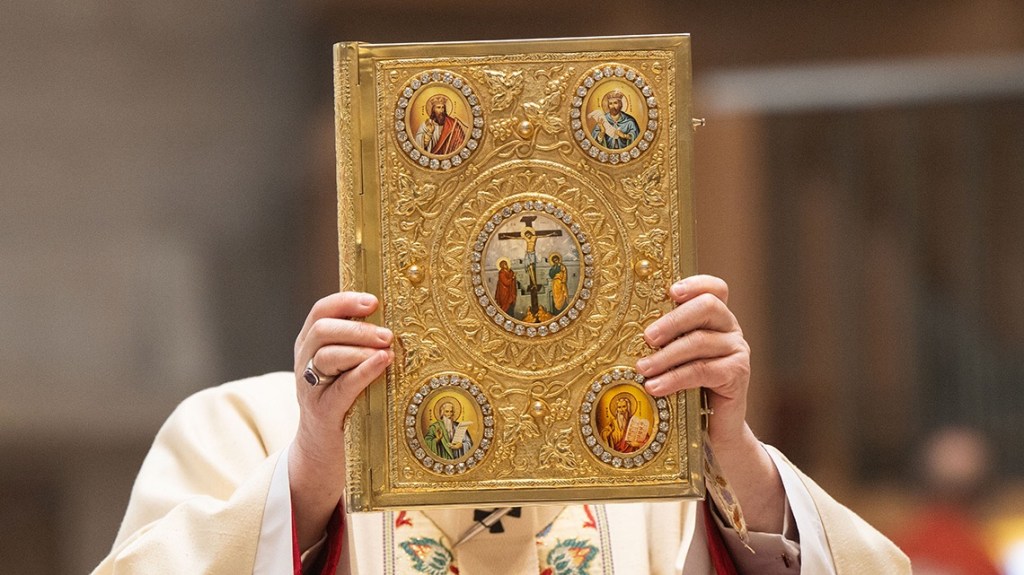
I know a priest who, as he approaches the altar at the beginning of the Eucharist, discretely and reverently bows to reverence the altar with a kiss. It is, after all, the place where heaven and earth meet and where the material of bread and wine become the very body and blood of Christ. It is my practice when taking up the Gospel Book — whether to mark it for the Deacon’s use during the Eucharist or to read it myself during the service — to discretely and reverently honor it with a kiss. It is, after all, the locus of the Holy Spirit’s action to make the word written become the living Word spoken and received. These things crossed my mind as I read the following passage from a favorite book this afternoon. The action takes place on Patmos — yes, that Patmos on which St. John the Theologian was exiled and on which he received and recorded the Apocalypse. The writer was, on the night in question, a wavering atheist on the slippery slope to faith. His wife, Felicia, was already an Orthodox Christian.
One evening — it was on the fourteenth of August — we met on our walk Vassos, who collected the town rubbish with a string of donkeys. He was, unusually, sitting at a table on the street, drinking ouzo. Even more unusually, he had a smartly pressed blue shirt and an unfamiliar newly shaved look. I asked him why the party suit and he told me he was on his way to the Monastery of Diasozousa for the night service before the big Festival of the Dormition the following day. Felicia and I decided to look in, even though I have a horror of church festivals. They are always crowded with women in the finest of their finery — an unnerving sight on Patmos, where the finery takes the form of jackets with shoulders like Al Capone’s, handbags with yards of brass chain attached and black high-heeled shoes with enormous bright buckles.
These are always social occasions on the island, and it is unthinkable to miss one. And they have always seemed to me to have little to do with faith and more a matter of putting in an appearance. They remind me of the village barn dances back home, when everyone got together for a good chat, the men and women in separate groups. As I have a horror of crowds, I tend to skulk in the shadows and leave it to Felicia to participate. But that evening, as we climbed the steps to the big church strung about with electric lights and saw the hundreds of faces looking up at it, I had a strong feeling that they were there for a common purpose, and that this purpose was more than just sociability.
A long queue of local people was waiting to kiss the wonderworking icon. Not having escaped to the fringes of the crowd, I was pulled in. We shuffled along, and as I chatted with people I know — the electrician, the grocer, the carpenter, the plumber — I was struck by the fact that these people, practical workingmen with no very obvious religious slant to their lives, were doing something extremely odd. They were all waiting patiently standing there in their best suits waiting to kiss a painting. What was really going on?
I remembered something that Philip Sherrard, an Orthodox writer whom I admired, had written about Western society’s having lost its way. Materialism had become the creed of the majority, and it was opposed not by the churches but by those who claimed a vague spiritual allegiance or inkling which they insisted had nothing to do with “organized religion.” But Sherrard pointed out that any genuine religious tradition provided for some formal discipline as a means of spiritual realization. He wrote that people who attached themselves to these modern, rather gaseous trends of New Worldism were spiritually inferior to the simple believers who practiced a faith sincerely but with only the slightest knowledge of the metaphysical principles on which it was based..
As we stood in the queue at Diasozousa, I realized that these people, by the simple act of kissing an icon, were rejecting the closed system of materialism in which most people of the West are living today. Even if the act is a formal one, done because everybody does it, to revere an icon is to perform an action which proclaims that the material world is not the end — that there is a spiritual dimension to life which we may not understand and which we may ignore in our daily business of living but which on occasions such as this we can come together and publicly acknowledge. To kiss an icon, to cross oneself, to say “an theli o Theos” (“God willing”), however perfunctorily or unthinkingly these actions are performed, is to strike a blow at the closed universe of the materialist (Peter France, A Place of Healing for the Soul: Patmos, Atlantic Monthly Press (2002), pp. 88-90).
“To strike a blow at the closed universe of the materialist” seems to me a noble and necessary Christian vocation, one that we all share. There are perhaps as many ways to do so as there are Christians. Pray. Ask a priest for a blessing. Light a candle in church. Cross yourself when you hear an emergency siren or when you pass a church. The latter is bit much, perhaps, since there are churches on seemingly every street corner here in the South. Learn to say, even if just to yourself, “Lord, have mercy,” “Glory to God,” “God bless it,” and a host of other breath prayers. Let your sacred imagination run wild. But strike a blow against the closed universe of the materialist!


A very odd thing you mention, “when you hear a siren.” My wife’s grandmother, who I only knew when we were dating before she passed, used to hear a siren and say, “someone’s child.” Somehow the thought of it touched me as a late teen, and I have often silently said a small prayer, just a sentence or two, when I hear one. And having been in Anglican churches for the last two decades, I find crossing myself is much the equivalent of beckoning God’s presence to the moment as a hardy “Amen” or lifting our hands in adoration. It is a personal behavior that calls God to moment, for us, or for others, and seems to sit well with me as I offer to the Lord a simple prayer for help to whoever is on the other end of the emergency, and finish with the name of the Trinity and the sign of the cross. It is always “someone’s child.” It is for me “the liturgy of the ordinary.”