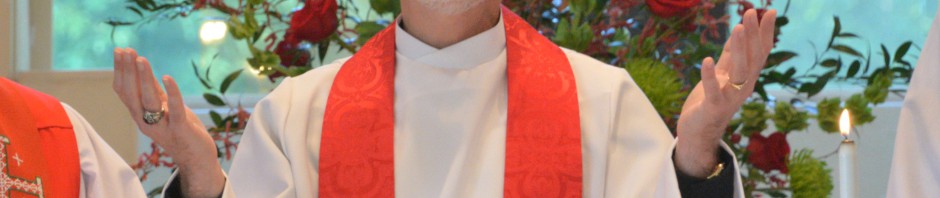
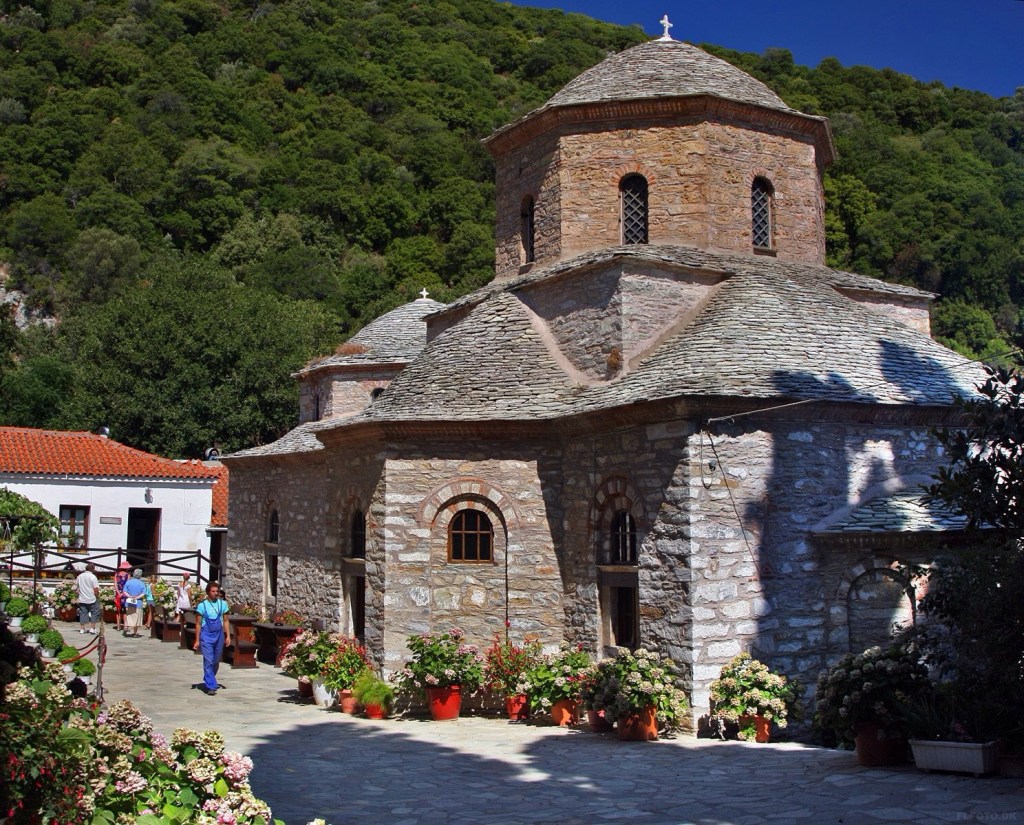
Soon after we met, I had the chance to talk to [Fr. Amphilochios Tsuokos] about Orthodox Christianity. The conversation was to alter my perspective on life, and I remember the setting clearly. We were sitting again on the rocks outside his little chapel with the early morning sun filtering through the trees. Felicia was there, patiently watching me falling into the mode she had seen so often, that of Everyman reporter. I had spent the previous twelve years interviewing religious leaders, and I recognized Father Amphilochios as a promising interviewee: he was firmly rooted in a primitive Christian faith which shaped his every waking hour; he seemed to combine a medieval austerity in his life with a renaissance enthusiasm for living. He was clearly a man whose priorities lay outside his immediate circumstances. Since he had experience as a missionary, spreading the Christian message among the tribal people of West Africa, it seemed fair to ask him about his techniques for enlightening unbelievers. I was one of them, and I was tackling him on behalf of liberal humanism.
I explained to him that I was a member of an enormous modern tribe that rejected the Christian message. This was not because we knew too little but because we knew too much. We understood the human psyche; we had analyzed the workings of the human mind, conscious and unconscious; we knew that religious faith was simply a compensatory mechanism that gave emotional reassurance to the insecure. We could not be deceived by myths, no matter how powerful their archetypal resonances. We sought the truth and, unlike Christian, saw no virtue in putting our trust in so-called realities for which there was insufficient evidence.
For the past three hundred years leading intellectuals of our tribe had examined the philosophical proofs for the existence of God and found them wanting. Our scholars had looked at the linguistic and archeological evidence for biblical truths and had pronounced them flawed. Our biologists accepted a version of the story of life on earth that needed no external directing hand. So, we had abandoned Christianity after long and careful consideration of its claims and with some regret. That rejection was c consequence of our fearless pursuit of truth. “If you came,” I said, “as a missionary to my tribe today, what would you say to us?” I sat back, conscious of having put him on the spot. He looked at me with a smile and said simply: “I would not say anything to you. I would simply live with you. And I would love you.”
This was not the answer I expected from a theologian…
I had been thinking and reading hard for forty years, slowly amassing knowledge but not advancing in understanding. That morning in the woods outside the Chapel of the Holy Trinity, a door opened.
I realized that to approach Christianity, as I had tried, from what seemed to be the logical first step — that is, by examining the arguments for the existence of God — was to tackle it from the wrong end. The most basic principle of learning is to start with the known and move to the unknown. I had been trying to start from the unknowable. Father Amphilochios was proposing that the journey to Christian trth should start with the human experience of love: it should move, that is, from the known to the unknown (Peter France, A Place of Healing for the Soul: Patmos, Atlantic Monthly Press (2002), pp. 82-83).


 First Blessings