APOSTLES ANGLICAN CHRUCH
Fr. John Roop
St. Lucy’s Day (13 December 2023)
(Revelation 19:5-8, Psalm 131, Matthew 25:1-13)
Collect
Almighty God, who gave to Lucy the grace of complete devotion in body, mind, and spirit and the courage to proclaim her faith in the day of persecution: Grant to us, your servants, that same resolute holiness and unshakable commitment to the Bridegroom of the Church, our Lord Jesus Christ who with you and the Holy Spirit lives and reigns, one God, now and for ever. Amen.
In the Name of the Father, and of the Son, and of the Holy Spirit. Amen.
Let’s begin with a question: what is the first commandment? I know that the question itself is a bit ambiguous — intentionally vague — and I know that it allows for multiple answers. Even so, how would you answer it?
We could certainly point to the Decalogue and its first commandment:
I am the LORD your God. You shall have no other gods before me.
Or, we might remember the words of our Lord Jesus Christ when asked about the greatest commandment:
You shall love the Lord your God with all your heart and with all your soul and with all your mind. This is the first and great commandment.
Both of these commandments have priority of place; they are first in the sense of being of fundamental importance. And, they are expressing the same foundational principle: remember that God is God and put him first in all things. To answer in this way is to take “first” to mean “of primary importance.”
But, if we take “first” in a chronological or sequential sense to mean before all others, then the first commandment given to humankind is found in Genesis 1:
And God blessed them. And God said to them, “Be fruitful and multiply and fill the earth and subdue it, and have dominion over the fish of the sea and over the birds of the heavens and over every living thing that moves on the earth” (Genesis 1:28).
Not to be crude, but God’s very first commandment to the primal pair of humans was to have sex and to have babies — lots of babies, enough through their descendants over generations to fill the world. And notice that this commandment was part of God’s blessing upon his creation and especially upon his humans; so the enterprise of having sex and having babies, within the covenant of God-ordained marriage, is a good and holy thing. It is fundamental to the human vocation, part of what it means to be human, and certainly necessary to perpetuate the species. God embodied humans in the way he did — gave us the gendered anatomy and physiology we have — to make this vocation possible.
The Jews took this commandment, this vocation, very seriously. That is why barrenness is considered such an affliction in Scripture; it is the inability to keep the first commandment. So, we sorrow along with Sarai and Rebekah and Rachel and Hannah and Elizabeth in their infertility, and we rejoice with them when at last they conceive. We grieve for Jephthah’s daughter who dies childless because of her stupid father’s stupid vow. Her words are tragic:
37 So she said to her father, “Let this thing be done for me: leave me alone two months, that I may go up and down on the mountains and weep for my virginity, I and my companions” (Judges 11:37).
She weeps that she will die a virgin, that she will die childless.
So, in the Old Testament ethos, to be infertile was a great tragedy and to choose to remain childless was … well, it wasn’t a thing; it was essentially unthinkable in that culture, a rejection of the human vocation.
One might expect that same ethos to prevail in the Church since the cultural and spiritual blood of Israel flows through the Church’s veins. And, to some great extent, it does; the Church has always upheld the sanctity of marriage and family life. In the Church, children always were and still are considered a blessing from the Lord. But, alongside the blessed state of marriage and child-rearing there grew up another God-given and God-blessed state of life: chastity — consecrated virginity. Hear these words from St. Thomas Á Kempis:
CONSIDER the lively examples set us by the saints, who possessed the light of true perfection and religion, and you will see how little, how nearly nothing, we do. What, alas, is our life, compared with theirs? The saints and friends of Christ served the Lord in hunger and thirst, in cold and nakedness, in work and fatigue, in vigils and fasts, in prayers and holy meditations, in persecutions and many afflictions. How many and severe were the trials they suffered—the Apostles, martyrs, confessors, virgins, and all the rest who willed to follow in the footsteps of Christ! They hated their lives on earth that they might have life in eternity (A Kempis, The Imitation of Christ, Book 1, Chapter 18).
Look at the noble fellowship in which he includes the virgins: the Apostles, martyrs, confessors, virgins, and all the rest who willed to follow in the footsteps of Christ.
We don’t make much of consecrated virgins in the Anglican Church; I doubt many cradle Anglicans have even heard of them. Part of that is almost certainly due to the dissolution of the monasteries under Henry VIII — frankly, a great loss for our church in my estimation — and to the elimination of the requirement for priestly celibacy. But, the early Church and the other churches now in the Great Tradition — the Roman Catholic Church and the Orthodox Church — have retained this charism and honor it highly. That should be enough to cause us to rethink the issue.
But, as good Anglicans, as we think about it, we will ask a fundamental question: does celibacy — consecrated virginity — have biblical warrant? Is it found in Scripture? Yes. St. Paul acknowledges consecrated virginity as a gift from God, as a holy state of life, and, in some cases, as even preferable to marriage and child-rearing.
Speaking of his own celibacy, St. Paul writes:
1 Corinthians 7:7–9 (ESV): 7 I wish that all were as I myself am. But each has his own gift from God, one of one kind and one of another.
8 To the unmarried and the widows I say that it is good for them to remain single, as I am. 9 But if they cannot exercise self-control, they should marry. For it is better to marry than to burn with passion.
He then continues with a two-fold defense of consecrated virginity or of widowed celibacy. The first justification is practical, based upon the difficulties of the time in which he lived.
1 Corinthians 7:25–26 (ESV): 25 Now concerning the betrothed [παρθένων, virgins], I have no command from the Lord, but I give my judgment as one who by the Lord’s mercy is trustworthy. 26 I think that in view of the present distress it is good for a person to remain as he is.
In a time of persecution, it is perhaps better, St. Paul says, not to multiply responsibilities or attachments. It is difficult enough to suffer for Christ oneself; imagine the difficulty of watching one’s spouse or children suffer. Is there the possibility of committing apostasy in order to end the suffering of a spouse or child? Yes, certainly that would be a great temptation. Better to avoid all that through celibacy.
St. Paul’s second justification is just as practical, but is also directed toward one’s relationship with Christ.
1 Corinthians 7:32–35 (ESV): 32 I want you to be free from anxieties. The unmarried man is anxious about the things of the Lord, how to please the Lord. 33 But the married man is anxious about worldly things, how to please his wife, 34 and his interests are divided. And the unmarried or betrothed woman is anxious about the things of the Lord, how to be holy in body and spirit. But the married woman is anxious about worldly things, how to please her husband. 35 I say this for your own benefit, not to lay any restraint upon you, but to promote good order and to secure your undivided devotion to the Lord.
Do you see what St. Paul — whether consciously or not — is doing here? He is moving from one “first commandment” — Be fruitful and multiply. — to another first commandment — You shall love the Lord your God with all your heart and with all your soul and with all your mind. In doing so, he is not pitting married life against celibacy. It is a matter of gifting, a matter of the vocation to which God has called each one. If you have the gift of celibacy, it is a holy estate, the means God has ordained for your sanctification and service. If you have the gift of marriage and child-rearing, it, too, is a holy estate, the means God has ordained for you to become a saint and to minister to others. St. Paul’s exhortation is thoroughly practical and thoroughly spiritual. Look to the times; look to your gifting. Look to what God has in mind for you.
In its best moments, the Church has listened to St. Paul’s guidance and has honored the role of consecrated virgins. These women vow a life of perpetual virginity for the sake of devotion to Christ and service in the Church and in the world. Some become cloistered nuns and devote themselves exclusively to prayer. Some live in the world and devote themselves to acts of charity, education, service to the poor.
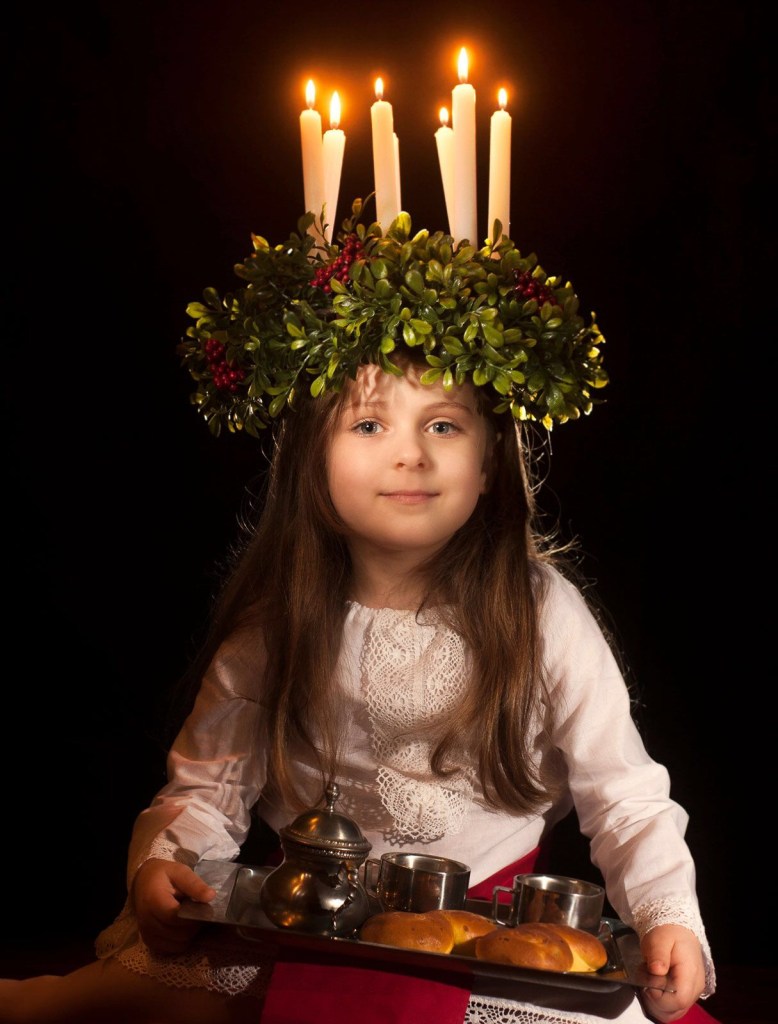
The early Church particularly honored four virgin martyrs among whom we find St. Lucy, whose feast day is observed on 13 December. That is, of course, why we are talking about this topic at all; today is the Feast of St. Lucy. As Anglicans we don’t quite know what to do with her. St. Lucy’s feast day is listed on our calendar as an optional, ecumenical commemoration which means it is largely ignored as a feast in its own right. It is mainly noted only to set the date for the winter ember days, the set of three days each season when the church fasts and prays for those called to or in holy orders. The winter ember days are the Wednesday, Friday, and Saturday following the feast of St. Lucy. The virgin martyr serves as a signpost pointing to something else; we notice St. Lucy mainly so we will know when to observe the ember days.
But, what of St. Lucy herself? What do we know of her?
Lucy was born in 283 in Syracusa, a city in Sicily, to affluent, Christian parents, who raised her in the faith from her birth. Her father died when she was young, and her mother Eutychia had a serious health issue also. As with the woman in the Gospel, Eutychia had suffered for four years with a flow of blood the doctors were unable to stanch. It was Lucy who insisted that she and her mother travel to Catana to pray for healing at the tomb of St. Agatha, a holy virgin martyr of Sicily. It was there — or at least as a result of the prayers offered there — that Eutychia was healed. And, perhaps it was that incident that confirmed in Lucy her own desire to offer herself fully to God as a holy virgin and to distribute her portion of the family wealth to the poor. She made this vow secretly; she did not reveal it to her mother.
Not knowing about her daughter’s vow, Eutychia sought to arrange a marriage for Lucy, as was the norm. An agreement was made with a young nobleman, but he soon began to suspect something was amiss. He noticed that Lucy had begun selling her jewelry and other possessions and was distributing the proceeds to the poor. That practice was highly unusual, except among one group of people: the Christians. Knowing now that he had been misled — inadvertently misled by the mother, but misled nonetheless — he denounced Lucy to the authorities as a Christian. All this was transpiring under the final but brutal persecution of Christians under the Emperor Diocletian. Without going into the details, Lucy refused to submit to her betrothed and to renounce her faith; she was tortured and died as a result of her wounds in A.D. 304.
We can assume that Lucy was honored locally from the time of her martyrdom onward. By the sixth century, within three hundred years of her death, that honor had spread throughout the Roman Church; Pope Gregory I (590-603) included St. Lucy in his sacramentary, the book used by bishops and priests for liturgical services. Her popular devotion had spread to England by the eighth century, where her feast day was observed until it was “lost” during the Reformation. As I understand it, the Church of England now observes St. Lucy’s Day as a lesser feast of the Church, but not so the American Anglican Church.
Might it be good for us to reclaim the virgin martyrs, to honor them again as the Church has always done? I think so. I think so because it makes room for and honors the variety of ways God calls people to holiness and service, and it uses the full range of God’s gifts for the sake of the Church and the world.
I think we should say about this what St. Paul says:
17 Only let each person lead the life that the Lord has assigned to him, and to which God has called him. This is my rule in all the churches (1 Cor 7:17).
St. Paul goes on specifically to contrast circumcision and uncircumcision, servitude and freedom. But, later in the letter he makes clear, implicitly, that virginity and marriage fall under this rule also. God has called people to sanctity of life and to faithful service in a vast array of different ways, and we should exult in all of them, utilize all of them to the glory of God, for the welfare of his people, and for the sake of the world.
In the end, one is not made holy by either state of life, virginity or marriage. One is made holy by one’s faithfulness to God expressed in and through a particular state of life. We do not honor St. Lucy just because she was a virgin, but rather because through her virginity she expressed her complete self-offering to God, a devotion for which she was willing to suffer martyrdom. That is the Christian goal, the Christian purpose, in any state of life to which God has called us — all of us. Amen.


