Good News, Bad News: Romans 1

Edited in Prisma app with Femme

In the Name of the Father, and of the Son, and of the Holy Spirit. Amen.

TODAY, IN THE DAILY OFFICE, THE CHURCH BEGINS READING ST PAUL’S magnum opus, the Epistle to the Romans. I thought I’d take this opportunity to orient our reading with some commentary on chapter one.

The Good News

You know jokes that begin, “I have good news, and I have bad news.”

A teenage boy walks into the living room and says to his dad: “Dad, I have good news and I have bad news. The good news is that the airbags in the Volvo work beautifully.”

The Gospel is no joke, but it does contain both bad news and good news. There is a problem — the bad news — to which the Gospel, the good news, is the answer. Paul presents both in Romans 1, first the good news of the Gospel which forms the thesis statement, the very heart of the letter.

Romans 1:16–17 (ESV): For I am not ashamed of the gospel, for it is the power of God for salvation to everyone who believes, to the Jew first and also to the Greek. 17 For in it the righteousness of God is revealed from faith for faith, as it is written, “The righteous shall live by faith.”

Paul says he is not ashamed of the Gospel. Does that strike you as odd? Why would anyone think otherwise — that Paul might be or should be ashamed of the Gospel? Consider the introduction to 1 Corinthians:

1 Corinthians 1:18–31 (ESV): For the word of the cross is folly to those who are perishing, but to us who are being saved it is the power of God. 19 For it is written,

“I will destroy the wisdom of the wise,

and the discernment of the discerning I will thwart.”

20 Where is the one who is wise? Where is the scribe? Where is the debater of this age? Has not God made foolish the wisdom of the world? 21 For since, in the wisdom of God, the world did not know God through wisdom, it pleased God through the folly of what we preach to save those who believe. 22 For Jews demand signs and Greeks seek wisdom, 23 but we preach Christ crucified, a stumbling block to Jews and folly to Gentiles, 24 but to those who are called, both Jews and Greeks, Christ the power of God and the wisdom of God. 25 For the foolishness of God is wiser than men, and the weakness of God is stronger than men.

26 For consider your calling, brothers: not many of you were wise according to worldly standards, not many were powerful, not many were of noble birth. 27 But God chose what is foolish in the world to shame the wise; God chose what is weak in the world to shame the strong; 28 God chose what is low and despised in the world, even things that are not, to bring to nothing things that are, 29 so that no human being might boast in the presence of God. 30 And because of him you are in Christ Jesus, who became to us wisdom from God, righteousness and sanctification and redemption, 31 so that, as it is written, “Let the one who boasts, boast in the Lord.”

In Paul’s world — the world of Jews and Greeks (everyone else) — the Gospel was a shameful thing: a stumbling block, folly. The idea of a crucified Messiah was incredible to the Jews, an obstacle they simply couldn’t get over or around. The idea of a crucified Jew being the savior of the world — not to mention that foolishness about resurrection — was incomprehensible to the Greeks. So, in his world, the Gospel was considered a shameful thing by all but the relative handful who were convicted of its truth.

It was shameful also because the cross stood right at the center of it, and the cross was designed specifically to shame and humiliate those executed on it and the people they represented. No Jew or Greek would even mention the cross in public conversation.

So why isn’t Paul ashamed? Because he sees God’s own power in the Gospel: power in the events themselves — the birth, life, death, resurrection, and ascension of Jesus — and power in his own proclamation of the events. God accomplished something powerful in and through the Gospel — Paul uses the shorthand term “salvation” to describe that powerful accomplishment — and the continued proclamation of the Gospel brings that power to bear in people’s lives. So, Paul can say without shame that the Gospel is the power of God for salvation.

Paul goes even further to insist that the Gospel is for everyone who believes, to the Jew first and also to the Greek, to those who formerly were ashamed of the Gospel. The Gospel comes through the Jews, because they were the elect of God, the bearers of the covenant. In these last days, God, in his righteousness, has been faithful to that covenant and has fulfilled it through the one, true Jew, the representative of all Israel, Jesus Christ. Since the covenant was always intended to address the problem of sin and death for all men, salvation has now come not only to the Jews, but also through the Jews to the Greeks. So, Paul says that in the Gospel, the righteousness of God — God’s faithfulness to the covenant — is revealed “from faith for faith,” that is, coming from the faithfulness of God and being received by the human response of faith. And later he will say, “The righteous shall live by faith.”

Who is this Paul who tells a good news / bad news story to the Romans? He introduces himself in the salutation.

Romans 1:1–7 (ESV): Paul, a servant of Christ Jesus, called to be an apostle, set apart for the gospel of God, 2 which he promised beforehand through his prophets in the holy Scriptures, 3 concerning his Son, who was descended from David according to the flesh 4 and was declared to be the Son of God in power according to the Spirit of holiness by his resurrection from the dead, Jesus Christ our Lord, 5 through whom we have received grace and apostleship to bring about the obedience of faith for the sake of his name among all the nations, 6 including you who are called to belong to Jesus Christ,

7 To all those in Rome who are loved by God and called to be saints:

Grace to you and peace from God our Father and the Lord Jesus Christ.

How do you generally introduce yourself to strangers? Perhaps with your name and your occupation. Perhaps with where you live and with possible common acquaintances. All of it is small talk, probably forgotten the minute it’s spoken. If we are ever called upon to introduce a guest speaker at an event, we give a litany of his or her credentials, expertise, and accomplishments. Paul does both of these things, but with a twist. Paul says, “I am a slave of Christ Jesus.”

There is a certain humility inherent in the word slave, but it is not abject humility, not worthlessness. Think here of Abram’s slave who was entrusted with the vital mission of finding a wife for Isaac. Think of Joseph who, as Potiphar’s slave, was second only to Potiphar himself in authority over the household. The key to Paul’s self identification as a slave of Christ Jesus follows these lines, I think: as a slave, Paul acts in the name of and with the authority of his Master, Jesus Christ. He is worth listening to because the message he carries is from the Lord. He emphasizes that when he moves from “slave” to “apostle.” An apostle is one who is sent bearing a message. And Paul says he has been set apart for that purpose, specifically to bear the message of God’s good news — the Gospel — to the Gentiles:

…we have received grace and apostleship to bring bout the obedience of faith for the sake of his name among all the nations, including you who are called to belong to Jesus Christ (Rom 1:5-6).

What is this good news about? A better question — a first question — is this: Who is the good news about? It is about God’s Son, Jesus Christ our Lord:

who was descended from David according to the flesh and was declared to be the Son of God in power according to the Spirit of holiness by this resurrection from the dead, Jesus Christ our Lord (Rom 1:3-4).

Jesus is a descendant of David. Why is that important? Because it means Jesus is of royal Jewish lineage and is the fulfillment of God’s promise to build David a house, a dynasty, and to appoint over it one whose rule would be everlasting. This roots the good news in Israel’s story and in covenant, this time a covenant between God and David. And how do we know that this Jesus is indeed the Son of God who fulfills the covenants? His resurrection from the dead. Paul does not shy away from this claim of resurrection or of the centrality of the cross. There is power in this good news: in the events themselves and in the proclamation of those events. Notice also the trinitarian nature of the good news: It is focused on the Son of God (the Father) and revealed in the power of the Holy Spirit — Father, Son, and Holy Spirit acting together in the Gospel.

The good news is to all people, not least to those in Rome, those who are loved by God and called to be saints: holy ones, ones who are set apart as God’s own. Through the Gospel comes grace and peace, from God our Father and the Lord Jesus Christ.

So much for the good news of the Gospel. What about the bad news?

The Bad News

Let’s start with a question: How do we know about God?

We have many sources of knowledge: Scripture, Creeds, the teaching of the Church, the Sacraments. Good Anglicans might even appeal to Richard Hooker’s threefold means of knowing: Scripture, Tradition, and Reason. Good. These are all examples of special revelation, examples of God taking the initiative to make himself known in very particular, covenantal and gospel ways. But what about people who have never heard of the Gospel, never heard of either the Old Covenant or the New Covenant. How are they to know about God?

Well, God has not left them without a witness, a witness we call general revelation. Look around at creation. Look at a specific tree. Now, go make one. Oh, you can plant a seed or a seedling and grow a tree, but that’s not what I mean. Go make one from scratch — starting with nothing but your own power. Or a mountain. Or a star. So where did all this come from? Well, not from nothing and not from us. There must be a creative power beyond us that is responsible for all creation, and it must be a power almost beyond our imagining. And it must be a power that has existed from the beginning. If not, then something made it, and that something would be a greater power. But there must be a first in this sequence, a power greater than which none can be conceived, or else nothing would ever be actualized. That is the external witness of general revelation: a nearly inconceivable creative power existing beyond time.

But, there is more; there is an internal witness that tells us something about the character of this power. Here, I am indebted — once again — to C. S. Lewis and his writings about such things. All people — sociopaths excepted, I suppose, though one wonders if they really should be counted as people — all people have a concept of right and wrong. And while cultures differ in some minor ways about the details of what we might call the moral law, no culture is without the moral law. That seems to suggest that morality is an inherent part of humankind, that we were created with it. And, now we are back to that eternal power that created all things, ourselves included. The moral law must come from that power. And what about love and joy and creativity and an appreciation for beauty? Again, though we might differ slightly on details, these things, too, seem to be common to mankind. Perhaps they, too, originate in this eternal power that created all things. Now, the argument behind this reasoning is really more complex and subtle than I’ve let on; you can read the first few chapters of Lewis’s Mere Christianity for a more thorough presentation. But this is enough to say that even those people without special revelation can know a lot about what we call God: eternal, powerful, moral, relational, and more.

Here is the really important conclusion: whether we are operating from special or general revelation, we know that we are not god, and we know that no other created thing is either. These truths are self-evident. And that is the beginning of the bad news. Knowing this, humankind has rejected that truth, suppressed that truth, and embraced false worship.

Romans 1:18–23 (ESV): For the wrath of God is revealed from heaven against all ungodliness and unrighteousness of men, who by their unrighteousness suppress the truth. 19 For what can be known about God is plain to them, because God has shown it to them. 20 For his invisible attributes, namely, his eternal power and divine nature, have been clearly perceived, ever since the creation of the world, in the things that have been made. So they are without excuse. 21 For although they knew God, they did not honor him as God or give thanks to him, but they became futile in their thinking, and their foolish hearts were darkened. 22 Claiming to be wise, they became fools, 23 and exchanged the glory of the immortal God for images resembling mortal man and birds and animals and creeping things.

Suppression of the truth about God leads to idolatry. Humans were created to worship and we will worship something, either the truth or a lie. And that has consequences, because we become like that which we worship. Worship the true God in Spirit and in truth, and he transforms you into his likeness in Christ. Worship creatures and become beastly.

Sin begins with a lie, with a rejection of the truth about God, and with the refusal to worship Him. It was so in the Garden and it is so today. All sins — small “s” and plural — all sins like aberrant sexuality, envy, murder, strife — the whole litany that Paul provides here — stem from Sin — capital “s” and singular — the Sin of the lie, the Sin of the rejection of God, the Sin of idolatry.

And, Paul convicts all mankind of Sin. That is the bad news for which the Gospel, the good news, is the remedy.

Romans 1 ends on this bad news, but don’t forget that Paul has already told us the good news, about which we learn much more later in our Daily Office readings of the whole of Romans:

Romans 1:16–17 (ESV): For I am not ashamed of the gospel, for it is the power of God for salvation to everyone who believes, to the Jew first and also to the Greek. 17 For in it the righteousness of God is revealed from faith for faith, as it is written, “The righteous shall live by faith.”

Amen.

Posted in Uncategorized | Leave a comment

Presentation of Our Lord Jesus Christ

https://www.monasterycandy.com/Product-List?c=12c=12

THE FAMILIAR INFANCY STORIES in Luke’s Gospel — the Circumcision and naming of Jesus, the Presentation of our Lord in the Temple, the encounters with Simeon and Anna — these are very human stories, very lovely and poignant stories that touch both heart and mind. Surely, Mary treasured all these things and pondered them in her heart, just as she had the words of the shepherds. The stories are both treasure and wonder, both gift and puzzle, for us as surely as they were for Mary.

Human stories, yes. Lovely and poignant stories, yes. But not simple stories. These stories plunge us deep into the heart of the Gospel, into a symbolic world of creation, fall, and redemption, into a rich and complex theological portrait painted in flesh and blood.

It is the Presentation of our Lord in the Temple that we treasure and ponder in our hearts this day. But it’s not the Temple in Jerusalem that provides the first stage for that drama; rather, it is the Temple of the Garden of Eden. The Garden is a temple because it is the intersection of heaven and earth, the meeting place between God and man. The Garden is a temple because it is the place where the image of God dwells in the persons of Adam and Eve. The Garden is a temple because it is the place where our first parents serve as the first priests, mediating between God and creation, gathering up and voicing the praise and worship of all creation, presenting it to God as offering. The Garden is the first Temple, long before any structure is built upon the holy hill of Zion.

God gives his priests, Adam and Eve, a blessing and a vocation:

28 And God blessed them. And God said to them, “Be fruitful and multiply and fill the earth and subdue it, and have dominion over the fish of the sea and over the birds of the heavens and over every living thing that moves on the earth” (Gen 1:28 ESV throughout unless otherwise noted).

This is a two-part vocation,and the two-parts interlock. Subdue the world. Eden is paradise; the world outside is not. Adam and Eve are to subdue the outside world by expanding paradise outward, by bringing God’s order and reign to bear over the whole earth. And how are they to do this? Be fruitful and multiply.

Have children. Send them out from the Temple into the world to order it and govern it and nurture it: the priestly vocation in the Temple becomes the kingly vocation in the world. We can only imagine what this would have looked like. Before it could happen, man traded God’s blessing and vocation for untimely knowledge and fell from the grace of priesthood. And what of the divine vocation? Subduing the earth will be harder now, impossible really:

17 [C]ursed is the ground because of you;

in pain you shall eat of it all the days of your life;

18 thorns and thistles it shall bring forth for you;

and you shall eat the plants of the field.

19 By the sweat of your face

you shall eat bread,

till you return to the ground,

for out of it you were taken;

for you are dust,

and to dust you shall return (Gen 3:17b-19).

As for filling the earth, it can still be done, but only at great cost.

16 To the woman [God] said,

“I will surely multiply your pain in childbearing;

in pain you shall bring forth children.

Your desire shall be [toward] your husband,

but he shall rule over you” (Gen 3:16).

Every human birth from this moment on — which means every human birth — takes place in the shadow of sin. Michael Card says it this way: We were meant to awaken in a garden; instead we are born into a sin-impregnated world. The human vocation — be fruitful and multiply — is now tainted by sin. The joy of bearing new life is intertwined with sorrow and pain by sin and is ultimately undone by sin’s unholy companion death. The blessing of the Garden spirals downward into the requirements of the Law of Sinai, Leviticus chapter 12:

If a woman conceives and bears a male child, then shall she be unclean for seven days. On the eighth day, the male child shall be circumcised. The woman shall remain unclean for thirty-three days following.

When the days of her uncleanness are ended, she shall bring an offering to the priest: a yearling lamb for a burnt offering and a pigeon or turtle dove for a sin offering. If she cannot afford a lamb, she may take two pigeons or turtle doves, one for the burnt offering and one for the sin offering (cf Levi 12).

Birth, uncleanness, sin: words that were never intended to be spoken in the same breath are now bound together under God’s Law.

And so Mary comes to the Temple to fulfill this Law, to make a burnt offering of thanksgiving and devotion to God, to present a sin offering as a daughter of her mother Eve, as have countless Jewish mothers before her.

But this birth, this sin offering — they are different. This offering is the beginning of the end of all sin offerings. This offering is not just of a dove; it is a mother’s offering of her son, of God’s only-begotten Son, of the Lamb of God who takes away the sin of the world. Every offering ever made is swept up and fulfilled in this one offering, in this one moment: a moment which stretches from manger to cross, a moment proclaimed in the dual cry, “It is finished,” and “Why do you look for the living among the dead? He is not here. He is risen as he said.” It is a moment made present and real in every baptism in which birth by water and Spirit is not tainted with sin, but in which that new birth destroys the power of sin. It is a moment in which Mary becomes the New Eve, consoling the mother of us all:

My mother, my daughter,

Life-giving Eve.

Do not be ashamed, do not grieve.

The former things have passed away.

Our God has brought us to a New Day.

See, I am with Child

Through whom all will be reconciled.

O Eve! My sister, my friend,

We will rejoice together

Forever

Life without end.1

And old Simeon is there: righteous and devout old Simeon, filled with the Holy Spirit, waiting — waiting for the consolation of Israel, trusting in the Spirit’s promise that his eyes would not see death until until his eyes had seen the Lord’s salvation. Please don’t misunderstand these next statements as sexist. They are not; they express the Gospel fulfillment of creation theology. Quite profoundly, this moment in the Temple is woman’s moment, the moment in which Mary, on behalf of Eve and all her daughters, fulfills the uniquely female priestly vocation of fruitfulness, of sending forth her child into the world to rightly order it, to redeem it. No man can add anything to this moment really. Simeon is only a witness, and recipient of the grace of the moment. But he knows what he has seen, and he startles Mary and Joseph with his gift of vision:

29 Lord, now you are letting your servant depart in peace,

according to your word;

30  for my eyes have seen your salvation

31  that you have prepared in the presence of all peoples,

32  a light for revelation to the Gentiles,

and for glory to your people Israel” (Lk 2:29-32).

Salvation, light, revelation, glory: Simeon knows what he has seen in this moment. We know what we’ve seen in this moment, too. We bless and light candles this day in witness, and we depart this place in peace according to God’s word, bearing the light we have received: priests leaving the Temple once again, going out into the world to fulfill the divine vocation to proclaim the Kingdom of God — Eve’s sons and daughters, Mary’s sons and daughters, God’s sons and daughters, as it was in the beginning, is now, and ever shall be, world without end. Amen.

Luke seems to conflate two events in his telling of this Temple visit: the purification of Mary and the pidyon haben, the redemption of the firstborn son. And once again we are plunged into the heart of the Gospel, not in the Garden this time, but in the Hebrew slave quarters in Egypt. Nine plagues there have been, nine attempts to convict Pharaoh, to compel him to let God’s people go: all to no avail.

Exodus 11:1 (ESV): The Lord said to Moses, “Yet one plague more I will bring upon Pharaoh and upon Egypt. Afterward he will let you go from here. When he lets you go, he will drive you away completely.

What is coming is so horrible, so devastating, as to be almost unthinkable: a righteous judgment by God, yes, but one that makes us catch our breath and bow our heads.

Exodus 11:4–6 (ESV): “Thus says the Lord: ‘About midnight I will go out in the midst of Egypt, 5 and every firstborn in the land of Egypt shall die, from the firstborn of Pharaoh who sits on his throne, even to the firstborn of the slave girl who is behind the handmill, and all the firstborn of the cattle. 6 There shall be a great cry throughout all the land of Egypt, such as there has never been, nor ever will be again.”

Every firstborn male child in Egypt will die in one night — a generation and all its heirs erased forever. But, the Hebrews will be spared, spared by the blood of the Passover lamb smeared on the doorposts and lintels of their slave quarters.

From this moment on, because God spared them, God claims the firstborn sons of Israel as his own. Every Jewish male child who first opens a mother’s womb is holy unto the Lord and is given to the Kohanim, the priests. This child may be — must be — redeemed from the priests by his parents for five silver shekels, five silver dollars in the pidyon haben, the redemption of the firstborn. And so Mary and Joseph bring Jesus on the thirty-first day of his life to be redeemed.

Luke 2:22–24 (ESV): And when the time came for their purification according to the Law of Moses, they brought him up to Jerusalem to present him to the Lord 23 (as it is written in the Law of the Lord, “Every male who first opens the womb shall be called holy to the Lord”) 24 and to offer a sacrifice according to what is said in the Law of the Lord, “a pair of turtledoves, or two young pigeons.”

This is a poor family: two pigeons for Mary’s purification is a poor family’s offering. The additional five shekels as the redemption price for their son must have been a burden. The priest, at least the priestly representative today, is allowed to return the money to the father to start a college fund or some such thing. Maybe this Temple priest had mercy on this poor family and returned the money to Joseph, not for college, but for food. Maybe not.

The firstborn sons of the Hebrews are saved by the blood of the Passover lamb, and they are consecrated to God as his firstborn sons. And now one of these firstborn Hebrew sons, the only-begotten Son of God, the Passover Lamb of God who takes away the sins of the world, the Redeemer of the world is himself redeemed from God by a man who is not even his father for five shekels that he cannot even afford. What an irony that is: what a mystery that is! And yet it is Jesus, even here, just thirty-one days old, entering fully into the human condition, fulfilling the Law, being redeemed that he might become the Redeemer, becoming the Passover Lamb whose blood saved the firstborn of Israel in Egypt, and whose blood — smeared no longer on doorposts and lintels but poured out on the cross — is offered for the salvation of us all: rich, deep, complex theology meant as much for the heart as for the mind.

Candlemas — Candle Mass — we call this day. We bless and light candles as witness to the Light of the World, because, like old Simeon and Anna, we have seen his salvation. We celebrate the Mass — a good word we rarely use for the Eucharist — by lifting up the cup of salvation, a cup containing the blood of the Passover Lamb. And we proclaim our redemption, a redemption not of the firstborn, but a redemption by the firstborn of all creation:

Alleluia! Christ our Passover has been sacrificed for us.

Therefore, let us keep the feast. Alleluia!

Then we are sent out into the world — priests and kings all — to fulfill our divine vocation: to love and serve as faithful witnesses of Christ our Lord, to whom with the Father and the Holy Spirit, be honor and glory, now and for ever. Amen.

1. (c) 2004 O.I. (Mississippi Abbey, Dubuque, IA). The posted image was painted at the Mississippi Abbey and is available for purchase in several formats at the link provided as a caption to the image.

Posted in Uncategorized | Leave a comment

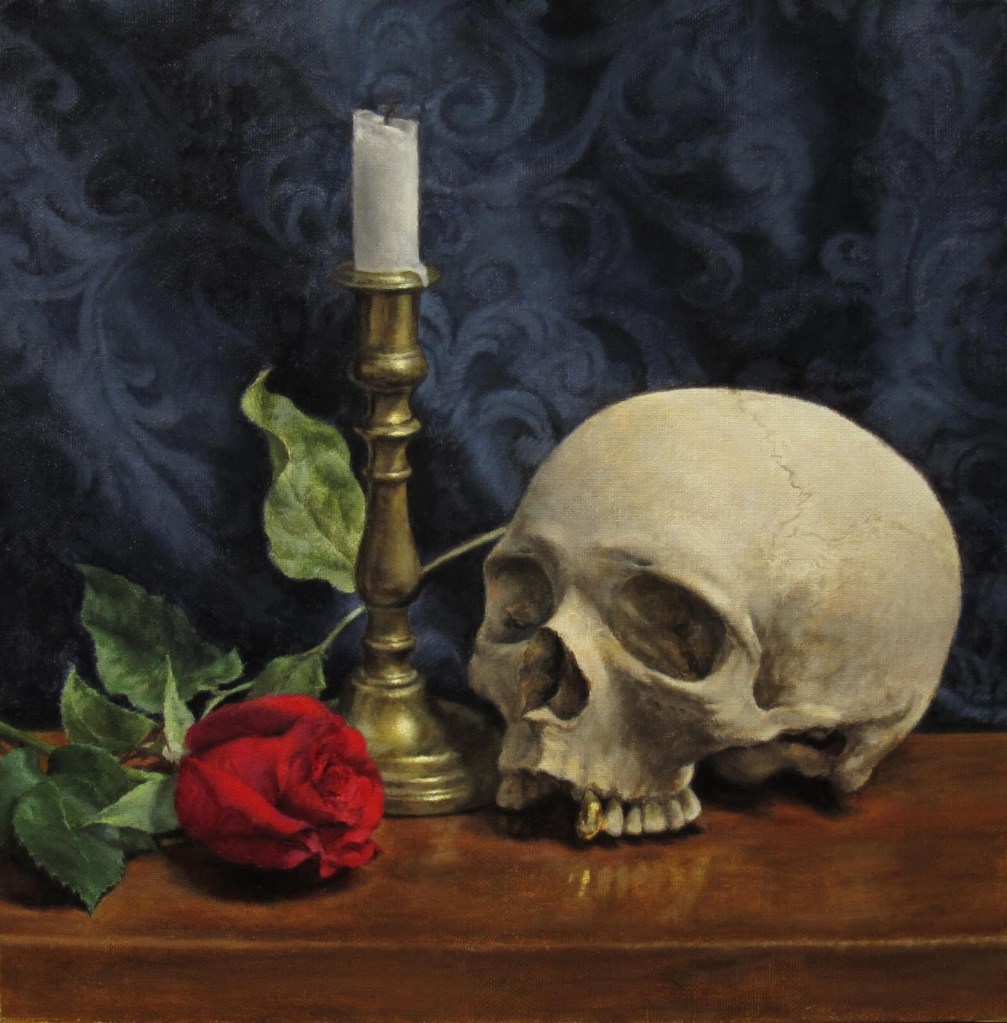
Memento Mori

As one so often does just before sleep, I was thinking again of death last night — neither morbidly nor morosely, but theologically and liturgically. Earlier in the day, standing at the altar with angels and archangels and all the company of heaven and with the host of faithful at Apostles Anglican Church, I proclaimed with the Church universal: By his resurrection he broke the bonds of death trampling Hell and Satan under his feet (BCP 2019, THE PRAYER OF CONSECRATION, p. 133). It was those words I pondered yet again as I lay in the darkness somewhere between waking and sleep.

In what sense has Jesus broken the bonds of death, not for himself, but for me, for you? If Christ tarries, I will die. It seems, then, as if some remnant, at least, of death’s power and of my bondage to it remains intact even after Christ’s resurrection. What bonds, then, were broken?

Hebrews 2:14–15 (ESV): 14 Since therefore the children share in flesh and blood, he himself likewise partook of the same things, that through death he might destroy the one who has the power of death, that is, the devil, 15 and deliver all those who through fear of death were subject to lifelong slavery.

Death itself has not yet been destroyed (1 Cor 15:26). While we have not yet fully been delivered from death — we will experience it — we have been delivered from bondage to fear of death. Christ’s resurrection has revealed death to be the Wizard of Oz: terrifying and manipulative when hidden behind the curtain pulling levers, but laughable and impotent — all blue smoke and mirrors — when revealed as the charlatan it really is. It is fear of death that drives us to seek power and riches and pleasure and honor, fear of death that enslaves us to the prince of this world. Break those bonds of fear and what do you have? Martyrs who can stare death in the face and back it down with faith. Confessors who facing great persecution can shout for all the world to hear, “Christ is risen from the dead, trampling down death by death and upon those in the tombs bestowing life!” Great saints who show us how to die in sure and certain hope of the resurrection. And “ordinary” Christian folk who go about the business of living for Christ in a dying world. As Anglican priest and poet, John Donne, wrote:

Death, be not proud, though some have called thee
Mighty and dreadful, for thou art not so;
For those whom thou think’st thou dost overthrow
Die not, poor Death, nor yet canst thou kill me.
From rest and sleep, which but thy pictures be,
Much pleasure; then from thee much more must flow,
And soonest our best men with thee do go,
Rest of their bones, and soul’s delivery.
Thou art slave to fate, chance, kings, and desperate men,
And dost with poison, war, and sickness dwell,
And poppy or charms can make us sleep as well
And better than thy stroke; why swell’st thou then?
One short sleep past, we wake eternally
And death shall be no more; Death, thou shalt die.

But there is more, as St. Athanasius writes in his On The Incarnation:

For these reasons, then, with death holding greater sway and corruption remaining fast against human beings, the race of humans was perishing, and the human being, made rational and in the image, was disappearing, and the work made by God was being obliterated. For as I said earlier, by the law death thereafter prevailed against us, and it was impossible to escape the law, since this had been established by God on account of the transgression. And what happened was truly both absurd and improper. It was absurd, on the one hand, that, having spoken, God should prove to be lying: that is, having legislated that the human being would die by death if he were to transgress the commandment, yet after the transgression he were not to die but rather this sentence dissolved. For God would not be true if, after saying that we would die, the human being did not die. On the other hand, it was improper that what had once been made rational and partakers of his Word should perish, and once again return to non-being through corruption. It was not worthy of the goodness of God that those created by him should be corrupted through the deceit wrought by the devil upon human beings. And it was supremely improper that the workmanship of God in human beings should disappear either through their own negligence or through the deceit of the demons.

St. Athanasius here envisions death as an eternal state of corruption equivalent to nonbeing. As God called forth man from nothing and granted him life, death — through sin — bids him return to nothing: nonbeing. But now, through the resurrection of Christ, Christian death is not corruption leading to nonbeing; it is the temporary rending apart of body and soul — the body consigned to the earth from which it came and the soul returning to God who gave it — in expectation of the resurrection of the body and the life everlasting. We are free from bondage to corruption and nonbeing.

So, yes, we will die if Christ tarries; death is not yet destroyed. But we need not, even now, live in fear of it; that bond has been broken by the resurrection. And we must not think of it as nonbeing, but rather as a brief respite on the way to the resurrection.

Posted in Uncategorized | Leave a comment

The Confession of St. Peter

Collect: Confession of Saint Peter

Almighty Father, who inspired Simon Peter, first among the apostles, to confess Jesus as Messiah and Son of the living God: Keep your Church steadfast upon the rock of this faith, that in unity and peace we may proclaim the one truth and follow the one Lord, our Savior Jesus Christ; who lives and reigns with you and the Holy Spirit, one God, now and for ever. Amen.

In the Name of the Father, and of the Son, and of the Holy Spirit. Amen.

I AM GOING TO MENTION a few words, with a pause after each. During that brief pause, I would like you to consider your response to each of the words: emotional, intellectual, spiritual response. I’ve chosen these words with no particular social agenda, but simply as a point of entry to the Scripture appointed for the day. Here are the words.

• Politician

• Immigrant

• Redneck

• Lawyer

• Antivaccer

• Feminist

• Fashion Model

All of these words represent aspects of human identity, ways that we characterize ourselves or others. They can be helpful, or they can be polarizing. They can be neutral, or they can elicit strong responses. When I learn that someone is a Democrat, for example, I might instinctively respond, “Oh, he’s one of us,” or “Oh, he’s one of them,” or “Oh, a pox on both their houses.” When I learn that someone is a CNN viewer or a FOX viewer, I might think, “Oh, here is someone who seeks out the truth,” or “Oh, here is someone who is blinded by fake news,” or “Oh, here is someone with too much time on his hands.” I have been cut off by drivers in traffic and had my anger flare up only then to see a church bumper sticker on the offending car. I suddenly became more charitable, because, in spite of the offender’s poor driving, we share the box “Christian.”

My point is that we tend to put people in boxes and to define their identities by those boxes. Boxes are convenient; they keep us from having to do the hard and time-consuming work of actually getting to know a person. Boxes allow us to immediately embrace some and to immediately reject others — no matter that we may be misguided and wrong on both counts. We even get a bit nervous — we find it socially awkward and disconcerting — when we can’t place people in specific boxes, when they don’t quite fit our understanding of the boxes, when they don’t behave as the box demands.

This putting of people into boxes is nothing new; we see it in Scripture, right at the beginning of the Gospel of John, with John the Baptist:

John 1:19–28 (ESV): 19 And this is the testimony of John, when the Jews sent priests and Levites from Jerusalem to ask him, “Who are you?” 20 He confessed, and did not deny, but confessed, “I am not the Christ.” 21 And they asked him, “What then? Are you Elijah?” He said, “I am not.” “Are you the Prophet?” And he answered, “No.” 22 So they said to him, “Who are you? We need to give an answer to those who sent us. What do you say about yourself?” 23 He said, “I am the voice of one crying out in the wilderness, ‘Make straight the way of the Lord,’ as the prophet Isaiah said.”

24 (Now they had been sent from the Pharisees.) 25 They asked him, “Then why are you baptizing, if you are neither the Christ, nor Elijah, nor the Prophet?” 26 John answered them, “I baptize with water, but among you stands one you do not know, 27 even he who comes after me, the strap of whose sandal I am not worthy to untie.” 28 These things took place in Bethany across the Jordan, where John was baptizing.

John is something new, something unexpected, something the authorities have not encountered before. And what do they try to do? They try to find out which box he belongs in. The priests and the Levites that come to examine John have a limited number of boxes, it seems: Messiah, Elijah, or the Prophet spoken of by Moses. When John refuses to identify with any of those boxes, the authorities finally ask him to identify himself, to climb into a box of his own making, as it were. “I am the voice of one crying out in the wilderness,” John says, which surely baffles priests and Levites alike; that’s not one of their boxes, and they don’t know what to make of it, don’t know what to make of him. They never did figure it out. This is God breaking into history in a new way, in a way that defies all our man made boxes, all our definitions of identity. This is God working as Isaiah foretold:

Isaiah 43:18–19 (ESV): 18  “Remember not the former things,

nor consider the things of old.

19  Behold, I am doing a new thing;

now it springs forth, do you not perceive it?

I will make a way in the wilderness

and rivers in the desert.

John will not fit in the old boxes; he would rip them apart as surely as new wine would destroy old wine skins.

Today, our Gospel reading takes us forward some three years in the story from John the Baptist. Jesus has taken his disciples very far north, beyond Galilee, into the pagan district of Caesarea Philippi, at the foot of Mount Hermon. In the Old Testament, this site was associated with Baal Worship; Baal Hermon, the mountain was sometimes called. In the first century it was associated with the worship of Pan, the Greek god of the underworld. You likely know that there was a cave opening at the base of the mountain called the Gates of Hell (Hades). That was the geographical context for Jesus’ promise that the gates of hell would not prevail against the church.

While here in Caesarea, Jesus asks his disciples a question of identity: Into which boxes do people put me?

Matthew 16:13 (ESV): 13 Now when Jesus came into the district of Caesarea Philippi, he asked his disciples, “Who do people say that the Son of Man is?”

We’re right back to the John the Baptist question again, and it seems that, like the priests and the Levites, the people have very limited boxes to work with. Who is Jesus? Perhaps he is John the Baptist risen from the dead. Or, he might be Elijah, just as they had proposed earlier about John. If not Elijah, then perhaps Jeremiah or another of the prophets.

But, all these are old boxes, old wine skins, and Jesus rejects them. It’s there in his language. He listens to what the people are saying and then responds, “But who do you say that I am?” That little conjunction, but, is important. It says that all the other boxes are wrong. It says that something new is required, that God is doing a new thing. And Jesus wants to know if the disciples understand that yet, wants to know if they have been given a better box for him yet.

And that is precisely what Peter’s confession is: a better box, the right box, the God-given box into which Jesus best fits, though no box can fully contain the One who created all things.

Matthew 16:15–16 (ESV): 15 He [Jesus] said to them, “But who do you say that I am?” 16 Simon Peter replied, “You are the Christ, the Son of the living God.”

This is right in some sense that none of the other answers is: Messiah, Son of God. We needn’t think for a moment that Peter is expressing some fully developed Nicene or Chalcedonian understanding of the nature of Christ, or even a notion as clear as that expressed later by John in his Gospel Prologue. All of that has yet to be worked out, thought through, inspired by the Holy Spirit. But Peter does take a step forward here, a step in the right direction. More correctly, God moves Peter a step forward. Jesus is clear that Peter has not constructed this new box all on his own, but rather that God has revealed it to him:

Matthew 16:17 (ESV): 17 And Jesus answered him, “Blessed are you, Simon Bar-Jonah! For flesh and blood has not revealed this to you, but my Father who is in heaven.

Getting Jesus in the right box, is never a matter of human ingenuity; instead, it is always a matter of grace, of God’s revelation to us of Jesus’ identity. Left to our own devices, we always try to put Jesus in the wrong box, in a box that is far too small. You’ve seen it happen; you’ve heard people say, “Well, I believe that Jesus was a good man,” or “I believe Jesus was a great moral teacher,” just not the Christ, the Son of the living God. But those boxes are wrong; they are too small. C. S. Lewis wrote about them in Mere Christianity, in a familiar passage:

I am trying here to prevent anyone saying the really foolish thing that people often say about Him: “I’m ready to accept Jesus as a great moral teacher, but I don’t accept His claim to be God.” That is the one thing we must not say. A man who was merely a man and said the sort of things Jesus said would not be a great moral teacher. He would either be a lunatic — on a level with the man who says he is a poached egg — or else he would be the Devil of Hell. You must make your choice. Either this man was, and is, the Son of God: or else a madman or something worse…. You can shut Him up for a fool, you can spit at Him and kill Him as a demon; or you can fall at His feet and call Him Lord and God. But let us not come up with any patronising nonsense about His being a great human teacher. He has not left that open to us. He did not intend to.

Lewis is right; that box — great moral teacher — simply won’t do. Jesus is the Christ, the Son of the living God.

I am not very concerned about us trying to fit Jesus into those far too constricting boxes like “good man” or “great moral teacher,” as if he were a better Gandhi or more compassionate Buddha. No, those aren’t our temptations. But I do wonder if there are other boxes into which Christians sometimes force Jesus, boxes that are again far too small.

There is the social justice or social reformer box: Jesus as the champion of the downtrodden, the poor, the outcast, the disenfranchised — a grander, more universal Martin Luther King, Jr. or Caesar Chavez with perhaps a little Karl Marx thrown in for good measure; at least they all share a common box. Certainly, Jesus does care for the poor. Certainly Jesus does want a righteous society — the Kingdom of God. But Jesus is not primarily a social reformer except in this expansive sense: Jesus came to make all things new — to redeem humankind, to restore and renew creation, and to unite all things in heaven and on earth to himself. What we call social justice or social reform is far too small a box for Jesus. Jesus is the Christ, the Son of the living God.

There is the gentle Jesus, meek and mild, “can’t we all just get along,” box: Jesus as an easy going, mellow guy who loves to put COEXIST bumper stickers on cars, the one who makes no demands on anyone, and accepts us just as we are. Certainly, Jesus does accept us just as we are in this particular sense:

Romans 5:6–10 (ESV): 6 For while we were still weak, at the right time Christ died for the ungodly. 7 For one will scarcely die for a righteous person—though perhaps for a good person one would dare even to die— 8 but God shows his love for us in that while we were still sinners, Christ died for us. 9 Since, therefore, we have now been justified by his blood, much more shall we be saved by him from the wrath of God. 10 For if while we were enemies we were reconciled to God by the death of his Son, much more, now that we are reconciled, shall we be saved by his life.

Jesus made no prior demands on us before he loved us and died for us, for all of us sinners and enemies. But this is the same Jesus who says, “I am the way, and the truth, and the life. No one comes to the Father except through me” (John 14:6). This is the same Jesus who called and calls for the world to repent and who warned and warns of the judgment to come. Gentle Jesus meek and mild, coexisting Jesus, is far too small a box for Jesus. Jesus is the Christ, the Son of the living God.

We could go listing boxes. There is the patriotic box: Jesus as the champion of liberal or conservative democracy who has a covenant with America to make our country the shining city on the hill. There is the masculine box: Jesus as John Wayne, the tough, silent Jesus who is tolerant for so long and then, when pushed too far, cleans up the town with guns blazing. There is the feminine box: Jesus as the champion of gender equality and women’s rights. There is the box defined by the verses you’ve highlighted and underlined in your Bibles: you know, the verses you like to the neglect of the ones that make you uncomfortable.

There are boxes galore — most containing some element of truth but all of them too small. The box we are looking for — the box we need — is the same box that God revealed to Peter: the box labeled “Jesus the Christ, the Son of the living God.” We won’t find it ourselves or make it ourselves. Just as with Peter, it must be revealed to us by God. So, we look to the revelation we have been given. We turn to Scripture. We turn to the Church. We turn to the faith once delivered to the saints, to the faith preserved in liturgy and Sacrament, to the faith made flesh and blood in the lives of the confessors and the martyrs and the faithful for two millennia. We turn to the work of the Holy Spirit in our own lives.

I’ve used the image of a box in which to place Jesus, by which I mean a label or category used to identify him. Of course, it is only an image, one that’s useful, I think, for illustration. But, the Christ, the Son of the living God cannot be circumscribed, cannot be contained by our feeble, human understanding, cannot be placed in any box, any temple, any created thing. And yet, paradoxically, he condescends to dwell in us, to make us the temple of his presence through the indwelling Holy Spirit. Wondrously, that is the box he’s chosen for himself. Amen.

Posted in Uncategorized | Leave a comment

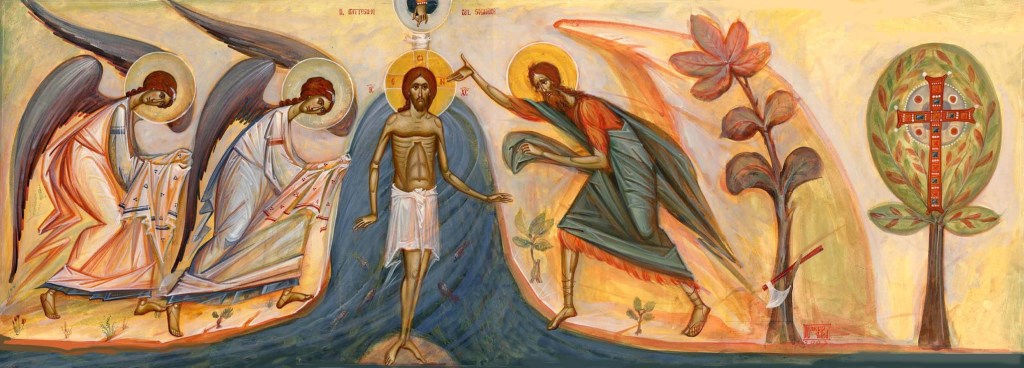
The Baptism of Our Lord Jesus Christ

Design for fresco in the Sanctuary of Monte Sant’Angelo, Mount Gargano, Italy, by Ioan (John) Popa (Romanian, 1976–) and Camelia Ionesco-Popa (Romanian, 1979–), 2003. http://www.sfnectariecoslada.ro/2016/01/09/duminica-dupa-botezul-domnului-matei-4-12-17/

In the Name of the Father, and of the Son, and of the Holy Spirit. Amen.

JUST TWO WEEKS AGO we celebrated Christmas, the birth of our Lord Jesus in Bethlehem: stable and manger, shepherds and angels, carols and candles. Yes, just two weeks have passed on our calendar, but in the Story, thirty years have flown by; today, the fully mature Jesus comes to the Jordan River to be baptized by his cousin John. Why have we skipped over those three decades of Jesus’ life? Is there nothing to be said about them, nothing to be learned from them?

We’re relatively silent about those thirty years because Scripture is relatively silent about them. There are just two events mentioned: the flight to Egypt when Jesus was two years old or under and the Passover in Jerusalem when Jesus was twelve. That latter event offers us some helpful insight into Jesus’ life in those hidden years. I know that you know the story, but let’s hear it again.

Luke 2:41–52 (ESV): 41 Now his parents went to Jerusalem every year at the Feast of the Passover. 42 And when he was twelve years old, they went up according to custom. 43 And when the feast was ended, as they were returning, the boy Jesus stayed behind in Jerusalem. His parents did not know it, 44 but supposing him to be in the group they went a day’s journey, but then they began to search for him among their relatives and acquaintances, 45 and when they did not find him, they returned to Jerusalem, searching for him. 46 After three days they found him in the temple, sitting among the teachers, listening to them and asking them questions. 47 And all who heard him were amazed at his understanding and his answers. 48 And when his parents saw him, they were astonished. And his mother said to him, “Son, why have you treated us so? Behold, your father and I have been searching for you in great distress.” 49 And he said to them, “Why were you looking for me? Did you not know that I must be in my Father’s house?” 50 And they did not understand the saying that he spoke to them. 51 And he went down with them and came to Nazareth and was submissive to them. And his mother treasured up all these things in her heart.

52 And Jesus increased in wisdom and in stature and in favor with God and man.

What do we learn about Jesus —and his family — from this account? First, Jesus was raised as a good, faithful, observant Jew. Eight days after his birth Jesus was named and circumcised in accordance with the Law. On the fortieth day of his life he was presented in the Temple for the rite of redemption of the firstborn and his mother Mary was purified according to the Law. Now, in this text we see that the family has a custom of traveling to Jerusalem for the Passover each year as required by the Law. Mary and Joseph are raising a faithful son of Abraham in accordance with the Law of Moses.

But, Jesus is more than this, more than meets the eye. At the age of twelve he can hold his own in religious debate with the Temple scholars. Whether his expertise in the subtleties of the Law comes from homeschooling or synagogue instruction or something more, we don’t know; but, he amazes the scholars — no small feat. Jesus also has some understanding — we don’t know how full yet — of his true identity; he knows that his Father’s house is not the family home in Nazareth but the Temple in Jerusalem.

It is the last statement in this account that interests me most: And Jesus increased in wisdom and in stature and in favor with God and man (Lk 2:52). Jesus learned and grew, and he was well thought of by his community and by God.

So, what we have in that brief statement, is a description of a seemingly ordinary life. Jesus grew up and he learned things. He learned how to navigate the joys and the challenges of a family. He learned how to take his place in the life of the community, some forty to fifty households on roughly four acres of land. He learned how to be faithful to the traditions of his people. He learned how to make a living as a τεκτον, a craftsman, like his father Joseph: building walls and rooms, hanging doors and making furniture, doing odd jobs and handyman specials — anything to put food on the table. On the surface, his was a very ordinary life. Of course, underneath all that were well-springs and deep currents of the Spirit, largely hidden from sight, waiting for the right time to burst forth.

That time came with the appearance of a prophet from the wilderness, John the son of Zechariah, “the voice of one crying in the wilderness: ‘Prepare the way of the Lord, make his paths straight’” (Lk 3:4b). News of this prophet had spread like wildfire. It had been four hundred years since a true prophet — one like Elijah — had risen in Israel; further, this was the time when one of Israel’s great prophets of the exile had foretold the coming of the Messiah. Expectations — hope — stirred as the news spread as far as Nazareth in Galilee. It seems Jesus heard about John, about his ministry of baptism in the Jordan. We can imagine the scene in Nazareth. Jesus shakes the sawdust out of his hair and brushes off his beard. He cleans his tools, puts them away, and folds up his work apron. He tells his mother that it is now his time to leave, and he turns over care of the family to his brothers. Then he starts walking toward the Jordan and John and his own mission, surely praying the whole way.

When he gets to the Jordan, he probably waits in line with the others in the crowd — ordinary folk, tax collectors, even soldiers — to step down into the water to be baptized by John. And that is strange, Jesus coming to be baptized; it has exercised the minds and faith of the greatest Church theologians for two millennia. Scripture says that John was “proclaiming a baptism of repentance for the forgiveness of sins” (Lk 3:3). But, Jesus comes to him without sin; Jesus comes as the Lamb of God who takes away the sins of the world. So, why would, why should, Jesus submit to John’s baptism? If the Eucharistic Prayer is right — and it is — whatever Jesus did he did “for us and for our salvation;” his baptism is no exception. Though it is far more than this, at the very least, Jesus’ baptism serves as the perfect icon, the perfect model, for our own baptism. Jesus’ baptism points to three great movements in every baptism: repentance, vocation, and identity.

First, repentance. When we think of repentance, we likely mean a godly sorrow for sin and a firm commitment to amendment of life. It is that for us, but it is more than that. The true meaning of repentance is to change one’s mind, to move in a new direction. Jesus had no need to repent of sins, to be sorry for wrongdoing, or to amend his life for the better. He did not experience or express repentance in those terms. But, his baptism was the moment when his life moved in a new direction, when he turned his mind toward a new way of being in the world. Up until this moment he had lived in obscurity as a member of a family in a small town working to make a living and support that family like everyone else in that small town. But, no more. Now he will emerge on the national stage as a prophet and more than a prophet, as a rabbi and more than a rabbi, as a rival to the priesthood and the Temple, as a challenge to the illegitimate king of Israel, and as a minor irritant to Rome itself. Jesus’ baptism was very much an act of repentance in this expanded understanding: a change in the direction of one’s life. And that is a model for us, for reflecting on our own baptism. If your life is fundamentally the same after your baptism as it was before — if your relationships with family and community and work, with wealth and power and honor, with politics and justice and mercy are unchallenged and unchanged by your baptism — then it may well be good to reflect on whether your baptism was actually an act of repentance, whether it was a changing of mind and direction.

Second, vocation. I wonder if Jesus was a good carpenter, a skillful stonemason, a master craftsman of fine furniture. I wonder if he was sought out by his neighbors in Nazareth and even called to be part of the great building projects in nearby Sepphoris. For fifteen years or more, that had been his vocation: craftsman, builder, maker, handyman, jack-of-all-trades. Whether he was exceptionally skillful or not, I’m certain he gave a good day’s work for a good day’s pay, and treated his customers as he would be treated. But he left that life behind with his baptism; he changed vocations. His vocation became a mission, not just to care for his family, not just to do good work in his community, but to save the world. Jesus’ baptism marked a change in vocation. Our baptism does, too. For those who are baptized as infants, baptism defines their most fundamental vocation of all, regardless of how they later choose to make a living and do good in the world. For those who are baptized as adults, baptism does not necessarily call them to leave their professions behind, though it may do. Rather, it more typically challenges them to reimagine their profession, their work, as ministry, as a way of proclaiming Christ, as a way of making the Kingdom of God manifest. It poses questions: What does it look like to be a Christian lawyer or doctor or policeman or teacher or businesswoman or secretary or mother or any other mode of living in and contributing to the world? Near the end of the Rite of Christian Baptism, the Church welcomes the newly baptized with these words of new vocation:

We receive you into the fellowship of the Church. Confess the faith of Christ crucified, proclaim his resurrection, and share with us in the royal priesthood of all his people (BCP 2019, p. 190).

However it is we make a living, this is how we are to make a life. This is our new, baptismal vocation.

Third, identity. Here there is a fundamental difference between Jesus’ baptism and our own. In his baptism, Jesus’ identity did not change; it was simply revealed:

Luke 3:21–22 (ESV): 21 Now when all the people were baptized, and when Jesus also had been baptized and was praying, the heavens were opened, 22 and the Holy Spirit descended on him in bodily form, like a dove; and a voice came from heaven, “You are my beloved Son; with you I am well pleased.”

“You are my beloved Son.” From all eternity the Son of God had been the beloved of God the Father. There was never a time the Son of God did not exist, never an instant when the Son of God was not the beloved. Now, at his baptism, that Son of God is revealed to be incarnate in Jesus of Nazareth, fully God and fully man. Jesus’ identity was not given, was not made new, in his baptism, but it was revealed at his baptism. And that is the difference: at our baptism, we are given a new identity, because we are born anew, born from above, born of the Spirit. In our baptism, by grace we are made to be the children of God, partakers in the Divine nature. If we only had the spiritual ears to hear and eyes to see, I am convinced that at our baptism the heavens were opened, the Holy Spirit descended upon us and remained with us, and a voice spoke from heaven saying, “You are my beloved child — my son, my daughter; with you I am well pleased.”

So, why was Jesus baptized? The short answer is simply this: Jesus was baptized for us and for our salvation: to lead us to repentance, to a change in mind and direction of life; to give us a godly vocation, to enable us to make not just a living, but a life; and to bestow upon us a new identity as sons and daughters of God.

Martin Luther, the great Protestant reformer, in times of difficulty, stress, or temptation would say aloud, “I am baptized.” Reportedly, he carved those words into the desk where he worked. He repeated counseled his people, “Remember your baptism.” The grace that is ours through baptism — the repentance, the vocation, the identity — is an unshakeable foundation of Christian life. May we always remember our baptism. And, if you have not yet been baptized, please seek out a priest or other minister; do not delay in laying hold of this great grace. Amen.

Posted in Uncategorized | Leave a comment

It’s All In The Details: Christmas Eve 2021

Alleluia, to us a child is born:

O come, let us adore him. Alleluia.

A FEW YEARS AGO, I decided to re-read The Lord of the Rings by J. R. R. Tolkien, a classic trilogy that I had read several times in my teenage years. I was surprised that on this reading — well, on this attempted reading — I didn’t care for it. I quickly bogged down in the details — Do we really need a hundred or so pages to describe a birthday party? — and I simply wanted Tolkien to get on with the story. It is a grand story, a grand set of intersecting and interlocking and conflicting stories, that he has to tell. Why bury them under a mound of minutiae? Of course, to Tolkien the details were not incidental to the story; they were integral to it. For Tolkien, the story is found in, comprised of, and flows out of all those details.

We come, this holy night, to another story, to the Gospel according to St. Luke, to the narrative of our Lord’s incarnation. It is not trite to say that this truly is one of the greatest chapters in the greatest story ever told. For Tolkien’s readers, the fictional fate of Middle Earth hung in the balance as Frodo faced the fire of Mount Doom. For all of humanity, the very real fate of the Earth — of the cosmos — hung in the balance as Mary and Joseph faced the birth of a child alone in a cave or stable far from home, far from the loving care of family and friends. How does Luke start this grand tale?

Luke 2:1–3 (ESV): 2 In those days a decree went out from Caesar Augustus that all the world should be registered. 2 This was the first registration when Quirinius was governor of Syria. 3 And all went to be registered, each to his own town.

The one by whom, through whom, and for whom all creation came into being; the one in whom all creation holds together; the logos, the very Word of God, the only Son of God, begotten of the Father before all ages, God from God, Light from Light, true God from true God, begotten not made, of one Being with the Father — this one is about to be born in human flesh of a human mother to dwell among us human and to unite us to his divinity. And Luke starts with Caesar Augustus and Quirinius, doing what politicians do — taxing the people? Forget these trivial details, Luke; get on with the story!

But, long before Tolkien, Luke had an eye for details; you see that all throughout his Gospel. For Luke, too, the details aren’t incidental, but are integral to the story. The story emerges from these details.

So, what of Caesar Augustus, whose name would endure beyond this story anyway, and what of Quirinius, some forgettable governor of Syrian whom the world would never have known apart from this story? What do these names, these details of their reign and administration and taxation add to the Gospel?

First, they mark Luke’s Gospel as history and not myth. Luke does not start “once upon a time,” or “long ago in a galaxy far, far away,” or in Middle Earth, but rather in the concrete, factual details of this time and this place and this ruler and this petty bureaucrat and these odious taxes, and this forced travel with this very pregnant wife. This is the real stuff of real first century life — though they didn’t yet mark this time as the first century — the real burdens of real people in a real place in a real time. Luke is an historian, a biographer, a theologian; but, he is not an author of fiction or fantasy. So, these details matter, these factual details matter, because they declare Luke’s intent to tell us the truth, the whole truth, and nothing but the truth — what really happened that night. While truth can be told in parable, in myth, in poetry — and we see all these in Scripture — these are not Luke’s genres; his form is narrative history. What he says happened, really happened.

Second, these details tell us that the world was going about its own business when God broke into history, so busy with ordinary things that it noticed the great invasion not at all, so intent on the levy and collection of taxes in this little backwater village that it noticed the rending apart of time into before and after this birth not at all. Augustus might have noticed the foundations of the empire shift under him, but he was otherwise occupied. Quirinius — well, he was just too busy following orders to notice anything but the bottom line on the tax ledger.

As in the first century, so in the twenty-first century, I suppose. We are so busy with the Marvel Cinematic Universe or Mark Zuckerberg’s Meta-verse or the conflicting media-verses of cable new channels or the universes we make of our private lives that we have too little time left to notice the in-breaking of Truth — the coming of the One who is the Truth. And, our politicians are busy with taxing and spending and writing bills that have little chance of becoming laws because other politicians are resolutely and busily opposed to anything at all getting done. So it goes from election to election regardless of which party is temporarily in power. What difference does the birth of a baby in Bethlehem make to our government, to any government, other than perhaps a day off from the hubris of some and the bureaucratic grind of others? No, the powers-that-be largely go about their business of pretending to be powerful: a few Caesars, thousands of Quiriniuses. And we pay our taxes and obey their laws, following the decrees of these days.

The story moves on and leaves these powers behind.

Luke 2:4–7 (ESV): 4 And Joseph also went up from Galilee, from the town of Nazareth, to Judea, to the city of David, which is called Bethlehem, because he was of the house and lineage of David, 5 to be registered with Mary, his betrothed, who was with child. 6 And while they were there, the time came for her to give birth. 7 And she gave birth to her firstborn son and wrapped him in swaddling cloths and laid him in a manger, because there was no place for them in the inn.

Geographic details this time: Galilee; Nazareth; Judea; Bethlehem, the city of David. Why? Why does place matter? Long before this night, God had spoken through the prophet Nathan to David, the great king of Israel, when David had proposed building a house for the Lord in Jerusalem. God speaks:

2 Samuel 7:12–14a (ESV): 12 When your days [David] are fulfilled and you lie down with your fathers, I will raise up your offspring after you, who shall come from your body, and I will establish his kingdom. 13 He shall build a house for my name, and I will establish the throne of his kingdom forever. 14 I will be to him a father, and he shall be to me a son.

The prophecy continues to say that this house, this throne, this kingdom of David’s offspring, will be everlasting. So, the detail of birthplace matters, the detail of Bethlehem matters, because Bethlehem is the ancestral home of David, and being born there identifies this child as the offspring of David, as one of royal lineage, as perhaps the one to fulfill Nathan’s prophecy.

Galilee and Nazareth matter, too, because they speak of obscurity, humility, poverty, weakness. Can anything good come from Nazareth? was a common byword of the day: no need to answer; just smile and shake your head and chuckle. All throughout the Law, God had expressed — and God had impressed upon his people — his concern for and their responsibility toward the poor, the orphan, the widow, and the stranger. What better geographical locale to symbolize this very class of the weak and powerless than Nazareth in Galilee: far removed from the locus of power in Judea, far removed in prestige from cosmopolitan Jerusalem. When God becomes man he does so among the very ones he instructed his people to care for, to experience himself in the flesh what it is to be the poor, the widow, the orphan, the stranger, the butt of jokes. So, yes, geographic details matter.

As in the first century, so in the twenty-first century, I suppose. Geography matters; birthplace matters. Zip codes matter; they serve as pretty reliable indicators of health, wealth, access to quality education, and more. It is not easy being born in a modern day, United States, Nazareth in Galilee. But, Jesus is there, as he was in the first-century and as he promised to be in every successive generation, there in the distressing guise of the poor:

Matthew 25:35–40 (ESV): 35 For I was hungry and you gave me food, I was thirsty and you gave me drink, I was a stranger and you welcomed me, 36 I was naked and you clothed me, I was sick and you visited me, I was in prison and you came to me.’ 37 Then the righteous will answer him, saying, ‘Lord, when did we see you hungry and feed you, or thirsty and give you drink? 38 And when did we see you a stranger and welcome you, or naked and clothe you? 39 And when did we see you sick or in prison and visit you?’ 40 And the King will answer them, ‘Truly, I say to you, as you did it to one of the least of these my brothers, you did it to me.’

The details of geography — and our response to it — matter. But, the story moves on again, this time to a field outside town.

Luke 2:8–14 (ESV): 8 And in the same region there were shepherds out in the field, keeping watch over their flock by night. 9 And an angel of the Lord appeared to them, and the glory of the Lord shone around them, and they were filled with great fear. 10 And the angel said to them, “Fear not, for behold, I bring you good news of great joy that will be for all the people. 11 For unto you is born this day in the city of David a Savior, who is Christ the Lord. 12 And this will be a sign for you: you will find a baby wrapped in swaddling cloths and lying in a manger.” 13 And suddenly there was with the angel a multitude of the heavenly host praising God and saying,

14  “Glory to God in the highest,

and on earth peace among those with whom he is pleased!”

Gender reveal parties are a recent trend among expectant parents. You have probably seen some on social media or television— particularly those that go badly and hilariously wrong: fathers-to-be who shoot themselves in the face with a blue power cannon filled with blue confetti or mothers-to-be whose homemade cake, when cut, is some indistinct grey color inside instead of a vibrant pink, leaving everyone puzzled. What we have in Luke’s Gospel is the great, divine reveal — not of gender, though that is implied, but of identity: a Savior, who is Christ the Lord. This detail matters! This is not just any baby. This is the offspring of David, the Savior, the Messiah, the Lord. This is the one whose birth merits an angelic annunciation and a heavenly host praising God and proclaiming peace throughout the earth to those with whom God is pleased. And this detail also matters: that the angels appear to shepherds watching their flocks all night long while everyone else snuggles up into whatever comfort they can find. These shepherds are among the essential workers of their day: necessary, but accorded little respect, little consideration, little notice. A collect from the Office of Compline — night prayer — in our Book of Common Prayer comes to mind:

O God, your unfailing providence sustains the world we live in and the life we live: Watch over those, both night and day, who work while other sleep, and grant that we may never forget that our common life depends upon each other’s toil; through Jesus Christ our Lord. Amen (BCP 2019, p. 64).

Why did the angels announce this great news first to shepherds? Well, they were up, working while others slept. The one born this night will have much to say later about watchfulness, about being found at work, about staying awake and being ready when the bridegroom or the master or the king returns. The shepherds were up watching — not for this, of course! — but, they were up watching, doing the work they had been given to do.

But, there is much more in this detail. There is an allusion to, a resonance with David. Psalm 78 tells the story of God and Israel and concludes with these words:

71 He chose David his servant,*

and took him away from the sheepfolds;

72 As he was following the ewes that were great with young, God took him,*

that he might feed Jacob his people, and Israel his inheritance.

73 So he fed them with a faithful and true heart,*

and guided them with skillful hands.

David was a shepherd-made-king by God. The one born this night, the one the angels herald, is the offspring of David who will be the Good Shepherd, who will feed Jacob his people and Israel his inheritance with a faithful and true heart, who will guide them with skillful hands: the Good Shepherd made King of kings and Lord of lords. Is it not fitting that his birth is first proclaimed to shepherds like David, to shepherds keeping watch over sheep in the fields outside Bethlehem, the city of David?

Can we see more in this detail? What need does Augustus have for a Savior when, in his own estimation, he is the great Savior of the World? What attention would Caesar pay to the ευαγγελιον, the Gospel, the proclamation of a royal birth coming from the fields of Bethlehem? What time does Quirinius have to spare, busy as he is with taxes, for a Jewish Lord? But the poor, the powerless, the ones of little reputation — the shepherds and those like them — they just might listen to such news; they just might hope for and in such a savior; they just might follow such a good, fellow shepherd. And so the angels come to them with the glad tidings.

As in the first-century, so in the twenty-first century, I suppose. The good news has always been most readily received by the poor, the powerless, the forgotten — by those who know they need a Savior. Yet, like the priests and the Sadducees of the first century, it seems that the church of the twenty-first century often seeks a seat at the table of the rich and powerful, seems to curry favor with the movers-and-shakers of society, and sometimes forgets to go out into the fields at night, to sit with the shepherds and the other essential workers, to watch sheep and listen for the angels.

The details of St. Luke’s Gospel really do matter, because they tell us of a world very like our own: a world busy with its own affairs — too busy, it seems, to attend to the birth of God-With-Us; a world in which the powers-that-be and the structures and policies they create have little room for the true King of kings; a world in which geography still disproportionately shapes the course of one’s life; a world in which we still depend upon each other’s toil but fail too often to properly honor and reward it; a world where, quite measurably, the rich get richer and the poor get poorer; a world where too few hear the proclamation of the Gospel because they have stopped their ears and because the church, sometimes, speak with a mumbled voice.

So, we come again tonight to be reminded of and challenged by all this in the details of the story. We come to listen to shepherds tell their tale of angels. We come to follow them even unto Bethlehem to see this thing which has come to pass. We come to kneel in the presence of the Creator of all things, now in human form, now as a helpless baby born in the wrong zip code. We come to wonder. We come to rejoice. We come to worship. We come to treasure up all these details, to ponder them in our hearts. We come so that we may go out again, returning to our world — to a world changed by this birth — as did the shepherds, glorifying and praising God for all we have heard and seen. Amen.

Posted in Uncategorized | Leave a comment

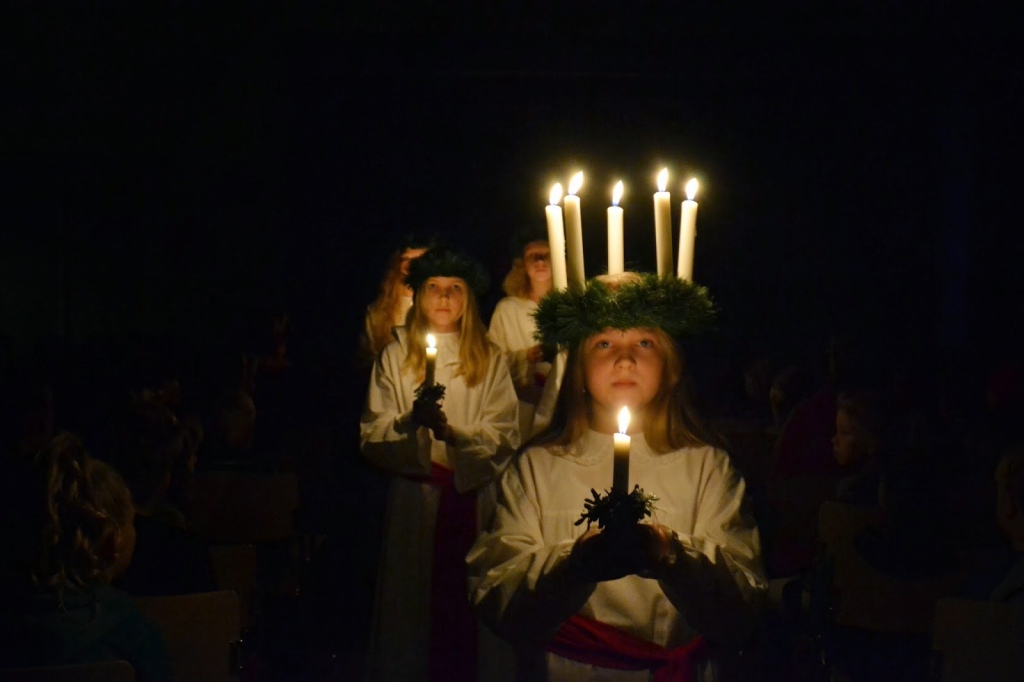
Feast of St. Lucy

Celebration of the Feast of St. Lucy

Collect

Almighty God, who gave to Lucy the grace of complete devotion in body, mind, and spirit and the courage to proclaim her faith in the day of persecution: Grant to us, your servants, that same resolute holiness and unshakable commitment to the Bridegroom of the Church, our Lord Jesus Christ who with you and the Holy Spirit lives and reigns, one God, now and for ever. Amen.

In the Name of the Father, and of the Son, and of the Holy Spirit. Amen.

CONSIDER the lively examples set us by the saints, who possessed the light of true perfection and religion, and you will see how little, how nearly nothing, we do. What, alas, is our life, compared with theirs? The saints and friends of Christ served the Lord in hunger and thirst, in cold and nakedness, in work and fatigue, in vigils and fasts, in prayers and holy meditations, in persecutions and many afflictions. How many and severe were the trials they suffered—the Apostles, martyrs, confessors, virgins, and all the rest who willed to follow in the footsteps of Christ! They hated their lives on earth that they might have life in eternity (A Kempis, The Imitation of Christ, Book 1, Chapter 18).

Wednesday is the first of the winter Ember Days. We’ve spoken before, at least in passing, of Ember Days: four sets of three days — always Wednesday, Friday, and Saturday — distributed seasonally among Winter, Spring, Summer, Fall. These days are designated for the church to fast and pray specifically for those called to Holy Orders. Those candidates for Holy Orders observe Ember Days by writing letters to their bishops, letters of reflection upon the candidates’ academic, personal, and spiritual formation and progress toward ordination. I remember writing them myself several years ago now.

So, before we go further, let’s offer the appointed Ember Days collect.

The Lord be with you.

And with your spirit.

Let us pray.

Almighty God, the giver of all good gifts, in your divine providence you have appointed various orders in your Church: Give your grace, we humbly pray, to all who are [now] called to any office and ministry for your people [and especially to Bruce]; and so fill them with the truth of your doctrine and clothe them with holiness of life, that they may faithfully serve before you, to the glory of your great Name and for the benefit of your holy Church; through Jesus Christ our Lord, who lives and reigns with you, in the unity of the Holy Spirit, one God, now and for ever. Amen.

Ember Days are not fixed dates on the calendar; they are determined relative to other holy days. The Spring Ember Days start on the Wednesday following the first Sunday of Lent, for example. Summer Days follows the Day of Pentecost and the Fall Days start on the Wednesday after Holy Cross Day (14 September). What of the Winter Ember Days: when do they start — why today? The Winter Ember Days begin the Wednesday next after St. Lucy’s Day, a commemoration held on 13 December. St. Lucy’s Day was Monday of this week and this is the Wednesday next, hence the beginning of the Winter Ember Days.

All this is detailed in the calendar instructions in the ACNA Book of Common Prayer, p. 689 if you’re interested in that sort of thing. It is one of only two places — that I’ve been able to find — that St. Lucy is even mentioned in the Book of Common Prayer. There is no collect of St. Lucy, no lectionary readings or Eucharistic preface provided for her feast day. St. Lucy’s Day functions simply as a marker on the church calendar by which we determine the start of Ember Days. St. Lucy herself, for the most part, is a cipher, a blank, in the Anglican spiritual imagination. Certainly, one reason for this is that little is known about St. Lucy. But, I suspect another reason may be more fundamental. St. Lucy is primarily known for her holy virginity and her commitment to it, a commitment even unto death. The Roman Catholic Church has always had a cult of virgin martyrs, has always accorded these women a special place of honor. But not so much the Anglican Church; we have not preserved and emphasized that same place of honor, perhaps, in part because Henry VIII abolished monasteries and convents, perhaps in part due to what the Anglican divines considered an excessive emphasis on the saints. If you look at the collects for commemorations in the Book of Common Prayer, you find prayers for these groups: martyrs, missionaries or evangelists, pastors, teachers of the faith, monastics or religious, ecumenists, reformers of the Church, renewers of society — but no mention of holy virgins. The Book of Common Prayer has a rite for Holy Matrimony, but no corresponding rite for the dedication of oneself to a celibate life of service to the Lord. This is not a critique; it is simply an observation as we reflect on St. Lucy.

So, who was this woman? What little do we know about her?

Lucy was born in Syracusa, a city in Sicily, to affluent, Christian parents, who raised her in the faith from her birth. Her father died when she was young, and her mother Eutychia had a serious health issue also. As with the woman in the Gospel, Eutychia had suffered for four years with a flow of blood the doctors were unable to stanch. It was Lucy who insisted that she and her mother travel to Catana to pray for healing at the tomb of St. Agatha, a holy virgin martyr of Sicily. It was there — or at least as a result of the prayers offered there — that Eutychia was healed. And, perhaps it was that incident that confirmed in Lucy her own desire to offer herself fully to God as a holy virgin and to distribute her portion of the family wealth to the poor. She made this vow secretly; she did not reveal it to her mother.

Not knowing about her daughter’s vow, Eutychia sought to arrange a marriage for Lucy, as was the norm. An agreement was made with a young nobleman, but he soon began to suspect something was amiss. He noticed that Lucy had begun selling her jewelry and other possessions and was distributing the proceeds to the poor. That practice was highly unusual, except among one group of people: the Christians. Knowing now that he had been misled — inadvertently misled by the mother, but misled nonetheless — he denounced Lucy to the authorities as a Christian. All this was transpiring under the final but brutal persecution of Christians under the Emperor Diocletian. Without going into the details, Lucy refused to submit to her betrothed and to renounce her faith; she was tortured and died as a result of her wounds in A.D. 304.

Lucy was venerated as a holy virgin martyr and saint as early as the sixth century, within some three hundred years of her death. By the eighth century, her popular devotion had spread to England, where her feast day was observed until the Reformation. As I understand it, the Church of England now observes St. Lucy’s Day as a lesser feast of the Church, but not so the American Anglican Church.

So, what are we to make of this, of the life of one who was so committed to holy virginity that she was willing to die for it? It is difficult for our culture, which prizes virginity hardly at all, to understand such a committed life. And, even as the Church, we must be very careful to get our theology right on this matter; frankly, it is foreign to most of us, too. In many — perhaps most? — churches, the Singles’ Group, is just the Christian alternative to eharmony or match.com: not as much support for those called to celibacy, but a matchmaking service for those looking for a Christian mate. So, what can we say about this? What should we say?

Holy Matrimony and holy virginity — perpetual virginity consecrated to the Lord — are both honorable — and yes, holy — states of life, neither more blessed than the other. A holy virgin consecrates herself, or himself, to the Lord fully — in body, mind, and spirit — not because there is something inherently impure about human sexuality within marriage, but solely because she or he is called by God to this unique expression of full Gospel self-sacrifice. St. Paul exalted marriage as the earthly, incarnational icon of the relationship between Christ and the Church: pure and holy. But, he also recognized celibacy — holy virginity — as an honorable estate, and, on occasion, a more desirable estate than marriage.

1 Corinthians 7:32–35 (ESV): 32 I want you to be free from anxieties. The unmarried man is anxious about the things of the Lord, how to please the Lord. 33 But the married man is anxious about worldly things, how to please his wife, 34 and his interests are divided. And the unmarried or betrothed woman is anxious about the things of the Lord, how to be holy in body and spirit. But the married woman is anxious about worldly things, how to please her husband. 35 I say this for your own benefit, not to lay any restraint upon you, but to promote good order and to secure your undivided devotion to the Lord.

For Paul, the choice between virginity and marriage is a spiritually practical one: a virgin may devote all her or his undivided time and attention to the Lord and to the Lord’s work, while the married person must attend to the demands of family life.

But, the decision between the two estates is more than just practical; it is also a matter of calling.

1 Corinthians 7:8–9 (ESV): 8 To the unmarried and the widows I say that it is good for them to remain single, as I am. 9 But if they cannot exercise self-control, they should marry. For it is better to marry than to burn with passion.

Male and female were, in the beginning, made for one another, and human sexuality was and is part of that, part of what was pronounced good by God within the context of marriage. The Church has sometimes gotten that wrong, has sometimes looked upon sex as somehow inherently degraded. It is allowed within marriage as a sort of concession, so that a man and woman can satisfy their physical needs without sin. But, the Church has sometimes gotten the other estate wrong, too, and has looked upon holy virginity as something abnormal, something that a good Christian Singles’ Group can remedy. Contrary to these errors, Paul insists that both estates are holy, that to choose one over the other is a matter of gifting. If God has not given you the gift of sexual self-control, then God has not called you to perpetual holy virginity. Marry, be faithful, raise children as God blesses; that is honorable and holy. But, if self-restraint is God’s gift to you — self-restraint and the ability to live without the emotional and physical intimacy of marriage — and if you wish to make a sacrifice of your sexuality, of that human intimacy, then that, too, is honorable and holy. The Church must make room for both of these holy estates. And more than make room: the Church must honor and support both estates. Jesus blessed the marriage at Cana, even while he himself remained a holy virgin.

In the end, one is not made holy by either state of life, virginity or marriage. One is made holy by one’s faithfulness to God expressed in and through a particular state of life. We do not honor St. Lucy just because she was a virgin, but rather because through her virginity she expressed her complete self-offering to God, a devotion for which she was willing to suffer martyrdom. That is the Christian goal, the Christian purpose, in any state of life to which God has called us — all of us. Amen.

Posted in Uncategorized | Leave a comment

Holiday or Holy Day?

The Eve of Thanksgiving

(Deut 8 / Ps 65:1-8 / James 1:17-27 / Matt 6:25-33)

Collect for Thanksgiving Day

Most merciful Father, we humbly thank you for all your gifts so freely bestowed upon us: for life and health and safety, for strength to work and leisure to rest, for all that is beautiful in creation and in human life; but above all we thank you for our spiritual mercies in Christ Jesus our Lord; who with you and the Holy Spirit lives and reigns, one God, for ever and ever. Amen.

In the Name of the Father, and of the Son, and of the Holy Spirit. Amen.

I WANT TO WAX SEMANTIC — and perhaps pedantic — for a moment by making a distinction between a holy day and a holiday. A holy day is a sacred observance; its focus is Godward. It is time spent in worship: fasting or feasting, praying or serving, lamenting or rejoicing, confessing or praising. A holiday is a secular observance; its focus in manward. It is time spent mainly not working: football and parades, fireworks and barbecues, family and friends. A holiday is the best approximation a secular culture has of a holy day: a flattened out holy day, a holy day without anything or anyone holy in it. Now, I have nothing against holidays. Who doesn’t like a day off? And, some holidays at least commemorate culturally significant events and persons, mainly political ones: Veterans’ Day, Memorial Day, the Fourth of July, Presidents’ Day and the like. Sometimes a holy day and a holiday coincide, like at Christmas. The culture celebrates Christmas — a holiday of family and feasting and gift-giving and festivity — while the church celebrates the Feast of the Nativity — a holy day that calls us to bow in wonder before God incarnate as a baby in Bethlehem. Most Western Christians, I suspect, celebrate both the holiday and the holy day on 25 December with scarcely a thought of the differences between the two. The same may be true of Thanksgiving. Holy day, holiday, or both?

Though this may surprise you, Thanksgiving is not a holy day on the church calendar; it is a holiday on the national calendar. The Book of Common Prayer recognizes it as a national holiday and even honors its historical religious roots by providing propers for the day: a collect and lectionary readings. Though it had been observed earlier, Thanksgiving formally became a national holiday in the midst of the Civil War, in 1863, when President Abraham Lincoln established a day “to commend to [God’s] tender care all those who have become widows, orphans, mourners or sufferers in the lamentable civil strife.” Even here, there is more a sense of penitence than of thanksgiving, more fasting than feasting.

But, the day did start as a time of thanksgiving nearly two and a half centuries before: Plymouth Colony, 1621, with a few surviving colonists and several members of the Wampanoag tribe. Against all odds, and with the help of the Wampanoag, fifty-three colonists had survived the previous winter, had planted crops, and now had reaped a harvest sufficient to last through the coming winter months. Thanksgiving seemed a good and right thing to do, and so this group gathered sometime between September and November — the date is uncertain — for three days of feasting and celebration. It was a harvest festival.

And that brings me back to holy days and holidays. Historically, I understand why Thanksgiving is not a holy day in the English Prayer Book tradition. It does not commemorate a biblical event or honor a saint. Nor is it indigenous to England: to the colonies, yes, but to England proper, no. So, liturgically it is relegated to a national holiday, both for the United States and, separately, for Canada. Historically and liturgically, I understand; that may well be correct. But, I’m not so convinced that it is biblically correct or theologically sound. Maybe, just maybe, Thanksgiving should be a holy day, and not just a holiday. There is ample biblical precedent in Israel.

Deuteronomy finds the Hebrews poised to enter the promised land, listening to Moses’ farewell address and review of the Law. He calls the people to remember.

Deuteronomy 8:7–20 (ESV): 7 For the Lord your God is bringing you into a good land, a land of brooks of water, of fountains and springs, flowing out in the valleys and hills, 8 a land of wheat and barley, of vines and fig trees and pomegranates, a land of olive trees and honey, 9 a land in which you will eat bread without scarcity, in which you will lack nothing, a land whose stones are iron, and out of whose hills you can dig copper. 10 And you shall eat and be full, and you shall bless the Lord your God for the good land he has given you.

11 “Take care lest you forget the Lord your God by not keeping his commandments and his rules and his statutes, which I command you today, 12 lest, when you have eaten and are full and have built good houses and live in them, 13 and when your herds and flocks multiply and your silver and gold is multiplied and all that you have is multiplied, 14 then your heart be lifted up, and you forget the Lord your God, who brought you out of the land of Egypt, out of the house of slavery, 15 who led you through the great and terrifying wilderness, with its fiery serpents and scorpions and thirsty ground where there was no water, who brought you water out of the flinty rock, 16 who fed you in the wilderness with manna that your fathers did not know, that he might humble you and test you, to do you good in the end. 19 And if you forget the Lord your God and go after other gods and serve them and worship them, I solemnly warn you today that you shall surely perish. 20 Like the nations that the Lord makes to perish before you, so shall you perish, because you would not obey the voice of the Lord your God.

There is, in every culture, a tendency to secularize the culture’s history and accomplishments. You need look no further than our national monuments to see this trend at work in America: political memorials to Washington, Jefferson, Lincoln; military monuments to every war we have fought and to the soldiers who fought them; economic monuments to capitalism and commerce, two of which fell on 9/11. Every one of these monuments say, “Look at us. Look at what we have accomplished — often at great cost. Look at what we have achieved with our power and might and intellect and will.” And we have holidays that proclaim in time what the monuments proclaim in stone and steel: holidays, but not holy days. And that is precisely what God warned Israel against as they entered a good land with bountiful food, houses, pasture, produce. How easy it would be to forget that all these blessings are just that — blessings from God and not the accomplishments of the people. How easy it would be to build monuments — and idols.

17 Beware lest you say in your heart, ‘My power and the might of my hand have gotten me this wealth.’ 18 You shall remember the Lord your God, for it is he who gives you power to get wealth, that he may confirm his covenant that he swore to your fathers, as it is this day (Deut 8:17-18).

How is Israel to avoid this tendency to self-congratulation, this temptation to build monuments to human accomplishment? By keeping holy day: not holiday, but holy day. Moses tells them how — instructions from God himself — as he continues his farewell address.

Deuteronomy 26:1–11 (ESV): 26 “When you come into the land that the Lord your God is giving you for an inheritance and have taken possession of it and live in it, 2 you shall take some of the first of all the fruit of the ground, which you harvest from your land that the Lord your God is giving you, and you shall put it in a basket, and you shall go to the place that the Lord your God will choose, to make his name to dwell there. 3 And you shall go to the priest who is in office at that time and say to him, ‘I declare today to the Lord your God that I have come into the land that the Lord swore to our fathers to give us.’ 4 Then the priest shall take the basket from your hand and set it down before the altar of the Lord your God.

5 “And you shall make response before the Lord your God, ‘A wandering Aramean was my father. And he went down into Egypt and sojourned there, few in number, and there he became a nation, great, mighty, and populous. 6 And the Egyptians treated us harshly and humiliated us and laid on us hard labor. 7 Then we cried to the Lord, the God of our fathers, and the Lord heard our voice and saw our affliction, our toil, and our oppression. 8 And the Lord brought us out of Egypt with a mighty hand and an outstretched arm, with great deeds of terror, with signs and wonders. 9 And he brought us into this place and gave us this land, a land flowing with milk and honey. 10 And behold, now I bring the first of the fruit of the ground, which you, O Lord, have given me.’ And you shall set it down before the Lord your God and worship before the Lord your God. 11 And you shall rejoice in all the good that the Lord your God has given to you and to your house, you, and the Levite, and the sojourner who is among you.

At the time of harvest — even before he eats of the harvest — every man of Israel is to take a basketful of the firstfruits of his land to the tabernacle and later to the temple. He is to present it to the priest to offer it to the Lord. And in what is one of the most poignant rituals in all Scripture he is to proclaim his story, the story of how God took him from nothing and brought him into this good land which has produced this good crop. And after recounting — in ritualized form — the story of his people; the story of Abraham, Isaac, and Jacob; the story of Egypt and slavery and deliverance; the story of conquest and now prosperity; the story of the faithfulness of God to the covenant; then he is to say, “And behold, now I bring the first of the fruit of the ground, which you, O Lord, have given me.” He is to worship. He is to feast, sharing his bounty with his family and friends, with the Levites — the servants of God — and with the sojourners. He is to celebrate the harvest — a day of Thanksgiving — as a holy day.

Can’t you see all of that in our great Thanksgiving hymn, Come Ye Thankful People Come, written by Henry Alford, a good Anglican churchman?

Come, ye thankful people, come,
Raise the song of harvest home!
All is safely gathered in,
Ere the winter storms begin;
God, our Maker, doth provide
For our wants to be supplied;
Come to God’s own temple, come;
Raise the song of harvest home!

For Israel, the harvest was to be a holy day. For Christians, Thanksgiving should be a holy day and not just a holiday.

On 9 May this year, the Sunday before the Ascension, we observed a holy day of the church: Rogation Sunday. It is a day to process through the fields and to ask God’s blessing on the crops. We include these petitions either in the Great Litany or in the Prayers of the People:

That it may please thee to grant favorable weather, temperate rain, and fruitful seasons, that there may be food and drink for all thy creatures,

We beseech thee to hear us, good Lord.

That it may please thee to bless the lands and waters, and all who work upon them to bring forth food and all things needful for thy people,

We beseech thee to hear us, good Lord.

That it may please thee to look with favor upon all who care for the earth, the water, and the air, that the riches of thy creation may abound from age to age,

We beseech thee to hear us, good Lord.

If planting started with a holy day of prayer to God for his blessing, it seems good and right that the harvest should end with a holy day of thanksgiving to God for his blessings: prayers offered and prayers answered.

So, while our culture celebrates the holiday of Thanksgiving tomorrow — and, of course, we will join with them in that — let’s also keep holy day tomorrow, presenting our feast to God as firstfruits of praise and Thanksgiving, recounting the story of God’s blessing and all his wonderful deeds. Amen.

Posted in Uncategorized | Leave a comment

Luke-Acts, Daniel and the Ascension

TODAY WE BEGIN reading the Acts of the Apostles in Morning Prayer. I hope these few reflections on today’s reading will provide a context for the readings to follow.

Luke 1:1–4 (ESV): 1 Inasmuch as many have undertaken to compile a narrative of the things that have been accomplished among us, 2 just as those who from the beginning were eyewitnesses and ministers of the word have delivered them to us, 3 it seemed good to me also, having followed all things closely for some time past, to write an orderly account for you, most excellent Theophilus, 4 that you may have certainty concerning the things you have been taught.

So begins the Gospel according to St. Luke. John’s Gospel comes next in order in our New Testaments since it is the magisterial summary and interpretation of the synoptic Gospels gone before. Then we come to the Acts of the Apostles, which begins with these words:

Acts 1:1–5 (ESV): 1 In the first book, O Theophilus, I have dealt with all that Jesus began to do and teach, 2 until the day when he was taken up, after he had given commands through the Holy Spirit to the apostles whom he had chosen. 3 He presented himself alive to them after his suffering by many proofs, appearing to them during forty days and speaking about the kingdom of God.

4 And while staying with them he ordered them not to depart from Jerusalem, but to wait for the promise of the Father, which, he said, “you heard from me; 5 for John baptized with water, but you will be baptized with the Holy Spirit not many days from now.”

Far be it from me to question the hallowed arrangement of the books of the Bible, but clearly, the Gospel of John notwithstanding, Luke and Acts belong together; they comprise a two-volume set by the same author, to the same patron, with the same theme: the Kingdom of God — inaugurated by Jesus and proclaimed and enacted by his followers empowered by the Holy Spirit.

The central act in this story is the passion and victory of Christ — the crucifixion and resurrection — in which Jesus defeated all the powers and rival kingdoms that opposed the coming of God’s Kingdom on earth as it is in heaven. That is the central act in the story. But, in literary, historical, and theological senses, there is a pivotal act in the two-volume Luke-Acts narrative also. It appears twice; it closes the Gospel of Luke, and it opens the Acts of the Apostles. It is pivotal because it marks not only a point of continuity between the accounts, but also because it marks a point of transition. It is the ascension of our Lord Jesus.

The account in Luke is quite simple:

Luke 24:50–53 (ESV): 50 And he led them out as far as Bethany, and lifting up his hands he blessed them. 51 While he blessed them, he parted from them and was carried up into heaven. 52 And they worshiped him and returned to Jerusalem with great joy, 53 and were continually in the temple blessing God.

The narrative in Acts adds some important details.

Acts 1:6–11 (ESV): 6 So when they had come together, they asked him, “Lord, will you at this time restore the kingdom to Israel?” 7 He said to them, “It is not for you to know times or seasons that the Father has fixed by his own authority. 8 But you will receive power when the Holy Spirit has come upon you, and you will be my witnesses in Jerusalem and in all Judea and Samaria, and to the end of the earth.” 9 And when he had said these things, as they were looking on, he was lifted up, and a cloud took him out of their sight. 10 And while they were gazing into heaven as he went, behold, two men stood by them in white robes, 11 and said, “Men of Galilee, why do you stand looking into heaven? This Jesus, who was taken up from you into heaven, will come in the same way as you saw him go into heaven.”

There are many details here worth exploring: the promise of the Holy Spirit, the commissioning of the Apostles for their evangelistic mission, the presence of two men/angels linking this account to the resurrection narrative. But this ascension narrative begins with perhaps the most interesting and important detail of all as matter of context; the disciples were asking about the Kingdom of God. They wrongly assumed, as they most surely always had, that God’s Kingdom would be made manifest in and through Israel. Though wrong about this important detail, they were still right to be looking toward the Kingdom.

Acts 1:6 (ESV): 6 So when they had come together, they asked him, “Lord, will you at this time restore the kingdom to Israel?”

Jesus reorients their thinking, though it still will be a few days before they work it all out. He says: (1) God’s timing is his own and it is not given you to know it; (2) you will be empowered by the Holy Spirit to be Gospel witnesses not just to the Jews, but to the ends of the earth. What he means becomes clearer later: Jesus has already inaugurated the Kingdom of God, and the Spirit filled and empowered disciples will begin to realize and enact the Kingdom by their witness to the Gospel. This is the way the kingdom will be restored, starting just a few days hence and progressing along God’s timeframe.

It is in the context of this Kingdom discourse that Luke places the ascension here in Acts. Why is that important? Because you can’t very well have a Kingdom without a King. And the ascension is precisely the enthronement of Jesus as King of all things in heaven and on earth. Matthew’s Gospel ends with the Great Commission. It begins with these words: “All authority in heaven and on earth has been give to me” (Mt 28:18b). The ascension is the visible realization of that claim of authority. The problem is that we see it only from the earthly perspective, from the vantage point of Jesus’ departure. What we need is a view from the heavenly perspective, from the vantage point of Jesus’ arrival. And that is exactly what Daniel provides us.

The first of Daniel’s great visions is recorded in Daniel 7. It is a strange affair with a wind disturbing the sea, with four beasts rising from the waves, with successive beastly dominions over the earth, with a beastly horn with eyes and a mouth speaking boastful things. And then:

Daniel 7:9–12 (ESV): 9 “As I looked,

thrones were placed,

and the Ancient of Days took his seat;

his clothing was white as snow,

and the hair of his head like pure wool;

his throne was fiery flames;

its wheels were burning fire.

10  A stream of fire issued

and came out from before him;

a thousand thousands served him,

and ten thousand times ten thousand stood before him;

the court sat in judgment,

and the books were opened.

11 “I looked then because of the sound of the great words that the horn was speaking. And as I looked, the beast was killed, and its body destroyed and given over to be burned with fire. 12 As for the rest of the beasts, their dominion was taken away, but their lives were prolonged for a season and a time.

Yes, the beasts — earthly powers and kingdoms backed by dark, spiritual powers — get to strut their few moments on the earthly stage pretending/presuming to be something, until God, the Ancient of Days, sits upon his throne and convenes his court for judgment. And in that judgment, the beasts are defeated — not totally destroyed, but defeated and shown to be impotent usurpers, trampled underfoot. May I suggest that we celebrate that reality at each Eucharist when the priest prays: By his resurrection he broke the bonds of death, trampling Hell and Satan under his feet. The resurrection is the great judgment of the beasts, of all the spiritual powers of Sin, Death, and Hell and of all their earthly representatives.

And after the resurrection? The ascension, which is why Daniel’s vision immediately continues:

Daniel 7:13–14 (ESV): 13 “I saw in the night visions,

and behold, with the clouds of heaven

there came one like a son of man,

and he came to the Ancient of Days

and was presented before him.

14  And to him was given dominion

and glory and a kingdom,

that all peoples, nations, and languages

should serve him;

his dominion is an everlasting dominion,

which shall not pass away,

and his kingdom one

that shall not be destroyed.

This is the ascension from the heavenly perspective. It is the return of the Son of Man to the Ancient of Days, to the courts of heaven. It is the enthronement of the Lord Jesus Christ. He is given an everlasting dominion — and glory and a kingdom — so that all peoples, nations, and languages should serve him.

Though they don’t know it, this is the larger and true context for the disciples’ questions about the coming of the Kingdom. Yes, it is coming. But first, the King must be crowned. And then the Kingdom will come to all peoples, nations, and languages as you, the Spirit filled and empowered heralds of the king, take your witness to Jerusalem, Judea, Samaria, and the ends of the earth. It is not through force that the Kingdom will come, but through proclamation, and through weakness and suffering and love.

This is a pivotal moment in the Luke-Acts saga, not just from a literary standpoint, but from a theological standpoint. In Jesus death and through his blood, he purified a people for himself. Through his resurrection he defeated all the spiritual power who stood athwart God’s good purposes for creation. Through his ascension he received all authority and dominion over all creation. But the world is still a wasteland, still fouled by beasts and powers and by human co-conspirators. It is, in a sense, as it was in the beginning, formless and void, as it was when God gave Adam and Eve their marching orders:

Genesis 1:28 (ESV): 28 And God blessed them. And God said to them, “Be fruitful and multiply and fill the earth and subdue it, and have dominion over the fish of the sea and over the birds of the heavens and over every living thing that moves on the earth.”

God had created Eden a paradise. But the world outside was still a work in progress, a work for Adam and Eve. They were to take God’s divine presence into that world — they were his image bearers, remember — to fill that world with the knowledge of the glory of God as the waters cover the sea, to bring God’s righteous rule to bear over all the earth. And the wheels of this vocation came off and the whole project was derailed. Until now. Until the ascension. The rightful King has assumed the throne in the ascension. In just ten days, he will fully restore his image bearer by filling them with divine life, with the Holy Spirit. And then he will send them out as his image bearers to take God’s presence and God’s rule into a world that had been devastated by the enemy, to a world that was spiritually formless and voice. God’s creation project and his image bearers’ role in it has been put back on track at last.

So, when the disciples ask — right before the ascension — if it is time for the kingdom to be restored to Israel, the answer is yes and no, now and later. Yes, the king has been enthroned — is about to be enthroned from their standpoint, but no his rule will not be immediately recognized. It will spread bit by bit as the disciples themselves do the kingdom work of proclamation. And the kingdom won’t be restricted to or manifest solely through Israel. That’s too small a thing. It will be good news for all the people.

This is the way we should read the Acts of the Apostles over the next few days of Morning Prayer: the renewal of the human vocation to take the righteous rule of God — the Kingdom of God — to the whole earth under the authority of our King, crowned at his ascension. Amen.

Posted in Uncategorized | Leave a comment

Holy Michael and All Angels

Holy Michael and All Angels

(Rev 12:7-12 / Pss 75, 76 / Matt 20:17-end)

Collect

Everlasting God, you have ordained and constituted in a wonderful order the ministries of angels and mortals: Mercifully grant that, as your holy angels always serve and worship you in heaven, so by your appointment they may help and defend us here on earth; through Jesus Christ our Lord, who lives and reigns with you and the Holy Spirit, one God, for ever and ever. Amen.

IN HIS PREFACE to The Screwtape Letters, C. S. Lewis wrote:

There are two equal and opposite errors into which our race can fall about the devils. One is to disbelieve in their existence. The other is to believe, and to feel an excessive and unhealthy interest in them.

Our culture falls into both errors related not just to demons but to all things spiritual. On the one hand, our culture is functionally materialistic, having reduced all reality to physical reality, all knowledge to scientific knowledge. Religion — the spiritual — is privatized, turned into a hobby like quilting or fly-fishing, harmless if kept in check, harmless if kept out of the public arena — schools, politics, business — where real education happens, where real decisions are made, where real stuff gets done. On the other hand, our culture is obsessed with spiritual and pseudo-spiritual matters. Folk religion — the people’s spirituality — is alive and well. Just visit any book store or peruse any podcast platform and you’ll find a smorgasbord of spiritual choices. Our culture is schizophrenic about things spiritual.

What C. S. Lewis wrote about demons applies just as well to angels:

There are two equal and opposite errors into which our race can fall about the [angels]. One is to disbelieve in their existence. The other is to believe, and to feel an excessive and unhealthy interest in them.

Materialists disbelieve in the existence of angels. Some who identify as spiritual or spiritual-but-not-religious believe in angels and feel an excessive and unhealthy interest in them. And what about Christians? What about the Church? This is my observation, and it’s just my observation: in the Church, the spectrum runs not as much from disbelief to excessive interest as it does from disinterest to adoration, from rarely a thought of angels to daily engagement and dependence on them. I don’t intend to adjudicate that difference or to advocate for a particular point of view or a precise placement on the spectrum; that is largely a matter of personal piety. I would suggest, though, that avoiding either extreme is probably good practice.

Angels have a place in Anglican faith and practice. We do not disregard them. Nor do we obsess over them or speculate over much about them. Angels have a single annual feast day on the liturgical calendar: Holy Michael and All Angels — today, 29 September. The collect of the day is instructive:

Everlasting God, you have ordained and constituted in a wonderful order the ministries of angels and mortals: Mercifully grant that, as your holy angels always serve and worship you in heaven, so by your appointment they may help and defend us here on earth; through Jesus Christ our Lord, who lives and reigns with you and the Holy Spirit, one God, for ever and ever. Amen.

What does this say? God has created two orders of beings to worship him and to serve as his ministers: angels and humans. It is the vocation of the angels to serve God and to worship in heaven and also to have some charge over the affairs of men — at God’s direction, to help and defend humans. Both aspects of the angelic vocation — worship and ministry to humans — appear in Anglican prayer and worship. In the Daily Office — typically Morning Prayer — we say or sing the canticle Benedicite, Omnia Opera Domini in which we call all creation, including the angels, to worship the Lord with us: “Glorify the Lord, you angels and all powers of the Lord.” We start the day with angels. In Evening Prayer we ask our dear Lord to give his “angels charge over those who sleep.” And at Compline, we end the day with angels as we pray for their presence with us and their protection over us:

Visit this place, O Lord, and drive far from it all snares of the enemy; let your holy angels dwell with us to preserve us in peace; and let your blessing be upon us always; through Jesus Christ our Lord. Amen.

In the Eucharist, we praise God, “joining our voices with Angels and Archangels and with all the company of heaven, who for ever sing” the Sanctus — Holy, Holy, Holy — to proclaim the glory of God’s Name.

So, daily (throughout the Prayer Book Offices), weekly (at the Eucharist), and annually (on this feast day) we acknowledge the angels in their vocations of worship and service.

What of Scripture? Do we find this dual vocation of angels — worship and ministry to humans — in Scripture?

Let’s start with an unlikely place, in the book of Job, specifically at the beginning of the Lord’s answer to Job:

Job 38:1–7 (ESV): 38 Then the Lord answered Job out of the whirlwind and said:

2 “Who is this that darkens counsel by words without knowledge?
3 Dress for action like a man;
I will question you, and you make it known to me.
4 “Where were you when I laid the foundation of the earth?
Tell me, if you have understanding.
5 Who determined its measurements—surely you know!
Or who stretched the line upon it?
6 On what were its bases sunk,
or who laid its cornerstone,
7 when the morning stars sang together
and all the sons of God shouted for joy?

This is God’s own description of creation: details not found in Genesis. Witnessing the creation of the earth, “the morning stars sang together and all the sons of God shouted for joy.” Stars don’t sing — do they? — except perhaps figuratively and poetically. But, if we keep in mind the structure of Hebrew poetic expression — particularly parallelism — we can make sense of this. The morning stars singing parallel and correspond to the sons of God shouting for joy. These stars are spiritual beings — called sons of God — spiritual beings including angels, who are present at the moment of creation, worshipping God, singing and shouting his glory and their joy. The very first Scriptural account of angels is of them fulfilling their vocation to worship. And, in the last Scriptural account in Revelation, the angels are still worshiping — singing this time:

Revelation 15:3–4 (ESV): 3 And they sing the song of Moses, the servant of God, and the song of the Lamb, saying,

“Great and amazing are your deeds,
O Lord God the Almighty!
Just and true are your ways,
O King of the nations!
4 Who will not fear, O Lord,
and glorify your name?
For you alone are holy.
All nations will come
and worship you,
for your righteous acts have been revealed.”

It is no wonder that in the Eucharistic Prayer we claim to join our voices with Angels and Archangels as we sing the Sanctus — Holy, Holy, Holy; they have been singing the praises of God eternally and will continue to worship him throughout the ages of ages.

Angels appear not infrequently in the Old Testament: two angels destroy Sodom and Gomorrah and the cities of the plain, but rescue Lot and his daughters; angels appear to Jacob in his dream at Beth El, coming and going from heaven to earth doing God’s bidding; Michael contends with the devil over the body of Moses (cf Jude 9); the Commander of the Lord’s army appears to Joshua just before the fall of Jericho.

And there is the puzzling account of angels — the Archangels Gabriel and Michael — in the book of Daniel. While in exile in Babylon, Daniel offers a magnificent prayer of repentance on behalf of his people — a plea for God to forgive and deliver. Daniel interrupts the written record of his prayer to say:

Daniel 9:20–23 (ESV): 20 While I was speaking and praying, confessing my sin and the sin of my people Israel, and presenting my plea before the Lord my God for the holy hill of my God, 21 while I was speaking in prayer, the man Gabriel, whom I had seen in the vision at the first, came to me in swift flight at the time of the evening sacrifice. 22 He made me understand, speaking with me and saying, “O Daniel, I have now come out to give you insight and understanding. 23 At the beginning of your pleas for mercy a word went out, and I have come to tell it to you, for you are greatly loved. Therefore consider the word and understand the vision.

The “man” Gabriel — the Archangel Gabriel who stands in the presence of God — comes to give Daniel insight and understanding. He comes in response to Daniel’s prayer. And, this happens on another occasion in response to Daniel’s prayer and fasting. Gabriel speaks to Daniel:

Daniel 10:12–14 (ESV): “Fear not, Daniel, for from the first day that you set your heart to understand and humbled yourself before your God, your words have been heard, and I have come because of your words. 13 The prince of the kingdom of Persia withstood me twenty-one days, but Michael, one of the chief princes, came to help me, for I was left there with the kings of Persia, 14 and came to make you understand what is to happen to your people in the latter days. For the vision is for days yet to come.”

And just a bit later, Gabriel continues:

Daniel 10:20–21 (ESV): But now I will return to fight against the prince of Persia; and when I go out, behold, the prince of Greece will come. 21 But I will tell you what is inscribed in the book of truth: there is none who contends by my side against these except Michael, your prince.

There is far more going on here than we can explore in these few minutes, and perhaps more than we could understand if we did take the time. But, this much seems clear: (1) God used an angel to respond to human prayer, and (2) angels are engaged in spiritual conflict on behalf of God’s people, a conflict that plays out in the material world and on the global stage.

Angels also appear on the pages of the New Testament, and we are perhaps more familiar with those accounts. Gabriel appears to Zechariah to announce the birth of John, the Forerunner of our Lord. Six months later, Gabriel appears to Mary:

Luke 1:30–33 (ESV): 30 And the angel said to her, “Do not be afraid, Mary, for you have found favor with God. 31 And behold, you will conceive in your womb and bear a son, and you shall call his name Jesus. 32 He will be great and will be called the Son of the Most High. And the Lord God will give to him the throne of his father David, 33 and he will reign over the house of Jacob forever, and of his kingdom there will be no end.”

An angel appears to Joseph in a dream to verify all that Mary has told him and to commission him in his role as husband and protector. Angels appear to the shepherds and sing the Gloria:

Luke 2:14 (ESV): 14  “Glory to God in the highest,

and on earth peace among those with whom he is pleased!”

An angel comes to tell Joseph to take his family to Egypt and then again to say it’s safe to return home.

Angels minister to Jesus at the beginning of his ministry — immediately following the temptation — and again near the end of his ministry during his agony in Gethsemane. Angels roll away the stone from his tomb and proclaim his victory to the women.

Angels release the apostles from prison on at least two occasions so they can continue to proclaim the Gospel with boldness.

And angels feature prominently in the Revelation: each of the seven churches has an angel; hosts of angels sing praises to God and to the Lamb; the angels enact God’s judgment upon the world, largely through disruption of the created order; the faithful angels battle against the dragon and his angels; and the armies of heaven — surely angelic armies — under the command of the rider on the white horse, the one called Faithful and True, defeat the beast and all the kings of this world.

So, I end where we started. We should not obsess over the angels, and —God forbid! — we must not worship them. But it is wrong to doubt them or dismiss them. They play a significant role in the great, sweeping narrative of creation, fall, and redemption. They are our fellow worshippers and our fellow servants, and they are God’s ministers on our behalf. As is so often the case, the collect for the day gets it quite right:

Everlasting God, you have ordained and constituted in a wonderful order the ministries of angels and mortals: Mercifully grant that, as your holy angels always serve and worship you in heaven, so by your appointment they may help and defend us here on earth; through Jesus Christ our Lord, who lives and reigns with you and the Holy Spirit, one God, for ever and ever. Amen.

Posted in Uncategorized | Leave a comment