Anglican Pastor

Fr. Greg Goebel, Canon to the Ordinary for the Anglican Diocese of the South, is the founder, editor, and contributing writer of Anglican Pastor (www.anglicanpastor.com), an online source of articles and reflections whose goal is to

“…explain Anglican experience, and provide the Anglican Pastor’s perspective on worship, faith, and life. Writers for this site are active Anglican priests, and the focus and scope of the material is based on experience in the parish.

Anglican Pastor started from the thought that writing for the parish could be shared with others, so that it might be useful outside of the parish. The first site was “Rector’s Notes” which then became Anglican Pastor. Even though it began with one writer, it has evolved into a team writer approach. We always write from the pastoral perspective, but we choose various topics and areas. We also invite contributing and guest writers from time to time.

We hope this is a site you can use and share with new Anglicans, or anyone who wants to hear about our way of being Christian” (excerpted from http://www.anglicanpastor.com/about).

Canon Greg+ has graciously offered to host First Blessings on Anglican Pastor.  Beginning on 13 October, previously published posts will appear on Anglican Pastor, one each day for 13 days.  Following that, I plan to post twice monthly, God willing.

As Canon to the Ordinary, Fr. Greg+ was instrumental in shepherding me through the discernment and ordination process.  It is a blessing to me to continue our association in this new way.

I invite you to join me at Anglican Pastor.  I have always found the writing there to be theologically and pastorally rich and helpful.

I also plan to maintain the separate First Blessings site for those rare occasions when I wish to post an article that might not be in keeping with the ethos of Anglican Pastor or the interests of its readers.  Frankly, I cannot imagine what that would be, but you never know.

Blessings.

Posted in Uncategorized | 1 Comment

A Baptismal Affront

Thebaptismal font Baptism of young Children is in any wise to be retained in the Church, as most agreeable with the institution of Christ (Article XXVII).

For several reasons — Clara and James prominent among them — I’ve been thinking much about baptism lately.  These two beautiful children recently became my sister and brother in Christ:  a little water, a little oil, some vows made by parents and Godparents, some prayers offered and the courts of heaven and Apostles Anglican Church resounded with joy.  Every baptism is a mystery and a wonder, perhaps especially the baptism of an infant.  But the concept and practice of infant baptism is also an affront.  It assaults and insults me with the claim that this precious new life is but dust and will one day to dust return, that death is the common lot of all men because all men bear the consequence – if not the guilt – of Adam’s sin, and that true life depends on new life in Christ. “You must be born again – of water and the Spirit,” Jesus said and says still, and the church insists this applies to all – “innocent” children and hardened adults as well. Infant baptism weighs in the balance and finds wanting all our cherished convictions about human nature: that each child is a tabula rosa on which we may write only the good and pure, or that men are inherently good and pure from birth. Instead, every baptismal font proclaims that every infant presented there is a cracked and tarnished icon of God: an image bearer, yes, but one with the perfect image of a holy God distorted by every selfish and errant choice made by every ancestor far and near, throughout the genealogy of all the world – begotten in sin, born in sin, and living in a sin-conditioned world. Every helpless, speechless child carried to the water by others, spoken for by others, speaks volumes to us all: you are broken and you are helpless and you are utterly dependent on the gift and grace of Another. Baptism is never more fully sacramental than when an infant is presented, for there the work is clearly and solely God’s: no false pride of adult choice or will or wisdom – just helpless acquiescence to the weak ministrations of men and the mighty acts of God. Such a baptism shames us in our weakness and glorifies God in his strength, a strength shown chiefly in the stooping down of love.

If you do not find infant baptism an affront, I think you are not paying attention. It is a slap in the face of our culture – of any culture. And precisely in that lies the truth and the power and the beauty of this sacrament; it shows the depth of our vanity and the breadth of God’s love. We cannot walk – as the Prodigal – to Him, yet He runs – as the Father – to us. We cannot repent – as the good thief – and yet He promises us paradise this day and every day. We cannot say the words of the vows, yet we hear God speak – a thunderous whisper – This is my beloved child in whom I am well pleased. If you do not find infant baptism an affront – and a joyous and marvelous gift of our gracious God – you are not paying attention. Thanks be to God for this sacrament.

Infant baptism is no less sacramental than adult baptism; it is not merely a sign or seal of something that will or might happen later.

Baptism is not only a sign of profession, and mark of difference, whereby Christian men are discerned from others that be not christened, but it is also a sign of Regeneration or New-Birth, whereby, as by an instrument, they that receive Baptism rightly are grafted into the Church; the promises of the forgiveness of sin, and of our adoption to be the sons of God by the Holy Ghost, are visibly signed and sealed; Faith is confirmed, and Grace increased by virtue of prayer unto God (Article XXVII).

Something happens when an infant is baptized, and I find no reason to suppose that that something is different in degree or kind from what happens when an adult is baptized:  new birth, new creation, forgiveness of sin, the gift of the Holy Spirit, full membership in the body of Christ.  If not these things, then what?  If not these things, then why bother?

Some argue that an infant cannot have a personal faith in Jesus Christ and therefore cannot fully receive all the blessings of baptism.  Perhaps the child receives only the promises of good things to come upon his or her adult affirmation of faith?  I cannot agree.  There was faith abounding at the baptism of the infant:  the faith of the parents and Godparents that God loves this child even beyond their own human love, the faith of the church that proclaims the Gospel in Word and Sacrament and that intends for this child to be baptized, the faith of the priest who prays the prayers and pours the water and anoints with oil.  Most of all, there is the faithfulness of Jesus into whose death and resurrection this child is baptized.  Yes, at this moment it might be vicarious faith.  But so was the faith of Mary and Martha that resulted in life for Lazarus.  So was the faith of Jairus that resulted in life for his daughter.  So was the faith of Tabitha’s friends that resulted in her life.  Need we multiply examples?  God honors faith.  For some — adults obviously — baptism might be the result of a personal faith.  For others — infants — baptism might be the beginning and source of faith.  God alone knows; we have no need to.

In his book A Place of Healing for the Soul, Peter France writes about his own struggle with faith before and even during his adult baptism into the Orthodox Church on the Island of Patmos:

Fortunately for me the Orthodox Church accepts that nobody is ever completely ready for or worthy of a sacrament.  The ceremony that was taking place was a help in getting there rather than a celebration of arrival.

Is an infant ready or worthy of baptism?  Of course not, but then, who is?  If France is correct — and I think he is — then baptism for an infant is a help in getting there — getting to a personal expression of faith in Christ — rather than a celebration of arrival.  It is for all of us.

Blessings.

Photo:  Public Domain.

Posted in Uncategorized | Leave a comment

That’s Not the Gospel

DSC_6006My parish hosts a monthly Eucharist at a local residential care facility.  This month I offered the following reflections on Mark 9:14-29.

Priests spend a fair amount of time in hospitals visiting the sick and praying with them and for them.  Some of those we visit are young and generally very healthy and are expected to make quick and full recoveries; they almost always do.  Praying for them is “easy” because our prayers for healing are answered and we look competent and maybe even a little holy.  Others we visit are terminal.  If the patient and his family are reconciled to death and have Christian hope, these visits, though emotionally fraught, carry great blessing.  The prayers we offer are theologically straightforward:  prayers for Christ’s presence, for peace, for comfort, and for a good and holy death at God’s right time.  As priests, we look pastoral.

The difficult prayers are for those whose lives really hang in the balance; we all feel they should live, but we all know they might not.  Something just seems wrong about the situation:  a young child is seriously injured or a man in the prime of life is stricken with heart attack or stroke or cancer.  In these cases, the family’s expectations for priestly prayer can be quite high.  Even though we know it’s not true, it can feel like the priesthood – or at least the validity of our priesthood – is on the line.  We do not worry about looking competent or holy or pastoral.  We may worry about looking the fraud.

So, I can sympathize with Jesus’ disciples in the text this morning.  Jesus has taken Peter, James and John up on the mountain for the glorious experience of his transfiguration.  He has left the other nine disciples below.  A crowd quickly forms around them with everyone clamoring to see Jesus.  Out of that crowd, a father steps forward bringing his demon-possessed son for healing.  Expectations are high.  Jesus has a great reputation as a healer and exorcist and he has empowered his disciples to do similar work in his name.  They must feel that their discipleship is on the line, and maybe even Jesus’ reputation.

Try as they might, the disciples cannot exorcise this particular demon.  You can just sense the tension in Mark’s account:  disappointment, frustration, and anger from both the father and the crowd.  The disciples don’t look competent or holy or pastoral at all.  They look like frauds.  And they may even feel that way.

Then Jesus comes.  The father complains that the disciples were not able to do anything and then pleads with Jesus:  “If you can do anything, have compassion on us and help us.”

Jesus’ response is the climax of this story: “‘If you can’! All things are possible for one who believes.”

What happens next – the father’s response – is, I believe, a case of tragic misunderstanding, and one to which we are all too susceptible.

24 Immediately the father of the child cried out and said, “I believe; help my unbelief!”

Why would the father say this?  What is it he thinks Jesus is saying?

 My disciples couldn’t exorcise this demon because you – the boy’s father – don’t have enough faith.  You don’t believe enough.  So, if you’ll just try a little harder, work at it a little more, screw up a little more faith, then I’ll heal your boy.  It all depends on you, now.  All things are possible for one who believes.

But this can’t be right, can it?  Can you imagine a priest standing by the bedside of a person at the verge of death and telling that person or his family that he could get up and walk out of the hospital totally healed if he – or they – just had more faith?  Try a little harder, work at it a little more, screw up a little more faith, and then God will heal you.

But that’s not the Gospel, is it?  The Gospel says that we can’t try a little harder and that even if we could it wouldn’t matter.  The Gospel says we can’t work at it a little more and that even if we could it wouldn’t change things.  The Gospel says that the issue is not my faith or my faithlessness but the faithfulness of Jesus.  Listen to Paul in Romans 5.

 For while we were still weak, at the right time Christ died for the ungodly.For one will scarcely die for a righteous person—though perhaps for a good person one would dare even to die— but God shows his love for us in that while we were still sinners, Christ died for us. Since, therefore, we have now been justified by his blood, much more shall we be saved by him from the wrath of God. 10 For if while we were enemies we were reconciled to God by the death of his Son, much more, now that we are reconciled, shall we be saved by his life. 11 More than that, we also rejoice in God through our Lord Jesus Christ, through whom we have now received reconciliation (Rom 5:6-11).

That’s the Gospel:  while we were still weak – not able to try harder or work a little more or muster up more faith, in fact, while we were still God’s enemies – Christ died for us, for the ungodly.  Jesus was and is faithful to the nature and mission of God, which is to show compassion to sinners and, through his blood, to make them his very own.

So, the father in our story missed the point, I’m afraid.  Jesus was not telling him to have more faith, but to trust in the faithfulness of Jesus.

“If you can!” Jesus says.  Well, of course he can.  Everything is possible to him because he believes in God the Father who sent him, because he has faith that the Father will answer his prayers, and because he is faithful to his Father’s will.

This is the only thing that gives me – or any priest, I suspect– the courage to stand by the hospital bed of someone whose life hangs in the balance and pray for healing.  If the outcome depended upon my feeble faith, I would never dare to ask.  But it doesn’t.  It all depends on Jesus:  on his faithfulness and compassion.  It all depends on the Gospel.  Whatever happens as a result of prayer happens not because we worked for it, but because Jesus loves us, because Jesus is faithful.  Amen.

Blessings.

Photo by Carole Metz.  Used by permission.

Posted in Uncategorized | Leave a comment

First Among Equals?

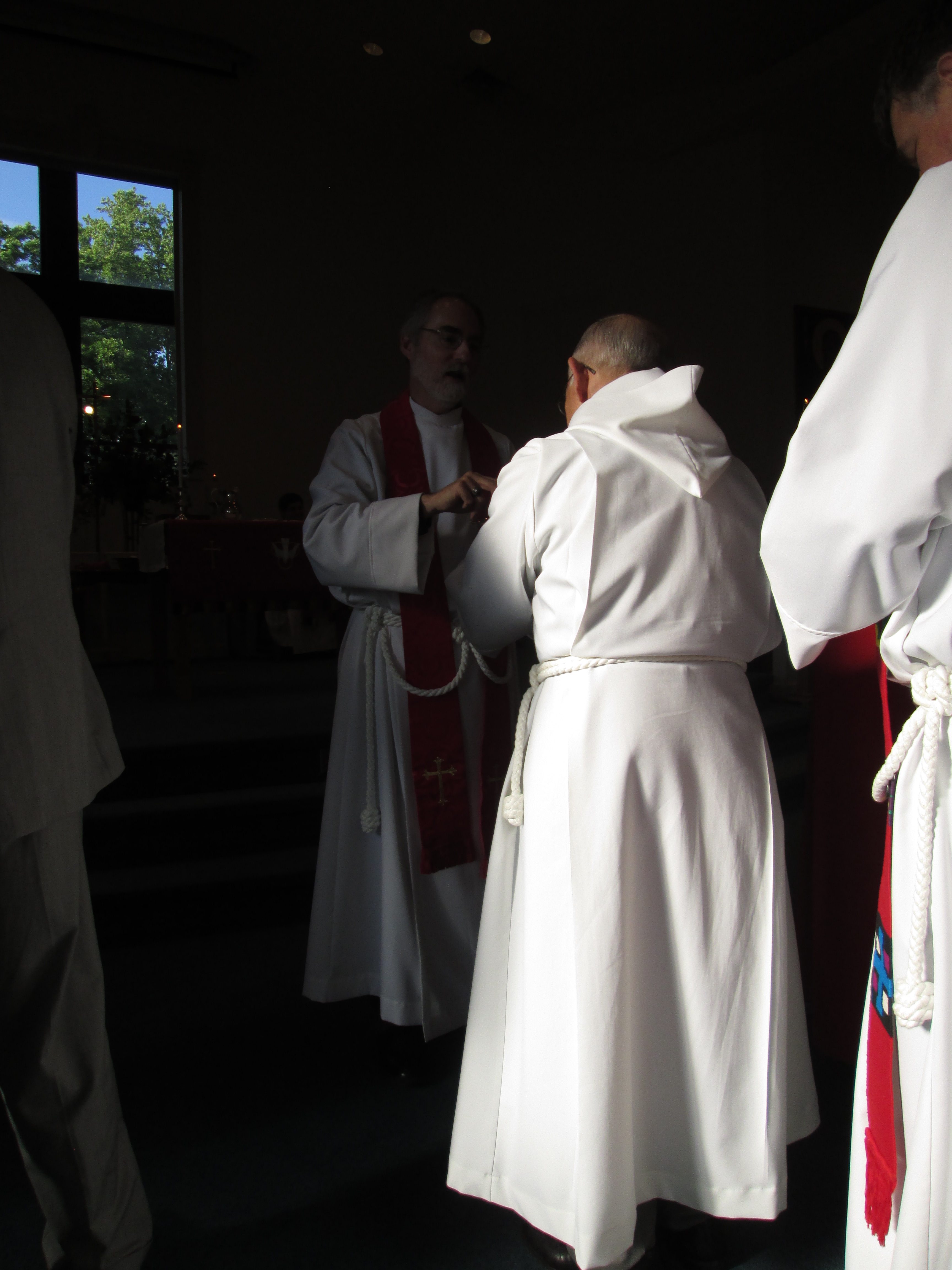
DSC_5895cropJust had a profound insight in my seminary class…The insight is this:  I believe in the validity of the ordained priests AND the priesthood of the believer.   The principles are held in tension.   How?   By seeing the ordained priest as merely the first among equals among a congregation  of lay priests.  This is a very different view from that of a top-down Episcopal model or a bottom-up congregational model…Suddenly my life makes sense.

This was recently posted on a social media site; it came to my attention simply because a dear friend and brother commented on it and suggested that my fellow parish priests and I would likely agree.  My true assessment is more nuanced than simple agreement, though.  I, too, recognize the validity of both the ordained priesthood, i.e., the vocational priesthood, and the priesthood of all believers, the baptismal priesthood.  While both are valid,  the post goes further to maintain that the two priesthood are equal, by which I presume the author means having the same nature.  It is only that which would allow him to consider the vocational priest as first among equals in the congregation of lay priests.  And it is just here that I must disagree.

To assert that the vocational priesthood conferred by the Holy Spirit and conveyed by the laying on of the bishop’s hands in the ordering of priests is identical with the priesthood of all believers conferred  by the Holy Spirit in baptism and strengthened  by the bishop in confirmation is to make a category mistake.

The prayers from the Book of Common Prayer 1662 draw out the distinctions between the priesthoods.  During Confirmation the confirmands  kneel before the bishop who lays hands on them and prays:

Defend, O Lord, this thy Child [thy Servant] with thy heavenly grace that he may continue thine forever; and daily increase in thy Holy Spirit, more and more, until he come into thy everlasting kingdom.  Amen.

The corresponding prayer for the ordering of priests is significantly different:

Receive the Holy Ghost for the office and work of a Priest  in the Church of God,  now committed unto thee  by the imposition of our hands.  Whose sins thou dost forgive, they are forgiven; and whose sins thou dost retain, they are retained.  And be thou a faithful dispenser of the Word of God, and of his holy Sacraments; in the Name of the Father, and of the Son, and of the Holy Ghost.  Amen.

The prayers following in the ordering of priests only highlight the differences between the two priesthoods further.

Classical Anglicanism rejects the first among  equals assertion of the post if it is the equality of either the nature or responsibilities of the vocational and baptismal priesthoods that is being asserted.  Certainly, both priesthoods are valid and are gifts of God for the people of God and for the world.  But, to conflate the two is not to elevate one to the perceived level of the other, but rather to diminish both.

The baptismal priesthood is ontological; baptism affects a change in one’s nature and identity.  According to St. Peter, the baptized believer becomes a partaker in the divine nature.  That does not happen again — nor does it need to happen again — in the ordering of priests.  Whether the vocational priesthood is ontological or existential is a debate for another time.  But, something happens — something changes — in the ordination of a priest that is different from and in addition to the ontological change wrought by baptism.  The ordained priest is not “merely the first among equals among a congregation of lay priests.”  He is different in some profound ways, even if we perhaps differ in opinion on precisely what those ways are.

Even the notion of “first” among equals is fraught with difficulty.  First implies rank or superiority, the very thing I think the author of the quote is trying to avoid.  Priests — the ones I know and serve along side — do not consider themselves first among equals in this sense, but rather servants of all.

In contrasting the resurrection body to the physical body, Paul notes:

There is one glory of the sun, and another glory of the moon, and another glory of the stars; for star differs from star in glory (1 Cor 15:41, ESV).

Might the same apply to the priesthood?  There is one glory of the ordained priesthood and another glory of the baptismal priesthood; for priesthood differs from priesthood in glory.  Why would we think they are the same?  Why would we want them to be?

So, no, I cannot agree that the ordained priest is merely — and how unfitting that word is for any priesthood! — the first among equals among a congregation of lay priests.  One day, I assume, I will lay aside the vocational priesthood; its purpose will have been fulfilled or my time of service will be complete.  But — thanks be to God! — I will never lay aside my baptismal priesthood, for it is the very essence of my new identify in Christ.

Blessings.

Photo by Carole Metz.  Used by permission.

Posted in Uncategorized | Leave a comment

Pastoral Prayer

praying in churchA priest is asked to pray – a lot.  Sometimes it is as designated or honorary pray-er, as at a church dinner.  “Father N., will you bless the food, please?”  Anyone could do this, of course, but it often falls to the priest.  While it is a token moment, it is also an important one, a public acknowledgment of our dependence upon God and our gratitude for the multitude of “ordinary” blessings he offers us daily.  The beginnings of meetings fall in this category, too.  “Father, will you open the meeting with a prayer, please?”  Again, while pro forma, this type of prayer is serious business:  what church meeting wouldn’t benefit from more prayer?

Sometimes the prayers are liturgical.  You often may recognize these by their introduction, “The Lord be with you,” which serves, not infrequently, as Anglican crowd control – a baptized version of “quieten down now, y’all.”  Even this introduction reminds us that all prayer ushers us into the presence of God the Father Almighty and should be undertaken with a certain fear and trembling.  Some of these liturgical prayers are the “property” of the whole church – laity and clergy – as in Morning and Evening Prayer.  Some few – those prayers of absolution, consecration, and blessing – are reserved for priests.  Liturgical prayer is also serious business; we are praying for and with the church, and not infrequently on behalf of all God’s creation.

Then there are pastoral prayers:  the prayers spoken at the bedsides of the sick and dying or by the gurney of a parishioner being prepared for surgery, the prayers offered for bereaved family and friends at the death of someone they simply can’t imagine living without, the prayers born of confession or spiritual direction, the prayers requested during late night emergency phone calls or on the prayer team emails.

“Father, the test results came back positive.  Will you pray for me, please?”

“Father, I’m worried about my daughter.  She doesn’t come to church anymore and she’s mixed up in some things she ought not to be.  Will you pray for her, please?”

“Father, my marriage/career/faith/etc. is falling apart and I don’t see how I can go on.  Will you pray for me, please?”

“Father, I don’t even know what to ask for, but will you pray for me, please?”

These prayers are sacred converse between priest and parishioner and between priest and Lord, and, as such, are profound blessings.  But they are also hard – sometimes, so very hard.  Does anyone really presume that a priest knows better how to pray or for what to pray than does anyone else?  If so, let me set the record straight.  It is a priest’s calling to pray.  It is a priest’s privilege to pray.  It is a priest’s blessing to pray.  But I suspect that no priest – and certainly not this one – feels “qualified” to pray, adequate to pray.  My rector, a faithful and grace-filled priest, recently confessed before the assembled body in a profoundly true and beautiful sermon that he is a beginner in prayer.  We all are – all priests, all people of God.  Priests are asked to pray not because we are experts and not because we are closer to God than other, but because it is our calling and because others assume – rightly, I hope – that we will be faithful to do so.  If we say we will pray, we actually will, in the midst of our own confusion, through our own halting words.

I recently learned that a parishioner had been admitted to the hospital and I planned a visit for the following morning.  His is a difficult situation – multiple long term health issues and disability with frequent admissions to health care facilities.  The night before, I began to pray about what to pray for the following day.  As I drove to the hospital, I prayed about what to pray for when I arrived.  As I stood by his bedside watching him sleep, I prayed about what to pray for when he awoke.  That is the most difficult part of pastoral prayer, I think:  knowing what to pray for.  You might think it would be easy:  pray for the sick to be healed, pray for the unemployed to get a job, pray for the test results to be negative.  But, it’s not easy at all.  I have seen a man profoundly changed – brought nearer God and transformed into the image of Christ – by prolonged injury and pain and disability.  Would a prayer for healing have honored God and this difficult means of grace?  What of an elderly patient considered terminal by her doctors?  Of course, God is the Great Physician of souls and bodies and can heal the most humanly hopeless cases.  But, he does not always do so, and who am I to say if it is appropriate in this case?  Might a self-sufficient and recalcitrant servant of God learn humility and dependence by the loss of a job followed by a prolonged time of unemployment and struggle?  Certainly, or it might break him entirely and drive him farther from God.  What do I pray for?  I don’t know.  I suspect no priest really does.

How, then, in the moment I am called upon, do I decide what to pray for?  I enter again the biblical story – its flow and rhythm and plot – because I know that all true prayer must be formed by the story and must carry the story forward in the lives of individuals and the church.  I study – yes, study – the prayer book as a text teaching me how to pray.  I pray the Psalms in all their depth and breadth of human longing, exultation, pain, and vengeance.  I listen to the heart and words of the one requesting prayer and to the heart and words of the One to whom the prayer will be offered.  Between the lines and in the silence between words, the answers are sometimes found.  And I trust that my words are not, in the end, the most important part of prayer at all.  If I say only, “Lord, have mercy,” it is enough and more than enough.  If I pray amiss, reading God’s will badly, I know that

…the Spirit helps us in our weakness. For we do not know what to pray for as we ought, but the Spirit himself intercedes for us with groanings too deep for words (Rom 8:26).

So what did I pray for when the patient awoke?  We talked and I listened and I heard the great weariness in his voice and the sound of growing hopelessness there.  And, in that moment God answered my prayer and gave me His prayer for my brother.

Please ask a priest to pray with you and for you.  To be invited into the breach between need and bounty, between sickness and health, between despair and faith, between life and death, is a profound gift.  To be invited to join with God in the good work he has already begun in the lives of his elect is all grace.  Yes, it is hard, but it is the best kind of hard.

Blessings.

(The hospital visit is a composite of several such visits; the brother mentioned is likewise a composite.  In this way I have sought to preserve the truth of such situations while honoring the confidence of those who accord me the grace of accepting pastoral care.)

Photo:  Public Domain.
Posted in Uncategorized | Leave a comment

Wearing the Collar

collarIn my diocese there are no policies, no rubrics, no real guidelines on when and where a priest is to wear the clerical collar.  The decision is informed by a troika of local custom (what your fellow priests do), common sense (church services but not church picnics), and personal preference.  For a  new priest, there is a trial-and-error feel to it; show up at a gathering as the only priest with, or without, a collar and you won’t make that same mistake again.

I wear the collar whenever and wherever the services or the mere presence of a priest might reasonably be required or desired:  for all assemblies of the church for worship, prayer, study, and business; for home visits or hospital calls; for funerals or weddings of family members or friends outside the diocese and in other churches.  After much prayer, discernment with my spiritual director, and reflection, I decided not to wear the collar when I teach each day in a public high school, nor even to ask the director of schools if I could.  It is a legal gray area, though in the South there is probably more leeway granted for public expression of faith than in other regions of our country.  My colleagues and administrators know that I am a priest and I often take a clerical shirt to school to change afterward for an afternoon hospital visit.  It is my students that most concern me.  I fear that the collar might distance me from the very ones that need a priest, or simply a caring teacher, the most – those on the margins, those with no real adult presence or guidance, those who feel isolated and alone.  For them, I can best be a priest incognito.  My white shirt and tie are better suited for this than a black shirt and clerical collar.  I also don’t generally wear the collar when relaxing at home with my wife, though there is always a shirt pressed and ready in case of emergency call out.

But all this still leaves large segments of my life unaccounted for.  As I write this, I am sitting outside at a local café early Saturday morning with a cup of coffee.  Collar on?  No, not today – not yet today; I haven’t decided about later, about after I mow and shower.  Will I wear the collar to the mall this afternoon when I take my daughter to purchase contacts or to the bookstore this afternoon for an hour or two of reading and family conversation over cafes au lait?  What will inform my decision?

Earlier this year I sat with my wife in the food court of an Orlando airport as my daughter and her male companion – I still can’t say boyfriend, though it’s true – browsed the shops awaiting his flight departure.  Some Orthodox clerics passed by across the concourse, very distinctive and noticeable with long beards and black cassocks.  There my wife and I sat, 600 miles from home, anonymous, in the company of hundreds of total strangers, and my heart leapt at the sight of these men.  My people!  These Orthodox priests, who would certainly consider me heterodox and perhaps even heretical, nevertheless brought me joy by their mere presence.  Though our communions are separated by history and suspicion and practice and theology, their presence proclaimed their love for our common Lord, proclaimed that they are my people:  one Lord, one faith, one baptism.  Their presence reminded me that the Lord is risen and is on the loose in the world, not least in and through his Spirit-filled people.  Their presence was silent proclamation of the Gospel.  I am certain there were many other faithful disciples of Christ in the Orlando airport that evening, but they were anonymous and unknown to me.  The cassock made the difference.  In my shorts and sandals – I was on vacation, after all – I made no one’s heart leap with joy for the risen Lord.  This will inform my decision about wearing the collar to the mall or the bookstore.

Yesterday afternoon – Thanks be to God it was Friday! – my wife and I were relaxing for a few minutes at Barnes and Noble.  We had just come from school and I was still dressed in my “teacher uniform” of shirt and tie.  I stood at the café counter awaiting our order, enjoying some friendly banter with the baristas when one of them said, “Do you mind if I ask you a question?  I’ve seen you in here with a collar on.  Are you some kind of pastor?”  I explained to her that I was an Anglican priest, and was pretty surprised that she knew what an Anglican is.  It seems her studies involve history and the history of religion, even though, as she acknowledged, she is not particularly religious.  We had an interesting, though brief talk, before my order came and she left for the evening.  (I had intended that discussion to be the topic of this post, but the writing went elsewhere, as it often does.  I will return to it later.)  But, I will see her again and often, and God only knows (truly) where this brief conversation might lead – all because of the collar.  How many conversations have I missed by not wearing the collar in pubic, I wonder.  The collar serves as an open and public invitation to strangers to strike up a conversation with me about important things, and I’ve seen it do this on several occasions.  This will inform my decision about wearing the collar this afternoon.

When I was in discernment for the priesthood – and even before formal discernment had begun – my spiritual director asked me wonderfully probing questions.  “Why do you feel a need for ordination?  What can you do with a collar that you can’t do without one?”  The answers are many and this is not the place to explore them.  But I do realize now, even if I didn’t fully then, that a priest is called in a unique way to be a public witness to the presence of Christ, not just in the parish, but in the world.  In a nominally Christian culture that is, in reality, increasingly secular or pagan, the simple wearing of a collar is a countercultural act of Gospel proclamation.  With no words necessary, the collar nonetheless testifies to the mystery of faith:  Christ has died.  Christ is risen.  Christ will come again.  As a priest, I have this great opportunity; it is something I can do with the collar that I can’t do as easily without it.  This will inform my decision about wearing the collar this afternoon.

But, I also live in the South and this is summer when the temperature and humidity both hover in the nineties.  Who chose black for a clerical shirt?  When the sun beats down and the sticky air makes it hard to breathe, a black clerical shirt and collar are miserable.  And though I’m ashamed to say it, this uncomfortable physical reality will also inform my decision about wearing a collar this afternoon.

In my diocese there are no policies, no rubrics, no real guidelines on when and where a priest is to wear the clerical collar.  It is a personal and private decision – certainly adiaphora – and I honor the various choices of my fellow priests.  But it is a decision I hope to make theologically and vocationally and not haphazardly or thoughtlessly.  As trivial as it may sometimes seem – Certainly there are more important issues, aren’t there? – it is not unimportant.

Blessings.

Posted in Uncategorized | Leave a comment

Healing and Wholeness

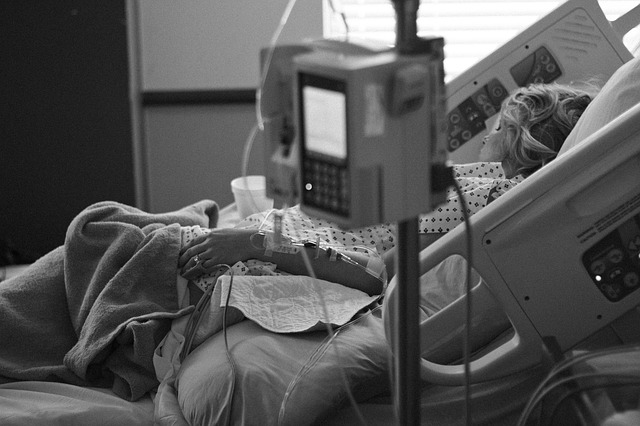
hospital bedAs you are outwardly anointed with this holy oil, so may our heavenly Father grant you the inward anointing of the Holy Spirit.  Of his great mercy, may he forgive you your sins, release you from suffering, and restore you to wholeness and strength.  May he deliver you from all evil, preserve you in all goodness, and bring you to everlasting life; through Jesus Christ our Lord.  Amen.

A priest spends not a little time in health care facilities – hospitals, nursing homes, assisted living centers, the homes of parishioners – where he is granted the sacred privilege of being welcomed into moments of human weakness and vulnerability.  It is a holy trust, and one that is best approached prayerfully and with great humility.

It is not only the patient who feels weak and vulnerable at such times though; as a priest I have felt that way myself.  I stand in the intensive care unit surrounded by scores of machines whose price tags can only be imagined, as efficient doctors bustle around with their extensive knowledge and hard won expertise.  Nurses exhibit their compassionate skill in practical ways that leave me standing clumsily in the corner, out of their way.  Orderlies and nutritionists serve vital roles.  But what of a priest?  What do I offer?  What can I do?  I come “equipped” with a stock of oil and a prayer book, and on some occasions, with bread and wine.  I can anoint.  I can pray.  I can bless.  I can absolve.  I can consecrate.  I can be present.  What are these compared to the expertise and efficiency of highly trained medical personnel?  Though it is a false dichotomy I know, if the patient had the choice of either doctor or priest but not of both, do we wonder which he would choose?  Weakness.  Vulnerability.

And yet.

But God chose what is foolish in the world to shame the wise; God chose what is weak in the world to shame the strong; God chose what is low and despised in the world, even things that are not, to bring to nothing things that are, so that no human being might boast in the presence of God.  And because of him you are in Christ Jesus, who became to us wisdom from God, righteousness and sanctification and redemption,31 so that, as it is written, “Let the one who boasts, boast in the Lord” (1 Cor 1:27-31, ESV throughout).

Priests believe in doctors; we are not dualists who denigrate the body and idolize the spirit.  Priests honor doctors – the wisdom of their learning and the strength of their expertise.  And yet, there is greater wisdom, greater strength in the Great Physician of souls and bodies.  While He has ordained healing through the hands of skilled men and women – physicians and surgeons and nurses with their medicine and scalpels and instruments and therapy – He has also ordained healing through the unworthy hands of weak and vulnerable priests with their oil and prayer books and bread and wine.  Whether doctor or priest, “Let the one who boasts, boast in the Lord,” for all healing is from the Father of Mercies from whom comes every good and perfect gift.

The oil I carry is blessed by our bishop, though the Book of Common Prayer allows for a prayer of blessing by a priest:

O Lord, holy Father, giver of health and salvation:  Send your Holy Spirit to sanctify this oil; that, as your holy apostles anointed many that were sick and healed them, so may those who in faith and repentance receive this holy unction be made whole; through Jesus Christ our Lord, who lives and reigns with you and the Holy Spirit, one God, for ever and ever.  Amen.

Thus blessed, the oil is sacramental, an outward and visible sign and channel of a hidden and inner grace through which the sick are made whole.  By God’s grace, doctors may affect cures.  By God’s grace, the Holy Spirit working through the priest’s oil-smeared thumb may affect wholeness.  Who would despise either – physical cure or wholeness?  God is the Great Physician of bodies and souls, after all.  It is not so much cure but wholeness that I carry.

The bread and wine I bear – the gifts of God for the people of God – are the flesh and blood of Christ when received by faith with thanksgiving.  About these Jesus, himself, said:

 “Truly, truly, I say to you, unless you eat the flesh of the Son of Man and drink his blood, you have no life in you. Whoever feeds on my flesh and drinks my blood has eternal life, and I will raise him up on the last day.  For my flesh is true food, and my blood is true drink. Whoever feeds on my flesh and drinks my blood abides in me, and I in him.  As the living Father sent me, and I live because of the Father, so whoever feeds on me, he also will live because of me” (John 6:53b-57).

Consecrated, the bread and wine are sacraments, the Gospel in sacred food and drink.  It is not just bread and wine; it is life that I bring.

As a priest among physicians, I have no particular skill, no great expertise.  It is true; I am as weak and vulnerable as any patient I have ever visited, and I will stay out of the way in a corner of the room while the experts are present.  But I have oil and I have a prayer book.  And if you ask me to, I will have bread and wine.  And these are neither weak nor vulnerable.  They are the very power and wisdom of God unto wholeness and salvation.  And so a priest spends not a little time in health care facilities – a sacred privilege, a holy trust.

Blessings.

Photo:  Public Domain

Posted in Uncategorized | Leave a comment

Eucharist and Forgetfulness

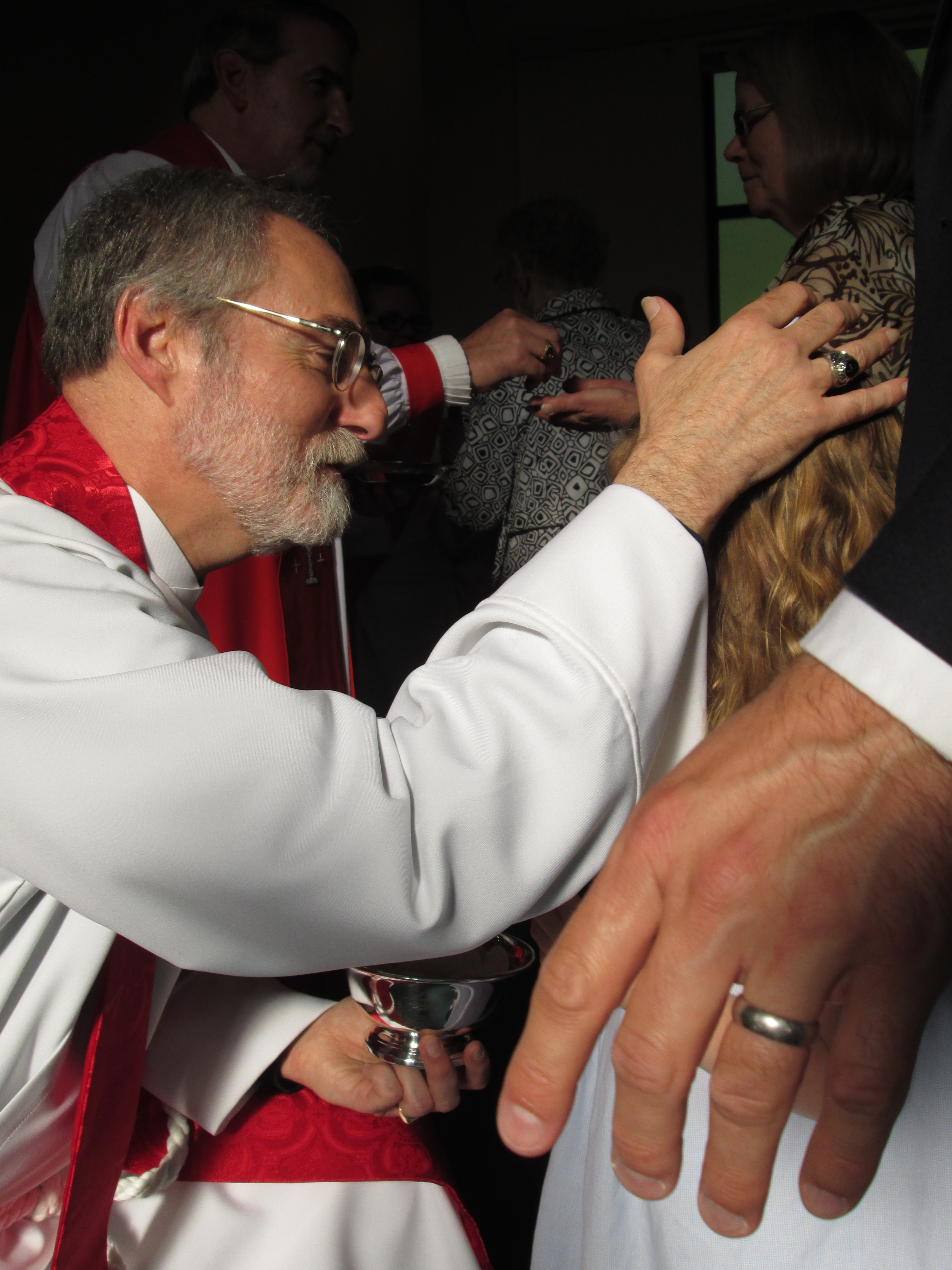
121The modern habit of doing ceremonial things unceremoniously is no proof of humility; rather it proves the offender’s inability to forget himself in the rite, and his readiness to spoil for everyone else the proper pleasure of the rite (C. S. Lewis).

One of the greatest of the abundant joys of celebrating the Eucharistic Liturgy is the sure knowledge that few, if any, parishioners will congratulate me afterwards on a job well done.  Certainly, it does happen from time to time.  When it does, it is a gift graciously offered and graciously received, a gift that simply proves the quote by C. S. Lewis; I have forgotten myself in the rite and thus have not spoiled for everyone else the proper pleasure of the ritual.  For me as celebrant, that is a chief joy of the rite – the utter forgetfulness of self and the total immersion in the grace and mercy of God the Father in and through our Lord Jesus Christ.  In celebrating the Eucharist I almost understand Paul:

I have been crucified with Christ.  It is no longer I who live, but Christ who lives in me.  And the life I now live in the flesh I live by faith in the Son of God, who loved me and gave himself for me (Gal 2:20, ESV).

I love to preach, though preparing a sermon is often a spiritual struggle of submission to the Word.  It is in the struggle to understand the Word and to stand under it that the Spirit moves and inspires a terribly frail and fallible human to declare, “Thus says the Lord.”  Often during sermon preparation, and often immediately before the sermon in the hearing of the people of God, I pray:

Let the words of my mouth and the meditation of my heart be acceptable in your sight, O Lord, my strength and my redeemer.

And yet, acceptable though they by, Spirit-filled though they be, the words of the sermon remain my words and the meditation my meditation.  Try as I might to decrease that he might increase, there is always part of me remaining in the sermon, inseparable from it – thus the comments from the parishioners, sometime complimenting, sometimes challenging the sermon.  If I have listened well to the Spirit there is little of me in it; if I had no ears to hear, there is much of me.  Little or much, I am nevertheless self-conscious – literally conscious of self – and aware that I am preaching and that my words are being weighed in the balance.

But, in the Eucharist, the words are not my words, the meditations are not my meditations.  Even the manual acts – the gestures – are specified in the rubrics or learned from local practice.  Innovation is of little value; conformity is blessing.

Just before approaching the table the celebrant and deacon share an intimate moment of preparation in which the deacon ritually cleanses the hands of the priest.  It serves as the celebrant’s final moment of repentance, his final appeal for mercy before approaching the mysteries.  It is a manual prayer for clean hands and a pure heart.  And it is – or can be – a washing away of self.

The celebrant moves to the table and stands in the fire of God’s love and grace as the last remnants of self are burned away, stands unworthy to gather up the crumbs under the Table and yet stands invited to serve as host in Jesus’ name.  He speaks not his words, but ancient words, received words:  prayer and hymn, blessing and invocation, institution and distribution.  He consecrates bread and wine that he did not bring to the table and he shares it with those he did not redeem:  the gifts of God for the people of God.  When the people of God receive the body of Christ – the bread of heaven – some whisper, “Thank you.”  It is not really the celebrant to whom they speak.

It is another mystery of God that a man is never more truly himself than when self is forgotten – crucified with Christ – and God is all and in all.  For a priest – for this priest at least, for I dare not speak for others – such forgetfulness of self  is yet another of the abundant Eucharistic gifts of God for the people of God.

Blessings.

Photo:  Mary Kathleen Roop.  Used by permission.

Posted in Uncategorized | Leave a comment

Marriage and Mystery

Marriage BCPTomorrow, in new cassock and surplice and for the first time as priest, I will read the Gospel and lead the matrimonial prayers in The Celebration and Blessing of a Marriage.  The couple is young and dear and in love (with Christ and with one another) and is, I feel confident, about as ready for marriage as is humanly possible, which is to say, not really ready at all.  Lord, have mercy upon them.  Shield the joyous.

In the Orthodox Church, marriage is considered a sacrament, though it is not called by that name.  Instead, the Orthodox speak of marriage — and each sacrament — as a mystery (mysterion).  And isn’t that a wonderful word to describe marriage?  Soon, my wife and I will celebrate our thirty-eighth wedding anniversary, and I still find our marriage — and, at times, my wife — to be as mysterious as ever, in the truest and most blessed sense of the word.  Marriage is an outward and visible sign of an inward and spiritual grace and the sure means by which that grace is received — perhaps not a sacrament, but certainly sacramental, certainly a mystery.

This is why marriage is about far more than who and how we love, and it is precisely why the church is so protective of it.  From the beginning, even in Eden, the union of the man and the woman was about more than love; physical and spiritual complementarity, support in vocation, fruitfulness — these were and are integral to marriage.  To reduce marriage to modern concepts of love is to impoverish it and to delude those who enter into it.

Now, we are exiles from Eden, and certainly the fall has changed marriage, as indeed it has changed everything.  But, in the case of marriage — perhaps uniquely — the fall did not diminish the relationship, but enhanced its importance, its dignity, its purpose.  In addition to all it was before, marriage is now also about grace, redemption, and sanctification.

Husbands, love your wives, as Christ loved the church and gave himself up for her, that he might sanctify her, having cleansed her by the washing of water with the word, so that he might present the church to himself in splendor, without spot or wrinkle, or any such thing, that she might be holy and without blemish.

This mystery is profound, and I am saying that it refers to Christ and the church (Eph 5:25-27, 32, ESV).

One day, sooner than I would like, a young man will likely ask to marry my daughter.  I imagine the ensuing conversation.

“And why do you want to marry my daughter?” I will ask pointedly in my best father-teacher-priest- you’d better get this right voice.

“I love her more than anything,” I can just hear him say.

“Who cares?!” will be my response.  “That’s not nearly good enough.  Will you give up your life for her as Christ gave up his life for the church?  Will you devote yourself not to loving yourself through my daughter but rather to her sanctification?  Will you do everything within your power to present her to Christ in splendor, without spot or wrinkle, so that she might be holy?  Will you lay aside all that has gone before and hold fast to her until you no longer know where you leave off and where she begins  Will you?”  God help him if he says no.  God help him if he says yes.

This is marriage this side of the fall.  Love is nice, but it’s not the basis of Christian marriage unless that love partakes of and mirrors the love with which Christ loved the church and gave himself for her.  It is a high standard and humanly impossible.  So, following the vows that commit the man and woman to do more than they can possibly do, we pray:

O gracious and everliving God, you have created us male and female in your image:  Look mercifully upon this man and this woman who come to you seeking your blessing, and assist them with your grace, that with true fidelity and steadfast love they may honor and keep the promises and vows they make; through Jesus Christ our Savior, who lives and reigns with you in the unity of the Holy Spirit, one God, for ever and ever.  Amen.

And so, to the dear couple who will, in the name of Christ, commit themselves to each other tomorrow:  Blessings.

Photo:  John A. Roop.  Used by permission.

Posted in Uncategorized | Leave a comment

Ministry, not Magic

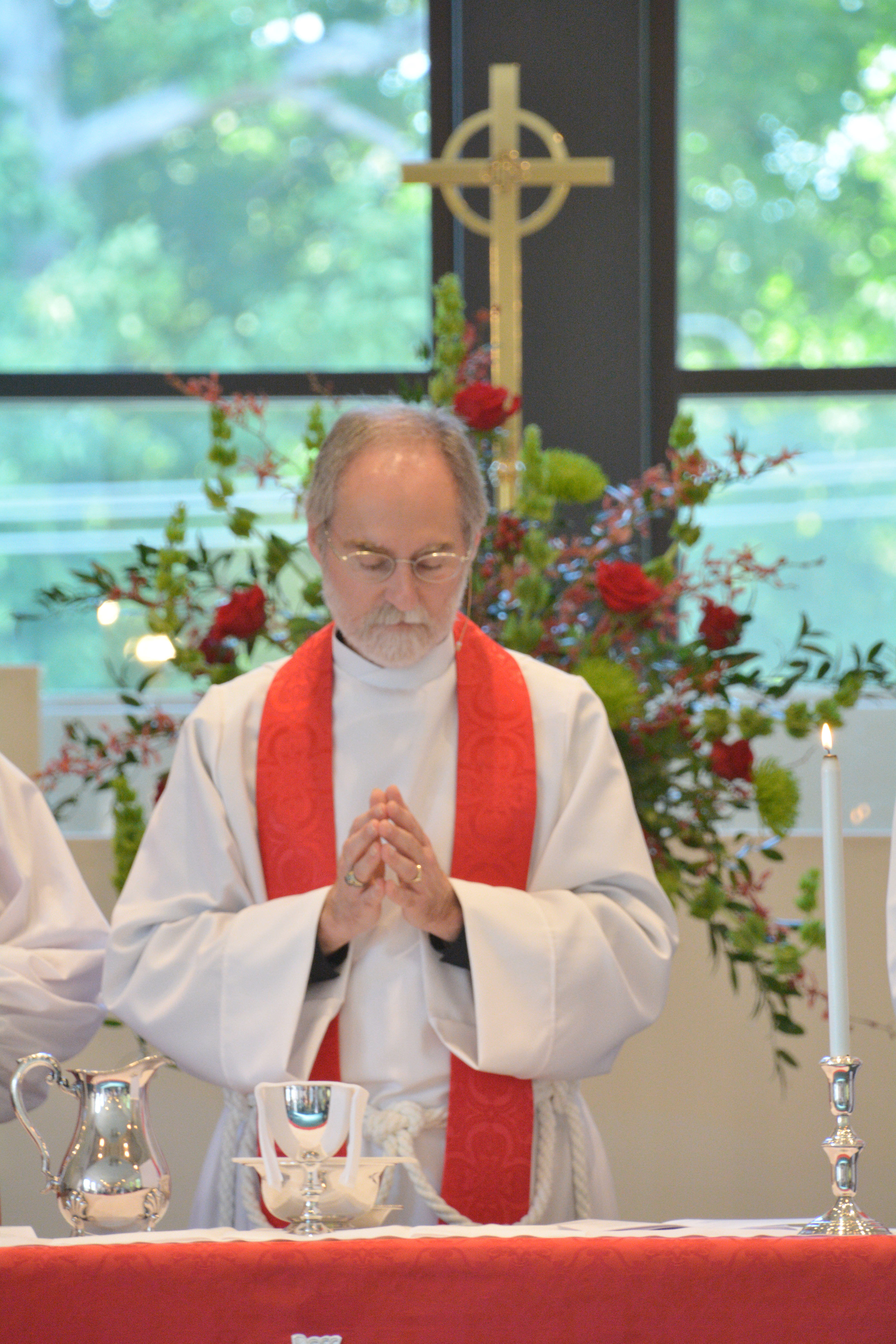
128So now, Father, we ask you to bless and sanctify, with your Word and Holy Spirit, these gifts of bread and wine, that we may partake of his most blessed Body and Blood.

What happens to the bread and wine in and through this prayer of epiclesis, when the priest invokes the Word and Holy Spirit and signs the elements with the cross?  What happens to the bread and wine in and through the following Words of Institution?

The Anglican formularies are explicit; the elements are consecrated — set apart for sacred purpose, for holy use:  nothing more, but nothing less.  Bread remains bread; wine remains wine.

Transubstantiation (or the change of the substance of Bread and Wine) in the Supper of the Lord, cannot be proved by Holy Writ; but is repugnant to the plain words of Scripture, overthroweth the nature of a Sacrament, and hath given occasion to many superstitions (Article XVIII.  Of the Lord’s Supper).

What then of the real presence of Christ?  What then of his Body and Blood?

The gifts of God for the people of God.  Take them in remembrance that Christ died for you and feed on him in your hearts by faith with thanksgiving.

The real presence of Christ is manifest in the act of Communion in which the people of God receive the consecrated bread and wine by faith with thanksgiving.  If consecrated bread is eaten in this manner, it is the Body of Christ; if not, it is bread.  So, too, with the wine.

Insomuch that to such as rightly, worthily, and with faith, receive the same, the Bread which we break is a partaking of the Body of Christ; and likewise the Cup of Blessing is a partaking of the Blood of Christ.

The Body of Christ is given, taken, and eaten in the Supper, only after an heavenly and spiritual manner.  And the mean whereby the Body of Christ is received and eaten in the Supper, is Faith (Article XXVIII).

The communicant receives the consecrated bread and wine by faith with thanksgiving and thus partakes of the most blessed Body and Blood of the Lord.

Why this excursus on the finer points of Anglican sacramental theology in the midst of a reflection on the priesthood?

Receive the Holy Spirit for the Office and Work of a Priest in the Church of God, now committed to you by the imposition of our Hands.  If you forgive the sins of anyone, they are forgiven.  If you withhold forgiveness from anyone, it is withheld.  Be a faithful minister of God’s holy Word and Sacraments; in the Name of the Father, and of the Son, and of the Holy Spirit.

What happens to the priest ordinand — What happened to me? — in this prayer of epiclesis, when the Bishop prays and the assembled presbyters lay hands on his head?  By the power and grace of the Holy Spirit he is consecrated — set apart for sacred ministry:  nothing more, but nothing less.  Flesh and blood remain flesh and blood.  He rises from his knees empowered and authorized for ministry, but not for magic.

I speak words of absolution, but if they are not received by faith with repentance, the burden of guilt remains:  ministry, not magic.  I bless, but if the blessing is not received by faith with thanksgiving, it is squandered:  ministry, not magic.  I consecrate bread and wine, but if they are not taken by faith with thanksgiving, they remain merely bread and wine:  ministry, not magic.

In this sense, the priesthood is truly sacramental.  A priest is an “outward and visible sign of an inward and spiritual grace and the certain means by which we receive that grace” (BCP 1979, p. 857), provided his sacramental ministry is received by faith with thanksgiving.  The priest is given the grace of the Holy Spirit for ministry, but not for magic.  In the absence of faith, even Jesus could do no mighty works.

A priest is a living sacrament through which the Holy Spirit acts to bestow grace on the faithful people of God, and he is a tangible witness to the real presence of Christ in the midst of a fallen world:  nothing more, but nothing less.  It is ministry, not magic.

Blessings.

Photo:  Mary Kathleen Roop.  Used by permission.

Posted in Uncategorized | Leave a comment