Identity and Uniforms

A Homily for ADOTS Morning Prayer:  28 August 2020

(Colossians 3:12-25)

In the Name of the Father, and of the Son, and of the Holy Spirit.  Amen.

You’ve seen the commercials on television, haven’t you?  An earnest looking actor in a white lab coat half leans, half sits on the corner of a desk in an office filled with shelves of medical books and journals.  Perhaps there is a stethoscope around his neck.  He looks meaningfully at the camera and says, “I’m not really a doctor.  I just play one on TV.”  Then he proceeds to give you medical advice anyway, to explain why you should try a particular medication that some pharmaceutical manufacturer has paid him big bucks to shill.

Of course, this same actor might also have played a cowboy or a soldier in another program.  But, the producers didn’t dress him in chaps or camo fatigues for this commercial.  They needed him to look like a doctor for his pitch to be believable.  I am amazed that ad men think such silly stunts work; I am even more amazed that such silly stunts actually do work.  Viewers seem only too willing to suspend disbelief and take medical advice from a soap star.  Once during her annual physical my wife said to her doctor, “I’ve been meaning to ask you about this drug” — and here fill in any drug name that you see on television; I can’t remember the one she said — “you know the one for” — and here fill in any illness that you see on television; again, I can’t remember the exact one.  “But you don’t have that condition,” her doctor said, a bit puzzled.  “Oh, I know, but the “doctor” on television told me to ask you about it.”  Then she laughed.  I don’t think her doctor did.

So, what’s the point to this?  Putting on a white lab coat doesn’t make you a doctor.  You first become a doctor; then you put on the “uniform”:  identity first, then the uniform.

Ordination to the priesthood is another good example of this order of events, and one I am familiar with.  First the Bishop issues The Exhortation in which he details the responsibilities, challenges, and general gravitas of the priesthood; it is a sobering moment.  This is followed by The Examination:  pointed questions as the Bishop probes the ordinand’s commitment to the doctrine and discipline of the Church and to the unique duties of the priesthood.  Here the priest-to-be makes binding vows.  Lastly, there is The Consecration Of The Priest in which, by prayer and laying on of hands by the Bishop and the other priests gathered, the ordinand “receives the Holy Spirit for the office and work of a Priest in the Church of God” (BCP 493).  He is thereby admitted to the Order of Priests; he is, from that moment ever onward, a priest.

But one thing remains, another essential part of the rite.  The new priest is then vested — dressed in vestments — according to the Order of Priests.  The Bishop or a significant person in the priest’s life — in my case it was my wife — places the stole around the neck and across the shoulders of the new priest.  It is the outward, visible symbol of the priesthood, the yoke of the Lord.  The priest may also be vested in a chasuble, the poncho-like garment the Celebrant wears at the altar, a symbol of charity and a perfect work.  Identity first, then the uniform.

Now understand, anyone can go to C. M. Almy’s website and order a stole and chasuble.  You don’t need an ordination certificate, just a credit card.  Anyone can put on the priest’s uniform.  But, like the TV doctor, the uniform doesn’t make the priest.  The uniform doesn’t change one’s identity.  The order is important:  identity first, then the uniform.

This brings us round to the second lesson for the morning, the reading from St. Paul’s Epistle to the Colossians.  Paul writes, in part, to make sure there are no play-actors in the church, to make sure that no one can say, “I’m not really a Christian; I just play one in the gathering” — or in the market or anywhere else:  no fake white linen robes — the baptismal garment of the saints — masking the identify of a pagan.  Remember the essential order:  identity first, then uniform.

That’s where Paul starts in our lesson from Colossians — with identity.  He writes to those who are “God’s chosen ones, holy and beloved” (Col 3:12a).  That’s their identity — chosen, holy, and beloved — and that identity is essential.  If we are not God’s chosen ones, if we are not the ones whom he has declared holy in Christ and whom he is sanctifying in the Spirit, if we are not his beloved ones, then nothing that follows makes any sense, nothing that follows is even possible.  Strip away for a moment all the characteristics you typically use to identify yourself:  your family relationships, your work, your hobbies and interests, your political affiliation, your church denomination, your cultural heritage, your place of residence, all of it.  When it is all stripped away, what is left of your identity?  What is most fundamental to it?  Who are you?  You are God’s chosen one, holy and beloved.  This is your true identity in Christ.  This is who you are and who you were made to be.  This is the identity — and the only identity — out of which you may truly live.  If this is not true of you, if you are not yet in Christ, not yet God’s chosen one, holy and beloved, then start there; seek the Lord, for he wills to be found.  Call upon him, for he is near.  Find a church; find a priest.  Turn to the Lord Jesus.

If this is your identity, then you may put on the uniform.  In fact, you must put on the uniform; it’s not optional.  The uniform of the saints is not made with fabric woven by men; it is made of Christ-like character imparted by the Holy Spirit.  Paul writes:

Colossians 3:12–13 (ESV): Put on then, as God’s chosen ones, holy and beloved, compassionate hearts, kindness, humility, meekness, and patience, 13 bearing with one another and, if one has a complaint against another, forgiving each other; as the Lord has forgiven you, so you also must forgive. 

This is the uniform of the saints, at least part of it; Paul has more to say.  But notice, even now, that when we are putting on this uniform, we are really putting on Christ.  Our hearts suffer with those who suffer, just as Christ suffered with us and for us.  We seek the lowly place, the place of kindness, humility, meekness and patience, just as Christ emptied himself in his incarnation — God in human flesh, the Uncreated Creator born of woman, the King of kings in a stable, the Lord of all a refugee, the one who spoke worlds into being making doors and tables in a carpenter’s shop.  We forgive one another just as Christ lived and died to forgive us.  Putting on the uniform is putting on Christ.

What is it that really makes a uniform, that really sets it off?  There’s always something, that one thing.  For soldiers it might be the medals or the insignia of rank.  For a police officer, perhaps the badge.  For the Secret Service agents who guard the President, it’s the black sunglasses.  For the saints, it’s love.

Colossians 3:14 (ESV): And above all these put on love, which binds everything together in perfect harmony.

Why is love so important?  Because you can buy and wear knock-off uniforms.  Want a Louis Vuitton or a Coach purse on the cheap?  Go to Chinatown in Manhattan.  If you’re not afraid to follow a stranger down an alley, you can get a great deal.  Unless you are truly gullible, you know it’s not the real thing, of course:  a good fake, but not genuine.  You have to look closely to tell, though; it may be in the stitching or in the quality of the leather, but there are subtle, telltale signs that the product is not authentic.  The same is true with the saint’s uniform; there are knock-offs out there:  people who seem so compassionate, so kind, so humble, so forgiving.  But stay around them long enough and you get the sense that something’s off.  You get the sense of play-acting.  Something’s missing, and that something is love.  Love is the mark of authenticity.  Love is the one thing that can’t be imitated.  If you question this, read 1 Corinthians 13 again and see if you can really fake that for the long term.  We must put on love because God is love, perfect love hung high on the cross for all to see.  You can’t fake that.  Putting on love is putting on Christ and taking up your cross daily to follow him.

There is much more in this passage that I’d like to pull out, but this homily is already growing a bit long and you may need to get about your day.  But I must mention just one more item in the uniform because Paul mentions it three times in quick succession:  thankfulness.  Listen:

Colossians 3:15–17 (ESV): And let the peace of Christ rule in your hearts, to which indeed you were called in one body. And be thankful. 16 Let the word of Christ dwell in you richly, teaching and admonishing one another in all wisdom, singing psalms and hymns and spiritual songs, with thankfulness in your hearts to God. 17 And whatever you do, in word or deed, do everything in the name of the Lord Jesus, giving thanks to God the Father through him. 

If the self-emptying virtues are the fabric of the uniform, if love is the one thing that sets off the uniform and proves its authenticity, then maybe thankfulness is the proper fit of the whole uniform.  Because, given who God is, given what he has done for us, what is more fitting for the saints than a thankful heart and spirit?  Thanks be to God for his indescribable gift to us and to all who put on Christ, the uniform of the saints.  Amen.

Posted in Uncategorized | Leave a comment

Who Would Jesus Endorse

WARNING: The following post is political — not partisan — but political nonetheless.

Jesus had options, political options aplenty. Not at the “national” level: that arena was dominated by Rome and Rome’s puppets. But, all politics is local and there were several viable local options, all with national aspirations: Sadducees, Pharisees, Zealots, Essenes. Each group was implicitly political in its intent to form a people; at least one was explicitly political in seeking to overthrown foreign rule.

The Essenes were The Benedict Option party of the day: withdraw from corrupt culture, create counter-communities and structures that promote and nurture righteousness, prepare for the apocalypse and what, if anything, comes after.

The Zealots were the Antifa of the day, if Rome might be considered the far right. They said their prayers and sharpened their knives, praising God and slitting Roman throats to restore home rule.

Neither of these were viable options for Jesus. So, it came down to a two-party system: Sadducees or Pharisees. Which to choose? Which party more nearly reflects — and will most strenuously advance — Jesus’ own political agenda?

The Sadducees ingratiated themselves with Rome, with the powers-that-be, so that they might preserve temple worship and their place of prestige within that system. Some were undoubtedly true believers; what they believed in was the question. Still, affiliating with the Sadducees would give Jesus access to the halls of power, access to the “room where it happens.”

The Pharisees were the purity party of the day; their world divided cleanly between saints (Pharisees) and tax collectors and other sinners. They were esteemed by the people for their personal piety, and they were “local organizers” at the synagogue level. Affiliating with Pharisees would give Jesus the populist vote, and certainly a reputation for righteousness.

So, on Election Day, when Jesus emerged gaunt and haggard from his trial in the wilderness, which lever did he pull, which ballot did he mark?

“The time is fulfilled, and the kingdom of God is at hand; repent and believe in the gospel” (Mk 1:15, ESV).

Repent, you Sadducees. Repent, you Pharisees. Repent you Zealots and Essenes. Repent, you who have placed your hope in these blind guides. Repent for the kingdom of God is at hand. Repent and believe in the gospel.

No party was the “Kingdom of God Party,” so Jesus called each to repent, to align itself with his agenda.

Repent you Republicans. Repent you Democrats. Repent you Liberals and Conservatives. Repent you who have placed your hope in these blind guides. Repent for the kingdom of God is at hand. Repent and believe in the gospel.

No party is the “Kingdom of God Party” today, so Jesus still calls each party to repent, to align itself with his agenda. Jesus still calls each of us individually to repent, to align ourself with his agenda.

As we approach the upcoming election, we must fast and pray as Jesus did in the wilderness before casting his vote. We must seek the will of God and reject the temptations of the evil one to put our trust in shortcuts to power. We must vote or abstain from voting as we believe God wills for us. We must repent for the kingdom of God is at hand. We must repent and believe in the gospel.

Posted in Uncategorized | Leave a comment

God Does Everything

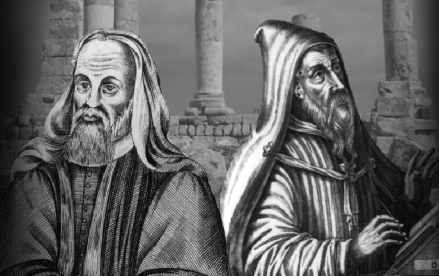
Pelagius and Augustine

In the Name of the Father, and of the Son, and of the Holy Spirit.  Amen.

Pelagianism lies on one end of the salvation spectrum; Universalism lies on the other end.

Pelagians deny the effects of the fall on the nature and will of man.  All men are born as Adam was created, they say:  in innocence and with the freedom of will needed to choose a life of righteousness by keeping God’s law.  You are born sinless, and by discipline, will, and obedience you can remain sinless and grow into perfection.  No grace is needed.  No redemption is needed for those without sin.

Universalists are a more diverse lot, so it is a bit hard to generalize.  But those on their far end of the spectrum hold this belief in common:  the sacrifice of Christ was for all men, and all men are included under it — without exception, without conditions, without requirements.  In answer to the question, “What must I do to be saved?” the true universalists answer, “Nothing.  You are already saved by the work of Christ.  There is nothing you must do.  In fact, there is nothing you can do.  Like it or not, believe it or not, accept it or not, you are saved through the work of Christ.”

Perhaps we could summarize these two ends of the salvation spectrum like this:

For Pelagians:  it all depend on you.

For Universalists:  it all depends on God.

At each end of the spectrum lies heresy.  Pelagians and Universalists alike deny the Gospel as given in Scripture, as received by the Church, as passed down through the generations by orthodox Christians everywhere, always, and by all.

So, where should the church fall on this spectrum of salvation?  Right in the middle:  fifty percent God and fifty percent man?  More toward the Pelagians or more toward the Universalists?  There are serious theological dangers anywhere you decide to “camp out” along that spectrum.  And that suggests that the true answer isn’t on the spectrum at all.  The true answer lies above it and denies the false dichotomies imposed by the linear scale of the spectrum.

The best answer I’ve heard to this question comes from the ACNA Canon Theologian of the Diocese of the Upper Midwest, Fr. Stephen Gauthier.  Whether this formulation is original with him or whether he is quoting another, I don’t know.  But about our salvation, Fr. Stephen says this:

God does everything.  We do something.

And that takes us off the spectrum entirely.  We don’t parcel out responsibility by percentages:  this much of salvation depends on God, that much on man.  No.

God does everything.  We do something.

That may sound like a paradox, but many deep, theological truths do, don’t they?  God is one-in-three and three-in-one.  Jesus is fully God and fully man.  The Blessed Virgin Mary is the Mother of God.

God does everything.  We do something.

Of course, some paradoxes are just nonsense, not paradoxes at all but real contradictions.  What about this one?  How are we to understand it?  What — if anything — does it mean?  We turn to Paul, from our Epistle reading this morning.

Philippians 2:12–13 (ESV): Therefore, my beloved, as you have always obeyed, so now, not only as in my presence but much more in my absence, work out your own salvation with fear and trembling, 13 for it is God who works in you, both to will and to work for his good pleasure. 

“Work out your own salvation,” Paul says; we must do something.

When I taught calculus, I would often present my students with a problem that seemed — and really was — absolutely unsolvable given their mathematical tools and understanding.  This — this cognitive dissonance — was the impetus to develop something new, to deepen their understanding and skill.  So, together — with me leading the way, of course — we would derive a new theorem, one that could unlock the problem.  Then, I would step back and say to the class, “You take it from here.  You work out how this theorem applies to and solves this problem.”  If I had done my job well, they were able to work it out — sometimes with fear and trembling — and they grew in the process; their knowledge deepened, their skills developed, their confidence blossomed.  So I ask, “Who solved the problem?”  In one sense, I did.  I gave them everything necessary for the solution, both the theorem and the motivation to apply it.  I did everything.  But the students had to do something.  They had to work out the application of what I had done for them, what I had given to them.  It’s a flawed analogy, as all analogies are, but you see it, right?

I did everything.  The students must do something.

Without me, the solution was not possible.  Without the students the solution was not realized.

Philippians 2:12–13 (ESV): Therefore, my beloved, as you have always obeyed, so now, not only as in my presence but much more in my absence, work out your own salvation with fear and trembling, 13 for it is God who works in you, both to will and to work for his good pleasure. 

There is something much deeper here than the solution of a calculus problem.  But the same principles apply, I think.  In our salvation, God does everything.  It is impossible without him; the Pelagians were and are wrong.  The cross is the crux of everything, absolutely essential.  Without the intervention of God the Father, through Jesus Christ his only Son, in the unity of the Holy Spirit, we are irrevocably lost.  Grace is all.  God does everything.  And yet, we must do something; the Universalists were and are wrong.  You must “confess with your mouth that Jesus is Lord and believe in your heart that God raised him from the dead, [and] you will be saved” (Rom 10:9).  You must work out your own salvation with fear and trembling as we pray in the General Thanksgiving:

And, we pray, give us such an awareness of your mercies,

     that with truly thankful hearts

     we may show forth your praise,

     not only with our lips, but in our lives,

     by giving up our selves to your service,

     and by walking before you 

     in holiness and righteousness all our days (BCP 25).

This is exactly what Paul is calling for.

Philippians 2:14–16 (ESV): Do all things without grumbling or disputing, 15 that you may be blameless and innocent, children of God without blemish in the midst of a crooked and twisted generation, among whom you shine as lights in the world, 16 holding fast to the word of life, so that in the day of Christ I may be proud that I did not run in vain or labor in vain. 

We do not earn our salvation, but we do work it out.  We work out of our salvation.  Knowing that God does everything, we are freed and empowered by God to do something, to work out just what it means to be God’s saved people in the midst of a crooked and twisted generation, just what it means to shine as lights in the world.

God does everything.  We do something.

And even the something we do is not independent of God’s agency.  Paul is clear:  “for it is God who works in you, both to will and to work for his good pleasure” (Phil 2:13).  God, and God alone, saves us.  And then, as a further expression of his grace — as if any more were needed! — God works in us to cause us to desire his good pleasure, to empower us to do his will, to grant us the great grace and dignity of working out our salvation with fear and trembling.  This is nowhere on the spectrum; this is the wisdom and grace of God.

So, though I think he is right, with great respect, I think I might slightly reword Fr. Stephen’s statement of all this:

God does everything.  We do something.  God does everything.  

Amen.

Posted in Uncategorized | Leave a comment

Look To The Rock

In the Name of the Father, and of the Son, and of the Holy Spirit.  Amen.

I am no seer, but I do see things.  I am no prophet, but I do read the times through the words and visions of the prophets.  I am no doom-sayer, but I do glimpse signs of warning at every turn, as did the Roman Catholic Cardinal Francis George (1937 – 2015) who said of this and future generations:

I expect to die in my bed, my successor will die in prison and his successor will die a martyr in the public square.  His successor will pick up the shards of a ruined society and slowly help rebuild civilization, as the church has done so often in human history.1

Cardinal George denied that this was a prophetic utterance, but I think otherwise.  Time will tell.  But, if prophecy is Godly social commentary — the world seen and judged through God’s eyes, if prophecy is Godly warning about what will likely transpire if the course of a people does not change, then this statement may well be prophetic.  Time will tell.  But time may be what we do not have in abundance; time may be growing short.

I am convinced that one of the most pressing challenges facing the Church is the formation of confessors and martyrs:  people who know the truth, people who will confess the truth before the world and its powers regardless of the personal cost, people who will die for the truth with the words, “Jesus is Lord” and “Father, forgive them, for they know not what they do,” on their lips.  It is time for such formation and for such people.

I expect to die in my bed, my successor will die in prison and his successor will die a martyr in the public square.

Such things do not happen overnight; there is a slow but accelerating progression.  Culture moves the Church from influential to tolerated, from tolerated to marginalized, from marginalized to silenced, from silenced to criminalized, from criminalized to exiled, from exiled to martyred.

I think we must do two things at once now:  pray to God that this is not the path we are on, and prepare — for God’s sake — as if it is.

The truth:  that’s the key to the formation of confessors and martyrs — the truth.  And here we must reckon with and answer Pilate’s question:  “What is truth?”  Where is truth to be found?

Isaiah 51:1 (ESV): “Listen to me, you who pursue righteousness, 

you who seek the Lord: 

  look to the rock from which you were hewn, 

and to the quarry from which you were dug. 

The truth rarely lies on the surface; you have to dig for it, you have to excavate it.  And people are digging today; all around us people are digging, looking for truth.  But mostly they are digging shallow holes, dry wells, broken cisterns that won’t hold water.

Isaiah 51:1 (ESV): “Listen to me, you who pursue righteousness, 

you who seek the Lord: 

  look to the rock from which you were hewn, 

and to the quarry from which you were dug. 

Disciples, confessors, martyrs:  these have to dig deeper; these have to strike rock.  Even that image is not quite right.  It is God who has done the excavation; it is God who has hewn us out of the rock; it is God who has quarried us.  Our task is to remember what God has done, to reckon who we are, and look to the rock from which we were hewn.

Isaiah 51:2 (ESV): Look to Abraham your father 

and to Sarah who bore you; 

  for he was but one when I called him, 

that I might bless him and multiply him. 

This is the rock from which we were hewn, the quarry from which we were dug:  Abraham, Sarah, and the covenant God made with them to bless them and to make them a blessing to all nations.  This is our story, the story we are to confess before the world:  the story of how God did not abandon the world to its own corruption, but chose a people through whom he would redeem and restore the world, a people through whom God’s justice would shine forth as a light to all peoples, a people through whom God’s righteousness would be displayed and God’s salvation made manifest:

Isaiah 51:4–6 (ESV): Give attention to me, my people, 

and give ear to me, my nation; 

  for a law will go out from me, 

and I will set my justice for a light to the peoples. 

 5  My righteousness draws near, 

my salvation has gone out, 

and my arms will judge the peoples; 

  the coastlands hope for me, 

and for my arm they wait. 

 6  Lift up your eyes to the heavens, 

and look at the earth beneath; 

  for the heavens vanish like smoke, 

the earth will wear out like a garment, 

and they who dwell in it will die in like manner; 

  but my salvation will be forever, 

and my righteousness will never be dismayed. 

This is the rock from which we were hewn; this is the quarry from which we were dug.  But the digging must go on; we are not yet at bedrock.  Down through the strata we chip away to reveal Isaac, Jacob, Joseph, Egypt, slavery, Moses, exodus, the Law — this is our quarry, the quarry of the Lord — Joshua, the Promised Land at last, the Judges, the Kings — Saul, David, Solomon — the civil war and the divided Kingdom, the Prophets — Isaiah, Jeremiah, Ezekiel — the idolatry and destruction of Israel, the injustice and unrighteousness of Judah, the exile, the return, the waiting, the expectation and longing for God to fulfill his covenant at last.  The digging is getting harder now; we are nearing bedrock, the strata laid down from the very foundations of the world, the pillars of the earth on which all things in heaven and on earth and under the earth rest.

Matthew 16:13–18 (ESV): Now when Jesus came into the district of Caesarea Philippi, he asked his disciples, “Who do people say that the Son of Man is?” 14 And they said, “Some say John the Baptist, others say Elijah, and others Jeremiah or one of the prophets.” 15 He said to them, “But who do you say that I am?” 16 Simon Peter replied, “You are the Christ, the Son of the living God.” 17 And Jesus answered him, “Blessed are you, Simon Bar-Jonah! For flesh and blood has not revealed this to you, but my Father who is in heaven. 18 And I tell you, you are Peter, and on this rock I will build my church, and the gates of hell shall not prevail against it. 

On this rock:  there it is.  We have now reached the bedrock, the foundation of all things, the one place where we can build without fear of being shaken.  “You are the Christ, the Son of the living God.”  This is truth, the Truth which Peter confessed before the world and for which he was martyred.  It is the Truth proclaimed by all faithful confessors and martyrs for two millennia, and it is the Truth the Church must confess today regardless of cost or consequences.  In a grand mixing of biblical metaphors, this is the rock from which we were hewn, this is the quarry from which we were dug, this is the rock upon which the Church is built:  You are the Christ, the Son of the living God.

There is a divine ambiguity in the language of this passage.  Simon, son of Jonah, confesses Jesus as the Christ.  Jesus acknowledges his confession as a revelation that Simon has received from God and blesses him for it.  To acknowledge this profound moment Jesus changes Simon’s name to Peter, Πέτρος, a word which sounds like rock, πέτρα.  Then Jesus says:

18 [And] I tell you, you are Peter, and on this rock I will build my church, and the gates of hell shall not prevail against it. 

How do we parse this text?  Who or what is the rock?  Is it Jesus himself?  Is it the revealed truth of Peter’s great confession that Jesus is the Christ, the Son of the living God?  Is it Peter?  Yes.  Yes, it is, yes to all and thanks be to God we do not have to pick and choose among the meanings, because that holy ambiguity enables Paul later to say of us:

Ephesians 2:18–22 (ESV):  19 So then you are no longer strangers and aliens, but you are fellow citizens with the saints and members of the household of God, 20 built on the foundation of the apostles and prophets, Christ Jesus himself being the cornerstone, 21 in whom the whole structure, being joined together, grows into a holy temple in the Lord. 22 In him you also are being built together into a dwelling place for God by the Spirit. 

Jesus is the cornerstone that orients, stabilizes, and holds together all else.  Peter as representative of the Apostles, and the prophets as representatives of Israel, are the foundation stones affixed to Jesus.  And we are there too, living stones being built upon this foundation, being “built together into a dwelling place for God by the Spirit,” as we confess that Jesus is the Christ, the Son of the living God, not only with our lips, but in our lives.

Isaiah 51:1 (ESV): “Listen to me, you who pursue righteousness, 

you who seek the Lord: 

  look to the rock from which you were hewn, 

and to the quarry from which you were dug. 

The Father’s love is the quarry.  Jesus is the rock.  The Holy Spirit hews and builds and fills the temple made of living stones.  Glory be to the Father and to the Son and to the Holy Spirit.

Jesus promises that the Church built upon this rock will conquer the very gates of hell.  To confess that Jesus is the Christ, the Son of the living God is to engage battle until the end of your days, to fling yourself upon the gates of hell and to storm them with all the power the Spirit provides.  I know that martial language — battle talk — is out of favor today; few sing Onward, Christian Soldiers anymore.  But Scripture is not hesitant to speak of warfare or to sound the charge.

Ephesians 6:10–13 (ESV): [Finally,] be strong in the Lord and in the strength of his might. 11 Put on the whole armor of God, that you may be able to stand against the schemes of the devil. 12 For we do not wrestle against flesh and blood, but against the rulers, against the authorities, against the cosmic powers over this present darkness, against the spiritual forces of evil in the heavenly places. 13 Therefore take up the whole armor of God, that you may be able to withstand in the evil day, and having done all, to stand firm. 

Brothers and sisters, we are engaged in this great battle.  It has always been so, though I fear the Church of recent years has mistaken the absence of open hostility for peace.  But the enemy has been on the move.  Rulers, authorities, cosmic powers, spiritual forces have stealthily wormed their way into culture, structures, organizations, laws, politics, education, and yes — Lord, have mercy — even the Church.  Our culture is post-Christian, more concerned with deconstruction than with recognizing the faith once delivered to the saints.  Our structures and organizations have largely abandoned the faith that gave them birth and nourished them.  Our laws, in the name of freedom and equity, permit practices that would have been unthinkable two generations ago.  Our politics…I will say no more.  Our public schools train students for productive employment but do not have adequate time, resources, or mandate to teach students to think deeply about beauty and goodness and Truth.  Good, faithful Christians labor in all these areas, to be sure, bringing the Kingdom of Heaven as near earth as they can.  Those who so labor faithfully are missionaries.  They are Christian soldiers, to whom we say “Onward!”  Thanks be to God that they have not abandoned the public square to its own devices and desires.  Theirs is not an easy task.  They are confessors, and daily their confession becomes more costly.  So they must dig deeply into the Truth.  They must look to the rock from which they were hewn, and to the quarry from which they were dug.  They must hold fast to the Truth.  So must we all, for we are all engaged in the great battle.

A good place to start is with The Sermon on the Mount.  Dig deeply there.  I think this sermon must become the Rule of Life for all Christian soldiers, confessors, and martyrs.  Read, mark, learn, and inwardly digest those words.  And then, with God as your helper, live them.  To conclude that sermon, to show how crucial it is, Jesus told this parable:

Matthew 7:24–27 (ESV): Everyone then who hears these words of mine and does them will be like a wise man who built his house on the rock. 25 And the rain fell, and the floods came, and the winds blew and beat on that house, but it did not fall, because it had been founded on the rock. 26 And everyone who hears these words of mine and does not do them will be like a foolish man who built his house on the sand. 27 And the rain fell, and the floods came, and the winds blew and beat against that house, and it fell, and great was the fall of it.” 

Is the theme emerging?  Look to the rock from which you were hewn, and to the quarry from which you were dug.  “You are the Christ, the Son of the living God;” yes, and upon this rock I will build my church.  “Everyone who hears these words of mine and does them will be like the wise man who built his house upon the rock.”

We are in a storm.  Plague stalks us.  Institutions fail us.  Justice is denied to too many of us.  Politicians pander to us.  Cultural norms shift under us.  The wind is blowing and beating on our house.  Will it stand?  Many won’t.  Many builders did not look to the rock from which they were hewn, to the quarry from which they were dug.  Many builders do not confess the rock solid truth that Jesus is the Christ, the son of the living God.  Many builders do not hear and heed his words, and so fail to build upon the rock.  Beloved, the rains will fall, the floods will come, and the winds will blow and beat against all houses.  The houses of soldiers, confessors, and martyrs will stand, because they are founded on the rock.

And this brings me back to Cardinal George:

I expect to die in my bed, my successor will die in prison and his successor will die a martyr in the public square.  His successor will pick up the shards of a ruined society and slowly help rebuild civilization, as the church has done so often in human history.

I don’t know if this is right, if we are there yet, or even nearly there yet.  God knows, and time will tell.  But we must live as if we are.  We must look to the rock from which we were hewn, and to the quarry from which we were dug.  We must confess Jesus as the Christ, the Son of the living God, for that is the rock upon which the Church is built.  We must sink our foundations deeply into the truth of the Sermon on the Mount and build our houses on that rock.  We are all soldiers in the great battle.  We must all become confessors.  We may — some of us — become martyrs.

Nebuchadnezzar had a dream in Daniel’s day.  And Daniel, who was both an exile and a confessor, told him what his dream was and what it meant.  A great statue — an idol — appeared before the king, an image constructed of many different materials.  These represented kingdoms that would rise and fall in the future — awesome and awful kingdoms.  But as the king looked, there came a stone cut out from a mountain by no human hands, and it struck the image and broke it in pieces.  The wind blew and the dust from the shattered image scattered like so much chaff so that not a trace of the former kingdoms could be found.  But the stone grew and became a great mountain and filled the whole earth.  And Daniel confessed to the great king Nebuchadnezzar that his kingdom would fall and be ground to dust by the stone, by the kingdom of God that will stand forever and fill the whole earth.

Isaiah 51:1 (ESV): “Listen to me, you who pursue righteousness, 

you who seek the Lord: 

  look to the rock from which you were hewn, 

and to the quarry from which you were dug. 

Amen.

1https://www.ncregister.com/blog/tim-drake/the-myth-and-the-reality-of-ill-die-in-my-bed

Posted in Uncategorized | Leave a comment

What Is That To You

    In the Name of the Father, and of the Son, and of the Holy Spirit.  Amen.

You know about life verses, yes?  If not, Google “life verse” and this is what you’ll find:

A life verse is a verse from the Bible that speaks to you in a very special way.  It seems as if it were put in God’s Word just for you!  There is usually a reason why it so resonates with your soul and spirit and you probably have a story connected with it.

How do you choose a life verse?  Well, if you’re a Calvinist, the life verse chooses you.  If you’re an Arminian, you choose the life verse.  If you’re an Anglican, you first have to decide if you want a 1662, 1928, or 2019 life verse.  I’ve even heard of a 1979 life verse, but no one admits to that in public.

I lived three-quarters of my allotted life expectancy without a life verse, so I don’t really think one is necessary:  nice, perhaps, if you have one but nothing to worry about if you don’t.

Well, you might imagine my surprise when, sometime last year, my life verse leapt off the pages of the Gospel according to St. John.  It is short and to the point:  six words in Greek, eight in English.  It is Jesus’ rebuke of Peter when Peter asks about John’s future.  Jesus says,

What is that to you?  You follow me.

I recognized it instantly, though I had read it countless times before:  that’s my life verse.  I’m a good Southern boy and that’s a good Southern verse, like a granny chiding an uppity kid:  “Child, mind your own business, and do what I tell you.”

Sure, there are reasons this has become my life verse, stories connected with it.  But, I’ll not be telling you; that’s between me and my spiritual director.  If you’re really curious, I refer you to the verse itself:  What is that to you?

I mention all this because it seems to me that my life verse is the perfect summary of Romans 14, our second reading for the morning.  There are some conflicts over personal piety in the Roman churches.  Some, the weaker in the faith, are essentially vegans.  This may be a hyperextension of kosher restrictions or an attempt to avoid eating meat offered to idols; Paul doesn’t say.  Others fill their plates with anything and everything.  Paul’s message to both is simple.  The omnivores must not disparage the vegans for their scruples, nor should the vegans judge the omnivores for their embrace of all foods.  Paul asks each a pointed question:  “Who are you to pass judgment on the servant of another?”  Each of these belong to God and each will stand or fall before God.  Concerning the dietary habits of your brother —I might slightly alter my life verse:

What is that to you?  You follow Christ.

You may know that our Orthodox brothers and sisters take fasting very seriously.  They are on some kind of fast for nearly 200 days each year:  no cheese this week, no wine or oil the next, no meat after that.  It’s all pretty complicated and especially confusing for converts.  When she was a new convert to Orthodoxy, writer Frederica Mathewes-Green was confounded by the fasting rules.  One Sunday at the church “coffee hour” — during a fasting season — she noticed a difference between her plate and the plates of those around her, those seasoned in Orthodoxy.  Her plate was nearly empty: just a few carefully chosen morsels in keeping with fasting restrictions.  Their plates were weighed down with savory and sweet delicacies of all kinds.  In an honest attempt to understand, she pointed this out to her priest and asked, “What are the fasting rules?”  He thought for a moment and replied, “The first rule of fasting is to keep your eyes on your own plate.”

What is that to you?  You follow Christ.

Some in Rome observed special days — perhaps the Jewish Christians holding onto new moons and Sabbaths, the feasts and fasts of the fathers.  Others made no distinctions among days, esteeming them all alike.  Paul says, what matters is that your practice — whatever it is — honors the Lord.  This is the day the Lord has made; we will rejoice and be glad in it.  And, if your brother honors the Lord in a different fashion:

What is that to you?  You follow Christ.

We must ourselves give an account to God for ourselves.  We must not demand an account from our brother.

Are there limits to this “I’m OK, You’re OK” attitude toward personal piety?  Of course.  The true limit is your brother’s welfare.  You may never use your personal freedom as license to wound the conscience of your brother.  Imagine a “coffee hour” or a love feast in one of the first century Roman house churches.  A Gentile Christian has his plate loaded with all kinds of food, including a beautiful slice of ham.  A Jewish Christian stands beside him with a few, carefully selected items on his plate, mainly vegetables.  He doesn’t know where the food came from and how it has been prepared, so he’s being careful.  Noticing the difference in plates, the two strike up a theological discussion on what is proper for the Christian to eat.  The Gentile is older in the faith and a more experienced debater.  He convinces — he pressures — his Jewish brother to try a bite of ham, knowing that this is really against his brother’s beliefs.  And, in the name of freedom, he wounds his brother.  He is actually the occasion of sin.  Paul is clear:

But whoever has doubts is condemned if he eats, because the eating is not from faith.  For whatever does not proceed from faith is sin (Rom 14:23, ESV).

In these matters of personal piety, don’t judge others.  Don’t wound them either, by insisting upon your rights and freedom to their detriment.

For if your brother is grieved by what you eat, you are no longer walking in love.  By what you eat, do not destroy the one for whom Christ died (Rom 14:15).

This is deep theology, but it’s also common sense, common Christian charity.  I am free to have a glass of wine with my meal, but I wouldn’t drink one if I’m sharing the meal with a recovering alcoholic.  What’s more important:  my enjoyment of a good Moscato D’Asti or the welfare of my brother for whom Christ died?

So, there are two fundamental principles at work here.  The first is this:  keep your eyes on your own plate.  When it comes to my brother, I should mind my own business and leave him to his.  It is my life verse:

What is that to you?  You follow me.

The second principle kicks in when my brother fails to follow the first one, when he does begin to look at my plate, when my legitimate behavior threatens to wound his conscience.  When it comes to my brother, I should put his legitimate spiritual welfare before my own personal freedom.  My freedom is not absolute; it is conditioned by my love for my brother.

That’s it; that’s Romans 14 in a nutshell.  But, I can’t leave well enough alone, so I have to meddle a bit with one application.  Paul starts his instruction with this:

As for the one who is weak in faith, welcome him, but not to quarrel over opinions (Rom 14:1).  

We have become a quarrelsome society, a cancel culture.  And, to our shame, the church is not immune to this evil.  Civil, charitable discourse is drowned in a sea of invective.  We are suspicious of one another; we are dismissive of one another.  We take sides and divide up our forces over matters that are not the Gospel.  We wound with our words; we alienate with our actions.  And for what?  To be right?  To be self-righteous?  About what?  Mere opinions on nonessential, non-gospel matters?  Paul speaks to us:

As for the one who is weak in faith, welcome him, but not to quarrel over opinions (Rom 14:1).

The church must take this seriously, because the world will not.  The church must model forbearance and charity, because the world will see it nowhere else.  For the sake of our brothers and sisters whose consciences we wound, we must heed Paul’s admonition.  So someone has a different understanding of something absolutely adiaphora, something absolutely nonessential.

“What is that to you?” Jesus asks.  “You follow me.”

Amen.

Posted in Uncategorized | Leave a comment

No Condemnation

     In the Name of the Father, and of the Son, and of the Holy Spirit.  Amen.

Wouldn’t some good news be welcome right about now?  A therapeutic cure for COVID-19 or a vaccine for it or the dawning of true Kingdom of God justice for every family, language, people, and nation or maybe even the dawning of the Kingdom itself on the last, great day.  Can you imagine how it would feel to have a tsunami of grace break upon us and wash this tired, old world clean?  Can you imagine how it will feel when heaven and earth are joined, when the dwelling place of God is with man, when he will be our God and we will be his people?

Revelation 21:4 (ESV): He will wipe away every tear from their eyes, and death shall be no more, neither shall there be mourning, nor crying, nor pain anymore, for the former things have passed away.” 

Wouldn’t some good news be welcome right about now?  Can you imagine how it would feel?

We don’t have to imagine.  We just have to listen to Paul.  We just have to believe that what he says, as incredible as it seems, is really true — really true about us:

Romans 8:1–4 (ESV): There is therefore now no condemnation for those who are in Christ Jesus. 2 For the law of the Spirit of life has set you free in Christ Jesus from the law of sin and death. 3 For God has done what the law, weakened by the flesh, could not do. By sending his own Son in the likeness of sinful flesh and for sin, he condemned sin in the flesh, 4 in order that the righteous requirement of the law might be fulfilled in us, who walk not according to the flesh but according to the Spirit. 

This is the tsunami of grace that Paul proclaims to the Christians in Rome and to all Christians everywhere:  no condemnation for those who are in Christ Jesus, freedom from the law of sin and death, life in the Spirit.  Frankly, bad as they seem, the recent troubles are as nothing, just the tip of the iceberg, just symptoms of the decay and death at the heart of the human condition:

Ephesians 2:1–3 (ESV): And you were dead in the trespasses and sins 2 in which you once walked, following the course of this world, following the prince of the power of the air, the spirit that is now at work in the sons of disobedience— 3 among whom we all once lived in the passions of our flesh, carrying out the desires of the body and the mind, and were by nature children of wrath, like the rest of mankind.

How ironic that those who are dead in their trespasses and sins are afraid of a plague.  How ironic that those who cry for justice and those who pervert it are both alike the sons of disobedience.  How ironic that those who champion freedom are slaves of their own passions and are by nature the children of wrath.  And that is not just some of us, but all of us.

We stand in the dock guilty as hell awaiting the righteous judgment of God, and instead we hear:

There is therefore now no condemnation for those who are in Christ Jesus.

Brothers and sisters, we could not have imagined this good news; we could not have dared hope for it.

Ephesians 2:4–10 (ESV): But God, being rich in mercy, because of the great love with which he loved us, 5 even when we were dead in our trespasses, made us alive together with Christ—by grace you have been saved— 6 and raised us up with him and seated us with him in the heavenly places in Christ Jesus, 7 so that in the coming ages he might show the immeasurable riches of his grace in kindness toward us in Christ Jesus. 8 For by grace you have been saved through faith. And this is not your own doing; it is the gift of God, 9 not a result of works, so that no one may boast. 10 For we are his workmanship, created in Christ Jesus for good works, which God prepared beforehand, that we should walk in them. 

We were dead in our trespasses; now we are alive in Christ.  We were consigned to the dustheap, to the dungeons; now we are seated with Christ in the heavenly places.  We were paupers; now we are heirs of immeasurable riches of grace.  We were disfigured image-bearers; now we are the very workmanship of God, created in Christ Jesus for good works.

There is therefore now no condemnation for those who are in Christ Jesus.

Just let that wash over you for a minute.  Let it wash away your fear and anxiety, your pain and suffering, your doubt and despair:

There is therefore now no condemnation for those who are in Christ Jesus.

Isn’t this the good news that we really need, the good news the world really needs?  If our scientists discovered a cure for COVID-19 tomorrow, that would not eliminate disease and death.  If our society ended racism tomorrow, that would not resolve the broken relationships among men.  If tomorrow we solved the climate crisis, eliminated third-world poverty, destroyed our nuclear arsenals, beat our swords into plowshares and made peace among rival nations, that would not keep this broken old world from coming apart at the seams.  Please, God, let us strive for all these good things and may God, in his mercy, bless the works of our hands.  But, none of this would be the good news.  This is the good news:

There is therefore now no condemnation for those who are in Christ Jesus.

And like the accused in the dock who has, against all reason and expectation, been declared not guilty, we find ourselves free:  free to set our minds on the Spirit, free to put to death the passions of the flesh, free to live righteously in the Spirit, free to cry out to God, “Abba!  Father!” because

Romans 8:16–17 (ESV): The Spirit himself bears witness with our spirit that we are children of God, 17 and if children, then heirs—heirs of God and fellow heirs with Christ, provided we suffer with him in order that we may also be glorified with him. 

Oh, it was tempting to leave off the last part of that last verse:  “provided we suffer with him in order that we may also be glorified with him.”  It would have made this homily flow so much better.  But it would have been untrue and unfaithful to Scripture.  And, frankly, it would diminish the good news.  Though we are no longer condemned — if we are in Christ Jesus — though we are no longer condemned, we are nonetheless resident aliens in this fallen world.  And we will suffer.  We are suffering now in all the ways I mentioned earlier:  pandemic, anxiety, injustice, racial tension, and on and on it goes.  We suffer.  But how we suffer makes all the difference in this world and in the world to come.  With whom we suffer makes all the difference in this world and in the world to come.  We suffer with him — with Christ — in order that we may also be glorified with him.  We unite our suffering with his as our offering of obedience and love, praise and thanksgiving.  We suffer as he did:  not for unrighteousness, but for the sake of righteousness; not for injustice, but for the sake of justice; not with hatred and recrimination, but with love and forgiveness.  We suffer this way not on our own — who is able to do so? — but by the power of the Holy Spirit who bears witness with our spirit that we are children of God (Rom 8:16).  Oh, and if we suffer in this way — with him — we will surely be glorified with him.  And that truly is part of the great good news:

There is therefore now no condemnation for those who are in Christ Jesus.

Thanks be to God through Jesus Christ our Lord (Rom 7:25a).  Amen.

Posted in Uncategorized | Leave a comment

Feast of the Transfiguration: Not Only With Our Lips

     Have you ever heard this old saying?

Don’t let your mouth write checks that your body can’t cash.

I’ve cleaned it up a bit — we are in church, after all — but you may be familiar with the original, more colorful version.  What does it mean?  Well, talk is cheap.  What’s important is whether you can back up what you say with what you do.  We even have something like that in the General Thanksgiving in the Book of Common Prayer:

And, we pray, give us such an awareness of your mercies,

     that with truly thankful hearts

     we may show forth your praise,

     not only with our lips, but in our lives,

     by giving up our selves to your service,

     and by walking before you

     in holiness and righteousness all our days (BCP 2019, p. 25).

The prayer calls us not to lip service only, but to life service.  There’s a difference, and sometimes it’s a big one.

If you’ve lived any length of time at all, you’ve probably lived the reality of the old saying; you’ve written checks with your mouth that your body couldn’t cash.  You’ve spoken rashly without weighing the consequences.  You’ve said yes when you really didn’t know what you were getting yourself into.  Surely, everyone who is or has been married knows this.  You stood before God and family and friends and said “Yes” and “I do” to promises that no one in his right mind would say yes to.  That was the easy part.  Living out those vows?  Well that’s more challenging, especially when better becomes worse, richer becomes poorer, and health becomes sickness.  That’s when you find out if your body can cash the check that your mouth wrote.

Wouldn’t it be nice to know — really know — what you were getting yourself into before you spoke, or, barring that, if you had the chance to change your mind before things got too difficult?  Imagine this — and many of us will have to go back in time to do so.  You tell a friend that you and your spouse have decided to start a family.  Right there, you’ve just written a big check, an enormous check.  Stay with me.  Imagine your friend — who is a parent — now paints a very vivid picture of what the first few months of parenthood look like:  new routines that are anything but routine, sleepless nights, confusion, worry, helplessness, diapers, expense, and crying; sometimes it’s even the baby who’s crying.  Would you change your mind?  If not, why not?  Hold those questions in mind.

The lectionary does us a bit of disservice today in telling only the end of a larger story that needs to be held together.  It is really a play in three acts, and we get only Act III.  So, let’s go back to the beginning, Act I:

Luke 9:18–20 (ESV): Now it happened that as he was praying alone, the disciples were with him. And he asked them, “Who do the crowds say that I am?” 19 And they answered, “John the Baptist. But others say, Elijah, and others, that one of the prophets of old has risen.” 20 Then he said to them, “But who do you say that I am?” And Peter answered, “The Christ of God.” 

Here, Peter has just let his mouth write a big check, an enormous check, and he has no real idea what he’s gotten himself into.  Truly confessing Jesus as Christ with your lips also requires confessing Jesus as Christ with your life.  Remember the General Thanksgiving?

     …not only with our lips, but in our lives,

     by giving up our selves to your service,

     and by walking before you

     in holiness and righteousness all our days.

And now, like the friend painting the vivid picture of the first few months of parenthood, Jesus tells Peter, and all the Twelve, just what such a confession means, what it will look like.  Act II:

Luke 9:21–27 (ESV): 21 And he strictly charged and commanded them to tell this to no one, 22 saying, “The Son of Man must suffer many things and be rejected by the elders and chief priests and scribes, and be killed, and on the third day be raised.” 

23 And he said to all, “If anyone would come after me, let him deny himself and take up his cross daily and follow me. 24 For whoever would save his life will lose it, but whoever loses his life for my sake will save it. 25 For what does it profit a man if he gains the whole world and loses or forfeits himself? 26 For whoever is ashamed of me and of my words, of him will the Son of Man be ashamed when he comes in his glory and the glory of the Father and of the holy angels. 27 But I tell you truly, there are some standing here who will not taste death until they see the kingdom of God.” 

It’s easy, perhaps, to say that Jesus is Christ — an easy check to write with our mouths.  But cashing that check — by giving up ourselves to his service and by walking before him in holiness and righteousness all our days — well, that’s not always so easy.  It always involves self-denial, a very real and continual death to self.  It always involves the cross, a very real and unique suffering for the sake of Christ.  It may involve rejection and persecution.  It may involve death, not figuratively, but actual, painful, premature death.

The Service of Holy Baptism is a gracious moment in the life of an individual, a family, a Church community, and the Kingdom.  But — and please forgive me — I sometimes wonder if it’s a bit sanguine, a bit rosy in the face of real challenges to follow.  In saying the baptismal vows, our mouths write lots of checks:

Do you renounce the devil and all the spiritual forces of wickedness that rebel against God?

Do you renounce the empty promises and deadly deceits of this world that corrupt and destroy the creatures of God?

Do you renounce the sinful desires of the flesh that draw you from the love of God?

Do you turn to Jesus Christ and confess him as your Lord and Savior?

Do you joyfully receive the Christian Faith, as revealed in the Holy Scriptures of the Old and New Testaments?

Will you obediently keep God’s holy will and commandments, and walk in them all the days of your life?

We answer “I do” or “I will” to all these.  But I doubt most of us have any real idea what we’re getting ourselves into.  Far be it from me to revise the liturgy, but these words should appear somewhere, at least in our baptismal preparation:

23 And he said to all, “If anyone would come after me, let him deny himself and take up his cross daily and follow me. 24 For whoever would save his life will lose it, but whoever loses his life for my sake will save it. 25 For what does it profit a man if he gains the whole world and loses or forfeits himself? 26 For whoever is ashamed of me and of my words, of him will the Son of Man be ashamed when he comes in his glory and the glory of the Father and of the holy angels.

We should not write checks without counting the cost.  We should not be baptized without counting the cross.

Now, back to my earlier question about having children.  Once your friend painted the vivid picture of all the difficulties of parenthood, would you change your mind?  If not, why not?  My wife and I didn’t.  We have children running around the church — thanks be to God! — and that says their parents didn’t.  But, why not?  Why run headlong into the struggles and sacrifices of parenthood?  Because they are only part of the story.  The joys of parenthood far outweigh the sacrifices required.  Parents lay down their lives for their children and it doesn’t seem like a sacrifice at all, but a privilege.  This part of the story has to be told, as well.  Yes, we write checks with our mouths.  Yes, our bodies sometimes struggle to cash them.  But, in the best moments, the good that we acquire far surpasses every sacrifice we made.  And that brings us to Act III:

Luke 9:28–36 (ESV): 28 Now about eight days after these sayings he took with him Peter and John and James and went up on the mountain to pray. 29 And as he was praying, the appearance of his face was altered, and his clothing became dazzling white. 30 And behold, two men were talking with him, Moses and Elijah, 31 who appeared in glory and spoke of his departure, which he was about to accomplish at Jerusalem. 32 Now Peter and those who were with him were heavy with sleep, but when they became fully awake they saw his glory and the two men who stood with him. 33 And as the men were parting from him, Peter said to Jesus, “Master, it is good that we are here. Let us make three tents, one for you and one for Moses and one for Elijah”—not knowing what he said. 34 As he was saying these things, a cloud came and overshadowed them, and they were afraid as they entered the cloud. 35 And a voice came out of the cloud, saying, “This is my Son, my Chosen One; listen to him!” 36 And when the voice had spoken, Jesus was found alone. And they kept silent and told no one in those days anything of what they had seen. 

Confess Jesus as Christ.  Take up your cross.  Lay down your life.  But that is not the whole story.  On the other side of all the sacrifices lies glory:  the glory of the voice of God, the glory of the light of Christ eclipsing all lesser things, the glory of the only begotten Son of God radiant and dazzling.  And Peter, who witnessed this as far as he was able tells us:

2 Peter 1:3–4a (ESV): His divine power has granted to us all things that pertain to life and godliness, through the knowledge of him who called us to his own glory and excellence, 4 by which he has granted to us his precious and very great promises, so that through them you may become partakers of the divine nature.

Partakers of the divine nature:  the glory that is Christ’s by nature, he shares with us by grace, so that we, too, may be transfigured into his likeness, from glory to glory.  That’s why we can say with our lips that Jesus is Christ.  That’s how we can take up our cross and lay down our lives.  That is how, by the grace of God and the power of the Holy Spirit, we can cash the check our mouth has written.  Keep the glory of Christ always before your eyes.  Amen.

Posted in Uncategorized | Leave a comment

Good News and Bad News

352C0445-A9F3-430D-8B02-ADFA6A56FE35 In the Name of the Father, and of the Son, and of the Holy Spirit.

You know the jokes that begin, “I have good news, and I have bad news.”  

A teenage boy walks into the living room and says to his dad:  “Dad, I have good news and I have bad news.  The good news is that the airbags in the Volvo work beautifully.”

The Gospel is no joke, but it does contain both bad news and good news.  There is a problem — the bad news — to which the Gospel — the good news — is the answer.  Paul presents both, the bad and the good, in Romans 1.  

The bad news concerns the sin of man — all mankind:

Romans 1:18 (ESV): For the wrath of God is revealed from heaven against all ungodliness and unrighteousness of men, who by their unrighteousness suppress the truth. 

Ungodliness and unrighteousness:  in this dismal chapter, Paul chronicles the spiraling downward of all mankind into the grips and depths of ungodliness and unrighteousness.  They knew God — ignorance is literally no excuse — but, knowing him, they refused to honor him or thank him or worship him.  They chose, instead, to exalt themselves, to worship mortal man and birds and animals and creeping things.  In consequence, God gave them up, left them to the devices and desires of their own hearts, and things quickly went from bad to worse:  dishonorable passions, distorted sexuality, debased minds, evil, covetousness, malice, envy, murder, strife, deceit, maliciousness, slander, arrogance, disobedience, foolishness, faithlessness, ruthlessness — a litany of the fall, to which our only response should be “Lord have mercy upon us, Christ have mercy upon us, Lord have mercy upon us.”  But that was not the human response.

Romans 1:32 (ESV): Though they know God’s righteous decree that those who practice such things deserve to die, they not only do them but give approval to those who practice them. 

When Paul says they, when I say they, we both really mean we, because this is a description of the fallen human condition.  This is not a description of each individual, but of the family to which each of us belongs.  We all share that fallen DNA.  And though each of us has been affected by it differently, we are — none of us — immune from it.  We all share the family resemblance.  This is the bad news.

How does God respond?

Romans 1:18 (ESV): [For] the wrath of God is revealed from heaven against all ungodliness and unrighteousness of men, who by their unrighteousness suppress the truth. 

I have good news and I have bad news.  Which kind of news is the wrath of God:  good news or bad news?  I know that in many Christian circles wrath has fallen out of favor; they have opted for a kinder, gentler God, a devoted, dottery, indulgent avuncular figure who, looking at the indiscretions of his young kinfolk, says, “Well, that’s all right, I guess, just as long as they’re happy.”  Or else they make a distinction between the brutal, tribal, wrathful, no-so-very-nice God of the Old Testament and gentle Jesus, meek and mild, of the New Testament.  The wrath of God:  good news or bad news?

Paul makes the case — and, for what it’s worth, I want to make the case also — that the wrath of God is good news, that it lies very near the heart of the Gospel.  Now, before I defend my claim, let’s get this straight:  God is love (1 John 4:7 ff).  God shows wrath, but God is love.  Love is of the very essence of God; love is integral to the nature of God and to the relationship among the persons of the Trinity.  Father, Son, and Holy Spirit have always existed, and always will exist, in a relationship of mutual love, a love which overflows to include us.  This cannot be said about wrath.  God is not wrath.  Wrath is not integral to the nature of God.  Now, get this; if you get nothing else, get this:

Wrath is love’s proper response to ungodliness and unrighteousness:  to sin, to all that would separate man from God, to all that would oppose God and seek to destroy God’s good creation.  Wrath is love’s answer of “no” to sin.  Wrath is God’s implacable opposition to all that opposes his good and perfect will.  Wrath is God’s love in action to redeem and restore his fallen creation. 

And that is good news.  God will not let sin reign forever.  God will not let sin have the final word.  God will not leave us to wallow in and die in our sin.  God, in his love, shows his wrath against all manner of unrighteousness and ungodliness.  Any god that refuses to oppose the corruption of his creation and his people is not worthy to be called God.  Any god who fails to show wrath — resolute commitment to judge, redeem, and restore — is not worthy to be called God.  Any god who is just too darned nice to say “No!” is no god at all.  Thanks be to the Lord our God that he loves us enough to show his wrath against all ungodliness and unrighteousness of men.

What does the wrath of God look like?  Not like an angry, bearded, old man in robes with a finger poised over the SMITE button as he looks at the world.  Wrath is not an uncontrolled, passionate explosion of anger.  Wrath is a resolute commitment to good, to redemption, to restoration.  What does the wrath of God look like?  It looks like the cross.  The cross is love’s response to the sin and brokenness of the world.  The cross is the image of the wrath of God, the fullest expression of his self-sacrificing commitment to put to rights all that has gone wrong in the world and in his fallen image-bearers.  The cross is precisely how the wrath of God is revealed from heaven against all ungodliness and unrighteousness of men.  And that, beloved, is great good news.  That is gospel.  That is why Paul writes:

Romans 1:16–17 (ESV): For I am not ashamed of the gospel, for it is the power of God for salvation to everyone who believes, to the Jew first and also to the Greek. 17 For in it the righteousness of God is revealed from faith for faith, as it is written, “The righteous shall live by faith.” 

What is our proper response to the wrath of God?  Paul is clear:  faith.  The righteous shall live by faith.

One day, when the ungodliness and unrighteousness of men are old tales, long forgotten in the New Jerusalem, God’s wrath will be no more and his love will be all and in all.  On that great day when death and its sting of sin is swallowed up in victory, wrath will be swallowed up in love.  On that great day, there will be no bad news.  Until then, the righteous shall live by faith.

Amen.

Posted in Uncategorized | Leave a comment

A Homily at the Burial of Louise Connor

CDC1C216-AB12-4CFE-842A-5C64B95B8071

In the Name of the Father, and of the Son, and of the Holy Spirit. Amen.

If Louise Connor had her way this morning, I am certain she would tell me not to waste time talking about her, but instead to spend the time well talking about her Lord Jesus, whom she loved with her heart and with her soul and with her mind. I hope she’ll forgive me if I do some of each. To talk about Louise is to talk about Jesus, because Louise was an iconic figure in the true theological sense of the word iconic: someone whose life and faith made the image of Christ visible to us, tangible among us, as Father Laird says, “Jesus with skin on.” You look at an icon, of course, but you also look through it and beyond it to see Jesus Christ made manifest in a particular way in the particular life of a particular saint. And Louise was a saint: not in that mushy, sentimental way that people often mean when they say about someone, “Oh, she was a real saint.” No, Louise was a saint in the biblical sense; she was a great sinner — as are we all — saved by the even greater grace of God through Christ in the unity of the Holy Spirit — not perfect, but redeemed by the perfect sacrifice of Christ. She never got over that. She never forgot that. She never let you forget that either.

How many times, I wonder, did I hear this conversation in the narthex before or after service? “How are you today, Louise?” someone would ask her. “Oh, I’m pretty good for an old lady,” was her standard response. And then, after a shared laugh, she would most often get to the deeper truth, to the real answer. “How are you today, Louise?” “I’m blessed,” she would say, and then she would tell you about the faithfulness of her Lord. I read Psalm 1 and I smile when I think about that “old lady” who knew just how blessed she was:

1 Blessed is the man
who walks not in the counsel of the wicked,
nor stands in the way of sinners,
nor sits in the seat of scoffers;
2  but his delight is in the law of the Lord,
and on his law he meditates day and night.
3  He is like a tree
planted by streams of water
that yields its fruit in its season,
and its leaf does not wither.
In all that he does, he prospers (Psalm 1:1-3, ESV throughout).

His delight is in the law of the Lord, the psalmist says. Her delight was in the law of the Lord. Her delight was in the Lord himself we might well say about Louise, and on his faithfulness she meditated day and night.

I once asked Louise this question: If you could pass on anything you’ve learned about the Lord to the next generation, what would it be? I said I was asking on behalf of the next generation, but I was really asking for myself; I covet the wisdom of the elders. Without missing a beat she answered along these lines, “How good the Lord is, and how faithful. He’s always been with me. He’s my friend and I love him and he loves me.” Do you remember Enoch, Methuselah’s father? This is all we know about him, and all we really need to know:

Genesis 5:21–24 (ESV): When Enoch had lived 65 years, he fathered Methuselah. 22 Enoch walked with God after he fathered Methuselah 300 years and had other sons and daughters. 23 Thus all the days of Enoch were 365 years. 24 Enoch walked with God, and he was not, for God took him.

Without doing violence to this Scripture, I think we can say:

Louise lived ninety years and walked with God; and she was not, for God took her.

Louise fell asleep in the Lord Saturday morning. But death did not take her; God took her to be with him because they had walked together many years. “How good the Lord is, and how faithful. He’s always been with me. He’s my friend and I love him and he loves me.” This is how Louise described walking with the Lord.

For the past several months Louise had been in residential care. On those Sunday afternoons when I visited her, she always greeted me with a smile. I was happy to see her and she was happy to see me. But, she was really happy to see me when I brought Communion — the body and blood of our Lord Jesus Christ — to share with her. We turned the bedside table in her room into an altar: white linen cloth, silver paten and chalice. I wonder how many times in her decades on the Altar Guild she had done the same thing. We turned her room itself into a sanctuary. And it was very crowded and noisy there, because it was filled with angels and archangels and with all the company of heaven singing:

Holy, holy, holy Lord, God of power and might,
Heaven and earth are full of your glory,
Hosanna in the highest.
Blessed is he who comes in the name of the Lord.
Hosanna in the highest.

And Louise joined in the heavenly worship. I mean Louise really joined in the heavenly worship. I am a bit of a liturgical stickler: priests should read the words of the liturgy as written and follow the rubrics as given. And so should the people. Regular print “belongs” to the priest. Bold print “belongs” to the people. It all belonged to Louise. She would often read the whole service right along with me, because it mattered to her; every word of the liturgy mattered to her, every part of the story of God’s love for her in Christ mattered to her. That delighted my heart, and I can’t help but think it delighted the heart of God. After every Eucharist she would say, “You have no idea what this means to me.” But I think I did. It was there in her eyes. It was written on her face. It was clear in the devotion with which she received the bread and wine, the body and blood of Christ.

At each of our regular Eucharist services we hear the Summary of the Law:

Jesus said: You shall love the Lord your God with all your heart and with all your soul and with all your mind. This is the great and first commandment. And the second is like it: You shall love your neighbor as yourself. On these two commandments depend all the Law and the Prophets.

This summary presents as a paradox to an old math guy like me. If I give all my love to the Lord — all my heart, all my soul, all my mind — then what is there left over to give to my neighbor? But love has its own calculus and is not restricted by the rules of our arithmetic. The nearer we come to loving God completely, the more filled we are with his love for others. We do not diminish love by giving it away freely. We replenish the treasuries of love. So, it is no contradiction to say that Louise loved the Lord — deeply, whole-heartedly — and her family, her friends, her church. She often told me as much. And, she wrote it down in a journal entry.

I thank you Lord for your love and care. I have walked with you all my life. Thank you for Dunkin my dear dog. Thank you for all my family and dear ones. I am so blessed by you Lord.

I will leave it to you to decide why she mentioned her dear dog Dunkin before she mentioned her family and her friends. Dunkin was probably there by her side when she wrote that, just waiting for their morning or evening walk. You couldn’t be around Louise any time at all without hearing about Dunkin and her family. Von, Pat, Louise: she loved you deeply. And, I think past tense isn’t appropriate here; she loves you deeply, as she does her grandchildren, her great-grandchildren, and her extended family. When I visited her, she proudly showed me pictures and told me stories. Louise loved her Lord. She loved her family. She loved her church. She loved her dog Dunkin. The Lord was first. The order of the others…well, I’ll let you decide.

I haven’t spoken much about Louise’s personal life; that is a story whose details are more rightly told by others. I can say this: it was not always an easy life. Louise knew what it was to struggle, to work hard, to hurt. She was tough and resourceful and resolved — a strong daughter of the Depression. She was a devoted care-giver to those she loved and to some she lost. I imagine she was a fierce and loyal friend. If her children are any indication, she was a good mother. I know she was a faithful and dedicated member of the church.

The words of St. Paul to his young protégé Timothy seem a fitting epitaph for our dear Louise, and with them I close:

2 Timothy 4:7–8 (ESV): I have fought the good fight, I have finished the race, I have kept the faith. 8 Henceforth there is laid up for me the crown of righteousness, which the Lord, the righteous judge, will award to me on that day, and not only to me but also to all who have loved his appearing.

May her soul, and the souls of all the faithful departed, through the mercy of God, rest in peace and rise in glory. Alleluia. Amen.

Posted in Uncategorized | 1 Comment

By Many Or By Few

0A793106-402C-4003-8C3A-2B103D644596

GAFCON Jerusalem 2018

In the Name of the Father, and of the Son, and of the Holy Spirit.  Amen.

Jonathan and his unnamed armor-bearer and their exploits against the Philistines: that’s the story for today — but, not just yet. First, a look backwards to the story of Gideon, a story we read recently in the office of Morning Prayer, and one that pairs nicely with that of Jonathan.

It was a dire time for Israel, caused by their own disobedience, of course, but a dire time nonetheless. Here is the description of those days from Judges 6:

Judges 6:1–6 (ESV): The people of Israel did what was evil in the sight of the Lord, and the Lord gave them into the hand of Midian seven years. 2 And the hand of Midian overpowered Israel, and because of Midian the people of Israel made for themselves the dens that are in the mountains and the caves and the strongholds. 3 For whenever the Israelites planted crops, the Midianites and the Amalekites and the people of the East would come up against them. 4 They would encamp against them and devour the produce of the land, as far as Gaza, and leave no sustenance in Israel and no sheep or ox or donkey. 5 For they would come up with their livestock and their tents; they would come like locusts in number—both they and their camels could not be counted—so that they laid waste the land as they came in. 6 And Israel was brought very low because of Midian. And the people of Israel cried out for help to the Lord.

Enter Gideon. God appears to Gideon and commands him to take a series of provocative actions against the gods of Midian and Amalek, rebellious actions designed to precipitate their retaliation against Israel. And so the Midianite and the Amalekite armies gather for war, a host like locusts in number. In response, Gideon assembles his own army, thirty-two thousand men, a large force but vastly outnumbered.

Enter the LORD. The Israelite army is too big, he tells Gideon.

Judges 7:2–3 (ESV): 2 The Lord said to Gideon, “The people with you are too many for me to give the Midianites into their hand, lest Israel boast over me, saying, ‘My own hand has saved me.’ 3 Now therefore proclaim in the ears of the people, saying, ‘Whoever is fearful and trembling, let him return home and hurry away from Mount Gilead.’ ” Then 22,000 of the people returned, and 10,000 remained.

Still too many. Through a strange test of how the soldiers drink water, God has Gideon reduce the troops even further — from ten thousand to three hundred. Just right.

Judges 7:6–7 (ESV): And the number of those who lapped, putting their hands to their mouths, was 300 men, but all the rest of the people knelt down to drink water. 7 And the Lord said to Gideon, “With the 300 men who lapped I will save you and give the Midianites into your hand, and let all the others go every man to his home.”

From thirty-two thousand men, to ten thousand, to three hundred. And here is the question this poses: Just how many men did God really need to deliver Israel from the Midianites and the Amalekites? Suppose fifty of the three hundred soldiers had gone AWOL during the night, slipped back home under cover of darkness. Would Gideon have postponed the battle? Would the LORD have said, “Three hundred was the perfect number; I can’t do this two-fifty. You need to round up fifty more soldiers.” Just how many men did God really need to deliver Israel from the Midianites and the Amalekites? I think I know what you want to answer, but let’s not be hasty. It’s time to look at Jonathan.

The political and military situation is once again dire; this time the threat is not from the Midianites but from the Philistines.

1 Samuel 13:5–7 (ESV): And the Philistines mustered to fight with Israel, thirty thousand chariots and six thousand horsemen and troops like the sand on the seashore in multitude. They came up and encamped in Michmash, to the east of Beth-aven. 6 When the men of Israel saw that they were in trouble (for the people were hard pressed), the people hid themselves in caves and in holes and in rocks and in tombs and in cisterns, 7 and some Hebrews crossed the fords of the Jordan to the land of Gad and Gilead. Saul was still at Gilgal, and all the people followed him trembling.

Against this force, Saul could field an army of only six hundred men, none of whom had so much as a sword or a spear.

Enter Jonathan.

1 Samuel 14:6 (ESV): Jonathan said to the young man who carried his armor, “Come, let us go over to the garrison of these uncircumcised. It may be that the Lord will work for us, for nothing can hinder the Lord from saving by many or by few.”

Just how many men did God need to save Israel in Gideon’s day? Three hundred? No: many or few; it makes no difference. Just how many men did God need to save Israel in Jonathan’s day? Six hundred? No: many or few; it makes no difference. One prince and one armor bearer are quite sufficient. But again, I don’t want to be hasty in answering this question. I am tempted to say that God doesn’t need anyone in order to save his people; by his power alone he can deliver. And that is certainly true; it is sound theology based upon the teaching and examples of Scripture. But it is only part of the truth. While God needs nothing and no one, yet he most often chooses to work through his faithful people. Jonathan says the Lord will save by many or few; he doesn’t say God will save by no one. God wants a prince and an unnamed armor bearer to fight the enemies of God, to witness the wonders of God, to proclaim the victory of God.

Enter us — you and me. For some reason known to God alone, God has chosen to engage us as his fellow-workers in the redemption of the world. It is a great dignity and an awe-filled responsibility to be called alongside God, to be his hands and feet and voice in the world, to have a part to play in reconciliation and restoration. Sometimes it seems that the forces arrayed against us are legion: as numberless as the Midianites, as well-armed as the Philistines. No matter; God can save by many or by few. Your gifts may be many or few. No matter; God can save by many or by few. The years ahead of you may be many or few. No matter; God can save by many or by few. You sins may be many or few. No matter; God can save by many or by few. Some, like Gideon and Jonathan, God calls to bear arms. Some he calls to bear armor. Some he calls to bear witness. But, he calls all those in Christ Jesus to bear the cross, to lift high the cross, to proclaim the love of Christ, to sing a song of triumph to the Crucified, to be his cross-shaped fellow-workers in proclaiming redemption and reconciliation through Christ to a lost and broken world.

Many or few: it makes no difference. God can and will deliver by many or by few. And, he has called us to join him. In this reading, Jonathan calls us also:

Come, let us go over…It may be that the LORD will work for us, for nothing can hinder the LORD from saving by many or by few.

Amen.

Posted in Uncategorized | Leave a comment