Christian Essentials / Anglican Distinctives

Session 1, Part 1: The Nature of Catechesis

Apostles Anglican Church
Fr. John A. Roop

Introduction: The Nature of Catechesis and Confirmation

The Lord be with you.
And with your spirit.

Let us pray.

O God, you have prepared for those who love you such good things as surpass our understanding: Pour into our hearts such love towards you, that we, loving you in all things and above all things, may obtain your promises, which exceed all that we can desire; through Jesus Christ our Lord; who lives and reigns with you and the Holy Spirit, one God, for ever and ever. Amen.

Catechesis

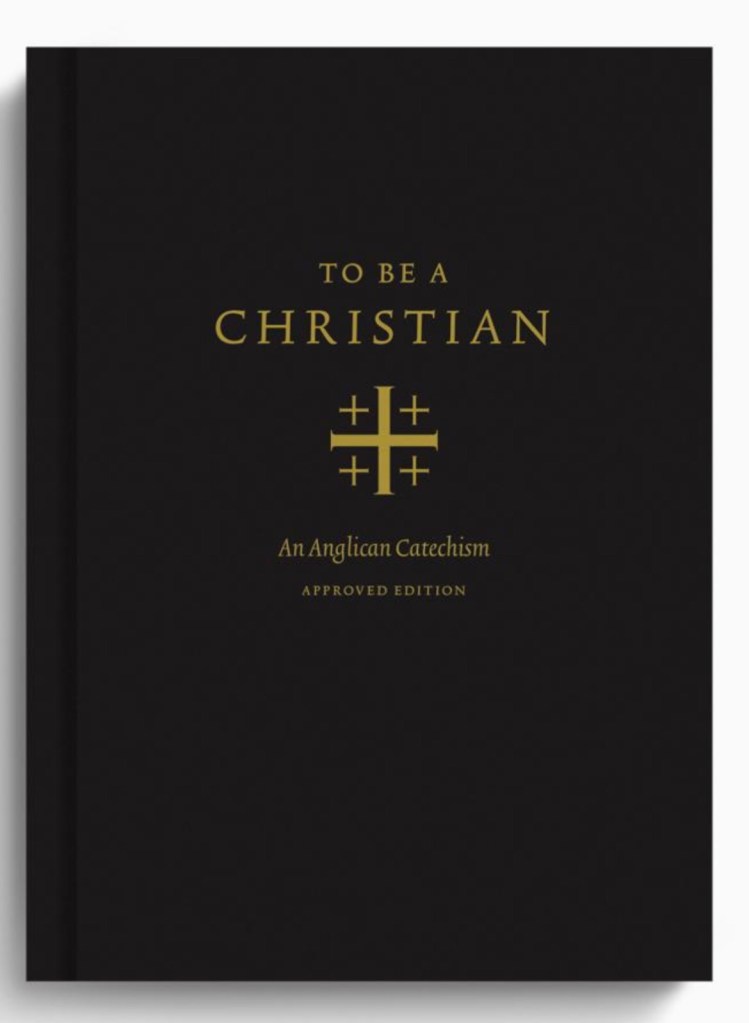
The “technical” term for what we will do in this class for the next several weeks is catechesis. It is a Greek word (κατήχησις) that essentially means “instruction by word of mouth”. It the West, it has come to be used mainly in a religious sense/setting to mean Christian instruction prior to either baptism or confirmation. Such instruction was a hallmark of the early Church in which the catechumenate (the course of instruction) often lasted from one to three years. We still have series of catechetical lectures from that early age, such as those by Saint Cyril of Jerusalem (313-386), https://www.newadvent.org/fathers/3101.htm. Today many expressions of the faith have consolidated and standardized catechetical instruction into a single book appropriate for the community. In the Anglican Church in North America, we have To Be A Christian: An Anglican Catechism. Going forward I will just refer to that text as The Catechism; we will use it frequently in this class. You may find it on line at https://anglicanchurch.net/catechism/ or you may purchase it from various sources including Amazon.

So, why catechesis at all? Is it not enough simply to hear the Gospel, be convicted, accept Jesus as Lord, and take one’s place in the Church? As with most complicated questions the answer is, well, both yes and no. To live the Christian life well, catechesis must happen at some time; actually, it must happen continually. But, the Church determined early on that the sooner the better for all parties concerned. Consider a first century context; if you keep Corinth in mind, you’ll do well. The church there was predominantly Gentile, that is, comprised mostly of former pagans. And that is highly significant. These people had been formed in and by a culture that had little in common with Judaism in terms of faith and practice. They were polytheistic idolaters who included Caesar in their pantheon. They frequented idol temples and may well have participated in ritualized sexual acts in worship there. Their social ethic and personal morals were formed by Greece and Rome and not by the Old Testament or the Sermon on the Mount. So, even though they were convicted by the Gospel, even though they were ready to accept the Lordship of Christ, they still required a great deal of formation to know what that really entailed and to live it well. They needed instruction. St. Paul’s Corinthian correspondence is, in some sense, an attempt at after-the-fact, remedial catechesis.

At this time, early in the Church’s history, the majority of converts were adults, though, of course, an adult male convert would also bring those in his family along with him into the faith. So, catechesis became a prerequisite for baptism, for entry into the Body of Christ. It was as if the Church were saying, “For everyone’s sake, before you become part of us, you need to know and we need you to know what that means. And, we need to know that you are committed to that as attested by your manner of life.” Conversion of belief wasn’t enough; conversion of manners (of one’s way of life) was also required.

So, catechetical instruction primarily focused (and still focuses) on three areas:

1. What Christians believe;

2. How Christians live; and

3. How Christians worship/pray.

As time elapsed, there were successive generations of Christians, so that much of the growth in the Church became organic: people having babies and raising them in the community of the faithful. Infant baptism became the norm and focused catechesis was delayed for all but adult converts. In the Anglican Communion, catechism became the process of preparation for Confirmation, the rite of mature, personal confession of the faith and the acceptance of mature ministry in the Church and in the world. Still, it focuses on the three primary areas of:

1. What Anglican Christians believe (Scripture and doctrine);

2. How Christians live (personal and social morals and ethics); and

3. How Anglican Christians worship, and particularly how we pray.

The traditional content of catechesis addresses these areas specifically:

1. The Creed (Scripture and doctrine);

2. The Ten Commandments (personal and social morals and ethics); and

3. The Lord’s Prayer (worship/prayer).

We will supplement these three with other topics and references, but the Creed, the Commandments, and the Lord’s Prayer are primary, so primary, in fact, that each catechumen is required to memorize them. That is your first and ongoing homework assignment. And yes, there will be test; we will, from time to time throughout the class say these together to fix them in your memory.

There is a Latin phrase that is heard not infrequently in Anglican circles: lex orandi, lex credendi, lex vivendi. It means the rule of prayer is the rule of faith is the rule of life. In other words faith, prayer, and the way of life — Creed, Prayer, and Ethics — are interdependent and are the foundations of the Christian Way. It is precisely these three that are the hallmarks of classical catechesis.

Confirmation

Now, I’d like to say a brief word about confirmation; there will be much more on this topic later, but I’d like you to know now whether confirmation is appropriate for you.

First, what is confirmation? It is the sacramental rite of full, mature inclusion in the life and ministry of the church. To say that it is sacramental is to say that it is a means of grace in which and through which God works for you and for your salvation. It is not an arbitrary church hoop to jump through and it is not a mere sign of something. God is actively doing something in confirmation. What is God doing? He is imparting the gifts of the Holy Spirit necessary for you to minister effectively in the church and in the world. He does this through the laying on of the bishop’s hands and the bishop’s prayer. There is firm biblical warrant for this as we will see later.

Confirmation is appropriate only for those who have been baptized in water in the name of the Father and of the Son and of the Holy Spirit. If you have not yet been baptized, this course provides necessary catechesis for that. For those baptized as infants, confirmation provides the opportunity to affirm as one’s own those promises made by parents or godparents at one’s baptism. The Anglican Church in North America requires a mature profession of faith and dedication to the Lordship of Jesus Christ by every member. Typically, confirmation provides that opportunity. For all — those baptized either as infants or as adults — confirmation calls upon God to pour out the Holy Spirit in a fresh and fuller way to empower the confirmand for ministry.

So, who should be confirmed?

If you have not already been confirmed in the Roman Catholic Church, the Orthodox Church, or an Anglican Church (including The Episcopal Church), you should be confirmed.

If you have been confirmed previously in one of those churches, you will be received into the Anglican Church rather than being confirmed. Outwardly, there is very little difference in the rites of reception versus confirmation; the major difference is one prayer and perhaps a few manual actions by the bishop. The catechetical preparation for confirmation and reception is the same.

Posted in Catechesis, Confirmation | Leave a comment

Genesis 3: The First Fall of Man

Apostles Anglican Church
Fr. John A. Roop
(Genesis 3, Psalm 9, John 2)

…he shall bruise your head, and you shall bruise his heel (Gen 3:15c).

In the Name of the Father, and of the Son, and of the Holy Spirit. Amen.

Even if you were reading the Bible for the very first time with no background knowledge, even if you were reading it not as a religious text but as cultural history/myth, even if you were simply reading it as a fictional saga, you would certainly know trouble was coming by the time you reached the middle of the second chapter of Genesis:

Genesis 2:15–17 (ESV): 15 The Lord God took the man and put him in the garden of Eden to work it and keep it. 16 And the Lord God commanded the man, saying, “You may surely eat of every tree of the garden, 17 but of the tree of the knowledge of good and evil you shall not eat, for in the day that you eat of it you shall surely die.”

Why even mention the tree, why even warn about death — which was as yet unknown — if it weren’t intended to presage something dire? Cue the ominous music.

The very presence of the tree of the knowledge of good and evil in the midst of the garden raises questions, doesn’t it? Why didn’t God “human-proof” Eden the way new parents baby-proof their home by removing all potential hazards and by installing safety gadgets: cabinet locks, oven knob protectors, electric outlet covers. What good parent would put a box of rat poison on the coffee table and warn the toddler not to eat it?

There are a couple of responses to this comparison. First, Adam is young — immature according to the Church Fathers — but he is not a toddler without understanding. He has both the knowledge and will to choose obedience to God’s single restriction. We are — each of us to this day — asked to demonstrate and exercise our faith and our faithfulness through our obedience. This is all that was asked of Adam, and that in a single act, a single law. Second, the tree of the knowledge of good and evil was not poison. According to the Fathers, humans were always intended to have access to that tree and the knowledge it represents, but only in due time when man had matured enough to use the knowledge wisely. Then, and only then, could man have eaten of it safely. And isn’t this paradigmatic of humankind? We seek after knowledge prematurely, before we have the wisdom to use it to our benefit, and death often results. One of last year’s — doesn’t it feel odd to say that? — one of last year’s blockbuster movies gives a modern version of the story: Oppenheimer. Scientists broke the code of atomic fission, and what is the first thing their political and military overlords used the knowledge for? To construct an unprecedented weapon of mass destruction that was unleashed on a civilian target and which killed the majority of Christians in Japan: but of the tree of the knowledge of good and evil you shall not eat, for in the day that you eat of it you shall surely die. It is the human story.

We should also note before moving on that only Adam received the instruction/warning directly from God. As far as we can tell, the woman got it secondhand — hearsay — from Adam. There was even some loss — or, in this case, gain — in the transmission.

And now, with that, we are ready for today’s text, Genesis 3. It begins with a creature we have not met before.

Genesis 3:1 (ESV): 3 Now the serpent was more crafty than any other beast of the field that the Lord God had made.

He said to the woman, “Did God actually say, ‘You shall not eat of any tree in the garden’?”

A sly, talking snake: what are we to make of that? Well, if this our first time through the story, we will likely be at a loss. We need more of the story, details that only come later, and we need to be able to hear those details with ears attuned to Ancient Near Eastern cultures. We need the prophets, particularly Isaiah and Ezekiel, and we need to hear these prophets on their own terms.

Isaiah tells of a rebellion in heaven, of a pretender to God’s throne:

Isaiah 14:12–15 (ESV): 12 “How you are fallen from heaven,
O Day Star, son of Dawn!
How you are cut down to the ground,
you who laid the nations low!
13 You said in your heart,
‘I will ascend to heaven;
above the stars of God
I will set my throne on high;
I will sit on the mount of assembly
in the far reaches of the north;
14 I will ascend above the heights of the clouds;
I will make myself like the Most High.’
15 But you are brought down to Sheol,
to the far reaches of the pit.

And Ezekiel connections this rebellion to Eden:

Ezekiel 28:12b–17a (ESV): “You were the signet of perfection,
full of wisdom and perfect in beauty.
13 You were in Eden, the garden of God;
every precious stone was your covering,
sardius, topaz, and diamond,
beryl, onyx, and jasper,
sapphire, emerald, and carbuncle;
and crafted in gold were your settings
and your engravings.
On the day that you were created
they were prepared.
14 You were an anointed guardian cherub.
I placed you; you were on the holy mountain of God;
in the midst of the stones of fire you walked.
15 You were blameless in your ways
from the day you were created,
till unrighteousness was found in you.
16 In the abundance of your trade
you were filled with violence in your midst, and you sinned;
so I cast you as a profane thing from the mountain of God,
and I destroyed you, O guardian cherub,
from the midst of the stones of fire.
17 Your heart was proud because of your beauty;
you corrupted your wisdom for the sake of your splendor.
I cast you to the ground.

Why is there a sly, talking snake in Eden? Well — don’t be scandalized by this — there isn’t, at least not as we typically think of snakes. This is an angel, a throne guardian angel, a cherub who had rebelled against God, who had sought to usurp God’s authority, who had sought to elevate himself, a mere creature — though a highly exalted one — above the Creator. Once he was in Eden in beauty, on the Holy Mountain of God. Eden was a garden on a mountain. It was the throne room of God and this cherub guarded it. But he was cast out for his sin, cast into the earthly Eden, where he sought to strike back at God in the only way he knew — by enlisting God’s human creatures in his rebellion.

So, why the form of a snake? Because that is how throne guardian angels were depicted in Ancient Near Eastern literature and art. No one in the culture from which this tale originated would have imagined this to be merely a rat snake or even a viper. No, this is an angelic being, a divine being. Perhaps the best visual image I can offer of this is the funerary mask of King Tutankhamen — the most ornate, golden one. On the crown on his forehead there is depicted a cobra with its hood spread, a sign of divine protection of the king — a throne guardian. That’s the ancient understanding. No one would have mistaken this snake in Eden for an ordinary snake in the grass. This was a angel, and a fallen one at that.

And he continues his assault upon God, this time through subtlety and misdirection. He attacks God’s “flank,” by using God’s creatures — our first parents — against God.

Genesis 3:1a–6 (ESV): He said to the woman, “Did God actually say, ‘You shall not eat of any tree in the garden’?” 2 And the woman said to the serpent, “We may eat of the fruit of the trees in the garden, 3 but God said, ‘You shall not eat of the fruit of the tree that is in the midst of the garden, neither shall you touch it, lest you die.’ ” 4 But the serpent said to the woman, “You will not surely die. 5 For God knows that when you eat of it your eyes will be opened, and you will be like God, knowing good and evil.” 6 So when the woman saw that the tree was good for food, and that it was a delight to the eyes, and that the tree was to be desired to make one wise, she took of its fruit and ate, and she also gave some to her husband who was with her, and he ate.

There is so much of importance to explore here, but so little time. First, note that the temptation to disobey God was not internal to the woman, but external. The thought did not originate with her; rather, she was assaulted with this thought by the serpent. We sometimes kid ourselves that we generate our thoughts, that our mind is a “thinking machine,” and that we are in control of it. Whether that is true at all, I will leave to others. But this text, and our experience, shows us that our minds are also receptive organs, just as our eyes. Our eyes don’t generate the sights they see; they receive light from external sources. The same is true with our ears…and with our minds. We receive thoughts from external sources. And not all those sources are good. You see the thoughts that the serpent is planting in the woman’s mind and heart: God is a liar. God is not to be trusted. God is selfish and wants to keep you “down” as a mere creature when you can be so much more, when you can be like God himself.

Isn’t that your experience, too? It certainly is mine. Thoughts, temptations, horrible things arise and you are dismayed that such darkness resides in you. Well, take courage; it doesn’t. You are being assaulted; you are under attack as the woman was under attack in Eden, as Jesus was under attack during his temptation in the wilderness and later in Gethsemane. Temptations — thoughts — will surely come. The issue is what we do with them.

The Desert Fathers, who were experts in the wiles of this ancient serpent and his use of thoughts against us, tell us simply to ignore such thoughts — just ignore them: pray, sing a Psalm, refocus yourself in worship or busy yourself with productive work. Do anything except engage with the thought. Down the path of engagement, of pondering and mulling over the thought, lies a fall. And that engagement, to mankind’s great harm, is exactly what the woman did. She gazed at the tree. She saw that it was good for food, that it was a delight to the eye, and she desired by it to be made wise: all acts of engagement with the temptation. And she ate. Moreover, she gave some to her husband — she became a temptress herself, she enlisted with the serpent in his rebellion — and he ate.

This is neither the place nor the time to apportion blame; the enemy deceived Eve and used her to spread the rebellion to Adam, and the consequences of that rebellion spread to all sons and daughters of these fallen parents. But, before the text gets to that, there is this word of God’s judgment to the serpent:

Genesis 3b:14–15 (ESV): “Because you have done this,
cursed are you above all livestock
and above all beasts of the field;
on your belly you shall go,
and dust you shall eat
all the days of your life.
15 I will put enmity between you and the woman,
and between your offspring and her offspring;
he shall bruise your head,
and you shall bruise his heel.”

Now, again, we need to beware a simplistic and literal reading of this. This is not about how snakes “lost their legs” or the power of speech. This is about the debasement of the throne guardian angel who sought to elevate himself about God. Instead, he finds himself as low as it is possible to go: not standing defiantly, but cowering on the ground, eating dust. We know that snakes don’t eat dust, so what does this mean? The answer lies ahead in the text, when God speaks to Adam:

Genesis 3:19 (ESV): 19 By the sweat of your face
you shall eat bread,
till you return to the ground,
for out of it you were taken;
for you are dust,
and to dust you shall return.”

Man is dust, and at his his death he returns to dust. And it is that — the dust of death and decay — that will be the food of the serpent. He will eat death; he will consume the world in death. He will reign over the dead, but his kingdom will be only dust and ashes.

There are more consequences to Adam and the woman. She will have pain in childbirth, though being fruitful is still her vocation. She will be at odds with her husband and will find herself subservient to him. As for Adam, the food which once came easily and freely as a gift from the earth, will henceforth come only grudgingly with toil and sweat, and, as we’ve noted, he and all those he will come to love, will die.

It all seems pretty harsh, doesn’t it, the punishment disproportionate to the crime: especially a death sentence on every human to be born? And yet the Fathers assure us that this was an act of grace and mercy and not of revenge or punishment. St. Athanasius, in his work On the Incarnation, writes that God gave us mortality, gave us death, to spare us from living eternally in our fallen state — a great mercy. St. John of Damascus, in An Exact Exposition of the Orthodox Faith, asserts that mortality is a requirement for repentance and return to God. He goes so far as to state that lack of mortality is precisely why the angels cannot repent. Death is God’s gift to man to bring us back to him in repentance. Notice in the text that while Adam and the woman were yet immortal — before God’s pronouncement to Adam — they were each given an opportunity to repent, and, instead, each excused himself and blamed another. I find that in my own life, the reality and the growing nearness of death spur me to greater repentance.

Well, all in all, Genesis 3 tells a pretty dismal story but for one glimmer of light, a word of prophesy and doom that God speaks to the serpent about this relationship he has initiated with the woman:

Genesis 3:15 (ESV): 15 I will put enmity between you and the woman,
and between your offspring and her offspring;
he shall bruise your head,
and you shall bruise his heel.”

The Fathers see in this the first hint of the Messiah, the offspring of the woman who will bruise/crush the head of the serpent, who will spell the end of his dominion over the dead. We are familiar with that, aren’t we, because we are still in the great twelve days of celebration of the fulfillment of that prophecy:

Fear not, for behold, I bring you good news of great joy that will be for all the people. For unto you is born this day in the city of David a Savior, who is Christ the Lord (Luke 2:10-11, BCP 2019, p. 27).

The serpent will — as the story moves toward its climax — bruise this Savior’s heel at Calvary. But the Savior will crush the head of the serpent there and will harrow the serpent’s dusty domain and bring all the dead to life. Man who fell in Eden was raised at the cross.

…he shall bruise your head, and you shall bruise his heel (Gen 3:15c).

Amen.

Posted in Uncategorized | Leave a comment

Caesar Speaks and the World Moves

Apostles Anglican Church
Fr. John A. Roop

Christmas Eve, 24 December 202
(Isaiah 9:1-7, Psalm 96, Luke 2:1-20, Titus 2:11-14)

For unto us a child is born: unto us a son is given.

1 And it came to pass in those days, that there went out a decree from Caesar Augustus, that all the world should be taxed.

2 (And this taxing was first made when Cyrenius was governor of Syria.)

3 And all went to be taxed, every one into his own city.

4 And Joseph also went up from Galilee, out of the city of Nazareth, into Judaea, unto the city of David, which is called Bethlehem; (because he was of the house and lineage of David:)

5 To be taxed with Mary his espoused wife, being great with child (Luke 2:1-5, KJV unless otherwise noted).

Caesar Augustus, Cyrenius, the first of the taxations: these are historical details, to be sure, a locating of St. Luke’s narrative within a certain world order of space and time and authority. This is history, not myth, St. Luke insists; this is fact, not fable. But the sheer fact with which St. Luke begins the nativity account is significant and sets the tone for much to follow. And this is the fact: Caesar speaks and the world moves. Caesar speaks and Joseph moves. Caesar speaks and Joseph has no choice but to take his wife — who is ready to deliver at any moment — on a grueling journey to his ancestral home, simply because Caesar speaks. That is the brute, and brutal fact: Caesar speaks and the world moves. That is power, power founded upon the threat of violence and upon the actual use of violence by the host of Roman soldiers under the command of the one who speaks. The story of Jesus starts with Caesar speaking, with the world moving, with Roman power, with the specter of Roman violence.

1 And it came to pass in those days, that there went out a decree from Caesar Augustus, that all the world should be taxed.

St. Luke does not tell his readers how the decree was disseminated; they were probably all too familiar with how Rome “got the news out” about such things. The Empire had good roads and a host of soldiers to travel them. It is not unreasonable to speculate that soldiers made their way throughout Galilee and all other subject territories proclaiming — none too gently — the news of the registration. Perhaps they pressed the local tax collectors into service to help. One way or another, the word spread. Caesar speaks and the world moves.

About this much we can be certain: this decree was not good news for any but the powerful in Rome and for their coffers. Since when has taxation ever been good news for the poor? Since when has compulsory registration for the “draft” ever been good news for the powerless? Since when has coming to the attention of the dictatorial powers-that-be ever been good news for the disenfranchised and the refugees?

Caesar speaks and the world moves: keeping its head down, keeping to the shadows, having seen the Pax Romana, the peace of Rome up close and personal — the brutal wasteland that Rome calls peace. Caesar speaks and the world moves. Caesar speaks and it is not good news.

But, even as Caesar’s voice reverberates, life goes on; “life finds a way” (Jurassic Park). In the midst of natural disasters, war, famine, poverty and the full range of human ills, in the midst of an imperial decree, life goes on and babies are born.

6 And so it was, that, while they were there, the days were accomplished that she should be delivered.

7 And she brought forth her firstborn son, and wrapped him in swaddling clothes, and laid him in a manger; because there was no room for them in the inn (Lk 2:6-7).

Caesar speaks from his palace and the world moves. A Jewish baby gasps in its first breath, squeezes out its first cry among the animals in a home or a stable or a cave — the tradition is not definitive on the location — and only the parents notice. Caesar is splendidly arrayed in royal robes and inhabits a palace. The baby is wrapped in swaddling clothes and laid in a manger, a feeding trough for the livestock. In solidarity with poor mothers throughout all the world then and now, Mary did the best she could with what she had.

We do not know for certain how news of Caesar’s decree spread — who first spoke it, who first heard it, and how it moved outward from those initial few. But, St. Luke does tell us who first proclaimed this news of the baby, who first heard it and how it traveled.

8 And there were in the same country shepherds abiding in the field, keeping watch over their flock by night.

9 And, lo, the angel of the Lord came upon them, and the glory of the Lord shone round about them: and they were sore afraid.

10 And the angel said unto them, Fear not: for, behold, I bring you good tidings of great joy, which shall be to all people.

11 For unto you is born this day in the city of David a Saviour, which is Christ the Lord (Lk 2:8-11).

The angel of the Lord — Gabriel, perhaps? So far in his narrative, St. Luke has mentioned no other angel by name but Gabriel alone, so his identity is a reasonable conjecture. Certainly the angel uses Gabriel’s familiar greeting: Fear not. There is no need to say that so routinely unless the angelic presence and the glory of the Lord are awful and terrible. Shepherds were tough, hardened men, afraid of little; remember that David fought the bear and the lion — not to mention Goliath — while he was still a shepherd. To say that this group was “sore afraid” is saying something.

The angel is pronouncing the words, but it is God speaking. God, too, it seems, has a decree for all the world: not that the world is to be taxed, but that it is to be saved. Caesar’s decree was good news for the very few and a heavy burden for the masses. God’s decree is good tidings of great joy for all people provided only they receive it as such.

The angel uses evocative language in this decree: city of David, Saviour, Christ, Lord. The ancestral city of David is the hamlet of Bethlehem, not terribly important either then or now. But, there was another city of David, and the angel’s double entendre cannot be ignored: Jerusalem, the city of the great king, the city on the hill that boasts the temple, the meeting place of God and man. Saviour: and what good Jew could fail to think of Moses when Saviour is mentioned, Moses who liberated God’s people from a brutal and idolatrous nation? Christ — christos in Greek and moshiach in Hebrew — the anointed one in any language. And who were the anointed ones in Scripture? Prophets. Priests. Kings. And finally, perhaps the most confrontational word of all: Lord. The central, non-negotiable Roman creed was “Caesar is Lord.” The great Caesar who speaks and the world moves. The great Caesar backed by the might of Rome. The great Caesar in royal robes in a splendid palace. Caesar — this Caesar — is Lord. No, says the angel. This baby who cries while only his parents notice, this baby whose parents lack the power to procure even a proper place for his birth, this baby wrapped in swaddling clothes and placed in a feeding trough — this baby, and not Caesar — is Lord.

Well, these are provocative words, dangerous words, “fighting words.” Caesar has all the armies of Rome at his command to validate and enforce his claim to lordship. What does the baby have?

13 And suddenly there was with the angel a multitude of the heavenly host praising God, and saying,

14 Glory to God in the highest, and on earth peace, good will toward men (Lk 2:13-14).

We must be careful not to let sentimentality, or familiarity with this beautiful language, or the gentle piety of Renaissance art mislead us here. The heavenly host does not refer to a small group of androgynous humanoids with fragile-looking feathery wings and beatific smiles singing Christmas carols in perfect four-part harmony. This is an army. This is God’s angel army any one of which, with a single act of intent, could lay waste Rome and all its world-feared might. And this host, perhaps myriads of myriads filling the sky, lifts its voice as one and proclaims that which brings to nought the pompous and pretentious claims of Caesar: Glory to God in the highest. The great Roman historian Tacitus said about Rome and its empire: They make a desert and call it peace. But of God — to whom be glory in the highest — the great prophet Isaiah said:

3 The voice of him that crieth in the wilderness, Prepare ye the way of the LORD, make straight in the desert a highway for our God.

4 Every valley shall be exalted, and every mountain and hill shall be made low: and the crooked shall be made straight, and the rough places plain:

5 And the glory of the LORD shall be revealed, and all flesh shall see it together: for the mouth of the LORD hath spoken (Is 40:3-5).

On this night, this word is fulfilled in the hearing of the shepherds as the angels give glory to God in the highest and proclaim not Rome’s peace, but God’s peace, not the Roman Emperor, but the true Prince of Peace: Glory to God in the highest, and on earth peace, good will toward men.

Caesar speaks and the world moves. God speaks — through the angels — and the shepherds move.

15 And it came to pass, as the angels were gone away from them into heaven, the shepherds said one to another, Let us now go even unto Bethlehem, and see this thing which is come to pass, which the Lord hath made known unto us.

16 And they came with haste, and found Mary, and Joseph, and the babe lying in a manger (Lk 2:15-16).

Caesar speaks and the world moves. At the end of the journey waits a tax man, a faceless, nameless bureaucrat just doing his duty in service of the Empire. God speaks and the shepherds move. At the end of their journey is a weary peasant couple in less than ideal surroundings — a weary peasant couple with a baby wrapped in swaddling clothes lying in a manger, a baby who is the Saviour, Christ the Lord.

17 And when they had seen it, they made known abroad the saying which was told them concerning this child.

18 And all they that heard it wondered at those things which were told them by the shepherds.

20 And the shepherds returned, glorifying and praising God for all the things that they had heard and seen, as it was told unto them (Lk 2:17-18, 20).

So, it is back to work for the shepherds. Flocks have to be gathered and moved to new grass and fresh water. Predators have to be dissuaded. Ewes have to be delivered of their lambs. Wool has to be sheared. Nothing has changed. Everything has changed. Rome will speak and the world will move, yes. But the shepherds have heard another voice; they have seen another king. They have traveled to Bethlehem and have seen this thing which the Lord made known to them through the angels; they have glimpsed the Saviour, the Messiah. They have, perhaps, just come to believe in a different kind of peace wrought not through violence but through this baby who is and will be prophet, priest, and king for all people. Though the shepherds almost certainly do not fully grasp it yet, they have seen the end of Rome, the end of empire and the dawning of the Kingdom of God.

18 And all they that heard it wondered at those things which were told them by the shepherds.

19 But Mary kept all these things, and pondered them in her heart (Lk 2:18-19).

There are Caesars still: empires that stride rough shod across the world, philosophies that demand absolute allegiance, charismatic figures that beguile and seduce, technologies that addict, sin that enslaves. These Caesars still speak and the world still moves. And so we come, year after year, generation after generation, to this story of Caesar and Cyrenius, of shepherds and angels, of Mary and Joseph and the babe wrapped in swaddling clothes, lying in a manger because we need to hear spoken the great good news:

10 …Fear not: for, behold, I bring you good tidings of great joy, which shall be to all people.

11 For unto you is born this day in the city of David a Saviour, which is Christ the Lord (Lk 2:10-11).

There are Caesars still, vaunting themselves in their pride and vain-glory, exulting in their power, shouting their names to the heavens, not realizing that their time is nearly up, that they will be debased, that their power is illusory, that their names are even now being forgotten. And so we come, year after year, generation after generation, to this story of one such Caesar, long gone, of one such empire which exists now only in its ruins. We come to shepherds and angels, to Mary and Joseph and the babe wrapped in swaddling clothes, lying in a manger, to the one whose kingdom is from everlasting and unto the ages of ages. We come to hear the words of the prophet Isaiah:

6 For unto us a child is born, unto us a son is given: and the government shall be upon his shoulder: and his name shall be called Wonderful, Counsellor, the mighty God, The everlasting Father, The Prince of Peace.

7 Of the increase of his government and peace there shall be no end, upon the throne of David, and upon his kingdom, to order it, and to establish it with judgment and with justice from henceforth even for ever. The zeal of the LORD of hosts will perform this (Is 9:6-7).

There are Caesars still who speak and expect the world to move, who stand and expect the world to bow, who survey all the kingdoms of the world and demand obeisance. And so we come, year after year, generation after generation to gather with God’s people, to take our stand with the angels, and to say: Glory to God in the highest, and on earth peace, good will toward men.

Amen.

Posted in Uncategorized | Leave a comment

A Tale of Two Arks

Apostles Anglican Church
Fr. John A. Roop

4 Advent, 24 December 2023
(2 Samuel 7:1-17, Psalm 132:1-9, Romans 16:25-27, Luke 1:26-38)

Arise, O Lᴏʀᴅ, into your resting-place, *
you and the ark of your strength.
Let your priests be clothed with righteousness,*
and let your saints sing with joy.

In the Name of the Father, and of the Son, and of the Holy Spirit:
as it was in the beginning, is now, and ever shall be, world without end. Amen.

It has been a long journey — good, but long. By now the babies are whiny, the men are grumpy, and the women are long-suffering and resigned. The last part of the trek is the hardest; it is uphill, quite an ascent: breathe, step, breathe, step, one foot in front of the other, one ragged breath after another. Yet, with each step the excitement of the group mounts; the expectation grows. They are singing now, singing the pilgrim psalms, the Shir Hama’aloth, the psalms of ascent (Psalms 120-134). They turn one last bend in the road, and there it is, the first glimpse of their destination in all its glory: the Temple of the Lord on Mount Zion, the temple to which they and all Israel come for holy day. And the singing swells:

1 Lᴏʀᴅ, remember David, *
and all his tribulations,
2 How he swore unto the Lᴏʀᴅ, *
and vowed a vow unto the Almighty God of Jacob:
3 “I will not come within the tabernacle of my house, *
nor climb up into my bed,
4 I will not allow my eyes to sleep, nor my eyelids to slumber, *
neither the temples of my head to take any rest,
5 Until I find a place for the temple of the Lᴏʀᴅ, *
a habitation for the mighty God of Jacob.”
6 Lo, we heard of the ark at Ephrathah *
and found it in the wood.
7 We will go into his tabernacle, *
and fall low on our knees before his footstool.
8 Arise, O Lᴏʀᴅ, into your resting-place, *
you and the ark of your strength.
9 Let your priests be clothed with righteousness, *
and let your saints sing with joy.

By the days of Caesar Augustus, when Quirinius was governor of Syria, this psalm that generations of pilgrims had sung is already an old story. A thousand years have come and gone since the events recounted in the psalm: David’s recovery of the ark of the covenant and its relocation to Jerusalem, David’s unfulfilled longing to build a temple for the LORD to house the ark. In those earlier days, the days even before David’s rule, Hophni and Phinehas, the foolish and wicked sons of the foolish and negligent priest/judge Eli, had taken the ark into battle against the Philistines, taken it into battle as a talisman — almost as an idol — thinking its presence would somehow manipulate God into granting Israel victory. But God — and his ark — are not instruments to be used. To the contrary: God destroyed the house of Eli and allowed the ark to be captured by the Philistines; Hophni and Phinehas were killed in battle and the old priest Eli died upon hearing the loss of his sons and, most especially, the loss of the ark. Within seven months — after a series of deadly plagues upon all their major cities — the Philistines were only too ready to return the captured ark to Israel. You can read all about it in 1 Samuel 6-7, about how the ark ended up at the house of Abinadab in Kiriath-jearim for decades, through the reign of Saul and into David’s reign. But, once David had firmly established his kingdom and his capital in Jerusalem, he determined to bring the ark there, to consolidate both church and state in his city, in the city of David. There he made a tabernacle, a tent, for the ark.

David had heard rumors that the ark was in Ephrathah, but those rumors were false. He searched and finally found it in the “woods” at Kiriath-jearim, at the house of Abinidab, where it had been since its return by the Philistines. Now, imagine the approach of David and his men to the ark, sitting there in its tabernacle. It is described in the psalm:

6 Lo, we heard of the ark at Ephrathah *
and found it in the wood.
7 We will go into his tabernacle, *
and fall low on our knees before his footstool.

And so, by fits-and-starts, the ark made its way to Jerusalem, to the tabernacle David had prepared for it there, and, a generation later, finally to the Holy of Holies in the temple David’s son Solomon built for it.

8 Arise, O Lᴏʀᴅ, into your resting-place, *
you and the ark of your strength.
9 Let your priests be clothed with righteousness, *
and let your saints sing with joy.

But when the Lord and the ark of his strength came into his resting-place, the priests, though clothed with the righteousness of their office, the saints, though singing with joy, could not abide the presence of the Lord.

3 And all the elders of Israel came, and the priests took up the ark. 4 And they brought up the ark of the LORD, the tent of meeting, and all the holy vessels that were in the tent; the priests and the Levites brought them up.

6 Then the priests brought the ark of the covenant of the LORD to its place in the inner sanctuary of the house, in the Most Holy Place, underneath the wings of the cherubim.

9 There was nothing in the ark except the two tablets of stone that Moses put there at Horeb, where the LORD made a covenant with the people of Israel, when they came out of the land of Egypt. 10 And when the priests came out of the Holy Place, a cloud filled the house of the LORD, 11 so that the priests could not stand to minister because of the cloud, for the glory of the LORD filled the house of the LORD (1 Kings 8:3-4, 6, 9-11, ESV throughout).

The ark comes, and the glory of the Lord overshadows the temple so that no man can stand before it.

Arise, O Lᴏʀᴅ, into your resting-place, *
you and the ark of your strength.

Some of the items once in the ark are missing; there is, now, only the two tablets of the covenant. Once there were also Aaron’s rod and a jar of manna:

A jar of manna, the symbol of God the creator of the universe and the sustainer of life, the symbol of God, the source of life — the very bread of life.

Aaron’s rod, the sign of the true high priest, the one authorized to make sacrifice and to atone for his people.

The stone tablets, the seal of the covenant between God and Israel.

The ark itself is important, of course, as the footstool of the Lord; but more important still is what it held in sign and symbol: manna, rod, and tablets — creator, sustainer, priest, sacrifice, covenant — all in the already but the not yet. This is the story of one ark in the psalm and the temple. But there is a second ark in the appointed readings this morning — this one in the Gospel — a second ark that we dare not miss, an ark of which the first one in the temple was but a mere shadow, a signpost pointing forward.

Luke 1:26–35 (ESV): 26 In the sixth month the angel Gabriel was sent from God to a city of Galilee named Nazareth, 27 to a virgin betrothed to a man whose name was Joseph, of the house of David. And the virgin’s name was Mary. 28 And he came to her and said, “Greetings, O favored one, the Lord is with you!” 29 But she was greatly troubled at the saying, and tried to discern what sort of greeting this might be. 30 And the angel said to her, “Do not be afraid, Mary, for you have found favor with God. 31 And behold, you will conceive in your womb and bear a son, and you shall call his name Jesus. 32 He will be great and will be called the Son of the Most High. And the Lord God will give to him the throne of his father David, 33 and he will reign over the house of Jacob forever, and of his kingdom there will be no end.”

34 And Mary said to the angel, “How will this be, since I am a virgin?”

35 And the angel answered her, “The Holy Spirit will come upon you, and the power of the Most High will overshadow you; therefore the child to be born will be called holy—the Son of God.

The ark of the covenant in the tabernacle and later in the temple was a box made of acacia wood overlaid with pure gold, and in it were all the signs and symbols of the old covenant: manna, staff, tablets. But the ark of the covenant in the Gospel is a young Jewish woman made of flesh and blood, and in her — in her womb — will reside all the fullness of the New Covenant, not in signs, but in the fulfillment of reality: manna no longer but the very bread of life himself, the one who will say of bread, “Take, eat, this is my body given for you”; the sign of the priesthood no longer but the Great High Priest himself, the one who sacrifices and the one who is himself the sacrifice; tablets of stone no longer but a new heart of flesh and spirit in which the very word of God beats and is made manifest — Jesus, Son of the Most High, heir of David, king forever over the house of Jacob, the holy one, the Son of God. And Mary is granted the unfathomable, the unparalleled, the singular honor of being the living, breathing ark of the new covenant who bears this treasure in her body, who yields not only room for the incarnation of the divine Logos, but who offers her very nature up to God so that the one to be born of her may be fully God and fully man, of one essence with the Father in his divinity and of one essence with Mary — with man — in his humanity.

As an ancient hymn of the Church bids us sing (Akathist Hymn to the Theotokos):

Rejoice, Tabernacle of God the Word.
Rejoice, Holy one, holier than the Holies.
Rejoice, Ark made golden by the Spirit.
Rejoice, inexhaustible Treasury of life.

The ark of the covenant in the tabernacle and later in the temple was a small thing, the size of a large Amazon box; you may well get Christmas presents bigger. But the ark of the covenant in the Gospel is at once both smaller than that and infinitely more expansive. As the Divine Liturgy of St. Basil the Great proclaims about Mary:

All of creation rejoices in you, O Full of Grace,
The assembly of Angels and the race of men.
O Sanctified Temple and Rational Paradise! O Glory of Virgins!
From you, God was incarnate and became a child, our God before the ages.
He made your body into a throne,
and your womb He made more spacious than the heavens.

The Creator of the Universe, the one by whom, through whom, and for whom all things were made, the one in whom all things consist, the source of all being, the Word of God who spoke the heavens into existence residing in the womb of Mary, the ark of the New Covenant. How extraordinarily spacious is her womb — more spacious than the heavens.

It is no wonder that we stand in wonder before this mystery. So did Mary herself.

34 And Mary said to the angel, “How will this be, since I am a virgin (Luke 1:34)?

In the face of such great mystery we often retreat to the mundane, to the practical, to that over which we have some degree of knowledge and perhaps even control. Conceive? But I am a virgin. How will this be? Mundane concerns. Practical questions. How-to knowledge.

35 And the angel answered her, “The Holy Spirit will come upon you, and the power of the Most High will overshadow you; therefore the child to be born will be called holy — the Son of God” (Luke 1:35).

This coming of the Holy Spirit upon Mary, this overshadowing by the power of the Most High, is the glory of God shrouding the ark and the Most Holy Place in Solomon’s temple so that not even the priests could minister in its presence, so that no man could stand in its presence. It is all happening again, this time in all its fullness. No man is needed to fill the ark of Mary’s womb, not even righteous Joseph, her lawful husband. The Holy Spirit overshadowed her. And though this comes a bit later in the story, no man can stand in the presence of this ark and the glory of God, not even the wise and the wealthy of this world:

11 And going into the house, they (magi — wisemen) saw the child with Mary his mother, and they fell down and worshiped him (Matt 2:11a).

They could not stand; they fell down and worshiped him. And shouldn’t that be our posture, as well, when contemplating the ark of the Gospel and the treasure it holds? We must bend the knees of our hearts and perhaps the knees of our bodies, as well — fall down and worship — because we simply cannot stand in the presence of such glory and wonder.

There is mystery and wonder, and, yes, paradox here. Ask any righteous Jew the meaning of the temple — from the Temple of Solomon to the second Temple — ask the prophet Isaiah, and this will be the answer: the temple is the meeting place between God and man, the intersection of heaven and earth. And the ark? It is the footstool of God, the earthly part of his throne where his train fills the temple (see Isaiah 6:1ff). The divine architecture of the Old Testament is perfectly rational: the smaller ark resides within the larger temple just as the smaller throne resides in the larger heavenly realm and intersects the earthly realm: the smaller within the larger. But not so in the great paradox of the Gospel. This baby, this holy one, is the meeting place of God and man, the perfect intersection of divinity and humanity in which God the Son takes unto his divine person our human nature. This baby, this holy one is the Temple. And in the glorious mystery of God, this temple takes up its residence in the ark of Mary’s womb — not the ark in the temple, but the temple in the ark, just the first of the many Gospel reversals to come.

Arise, O Lᴏʀᴅ, into your resting-place, *
you and the ark of your strength.

How did Mary respond to all this?

38 And Mary said, “Behold, I am the servant of the Lord; let it be to me according to your word.” And the angel departed from her (Luke 1:38).

I suspect that we sometimes read the account of the Annunciation as God’s invitation to Mary to participate — or to refuse to participate — in the Incarnation of the Lord. We figuratively and piously hold our breath waiting and hoping for her yes, for her fiat: let it be to me according to your word. But read the account again, sometime this day or sometime this season. It is not an invitation; it is a proclamation of what God will do — what God is even now doing — through Mary, his favored one, the one who is blessed among women, the one who is full of grace, his chosen Ark of the New Covenant. God does not wait for or need Mary’s yes in this moment because he has blessed her, because he has filled her with grace, because her life has become a yes, because she could no more bring herself to refuse this blessing than God could refuse to fulfill his covenant with Israel and through Israel with the world in and through this holy woman and this holy child. When Mary says to Gabriel, “Behold, I am the servant of the Lord; let it be to me according to your word,” it is more a statement of fact, this is who I am — it is more a summary of her entire life — this is who I was born to be — than it is a yes to this one particular moment. God was not worried that Mary would say, “No, thank you; I’d rather not.” God does not stand helpless before his creation in that, or in any, way. Could the tree say to the craftsman, “No, don’t make me into the ark?” No more could Mary say to Gabriel, “No, but thank you very much.”

Arise, O Lᴏʀᴅ, into your resting-place, *
you and the ark of your strength.

Yes, this is about what God is doing. God the Father, the Most High, is acting. God the Holy Spirit is being set loose in the world. God the Son is being made flesh to dwell among us. This is the answer not only to Mary’s question, How can this be?, but also the answer to Israel’s prayer and longing reflected in the psalm:

Arise, O Lᴏʀᴅ, into your resting-place, *
you and the ark of your strength.

This is the answer to creation’s groaning for release. This is the answer to Adam’s sin and the bondage of all his sons and daughters under sin and death and the fallen powers. As St. Mark writes, this is “the beginning of the gospel of Jesus Christ, the Son of God” (Mark 1:1). This is Jesus, the one who saves. This is Emmanuel — God with us — in the Ark of the New Covenant, in the ark of Mary’s womb. This is, after all, what the Gospel is: not first an invitation but the proclamation of what God is doing in and through Jesus Christ to redeem the world. Not a question, but the answer.

But, we must respond to the proclamation. Indifference is not an option, though many, tragically, seem to think it is. What is our proper response to all this? Perhaps the words of the psalm capture it best:

8 Arise, O Lᴏʀᴅ, into your resting-place, *
you and the ark of your strength.
9 Let your priests be clothed with righteousness, *
and let your saints sing with joy.

Amen.

Posted in Uncategorized | Leave a comment

Feast of St. Lucy

APOSTLES ANGLICAN CHRUCH
Fr. John Roop

St. Lucy’s Day (13 December 2023)
(Revelation 19:5-8, Psalm 131, Matthew 25:1-13)

Collect
Almighty God, who gave to Lucy the grace of complete devotion in body, mind, and spirit and the courage to proclaim her faith in the day of persecution: Grant to us, your servants, that same resolute holiness and unshakable commitment to the Bridegroom of the Church, our Lord Jesus Christ who with you and the Holy Spirit lives and reigns, one God, now and for ever. Amen.

In the Name of the Father, and of the Son, and of the Holy Spirit. Amen.

Let’s begin with a question: what is the first commandment? I know that the question itself is a bit ambiguous — intentionally vague — and I know that it allows for multiple answers. Even so, how would you answer it?

We could certainly point to the Decalogue and its first commandment:

I am the LORD your God. You shall have no other gods before me.

Or, we might remember the words of our Lord Jesus Christ when asked about the greatest commandment:

You shall love the Lord your God with all your heart and with all your soul and with all your mind. This is the first and great commandment.

Both of these commandments have priority of place; they are first in the sense of being of fundamental importance. And, they are expressing the same foundational principle: remember that God is God and put him first in all things. To answer in this way is to take “first” to mean “of primary importance.”

But, if we take “first” in a chronological or sequential sense to mean before all others, then the first commandment given to humankind is found in Genesis 1:

And God blessed them. And God said to them, “Be fruitful and multiply and fill the earth and subdue it, and have dominion over the fish of the sea and over the birds of the heavens and over every living thing that moves on the earth” (Genesis 1:28).

Not to be crude, but God’s very first commandment to the primal pair of humans was to have sex and to have babies — lots of babies, enough through their descendants over generations to fill the world. And notice that this commandment was part of God’s blessing upon his creation and especially upon his humans; so the enterprise of having sex and having babies, within the covenant of God-ordained marriage, is a good and holy thing. It is fundamental to the human vocation, part of what it means to be human, and certainly necessary to perpetuate the species. God embodied humans in the way he did — gave us the gendered anatomy and physiology we have — to make this vocation possible.

The Jews took this commandment, this vocation, very seriously. That is why barrenness is considered such an affliction in Scripture; it is the inability to keep the first commandment. So, we sorrow along with Sarai and Rebekah and Rachel and Hannah and Elizabeth in their infertility, and we rejoice with them when at last they conceive. We grieve for Jephthah’s daughter who dies childless because of her stupid father’s stupid vow. Her words are tragic:

37 So she said to her father, “Let this thing be done for me: leave me alone two months, that I may go up and down on the mountains and weep for my virginity, I and my companions” (Judges 11:37).

She weeps that she will die a virgin, that she will die childless.

So, in the Old Testament ethos, to be infertile was a great tragedy and to choose to remain childless was … well, it wasn’t a thing; it was essentially unthinkable in that culture, a rejection of the human vocation.

One might expect that same ethos to prevail in the Church since the cultural and spiritual blood of Israel flows through the Church’s veins. And, to some great extent, it does; the Church has always upheld the sanctity of marriage and family life. In the Church, children always were and still are considered a blessing from the Lord. But, alongside the blessed state of marriage and child-rearing there grew up another God-given and God-blessed state of life: chastity — consecrated virginity. Hear these words from St. Thomas Á Kempis:

CONSIDER the lively examples set us by the saints, who possessed the light of true perfection and religion, and you will see how little, how nearly nothing, we do. What, alas, is our life, compared with theirs? The saints and friends of Christ served the Lord in hunger and thirst, in cold and nakedness, in work and fatigue, in vigils and fasts, in prayers and holy meditations, in persecutions and many afflictions. How many and severe were the trials they suffered—the Apostles, martyrs, confessors, virgins, and all the rest who willed to follow in the footsteps of Christ! They hated their lives on earth that they might have life in eternity (A Kempis, The Imitation of Christ, Book 1, Chapter 18).

Look at the noble fellowship in which he includes the virgins: the Apostles, martyrs, confessors, virgins, and all the rest who willed to follow in the footsteps of Christ.

We don’t make much of consecrated virgins in the Anglican Church; I doubt many cradle Anglicans have even heard of them. Part of that is almost certainly due to the dissolution of the monasteries under Henry VIII — frankly, a great loss for our church in my estimation — and to the elimination of the requirement for priestly celibacy. But, the early Church and the other churches now in the Great Tradition — the Roman Catholic Church and the Orthodox Church — have retained this charism and honor it highly. That should be enough to cause us to rethink the issue.

But, as good Anglicans, as we think about it, we will ask a fundamental question: does celibacy — consecrated virginity — have biblical warrant? Is it found in Scripture? Yes. St. Paul acknowledges consecrated virginity as a gift from God, as a holy state of life, and, in some cases, as even preferable to marriage and child-rearing.

Speaking of his own celibacy, St. Paul writes:

1 Corinthians 7:7–9 (ESV): 7 I wish that all were as I myself am. But each has his own gift from God, one of one kind and one of another.

8 To the unmarried and the widows I say that it is good for them to remain single, as I am. 9 But if they cannot exercise self-control, they should marry. For it is better to marry than to burn with passion.

He then continues with a two-fold defense of consecrated virginity or of widowed celibacy. The first justification is practical, based upon the difficulties of the time in which he lived.

1 Corinthians 7:25–26 (ESV): 25 Now concerning the betrothed [παρθένων, virgins], I have no command from the Lord, but I give my judgment as one who by the Lord’s mercy is trustworthy. 26 I think that in view of the present distress it is good for a person to remain as he is.

In a time of persecution, it is perhaps better, St. Paul says, not to multiply responsibilities or attachments. It is difficult enough to suffer for Christ oneself; imagine the difficulty of watching one’s spouse or children suffer. Is there the possibility of committing apostasy in order to end the suffering of a spouse or child? Yes, certainly that would be a great temptation. Better to avoid all that through celibacy.

St. Paul’s second justification is just as practical, but is also directed toward one’s relationship with Christ.

1 Corinthians 7:32–35 (ESV): 32 I want you to be free from anxieties. The unmarried man is anxious about the things of the Lord, how to please the Lord. 33 But the married man is anxious about worldly things, how to please his wife, 34 and his interests are divided. And the unmarried or betrothed woman is anxious about the things of the Lord, how to be holy in body and spirit. But the married woman is anxious about worldly things, how to please her husband. 35 I say this for your own benefit, not to lay any restraint upon you, but to promote good order and to secure your undivided devotion to the Lord.

Do you see what St. Paul — whether consciously or not — is doing here? He is moving from one “first commandment” — Be fruitful and multiply. — to another first commandment — You shall love the Lord your God with all your heart and with all your soul and with all your mind. In doing so, he is not pitting married life against celibacy. It is a matter of gifting, a matter of the vocation to which God has called each one. If you have the gift of celibacy, it is a holy estate, the means God has ordained for your sanctification and service. If you have the gift of marriage and child-rearing, it, too, is a holy estate, the means God has ordained for you to become a saint and to minister to others. St. Paul’s exhortation is thoroughly practical and thoroughly spiritual. Look to the times; look to your gifting. Look to what God has in mind for you.

In its best moments, the Church has listened to St. Paul’s guidance and has honored the role of consecrated virgins. These women vow a life of perpetual virginity for the sake of devotion to Christ and service in the Church and in the world. Some become cloistered nuns and devote themselves exclusively to prayer. Some live in the world and devote themselves to acts of charity, education, service to the poor.

The early Church particularly honored four virgin martyrs among whom we find St. Lucy, whose feast day is observed on 13 December. That is, of course, why we are talking about this topic at all; today is the Feast of St. Lucy. As Anglicans we don’t quite know what to do with her. St. Lucy’s feast day is listed on our calendar as an optional, ecumenical commemoration which means it is largely ignored as a feast in its own right. It is mainly noted only to set the date for the winter ember days, the set of three days each season when the church fasts and prays for those called to or in holy orders. The winter ember days are the Wednesday, Friday, and Saturday following the feast of St. Lucy. The virgin martyr serves as a signpost pointing to something else; we notice St. Lucy mainly so we will know when to observe the ember days.

But, what of St. Lucy herself? What do we know of her?

Lucy was born in 283 in Syracusa, a city in Sicily, to affluent, Christian parents, who raised her in the faith from her birth. Her father died when she was young, and her mother Eutychia had a serious health issue also. As with the woman in the Gospel, Eutychia had suffered for four years with a flow of blood the doctors were unable to stanch. It was Lucy who insisted that she and her mother travel to Catana to pray for healing at the tomb of St. Agatha, a holy virgin martyr of Sicily. It was there — or at least as a result of the prayers offered there — that Eutychia was healed. And, perhaps it was that incident that confirmed in Lucy her own desire to offer herself fully to God as a holy virgin and to distribute her portion of the family wealth to the poor. She made this vow secretly; she did not reveal it to her mother.

Not knowing about her daughter’s vow, Eutychia sought to arrange a marriage for Lucy, as was the norm. An agreement was made with a young nobleman, but he soon began to suspect something was amiss. He noticed that Lucy had begun selling her jewelry and other possessions and was distributing the proceeds to the poor. That practice was highly unusual, except among one group of people: the Christians. Knowing now that he had been misled — inadvertently misled by the mother, but misled nonetheless — he denounced Lucy to the authorities as a Christian. All this was transpiring under the final but brutal persecution of Christians under the Emperor Diocletian. Without going into the details, Lucy refused to submit to her betrothed and to renounce her faith; she was tortured and died as a result of her wounds in A.D. 304.

We can assume that Lucy was honored locally from the time of her martyrdom onward. By the sixth century, within three hundred years of her death, that honor had spread throughout the Roman Church; Pope Gregory I (590-603) included St. Lucy in his sacramentary, the book used by bishops and priests for liturgical services. Her popular devotion had spread to England by the eighth century, where her feast day was observed until it was “lost” during the Reformation. As I understand it, the Church of England now observes St. Lucy’s Day as a lesser feast of the Church, but not so the American Anglican Church.

Might it be good for us to reclaim the virgin martyrs, to honor them again as the Church has always done? I think so. I think so because it makes room for and honors the variety of ways God calls people to holiness and service, and it uses the full range of God’s gifts for the sake of the Church and the world.

I think we should say about this what St. Paul says:

17 Only let each person lead the life that the Lord has assigned to him, and to which God has called him. This is my rule in all the churches (1 Cor 7:17).

St. Paul goes on specifically to contrast circumcision and uncircumcision, servitude and freedom. But, later in the letter he makes clear, implicitly, that virginity and marriage fall under this rule also. God has called people to sanctity of life and to faithful service in a vast array of different ways, and we should exult in all of them, utilize all of them to the glory of God, for the welfare of his people, and for the sake of the world.

In the end, one is not made holy by either state of life, virginity or marriage. One is made holy by one’s faithfulness to God expressed in and through a particular state of life. We do not honor St. Lucy just because she was a virgin, but rather because through her virginity she expressed her complete self-offering to God, a devotion for which she was willing to suffer martyrdom. That is the Christian goal, the Christian purpose, in any state of life to which God has called us — all of us. Amen.

Posted in Uncategorized | Leave a comment

Happiness or Holiness?

Apostles Anglican Church
Fr. John A. Roop

Eve of Thanksgiving 2023
(Deut 8/Ps 65:1-8/James 1:1-17/Matt 6:25-33)

Collect for Thanksgiving
Most merciful Father, we humbly thank you for all your gifts so freely bestowed upon us: for life and health and safety, for strength to work and leisure to rest, for all that is beautiful in creation and in human life; but above all we thank you for our spiritual mercies in Christ Jesus our Lord; who with you and the Holy Spirit lives and reigns, one God, for ever and ever. Amen.

17 Every good gift and every perfect gift is from above, coming down from the Father of lights, with whom there is no variation or shadow due to change (James 1:17).

In the name of the Father, and of the Son, and of the Holy Spirit. Amen.

Just in case you haven’t looked at your calendar recently, let me remind you that tomorrow is a holiday; it is the Eve of Black Friday, the Great Vigil of Christmas Shopping Season, sometimes known also, I understand, as Thanksgiving Day.

I’m not really as cynical about the day as that made me sound; I like Thanksgiving even if its observance sometimes seems a little off. It is good that our secular government acknowledges the human duty, right, and need to be thankful. It’s at least an implicit recognition that Someone has blessed us — God sneaking in through the back door of a government holiday. It may not be explicitly the God of Abraham, Isaac, and Jacob, the God perfectly revealed in Jesus Christ, but it is at least “Nature’s God,” the Creator who has endowed all men with the unalienable rights of life, liberty, and the pursuit of happiness. And — pardon the double negative — that’s not nothing.

For Christians, not least for Anglican Christians, Thanksgiving should be a day like any other day, a day of business as usual. Except perhaps for the time off from work, the parades, and the football games, Thanksgiving Day should be just another Thursday. That’s true because we are, day in and day out, a thanksgiving people. Consider the Daily Office of Morning and Evening Prayer. We begin the day with an Invitatory Psalm, usually the Venite, Psalm 95:

O come, let us sing unto the LORD;*
let us heartily rejoice in the strength of our salvation.

Let us come before his presence with thanksgiving*
and show ourselves glad in him with psalms (BCP 2019, p. 14).

We end the day with The General Thanksgiving:

Almighty God, Father of all mercies,
we your unworthy servants give you humble thanks
for all your goodness and loving-kindness
to us and to all whom you have made (BCP 2019, p. 51).

Our days, all our days, are bracketed with thanksgiving — morning and evening. But, it’s not just our days; it’s our weeks, as well. On the first day of each week we gather with God’s people for the principal service of Christian worship, the Holy Eucharist, which “is a chief means of grace for sustained and nurtured life in Christ” (BCP 201, p. 7). “Eucharist” — the name we often use for Holy Communion — comes to us directly from the Greek εύχαριστία which simply means “thanksgiving.” The Eucharistic Prayer itself is called The Great Thanksgiving. It begins with a dialogue between priest and people:

Let us give thanks to the Lord our God.
It is right to give him thanks and praise
(BCP 2019, p. 132)

before it turns to prayer to God himself:

It is right, our duty and our joy, always and everywhere to give thanks to you, Father Almighty, Creator of heaven and earth (BCP 2019, p. 132).

Daily, weekly, always and everywhere the Christian life is bracketed by, punctuated by, and characterized by thanksgiving. That the government makes space for such thanksgiving one day each year is a good thing, but for us it is simply business as usual; we are a thanksgiving people.

Having the “official” day does give us cause and time to consider the nature and practices of thanksgiving, though, and that is what I’d like to do for just a moment. I’ll start with this general conviction:

What we are thankful for depends on and reveals what we value.

Let me give a trivial example. If someone were to bake a tray of fresh garlic knots for me, I would certainly be grateful for the thoughtfulness and the expression of hospitality, but I would not be thankful for the gift itself; I find garlic distasteful. To me it has no redeeming value. But, if someone were to pour me a fresh cup of coffee, I would be both grateful for the act and thankful for the gift. Coffee is proof that God exists and that he loves us; I value a good cup of coffee very highly. So, back to my conviction:

What we are thankful for depends on and reveals what we value.

Now, imagine we could go house to house tomorrow afternoon, interrupt people’s celebrations and ask this survey question: What are you especially thankful for today? What are some answers you would expect to receive?

Lifeway Research actually conducted such a survey in 2020. Here are the results in decreasing order of thankfulness: family, health, friends, memories, personal freedom, stability, fun experiences, opportunities, achievements, and wealth (https://research.lifeway.com/2020/11/17/americans-most-thankful-for-and-to-family-this-thanksgiving/, accessed 11/14/2023). The answers aren’t particularly surprising, though the order of a few are not what I would have predicted. I’ve tried to generalize and categorize the answers. What are Americans most thankful for? What do we most value?

Relationships: family and friends, memories

Security: health, stability,

Self-Fulfillment: personal freedom, fun experiences, achievements

Provision: wealth

Relationships, security, self-fulfillment, and wealth: these values are certainly reflected in how we celebrate Thanksgiving. We feast securely in our homes with family and friends. We tell stories and share memories and observe family traditions. We review the highlights of the year — all the fun experiences and achievements — and perhaps we grieve some losses, thankful that at least we’re still here and healthy: relationships, security, self-fulfillment, and provision.

This is an overly simplistic summary, I know, but we are thankful for those things that make us happy. We value happiness. How many times have you heard parents say about their children, “I just want them to be happy”?

And so, I am right back to this conviction:

What we are thankful for depends on and reveals what we value.

We — typical Americans — value relationships, security, self-fulfillment, and provision. We value happiness.

Here’s the question that brings to mind, a question I’d like to think about a bit with you. What if we valued holiness instead of happiness, or at least valued holiness more than happiness. How would that change what we are thankful for?

The lectionary for Thanksgiving Day appoints a reading from the Letter of St. James, beginning with the 1st chapter, the 17th verse. It takes verse 17 as the first verse of what follows. Today I would instead like to consider verse 17 as the last verse of what goes before and let the first sixteen verses spur our thinking on the question I proposed: what if we valued holiness more than happiness? How would that change what we are thankful for?

James 1:2–4, 12 (ESV): 2 Count it all joy, my brothers, when you meet trials of various kinds, 3 for you know that the testing of your faith produces steadfastness. 4 And let steadfastness have its full effect, that you may be perfect and complete, lacking in nothing.

12 Blessed is the man who remains steadfast under trial, for when he has stood the test he will receive the crown of life, which God has promised to those who love him.

If we value holiness more than happiness, we will be thankful for trials and testing and not just for ease and comfort. This notion is strictly counter-cultural in our society. Our culture today has a great affinity for “safe spaces,” for contexts and situations where people are always affirmed, always made comfortable, never challenged, never corrected, where everyone’s “truth” is considered equally valid even if those various truths are objectively false and contradictory. One of the many problems with such safe spaces is stagnation; no growth can happen there. Growth requires challenge, stretch/stress/tension. Growth — psychological, intellectual, physical, and yes, spiritual — requires trials and testing. Almost by definition trials aren’t pleasant in the moment; nor is testing. But, they do good work in us and on us and for us as we cooperate. If we pass the test, we grow in steadfastness, in the stability and strength of our faith “until we all attain to the unity of the faith and of the knowledge of the Son of God, to mature manhood, to the measure of the stature of the fullness of Christ” (Eph 4:13, ESV). And if we fail? Then we participate in the grace of repentance for the salvation of our souls. Either way — success or failure:

2 Count it all joy, my brothers, when you meet trials of various kinds, 3 for you know that the testing of your faith produces steadfastness (Jame 1:2-3).

If we value holiness more than happiness, we will be thankful for our limitations.

James 1:5–8 (ESV): 5 If any of you lacks wisdom, let him ask God, who gives generously to all without reproach, and it will be given him. 6 But let him ask in faith, with no doubting, for the one who doubts is like a wave of the sea that is driven and tossed by the wind. 7 For that person must not suppose that he will receive anything from the Lord; 8 he is a double-minded man, unstable in all his ways.

St. James specifically mentions the limits of our wisdom and our need to pray God for it. But, this applies more generally, also, to our human limitations of love, joy, peace, patience, kindness, goodness, faithfulness, gentleness, and self-control —to all the fruit of the Spirit (see Gal 5:22-23). We cannot overcome our limitations of virtue on our own. We must pray, and pray with faith knowing that our good Father wants to give these generously. We can — and should — be thankful for all human limitations which make us recognize our utter dependence upon God and which drive us to him in prayer. As St. Paul instructs us, when we are weak — when we are limited — then we are strong.

5 If any of you lacks wisdom, let him ask God, who gives generously to all without reproach, and it will be given him (James 1:5, ESV).

If we value holiness more than happiness, we will be thankful for the great kingdom reversal.

James 1:9–11 (ESV): 9 Let the lowly brother boast in his exaltation, 10 and the rich in his humiliation, because like a flower of the grass he will pass away. 11 For the sun rises with its scorching heat and withers the grass; its flower falls, and its beauty perishes. So also will the rich man fade away in the midst of his pursuits.

Our fallen world is upside down, and the Gospel is the proclamation that the right side up Kingdom of God has dawned. It is right there in the Magnificat:

He has shown the strength of his arm;
he has scattered the proud in the imaginations of their hearts.

He has brought down the mighty from their thrones,
and has exalted the humble and meek.

He has filled the hungry with good things,
and the rich he has sent empty away (BCP 2019, p. 45).

It is right there in the Beatitudes where the poor in spirit, those who mourn, the meek, those who hunger for righteousness, the merciful, the pure in heart, the peacemakers, the persecuted and the reviled are the blessed ones. This world cannot be redeemed, cannot be put to rights unless it is turned on its head, unless there is a great, Gospel reversal. And we should be thankful whenever and wherever and however we see it happening in the name of Christ. Our churches should be models of the great reversal — costly models. Those who are privileged in this upside down world may well find the great reversal initially disorienting. But it will prove to be a blessing.

9 Let the lowly brother boast in his exaltation, 10 and the rich in his humiliation, because like a flower of the grass he will pass away.

If we value holiness more than happiness, we might even — and I think we would — come to value temptation; not sin, but temptation.

James 1:13–15 (ESV): 13 Let no one say when he is tempted, “I am being tempted by God,” for God cannot be tempted with evil, and he himself tempts no one. 14 But each person is tempted when he is lured and enticed by his own desire. 15 Then desire when it has conceived gives birth to sin, and sin when it is fully grown brings forth death.

Notice what makes temptation possible: our own disordered passions/desires. How many people today are tempted by and led into sin by pornography? It is a major spiritual epidemic even among Christians, men and women of all ages. Imagine showing a pornographic image or video to a saint. The result would not be lust, not the stirring of disordered passions but rather deep sorrow for all those dehumanized and degraded by such sin, deep sorrow which would move the saint to deep prayer. Having been purified of lust, there is nothing in the saint to resonate with the outward enticement, with the temptation. But the rest of us? Whatever tempts us reveals to us a passion in ourselves that has yet to be healed, has yet to be rightly ordered by the Spirit. And that provides us with the self-knowledge necessary for repentance. Consider temptation like a spiritual x-ray or MRI that reveals in us a previously undiagnosed illness that if left untreated will prove fatal. Wouldn’t you be thankful for that test?

14 But each person is tempted when he is lured and enticed by his own desire. 15 Then desire when it has conceived gives birth to sin, and sin when it is fully grown brings forth death (James 1:14-15, ESV).

Tomorrow, on the day our government has gracious provided us, we will be, and we should be, thankful for relationships, security, self-fulfillment, and provision. But, if we value holiness more than happiness, we might also want to make a start of thankfulness for trials, limitations, the great reversal, and even temptation — all good gifts.

17 Every good gift and every perfect gift is from above, coming down from the Father of lights, with whom there is no variation or shadow due to change (James 1:17).

Amen.

Posted in Uncategorized | Leave a comment

Guides and Maps

I have found St. Ignatius of Loyola to be a faithful spiritual director and his Spiritual Exercises to be a reliable roadmap along the way of discernment and spiritual growth.

These following concepts, presented so well in God’s Voice Within, by Mark E. Thibodeaux, SJ, are foundational for Ignatian spirituality. The following summaries are my own, but I commend Fr. Thibodeaux’s book.

Man is subject to two spiritual “forces”, the false (evil) spirit and the true (good) spirit. We might think of the false spirit — in biblical and Anglican terms — as the world, the flesh, and the devil, the congeries of influences that distort our thinking, lead us into temptation, draw us from the love of God, and lead to a waning of the theological virtues of faith, hope and love. Contrary to this is the true spirit, supremely the Holy Spirit, but also a constellation of influences clustered around the great transcendentals of the good, the true, and the beautiful — everything that comes from and conduces to the love of God and that increases in us faith, hope, and love.

One under the influence of the false spirit is in the state of desolation, while one under the influence of the true spirit is in consolation. To be clear, one may feel elated in a state of desolation and miserable in a state of consolation. These are not descriptions of one’s emotional affect, but rather of the guiding influence under which one is operating. One may feel quite content when moving from sin to greater sin; in fact, the false spirit will encourage that affect. But, that one is still is desolation and, perhaps worse still, in delusion. To the contrary, one may — by the grace of God — realize his/her sinful state and lament that offense against God and man with tears and anguish and precisely because of that be in a state of consolation, of moving toward God and increasing in faith, hope, and love.

St. Ignatius used these movements of the spirits and the states of being as reliable aids to discernment. While these are primarily intended for spiritual introspection — Under which spiritual influence am I moving and in which state do I find myself? — they are also reliable as an external testing of the spirits such as St. John commends. Listen to the words being spoken by another. Do they come from and promote an increase of faith, hope, and love or are they rather base, manipulative, harsh? Do they raise the spirit Godward or rather plunge it into the depths? Do they waft the aroma of Christ or is there the scent of sulfur about them? Jesus cautions us to be careful how we hear (Luke 8:18). It is possible — and surprisingly easy — to be drawn into another’s desolation and delusion. St. Ignatius offers us essential tools, critical questions: Does this draw us to the love of God and increase in us the virtues of faith, hope, and love? If not, rest assured that it is from the false spirit and leads only to desolation and, God forbid, jeopardy for one’s soul.

Posted in Uncategorized | Leave a comment

CONTINUITY WITH DEVELOPMENT

Apostles Anglican Church
Fr. John A. Roop

Continuity with Development: A Reflection on Acts 4:5-31

Collect, Proper 24
Set us free, loving Father, from the bondage of our sins, and in your goodness and mercy give us the liberty of that abundant life which you have made know to us in our Savior Jesus Christ; who lives and reigns with you, in the unity of the Holy Spirit, one God, now and for ever. Amen.

“Whether it is right in the sight of God to listen to you rather than to God, you must judge, for we cannot but speak of what we have seen and heard” (Acts 4:19-20).

In the Name of the Father and of the Son and of the Holy Spirit. Amen.

There is a principle at work in the biological realm that is obvious even to people like me who know little about the science of biology. There is probably a scientific name for this principle, but I’ll just call it continuity with development. I think an example will make this principle clear.

A human child starts with the union of egg and sperm and under normal circumstances develops in the womb for nine months, is born, grows into a toddler, then a child, an adolescent, a young adult, a mature adult, and finally an elderly adult. I have been through all these stages. But it is the same “I” that has been through them. There is biological continuity from the womb to me, standing here, speaking to you, the same person throughout. I have a unique DNA signature that began at conception and continues throughout my life: continuity. And yet, I have developed; I have grown. I look and function differently than when I was in those other stages of adolescence or young adulthood: development. I am me — continuity — but I have grown and changed — development. That is the principle: continuity with development.

We see this same principle in various aspects of our culture. One type of musical composition, for example, is called theme with variations. In it, a musical phrase is given as a basis or theme for the composition. Then that same theme is played in many different, but recognizable variations: perhaps in both major and minor keys, perhaps inverted or backwards, perhaps with a different rhythm. It is the same, recognizable theme throughout — continuity — but with variation — development.

The opening of Beethoven’s Fifth Symphony is an example, with its classic four note theme repeated at different musical intervals and with slight variation. Or consider literature. Imagine one grand, sweeping story in two volumes. You finish the first volume and open the second with a set of expectations: (1) that volume two will be a continuation of volume one, that it will not be a totally different story and (2) that volume two will not be simply a repeat of volume one, but that it will take the original story farther along. Again, what you are looking for is continuity with development.

This last, literary example is pertinent to our text today in Acts. Acts is the second volume of a two volume history of the inauguration and growth of the Kingdom of God. The first volume, the Gospel according to St. Luke, recounts the in-breaking of the Kingdom of God in the incarnation, life, death, resurrection, and ascension of the Lord Jesus Christ. The second volume, Acts of the Apostles, records the working out and expansion of that Kingdom — the founding and growth of the Church — particularly in the missions of two Apostles, Peter and Paul. In these two volumes — in this single story — you would expect to see both continuity and development: the story begun by Jesus continued with growth and change through the Apostles — not a different story, but the same story realized in different ways and in different places: continuity with development. And that is precisely what we see.

Jesus’ ministry “technique”, if I can use that word, was simple. He performed signs and wonders: healings of all kinds, exorcisms, nature miracles, even resurrections. Then, when people asked, “What can this mean?” or “What kind of man is this?” or “By what power and authority can he do these things?” Jesus announced the in-breaking of the Kingdom of God: “Repent, for the Kingdom of God is at hand.” And that is the pattern that both Peter and Paul continue in Acts of the Apostles. Jesus healed; they heal. Jesus proclaimed the arrival of the Kingdom of God; they proclaim the presence of the Kingdom of God in and through Jesus.

The story of Peter and John before the Council that we have in our text from Acts 4 today, actually begins a chapter earlier in the Temple with the healing of a man lame from birth. Even there you see the continuity with Jesus; Jesus healed a lame man on the Sabbath, causing quite quite an uproar, and he healed a man blind from birth.

How did the people respond to the healing of this lame man?

Acts 3:8–10 (ESV): 9 And all the people saw him walking and praising God, 10 and recognized him as the one who sat at the Beautiful Gate of the temple, asking for alms. And they were filled with wonder and amazement at what had happened to him.

They begin asking the same questions that Jesus’ signs had evoked. What can this mean? What kind of men are these? By what power and authority can they do these things? And those questions give Peter the opportunity to proclaim the Gospel.

Acts 3:12–16 (ESV): “Men of Israel, why do you wonder at this, or why do you stare at us, as though by our own power or piety we have made him walk? 13 The God of Abraham, the God of Isaac, and the God of Jacob, the God of our fathers, glorified his servant Jesus, whom you delivered over and denied in the presence of Pilate, when he had decided to release him. 14 But you denied the Holy and Righteous One, and asked for a murderer to be granted to you, 15 and you killed the Author of life, whom God raised from the dead. To this we are witnesses. 16 And his name—by faith in his name—has made this man strong whom you see and know, and the faith that is through Jesus has given the man this perfect health in the presence of you all.

Of course, Peter goes on to proclaim the full Gospel and to call for repentance. And that upset the temple authorities, the priests and the Sadducees, particularly when Peter proclaimed in Jesus the resurrection of the dead. The two Apostles were taken into custody overnight and trotted out the next day before the rulers, elders, and scribes, before Annas the high priest and Caiaphas and John and Alexander, all members of the high priest’s family. And these powers-that-be ask precisely the question that Peter intended for them to ask: “By what power or by what name did you do this?” That, again, is in perfect continuity with Jesus: sign, question, proclamation. The development lies in the Apostles’ witness to the resurrection.

Acts 4:8–12 (ESV): 8 Then Peter, filled with the Holy Spirit, said to them, “Rulers of the people and elders, 9 if we are being examined today concerning a good deed done to a crippled man, by what means this man has been healed, 10 let it be known to all of you and to all the people of Israel that by the name of Jesus Christ of Nazareth, whom you crucified, whom God raised from the dead—by him this man is standing before you well. 11 This Jesus is the stone that was rejected by you, the builders, which has become the cornerstone. 12 And there is salvation in no one else, for there is no other name under heaven given among men by which we must be saved.”

By what power and by what name? By the same power of God that raised Jesus Christ from the dead and in the authority of his name, the name of Jesus Christ of Nazareth. And next comes one of my favorite commentaries in all Scripture:

Acts 4:13 (ESV): 13 Now when they saw the boldness of Peter and John, and perceived that they were uneducated, common men, they were astonished. And they recognized that they had been with Jesus.

How is it that uneducated, common people — nobodies like me — can be bold before the powers-that-be? Such boldness comes from being with Jesus. It also comes from being with the Church in prayer. Let me jump ahead in the story a bit. After being warned to speak no longer in the name of Jesus and then released, Peter and John sought out the church. And what did the Church do? It held a good, old-fashioned, Wednesday night prayer meeting! Listen to their request:

Acts 4:29–30 (ESV): 29 And now, Lord, look upon their threats and grant to your servants to continue to speak your word with all boldness, 30 while you stretch out your hand to heal, and signs and wonders are performed through the name of your holy servant Jesus.”

They didn’t pray for the Lord to smite the Jewish authorities. They didn’t pray for the Lord to protect the Apostles or the Church from persecution. No. They prayed for boldness to defy the authorities who were gathered together against the Lord and against his Anointed, boldness to speak God’s word. They prayed for God to stretch out his hand with signs and wonders that would spark more questions and more opportunities for proclamation. Is that a God-honoring prayer? Well, look at the results.

Acts 4:31 (ESV): 31 And when they had prayed, the place in which they were gathered together was shaken, and they were all filled with the Holy Spirit and continued to speak the word of God with boldness.

This seems like Pentecost: The Sequel, doesn’t it? And isn’t that what we want: a church that prays so fervently that it is shaken to the core and filled with the Holy Spirit and with holy boldness to speak the word of God to all who are ignorant of it or opposed to it?

That’s the story we are presented. I suggested earlier that one of the keys to appreciating the story is the principle of continuity with development. Peter acts in continuity with Jesus in his method of evangelism: sign, question, proclamation. Work a sign that provokes people to ask, “What can this mean?” or “What kind of person is this?” or “By what power and authority can he/she do this things?” Then proclaim the Gospel of Jesus Christ in word as well as in deed. What is the development? Jesus could only proclaim the coming of the Kingdom of God. We can proclaim its arrival and presence through the resurrection of Jesus Christ and the inauguration of the Church.

I also asked you to consider Luke’s recounting of the grand story as a two volume set: The Gospel according to St. Luke and Acts of the Apostles, a set that demonstrates continuity with development. Now, I’d like to expand that a bit by suggesting that there is a third volume, The Acts of the Church, and that we have the honor and responsibility of writing a paragraph or two or maybe even a page of it. The principle of continuity with development is still essential in this third volume. That means, not least, continuity with the method of evangelism that Jesus and the Apostles used: (1) Do some sign that is so out of the ordinary, so counter-cultural that it provokes people to ask “What does that mean?” or “What kind of a person does such a thing?” or “By what power or authority does this person act?” and then (2) proclaim the Gospel boldly, even though you might be shaking in your boots. That is the continuity.

What is the development? Well, the signs we work will likely be different than those of Jesus and the Apostles. I don’t have the gift of healing as they did. Some today do; I do not, though I do exercise a priestly, sacramental healing ministry of the church through the laying on of hands, anointing, and prayer. My signs will be different, and many of yours will be as well. What do those signs look like? I don’t know. That is for you to determine with prayer and a consideration of your gifts and opportunities. In considering such possible signs, theologian Stanley Hauerwas said, “If in a hundred years, Christians are identified as the people who don’t kill their children or kill their elders we will have done well.” That seems like such a low bar, such a feeble sign. But in a society where aborting babies seems reasonable and where euthanasia is just around the corner, standing for the sanctity of human life because all life belongs to God is really a pretty astounding sign and will call for explanation. And the explanation is the Gospel. Forgive someone who has hurt you; there’s a sign. Be generous instead of greedy; there’s a sign. Get up on Sunday morning and go to worship the Lord with a bunch of other redeemed sinners; there’s a sign. Then, on Monday morning, act like Sunday made a difference; there’s a real sign. I don’t know what signs and wonders you are called and empowered to do; that is between you and God. But, how exciting it is — what a great adventure it is — to confound the world, to make them scratch their cultural heads and wonder what in the world we’re up to. They might just ask. Just in case they do, we should be prepared to answer with a reasonable proclamation of the Gospel.

There is one other clear point of continuity — prayer: prayer for boldness for ourselves and for our brothers and sisters, prayer for the Church to go boldly into the world — boldly, not timidly — with the truth about Jesus, the truth that, in Peter’s words, “there is salvation in no one else, for there is no other name under heaven given among men by which we must be saved” (Act 4:12).

If we do this, get ready: the Church might just be shaken to the core and filled with the Holy Spirit. Then, who knows what will happen? Amen.

Posted in Uncategorized | Leave a comment

DEM BONES, DEM BONES

XXII. OF PURGATORY
The Romish Doctrine concerning Purgatory, Pardons, Worshipping, and Adoration, as well of Images as of Reliques, and also Invocation of Saints, is a fond thing vainly invented, and grounded upon no warranty of Scripture, but rather repugnant to the Word of God (Thirty-Nine Articles of Religion, BCP 2019, p. 780).

First, an apology of sorts: the Thirty-Nine Articles of Religion were written in a time of great theological conflict and are expressed in polemical language. While it was and is appropriate to critique certain accretions and abuses that characterized the medieval Roman Catholic Church, today a more irenic tone is generally in order. I quote the Articles not to give offense, but to reflect upon certain aspects of Anglican thought.

This particular article came to mind as I prayed the Daily Office this morning, particularly during the appointed Old Testament reading, 2 Kings 13, a portion of which follows:

20 So Elisha died, and they buried him. Now bands of Moabites used to invade the land in the spring of the year. 21 And as a man was being buried, behold, a marauding band was seen and the man was thrown into the grave of Elisha, and as soon as the man touched the bones of Elisha, he revived and stood on his feet (2 Kings 13:20-21, ESV).

The bones of Elisha are reliques (relics) of the prophet. And while the Articles are right to condemn worship of relics, it would be a “fond thing vainly invented, and grounded upon no warranty of Scripture, but rather repugnant to the Word of God” to deny that God has worked — and may still work — through such relics to vindicate his servants, to bless his people, to bring honor to his name, and to draw men and women to himself.

11 And God was doing extraordinary miracles by the hands of Paul, 12 so that even handkerchiefs or aprons that had touched his skin were carried away to the sick, and their diseases left them and the evil spirits came out of them (Acts 19:11-12, ESV).

Handkerchiefs and aprons, too, are relics, and God used them not least to vindicate Paul and his ministry. Is it a step too far to think that God might still work in such a way, to believe that relics of a holy man or woman of God might be imbued with power and used by God for the healing of body, mind, or spirit? Were I healed through such a relic, would I not treasure it as a marker of God’s grace? Treasure it, yes. Honor it as a sacramental through which God had worked powerfully, yes. Worship it, no. Superstition and idolatry are twin poles around which we may not orbit. Cranmer was right on this.

As I have expressed before, the issues we face today are not co-terminal with those pressed upon the Reformers. Cranmer dealt with a culture that had moved beyond sacramentalism to superstition. Our culture has moved in the opposite direction: from sacramentalism to materialism. Our materialistic Western culture does not seem to believe that matter can be sacramental, can be imbued with power or can be a channel of grace. That is true, of course, because it no longer believes in the God of creation who called matter into being. One of the challenges of the Church today, then, is to “re-enchant,” to “re-consecrate” the world, to show it as sacramental. It is not unimportant then — in fact, I would say it is vital — that we embrace the material as revelatory of God, as instrumental in his working: bread, wine, oil, water, incense, candles and the like. This is not merely a matter of personal preference for “bells and smells,” but rather a conviction regarding the imminence of God and the revelatory and sanctifying nature of his material creation as sacramental.

Posted in Uncategorized | Leave a comment

Render Unto Caesar?

Apostles Anglican Church
Fr. John A. Roop
Pentecost 21 (22 October 2023)

Render Unto Caesar?
(Matthew 22:15-22)

Matthew 22:17 (ESV): 17 Tell us, then, what you think. Is it lawful to pay taxes to Caesar, or not?”

In the Name of the Father, and of the Son, and of the Holy Spirit. Amen.

You’re surely familiar with “no-win questions” — questions that can’t be answered without incurring significant, self-imposed, personal damage. These questions often trade on complex or controversial issues, reducing them to a ridiculously oversimplified “yes/no” format where each answer presents an untenable and dangerous option. Political pundits — I will not dignify them by calling them journalists — political pundits have made asking these questions into an art form and politicians have made evading these questions into an equal and opposite art form.

I don’t want to wax partisan here, but I do need to give a recent example to make this idea clear. Don’t read anything into this example other than an attempt to give needed background as I segue into the Gospel text.

Several Republican notables are vying for the party’s presidential nomination, and all trail Donald Trump by double digits in the polls. In a recent debate — actually before the debate, I think — all the candidates were asked this question: If Donald Trump becomes the Republican Party nominee for President, will you pledge now to support him?

How can you answer such a no-win question? “Yes” would essentially be a concession, an admission that you don’t really think you have a viable shot at being the nominee and that you are really just trying to garner name recognition in hopes of some cabinet appointment or perhaps the vice-presidential slot on the ticket. It might well erode what little support you have. But, a “No” answer is no better. “No” would alienate much of the base and even much of the undecided block. Can you really trust someone who is openly disloyal to his/her party, who won’t support the party’s nominee? There simply is no way to answer that question without damage. That is why it was asked: to watch the politicians squirm on the public stage.

Or what about this political-adjacent question: Are you in favor of personal autonomy, of the right of each individual to make final decisions about his/her own body? Answer “yes” — which might seem the obvious answer — and the follow up comments will implicate you in the approval of abortion — the right of a woman to make final decisions about her own body — and of support for a minor’s right to receive gender-affirming surgery or hormonal therapy without parental consent. Don’t want to go there? Then answer “no.” But wait: that means that someone else, perhaps even the state, will have the right to make final decisions about your body. That makes you complicit in supporting euthanasia, the right of the state to determine when you should no longer receive medical care and should instead be “murdered with dignity.” There is simply no way to answer that complex and controversial question with yes or no. It was intentionally designed to be unanswerable, to trap the respondent.

Why ask such no-win questions? It seems to me there are two fundamental reasons: either the questioner seeks to elevate his own status — See how clever I am? — or else he seeks to destroy the respondent’s status or power — Watch what this question does to your following. This kind of question puts people in their place.

To be fair, Jesus himself used such a no-win question on a least one occasion to silence the chief priests and the elders. Watch how it works, and how well it works:

Matthew 21:23–27 (ESV): 23 And when he entered the temple, the chief priests and the elders of the people came up to him as he was teaching, and said, “By what authority are you doing these things, and who gave you this authority?” 24 Jesus answered them, “I also will ask you one question, and if you tell me the answer, then I also will tell you by what authority I do these things. 25 The baptism of John, from where did it come? From heaven or from man?” And they discussed it among themselves, saying, “If we say, ‘From heaven,’ he will say to us, ‘Why then did you not believe him?’ 26 But if we say, ‘From man,’ we are afraid of the crowd, for they all hold that John was a prophet.” 27 So they answered Jesus, “We do not know.” And he said to them, “Neither will I tell you by what authority I do these things.

So, Jesus posed a no-win question to best and to silence the temple authorities. It worked all right, but, turnabout, they say, is fair play. So, in our text today, the Pharisees and the Herodians come with a similar no-win question for Jesus, maliciously intending to entangle him in his own words.

Matthew 22:15–17 (ESV): 15 Then the Pharisees went and plotted how to entangle him in his words. 16 And they sent their disciples to him, along with the Herodians, saying, “Teacher, we know that you are true and teach the way of God truthfully, and you do not care about anyone’s opinion, for you are not swayed by appearances. 17 Tell us, then, what you think. Is it lawful to pay taxes to Caesar, or not?”

We must give credit where credit is due, even if grudgingly; this is a clever question. It is a classic example of the no-win form: a complex and controversial issue reduced to an over-simplified yes/no question format with each possible answer incurring significant, self-imposed, personal damage on the respondent. Well done, you Pharisees. Good on you, Herodians.

If Jesus answers “no” — as his most ardent supporters and the general downtrodden masses almost certainly want him to do — then he will place himself in open rebellion against Rome; he will position himself — or will allow the Pharisees and Herodians to position him — as the leader of a tax revolt. He is already on shaky ground with Rome due to his entry into Jerusalem just days before and his disruption of Temple commerce. That’s two strikes; one more strike over taxes might just be enough to force Rome’s hand.

But, if Jesus answers “yes” — as perhaps his most sober minded opponents among the high priests and Sadducees want him to do — then he will effectively renounce his messianic aspirations; his support will go instantly from relatively small but growing to vanishingly small and decreasing.

It is a splendidly wicked question, matched only by — surpassed only by — Jesus’ answer.

Matthew 22:17–22 (ESV): 17 “Tell us, then, what you think. Is it lawful to pay taxes to Caesar, or not?” 18 But Jesus, aware of their malice, said, “Why put me to the test, you hypocrites? 19 Show me the coin for the tax.” And they brought him a denarius. 20 And Jesus said to them, “Whose likeness and inscription is this?” 21 They said, “Caesar’s.” Then he said to them, “Therefore render to Caesar the things that are Caesar’s, and to God the things that are God’s.” 22 When they heard it, they marveled. And they left him and went away.

How can we describe the brilliance of Jesus’ answer? It is a living chess gambit, a spectacular mate-in-three victory.

Move 1: “Show me the coin for the tax.” This crucial move sets everything in motion.

Move 2: “Whose likeness and inscription is this?” Get the opponents to commit.

Move 3: “Render to Caesar the things that are Caesar’s, and to God the things that are God’s.” Spring the trap.

Now, before we look at these moves in detail, we first must consider what game Jesus is really playing. This is not a petty game of one-upsmanship. “Oh, so you think you’re clever? Watch this.” This is not a partisan game of religious rivalries: Pharisees and Herodians and Priests and Sadducees versus the Nazarene. This is not a high-stakes game of political “chicken” — Israel versus Rome. It doesn’t even really have anything in particular to do with taxes. Although I introduced the language of games into Jesus’ answer, this is not really a game at all. It is a pitched battle for the hearts, minds, and souls of the human race: God in the Person of his incarnate Son contending against all the forces of the world, the flesh, and the devil in the forms of misguided religion, brutal state power, and feckless humanity, contending for the hearts, minds, and souls of the very people trying to ensnare him with their no-win question. This is serious business with eternal consequences.

To better understand Jesus’ answer, I think we have to read it backwards, to take the moves in reverse order starting with the conclusion.

“Render to Caesar the things that are Caesar’s, and to God the things that are God’s.” That “answer” isn’t intended to put a period at the end of the sentence and stop the discussion; it is intended to provoke a soul-searching question: What actually does belong to Caesar, and what actually does belong instead to God? We should stop here for some prayer and reflection on that, but time won’t allow. So, we’ll move on directly to the litmus test that Jesus gave.

“Whose likeness and inscription is this?” Jesus is asking about the coin for the tax, of course, but surely he wants us to broaden the question and the answer. What is it that uniquely and solely bears Caesar’s image? Asked another way, what is it that does not bear the imprint of God?

In the beginning God created the heavens and the earth. This is the very first assertion about God in Scripture. And then, surveying all that he had made God said, “It is good.” Why is it good? Because it expresses his will. Because it bears the imprint of God. Lest we miss this, St. John tells us again in his Prologue, intentionally harkening back to Genesis but now with Jesus front and center:

John 1:1–3 (ESV): 1 In the beginning was the Word, and the Word was with God, and the Word was God. 2 He was in the beginning with God. 3 All things were made through him, and without him was not any thing made that was made.

There is nothing in all the created order that does not bear the imprint of the Word by whom, through whom, and for whom it was made: nothing. Whose likeness is this? God’s. Whose inscription is this? The Word’s.

And now, more personally:

Genesis 1:26–28 (ESV): 26 Then God said, “Let us make man in our image, after our likeness. And let them have dominion over the fish of the sea and over the birds of the heavens and over the livestock and over all the earth and over every creeping thing that creeps on the earth.”

27 So God created man in his own image,
in the image of God he created him;
male and female he created them.

28 And God blessed them.

The whole sordid history of this world is simply a record of man denying the imprint of God upon himself and others, the attempt to eradicate the likeness and image of God in the face in the mirror or in the faces across the border or behind the barbed wire or the prison bars or in the faces across the boardroom table or in the faces and bodies seen in the pornography on the computer screen or in the baby in the womb or in the old person in hospice or in the beggar on the street. Who is it that bears the image of God? Jesus prods us to ask. Who doesn’t?

And as difficult as that question might be to face directly, there is even more. Jesus asks his interlocutors whose likeness they see on the coin. They almost certainly look first at the coin and then at him before they answer, and that — right there in the space between them, as they look at him — is where the real question hangs in the air: Forget the coin for a moment. Look at me. Whose likeness do you see? They have no answer. They don’t even perceive the question. But we have the answer, given to us by St. Paul:

Colossians 1:15–20 (ESV): 15 He is the image of the invisible God, the firstborn of all creation. 16 For by him all things were created, in heaven and on earth, visible and invisible, whether thrones or dominions or rulers or authorities—all things were created through him and for him. 17 And he is before all things, and in him all things hold together. 18 And he is the head of the body, the church. He is the beginning, the firstborn from the dead, that in everything he might be preeminent. 19 For in him all the fullness of God was pleased to dwell, 20 and through him to reconcile to himself all things, whether on earth or in heaven, making peace by the blood of his cross.

The Pharisees and Herodians are haggling over a little piece of metal on which Caesar has stamped his imprint when the image of the invisible God of all creation stands right there before them, the one who bears the fullness of God in human flesh. For God’s sake — truly, for God’s sake — ask the right question, people: Whose image and inscription do you see in the face of Jesus?

And now we come to the first, pivotal move of Jesus’ answer with a chance of beginning to understand its brilliance: Show me the coin for the tax. This much is obvious; Jesus doesn’t have a coin. I don’t think this is a commentary on his poverty or on the fact that Judas has the moneybag for the group. I don’t consider it primarily a comment on Jesus’ piety, a refusal to carry a graven image of Caesar. Taken in context, I think it is a declaration: There is nothing about me that bears the image of Caesar or that belongs to him. Caesar has no claim on me, and I do not owe anything to Caesar, but instead everything to God. And what is true uniquely and supremely of Jesus is true derivatively of us. The world, the flesh, and the devil have no claim on us for we are citizens of the Kingdom of God and we bear the image of the one who has redeemed us and made us his own, the one who indwells us through the Holy Spirit. Is it proper to pay tribute to the world, the flesh, and the devil? Show us a coin. Now look into the face of Jesus.

While studying and praying this text, an image kept coming to mind, less an invitation to ponder than an intrusion clamoring for attention. Since I can’t seem to shake it, I’ll share it with you. Imagine a picture of yourself, full body, head to toe. Now imagine that the photograph is actually a jigsaw puzzle — five hundred little interlocking pieces that make you up. Now imagine your boss or teacher or other significant authority figure standing there reaching for several of the pieces, taking them out of the puzzle and saying, “These belong to me.” Then along comes the government to claim a few pieces. And your colleagues. And your family. And your friends — maybe even your enemies, too. And your book club. And, and, and … all claiming the pieces that they think belong to them until all the pieces are gone and there is nothing left of you. And all along you have simply been rendering unto Caesar what is Caesar’s. Right? But there is this little, niggling voice in the background asking, “Whose likeness and inscription is this?” There is this still, small voice whispering, “Render to God what is God’s.”

So, what are we to do? How are we to reclaim the pieces? Perhaps we start here with this recognition and offering from one of our Eucharistic liturgies:

And here we offer and present to you, O Lord, ourselves, our souls and bodies, to be a reasonable, holy, and living sacrifice (BCP 2019, p. 117).

What must we render to God? Ourselves, our whole selves, our souls and bodies — all that we are and all that we have.

Our maybe we start with reordering our loves if they have become disordered. Hear what our Lord Jesus Christ says:

You shall love the Lord you God with all your heart and with all your soul and with all your mind. This is the first and great commandment (ibid, p. 106).

Or maybe we start by refusing any more to buy security with little pieces of ourselves:

Matthew 6:31–33 (ESV): 31 Therefore do not be anxious, saying, ‘What shall we eat?’ or ‘What shall we drink?’ or ‘What shall we wear?’ 32 For the Gentiles seek after all these things, and your heavenly Father knows that you need them all. 33 But seek first the kingdom of God and his righteousness, and all these things will be added to you.

I know it would be easy to misunderstand what I’ve been so haltingly trying to communicate, just as it was easy for the Pharisees and Herodians to misunderstand Jesus’ answer. I am not talking about social or spiritual isolation, about joining a monastery or convent so that we can spend every waking moment in prayer. I’m not talking about an attitude that says to others, “What we might have given to you, we have devoted to God, so we can no longer help you.” I am saying this: that we must render our whole self to God — nothing kept back, nothing offered to modern day Caesars in whatever form they take — so that God can then use us as he will. Let me offer another image to contrast with the earlier puzzle image, a Eucharistic image this time, that captures what I’m trying to say.

We offer ourselves, our souls and bodies, to be a reasonable, holy, and living sacrifice. God takes that self-offering, blesses it — blesses us — breaks it — breaks us — into God only knows how many pieces, and gives it — gives us — away for the life of the world. We render nothing to Caesar and everything to God for him to use for his glory and for the welfare of his people. It is only in this offering, only in this blessing, only in this breaking and being given, that we are made whole.

Matthew 22:17 (ESV): 17 Tell us, then, what you think. Is it lawful to pay taxes to Caesar, or not?”

Amen.

Posted in Uncategorized | Leave a comment