Apostles Anglican Church
Fr. John A. Roop
4 Advent, 24 December 2023
(2 Samuel 7:1-17, Psalm 132:1-9, Romans 16:25-27, Luke 1:26-38)
Arise, O Lᴏʀᴅ, into your resting-place, *
you and the ark of your strength.
Let your priests be clothed with righteousness,*
and let your saints sing with joy.
In the Name of the Father, and of the Son, and of the Holy Spirit:
as it was in the beginning, is now, and ever shall be, world without end. Amen.
It has been a long journey — good, but long. By now the babies are whiny, the men are grumpy, and the women are long-suffering and resigned. The last part of the trek is the hardest; it is uphill, quite an ascent: breathe, step, breathe, step, one foot in front of the other, one ragged breath after another. Yet, with each step the excitement of the group mounts; the expectation grows. They are singing now, singing the pilgrim psalms, the Shir Hama’aloth, the psalms of ascent (Psalms 120-134). They turn one last bend in the road, and there it is, the first glimpse of their destination in all its glory: the Temple of the Lord on Mount Zion, the temple to which they and all Israel come for holy day. And the singing swells:
1 Lᴏʀᴅ, remember David, *
and all his tribulations,
2 How he swore unto the Lᴏʀᴅ, *
and vowed a vow unto the Almighty God of Jacob:
3 “I will not come within the tabernacle of my house, *
nor climb up into my bed,
4 I will not allow my eyes to sleep, nor my eyelids to slumber, *
neither the temples of my head to take any rest,
5 Until I find a place for the temple of the Lᴏʀᴅ, *
a habitation for the mighty God of Jacob.”
6 Lo, we heard of the ark at Ephrathah *
and found it in the wood.
7 We will go into his tabernacle, *
and fall low on our knees before his footstool.
8 Arise, O Lᴏʀᴅ, into your resting-place, *
you and the ark of your strength.
9 Let your priests be clothed with righteousness, *
and let your saints sing with joy.
By the days of Caesar Augustus, when Quirinius was governor of Syria, this psalm that generations of pilgrims had sung is already an old story. A thousand years have come and gone since the events recounted in the psalm: David’s recovery of the ark of the covenant and its relocation to Jerusalem, David’s unfulfilled longing to build a temple for the LORD to house the ark. In those earlier days, the days even before David’s rule, Hophni and Phinehas, the foolish and wicked sons of the foolish and negligent priest/judge Eli, had taken the ark into battle against the Philistines, taken it into battle as a talisman — almost as an idol — thinking its presence would somehow manipulate God into granting Israel victory. But God — and his ark — are not instruments to be used. To the contrary: God destroyed the house of Eli and allowed the ark to be captured by the Philistines; Hophni and Phinehas were killed in battle and the old priest Eli died upon hearing the loss of his sons and, most especially, the loss of the ark. Within seven months — after a series of deadly plagues upon all their major cities — the Philistines were only too ready to return the captured ark to Israel. You can read all about it in 1 Samuel 6-7, about how the ark ended up at the house of Abinadab in Kiriath-jearim for decades, through the reign of Saul and into David’s reign. But, once David had firmly established his kingdom and his capital in Jerusalem, he determined to bring the ark there, to consolidate both church and state in his city, in the city of David. There he made a tabernacle, a tent, for the ark.
David had heard rumors that the ark was in Ephrathah, but those rumors were false. He searched and finally found it in the “woods” at Kiriath-jearim, at the house of Abinidab, where it had been since its return by the Philistines. Now, imagine the approach of David and his men to the ark, sitting there in its tabernacle. It is described in the psalm:
6 Lo, we heard of the ark at Ephrathah *
and found it in the wood.
7 We will go into his tabernacle, *
and fall low on our knees before his footstool.
And so, by fits-and-starts, the ark made its way to Jerusalem, to the tabernacle David had prepared for it there, and, a generation later, finally to the Holy of Holies in the temple David’s son Solomon built for it.
8 Arise, O Lᴏʀᴅ, into your resting-place, *
you and the ark of your strength.
9 Let your priests be clothed with righteousness, *
and let your saints sing with joy.
But when the Lord and the ark of his strength came into his resting-place, the priests, though clothed with the righteousness of their office, the saints, though singing with joy, could not abide the presence of the Lord.
3 And all the elders of Israel came, and the priests took up the ark. 4 And they brought up the ark of the LORD, the tent of meeting, and all the holy vessels that were in the tent; the priests and the Levites brought them up.
6 Then the priests brought the ark of the covenant of the LORD to its place in the inner sanctuary of the house, in the Most Holy Place, underneath the wings of the cherubim.
9 There was nothing in the ark except the two tablets of stone that Moses put there at Horeb, where the LORD made a covenant with the people of Israel, when they came out of the land of Egypt. 10 And when the priests came out of the Holy Place, a cloud filled the house of the LORD, 11 so that the priests could not stand to minister because of the cloud, for the glory of the LORD filled the house of the LORD (1 Kings 8:3-4, 6, 9-11, ESV throughout).
The ark comes, and the glory of the Lord overshadows the temple so that no man can stand before it.
Arise, O Lᴏʀᴅ, into your resting-place, *
you and the ark of your strength.
Some of the items once in the ark are missing; there is, now, only the two tablets of the covenant. Once there were also Aaron’s rod and a jar of manna:
A jar of manna, the symbol of God the creator of the universe and the sustainer of life, the symbol of God, the source of life — the very bread of life.
Aaron’s rod, the sign of the true high priest, the one authorized to make sacrifice and to atone for his people.
The stone tablets, the seal of the covenant between God and Israel.
The ark itself is important, of course, as the footstool of the Lord; but more important still is what it held in sign and symbol: manna, rod, and tablets — creator, sustainer, priest, sacrifice, covenant — all in the already but the not yet. This is the story of one ark in the psalm and the temple. But there is a second ark in the appointed readings this morning — this one in the Gospel — a second ark that we dare not miss, an ark of which the first one in the temple was but a mere shadow, a signpost pointing forward.
Luke 1:26–35 (ESV): 26 In the sixth month the angel Gabriel was sent from God to a city of Galilee named Nazareth, 27 to a virgin betrothed to a man whose name was Joseph, of the house of David. And the virgin’s name was Mary. 28 And he came to her and said, “Greetings, O favored one, the Lord is with you!” 29 But she was greatly troubled at the saying, and tried to discern what sort of greeting this might be. 30 And the angel said to her, “Do not be afraid, Mary, for you have found favor with God. 31 And behold, you will conceive in your womb and bear a son, and you shall call his name Jesus. 32 He will be great and will be called the Son of the Most High. And the Lord God will give to him the throne of his father David, 33 and he will reign over the house of Jacob forever, and of his kingdom there will be no end.”
34 And Mary said to the angel, “How will this be, since I am a virgin?”
35 And the angel answered her, “The Holy Spirit will come upon you, and the power of the Most High will overshadow you; therefore the child to be born will be called holy—the Son of God.
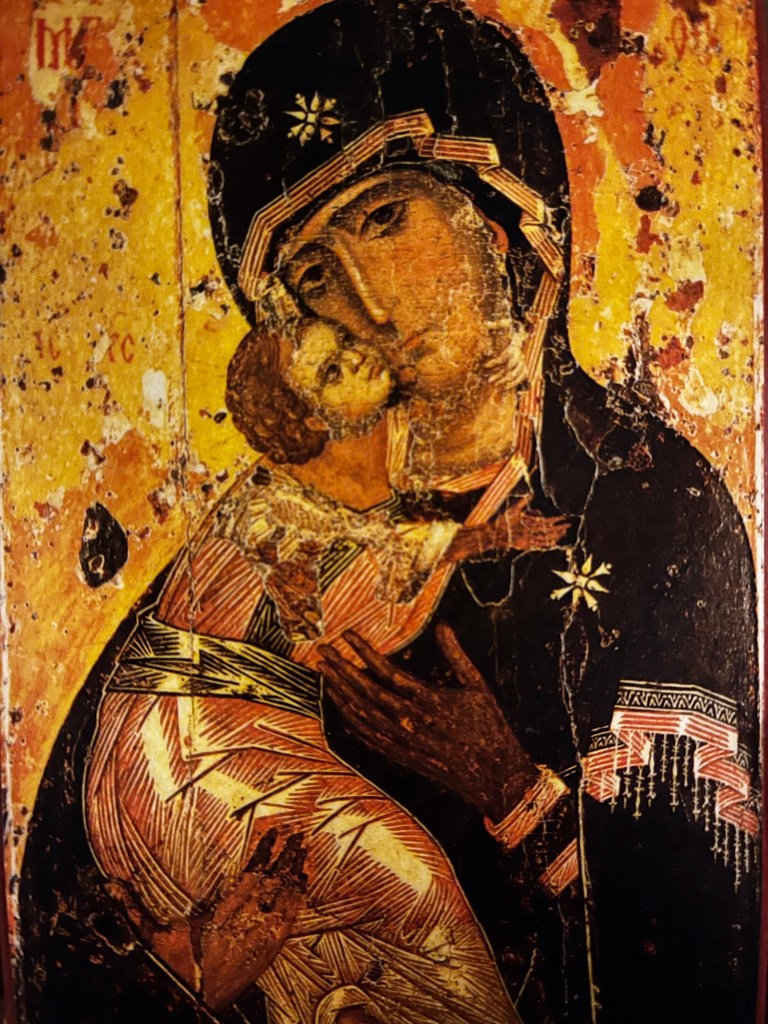
The ark of the covenant in the tabernacle and later in the temple was a box made of acacia wood overlaid with pure gold, and in it were all the signs and symbols of the old covenant: manna, staff, tablets. But the ark of the covenant in the Gospel is a young Jewish woman made of flesh and blood, and in her — in her womb — will reside all the fullness of the New Covenant, not in signs, but in the fulfillment of reality: manna no longer but the very bread of life himself, the one who will say of bread, “Take, eat, this is my body given for you”; the sign of the priesthood no longer but the Great High Priest himself, the one who sacrifices and the one who is himself the sacrifice; tablets of stone no longer but a new heart of flesh and spirit in which the very word of God beats and is made manifest — Jesus, Son of the Most High, heir of David, king forever over the house of Jacob, the holy one, the Son of God. And Mary is granted the unfathomable, the unparalleled, the singular honor of being the living, breathing ark of the new covenant who bears this treasure in her body, who yields not only room for the incarnation of the divine Logos, but who offers her very nature up to God so that the one to be born of her may be fully God and fully man, of one essence with the Father in his divinity and of one essence with Mary — with man — in his humanity.
As an ancient hymn of the Church bids us sing (Akathist Hymn to the Theotokos):
Rejoice, Tabernacle of God the Word.
Rejoice, Holy one, holier than the Holies.
Rejoice, Ark made golden by the Spirit.
Rejoice, inexhaustible Treasury of life.
The ark of the covenant in the tabernacle and later in the temple was a small thing, the size of a large Amazon box; you may well get Christmas presents bigger. But the ark of the covenant in the Gospel is at once both smaller than that and infinitely more expansive. As the Divine Liturgy of St. Basil the Great proclaims about Mary:
All of creation rejoices in you, O Full of Grace,
The assembly of Angels and the race of men.
O Sanctified Temple and Rational Paradise! O Glory of Virgins!
From you, God was incarnate and became a child, our God before the ages.
He made your body into a throne,
and your womb He made more spacious than the heavens.
The Creator of the Universe, the one by whom, through whom, and for whom all things were made, the one in whom all things consist, the source of all being, the Word of God who spoke the heavens into existence residing in the womb of Mary, the ark of the New Covenant. How extraordinarily spacious is her womb — more spacious than the heavens.
It is no wonder that we stand in wonder before this mystery. So did Mary herself.
34 And Mary said to the angel, “How will this be, since I am a virgin (Luke 1:34)?
In the face of such great mystery we often retreat to the mundane, to the practical, to that over which we have some degree of knowledge and perhaps even control. Conceive? But I am a virgin. How will this be? Mundane concerns. Practical questions. How-to knowledge.
35 And the angel answered her, “The Holy Spirit will come upon you, and the power of the Most High will overshadow you; therefore the child to be born will be called holy — the Son of God” (Luke 1:35).
This coming of the Holy Spirit upon Mary, this overshadowing by the power of the Most High, is the glory of God shrouding the ark and the Most Holy Place in Solomon’s temple so that not even the priests could minister in its presence, so that no man could stand in its presence. It is all happening again, this time in all its fullness. No man is needed to fill the ark of Mary’s womb, not even righteous Joseph, her lawful husband. The Holy Spirit overshadowed her. And though this comes a bit later in the story, no man can stand in the presence of this ark and the glory of God, not even the wise and the wealthy of this world:
11 And going into the house, they (magi — wisemen) saw the child with Mary his mother, and they fell down and worshiped him (Matt 2:11a).
They could not stand; they fell down and worshiped him. And shouldn’t that be our posture, as well, when contemplating the ark of the Gospel and the treasure it holds? We must bend the knees of our hearts and perhaps the knees of our bodies, as well — fall down and worship — because we simply cannot stand in the presence of such glory and wonder.
There is mystery and wonder, and, yes, paradox here. Ask any righteous Jew the meaning of the temple — from the Temple of Solomon to the second Temple — ask the prophet Isaiah, and this will be the answer: the temple is the meeting place between God and man, the intersection of heaven and earth. And the ark? It is the footstool of God, the earthly part of his throne where his train fills the temple (see Isaiah 6:1ff). The divine architecture of the Old Testament is perfectly rational: the smaller ark resides within the larger temple just as the smaller throne resides in the larger heavenly realm and intersects the earthly realm: the smaller within the larger. But not so in the great paradox of the Gospel. This baby, this holy one, is the meeting place of God and man, the perfect intersection of divinity and humanity in which God the Son takes unto his divine person our human nature. This baby, this holy one is the Temple. And in the glorious mystery of God, this temple takes up its residence in the ark of Mary’s womb — not the ark in the temple, but the temple in the ark, just the first of the many Gospel reversals to come.
Arise, O Lᴏʀᴅ, into your resting-place, *
you and the ark of your strength.
How did Mary respond to all this?
38 And Mary said, “Behold, I am the servant of the Lord; let it be to me according to your word.” And the angel departed from her (Luke 1:38).
I suspect that we sometimes read the account of the Annunciation as God’s invitation to Mary to participate — or to refuse to participate — in the Incarnation of the Lord. We figuratively and piously hold our breath waiting and hoping for her yes, for her fiat: let it be to me according to your word. But read the account again, sometime this day or sometime this season. It is not an invitation; it is a proclamation of what God will do — what God is even now doing — through Mary, his favored one, the one who is blessed among women, the one who is full of grace, his chosen Ark of the New Covenant. God does not wait for or need Mary’s yes in this moment because he has blessed her, because he has filled her with grace, because her life has become a yes, because she could no more bring herself to refuse this blessing than God could refuse to fulfill his covenant with Israel and through Israel with the world in and through this holy woman and this holy child. When Mary says to Gabriel, “Behold, I am the servant of the Lord; let it be to me according to your word,” it is more a statement of fact, this is who I am — it is more a summary of her entire life — this is who I was born to be — than it is a yes to this one particular moment. God was not worried that Mary would say, “No, thank you; I’d rather not.” God does not stand helpless before his creation in that, or in any, way. Could the tree say to the craftsman, “No, don’t make me into the ark?” No more could Mary say to Gabriel, “No, but thank you very much.”
Arise, O Lᴏʀᴅ, into your resting-place, *
you and the ark of your strength.
Yes, this is about what God is doing. God the Father, the Most High, is acting. God the Holy Spirit is being set loose in the world. God the Son is being made flesh to dwell among us. This is the answer not only to Mary’s question, How can this be?, but also the answer to Israel’s prayer and longing reflected in the psalm:
Arise, O Lᴏʀᴅ, into your resting-place, *
you and the ark of your strength.
This is the answer to creation’s groaning for release. This is the answer to Adam’s sin and the bondage of all his sons and daughters under sin and death and the fallen powers. As St. Mark writes, this is “the beginning of the gospel of Jesus Christ, the Son of God” (Mark 1:1). This is Jesus, the one who saves. This is Emmanuel — God with us — in the Ark of the New Covenant, in the ark of Mary’s womb. This is, after all, what the Gospel is: not first an invitation but the proclamation of what God is doing in and through Jesus Christ to redeem the world. Not a question, but the answer.
But, we must respond to the proclamation. Indifference is not an option, though many, tragically, seem to think it is. What is our proper response to all this? Perhaps the words of the psalm capture it best:
8 Arise, O Lᴏʀᴅ, into your resting-place, *
you and the ark of your strength.
9 Let your priests be clothed with righteousness, *
and let your saints sing with joy.
Amen.


 First Blessings