Anglican Church of the Redeemer
Formed Conference 2023: Male and Female in Christ
The Cruciform Shape of Gender:
Male and Female and the Cross of Christ
Following is a talk I presented at the Formed Conference 2023.
The Lord be with you.
And with your spirit.
Let us pray.
Both here and in all your churches throughout the whole world,
we adore you, O Christ, and we bless you,
because by your holy cross you have redeemed the world. Amen.
I like to begin presentations by lowering expectations; that way, I am less likely to dramatically disappoint. My contribution to this conference will be quite modest, not unimportant, I hope, but modest nonetheless. I am neither a sociologist nor a psychologist. I am neither a biologist nor a philosopher. I am a parish priest, and an assisting priest at that. I think and speak as a priest; so, primarily, I want to frame the context and character of the gender debate in which we find ourselves in terms of the great narrative of Scripture, which means in terms of the cross of Christ. It is a vast narrative that climaxes in the cross, but, it starts here:
Genesis 1:1–2 (ESV): 1 In the beginning, God created the heavens and the earth. 2 The earth was without form and void, and darkness was over the face of the deep. And the Spirit of God was hovering over the face of the waters.
The earth was without form and void; it was chaotic and empty. In the following six days of creation, God remedies those two deficits. God first creates order through separation and differentiation: light from darkness (day from night), the waters above from the waters below, the dry land from the seas. Then having established order on the first three days, God begins to fill the emptiness on the next three days: plants and fruit trees; sun, moon and stars; sea creatures, great and small, and all winged birds; livestock and creeping things and the beasts of the earth. On the sixth day, God creates man — humankind — male and female, and he calls them to a specific vocation:
Genesis 1:28 (ESV): 28 And God blessed them. And God said to them, “Be fruitful and multiply and fill the earth and subdue it, and have dominion over the fish of the sea and over the birds of the heavens and over every living thing that moves on the earth.”
As his image-bearing humans, man — male and female — are to continue God’s work of bringing order out of chaos (subdue, have dominion) and of filling the emptiness with life (be fruitful, multiply). This account of creation in Genesis 1 emphasizes the mutuality of male and female in the human vocation.
Genesis 2 adds detail to our understanding of the creation and vocation of man. In this account, God creates the male, Adam, first and specifically assigns to him one part of the human vocation:
Genesis 2:15 (ESV): 15 The Lord God took the man and put him in the garden of Eden to work it and keep it.
This is the task of bringing order (work it) and defending order (keep it). This is the uniquely male aspect of the human vocation. Missing from this is the mandate to be fruitful and multiply, because there is, as yet, no helper — no mate — fit for Adam.
To emphasize both Adam’s role in the ordering of creation and his inability to fill the emptiness with human life, God next brings the animals to Adam to be named, to be placed in their proper order in creation. All the animals have mates fit for them, but Adam does not.
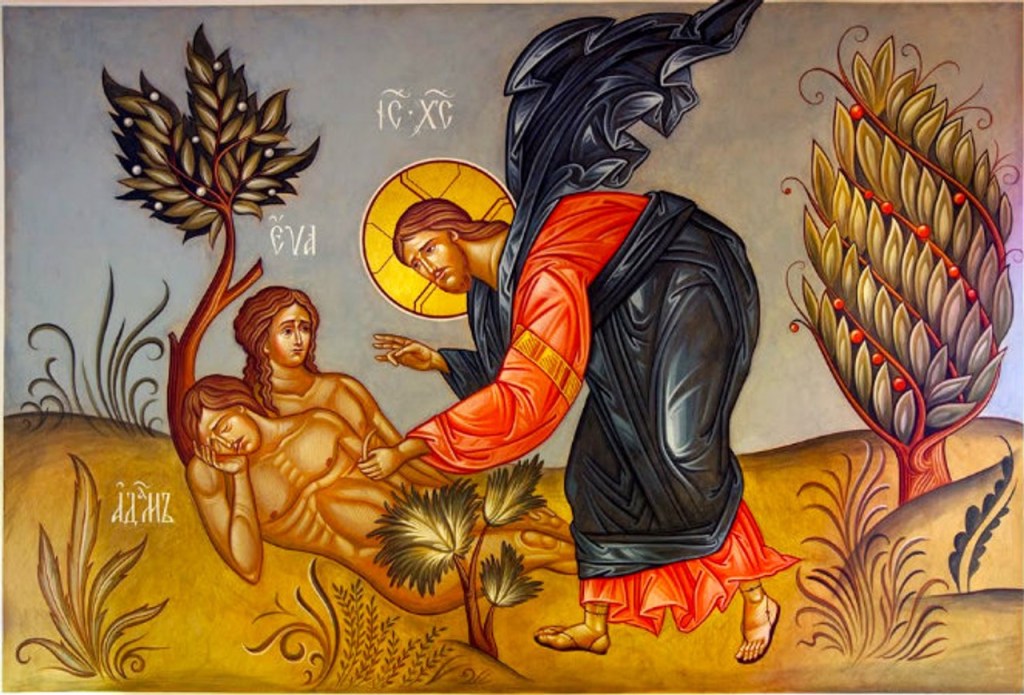
Genesis 2:20–25 (ESV): . 21 So the Lord God caused a deep sleep to fall upon the man, and while he slept took one of his ribs and closed up its place with flesh. 22 And the rib that the Lord God had taken from the man he made into a woman and brought her to the man. 23 Then the man said,
“This at last is bone of my bones
and flesh of my flesh;
she shall be called Woman,
because she was taken out of Man.”
24 Therefore a man shall leave his father and his mother and hold fast to his wife, and they shall become one flesh. 25 And the man and his wife were both naked and were not ashamed.
Notice that Adam — the man, ish in Hebrew — names the woman, ishshah, giving the human species an order also. Together, man and woman can now fulfill the entire human vocation of ordering, subduing, and filling. Man and woman were made for one another — bone of bone and flesh of flesh — and designed for mutuality and intimacy; they were naked and were not ashamed.
The relationship between man and woman is, by God’s design, non-competitive (rf Gen 2:18), interdependent (rf 1 Cor 11:11-12), and vocationally ordered (rf 1 Cor 11:3).
In that, it is an icon of the relationship among the persons of the Trinity. The persons of man and woman are of one bone and flesh. The persons of the Trinity are consubstantial, of one substance/essence. And though, in marriage, male and female become one flesh in a unique spiritual and physical relationship, yet they do not lose their individual identities nor are they made interchangeable. Similarly, Father, Son, and Holy Spirit are one in essence, yet they remain three persons and are not interchangeable. There is a vocational order in both relationships, human and divine, as St. Paul writes:
1 Corinthians 11:3 (ESV): 3 But I want you to understand that the head of every man is Christ, the head of a wife is her husband, and the head of Christ is God.
This is God’s iconic, anthropological intent as manifested in creation: the relationship between man and woman is, by God’s design, non-competitive, interdependent, and vocationally ordered. This relationship was God-ordained and was intended for the fulfillment of the human vocation and for the flourishing of both man and woman and of all creation. Apart from that relationship, we cannot effectively accomplish God’s will, nor can we flourish independently or relationally.
To say that the male-female relationship is vocationally ordered is not to imply a hierarchy of worth or importance. The divine relationship is eternally ordered. Who is worth more, the Father or the Son? Who is more important, the Son or the Holy Spirit? These are nonsense questions, because order is not about worth or importance. Order addresses proper place and function within a matrix of relationships, each person fulfilling a unique and irreplaceable purpose within God’s creation, exercising those gifts given by God for the people of God.
How long this non-competitive, interdependent, vocationally ordered relationship continued we do not know, but there are hints early in Genesis 3 that all was not well in the male-female relationship even before the actual act of disobedience.
Genesis 3:1–6 (ESV): 3 Now the serpent was more crafty than any other beast of the field that the Lord God had made.
He said to the woman, “Did God actually say, ‘You shall not eat of any tree in the garden’?” 2 And the woman said to the serpent, “We may eat of the fruit of the trees in the garden, 3 but God said, ‘You shall not eat of the fruit of the tree that is in the midst of the garden, neither shall you touch it, lest you die.’ ” 4 But the serpent said to the woman, “You will not surely die. 5 For God knows that when you eat of it your eyes will be opened, and you will be like God, knowing good and evil.” 6 So when the woman saw that the tree was good for food, and that it was a delight to the eyes, and that the tree was to be desired to make one wise, she took of its fruit and ate, and she also gave some to her husband who was with her, and he ate.
This text raises many questions about the prelapsarian male-female relationship.
Where was the man during the woman’s conversation with the serpent?
Why was the man not exercising dominion over the serpent?
Why was he not keeping (protecting) the woman and the garden?
Why does the man, who was given the vocation of working and keeping the garden, appear totally passive?
Why was the woman taking the initiative in this conversation and acting independently of the man?
The non-competitive, interdependent, vocationally ordered relationship seems already disjoint, already disordered, which might even be seen as the precursor of the great disobedience. The man yields dominion and forsakes responsibility. The woman ceases to be helper and becomes tempter.
And, what are the consequences of disobedience?
• Shame before one another and before God.
• Blame — the woman blaming the serpent and the man blaming the woman and, by implication, blaming God.
• Competition and struggle for dominance:
Genesis 3:16 (ESV): 16 To the woman (God) said,
“I will surely multiply your pain in childbearing;
in pain you shall bring forth children.
Your desire shall be against ( alternate reading) your husband,
but he shall rule over you.”
• Unproductive toil.
• Exile and death.
The non-competitive, interdependent, vocationally ordered relationship between man and woman is a casualty of the fall, replaced with shame, blame, a struggle for dominance, a war of independence, and chaos. That is what it means to be “male and female” in the aftermath of the fall. Insisting on this way to be male and female does not promote human flourishing, does not fulfill the human vocation to tend and keep creation, and does not glorify God.
Insisting on that way of being male and female distorts anthropology — and even biology — to the extent that our culture can no longer even define male or female or else considers male and female to be optional endpoints of a gender spectrum along which one is free to move at will.
Insisting on that way of being male and female distorts sociology by separating people into oppressor and oppressed groups with one group exercising coercive power to retain dominance and the other group exercising coercive victimization to tip the scales and achieve dominance.
Insisting on that way of being male and female distorts theology by rejecting the revealed created order in favor of culturally conditioned, distorted reason and postmodern philosophy.
How might St. Paul respond to this muddle? His words to the church at Colossae seem pertinent:
Colossians 2:8–9 (ESV): 8 See to it that no one takes you captive by philosophy and empty deceit, according to human tradition, according to the elemental spirits of the world, and not according to Christ. 9 For in him the whole fullness of deity dwells bodily.
The prevailing narratives and philosophies of our culture – the elemental spirits of this world — offer no healing for the disordered male and female relationship: no way forward to human flourishing, no opportunity to image God into the world, no means of fulfilling the human vocation. But, the Gospel offers all this and more. Hear St. Paul again, this time to the churches of Galatia:
Galatians 3:26–28 (ESV): …for in Christ Jesus you are all sons of God, through faith. 27 For as many of you as were baptized into Christ have put on Christ. 28 There is neither Jew nor Greek, there is neither slave nor free, there is no male and female, for you are all one in Christ Jesus.
Notice carefully what St. Paul says: In Christ, there is neither Jew nor Greek, there is neither slave nor free, there is no male and female. From the the call of Abram on, there was a covenantal separation between Jew and Greek. From the beginning of societies, there was a sociological and political separation between slave and free. In Christ, those separations are ended: neither Jew nor Greek, neither slave nor free. But, from creation, God intended the relationship between male and female to be and not or: to be non-competitive, interdependent, and vocationally ordered — not a separation, but an ordered harmony. It is the fall that distorted that relationship and made of male and female a struggle for dominance, a chaotic muddle in which the very meaning of male and female is uncertain, a fierce war of independence that pits male and female against one another. But, not in Christ. In Christ there is no longer male and female in that fallen state. St. Paul is not abolishing sexual differentiation. He is not making male and female indistinguishable and interchangeable. Rather he is insisting that the fallen, disordered, competitive male and female relationship characterized by shame, blame, struggle, desire, dominance, and opposition has been healed by Christ and must no longer exist in the Church. He is insisting that through the cross male and female have, in Christ, returned to the non-competitive, interdependent, vocationally ordered relationship as it was in the beginning.
The debate about what it means to be male and female — the debate within the Church and in the broader culture — has no other resolution than Christ and him crucified. Our culture stokes division and that division and strife infiltrate the church. And how did St. Paul address division in the church, deep division in the Corinthian Church?
1 Corinthians 2:1–5 (ESV): 2 And I, when I came to you, brothers, did not come proclaiming to you the testimony of God with lofty speech or wisdom. 2 For I decided to know nothing among you except Jesus Christ and him crucified. 3 And I was with you in weakness and in fear and much trembling, 4 and my speech and my message were not in plausible words of wisdom, but in demonstration of the Spirit and of power, 5 so that your faith might not rest in the wisdom of men but in the power of God.
Not the wisdom of men — not philosophy or the latest social theory — but Jesus Christ and him crucified. Not lofty speech or plausible words, but Jesus Christ and him crucified. And that is the conviction I bring and the whole of what I have to offer to this conference: that we must plant the cross of Christ firmly — immovably — in the center of this muddled, heated, divisive issue of male and female and there at the cross take our stand, knowing nothing but Jesus Christ and him crucified. The cross of Jesus Christ is the power of God unto reconciliation: the reconciliation of man to God, yes, but also the reconciliation of male and female.
The whole of the Old Testament leads up to the cross. The Gospels present the cross. The Epistles flow from the cross as the economia — the pastoral dispensation or working out — of the cross. The great Tradition of the Church enshrines the cross as its very reason for being. When we stand with the Scriptures and the Tradition, we stand at the cross. When we know the Scriptures and the Tradition, we know Jesus Christ and him crucified.
But, knowing Jesus Christ and him crucified also means knowing and having the mind of Christ that led him to embrace the cross:
Philippians 2:1–8 (ESV): 2 So if there is any encouragement in Christ, any comfort from love, any participation in the Spirit, any affection and sympathy, 2 complete my joy by being of the same mind, having the same love, being in full accord and of one mind. 3 Do nothing from selfish ambition or conceit, but in humility count others more significant than yourselves. 4 Let each of you look not only to his own interests, but also to the interests of others. 5 Have this mind among yourselves, which is yours in Christ Jesus, 6 who, though he was in the form of God, did not count equality with God a thing to be grasped, 7 but emptied himself, by taking the form of a servant, being born in the likeness of men. 8 And being found in human form, he humbled himself by becoming obedient to the point of death, even death on a cross.
In Jesus Christ and him crucified, there is no fallen male and female but rather a return to the non-competitive, interdependent, vocationally ordered relationship manifest in God’s creative act and the human vocation, revealed in Scripture, worked out and preserved in the great Tradition, and expressed most fully in the mind of Christ through humility, love, and obedience.


 First Blessings
This is excellent. Thank you.