CONFIRMATION: Session 2 — Authority (Scripture, Creeds, Councils, Bishops)

APOSTLES ANGLICAN CHURCH
Fr. John A. Roop

Christian Essentials / Anglican Distinctives
Session 2: Authority — Scripture, Creeds, Councils, Bishops

The Lord be with you.
And with your spirit.

Let us pray.

For A Province Or Diocese
O God, by your grace you have called us in this Province and Diocese to be a good and godly fellowship of faith. Bless our Archbishop and Bishop Foley, our Assisting Bishop Frank, and other clergy, and all our people. Grant that your Word may be truly preached and truly heard, your Sacraments faithfully administered and faithfully received. By your Spirit, fashion our lives according to the example of your Son, and grant that we may show the power of your love to all among whom we live; through Jesus Christ our Lord. Amen.

Introduction: The Question of Authority
One of the most notable characteristics of this post-modern culture in which we live is the distrust and rejection of, and even the rebellion against authority. This was clearly manifest on 6 January 2022 in the assault on the Capitol, in recent calls to defund the police, in the suspicion directed toward the Supreme Court, in distrust of news outlets — essentially everywhere we turn. The older structures that used to speak truth to us, that used to rightly order our lives we now suspect of manipulative propaganda — we don’t know where to look for truth — and rampant self-interest at our expense. Educational systems seem to deconstruct truth more than search for it and teach it. Political systems seem more engaged in internal struggles for power than in right governing and public service. Our judiciary and legal systems seem to fail as often as not to impartially administer justice. Our churches seem rife with scandal, false doctrine, and cultural pandering. It may always have been so in every generation, more or less. This is neither the best of times nor the worst of times; it is simply our time, and we see its flaws because they affect us.

Still, the question confronts us as it does those in every generation: what are the reliable sources of truth and authority? How do we know what to believe and how to rightly order our lives, and to whose authority we may/must rightly submit? These question arise not only in regard to civil society but also pertaining to matters of the spirit.

As Anglicans, we have answers for those questions. The Fundamental Declarations of the Province answer them, in part for our Province (ACNA).

ACNA Fundamental Declarations of the Province

We believe and confess Jesus Christ to be the Way, the Truth, and the Life: no one comes to the Father but by Him. Therefore, the Anglican Church in North America identifies the following seven elements as characteristic of the Anglican Way, and essential for membership:

1. We confess the canonical books of the Old and New Testaments to be the inspired Word of God, containing all things necessary for salvation, and to be the final authority and unchangeable standard for Christian faith and life.

2. We confess Baptism and the Supper of the Lord to be Sacraments ordained by Christ Himself in the Gospel, and thus to be ministered with unfailing use of His words of institution and of the elements ordained by Him.

3. We confess the godly historic Episcopate as an inherent part of the apostolic faith and practice, and therefore as integral to the fullness and unity of the Body of Christ.

4. We confess as proved by most certain warrants of Holy Scripture the historic faith of the undivided church as declared in the three Catholic Creeds: the Apostles’, the Nicene, and the Athanasian.

5. Concerning the seven Councils of the undivided Church, we affirm the teaching of the first four Councils and the Christological clarifications of the fifth, sixth and seventh Councils, in so far as they are agreeable to the Holy Scriptures.

6. We receive The Book of Common Prayer as set forth by the Church of England in 1662, together with the Ordinal attached to the same, as a standard for Anglican doctrine and discipline, and, with the Books which preceded it, as the standard for the Anglican tradition of worship.

7. We receive the Thirty-Nine Articles of Religion of 1562, taken in their literal and grammatical sense, as expressing the Anglican response to certain doctrinal issues controverted at that time, and as expressing the fundamental principles of authentic Anglican belief.

In all these things, the Anglican Church in North America is determined by the help of God to hold and maintain as the Anglican Way has received them the doctrine, discipline and worship of Christ.

So, back to our questions. Based on the Fundamental Declarations, what are the reliable sources of truth and authority in the Christian life? How do we know what to believe and how to rightly order our lives, and to whose authority we may/must rightly submit? [Let the class examine the Fundamental Declarations and discuss the answers they provide.]

Holy Scripture
Holy Scripture is the final authority and unchangeable standard for Christian faith and life. Even as we say that, it must be nuanced in light of Jesus’ own claim:

Matthew 28:18 (ESV): 18 And Jesus came and said to [the disciples], “All authority in heaven and on earth has been given to me.

So, when we say that Holy Scripture is the final authority we don’t mean that Scripture has an authority independent of or superseding Christ’s authority. Instead we mean that Jesus’ ultimate authority over all things is mediated to the Church in and through the Scriptures. Scripture is one way — orthodox Anglicans go so far as to say it is the primary way — in which Christ exercises his authority in the world.

The ACNA Catechism, To Be A Christian (TBAC), expands on this notion in a series of questions and answers.

[Review To Be A Christian, Questions 25-35, pages 32-35.]

The Reformed Churches are known for their insistence upon five sola statements: sola scriptura, sola gratia, sola fides, solus Christus, soli Deo gloria. It is the first of these — sola scriptura, Scripture alone, that concerns us here. In its popular connotation, this statement is often misconstrued as a “me and my Bible” attitude. I don’t need anyone else to tell me what to believe; I can sit down by myself — just me and my Bible — and understand everything perfectly well myself. I don’t think that is what sola scriptura actually meant historically because that is not how the Reformers actually dealt with Scripture. And that is certainly not the Anglican approach to Scripture; it is, instead, a recipe for disaster — every man a pope, every man his own infallible spiritual authority. The Bible was not given first to individuals, but to the Church, to the Body of Christ, and it is in and through the Church that the Holy Spirit works to lead all God’s people into right understanding of Scripture. The Church — not the academy and not even the private study — is the “natural habitat” of Scripture. St. Paul codifies this understanding in his first letter to Timothy:

1 Timothy 3:14–15 (ESV): 14 I hope to come to you soon, but I am writing these things to you so that, 15 if I delay, you may know how one ought to behave in the household of God, which is the church of the living God, a pillar and buttress of the truth.

St. Paul is not pitting the Church against Scripture or Scripture against the Church: far from it! Rather, the Church is the living expression of the deposit of faith found in Scripture, the most reliable interpreter of that faith, the body in which Scriptural faith comes to life.

In centering Scripture in the Church, I am not saying that individuals should not read and study the Bible individually, personally! God forbid: let us be people of the Word. Personal engagement with Scripture is essential for spiritual growth. But, I am saying that our individual understanding of Scripture must be submitted to the Church, to the Great Tradition of the one, holy, catholic, and Apostolic Church, that we must exercise some humility and that we must not insist on our own, idiosyncratic interpretations of Scripture over the consensus fidelium, the consensus of the faithful for over two millennia. To say, “I know what the Church teaches, but I read the Scripture differently,” to persist in that attitude when corrected, and to encourage others to follow your personal understanding is the definition of heretic.

The authority in all things belongs to Christ. He mediates that authority in and through Scripture which contains all things necessary for salvation and which is the unchangeable standard for Christian faith and life. Scripture is to be read and understood consensually, that is, by the whole Church.

This consensual understanding of Scripture — Scripture read in and by the Church — means that the Church is also an instrument through which Christ mediates his authority. That is also emphasized in the Fundamental Declarations which confess the Creeds, affirm the Councils, and confess the godly, historic Episcopacy. Creeds, Councils, and Bishops speak for the Church and so exercise a delegated authority within the Church.

Creeds
What are the Creeds and what role do they play in the life and faith of the Church? The ACNA Catechism (TBAC) provides a good, brief answer. See Part II, The Apostles Creed And The Life Of Faith, pages 29-32.

Think of the Creeds as the “Cliff Notes” summary of the Gospel. They do not contain everything that is essential for the life of faith and Christian practice, but everything they do contain is essential for the life of faith and Christian practice. Only those who can affirm them in their entirety have embraced the non-negotiable essentials of the faith delivered once for all to the saints and are ready for baptism and full participation in the life of the Church.

The Creeds serve another function, as well; they provide a lens through which the Church reads and understands Scripture. For example, the Athanasian Creed details the way the Church understands and expresses the reality of the Trinity and the dual nature of Christ (fully God and fully man). The Church, guided by the Holy Spirit, discerned that this is the proper and authoritative way to read and understand the Scriptures as they reveal to us the Triune God and the incarnate Logos. In this sense, rejection of the Creeds is a rejection of Scripture as understood consensually by the Church. This notion brings us naturally to the topic of consensual understanding and the Councils of the Church.

Ecumenical Church Councils
From time to time there are issues that arise in the life of the Church that are not explicitly addressed in Scripture, or that are perhaps addressed only obliquely. One group within the Church may read Scripture in a way that conflicts with others in the Church; each group is trying to be faithful to Scripture, but it is not perfectly clear what faithfulness looks like. We have examples of this in Scripture itself, the classic one being the inclusion of the Gentiles, as Gentiles, in the Church. Paul and Barnabas read Scripture and discerned the direction of the Holy Spirit toward inclusion of the Gentiles without their prior conversion to Judaism and without imposing upon them the keeping of the Mosaic Law. Other leaders in the Church read Scripture differently. To them, Jesus was the Messiah of Israel; to follow Jesus required identification first with Israel, i.e., converting to Judaism and faithfully observing the Law. How was the Church to determine which group, which reading of Scripture, was correct?

We find the answer in Acts 15. The apostles and the elders of the Church came together in council in Jerusalem, under the auspices of James, the bishop of the Jerusalem church, to listen to one another, to read Scripture together, to pray together, to listen to the Holy Spirit together, and to decide together the proper way forward for the Church. This was the first of the Church’s councils, and it served as the model for Church-wide discernment for a thousand years. When important decisions had to be made regarding the faith and practice of the Church, leaders of the Church from throughout the world assembled to listen to one another, to search the Scriptures, to pray, to discern the movement of the Holy Spirit, and to decide the issue on behalf of the whole Church. When the council spoke, it spoke with authority for the Church.

There were seven such councils of the whole Church. Anglicans recognize them as a valid source of authority with a certain caveat, according to the Fundamental Declarations:

Concerning the seven Councils of the undivided Church, we affirm the teaching of the first four Councils and the Christological clarifications of the fifth, sixth and seventh Councils, in so far as they are agreeable to the Holy Scriptures.

There are several important features of this affirmation. First, we embrace only the Councils of the undivided Church, when East and West were one, before the Great Schism of 1054. That is the period when the Councils spoke for the universal Church. Second, we affirm fully only the first four of these Councils. These are the ones which defined and clarified the essential dogmas of the Church:

Nicea (325)
Christ is one being with the Father and co-eternal.

Constantinople (381)
The Holy Spirit is the third person of the Trinity, of one being and co-eternal with the Father and the Son. It was this council that gave the final form to the Nicene Creed, which accordingly is more precisely called the Niceno-Constantinopolitan Creed.

Ephesus (431)
Mary is rightly called the Theotokos (God bearer) since Jesus is God incarnate from conception. (This has less to do with Mary and more to do with Jesus. It insists that Jesus was fully God from conception as opposed to such heresies as adoptionism which insists that Mary bore only a human person who was later filled with the Spirit of Sonship — adopted — by God. To insist that Jesus was fully God and fully man from conception implies that Mary bore God in her womb, thus rightly bestowing on her the title Theotokos, God bearer.)

Chalcedon (451)
Christ is one person with two natures — fully human and fully divine — and those two natures are neither separated nor confused.

The fifth, sixth, and seventh Councils are different in nature than these first four. They provide detail and clarification of the four, and defend them against some heretical interpretations. We affirm those Christological clarifications. But they also range into political matters and matters of church practice that we have determined is more appropriately left to local discretion. We affirm the first four Councils fully, and the fifth, sixth, and seventh insofar as they shed additional light upon the essential dogmatic statements made previously, and insofar as they are agreeable to the Holy Scriptures.

Bishops
Tragically, the Church split along an East-West line in 1054, creating the Orthodox Church and the Roman Catholic Church, and fractured again during and after the Reformation. That makes the convening of an Ecumenical Council impossible. So, how do churches make important doctrinal and liturgical decisions today? How do we, as Anglicans, do it? What is the ongoing source of authority in the life of the church, acting under Scripture, Creeds, and Councils? The answer is found in the third of the Fundamental Declarations:

We confess the godly historic Episcopate [Bishops] as an inherent part of the apostolic faith and practice, and therefore as integral to the fullness and unity of the Body of Christ.

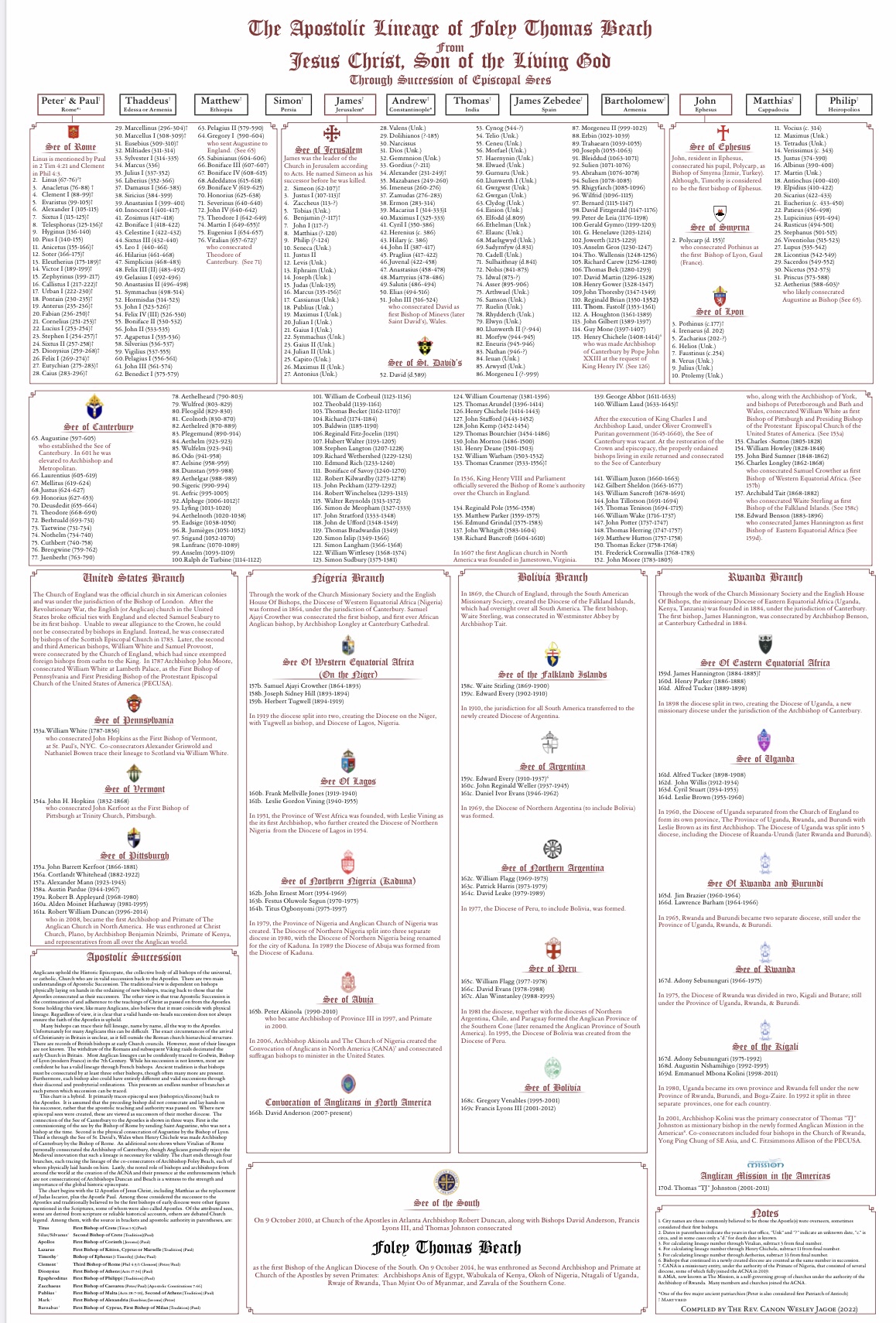
Jesus gave the Apostles certain authority in the Church, empowering them, for example, to forgive sins or to withhold forgiveness of sins and to bind on earth or to loose on earth (ref Mt 16:19 and John 20:22). Since the mission of the Church extended beyond the life of the Twelve, the role they played in the life of the Church needed to extend, as well. Thus, the Apostles appointed/ordained bishops through prayer and the laying on of hands to succeed them in their apostolic ministry. The bishops are to today’s church as the Apostles were to the first-century church. This doctrine and practice is often referred to as Apostolic Succession. Each bishop in the ACNA is able to trace his spiritual lineage directly and in an unbroken line to one or more of the Apostles. That means, of course, that each priest and deacon can, as well, since priests and deacons are ordained by Bishops. [As an aside, Archbishop Foley’s apostolic lineage, and thus mine since he ordained me to the priesthood, has been traced back to Peter, James, John, and Paul.]

But, Apostolic Succession means more than laying on of hands in ordination. It means fidelity to the Apostolic witness, passing on faithfully and fully that deposit of Apostolic faith received in and through Scriptures, Creeds, Councils, and the Church.

In the ACNA, the College of Bishops, i.e., the Bishops from every diocese meeting together, make decisions pertaining to the entire Province — to all the dioceses and parishes comprising the Province.

For decisions that affect only a particular dioceses, the Ordinary — the bishop of that diocese — convenes a synod, a gathering of all clergy and elected/appointed lay delegates from each parish to reach a decision through prayer, study of Scripture, listening, and voting. Our diocese, the Anglican Diocese of the South, has an annual synod in November.

Conclusion: The Question of Authority
So, what are the reliable sources of truth and authority in the Anglican Church? First, we note that all authority lies in and with Jesus Christ; it was given to him by God the Father. But, Jesus, through the work and indwelling presence of his Holy Spirit, ministers that authority in several ways: Scripture, Creeds, Councils, and Bishops.

Posted in Uncategorized | Tagged , | Leave a comment

CONFIRMATION: Session 2 — Handout

ACNA Fundamental Declarations of the Province

We believe and confess Jesus Christ to be the Way, the Truth, and the Life: no one comes to the Father but by Him. Therefore, the Anglican Church in North America identifies the following seven elements as characteristic of the Anglican Way, and essential for membership:

1. We confess the canonical books of the Old and New Testaments to be the inspired Word of God, containing all things necessary for salvation, and to be the final authority and unchangeable standard for Christian faith and life.

2. We confess Baptism and the Supper of the Lord to be Sacraments ordained by Christ Himself in the Gospel, and thus to be ministered with unfailing use of His words of institution and of the elements ordained by Him.

3. We confess the godly historic Episcopate as an inherent part of the apostolic faith and practice, and therefore as integral to the fullness and unity of the Body of Christ.

4. We confess as proved by most certain warrants of Holy Scripture the historic faith of the undivided church as declared in the three Catholic Creeds: the Apostles’, the Nicene, and the Athanasian.

5. Concerning the seven Councils of the undivided Church, we affirm the teaching of the first four Councils and the Christological clarifications of the fifth, sixth and seventh Councils, in so far as they are agreeable to the Holy Scriptures.

6. We receive The Book of Common Prayer as set forth by the Church of England in 1662, together with the Ordinal attached to the same, as a standard for Anglican doctrine and discipline, and, with the Books which preceded it, as the standard for the Anglican tradition of worship.

7. We receive the Thirty-Nine Articles of Religion of 1562, taken in their literal and grammatical sense, as expressing the Anglican response to certain doctrinal issues controverted at that time, and as expressing the fundamental principles of authentic Anglican belief.

In all these things, the Anglican Church in North America is determined by the help of God to hold and maintain as the Anglican Way has received them the doctrine, discipline and worship of Christ.

Posted in Uncategorized | Tagged , | Leave a comment

CONFIRMATION: Session 1 — Anglican Identity

APOSTLES ANGLICAN CHURCH
Fr. John A. Roop

Christian Essentials / Anglican Distinctives

Session 1: Anglican Identity

The Lord be with you.
And with your spirit.

Let us pray.

A Prayer of Self-Dedication
Almighty and eternal God, so draw our hearts to you, so guide our minds, so fill our imaginations, so control our wills, that we may be wholly yours, utterly dedicated to you; and then use us, we pray, as you will, and always to your glory and the welfare of your people; through our Lord and Savior Jesus Christ. Amen.

Introduction: An Exploration of Anglican Identity

Who are we as Anglicans? While that would seem to be a simple question, it is, in reality, anything but simple. We are a diverse group in terms of nationality, culture, and expressions of faith. But, we are held together by historical bonds of association and affection, by common prayer and worship, and, until recently, by a common understanding of the essentials of our faith.

So, out of this complex question, we will look at three areas of Anglican Identity: (1) the historical development of Anglicanism and the Anglican Communion, (2) the ecclesial structure and hierarchy of the Anglican Church in North America (ACNA), the province to which we belong, and (3) the ethos — the character, the spirit — of the ACNA.

History

The Church in England and The Anglican Communion: Historical Considerations

Let’s begin with a “trick” question: Where, when, and by whom did the Anglican Church originate? I know that the most obvious answer is (1) in England, (2) in the early 16th century, (3) by Henry VIII, but that is not actually the case — at least not fully the case.

The Church in England began in Galilee sometime around 33 AD by the authority of Jesus Christ.

16Now the eleven disciples went to Galilee, to the mountain to which Jesus had directed them. 17And when they saw him they worshiped him, but some doubted. 18And Jesus came and said to them, “All authority in heaven and on earth has been given to me. 19Go therefore and make disciples of all nations, baptizing them in the name of the Father and of the Son and of the Holy Spirit, 20teaching them to observe all that I have commanded you. And behold, I am with you always, to the end of the age (Mt 28:16-20).

This, the Great Commission, is where Anglican identity starts, because it is where the mission of the one, holy, catholic and Apostolic church starts. There is only one Church with many expressions of the Church’s common faith. I will, from time to time, refer to this common faith as the Great or Catholic Tradition, where Catholic simple means universal. Anglicans are and always have been part of the one, Holy, Catholic, and Apostolic Church. From Jesus’ ascension the apostles and disciples tarried in Jerusalem for ten more days until, on Pentecost, they received the power of the indwelling Holy Spirit to accomplish this mission. Then, they began to make disciples – to baptize and to teach – first in Jerusalem, then in Judea and Samaria, and then to the uttermost parts of the world. Thomas headed east, carrying the Gospel to India. Mark went southwest to Egypt where he founded a thriving and influential Christian community in Alexandria, a community that produced some of the greatest theologians in the early church. Paul went – well, Paul went everywhere throughout Asia Minor, into Europe, and perhaps as far west as Spain. Tradition tells us that both he and Peter were martyred in Rome around 65 AD. The Roman church gained a particular prominence, as did its bishops in succession after Peter, due to its association with both Peter and Paul. The relationship between the church at Rome and other prominent historic churches – Jerusalem, Antioch, Alexandria, and Constantinople – is best described as “first among equals.” Historically, the Bishop of Rome had a position of honor, but no more or less authority than any other bishop. That the Bishop of Rome began later to claim such authority over other bishops was one major factor leading to the Great Schism (1054) between the Eastern and Western Churches, the first major division in Christendom.

It wasn’t just the Apostles who carried the Gospel throughout the world; the word was spread naturally and organically by those who had received it. It accompanied soldiers on their marches and travelers on their journeys, and it was carried by merchants along with their wares. The history of this “ordinary” evangelism was not recorded, so we usually have no details of precisely when and how the Gospel reached a particular region or people. Britain is a case in point. Was it Roman soldiers or tin merchants who brought the Gospel to the isles? And, when was Christ first preached there? We simply do not know. But, we do have some notion of when the faith arrived in Britain.

The Church in Britain

Some church fathers and historians claim a very early arrival of the church in Britain. In his defense of the faith, Tertullian (d. 222) writes:

The extremities of Spain, the various parts of Gaul, the regions of Britain which have never been penetrated by Roman arms have received the religion of Christ.

Eusebius, a 4th century church historian, even claims apostolic evangelization of Britain:

The Apostles passed beyond the ocean to the isles called the Britannic Isles (Demonstratio Evangelica).

Perhaps. But what we can say with certainty is that the church was well established in England by 314. In that year, at the Emperor Constantine’s directive, representatives of the Church met in the town of Arles to address the heresy of Donatism. Documents from the council record the presence of three British bishops: Eborius of York, Restitutus of London, and Adelphius, whose episcopal see is uncertain. If there were British bishops, there were British clergy and churches. While the church was present in Britain at this time, it was not widespread in geographical scope or influence, both of which waxed and waned for centuries, almost disappearing entirely during the Saxon conquest (5th-6th centuries).

Synod of Whitby: Roman Jurisdiction

What follows is an abbreviated and simplified summary of English church history; volumes have been written if you are interested. But, for our purposes, this abstract should suffice.

By the 7th century, there were two distinct forms of Christianity practiced in the British kingdom of Northumbria: Celtic and Roman. Celtic Christianity entered the kingdom through the Abbey of Iona – an abbey founded on the Scottish island of Iona by the Irish monk Columba. Roman Christianity was likely introduced by missionaries sent by Pope Gregory the Great expressly to convert the Anglo-Saxons. There were differences in these two forms of the faith in such areas as organization and liturgy: Celtic Christianity was ordered around a monastic model governed by abbots and monks while Roman Christianity was governed hierarchically by Pope (the Bishop of Rome), bishops, and priests. The liturgies and calendar the two forms used varied somewhat – particularly calculations of the date for Easter. They shared one, common faith – the faith once for all delivered to the saints, as Jude writes – but they expressed it in different forms and with different governing structures.

Each form cycled into and out of dominance at the preference of successive kings, and tension between them grew. In 664, King Oswiu of Northumbria convened a synod at Whitby – a gathering of officials from both the Celtic and Roman churches – to determine which form of Christianity his kingdom would practice. Each side presented its case. Ultimately King Oswiu decided in favor of Roman practice, based largely upon Peter’s position as chief of the Apostles and his association with the church at Rome. At this point, the church in Britain came under the jurisdiction of the Roman Catholic Church.

Anglican History Summary

Why bother with all this history? Two important points emerge from it that shape our Anglican identity. First, there was a church in Britain, in England – part of the one, holy, catholic, and Apostolic Church established by Christ and built through the mission of the Apostles and their successors – before that church was under the jurisdiction of Rome; there was nothing essentially Roman about the English church. Second, coming under the jurisdiction of Rome was a political decision made by the King of Northumbria. The decision could have been otherwise, favoring the Celtic church.

The English Church and the Reformation

Let’s now fast-forward some eight centuries. By the 15th century a reformation movement was growing in some quarters of the Roman Catholic Church. The fundamental conviction of this movement and those who led it was that through the years the Roman Church had departed in some significant ways from the purity of the Apostolic faith and had added to the faith doctrines, as necessary for salvation, that could not be found in or proved by Scripture. Some of the main differences between Roman doctrine and the growing convictions of the reformers can be found in The Thirty Nine Articles of Religion in the Book of Common Prayer.

So, the movement to reform the Roman Church grew, initiated and led by men such as Jan Hus, John Wycliffe, Martin Luther, John Calvin, and Huldrych Zwingli. Each of these men and their respective groups differed in particulars, but they were united in their desire to return to the purity of the Gospel message of salvation by grace through faith – and not of works. They were united in their emphasis on the centrality of the Word of God, the Scriptures, and upon its central, essential, and authoritative role in establishing doctrine and governing the Church.

England had its own reformation underway – partly political and partly religious. You probably know the politics: Henry VIII needed a male heir to continue his dynasty and his wife, Catherine of Aragon, was apparently unable to produce a son. Henry needed an annulment which could be granted only by the Pope – the Bishop of Rome. To Henry, this was a political matter of national sovereignty. When the annulment was not forthcoming, Henry challenged the right of the Pope to interfere with the political affairs of a sovereign nation, England. He ultimately disavowed the Pope and severed the relationship between the English Church and the Roman Church. In some sense, Henry VIII returned England to the religious independence it had had before the Synod of Whitby. There had been an English Church not under Roman authority before, and now there was again. It’s not quite fair to say that the Church of England began with Henry VIII; it is fair to say that the church returned to English autonomy under Henry VIII.

Henry chose Thomas Cranmer as the first English Archbishop of Canterbury. In some sense, it was Cranmer who created a unique Anglican identity through his reformation of English liturgy (the creation of The Book of Common Prayer), his expression of doctrine (The Articles of Religion), and his book of homilies (required sermons in the Church of England). Others had major influence in nuancing Anglican identity both in the beginning and throughout its history, but none more so than Thomas Cranmer.

I will spare you the ins-and-outs of the development of the Church of England – the Anglican Church – over the next several generations; it is not pretty. Needless to say, there were various factions in the Church striving for dominance: the Evangelicals who sought to identify with and emulate the Continental Reform movements of Luther and Calvin more closely; the Puritans who wanted to out-reform the Reformers and to strip everything from the faith that was not specifically commanded in Scripture; and the Anglo-Catholics who felt the Reformation had gone a bit far and wanted to reintroduce many aspects of Catholicism – minus the Pope – into Anglicanism. These factions have existed from the beginning of the Anglican Church and are still present in various forms; frankly, this diversity is as much a part of the distinctive Anglican identity as is our common faith.

Expansion and Contraction

England grew as a world power and established colonies across the globe. It was said that the “sun never sets on the British Empire,” a testimony to the breadth and scope of the global British control and influence. As colonies were established, so were outposts of the Church of England. In this way, Anglicanism was exported globally. In its best moments, the church evangelized the indigenous populations; sometimes, however, it was insular and existed solely for the benefit of the colonists. Each of these colonial churches was part of the Church of England – the Anglican Church – and looked to the King or Queen of England as its political monarch and to the Archbishop of Canterbury as its spiritual head (under the authority of the Supreme Head of the Church, the reigning monarch).

One of these colonies was a little thing that became the United States of America. Many of our settlers and Founding Fathers were Anglicans of one stripe or another and the Church of England exerted significant spiritual influence in the Colonies and ultimately in the States.

As England’s power waned, colonies became independent either by choice of England or, in our case, by armed revolt. As England withdrew governmentally, it remained spirituality; the Church of England stayed in the former colonies and the colonists and indigenous people assumed leadership. These churches were no longer quite the Church of England, but they did originate there and they did feel strong connections to the faith, practice, and polity of the Anglican Church. They now formed a communion of churches throughout much of the world all of which looked to the Church of England and the Archbishop of Canterbury as their home and titular head. This is the Anglican Communion: a global confederation of churches originating historically in the Church of England or choosing to affiliate with the Church of England, and bound together by common faith and practice.

As you can imagine, the American Revolution stressed the relationship between the American colonial church and the Church of England. All clerics – priests and bishops – had to subscribe to the supremacy of the English monarch, which simply wouldn’t do. “Back door” ways were found around this, and an American episcopacy – body of bishops – was established so the American church could function independently of England. This uniquely American version of the Anglican Church called itself the Protestant Episcopal Church in the United States, or simply, The Episcopal Church (TEC). Soon, it reestablished ties with the Church of England and took its place – a prominent place – in the global Anglican Communion, not least through the wealth it contributed, and still contributes, to the Anglican coffers. Frankly, its wealth allows it to exert influence in the Communion far disproportionate to its numerical membership in the global Anglican Church.

TEC

In the last half of the twentieth century, the Episcopal Church began to move away from traditional orthodox understanding of faith, practice, and church discipline. One of the early issues was the unauthorized ordination of women to the priesthood. Another issue — and one most people consider far more serious — was a change in standards of human sexuality and an acceptance of same sex relationships and civil unions/marriages. Additionally, the Episcopal Church consecrated as Bishop an openly gay man living with his same sex partner. All of this was in opposition to the standards of the worldwide Anglican Communion.

Even more disturbing to many was the drift of the Episcopal Church away from the centrality of Christ. A former Presiding Bishop of the Episcopal Church, Katherine Jefferts Schori made statements indicating Jesus was a way to God, but not necessarily the only way to God; and this trend has only intensified. There were and are tendencies in the Episcopal Church to deny such fundamental tenets of the faith as the virgin birth, the bodily resurrection of Christ, and his divinity.

Reverse Missions

Reform movements developed within the Episcopal Church to recall it to the true faith, but these were largely unsuccessful. There came a point when many orthodox Episcopalians felt they could no longer stay in the Episcopal Church. At this same time, other provinces – national churches – in the Anglican Communion were growing concerned about the theological drift of the Episcopal Church and determined to launch missionary efforts to the United States. These provinces – largely from Africa and the Southern Cone (southernmost region of South America) – offered shelter and episcopal oversight to disaffected Episcopalians. Several groups were formed to allow these Episcopalians to worship as Anglicans – to maintain ties with the Anglican Communion – apart from the Episcopal Church.

This was a confusing and messy time, and I will not (cannot) go into all the details. But, out of this “mess” emerged strong leadership in the form of GAFCON – the Global Anglican Futures Conference – a conference of orthodox primates (leaders of provinces in the Anglican Communion) representing the majority of Anglicans worldwide and functioning somewhat as an orthodox communion within the broader Anglican Communion. These primates supported the formation of an autonomous Anglican province in North America as an alternative to the Episcopal Church. With their support, the Anglican Church in North America (ACNA) was formed. It is this province to which Apostles Anglican Church belongs. The ACNA is recognized as a province within the Anglican Communion by the majority of Anglicans worldwide, though it is not recognized formally by the Archbishop of Canterbury or the Church of England. Our Primate is Archbishop Foley Beach, who also serves as Chair of GAFCON and as our diocesan bishop in the Anglican Diocese of the South.

This is a brief(!) summary of our historical Anglican Identity. We will cover some of this in greater detail as we continue with this class. Before we go on, are there any questions?

Anglican Hierarchy

I have used several Anglican terms related to our hierarchy, our structure of governance and authority, and our organizational structure. I’d like to give a bit more detail on that structure.

Parish

The local worshipping body under the spiritual authority of a rector, if the parish is financially self-sufficient, or a vicar if the parish receives financial support from the diocese. A parish that is not financially self-sufficient is most often called a mission. Our parish is Apostles Anglican Church and our Rector is Fr. Jack King.

Deanery

A communion of local parishes under the care of a Dean. The dean assists the rectors/vicars as needed and convenes meetings of the local parishes for fellowship, common efforts, common worship, etc. Apostles belongs to the Deanery of East Tennessee along with Old North Abbey and St. Brendan’s. Currently, our Dean is Fr. Aaron Wright who also servers as rector of Old North Abbey.

Diocese

A communion of parishes under the spiritual authority of a bishop. In the Anglican Church in North America (ACNA) there are two types of dioceses: geographical dioceses and dioceses of affiliation. Historically, dioceses were based upon geographical boundaries; there might be a Diocese of East Tennessee, for example, to which all the Anglican churches in that geographical region belonged. Our diocese, the Anglican Diocese of the South (ADOTS), is primarily geographical and covers several southern states. The ACNA also allows for a parish to affiliate with a diocese outside its geographical boundaries. Typically, this involves a difference in ministry emphasis or theology between the parish and the geographical diocesan bishop. A case in point is the issue of women’s ordination to the priesthood. ADOTS does not allow for ordination of women to the priesthood. Some other dioceses do. A parish within ADOTS’ geographical boundaries that favors women’s ordination might choose to affiliate with a different diocese which allows for it.

Province

A regional or national communion of dioceses under the spiritual authority of an Archbishop or Primate. Our province is the Anglican Church in North America (ACNA) and our Archbishop/Primate is Abp Foley Beach.

Anglican Communion

The communion of all Anglican provinces. I am fudging a bit on this definition because it is debated. Formally, to be a member province of the Anglican Communion, a province must be recognized as such by the Archbishop of Canterbury. However, the majority of provinces currently disagree with that requirement. Why is that important? Because the ACNA is recognized as a member of the Anglican Communion by a vast majority of Anglican provinces and Anglicans worldwide, but is not recognized by the Archbishop of Canterbury.

Orders of Ordained Ministry

A deacon is the first order of ordained ministers. He/she is under the direct spiritual authority of a bishop. Every deacon “belongs” to a bishop, though, in practice, the deacon resides in a parish and is under the day-to-day spiritual authority of the rector/vicar. The deacon’s ministry is to represent the world to the church and the church to the world, particularly in works of charity. Additionally, the deacon is to be a catechist (teacher, particularly of the Catechism), and to read the Gospel in the liturgy. Also, the deacon may preach, baptize, perform weddings and funerals, and conduct other liturgical services at the discretion of the rector.

A priest is the second order of ordained ministers. He is under the direct spiritual authority of a bishop and is assigned to a particular ministry, typically to parish ministry. A priest with spiritual authority/oversight for a parish is called a rector or vicar, as discussed above. A full time assistant to the priest may be called a curate. Other priests who assist are called assisting priests. All priests are identical in the integrity of their orders, though they differ in the exercise of that ministry. For example, Fr. Jack and Fr. Thomas — all the priests at Apostles — are equally priests and do not differ in the fundamental nature of their priestly vocation. But, as Rector, Fr. Jack has administrative authority over all other priests in the parish. Fr. Jack is the first among equals of all priests at Apostles.

A bishop is the successor of the Apostles and has the responsibility for maintaining sound doctrine, teaching, unity, and order in the Church. It falls to the bishops to ordain other clergy and to confirm all members of the church. Diocesan Bishops, also called Ordinaries, have spiritual and administrative oversight of a diocese.

A canon is a clergy or lay person chosen by the bishop and appointed to assist him in a particular ministry.

An archbishop may have authority over multiple dioceses.

The primate has spiritual authority over a province.

Three Streams of Anglican Identity and the ACNA

When ++Foley Beach was selected as the second Archbishop and Primate of the ACNA he was asked in an interview to discuss his concept of Anglican identity. Following is the question and his response.

Q: How would you define the Anglican identity”? What does ACNA distinctively have to offer both Christians and non-Christians in America? Should Anglicans have more of a “confessional” identity? Is the new catechism an attempt to develop a more confessional identity, especially given Dr. Packer’s recommendation to teach it in ACNA parishes at the Provincial Assembly?

Abp. Beach: Let me answer that last question first. I think a lot of us get in trouble when we think we have the Anglican identity, because we’re a diverse lot. From our formation days back in the Reformation, we’ve been a diverse group. Currently—and this is something I think that’s very distinctive about who we are— we are a group that is Anglo-Catholic, Evangelical, and Charismatic. Some call that the ‘Three Streams,’ and that’s a simple way of explaining it. But, even some of our most Anglo-Catholic folks would be more charismatic than I am. All of us tend to have those three streams somewhere in our mix.

I think that’s very unique for American Christianity today. All of us have our core; my core would be evangelical. Although I have the other two pieces, my core or default is evangelical. But, these streams enable us to bring the richness of the breadth of Christianity, and it’s truly powerful when these streams are together.

Three streams, one river: that is how Anglican identity as understood by and practiced in the ACNA is often described. What are the characteristics of these three streams: evangelical, charismatic, and Ango-Catholic?

Evangelical: the centrality of Scripture, the preaching of the Gospel, the necessity of a personal commitment to Jesus Christ

Charismatic: the presence and work of the Holy Spirit, the spiritual empowerment of the priesthood of all believers, the continuation of spiritual gifts

Anglo-Catholic: the centrality of the sacraments, the emphasis on history and tradition, the focus on true and beautiful worship

Different parishes in the ACNA emphasize different streams. There are evangelical parishes. When Archbishop Foley Beach was rector at Holy Cross Anglican Church, it would have been described as evangelical, because that is his core identity. There are evangelical, charismatic and Anglo-Catholic parishes within our diocese. And, within each parish, there are individuals who are more comfortable with one stream or another. But, we need one another for balance, and we need to appreciate the vital contributions of each of these streams to our faith and identity – not just Anglican faith and identity, but Christian faith and identity.

Anglican Ethos

Via Media (middle way)

• Not compromise, but finding a way to live together

• Both/And versus Either/Or

• Unity (and strength) in Diversity

• In essentials unity, in non-essentials liberty, in all things charity

Authority (three legged stool)

• SCRIPTURE

• Tradition — Vincentian Canon: Always, Everywhere, By All

• Reason

Worship

• Trinitarian — “By him, and with him, and in him, in the unity of the Holy Spirit all honor and glory is yours, Almighty Father, now and for ever:” to God, through Christ, in the Holy Spirit.

• Sacramental

• Ordered and Beautiful

Spiritual Formation

• Three-fold regula: Daily Office, Weekly Eucharist, Personal Piety

• Classical disciplines: prayer, fasting, almsgiving

Summary

• Generous orthodoxy

A way (Anglicanism) but not the Way (Christ)

• Holistic

• Broad, deep, rich

Posted in Uncategorized | Tagged , | Leave a comment

CONFIRMATION: Requirements

CONFIRMATION REQUIREMENTS

Dearly beloved, it is essential that those who wish to be Confirmed or Received in this Church publicly confess Jesus Christ as their Lord and Savior; become his disciples; know and affirm the Nicene Creed, the Lord’s Prayer, and the Ten Commandments; and have received instruction in the Holy Scriptures of the Old and New Testaments and the Catechism of the Church (BCP 2019, p. 176).

In accordance with the Book of Common Prayer 2019, Apostles Anglican Church requires all confirmands (those standing for Confirmation) to memorize the Apostles’ Creed, the Lord’s Prayer, and the Ten Commandments as found below. In addition, the Confirmands are expected to have a basic understanding of each sufficient to guide worship, faith, practice and mature ministry.

The Apostles’ Creed (BCP 2019, p. 20)

I believe in God, the Father almighty,
creator of heaven and earth.

I believe in Jesus Christ, his only Son, our Lord.
He was conceived by the Holy Spirit
and born of the Virgin Mary.
He suffered under Pontius Pilate,
was crucified, died, and was buried.
He descended to the dead.
On the third day he rose again.
He ascended into heaven,
and is seated at the right hand of the Father.
He will come again to judge the living and the dead.

I believe in the Holy Spirit,
the holy Catholic Church,
the communion of saints,
the forgiveness of sins,
the resurrection of the body,
and the life everlasting. Amen.

The Lord’s Prayer (BCP 2019, p. 134)

Our Father, who art in heaven,
hallowed be thy Name,
thy kingdom come,
thy will be done,
on earth as it is in heaven.

Give us this day our daily bread.
And forgive us our trespasses,
as we forgive those
who trespass against us.
And lead us not into temptation,
but deliver us from evil.

For thine is the kingdom,
and the power, and the glory,
for ever and ever. Amen.

The Decalogue (BCP 2019, pp. 100-101)

I am the Lord your God.

You shall have no other gods but me.

You shall not make for yourself any idol.

You shall not take the Name of the Lord your God in vain.

Remember the Sabbath day and keep it holy.

Honor your father and your mother.

You shall not murder.

You shall not commit adultery.

You shall not steal.

You shall not bear false witness against your neighbor.

You shall not covet.

Ministry

Confirmation is the sacramental rite in which the grace of the Holy Spirit is received to empower one for mature ministry in the church and in the world. Accordingly, our rector, Fr. Jack King, would like each confirmand to prayerfully and prudently reflect on his/her sense of calling to lay ministry, to discern the work that God has given you to do, both in the church and in the whole of your life beyond the walls of the church. He would like you to briefly express this in writing and to give it to him or to me before the service of confirmation.

Posted in Uncategorized | Tagged , | Leave a comment

CONFIRMATION: Syllabus and Schedule

APOSTLES ANGLICAN CHURCH
Fr. John A. Roop and Dcn. Bruce Corrigan

Christian Essentials / Anglican Distinctives

Syllabus and Schedule

Session 1 2/19/2023 Anglican Identity (Roop)

Session 2 2/26/2023 Anglican Sources of Authority (Roop)

Session 3 3/5/2023 Creeds (Roop)

Session 4 3/12/2023 The Lord’s Prayer (Corrigan)

Session 5 3/19/2023 The Decalogue (Corrigan)

Session 6 3/26/2023 Sacraments (Roop)

Session 7 4/2/20203 Sacramental Rites (Roop)

Session 8 4/16/2023 Anglican Spiritual Formation (Roop)

Session 9 4/23/2023 Confirmation (Roop)

Session 10 4/30/2023 Ask Me Anything Anglican (Roop and Corrigan)

Posted in Uncategorized | Tagged , | Leave a comment

Repent: The Gospel Imperative

Anglican Diocese of the South
Canon John A. Roop

1 Corinthians 7: A Homily at Evening Prayer, Clergy Retreat 2023

Matthew 4:17 (ESV): 17 From that time Jesus began to preach, saying, “Repent, for the kingdom of heaven is at hand.”

Coming, as it does, from near the beginning of St. Matthew’s Gospel and from the very beginning of Jesus’ public ministry, this text suggests that the primary, the most fundamental imperative of the Gospel is, “Repent.” We must not confuse that imperative with the content of the Gospel: the proclamation of what God has accomplished by, in, and through the incarnation, ministry, death, burial, resurrection, ascension, and reign of our Lord Jesus Christ to inaugurate the kingdom, to defeat the unholy trinity of death, sin, and enslavement to the fallen powers, to reconcile man to God, and to renew the cosmos. The imperative is the response to that Gospel, to that good news, as we see happen at Peter’s first public proclamation on Pentecost:

Acts 2:36–38 (ESV): 36 “Let all the house of Israel therefore know for certain that God has made him both Lord and Christ, this Jesus whom you crucified.”

37 Now when they heard this they were cut to the heart, and said to Peter and the rest of the apostles, “Brothers, what shall we do?” 38 And Peter said to them, “Repent and be baptized every one of you in the name of Jesus Christ for the forgiveness of your sins, and you will receive the gift of the Holy Spirit.

The Gospel imperative was from the beginning, is now, and ever shall be, “Repent:” change your mind; reorient your direction; relinquish your agenda; embrace Christ and the way of the kingdom of God; renounce the world, the flesh, and the devil; pursue holiness and virtue.

That means that the Gospel imperative to repent is not one off; it is not one and done. Rather, the Gospel imperative to repent demands the essential and continual re-orientation of the Christian life: conversatio morum, as the Benedictines vow — the continual conversion of life, the continual practice of repentance.

It was the Gospel imperative of repentance that St. Paul proclaimed to the church in Corinth, not just to the man living in notorious sexual sin, but also to the church that failed to address that sin by refusing to exercise godly church discipline. It was the Gospel imperative of repentance that St. Paul proclaimed to the entire church in Corinth when he denounced their divisive spirit, their arrogance, their readiness to embrace false apostles so-called, their refusal to honor the traditions of the Church. It was the Gospel imperative of repentance that animated St. Paul’s visits and letters and that prompted a temporary rupture of relationship between church and Apostle. And yet, in the end, it was the Gospel imperative to repent that did its holy work so that St. Paul could write:

2 Corinthians 7:8–11 (ESV): 8 For even if I made you grieve with my letter, I do not regret it—though I did regret it, for I see that that letter grieved you, though only for a while. 9 As it is, I rejoice, not because you were grieved, but because you were grieved into repenting. For you felt a godly grief, so that you suffered no loss through us.

10 For godly grief produces a repentance that leads to salvation without regret, whereas worldly grief produces death. 11 For see what earnestness this godly grief has produced in you, but also what eagerness to clear yourselves, what indignation, what fear, what longing, what zeal, what punishment!

This Gospel imperative is the paradigm for us — for all of us called to ordained ministry perhaps especially, but also to all the people of God, the treasure committed to our charge, the sheep of Christ for whom he shed his blood, his bride, his body (cf THE EXHORTATION, BCP 2019, p. 489). We are to work diligently, with our whole heart, to bring those in our care into the unity of faith and of the knowledge of God, and to maturity in Christ, to banish error in religion and immorality in life (ibid). We are to model repentance. We are to proclaim repentance.

Who among us does not long to see in himself or herself and to inculcate in the church entrusted to his or her pastoral care and stewardship such godly sorrow for sin, eagerness for purity, indignation at all that would corrupt the people of God, godly fear of falling and failing, longing for righteousness, zeal for the Gospel and the life of the kingdom? To all who long for this, the Gospel imperative is the answer. The Gospel imperative is clear; the way forward is clear; the way further up and further in is clear: “Repent, for the kingdom of heaven is at hand.” Repent of all within us that is not good, that is not holy. Repent of all within and without that distracts from or distorts the Gospel. Repent of all that does not conduce to increase in faith, hope, and charity. Repent of all within that still resonates with the world, the flesh, and the devil. Repent of everything that weighs us down, that clings to us, that hinders us in our race forward toward our Lord Jesus Christ who loves us and gave himself for us, according to the will of God the Father, in unity with God the Holy Spirit unto Whom one God in three Persons be the glory now and unto the ages of ages. Amen.

Posted in Uncategorized | Leave a comment

CONFESSION OF SAINT PETER

The Confession of St. Peter
(Acts 4:8-13, Psalm 23, 1 Peter 5:1-11, Matthew 16:13-19)

Collect
Almighty Father, who inspired Simon Peter, first among the apostles, to confess Jesus as Messiah and Son of the living God: Keep your Church steadfast upon the rock of this faith, that in unity and peace we may proclaim the one truth and follow the one Lord, our Savior Jesus Christ; who lives and reigns with you and the Holy Spirit, one God, now and for ever. Amen.

Matthew 16:15–16 (ESV): 15 He said to them, “But who do you say that I am?” 16 Simon Peter replied, “You are the Christ, the Son of the living God.”

In the Name of the Father, and of the Son, and of the Holy Spirit. Amen.

Some of us here are old enough to remember the Senate Watergate Hearings in 1973, hearings which ultimately led to the resignation of President Richard Nixon. A relatively young senator from Tennessee, Howard Baker, Jr., emerged as a key figure in those hearings, not simply by virtue of being the ranking minority member of the Senate Watergate Committee, but by virtue of a crucial question he posed: “What did the President know, and when did he know it?” The issue there was a presidential coverup of a crime: Did the President know that a crime had been committed and, if so, when did he know it?

That same question takes a theological turn if asked about Jesus: What did Jesus know, and when did he know it? Was Jesus born knowing his divine identity or did he grow into that knowledge and conviction as Mary and Joseph told him the story of his birth or as he studied the prophetic scriptures that pointed toward him? Did the Father, at some particular point, reveal to Jesus his divine Sonship? If so, was that at age twelve in the Temple or at age thirty at the Jordan when a voice from heaven said, “This is my beloved Son, with whom I am well pleased” (Mt 3:17)? Such questions abound: What did Jesus know, and when did he know it?

I don’t think we can answer that question with certainty; we simply don’t know, and can’t know, what it’s like to be the incarnate Son of God, to know as Jesus knew. The best answer I’ve ever heard, and the best that I think we can give, comes from Canon Stephen Gautier who said, in paraphrase, Jesus knew everything he needed to know, at every point in his life, in order to perfectly accomplish his unique vocation. Yes, I think we can state that with certainty. It answers the question without actually answering the question, and it does so very well.

My own opinion — and keep in mind that it is worth precisely and only what you paid for it — is that, in his humanity, Jesus’ knowledge was much like ours. There were some things he knew with certainty and there were other things that he had to discern through prayer, study of Scripture, wise counsel, signs from God and man. For instance, we know with certainty that God is, that God loves us, that God works all things together for our good and for our salvation. In general, we know God’s will: that we love him with all our heart and soul and mind and that we love our neighbor as ourselves. But, what that looks like in any particular moment, what light that knowledge sheds on any particular decision facing us may not be, and often is not, perfectly clear. And so we pray, we search the Scriptures, we seek wise counsel from spiritual fathers and mothers, we look for signs from God and man. Then, we act in faith, with a desire to please God, believing that, as Thomas Merton wrote, our desire to please God really does please him, and that, if we are in error, God will not abandon us there, but will finally lead us along the right way. If Jesus were fully human as Scripture asserts and as we believe, then I see no reason to suppose his experience of humanity was any different than this.

I believe we see evidence of Jesus using all these methods of discernment in the Gospels. He is living in obscurity in Nazareth, plying his trade as a tekton, a craftsman, when reports reach him of a wild-man prophet down at the Jordan, calling people to a baptism for the repentance of sins and proclaiming that one greater than he is to come, one whose sandals he is not worthy to loose, one who will baptize not with water but with fire and the Spirit, one who will be the Lamb of God who takes away the sin of the world. Apparently, Jesus discerns in this report the sign he has been waiting for. He lays aside his tools, says goodbye to his family, and makes his way to the Jordan. His act of discernment is then ratified by the voice — God’s voice — from heaven, “This is my beloved Son, with whom I am well pleased.”

But now what? Jesus listens to the Spirit, follows the Spirit, as the Spirit throws him into the wilderness to be tempted by Satan. And, in the wilderness Jesus searches Scripture — the Scripture that he has stored in his mind and heart — for the answer to the temptations that Satan hurls at him. He discerns the will of God in the moment.

At the wedding at Cana in Galilee, Jesus first seems reluctant to involve himself with the host’s dilemma, a shortage of wine: “My time has not yet come,” Jesus says to his mother. And yet, when Mary acts very much as if she expects him to do something — “Do whatever he tells you,” she says to the servants — Jesus seems to discern through her actions that it is indeed fitting and right for him to perform the first sign of his ministry.

Before he called the Apostles, Jesus spent the night in discerning prayer as he did also the night before he died.

There is the Syro-Phoenician woman who begs Jesus to heal her daughter. There are many ways to read this particular story, but one way is to see her faith as persuasive — a sign from God that Jesus is to extend his ministry to this Gentile woman and her daughter.

We can multiply examples, but these may suffice to support my supposition: Jesus, in his human nature, seems to have used all those means of discernment that we are so often thrown back upon: prayer, Scripture, counsel — human and divine — and signs from God often through people.

This bring us to the text for this feast day, The Confession of St. Peter. Hear it again.

Matthew 16:13–19 (ESV): 13 Now when Jesus came into the district of Caesarea Philippi, he asked his disciples, “Who do people say that the Son of Man is?” 14 And they said, “Some say John the Baptist, others say Elijah, and others Jeremiah or one of the prophets.” 15 He said to them, “But who do you say that I am?” 16 Simon Peter replied, “You are the Christ, the Son of the living God.” 17 And Jesus answered him, “Blessed are you, Simon Bar-Jonah! For flesh and blood has not revealed this to you, but my Father who is in heaven. 18 And I tell you, you are Peter, and on this rock I will build my church, and the gates of hell shall not prevail against it. 19 I will give you the keys of the kingdom of heaven, and whatever you bind on earth shall be bound in heaven, and whatever you loose on earth shall be loosed in heaven.”

There is much we need to explore here, and we’ll do a bit of that in a minute. But first, I want you to hear the next two verses, which weren’t included in our reading.

Matthew 16:20–21 (ESV): 20 Then he strictly charged the disciples to tell no one that he was the Christ.

21 From that time Jesus began to show his disciples that he must go to Jerusalem and suffer many things from the elders and chief priests and scribes, and be killed, and on the third day be raised.

Peter’s confession was an inflection point in Jesus’ ministry. Conflict with the Jewish authorities had been increasing for awhile; the pressure on Jesus was growing. It seems clear that Jesus knew the end of his ministry was drawing nearer and the cross was looming larger. But this — Peter’s Confession — was the moment when everything seems to accelerate, the moment when Jesus begins to make clear to his disciples what he knows to be coming. In short, it seems that Jesus discerns Peter’s Confession as a sign from God — from whom the revelation came to Peter — that this is the moment to draw all things to Jerusalem, to Gethsemane, to Golgotha. This was the sign he may well have been waiting for, and now he accelerates the pace and takes some decisive actions, not least by revealing his glory six days later in the Transfiguration and by calling his disciples to cruciform discipleship: Take up your cross and follow me.

I may be wrong in my understanding of what’s going on here; remember, we do not and cannot know what it’s like to be the incarnate Son of God. But this reads like a moment of discernment in which Jesus, in his humanity, perceives a sign from God through Peter directing him toward the climax of his ministry. I find that encouraging, that the man Jesus discerned the will of God just as we must do. I find it helpful to see how the man Jesus did so: through prayer, in Scripture, through the words and deeds of others, and through signs from God acting through men and women.

This is how I see Peter’s Confession working in the Gospel narrative. But, the content of the confession is central to the Gospel, too, and we need to turn our attention to that, at least briefly.

“You are the Christ, the Son of the living God,” Peter says. He probably doesn’t know what he’s saying; it is a revelation from God, remember, and not a rational deduction from Peter. He certainly doesn’t know fully what he is saying. That will take some time to flesh out: time and the Resurrection and the the outpouring of the Holy Spirit on Pentecost. But we know now the meaning of what Peter said then, and what he grew to understand.

You are the Christ, the Messiah, the one anointed by God to inaugurate the Kingdom of God on earth as it is in heaven, the one appointed to fulfill God’s covenant with Abraham to bless Israel and through Israel to bless the world.

You are the Son of the living God. Here we have to be a bit careful not to let our modern ideas interfere with, and even limit, the biblical notion of sonship. We think in terms of biology, DNA. But, I would suggest that the Bible looks at sonship through the lenses of image bearing, authority, and obedience.

The son is the one who bears the image, the imprint of the father. To look at the son — not just at his appearance, but at the totality of his being — is to look at the father. A man may have several biological sons, but of one it might be said, “He is really his father’s son.” In our ordinary speech we mean that this one son, among all the others, best images his father, best shows forth who his father is. Jesus was uniquely the Son of the living God in just that way: the perfect image bearer of the Father. So St. Paul writes:

Colossians 1:15 (ESV): 15 He is the image of the invisible God, the firstborn of all creation.

And again:

Colossians 1:19 (ESV): 19 For in him all the fullness of God was pleased to dwell.

The son bears the image of the father. But, there is more. The son acts with the authority of the father. Jesus combines these characteristics of sonship in his response to Philip in the upper room:

John 14:8–11 (ESV): 8 Philip said to him, “Lord, show us the Father, and it is enough for us.” 9 Jesus said to him, “Have I been with you so long, and you still do not know me, Philip? Whoever has seen me has seen the Father. How can you say, ‘Show us the Father’? 10 Do you not believe that I am in the Father and the Father is in me? The words that I say to you I do not speak on my own authority, but the Father who dwells in me does his works. 11 Believe me that I am in the Father and the Father is in me, or else believe on account of the works themselves.

And again, Jesus emphasizes that he bears the authority of the Father in the Great Commission:

Matthew 28:18 (ESV): 18 And Jesus came and said to them, “All authority in heaven and on earth has been given to me.

Though the Father is not mentioned explicitly, Jesus makes clear throughout his whole ministry that he has come to do the will of his Father, that he has come to make the Father known, that he does only what he sees the Father doing, that his entire ministry and the authority for it are under the auspices of the Father. The Son is the one who acts with and under the authority of the Father.

And that means that the Son is the one who perfectly does the will of the Father, is perfectly obedient to the Father in all things. We have it directly from the Lord:

John 6:38–40 (ESV): 38 For I have come down from heaven, not to do my own will but the will of him who sent me. 39 And this is the will of him who sent me, that I should lose nothing of all that he has given me, but raise it up on the last day. 40 For this is the will of my Father, that everyone who looks on the Son and believes in him should have eternal life, and I will raise him up on the last day.”

And again, in the ultimate moment of decision, it is Jesus’ submission to the will of Father that shines through:

Matthew 26:39–42 (ESV): 39 And going a little farther he fell on his face and prayed, saying, “My Father, if it be possible, let this cup pass from me; nevertheless, not as I will, but as you will.” 40 And he came to the disciples and found them sleeping. And he said to Peter, “So, could you not watch with me one hour? 41 Watch and pray that you may not enter into temptation. The spirit indeed is willing, but the flesh is weak.” 42 Again, for the second time, he went away and prayed, “My Father, if this cannot pass unless I drink it, your will be done.”

The Son does the Father’s will, even unto death.

I doubt that Peter understood the true depth of what he was saying. I doubt that we do, even now, thought the Church has had two millennia to ponder it. But his confession was an inflection point Jesus’ ministry and, if I am even vaguely correct in my reading of it, an example of the man Jesus discerning the will of God. It was also a further revealing of Jesus as the Messiah of Israel, and, through that, as Saviour of the world; a further revelation of Jesus as the Son of the living God — the perfect image-bearer, the one who acts with the authority of the Father, and the one who seeks only the will of the Father. It is the perfect model for our own confession.

Matthew 16:15–16 (ESV): 15 He said to them, “But who do you say that I am?” 16 Simon Peter replied, “You are the Christ, the Son of the living God.”

Amen.

Posted in Uncategorized | Leave a comment

Feast of the Circumcision and Holy Name

The Circumcision and Holy Name of our Lord Jesus Christ
(Ex 34:1-9, Ps 8, Rom 1:1-7, Lk 2:15-21)

Luke 2:21 (ESV): 21 And at the end of eight days, when he was circumcised, he was called Jesus, the name given by the angel before he was conceived in the womb.

In the Name of the Father, and of the Son, and of the Holy Spirit. Amen.

A great novelist is writing a sweeping saga, a grand story spanning generations and geography, vast ranges of time and space. He knows the story from beginning to end, from “once upon a time” to “they lived happily ever after.” It is a good and very good story he has in mind. The author has created a cast of vividly written and uniquely realistic characters: so realistic that they seem to leap off the page, almost to have lives and wills of their own. And, in fact, they have come to do. The author has breathed so much of himself into these characters that astonishingly they have come to life. They begin to act independently of him, to say and do things he had never intended, to take the story in directions far from the good plot and climax he had in mind. They begin to do harm to themselves and others. The more the author tries to edit the pages, the more he writes them new and better sets of lines, the more he redirects the plot, the more the characters rebel and plunge headlong down a storyline of destruction. What is the author to do? Perhaps it is time to throw the manuscript into the fireplace, to consign it to dust and ashes and to start anew?

But, no: the author has another plan in mind — a daring, risky venture. The author decides to add another character to the cast. He decides to write himself into the story in a way never known before and never done since: as the perfect union of author and character. The author will live among his characters as one of them and re-write the narrative from inside the story. Of course, there is more than a little jeopardy in that bold move, given the wayward nature of the characters and the plot gone awry.

To become truly one of the characters, the novelist decides not to enter the story with great authorial power and glory, but instead to be born into the story meekly — to be born into obscurity in the story — and to grow up learning, from the inside, what it means to be a character: to live and love as a character, to rejoice and to suffer as a character. So, the author plots his own birth, with some strong hints placed in the story beforehand to point toward his identity. He grows up and lives in a messy family. He learns a trade and plies it for several years to support that messy family. One day, he lays aside the tools of his trade and “takes up his pen” to begin re-writing, redeeming the story. Yes, the author enters the story, but not generally, not generically. He enters the specific story of the specific characters he came to rescue.

The kingdom of God is like this. Oh, this parable falls apart if pushed too far, as all parables do, and it is certainly not right in all its details. But, in essence, it is true. It is the story of our first parents, Adam and Eve. It is the story of man, male and female, the story of all of us, neither you nor I excepted. It is the story of Israel: called and created, delivered, rebellious, exiled, waiting for the fulfillment of promises that seem hopelessly broken. And it is the story of Jesus, the Author-become-character, who enters the story, who places himself at the mercy of the twisted and broken characters who have “untold” their own story, deformed God’s own story — all to save them, to re-write and redeem the story, to bring it to its good and very good end.

Jesus entered the story of man at his incarnation, when, as St. John writes, “the Word became flesh and dwelt among us” (John 1:14a, ESV). We celebrated that wonder a mere week ago, and we are celebrating it still throughout Christmastide; twelve days is not nearly enough, but it is what we are given. Today, eight days from the Feast of the Nativity, we celebrate Jesus’ entry into a particular story, not just the story of man, but the story of Israel.

Luke 2:21 (ESV): 21 And at the end of eight days, when he was circumcised, he was called Jesus, the name given by the angel before he was conceived in the womb.

The incarnation of the Lord marked Jesus out as the flesh-bearing son of Adam, a man subject to temptation, though not guilty of sin, a man in solidarity with all men. But the circumcision of the Lord — on the eighth day according to the Law — marked Jesus out, in the flesh of his incarnation — as the covenant-bearing son of Abraham, subject to the Law, though not guilty of it, a son of Abraham in solidarity with all Israel. These two events, incarnation and circumcision, locate Jesus in a particular story: in the Story of God’s redemptive purpose for all the sons of Adam and daughters of Eve through this one, particular son of Abraham, through this one and only-begotten Son of God, through the one particular story of Israel. We cannot remove Jesus from that particular story to create an abstract Christ, some gnostic redemptive power, some generic spiritual principle or some good, moral teacher. No, the incarnation and the circumcision will not allow that. These two gritty, fleshly events root Jesus inextricably in the story of Israel — the story of Israel for the world. It is through Israel, through this one faithful son of Israel — Jesus, the Messiah — that the author will re-write the story of us all.

It is tempting to dismiss the circumcision of Jesus as a quaint Jewish practice and tale with no meaning for us, no application to us. We might even wonder why the Church still observes it as a holy day. But, we would dismiss it and remove it from our liturgical calendar only at great loss. While it is the story pertaining to Israel, a story of Jesus’ identification with Israel, it is also your story and mine, as St. Paul insists.

In his letter to the Colossians, St. Paul weaves these two Christological themes — incarnation and circumcision — together with yet a third theme, baptism. It is precisely our baptism that locates us in the same story; it is precisely our baptism that offers us a point of inclusion in the mysteries of incarnation and circumcision:

Colossians 2:8–15 (ESV): 9 For in him [in Christ] the whole fullness of deity dwells bodily, 10 and you have been filled in him, who is the head of all rule and authority. 11 In him also you were circumcised with a circumcision made without hands, by putting off the body of the flesh, by the circumcision of Christ, 12 having been buried with him in baptism, in which you were also raised with him through faith in the powerful working of God, who raised him from the dead. 13 And you, who were dead in your trespasses and the uncircumcision of your flesh, God made alive together with him, having forgiven us all our trespasses, 14 by canceling the record of debt that stood against us with its legal demands. This he set aside, nailing it to the cross. 15 He disarmed the rulers and authorities and put them to open shame, by triumphing over them in him.

Our baptism — a spiritual circumcision which removes not a small piece of skin but the entire body of flesh and sin — marks us as the Spirit-bearing sons and daughters of the Father of our Lord Jesus Christ, in solidarity with the incarnation, circumcision, life, ministry, death, burial, resurrection, and ascension of the Lord. Jesus joined the story of man and the particular story of Israel in his incarnation and circumcision. We join the story of Jesus in our baptism.

In the Anglican Rite of Holy Baptism, the bishop or priest presiding may place a hand on the head of the newly baptized saint, mark on his or her forehead the sign of the cross with Holy Chrism, call the new child of God by name and say:

You are sealed by the Holy Spirit in Baptism and marked as Christ’s own forever. Amen (BCP 2019, p. 169).

As Jesus was marked in his flesh as a son of Abraham by circumcision, we are marked on the body and in the spirit as sons and daughters of God in our baptism. We enter and take our part in the ancient story, in solidarity with our Lord Jesus Christ.

Jesus assumed our flesh in the incarnation and became part of Israel’s story and vocation for the redemption of the world through his circumcision, so that in and through baptism we might bear the Spirit and become part of God’s story and vocation for the redemption of the world.

As wondrous as that is, it is only part of the story of this day.

Luke 2:21 (ESV): 21 And at the end of eight days, when he was circumcised, he was called Jesus, the name given by the angel before he was conceived in the womb.

Jesus was not only circumcised on the eighth day; he was also named as the angel had instructed a very confused and disillusioned Joseph:

Matthew 1:20–25 (ESV): But as he considered these things, behold, an angel of the Lord appeared to him in a dream, saying, “Joseph, son of David, do not fear to take Mary as your wife, for that which is conceived in her is from the Holy Spirit. 21 She will bear a son, and you shall call his name Jesus, for he will save his people from their sins.” 22 All this took place to fulfill what the Lord had spoken by the prophet:

23 “Behold, the virgin shall conceive and bear a son,
and they shall call his name Immanuel”

(which means, God with us). 24 When Joseph woke from sleep, he did as the angel of the Lord commanded him: he took his wife, 25 but knew her not until she had given birth to a son. And he called his name Jesus.

Jesus, savior: savior by virtue of being Immanuel, God with us, savior by virtue of being one of us — fully God and fully man. His name was not an arbitrary or meaningless label, not simply something for Mary to yell at the boy when she wanted him to come home for supper. His name was another identification with Israel’s story, a fulfillment of the heroic and faithful figure of Joshua whose name Jesus bore. Joshua led Israel into the land that was the fulfillment of God’s promise to Abraham: a people and a land. Jesus would lead us all to the fulfillment of God’s greater promise to Abraham: “in you all the families of the earth shall be blessed” (Gen 12:3b, ESV).

Jesus: there is mystery and power and glory and love and mercy in that name. All things in heaven and on earth find their origin and fulfillment in that name.

Luke 1:26–35 (ESV): 26 In the sixth month the angel Gabriel was sent from God to a city of Galilee named Nazareth, 27 to a virgin betrothed to a man whose name was Joseph, of the house of David. And the virgin’s name was Mary. 28 And he came to her and said, “Greetings, O favored one, the Lord is with you!” 29 But she was greatly troubled at the saying, and tried to discern what sort of greeting this might be. 30 And the angel said to her, “Do not be afraid, Mary, for you have found favor with God. 31 And behold, you will conceive in your womb and bear a son, and you shall call his name Jesus. 32 He will be great and will be called the Son of the Most High. And the Lord God will give to him the throne of his father David, 33 and he will reign over the house of Jacob forever, and of his kingdom there will be no end.”

34 And Mary said to the angel, “How will this be, since I am a virgin?”

35 And the angel answered her, “The Holy Spirit will come upon you, and the power of the Most High will overshadow you; therefore the child to be born will be called holy—the Son of God.

“You shall call his name Jesus.” Jesus: Son of the Most High. Jesus: Son of David. Jesus: King of all ages.

Luke 2:8–21 (ESV): 8 And in the same region there were shepherds out in the field, keeping watch over their flock by night. 9 And an angel of the Lord appeared to them, and the glory of the Lord shone around them, and they were filled with great fear. 10 And the angel said to them, “Fear not, for behold, I bring you good news of great joy that will be for all the people. 11 For unto you is born this day in the city of David a Savior, who is Christ the Lord. 12 And this will be a sign for you: you will find a baby wrapped in swaddling cloths and lying in a manger.” 13 And suddenly there was with the angel a multitude of the heavenly host praising God and saying,

14 “Glory to God in the highest,
and on earth peace among those with whom he is pleased!”

15 When the angels went away from them into heaven, the shepherds said to one another, “Let us go over to Bethlehem and see this thing that has happened, which the Lord has made known to us.” 16 And they went with haste and found Mary and Joseph, and the baby lying in a manger. 17 And when they saw it, they made known the saying that had been told them concerning this child. 18 And all who heard it wondered at what the shepherds told them. 19 But Mary treasured up all these things, pondering them in her heart. 20 And the shepherds returned, glorifying and praising God for all they had heard and seen, as it had been told them.

21 And at the end of eight days, when he was circumcised, he was called Jesus, the name given by the angel before he was conceived in the womb.

Jesus: Glory and good news of angels. Jesus: Joy of all people. Jesus: Wonder of shepherds. Jesus: Mystery and treasure of the human heart.

Luke 2:25–32 (ESV): 25 Now there was a man in Jerusalem, whose name was Simeon, and this man was righteous and devout, waiting for the consolation of Israel, and the Holy Spirit was upon him. 26 And it had been revealed to him by the Holy Spirit that he would not see death before he had seen the Lord’s Christ. 27 And he came in the Spirit into the temple, and when the parents brought in the child Jesus, to do for him according to the custom of the Law, 28 he took him up in his arms and blessed God and said,

29 “Lord, now you are letting your servant depart in peace,
according to your word;
30 for my eyes have seen your salvation
31 that you have prepared in the presence of all peoples,
32 a light for revelation to the Gentiles,
and for glory to your people Israel.”

Jesus: Salvation made manifest to all peoples. Jesus: Light of the Gentiles. Jesus: Glory of Israel. Jesus: Fulfillment of God’s word and climax of life.

Bartimaeus will not allow us to forget Jesus, hope and sight of the blind.

And the Geresene demoniac, now freed, clothed, and in his right mind would remind us of Jesus, terror of demons and deliverer of the oppressed.

Mary, Martha, and Lazarus proclaim Jesus: Resurrection and Life, Conqueror of death.

Stephen, with his last breath would witness of Jesus, vision of heaven; Jesus, courage and strength of martyrs; Jesus fount of forgiveness to enemies.

Our every prayer proclaims Jesus’ name: Jesus, our only mediator and advocate. Jesus, our great high priest through whom we have access to his Father and our Father.

And so, we hymn the holy name of Jesus:

Jesus, God before the ages.
Jesus, King almighty.
Jesus, Master long-suffering.
Jesus, Saviour most merciful.
Jesus [my] Guardian most kind.
Jesus, invincible Power.
Jesus, unending Mercy.
Jesus, radiant Beauty.
Jesus, unspeakable Love.
Jesus, Creator of those on high.
Jesus, Redeemer of those below.
Jesus, Vanquisher of the nethermost powers.
Jesus, Adorner of every creature.
Jesus, Comforter of my soul.
Jesus, Enlightener of my mind.
Jesus, Gladness of my heart.
Jesus, Health of my body.
Jesus, my Savior, save me (adapted from “The Akathist Hymn To Jesus Christ,” in “A Prayer Book for Orthodox Christians” (2009), Holy Transfiguration Monastery).

Luke 2:21 (ESV): 21 And at the end of eight days, when he was circumcised, he was called Jesus, the name given by the angel before he was conceived in the womb.

Dear brothers and sisters — people of God — you and I bear that holy name of Jesus. It was given to us and we were given to it. It was poured over us in water, and signed on us with oil. It was invoked over us and we were sealed with it forever in our baptism. It is the most glorious privilege and the most awe-filled burden that anyone can bear. You will leave here soon, bearing the name of Jesus, going into the world to do the work you have been given to do. And so, St. Paul enjoins all the name-bearers of Jesus:

Colossians 3:17 (ESV): 17 And whatever you do, in word or deed, do everything in the name of the Lord Jesus, giving thanks to God the Father through him.

Whatever we do, whatever we say or think, we do in the holy name of Jesus. And so, it is right, our duty and our joy to pray:

Almighty God, your blessed Son fulfilled the covenant of circumcision for our sake, and was given the Name that is above every name: Give us grace faithfully to bear his Name, and to worship him with pure hearts according to the New Covenant; who lives and reigns with you, in the unity of the Holy Spirit, one God, now and for ever. Amen.

Posted in Uncategorized | 1 Comment

Us vs Them

“Us versus Them” and O Rex Gentium:
An Advent Reflection on Isaiah 64:1-2
(Isaiah 64, Psalm 118, Luke 20:1-26)

Collect for The Fourth Sunday in Advent
Stir up your power, O Lord, and with great might come among us; and as we are sorely hindered by our sins from running the race that is set before us, let your bountiful grace and mercy speedily help and deliver us; through Jesus Christ our Lord, to whom, with you and the Holy Spirit, be honor and glory, now and for ever. Amen.

Collect for Saint Thomas (21 December)
Everliving God, you strengthened your apostle Thomas with firm and certain faith in you Son’s resurrection: Grant us so perfectly and without doubt to believe in Jesus Christ, our Lord and our God, that our faith may never be found wanting in your sight; through him who lives and reigns with you and the Holy Spirit, now and for ever. Amen.

In the Name of the Father, and of the Son, and of the Holy Spirit. Amen.

Isaiah 64:1–2 (ESV): 64 Oh that you would rend the heavens and come down,
that the mountains might quake at your presence—
2 as when fire kindles brushwood
and the fire causes water to boil—
to make your name known to your adversaries,
and that the nations might tremble at your presence!

Why the prophet Isaiah’s pleading invocation of God spoken on behalf of the people? Rend the heavens! Come down! Why? The answer comes in the verses immediately preceding our appointed text:

Isaiah 63:17–19 (ESV): 17 O Lord, why do you make us wander from your ways and harden our heart, so that we fear you not?
Return for the sake of your servants,
the tribes of your heritage.
18 Your holy people held possession for a little while;
our adversaries have trampled down your sanctuary.
19 We have become like those over whom you have never ruled,
like those who are not called by your name.

There is a strong “Us versus Them” mentality evident in this passage. Notice how Isaiah characterizes Judah, how Judah characterizes herself: the servants of God, the tribes of God’s heritage, God’s holy people, those over whom God rules, those who are called by God’s name. But, as for “Them,” as for the nations, they are the adversaries, the ones who have trampled down God’s own sanctuary.

Rend the heavens! Come down! Deal with Them. Deal with our adversaries; deal with your adversaries. Make the nations tremble at your presence. “Us versus Them,” Israel against the nations and the nations against Israel: thus it had always been.

That story starts in Genesis 11.

Genesis 11:1–9 (ESV): 11 Now the whole earth had one language and the same words. 2 And as people migrated from the east, they found a plain in the land of Shinar and settled there. 3 And they said to one another, “Come, let us make bricks, and burn them thoroughly.” And they had brick for stone, and bitumen for mortar. 4 Then they said, “Come, let us build ourselves a city and a tower with its top in the heavens, and let us make a name for ourselves, lest we be dispersed over the face of the whole earth.” 5 And the Lord came down to see the city and the tower, which the children of man had built. 6 And the Lord said, “Behold, they are one people, and they have all one language, and this is only the beginning of what they will do. And nothing that they propose to do will now be impossible for them. 7 Come, let us go down and there confuse their language, so that they may not understand one another’s speech.” 8 So the Lord dispersed them from there over the face of all the earth, and they left off building the city. 9 Therefore its name was called Babel, because there the Lord confused the language of all the earth. And from there the Lord dispersed them over the face of all the earth.

There is deep, theological resonance between our text in Isaiah and this text from Genesis. It is signaled by the beginning of verse 7, God speaking: “Come, let us go down.” What Isaiah was pleading for — Rend the heavens and come down. — had happened before, on a plain in the land of Shinar when God had rent the heavens and come down in judgment against a stubborn and rebellious people. And God’s judgment wasn’t just the confusion of tongues — the creation of languages — but the creation of nations. This is the beginning of “Us versus Them,” Israel versus the Nations. This is spelled out in Deuteronomy, in the great, final Song of Moses:

Deuteronomy 32:7–12 (ESV): 7 Remember the days of old;
consider the years of many generations;
ask your father, and he will show you,
your elders, and they will tell you.
8 When the Most High gave to the nations their inheritance,
when he divided mankind,
he fixed the borders of the peoples
according to the number of the sons of God.
9 But the Lord’s portion is his people,
Jacob his allotted heritage.
10 “He found him in a desert land,
and in the howling waste of the wilderness;
he encircled him, he cared for him,
he kept him as the apple of his eye.
11 Like an eagle that stirs up its nest,
that flutters over its young,
spreading out its wings, catching them,
bearing them on its pinions,
12 the Lord alone guided him,
no foreign god was with him.

There is much to be said about this passage — much which must remain unsaid due to the limitations of time — but the heart of it is this: when the people rebelled against God at Babel, God created and separated nations one from another and gave those nations into the keeping of other spiritual powers, called the sons of God in the text. God did not take one of those nations for his own portion. Rather, he created an entirely new nation from one man, Abram, through his sons Isaac and Jacob: God’s people, God’s portion. And there began “Us versus Them,” not by God’s intent, but by Israel’s misunderstanding of her own nature and calling and by the nations’ descent into idolatry. It was never intended to be “Israel versus the Nations,” but rather “Israel for the Nations.” Israel was to be the signpost for the nations, a light to manifest the righteous rule of God and to call all nations to it; this is what it looks like to be the holy people of God. This is what God intends for all people and for all nations. But, Israel became proprietary and the nations became idolatrous and the world became “Us versus Them.” Hence the prophet’s cry:

Oh, that you would rend the heavens and come down…
to make your name known to your adversaries,
and that the nations might tremble at your presence.

But, this “Us versus Them” conflict between Israel and the nations can’t be the end of the story, because it was not God’s intent from the beginning of the story. And that brings us round to the great hope of Advent. There is a wonderful, holy coincidence at work today, which is to say not a coincidence at all but a subtle manifestation of the great mercy of God. I’ve spoken to you before of the Great O Antiphons of Advent: beautiful, traditional musical introductions to the Magnificat sung at Evening Prayer in the final week of Advent. They are called the “O” Antiphons because each is introduced with the interjection “O” followed by some name or description of the one who is to come, Jesus. We begin with O Sapientia (Wisdom) on 16 December, followed by O Adonai (Lord), O Radix Jesse (Root of Jesse), O Clavis David (Key of David), O Oriens (Dayspring). That bring us to today, 21 December, when the reading from Isaiah calls for the Lord to rend the heavens to come down to make the nations tremble: “Us versus Them.” Today’s O Antiphon is O Rex Gentium — O King of the Nations:

O King of the nations, and their Desire;
the Cornerstone, who makest both one:
Come, and save mankind, whom thou formedst of clay.

Do you see how the “Us versus Them” of Israel and the nations is destroyed in the coming of Christ who is the King of the nations, the Desire of the Nations, the one who comes to make Israel and the Nations one, who comes to save not just Israel, but all mankind, all those formed of clay? The O Antiphon for this day is the answer to Isaiah’s invocation, but an answer that radically overturns and fulfills Israel’s plea. Yes, God will rend the heavens and come down. And yes, God will make the nations tremble, not with fear but with joy and desire. The “Us versus Them” will again become “Us for Them” as God intended and even more: “Us with Them,” or simply “Us” as the arbitrary distinctions vanish in the love and grace of the One who is to come.

Righteous, old Simeon saw this when he took Jesus into his arms and quietly sang:

Lord, you now have set your servant free
to go in peace as you have promised;
For these eyes of mine have seen the Savior,
whom you have prepared for all the world to see:
A Light to enlighten the nations,
and the glory of your people Israel (Nunc Dimittis, BCP 1979).

The Savior whom Simeon held in his arms had been prepared from before the foundations of the world not to come down and make the nations tremble, but to come down as a Light to enlighten the nations. And, as beautiful as that is, it is just the firstfruits of what is to come, a glimpse of what we see at the renewal of all things:

Revelation 7:9–12 (ESV): 9 After this I looked, and behold, a great multitude that no one could number, from every nation, from all tribes and peoples and languages, standing before the throne and before the Lamb, clothed in white robes, with palm branches in their hands, 10 and crying out with a loud voice, “Salvation belongs to our God who sits on the throne, and to the Lamb!” 11 And all the angels were standing around the throne and around the elders and the four living creatures, and they fell on their faces before the throne and worshiped God, 12 saying, “Amen! Blessing and glory and wisdom and thanksgiving and honor and power and might be to our God forever and ever! Amen.”

In the end, every vestige of “Us versus Them” is swallowed up in the mercy of God, nailed to the cross and abolished by the victory of the One who came and who is to come, The King of the Nations and the Glory of Israel.

Isn’t God gracious to weave all these themes together for us today in this great tapestry of grace? And how should we respond? Perhaps this prayer is a good place to start.

The Lord be with you.
And with your spirit.

Let us pray.

O God, you have made of one blood all the peoples of the earth, and sent your blessed Son to preach peace to those who are far off and to those who are near: Grant that people everywhere may seek after you and find you; bring the nations into your fold; pour out your Spirit upon all flesh; and hasten the coming of your kingdom; through Jesus Christ our Lord. Amen.

Posted in Uncategorized | Leave a comment

The Four Last Things of Advent

Session 4 — Hell

The Lord be with you.
And with your spirit.

Let us pray.

Almighty God, give us grace to cast away the works of darkness, and put on the armor of light, now in the time of this mortal life in which your Son Jesus Christ came to visit us in great humility; that in the last day, when he shall come again in his glorious majesty to judge both the living and the dead, we may rise to the life immortal; through him who lives and reigns with you and the Holy Spirit, one God, now and for ever. Amen.

INTRODUCTION

The fourth Sunday of Advent brings us to the last of the four last things: hell. This is a topic I have no desire to speak of. It is, in some sense, unspeakable and unthinkable, because the thought of someone — anyone — being separated eternally from the grace of God is unimaginable. It could easily plunge one into a state of hopelessness. I think it is important to start, then, not with a sense of despair, but with a word of hope from the prophet Jonah.

Jonah 1:1–2 (ESV): 1 Now the word of the Lord came to Jonah the son of Amittai, saying, 2 “Arise, go to Nineveh, that great city, and call out against it, for their evil has come up before me.”

You know how the next part of the story goes, so we don’t need to rehearse it. We’ll pick up just after the great fish has vomited Jonah onto dry land and the Lord speaks again.

Jonah 3:1–10 (ESV): 3 Then the word of the Lord came to Jonah the second time, saying, 2 “Arise, go to Nineveh, that great city, and call out against it the message that I tell you.” 3 So Jonah arose and went to Nineveh, according to the word of the Lord. Now Nineveh was an exceedingly great city, three days’ journey in breadth. 4 Jonah began to go into the city, going a day’s journey. And he called out, “Yet forty days, and Nineveh shall be overthrown!” 5 And the people of Nineveh believed God. They called for a fast and put on sackcloth, from the greatest of them to the least of them.

6 The word reached the king of Nineveh, and he arose from his throne, removed his robe, covered himself with sackcloth, and sat in ashes. 7 And he issued a proclamation and published through Nineveh, “By the decree of the king and his nobles: Let neither man nor beast, herd nor flock, taste anything. Let them not feed or drink water, 8 but let man and beast be covered with sackcloth, and let them call out mightily to God. Let everyone turn from his evil way and from the violence that is in his hands. 9 Who knows? God may turn and relent and turn from his fierce anger, so that we may not perish.”

10 When God saw what they did, how they turned from their evil way, God relented of the disaster that he had said he would do to them, and he did not do it.

The story begins with God’s proclamation of judgment against Nineveh and the coming destruction of the city. But, as Jonah knew, and as the text makes clear, destruction was never God’s intent. Instead, the decree of judgment was issued as a warning: if you continue down this path, destruction will come. Jonah’s proclamation of judgment was given to compel the people to repentance. That is exactly what God intended and exactly what happened.

Jonah 4:1–2 (ESV): 4 But it displeased Jonah exceedingly, and he was angry. 2 And he prayed to the Lord and said, “O Lord, is not this what I said when I was yet in my country? That is why I made haste to flee to Tarshish; for I knew that you are a gracious God and merciful, slow to anger and abounding in steadfast love, and relenting from disaster.

So, I begin here: any “threat” of Gehenna, Hades, or Tarturos — the New Testament terms often incorrectly lumped together under the single English word “hell” — any mention of that is meant as the word of judgment to Nineveh was meant: as warning, as call to repentance, as plea to be reconciled to God, and not as inescapable condemnation. Any discussion of Hell must be situated in that context which is expressed so beautifully and memorably in John 3:16-17:

John 3:16–17 (ESV): 16 “For God so loved the world, that he gave his only Son, that whoever believes in him should not perish but have eternal life. 17 For God did not send his Son into the world to condemn the world, but in order that the world might be saved through him.

With that context, we can now turn to the relatively scant New Testament teaching on hell. Note: I will use the term “hell” as an umbrella word, but I’ll disambiguate, I’ll distinguish among Gehenna, Hades, and Tarturos as we discuss individual texts.

GEHENNA

We are the children of the Enlightenment and the Reformation, and that has formed how we read Scripture, sometimes for better and sometimes for worse. We bring our questions to the text and demand answers; that means we sometimes filter out the actual questions and issues that the text wants to and does address. Oftentimes we find ourselves as twenty-first century Christians asking sixteenth century questions of a first century text. And that can cause problems of interpretation.

The Reformation reading of Scripture tends toward the individualistic. Those who have inherited it — most modern evangelical Protestants, most modern Western Christians — want the answer to this question: What must I do to be saved? That is an important question, and one that we should ask. It needs to be clarified and worked through carefully and scripturally. What many people mean is, What do I have to do so that when I die my soul will go to eternal reward in heaven and not to eternal punishment in hell? As we saw in our discussion of heaven, that is not exactly the right way to frame the concern and the question, and I’d want to clarify that. It’s not a bad place to start; it is perhaps the beginning of true and life-giving repentance. But I’d like you to notice how inherently individualistic the question is. It is about one’s individual salvation: again, not unimportant, but slightly off kilter with the main thrust of the Gospel.

In light of that, this statement may sound controversial; I think it shouldn’t, but it may: the message of Jesus was not primarily individual but corporate. Let me say it another way: the Gospel is individual only by virtue of first being corporate. What was the essence of Jesus’ proclamation? What did he come preaching?

“Repent, for the kingdom of heaven is at hand” (Mt 4:17b, ESV).

That is a kingdom message, not primarily an individual message; it was spoken to the whole house of Israel — corporately to all Israel:

“I was sent only to the lost sheep of the house of Israel” (Mt 15:24, ESV).

My point here is simple: Jesus came to Israel announcing the inbreaking of the Kingdom of God, that is, the fulfillment of Covenants, the Law, and the Prophets. What YHWH had promised to Israel, Jesus was fulfilling in his person and ministry. That is a corporate message to Israel that had little primarily/firstly to do with how individuals might go to heaven and avoid hell. All of that, with appropriate nuance, will come later, and it is vitally important, but it is not the primary thrust of Jesus’ message in the Gospels. So, please hear me clearly when I say that Jesus’ message was primarily to Israel, but that it is also for us. It was primarily corporate, but by being corporate it calls us individually into a corporate body, and that call has vast individual implications.

It may be hard to wrap our heads around that because of the way we’ve been taught to read the story, but it is vital that we do so, or we’ll distort the story. The main idea is that Jesus is first and foremost speaking corporately to Israel, announcing how God is fulfilling his promises, and laying out for all the people what it looks like to live in the inbreaking Kingdom of God. That is, for example, the heart of the Sermon on the Mount and the Beatitudes: guidelines for what it looks like to be faithful Israel in the inbreaking Kingdom of God. Live this way, and as a nation you will be blessed; you’ll get in on the Kingdom. And what happens if you don’t get with the Gospel program; what happens if you reject Jesus and his way of being Israel? You will find yourself — your nation — consigned to Gehenna. This word, “Gehenna,” is the term most frequently used by Jesus to express the loss incurred for failing to live in relationship with him and in accordance with his kingdom agenda. It is confusingly translated as “hell” in many English Bibles. You probably know its true origin and meaning. The Valley of Hinnom, or Gehinnom, outside the walls of Jerusalem had a notorious history. In the Old Testament, it was a desecrated place where some of the kings of Judah had sacrificed their children in the fire (Jer 19:2-6). Later, and likely because of this, it became a place associated with divine judgment and punishment. During the Second Temple period and the time of Jesus, Gehenna was used as Jerusalem’s trash heap. The fires were constantly lit there and it smoldered continually. It was a visual image of waste and destruction.

Now, let’s put all this together. Jesus came primarily with a corporate message to Israel. Repent, for the Kingdom of God is at hand in and through the person and teaching of Jesus. Jesus laid out before them two ways: life according to his way, his kingdom agenda, or death according to the way of resistance. If Israel chose to continue down the path they were on, the nation would find itself destroyed and relegated to the trash heap of history — whose visual image was Gehenna — by the Romans. And, of course, that is just what happened some forty years after Jesus’ rejection and crucifixion.

This is, I think, where we must start in understanding Jesus’ words about Gehenna: a corporate warning to Israel about the consequences of rejecting Jesus and their peculiar vocation to live as witnesses to the inbreaking Kingdom of God. That does not mean that we neglect the personal implications of Jesus’ message; we are each to live in faithfulness to him and in accordance with his teaching. Just as there was corporate loss to Israel for failing to do so, there will be individual loss for any of us in failing to do so. But, we must also be cautious in making an equivalence between Gehenna and popular, modern notions of hell.

Gehenna: Mt 5:22, 29, 30; 10:28; 18:9, 23:15, 33; Mk 9:43, 45, 47; Lk 12:5; James 3:6

HADES

Sheol is the general name for the place of the dead in the Old Testament; Hades is sometimes used in a similar way in the New Testament, as in Peter’s sermon on Pentecost:

Acts 2:22–32 (ESV): 22 “Men of Israel, hear these words: Jesus of Nazareth, a man attested to you by God with mighty works and wonders and signs that God did through him in your midst, as you yourselves know— 23 this Jesus, delivered up according to the definite plan and foreknowledge of God, you crucified and killed by the hands of lawless men. 24 God raised him up, loosing the pangs of death, because it was not possible for him to be held by it. 25 For David says concerning him,

“ ‘I saw the Lord always before me,
for he is at my right hand that I may not be shaken;
26 therefore my heart was glad, and my tongue rejoiced;
my flesh also will dwell in hope.
27 For you will not abandon my soul to Hades,
or let your Holy One see corruption.
28 You have made known to me the paths of life;
you will make me full of gladness with your presence.’

29 “Brothers, I may say to you with confidence about the patriarch David that he both died and was buried, and his tomb is with us to this day. 30 Being therefore a prophet, and knowing that God had sworn with an oath to him that he would set one of his descendants on his throne, 31 he foresaw and spoke about the resurrection of the Christ, that he was not abandoned to Hades, nor did his flesh see corruption. 32 This Jesus God raised up, and of that we all are witnesses.

But, as we noted in our previous session on death, the understanding of Sheol varies from the shadowy, diminished state of all the dead to a state where a distinction was made between the unrighteous and the righteous dead. This distinction is maintained in the New Testament where the place of the dead consists of two regions: Abraham’s bosom (or Paradise), the place of rest and refreshment for the righteous, and Hades, the place of punishment for the wicked. This is perhaps seem most clearly in Jesus’ parable of Dives and Lazarus:

Luke 16:19–31 (ESV): 19 “There was a rich man who was clothed in purple and fine linen and who feasted sumptuously every day. 20 And at his gate was laid a poor man named Lazarus, covered with sores, 21 who desired to be fed with what fell from the rich man’s table. Moreover, even the dogs came and licked his sores. 22 The poor man died and was carried by the angels to Abraham’s side. The rich man also died and was buried, 23 and in Hades, being in torment, he lifted up his eyes and saw Abraham far off and Lazarus at his side. 24 And he called out, ‘Father Abraham, have mercy on me, and send Lazarus to dip the end of his finger in water and cool my tongue, for I am in anguish in this flame.’ 25 But Abraham said, ‘Child, remember that you in your lifetime received your good things, and Lazarus in like manner bad things; but now he is comforted here, and you are in anguish. 26 And besides all this, between us and you a great chasm has been fixed, in order that those who would pass from here to you may not be able, and none may cross from there to us.’ 27 And he said, ‘Then I beg you, father, to send him to my father’s house— 28 for I have five brothers—so that he may warn them, lest they also come into this place of torment.’ 29 But Abraham said, ‘They have Moses and the Prophets; let them hear them.’ 30 And he said, ‘No, father Abraham, but if someone goes to them from the dead, they will repent.’ 31 He said to him, ‘If they do not hear Moses and the Prophets, neither will they be convinced if someone should rise from the dead.’ ”

The common second temple cultural view of Sheol — Abraham’s bosom and Hades — forms the backdrop of this parable, but it is not the main point of the parable. In other words, Jesus does not tell this parable to teach about the geography of the afterlife. He tells it to warn about the dangers of riches and the moral obligation of the rich to care for the poor. He tells it to emphasize that temporal decisions have eternal consequences. He tells it to caution against greed and to promote generosity. For that reason, I would not want to push the parable too far as a description of the afterlife beyond these basic ideas: what you do now in this life matters eternally, and real loss is as possible as real reward is certain. The parable also contains a note of finality; decisions made in life are confirmed and ratified in death with no apparent chance of change. This is a strike against the resurgence of universalism, the notion that given a post-mortem eternity, all will ultimately be won over by the love of Christ and will enter the kingdom of God. You may have seen bumper stickers and signs — some church signs — that say “Love wins.” That was the title of a popular book by former mega church pastor Rob Bell: Love Wins: A Book About Heaven, Hell, and the Fate of Every Person Who Ever Lived. It is a false universalist claim that all people will ultimately be won over by the love of God, either during life our afterward. While that notion may be emotionally satisfying, it is Scripturally unfounded and heterodox. It seriously distorts the Gospel; it creates a false Gospel.

Hades is also used symbolically to denote God’s judgment, not necessarily against individuals, but against cities and peoples:

Matthew 11:20–24 (ESV): 20 Then he began to denounce the cities where most of his mighty works had been done, because they did not repent. 21 “Woe to you, Chorazin! Woe to you, Bethsaida! For if the mighty works done in you had been done in Tyre and Sidon, they would have repented long ago in sackcloth and ashes. 22 But I tell you, it will be more bearable on the day of judgment for Tyre and Sidon than for you. 23 And you, Capernaum, will you be exalted to heaven? You will be brought down to Hades. For if the mighty works done in you had been done in Sodom, it would have remained until this day. 24 But I tell you that it will be more tolerable on the day of judgment for the land of Sodom than for you.”

Hades is also personified in Scripture as an evil power that rebels against God and stands athwart his redemptive purposes in Christ. We encounter it in Revelation:

Revelation 6:7–8 (ESV): 7 When he opened the fourth seal, I heard the voice of the fourth living creature say, “Come!” 8 And I looked, and behold, a pale horse! And its rider’s name was Death, and Hades followed him. And they were given authority over a fourth of the earth, to kill with sword and with famine and with pestilence and by wild beasts of the earth.

Revelation 20:12–15 (ESV): 12 And I saw the dead, great and small, standing before the throne, and books were opened. Then another book was opened, which is the book of life. And the dead were judged by what was written in the books, according to what they had done. 13 And the sea gave up the dead who were in it, Death and Hades gave up the dead who were in them, and they were judged, each one of them, according to what they had done. 14 Then Death and Hades were thrown into the lake of fire. This is the second death, the lake of fire. 15 And if anyone’s name was not found written in the book of life, he was thrown into the lake of fire.

There are two points that I wish to draw from these passages. First, though Death and Hades are the enemies of God, God uses them for his purposes of judgment. In this sense, they are like Assyria and Babylon in the Old Testament. Second, Death and Hades, which we consider to be the last word in punishment, will themselves be punished in the lake of fire. This seems to be the final destiny of those who resolutely set themselves against God, a terrifying possibility.

Revelation 20:14–15 (ESV): 15 And if anyone’s name was not found written in the book of life, he was thrown into the lake of fire.

Revelation 21:8 (ESV): 8 But as for the cowardly, the faithless, the detestable, as for murderers, the sexually immoral, sorcerers, idolaters, and all liars, their portion will be in the lake that burns with fire and sulfur, which is the second death.”

We see this lake of fire in Jesus’ parable of the final judgment in Matthew 25, also:

Matthew 25:41–46 (ESV): 41 “Then he will say to those on his left, ‘Depart from me, you cursed, into the eternal fire prepared for the devil and his angels. 42 For I was hungry and you gave me no food, I was thirsty and you gave me no drink, 43 I was a stranger and you did not welcome me, naked and you did not clothe me, sick and in prison and you did not visit me.’ 44 Then they also will answer, saying, ‘Lord, when did we see you hungry or thirsty or a stranger or naked or sick or in prison, and did not minister to you?’ 45 Then he will answer them, saying, ‘Truly, I say to you, as you did not do it to one of the least of these, you did not do it to me.’ 46 And these will go away into eternal punishment, but the righteous into eternal life.”

If there is anything that corresponds to our general notion of hell, it is probably the lake of fire and the second death. As with Hades, these is no implication that this is anything but a final, irrevocable destiny.

TARTAROS

There is one additional word used in the New Testament for a place of confinement and punishment, though what it has to do with humans is not clear: Tartaros.

2 Peter 2:1–10 (ESV): 2 But false prophets also arose among the people, just as there will be false teachers among you, who will secretly bring in destructive heresies, even denying the Master who bought them, bringing upon themselves swift destruction. 2 And many will follow their sensuality, and because of them the way of truth will be blasphemed. 3 And in their greed they will exploit you with false words. Their condemnation from long ago is not idle, and their destruction is not asleep.

4 For if God did not spare angels when they sinned, but cast them into hell and committed them to chains of gloomy darkness to be kept until the judgment; 5 if he did not spare the ancient world, but preserved Noah, a herald of righteousness, with seven others, when he brought a flood upon the world of the ungodly; 6 if by turning the cities of Sodom and Gomorrah to ashes he condemned them to extinction, making them an example of what is going to happen to the ungodly; 7 and if he rescued righteous Lot, greatly distressed by the sensual conduct of the wicked 8 (for as that righteous man lived among them day after day, he was tormenting his righteous soul over their lawless deeds that he saw and heard); 9 then the Lord knows how to rescue the godly from trials, and to keep the unrighteous under punishment until the day of judgment, 10 and especially those who indulge in the lust of defiling passion and despise authority.

God has consigned certain sinful angels to confinement in gloomy darkness until the final judgment and their ultimate consignment to the lake of fire. This likely refers to those angels in Genesis 6:1-4, about whom much more information is given in the apocryphal Book of Enoch. It may be — I suspect it is — these angels about whom St. Peter also writes:

1 Peter 3:18–20 (ESV): 18 For Christ also suffered once for sins, the righteous for the unrighteous, that he might bring us to God, being put to death in the flesh but made alive in the spirit, 19 in which he went and proclaimed to the spirits in prison, 20 because they formerly did not obey, when God’s patience waited in the days of Noah, while the ark was being prepared, in which a few, that is, eight persons, were brought safely through water.

Christ’s proclamation would have been of his victory and of the final judgment coming to these rebellious angels; it was almost certainly a shout of victory and not a call to Gospel repentance. For those in Tartaros, apparently no repentance is possible.

SUMMARY

So that is a relatively brief overview of what Scripture has to say about what we call hell. It leaves us with many unanswered questions about which some people speculate endlessly and other people answer with a sort of false confidence. It is not a theme that we Anglicans are noted for, because it is horrible to contemplate that even one person — the vilest imaginable person — might ultimately be separated eternally from God. But, since that seems to be the case, since that seems to be the clear teaching of Scripture, believed always, everywhere, and by all, we must take the reality of hell seriously — not fearfully, but seriously as this prayer captures:

Most loving Father, you will us to give thanks for all things, to dread nothing but the loss of you, and to cast all our care on the One who cares for us. Preserve us from faithless fears and worldly anxieties, and grant that no clouds of this mortal life may hide from us the light of that love which is immortal, and which you have manifested unto us in your Son, Jesus Christ our Lord. Amen (BCP 2019, p. 670).

The loss of God is a terrible potential reality, the loss above all others which we should dread. That possibility must turn us to prayer and not to despair. I think C. S. Lewis offers some perspective about how to approach this reality; he was speaking of demons in The Screwtape Letters, but the principle holds, I think, with respect to hell, and I will adapt his statement accordingly:

There are two equal and opposite errors into which our race can fall about hell. One is to disbelieve in its existence and to ignore it. The other is to believe, and to feel an excessive and unhealthy interest in it.

I would like to close this session on hell with one other quote by Lewis, this one from his imaginative journey to heaven and hell, The Great Divorce:

There are only two kinds of people in the end: those who say to God, “Thy will be done,” and those to whom God says, in the end, “Thy will be done.” All that are in Hell, choose it. Without that self-choice there could be no Hell. No soul that seriously and constantly desires joy will ever miss it. Those who seek find. To those who knock it is opened (C. S. Lewis, The Great Divorce).

THE FOUR LAST THINGS: CONCLUSION

As we Anglicans are wont to say, “Here endeth the lesson,” or rather the series of lessons on The Four Last Things: Death, Judgment, Heaven, and Hell. The Church gives us these Advent themes as God gave the word to Nineveh through Jonah, that we might repent, return, and prepare for the Lord’s coming. Whether at our death or in the far distant future, the Advent Acclamation is nonetheless true:

Surely the Lord is coming soon,
Amen. Come Lord Jesus!

Posted in Uncategorized | Leave a comment