To Kiss An Icon

TO KISS AN ICON

For some twenty years this book has been a favorite traveling companion on the spiritual path. Part spiritual memoir, part travelogue, part poetry, part comedy, it is all treasure. It called to me this Lent, and I answered.

The author begins the book as a confirmed agnostic who saw no validity to traditional religion and especially none to Christianity. His wife had recently converted to Orthodoxy. They find themselves vacationing on Patmos — yes, that Patmos where St. John had the series of visions we call The Revelation — where daily they are surrounded by the culture of Orthodox Christianity. Eventually, they purchase a house there where they lived several months each year.

One evening they end up at the Monastery of Diasozousa where the entire town has gathered for the night service of the Feast of the Dormition (the falling asleep of the Blessed Virgin Mary). The monastery houses a wonder-working icon, and the worshipers queue up to kiss it, something that the author has strongly resisted in the past. I quote now from the book:

A long queue of local people was waiting to kiss the wonder-working icon. Not having escaped to the fringes of the crowd, I was pulled in. We shuffled along, and as I chatted with people I knew — the electrician, the grocer, the carpenter, the plumber — I was struck by the fact that these people, practical working men with no very obvious religious slant to their lives, were doing something extremely odd. They were all patiently standing there in their best suits waiting to kiss a painting. What was really going on?

I remembered something that Philip Sherrard, an Orthodox writer whom I admired, had written about Western society’s having lost its way. Materialism had become the creed of the majority, and it was opposed not by the churches but by those who claimed a vague spiritual allegiance or inkling which they insisted had nothing to do with “organized religions.” But Sherrard pointed out that any genuine religious tradition provided for some formal discipline as a means of spiritual realization. He wrote that people who attached themselves to these modern, rather gaseous trends of New Worldism were spiritually inferior to the simple believers who practiced a faith sincerely but with only the slightest knowledge of the metaphysical principles on which it was based.

As we stood in the queue at Diasozousa, I realized that these people, by the simple act of kissing the icon, were rejecting the closed system of materialism in which most people of the West are living today. Even if the act is a formal one, done because everybody does it, to revere an icon is to perform an action which proclaims that the material world is not the end — that there is a spiritual dimension to life which we may not understand and which we may ignore in our daily business of living but which on occasions such as this we can come together and publicly acknowledge. To kiss an icon, to cross oneself, to say “an theli o Theos” (God willing), however perfunctorily or unthinkingly these actions are performed, is to strike a blow at the closed universe of the materialists.

Posted in Uncategorized | Leave a comment

1 Lent: A Homily on the Temptation of Jesus

Apostles Anglican Church
Fr. John A. Roop

(Gen 2:4-9,15-17, 2:25-3:7; Ps 51; Romans 5:12-21; Matt 4:1-11)

A Homily on Matthew 4:1-11 — Temptation

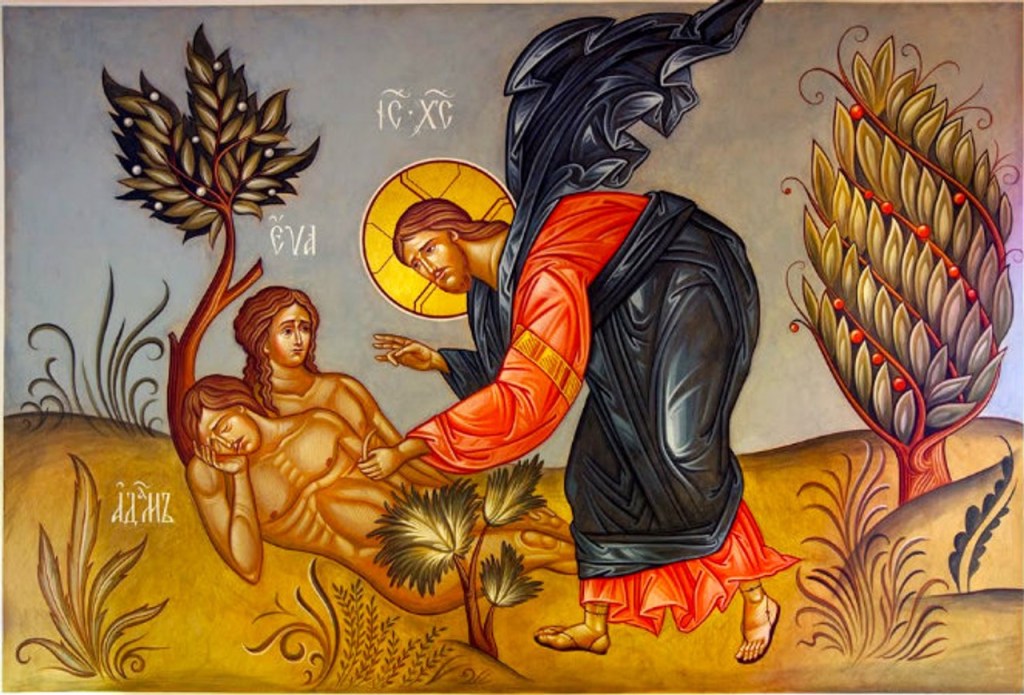
Then Jesus was led up by the Spirit into the wilderness to be tempted by the devil (Mt 4:1, ESV).

O God, make speed to save us.
O Lord, make haste to help us.

It is not possible to tempt a thief to steal in the same sense that it is possible to tempt a faithful husband to commit adultery. How’s that for an opening line? Let me say it again, because it’s important to what follows. It is not possible to tempt a thief to steal in the same sense that it is possible to tempt a faithful husband to commit adultery.

When a thief sees an unlocked door in an empty house or an unwatched purse at a restaurant, it is not a temptation, but rather an opportunity to do what has, step by step, choice by choice become second nature to him. There is no inner turmoil, no grappling between motives and counter-motives; there may be a quick assessment of risk or of cost-benefit ratio, but there is no real ethical calculus at play, no moral qualms to work through. To steal is to act in accordance with the real identity the thief has forged for himself. A thief may be tempted to return found money, but he cannot be tempted to keep it.

A faithful husband, however, can be tempted to adultery precisely because faithfulness is second nature to him; it lies near the core of his real identity, and even to momentarily contemplate adultery seems to break faith not only with his wife, but with himself and with God. If the temptation is strong, he will grapple with it as Jacob grappled with God at the Jabbok, and he may emerge wounded and limping. But, please God, he will emerge victorious and blessed.

What I’m sketching out here is a notion of temptation as an enticement away from one’s real identity — the identity that is a second nature — and toward a false identity. A thief cannot be tempted to steal because the chance to steal is an merely an opportunity to exercise and express his real identity as thief, an identity that he has forged with the encouragement and help of the evil one. For those who might be concerned with theological nuance, note that I am distinguishing between identity and nature. By nature, the thief is an image-bearer of God; by identity he is, well, a thief. So, the main point remains: temptation is an enticement away from one’s real identity, one’s second nature, and toward a false identity.

Well, that was fun. But does it matter? It must, I think, because it is integral to the text presented us today in Matthew 4, the temptation of Jesus. There is an unfortunate chapter break at the beginning our text, and unfortunately the lectionary submits to it. But the end of the previous chapter must be taken into account as the necessary context for Jesus’ temptation.

Matthew 3:13–17 (ESV): 13 Then Jesus came from Galilee to the Jordan to John, to be baptized by him. 14 John would have prevented him, saying, “I need to be baptized by you, and do you come to me?” 15 But Jesus answered him, “Let it be so now, for thus it is fitting for us to fulfill all righteousness.” Then he consented. 16 And when Jesus was baptized, immediately he went up from the water, and behold, the heavens were opened to him, and he saw the Spirit of God descending like a dove and coming to rest on him; 17 and behold, a voice from heaven said, “This is my beloved Son, with whom I am well pleased.”

This is a proclamation of identity, not the creation of identity. The Logos is the eternal Son of God and, at his conception, the man Jesus — his human nature — was taken up into that eternal identity of the Logos. So, Jesus’ baptism is not the creation of identity, but rather the very public proclamation by God the Father that this man standing in the river dripping wet is his beloved Son; it is the very public anointing by God the Holy Spirit of this man Jesus for his ministry to come. It is baptism and confirmation both in one. We do not know how many people heard the voice of God the Father that day or saw God the Holy Spirit descend: relatively few, I would think. But, the proclamation of Jesus’ identity certainly resounded throughout the whole spiritual realm of angels and archangels, of cherubim and seraphim, of demons and fallen powers. Even the devil himself, our ancient foe, took notice. And what was his first response? To tempt Jesus, to entice him away from his true identity to a false identity: “If you are the Son of God,” was the devil’s constant taunt and refrain throughout the temptations — a questioning and challenging of Jesus’ identity.

Brothers and sisters, that is not Jesus’ story only, but yours and mine as well. When the Celebrant immerses the baptismal Candidate or pours water upon the Candidate three times saying, “I baptize you in the Name of the Father, and of the Son, and of the Holy Spirit” (BCP 2019, p. 169), that is both the creation of a new identity and the public proclamation of that identity to the people of God gathered and seen and to the spiritual hosts gathered and unseen — angels of light and demons of darkness. And the devil himself, our ancient foe, takes notice. His sure response will be to tempt that newborn or newly commissioned child and servant of God, as he tempted Jesus, to entice that one away from his/her new, real identity to the old, false identity. That is, in part, why we so desperately need this account of Jesus’ temptation; it is a paradigm for everyone who is “sealed by the Holy Spirit in Baptism and marked as Christ’s own for ever” (ibid), a paradigm of temptation and of victory over it.

Matthew 4:1 (ESV): 4 Then Jesus was led up by the Spirit into the wilderness to be tempted by the devil.

There is so much to be said about that brief statement, so much to be pondered and prayed. The Spirit who had just descended upon Jesus now leads him into the place and time of temptation. Clarity matters here, as St. James insists:

James 1:13 (ESV): 13 Let no one say when he is tempted, “I am being tempted by God,” for God cannot be tempted with evil, and he himself tempts no one.

God the Holy Spirit is not tempting Jesus, not enticing Jesus away from his true identity, but is rather providing Jesus the opportunity to exercise that identity, to perfect that identity (cf Heb 5:8-9), to vanquish the devil in the power of that identity. The Holy Spirit does not abandon Jesus in his time of testing, but leads him, guides him, guards him, strengthens him, encourages him. And so the Spirit does for you and for me. The Holy Spirit may lead us into the wilderness to be tempted by the devil, but the end of that temptation, the purpose of it, is our salvation and victory, not our downfall. And in the midst of temptation, know that God tempers temptation, limits its scope to that which we can bear:

1 Corinthians 10:13 (ESV): 13 No temptation has overtaken you that is not common to man. God is faithful, and he will not let you be tempted beyond your ability, but with the temptation he will also provide the way of escape, that you may be able to endure it.

God will provide the way of escape, that you may be able to endure the temptation, and not endure it only, I think, but also to triumph over it. And this way of escape is not a mystery. It is what we see Jesus doing when he found himself in the wilderness of temptation. It is clear in this text and in others throughout the Gospels. It is the way of Lenten practice. It is the way of the spiritual disciplines, not for Lent only, but for the whole of the Christian life: fasting, prayer, Scripture.

Matthew 4:2 (ESV): 2 And after fasting forty days and forty nights, he was hungry.

Fasting: I fear that I misunderstood this passage for most of my adult life, until I began to take fasting seriously and to listen carefully to what the saints had been saying for two millennia. We read of a forty day fast and immediately think of how weak and vulnerable that must have made Jesus, how susceptible to temptation. But that is — and I say this with all reverence and sincerity — that is devilish thinking, because it is apparently what the devil himself thought. How little the devil as an incorporeal (unbodied) spirit can know about the grace of God ministered incarnationally through the union of human body and soul. How little can he understand that the weakness of the body can strengthen and steel the soul and spirit. Jesus did not fast to make himself weak, but to make himself strong for battle. As St. Gregory the Great wrote, “It is impossible to engage in spiritual conflict, without the previous subjugation of the appetite.” Yes, Jesus’ body was hungry, but his soul was full. Yes, his body was weak, but his spirit was strong. Ironically, the devil tempts Jesus with bread, thinking him weak from fasting. Jesus responds with the word of God showing himself strong from fasting.

It is neither incidental nor unimportant that fasting is a traditional Lenten practice. It is neither incidental nor unimportant that the early church observed Wednesdays and Fridays as regular fast days throughout the year (Didachē). It is neither incidental nor unimportant that the Desert Fathers and Mothers made fasting a foundational spiritual discipline. Fasting is preparation for battle; fasting is armor and weapon in the midst of battle.

The proclamation of Jesus’ identity and the descent of the Holy Spirit were the context and impetus for Jesus’ temptation. Fasting was his preparation for temptation. But, not fasting only. Hear these words from St. Mark’s Gospel:

Mark 1:35 (ESV): 35 And rising very early in the morning, while it was still dark, he departed and went out to a desolate place, and there he prayed.

We miss the connection in our English translations between this verse and St. Matthew’s description of the temptation locale. “Desolate place” in St. Mark and “wilderness” in St. Matthew are the same word. Jesus goes to the wilderness to pray; that was his practice. So, it is no stretch to say — and, in fact, I think it is only reasonable to say — that when the Spirit led Jesus up to the wilderness, to the desolate place, to be tempted, there Jesus prayed. The forty days of fasting were forty days of fasting and prayer. What might Jesus have prayed? We need look no further than the Psalms — the Jewish Book of Common Prayer, the Hebrew Hymnal. Can you hear Jesus praying these Psalms in the wilderness preparing for the temptation to come or in the midst of temptation present?

Psalm 1:1–2 (ESV): 1 Blessed is the man
who walks not in the counsel of the wicked,
nor stands in the way of sinners,
nor sits in the seat of scoffers;
2 but his delight is in the law of the Lord,
and on his law he meditates day and night.

Psalm 3:1–4, 7a (ESV): 1 O Lord, how many are my foes!
Many are rising against me;
2 many are saying of my soul,
“There is no salvation for him in God.” Selah
3 But you, O Lord, are a shield about me,
my glory, and the lifter of my head.
4 I cried aloud to the Lord,
and he answered me from his holy hill. Selah
7 Arise, O Lord!
Save me, O my God!

Psalm 4:1–4, 8 (ESV): 1 Answer me when I call, O God of my righteousness!
You have given me relief when I was in distress.
Be gracious to me and hear my prayer!
2 O men, how long shall my honor be turned into shame?
How long will you love vain words and seek after lies? Selah
3 But know that the Lord has set apart the godly for himself;
the Lord hears when I call to him.
4 Be angry, and do not sin;
ponder in your own hearts on your beds, and be silent. Selah
8 In peace I will both lie down and sleep;
for you alone, O Lord, make me dwell in safety.

It is neither incidental nor unimportant that prayer — not least praying the Psalms — is a traditional Lenten practice. It is neither incidental nor unimportant that the early church embraced the Psalms whole heartedly, incorporating them into prayer and liturgy. It is neither incidental nor unimportant that the Psalms were the very breath of the Desert Fathers and Mothers. St. Augustine said, “He who sings prays twice.” It is no wonder the devil cowers and trembles when God’s people sing the Psalms, pray the Psalms, breathe the Psalms.

Jesus fasted in the wilderness. Jesus prayed in the wilderness. Jesus immersed himself in Scripture in the wilderness, the Word of God incarnate feasting on the word of God written. We know this because every response of Jesus to the devil’s temptation was a word of Scripture. Jesus did not depend upon his own human strength, his own human cleverness, his own human will to overcome the devil; he simply refuted and rebuffed the devil with the word of God: not the twisted word, the distorted word that the evil one offered, but the true, the pure word of God as received from the Holy Spirit. As the Psalmist writes:

9 How shall a young man cleanse his way?*
By ruling himself according to your word.
10 With my whole heart I have sought you;*
O let me not go astray from your commandments.
11 Your words have I hidden within my heart,*
that I may not sin against you (Ps 119:9-11, BCP 2019).

It is neither incidental nor unimportant that reading and reflecting on Scripture is a traditional Lenten practice. It is neither incidental nor unimportant that at the heart of the Book of Common Prayer lies the regular, daily reading of the whole of Scripture in the context of prayer, Psalmody, and worship. It is neither incidental nor unimportant that St. Paul identifies the word of God as the sword of the Spirit (Eph 6:7), the spiritual weapon with which to strike down the enemy and his temptations.

When temptation came to Jesus, when temptation comes to us, it comes as a spiritual attack. Temptation is not a sin; it is an assault. In Jesus’ case, it was an assault from without, from the devil, since in Christ there is no darkness. In our case, it may be without from the devil, or within from our own unruly passions of body, mind, and spirit. Regardless of the source, it is what we do with the assault that determines whether it progresses to sin. We must follow the way of our Lord; we must do as he did in the wilderness, do as the saints for two millennia have taught us. Jesus did not engage with the temptation, did not ponder it or reflect upon it. He did not entertain an extended debate with the devil. Jesus simply refuted the temptation with God’s word. As the Desert Fathers tell us, we cannot keep flies from buzzing around our heads, but we do not need to let them light there. We cannot prevent the assaults of the devil, but we dare not let them linger; we dare not engage them. St. Ignatius recommends a three-fold strategy of watchfulness and action. First, become aware that something is stirring spiritually. Second, understand it for what it is. Third, accept it if from God or reject it if from the devil. Awareness is key. The Desert Fathers and Mothers called this awareness nepsis or watchfulness. It is placing a guard over the senses, a watchman over the mind and heart to prevent temptation from penetrating our spiritual defenses. Be careful what you watch. Be careful what you listen to. Be careful where you go. Be careful what you think about and imagine and dwell on:

1 Peter 5:8–9a (ESV): 8 Be sober-minded; be watchful. Your adversary the devil prowls around like a roaring lion, seeking someone to devour. 9 Resist him, firm in your faith.

If one temptation does not induce you to sin, know that another will soon follow. We do not know the full extent of Jesus’ temptation in the wilderness; three temptations are given us as a summary of the wiles of the devil: three enticements away from Jesus’ true identity, three seductions of the world, the flesh, and the devil as symbolic of all temptations. We do not know the full extent of Jesus’ temptations, but we do know how they ended. Jesus rebuked the tempter: “Be gone, Satan!” Near the end of his ministry, Jesus said a similar thing when tempted by Satan through the human agency of Peter: “Get behind me, Satan.” And we read this somewhat cryptic but powerful word in Jude:

Jude 9 (ESV): 9 But when the archangel Michael, contending with the devil, was disputing about the body of Moses, he did not presume to pronounce a blasphemous judgment, but said, “The Lord rebuke you.”

Be gone, Satan. Get behind me, Satan. The Lord rebuke you. What powerful responses to temptation, what potent weapons against temptation and the tempter these few words are. They should become part of our vocabulary of spiritual warfare. Our foe is ancient. Our foe knows us better than we know ourselves. We dare not trust in ourselves, in our own devices, but rather in the power and the authoritative word of the Lord: Be gone, Satan. Get behind me, Satan. The Lord rebuke you.

Jesus’ identity was declared at his baptism, and temptation surely followed. And now, we find our identity in him; it was created and proclaimed in baptism. And temptation surely follows. Fasting, prayer, Scripture, watchfulness, and a word of rebuke spoken in the power of the Spirit: these were the weapons Jesus used to vanquish the tempter and his temptations, the same proven weapons that are commended by and bequeathed to us in Scripture and in the great tradition of the Church. May we wield them well to the glory of the Father, and of the Son, and of the Holy Spirit. Amen.

Posted in Uncategorized | Leave a comment

CONFIRMATION: Session 2 — Apostolic Lineage of Archbishop Foley Beach

For the research leading to and the publication of the following chart of Apostolic Lineage we are indebted to the Reverend Canon Wes Jagoe; his work is a gift to the ACNA and thus to the one, holy, catholic, and Apostolic Church.

Posted in Uncategorized | Tagged , | Leave a comment

CONFIRMATION: Session 2 — Authority (Scripture, Creeds, Councils, Bishops)

APOSTLES ANGLICAN CHURCH
Fr. John A. Roop

Christian Essentials / Anglican Distinctives
Session 2: Authority — Scripture, Creeds, Councils, Bishops

The Lord be with you.
And with your spirit.

Let us pray.

For A Province Or Diocese
O God, by your grace you have called us in this Province and Diocese to be a good and godly fellowship of faith. Bless our Archbishop and Bishop Foley, our Assisting Bishop Frank, and other clergy, and all our people. Grant that your Word may be truly preached and truly heard, your Sacraments faithfully administered and faithfully received. By your Spirit, fashion our lives according to the example of your Son, and grant that we may show the power of your love to all among whom we live; through Jesus Christ our Lord. Amen.

Introduction: The Question of Authority
One of the most notable characteristics of this post-modern culture in which we live is the distrust and rejection of, and even the rebellion against authority. This was clearly manifest on 6 January 2022 in the assault on the Capitol, in recent calls to defund the police, in the suspicion directed toward the Supreme Court, in distrust of news outlets — essentially everywhere we turn. The older structures that used to speak truth to us, that used to rightly order our lives we now suspect of manipulative propaganda — we don’t know where to look for truth — and rampant self-interest at our expense. Educational systems seem to deconstruct truth more than search for it and teach it. Political systems seem more engaged in internal struggles for power than in right governing and public service. Our judiciary and legal systems seem to fail as often as not to impartially administer justice. Our churches seem rife with scandal, false doctrine, and cultural pandering. It may always have been so in every generation, more or less. This is neither the best of times nor the worst of times; it is simply our time, and we see its flaws because they affect us.

Still, the question confronts us as it does those in every generation: what are the reliable sources of truth and authority? How do we know what to believe and how to rightly order our lives, and to whose authority we may/must rightly submit? These question arise not only in regard to civil society but also pertaining to matters of the spirit.

As Anglicans, we have answers for those questions. The Fundamental Declarations of the Province answer them, in part for our Province (ACNA).

ACNA Fundamental Declarations of the Province

We believe and confess Jesus Christ to be the Way, the Truth, and the Life: no one comes to the Father but by Him. Therefore, the Anglican Church in North America identifies the following seven elements as characteristic of the Anglican Way, and essential for membership:

1. We confess the canonical books of the Old and New Testaments to be the inspired Word of God, containing all things necessary for salvation, and to be the final authority and unchangeable standard for Christian faith and life.

2. We confess Baptism and the Supper of the Lord to be Sacraments ordained by Christ Himself in the Gospel, and thus to be ministered with unfailing use of His words of institution and of the elements ordained by Him.

3. We confess the godly historic Episcopate as an inherent part of the apostolic faith and practice, and therefore as integral to the fullness and unity of the Body of Christ.

4. We confess as proved by most certain warrants of Holy Scripture the historic faith of the undivided church as declared in the three Catholic Creeds: the Apostles’, the Nicene, and the Athanasian.

5. Concerning the seven Councils of the undivided Church, we affirm the teaching of the first four Councils and the Christological clarifications of the fifth, sixth and seventh Councils, in so far as they are agreeable to the Holy Scriptures.

6. We receive The Book of Common Prayer as set forth by the Church of England in 1662, together with the Ordinal attached to the same, as a standard for Anglican doctrine and discipline, and, with the Books which preceded it, as the standard for the Anglican tradition of worship.

7. We receive the Thirty-Nine Articles of Religion of 1562, taken in their literal and grammatical sense, as expressing the Anglican response to certain doctrinal issues controverted at that time, and as expressing the fundamental principles of authentic Anglican belief.

In all these things, the Anglican Church in North America is determined by the help of God to hold and maintain as the Anglican Way has received them the doctrine, discipline and worship of Christ.

So, back to our questions. Based on the Fundamental Declarations, what are the reliable sources of truth and authority in the Christian life? How do we know what to believe and how to rightly order our lives, and to whose authority we may/must rightly submit? [Let the class examine the Fundamental Declarations and discuss the answers they provide.]

Holy Scripture
Holy Scripture is the final authority and unchangeable standard for Christian faith and life. Even as we say that, it must be nuanced in light of Jesus’ own claim:

Matthew 28:18 (ESV): 18 And Jesus came and said to [the disciples], “All authority in heaven and on earth has been given to me.

So, when we say that Holy Scripture is the final authority we don’t mean that Scripture has an authority independent of or superseding Christ’s authority. Instead we mean that Jesus’ ultimate authority over all things is mediated to the Church in and through the Scriptures. Scripture is one way — orthodox Anglicans go so far as to say it is the primary way — in which Christ exercises his authority in the world.

The ACNA Catechism, To Be A Christian (TBAC), expands on this notion in a series of questions and answers.

[Review To Be A Christian, Questions 25-35, pages 32-35.]

The Reformed Churches are known for their insistence upon five sola statements: sola scriptura, sola gratia, sola fides, solus Christus, soli Deo gloria. It is the first of these — sola scriptura, Scripture alone, that concerns us here. In its popular connotation, this statement is often misconstrued as a “me and my Bible” attitude. I don’t need anyone else to tell me what to believe; I can sit down by myself — just me and my Bible — and understand everything perfectly well myself. I don’t think that is what sola scriptura actually meant historically because that is not how the Reformers actually dealt with Scripture. And that is certainly not the Anglican approach to Scripture; it is, instead, a recipe for disaster — every man a pope, every man his own infallible spiritual authority. The Bible was not given first to individuals, but to the Church, to the Body of Christ, and it is in and through the Church that the Holy Spirit works to lead all God’s people into right understanding of Scripture. The Church — not the academy and not even the private study — is the “natural habitat” of Scripture. St. Paul codifies this understanding in his first letter to Timothy:

1 Timothy 3:14–15 (ESV): 14 I hope to come to you soon, but I am writing these things to you so that, 15 if I delay, you may know how one ought to behave in the household of God, which is the church of the living God, a pillar and buttress of the truth.

St. Paul is not pitting the Church against Scripture or Scripture against the Church: far from it! Rather, the Church is the living expression of the deposit of faith found in Scripture, the most reliable interpreter of that faith, the body in which Scriptural faith comes to life.

In centering Scripture in the Church, I am not saying that individuals should not read and study the Bible individually, personally! God forbid: let us be people of the Word. Personal engagement with Scripture is essential for spiritual growth. But, I am saying that our individual understanding of Scripture must be submitted to the Church, to the Great Tradition of the one, holy, catholic, and Apostolic Church, that we must exercise some humility and that we must not insist on our own, idiosyncratic interpretations of Scripture over the consensus fidelium, the consensus of the faithful for over two millennia. To say, “I know what the Church teaches, but I read the Scripture differently,” to persist in that attitude when corrected, and to encourage others to follow your personal understanding is the definition of heretic.

The authority in all things belongs to Christ. He mediates that authority in and through Scripture which contains all things necessary for salvation and which is the unchangeable standard for Christian faith and life. Scripture is to be read and understood consensually, that is, by the whole Church.

This consensual understanding of Scripture — Scripture read in and by the Church — means that the Church is also an instrument through which Christ mediates his authority. That is also emphasized in the Fundamental Declarations which confess the Creeds, affirm the Councils, and confess the godly, historic Episcopacy. Creeds, Councils, and Bishops speak for the Church and so exercise a delegated authority within the Church.

Creeds
What are the Creeds and what role do they play in the life and faith of the Church? The ACNA Catechism (TBAC) provides a good, brief answer. See Part II, The Apostles Creed And The Life Of Faith, pages 29-32.

Think of the Creeds as the “Cliff Notes” summary of the Gospel. They do not contain everything that is essential for the life of faith and Christian practice, but everything they do contain is essential for the life of faith and Christian practice. Only those who can affirm them in their entirety have embraced the non-negotiable essentials of the faith delivered once for all to the saints and are ready for baptism and full participation in the life of the Church.

The Creeds serve another function, as well; they provide a lens through which the Church reads and understands Scripture. For example, the Athanasian Creed details the way the Church understands and expresses the reality of the Trinity and the dual nature of Christ (fully God and fully man). The Church, guided by the Holy Spirit, discerned that this is the proper and authoritative way to read and understand the Scriptures as they reveal to us the Triune God and the incarnate Logos. In this sense, rejection of the Creeds is a rejection of Scripture as understood consensually by the Church. This notion brings us naturally to the topic of consensual understanding and the Councils of the Church.

Ecumenical Church Councils
From time to time there are issues that arise in the life of the Church that are not explicitly addressed in Scripture, or that are perhaps addressed only obliquely. One group within the Church may read Scripture in a way that conflicts with others in the Church; each group is trying to be faithful to Scripture, but it is not perfectly clear what faithfulness looks like. We have examples of this in Scripture itself, the classic one being the inclusion of the Gentiles, as Gentiles, in the Church. Paul and Barnabas read Scripture and discerned the direction of the Holy Spirit toward inclusion of the Gentiles without their prior conversion to Judaism and without imposing upon them the keeping of the Mosaic Law. Other leaders in the Church read Scripture differently. To them, Jesus was the Messiah of Israel; to follow Jesus required identification first with Israel, i.e., converting to Judaism and faithfully observing the Law. How was the Church to determine which group, which reading of Scripture, was correct?

We find the answer in Acts 15. The apostles and the elders of the Church came together in council in Jerusalem, under the auspices of James, the bishop of the Jerusalem church, to listen to one another, to read Scripture together, to pray together, to listen to the Holy Spirit together, and to decide together the proper way forward for the Church. This was the first of the Church’s councils, and it served as the model for Church-wide discernment for a thousand years. When important decisions had to be made regarding the faith and practice of the Church, leaders of the Church from throughout the world assembled to listen to one another, to search the Scriptures, to pray, to discern the movement of the Holy Spirit, and to decide the issue on behalf of the whole Church. When the council spoke, it spoke with authority for the Church.

There were seven such councils of the whole Church. Anglicans recognize them as a valid source of authority with a certain caveat, according to the Fundamental Declarations:

Concerning the seven Councils of the undivided Church, we affirm the teaching of the first four Councils and the Christological clarifications of the fifth, sixth and seventh Councils, in so far as they are agreeable to the Holy Scriptures.

There are several important features of this affirmation. First, we embrace only the Councils of the undivided Church, when East and West were one, before the Great Schism of 1054. That is the period when the Councils spoke for the universal Church. Second, we affirm fully only the first four of these Councils. These are the ones which defined and clarified the essential dogmas of the Church:

Nicea (325)
Christ is one being with the Father and co-eternal.

Constantinople (381)
The Holy Spirit is the third person of the Trinity, of one being and co-eternal with the Father and the Son. It was this council that gave the final form to the Nicene Creed, which accordingly is more precisely called the Niceno-Constantinopolitan Creed.

Ephesus (431)
Mary is rightly called the Theotokos (God bearer) since Jesus is God incarnate from conception. (This has less to do with Mary and more to do with Jesus. It insists that Jesus was fully God from conception as opposed to such heresies as adoptionism which insists that Mary bore only a human person who was later filled with the Spirit of Sonship — adopted — by God. To insist that Jesus was fully God and fully man from conception implies that Mary bore God in her womb, thus rightly bestowing on her the title Theotokos, God bearer.)

Chalcedon (451)
Christ is one person with two natures — fully human and fully divine — and those two natures are neither separated nor confused.

The fifth, sixth, and seventh Councils are different in nature than these first four. They provide detail and clarification of the four, and defend them against some heretical interpretations. We affirm those Christological clarifications. But they also range into political matters and matters of church practice that we have determined is more appropriately left to local discretion. We affirm the first four Councils fully, and the fifth, sixth, and seventh insofar as they shed additional light upon the essential dogmatic statements made previously, and insofar as they are agreeable to the Holy Scriptures.

Bishops
Tragically, the Church split along an East-West line in 1054, creating the Orthodox Church and the Roman Catholic Church, and fractured again during and after the Reformation. That makes the convening of an Ecumenical Council impossible. So, how do churches make important doctrinal and liturgical decisions today? How do we, as Anglicans, do it? What is the ongoing source of authority in the life of the church, acting under Scripture, Creeds, and Councils? The answer is found in the third of the Fundamental Declarations:

We confess the godly historic Episcopate [Bishops] as an inherent part of the apostolic faith and practice, and therefore as integral to the fullness and unity of the Body of Christ.

Jesus gave the Apostles certain authority in the Church, empowering them, for example, to forgive sins or to withhold forgiveness of sins and to bind on earth or to loose on earth (ref Mt 16:19 and John 20:22). Since the mission of the Church extended beyond the life of the Twelve, the role they played in the life of the Church needed to extend, as well. Thus, the Apostles appointed/ordained bishops through prayer and the laying on of hands to succeed them in their apostolic ministry. The bishops are to today’s church as the Apostles were to the first-century church. This doctrine and practice is often referred to as Apostolic Succession. Each bishop in the ACNA is able to trace his spiritual lineage directly and in an unbroken line to one or more of the Apostles. That means, of course, that each priest and deacon can, as well, since priests and deacons are ordained by Bishops. [As an aside, Archbishop Foley’s apostolic lineage, and thus mine since he ordained me to the priesthood, has been traced back to Peter, James, John, and Paul.]

But, Apostolic Succession means more than laying on of hands in ordination. It means fidelity to the Apostolic witness, passing on faithfully and fully that deposit of Apostolic faith received in and through Scriptures, Creeds, Councils, and the Church.

In the ACNA, the College of Bishops, i.e., the Bishops from every diocese meeting together, make decisions pertaining to the entire Province — to all the dioceses and parishes comprising the Province.

For decisions that affect only a particular dioceses, the Ordinary — the bishop of that diocese — convenes a synod, a gathering of all clergy and elected/appointed lay delegates from each parish to reach a decision through prayer, study of Scripture, listening, and voting. Our diocese, the Anglican Diocese of the South, has an annual synod in November.

Conclusion: The Question of Authority
So, what are the reliable sources of truth and authority in the Anglican Church? First, we note that all authority lies in and with Jesus Christ; it was given to him by God the Father. But, Jesus, through the work and indwelling presence of his Holy Spirit, ministers that authority in several ways: Scripture, Creeds, Councils, and Bishops.

Posted in Uncategorized | Tagged , | Leave a comment

CONFIRMATION: Session 2 — Handout

ACNA Fundamental Declarations of the Province

We believe and confess Jesus Christ to be the Way, the Truth, and the Life: no one comes to the Father but by Him. Therefore, the Anglican Church in North America identifies the following seven elements as characteristic of the Anglican Way, and essential for membership:

1. We confess the canonical books of the Old and New Testaments to be the inspired Word of God, containing all things necessary for salvation, and to be the final authority and unchangeable standard for Christian faith and life.

2. We confess Baptism and the Supper of the Lord to be Sacraments ordained by Christ Himself in the Gospel, and thus to be ministered with unfailing use of His words of institution and of the elements ordained by Him.

3. We confess the godly historic Episcopate as an inherent part of the apostolic faith and practice, and therefore as integral to the fullness and unity of the Body of Christ.

4. We confess as proved by most certain warrants of Holy Scripture the historic faith of the undivided church as declared in the three Catholic Creeds: the Apostles’, the Nicene, and the Athanasian.

5. Concerning the seven Councils of the undivided Church, we affirm the teaching of the first four Councils and the Christological clarifications of the fifth, sixth and seventh Councils, in so far as they are agreeable to the Holy Scriptures.

6. We receive The Book of Common Prayer as set forth by the Church of England in 1662, together with the Ordinal attached to the same, as a standard for Anglican doctrine and discipline, and, with the Books which preceded it, as the standard for the Anglican tradition of worship.

7. We receive the Thirty-Nine Articles of Religion of 1562, taken in their literal and grammatical sense, as expressing the Anglican response to certain doctrinal issues controverted at that time, and as expressing the fundamental principles of authentic Anglican belief.

In all these things, the Anglican Church in North America is determined by the help of God to hold and maintain as the Anglican Way has received them the doctrine, discipline and worship of Christ.

Posted in Uncategorized | Tagged , | Leave a comment

CONFIRMATION: Session 1 — Anglican Identity

APOSTLES ANGLICAN CHURCH
Fr. John A. Roop

Christian Essentials / Anglican Distinctives

Session 1: Anglican Identity

The Lord be with you.
And with your spirit.

Let us pray.

A Prayer of Self-Dedication
Almighty and eternal God, so draw our hearts to you, so guide our minds, so fill our imaginations, so control our wills, that we may be wholly yours, utterly dedicated to you; and then use us, we pray, as you will, and always to your glory and the welfare of your people; through our Lord and Savior Jesus Christ. Amen.

Introduction: An Exploration of Anglican Identity

Who are we as Anglicans? While that would seem to be a simple question, it is, in reality, anything but simple. We are a diverse group in terms of nationality, culture, and expressions of faith. But, we are held together by historical bonds of association and affection, by common prayer and worship, and, until recently, by a common understanding of the essentials of our faith.

So, out of this complex question, we will look at three areas of Anglican Identity: (1) the historical development of Anglicanism and the Anglican Communion, (2) the ecclesial structure and hierarchy of the Anglican Church in North America (ACNA), the province to which we belong, and (3) the ethos — the character, the spirit — of the ACNA.

History

The Church in England and The Anglican Communion: Historical Considerations

Let’s begin with a “trick” question: Where, when, and by whom did the Anglican Church originate? I know that the most obvious answer is (1) in England, (2) in the early 16th century, (3) by Henry VIII, but that is not actually the case — at least not fully the case.

The Church in England began in Galilee sometime around 33 AD by the authority of Jesus Christ.

16Now the eleven disciples went to Galilee, to the mountain to which Jesus had directed them. 17And when they saw him they worshiped him, but some doubted. 18And Jesus came and said to them, “All authority in heaven and on earth has been given to me. 19Go therefore and make disciples of all nations, baptizing them in the name of the Father and of the Son and of the Holy Spirit, 20teaching them to observe all that I have commanded you. And behold, I am with you always, to the end of the age (Mt 28:16-20).

This, the Great Commission, is where Anglican identity starts, because it is where the mission of the one, holy, catholic and Apostolic church starts. There is only one Church with many expressions of the Church’s common faith. I will, from time to time, refer to this common faith as the Great or Catholic Tradition, where Catholic simple means universal. Anglicans are and always have been part of the one, Holy, Catholic, and Apostolic Church. From Jesus’ ascension the apostles and disciples tarried in Jerusalem for ten more days until, on Pentecost, they received the power of the indwelling Holy Spirit to accomplish this mission. Then, they began to make disciples – to baptize and to teach – first in Jerusalem, then in Judea and Samaria, and then to the uttermost parts of the world. Thomas headed east, carrying the Gospel to India. Mark went southwest to Egypt where he founded a thriving and influential Christian community in Alexandria, a community that produced some of the greatest theologians in the early church. Paul went – well, Paul went everywhere throughout Asia Minor, into Europe, and perhaps as far west as Spain. Tradition tells us that both he and Peter were martyred in Rome around 65 AD. The Roman church gained a particular prominence, as did its bishops in succession after Peter, due to its association with both Peter and Paul. The relationship between the church at Rome and other prominent historic churches – Jerusalem, Antioch, Alexandria, and Constantinople – is best described as “first among equals.” Historically, the Bishop of Rome had a position of honor, but no more or less authority than any other bishop. That the Bishop of Rome began later to claim such authority over other bishops was one major factor leading to the Great Schism (1054) between the Eastern and Western Churches, the first major division in Christendom.

It wasn’t just the Apostles who carried the Gospel throughout the world; the word was spread naturally and organically by those who had received it. It accompanied soldiers on their marches and travelers on their journeys, and it was carried by merchants along with their wares. The history of this “ordinary” evangelism was not recorded, so we usually have no details of precisely when and how the Gospel reached a particular region or people. Britain is a case in point. Was it Roman soldiers or tin merchants who brought the Gospel to the isles? And, when was Christ first preached there? We simply do not know. But, we do have some notion of when the faith arrived in Britain.

The Church in Britain

Some church fathers and historians claim a very early arrival of the church in Britain. In his defense of the faith, Tertullian (d. 222) writes:

The extremities of Spain, the various parts of Gaul, the regions of Britain which have never been penetrated by Roman arms have received the religion of Christ.

Eusebius, a 4th century church historian, even claims apostolic evangelization of Britain:

The Apostles passed beyond the ocean to the isles called the Britannic Isles (Demonstratio Evangelica).

Perhaps. But what we can say with certainty is that the church was well established in England by 314. In that year, at the Emperor Constantine’s directive, representatives of the Church met in the town of Arles to address the heresy of Donatism. Documents from the council record the presence of three British bishops: Eborius of York, Restitutus of London, and Adelphius, whose episcopal see is uncertain. If there were British bishops, there were British clergy and churches. While the church was present in Britain at this time, it was not widespread in geographical scope or influence, both of which waxed and waned for centuries, almost disappearing entirely during the Saxon conquest (5th-6th centuries).

Synod of Whitby: Roman Jurisdiction

What follows is an abbreviated and simplified summary of English church history; volumes have been written if you are interested. But, for our purposes, this abstract should suffice.

By the 7th century, there were two distinct forms of Christianity practiced in the British kingdom of Northumbria: Celtic and Roman. Celtic Christianity entered the kingdom through the Abbey of Iona – an abbey founded on the Scottish island of Iona by the Irish monk Columba. Roman Christianity was likely introduced by missionaries sent by Pope Gregory the Great expressly to convert the Anglo-Saxons. There were differences in these two forms of the faith in such areas as organization and liturgy: Celtic Christianity was ordered around a monastic model governed by abbots and monks while Roman Christianity was governed hierarchically by Pope (the Bishop of Rome), bishops, and priests. The liturgies and calendar the two forms used varied somewhat – particularly calculations of the date for Easter. They shared one, common faith – the faith once for all delivered to the saints, as Jude writes – but they expressed it in different forms and with different governing structures.

Each form cycled into and out of dominance at the preference of successive kings, and tension between them grew. In 664, King Oswiu of Northumbria convened a synod at Whitby – a gathering of officials from both the Celtic and Roman churches – to determine which form of Christianity his kingdom would practice. Each side presented its case. Ultimately King Oswiu decided in favor of Roman practice, based largely upon Peter’s position as chief of the Apostles and his association with the church at Rome. At this point, the church in Britain came under the jurisdiction of the Roman Catholic Church.

Anglican History Summary

Why bother with all this history? Two important points emerge from it that shape our Anglican identity. First, there was a church in Britain, in England – part of the one, holy, catholic, and Apostolic Church established by Christ and built through the mission of the Apostles and their successors – before that church was under the jurisdiction of Rome; there was nothing essentially Roman about the English church. Second, coming under the jurisdiction of Rome was a political decision made by the King of Northumbria. The decision could have been otherwise, favoring the Celtic church.

The English Church and the Reformation

Let’s now fast-forward some eight centuries. By the 15th century a reformation movement was growing in some quarters of the Roman Catholic Church. The fundamental conviction of this movement and those who led it was that through the years the Roman Church had departed in some significant ways from the purity of the Apostolic faith and had added to the faith doctrines, as necessary for salvation, that could not be found in or proved by Scripture. Some of the main differences between Roman doctrine and the growing convictions of the reformers can be found in The Thirty Nine Articles of Religion in the Book of Common Prayer.

So, the movement to reform the Roman Church grew, initiated and led by men such as Jan Hus, John Wycliffe, Martin Luther, John Calvin, and Huldrych Zwingli. Each of these men and their respective groups differed in particulars, but they were united in their desire to return to the purity of the Gospel message of salvation by grace through faith – and not of works. They were united in their emphasis on the centrality of the Word of God, the Scriptures, and upon its central, essential, and authoritative role in establishing doctrine and governing the Church.

England had its own reformation underway – partly political and partly religious. You probably know the politics: Henry VIII needed a male heir to continue his dynasty and his wife, Catherine of Aragon, was apparently unable to produce a son. Henry needed an annulment which could be granted only by the Pope – the Bishop of Rome. To Henry, this was a political matter of national sovereignty. When the annulment was not forthcoming, Henry challenged the right of the Pope to interfere with the political affairs of a sovereign nation, England. He ultimately disavowed the Pope and severed the relationship between the English Church and the Roman Church. In some sense, Henry VIII returned England to the religious independence it had had before the Synod of Whitby. There had been an English Church not under Roman authority before, and now there was again. It’s not quite fair to say that the Church of England began with Henry VIII; it is fair to say that the church returned to English autonomy under Henry VIII.

Henry chose Thomas Cranmer as the first English Archbishop of Canterbury. In some sense, it was Cranmer who created a unique Anglican identity through his reformation of English liturgy (the creation of The Book of Common Prayer), his expression of doctrine (The Articles of Religion), and his book of homilies (required sermons in the Church of England). Others had major influence in nuancing Anglican identity both in the beginning and throughout its history, but none more so than Thomas Cranmer.

I will spare you the ins-and-outs of the development of the Church of England – the Anglican Church – over the next several generations; it is not pretty. Needless to say, there were various factions in the Church striving for dominance: the Evangelicals who sought to identify with and emulate the Continental Reform movements of Luther and Calvin more closely; the Puritans who wanted to out-reform the Reformers and to strip everything from the faith that was not specifically commanded in Scripture; and the Anglo-Catholics who felt the Reformation had gone a bit far and wanted to reintroduce many aspects of Catholicism – minus the Pope – into Anglicanism. These factions have existed from the beginning of the Anglican Church and are still present in various forms; frankly, this diversity is as much a part of the distinctive Anglican identity as is our common faith.

Expansion and Contraction

England grew as a world power and established colonies across the globe. It was said that the “sun never sets on the British Empire,” a testimony to the breadth and scope of the global British control and influence. As colonies were established, so were outposts of the Church of England. In this way, Anglicanism was exported globally. In its best moments, the church evangelized the indigenous populations; sometimes, however, it was insular and existed solely for the benefit of the colonists. Each of these colonial churches was part of the Church of England – the Anglican Church – and looked to the King or Queen of England as its political monarch and to the Archbishop of Canterbury as its spiritual head (under the authority of the Supreme Head of the Church, the reigning monarch).

One of these colonies was a little thing that became the United States of America. Many of our settlers and Founding Fathers were Anglicans of one stripe or another and the Church of England exerted significant spiritual influence in the Colonies and ultimately in the States.

As England’s power waned, colonies became independent either by choice of England or, in our case, by armed revolt. As England withdrew governmentally, it remained spirituality; the Church of England stayed in the former colonies and the colonists and indigenous people assumed leadership. These churches were no longer quite the Church of England, but they did originate there and they did feel strong connections to the faith, practice, and polity of the Anglican Church. They now formed a communion of churches throughout much of the world all of which looked to the Church of England and the Archbishop of Canterbury as their home and titular head. This is the Anglican Communion: a global confederation of churches originating historically in the Church of England or choosing to affiliate with the Church of England, and bound together by common faith and practice.

As you can imagine, the American Revolution stressed the relationship between the American colonial church and the Church of England. All clerics – priests and bishops – had to subscribe to the supremacy of the English monarch, which simply wouldn’t do. “Back door” ways were found around this, and an American episcopacy – body of bishops – was established so the American church could function independently of England. This uniquely American version of the Anglican Church called itself the Protestant Episcopal Church in the United States, or simply, The Episcopal Church (TEC). Soon, it reestablished ties with the Church of England and took its place – a prominent place – in the global Anglican Communion, not least through the wealth it contributed, and still contributes, to the Anglican coffers. Frankly, its wealth allows it to exert influence in the Communion far disproportionate to its numerical membership in the global Anglican Church.

TEC

In the last half of the twentieth century, the Episcopal Church began to move away from traditional orthodox understanding of faith, practice, and church discipline. One of the early issues was the unauthorized ordination of women to the priesthood. Another issue — and one most people consider far more serious — was a change in standards of human sexuality and an acceptance of same sex relationships and civil unions/marriages. Additionally, the Episcopal Church consecrated as Bishop an openly gay man living with his same sex partner. All of this was in opposition to the standards of the worldwide Anglican Communion.

Even more disturbing to many was the drift of the Episcopal Church away from the centrality of Christ. A former Presiding Bishop of the Episcopal Church, Katherine Jefferts Schori made statements indicating Jesus was a way to God, but not necessarily the only way to God; and this trend has only intensified. There were and are tendencies in the Episcopal Church to deny such fundamental tenets of the faith as the virgin birth, the bodily resurrection of Christ, and his divinity.

Reverse Missions

Reform movements developed within the Episcopal Church to recall it to the true faith, but these were largely unsuccessful. There came a point when many orthodox Episcopalians felt they could no longer stay in the Episcopal Church. At this same time, other provinces – national churches – in the Anglican Communion were growing concerned about the theological drift of the Episcopal Church and determined to launch missionary efforts to the United States. These provinces – largely from Africa and the Southern Cone (southernmost region of South America) – offered shelter and episcopal oversight to disaffected Episcopalians. Several groups were formed to allow these Episcopalians to worship as Anglicans – to maintain ties with the Anglican Communion – apart from the Episcopal Church.

This was a confusing and messy time, and I will not (cannot) go into all the details. But, out of this “mess” emerged strong leadership in the form of GAFCON – the Global Anglican Futures Conference – a conference of orthodox primates (leaders of provinces in the Anglican Communion) representing the majority of Anglicans worldwide and functioning somewhat as an orthodox communion within the broader Anglican Communion. These primates supported the formation of an autonomous Anglican province in North America as an alternative to the Episcopal Church. With their support, the Anglican Church in North America (ACNA) was formed. It is this province to which Apostles Anglican Church belongs. The ACNA is recognized as a province within the Anglican Communion by the majority of Anglicans worldwide, though it is not recognized formally by the Archbishop of Canterbury or the Church of England. Our Primate is Archbishop Foley Beach, who also serves as Chair of GAFCON and as our diocesan bishop in the Anglican Diocese of the South.

This is a brief(!) summary of our historical Anglican Identity. We will cover some of this in greater detail as we continue with this class. Before we go on, are there any questions?

Anglican Hierarchy

I have used several Anglican terms related to our hierarchy, our structure of governance and authority, and our organizational structure. I’d like to give a bit more detail on that structure.

Parish

The local worshipping body under the spiritual authority of a rector, if the parish is financially self-sufficient, or a vicar if the parish receives financial support from the diocese. A parish that is not financially self-sufficient is most often called a mission. Our parish is Apostles Anglican Church and our Rector is Fr. Jack King.

Deanery

A communion of local parishes under the care of a Dean. The dean assists the rectors/vicars as needed and convenes meetings of the local parishes for fellowship, common efforts, common worship, etc. Apostles belongs to the Deanery of East Tennessee along with Old North Abbey and St. Brendan’s. Currently, our Dean is Fr. Aaron Wright who also servers as rector of Old North Abbey.

Diocese

A communion of parishes under the spiritual authority of a bishop. In the Anglican Church in North America (ACNA) there are two types of dioceses: geographical dioceses and dioceses of affiliation. Historically, dioceses were based upon geographical boundaries; there might be a Diocese of East Tennessee, for example, to which all the Anglican churches in that geographical region belonged. Our diocese, the Anglican Diocese of the South (ADOTS), is primarily geographical and covers several southern states. The ACNA also allows for a parish to affiliate with a diocese outside its geographical boundaries. Typically, this involves a difference in ministry emphasis or theology between the parish and the geographical diocesan bishop. A case in point is the issue of women’s ordination to the priesthood. ADOTS does not allow for ordination of women to the priesthood. Some other dioceses do. A parish within ADOTS’ geographical boundaries that favors women’s ordination might choose to affiliate with a different diocese which allows for it.

Province

A regional or national communion of dioceses under the spiritual authority of an Archbishop or Primate. Our province is the Anglican Church in North America (ACNA) and our Archbishop/Primate is Abp Foley Beach.

Anglican Communion

The communion of all Anglican provinces. I am fudging a bit on this definition because it is debated. Formally, to be a member province of the Anglican Communion, a province must be recognized as such by the Archbishop of Canterbury. However, the majority of provinces currently disagree with that requirement. Why is that important? Because the ACNA is recognized as a member of the Anglican Communion by a vast majority of Anglican provinces and Anglicans worldwide, but is not recognized by the Archbishop of Canterbury.

Orders of Ordained Ministry

A deacon is the first order of ordained ministers. He/she is under the direct spiritual authority of a bishop. Every deacon “belongs” to a bishop, though, in practice, the deacon resides in a parish and is under the day-to-day spiritual authority of the rector/vicar. The deacon’s ministry is to represent the world to the church and the church to the world, particularly in works of charity. Additionally, the deacon is to be a catechist (teacher, particularly of the Catechism), and to read the Gospel in the liturgy. Also, the deacon may preach, baptize, perform weddings and funerals, and conduct other liturgical services at the discretion of the rector.

A priest is the second order of ordained ministers. He is under the direct spiritual authority of a bishop and is assigned to a particular ministry, typically to parish ministry. A priest with spiritual authority/oversight for a parish is called a rector or vicar, as discussed above. A full time assistant to the priest may be called a curate. Other priests who assist are called assisting priests. All priests are identical in the integrity of their orders, though they differ in the exercise of that ministry. For example, Fr. Jack and Fr. Thomas — all the priests at Apostles — are equally priests and do not differ in the fundamental nature of their priestly vocation. But, as Rector, Fr. Jack has administrative authority over all other priests in the parish. Fr. Jack is the first among equals of all priests at Apostles.

A bishop is the successor of the Apostles and has the responsibility for maintaining sound doctrine, teaching, unity, and order in the Church. It falls to the bishops to ordain other clergy and to confirm all members of the church. Diocesan Bishops, also called Ordinaries, have spiritual and administrative oversight of a diocese.

A canon is a clergy or lay person chosen by the bishop and appointed to assist him in a particular ministry.

An archbishop may have authority over multiple dioceses.

The primate has spiritual authority over a province.

Three Streams of Anglican Identity and the ACNA

When ++Foley Beach was selected as the second Archbishop and Primate of the ACNA he was asked in an interview to discuss his concept of Anglican identity. Following is the question and his response.

Q: How would you define the Anglican identity”? What does ACNA distinctively have to offer both Christians and non-Christians in America? Should Anglicans have more of a “confessional” identity? Is the new catechism an attempt to develop a more confessional identity, especially given Dr. Packer’s recommendation to teach it in ACNA parishes at the Provincial Assembly?

Abp. Beach: Let me answer that last question first. I think a lot of us get in trouble when we think we have the Anglican identity, because we’re a diverse lot. From our formation days back in the Reformation, we’ve been a diverse group. Currently—and this is something I think that’s very distinctive about who we are— we are a group that is Anglo-Catholic, Evangelical, and Charismatic. Some call that the ‘Three Streams,’ and that’s a simple way of explaining it. But, even some of our most Anglo-Catholic folks would be more charismatic than I am. All of us tend to have those three streams somewhere in our mix.

I think that’s very unique for American Christianity today. All of us have our core; my core would be evangelical. Although I have the other two pieces, my core or default is evangelical. But, these streams enable us to bring the richness of the breadth of Christianity, and it’s truly powerful when these streams are together.

Three streams, one river: that is how Anglican identity as understood by and practiced in the ACNA is often described. What are the characteristics of these three streams: evangelical, charismatic, and Ango-Catholic?

Evangelical: the centrality of Scripture, the preaching of the Gospel, the necessity of a personal commitment to Jesus Christ

Charismatic: the presence and work of the Holy Spirit, the spiritual empowerment of the priesthood of all believers, the continuation of spiritual gifts

Anglo-Catholic: the centrality of the sacraments, the emphasis on history and tradition, the focus on true and beautiful worship

Different parishes in the ACNA emphasize different streams. There are evangelical parishes. When Archbishop Foley Beach was rector at Holy Cross Anglican Church, it would have been described as evangelical, because that is his core identity. There are evangelical, charismatic and Anglo-Catholic parishes within our diocese. And, within each parish, there are individuals who are more comfortable with one stream or another. But, we need one another for balance, and we need to appreciate the vital contributions of each of these streams to our faith and identity – not just Anglican faith and identity, but Christian faith and identity.

Anglican Ethos

Via Media (middle way)

• Not compromise, but finding a way to live together

• Both/And versus Either/Or

• Unity (and strength) in Diversity

• In essentials unity, in non-essentials liberty, in all things charity

Authority (three legged stool)

• SCRIPTURE

• Tradition — Vincentian Canon: Always, Everywhere, By All

• Reason

Worship

• Trinitarian — “By him, and with him, and in him, in the unity of the Holy Spirit all honor and glory is yours, Almighty Father, now and for ever:” to God, through Christ, in the Holy Spirit.

• Sacramental

• Ordered and Beautiful

Spiritual Formation

• Three-fold regula: Daily Office, Weekly Eucharist, Personal Piety

• Classical disciplines: prayer, fasting, almsgiving

Summary

• Generous orthodoxy

A way (Anglicanism) but not the Way (Christ)

• Holistic

• Broad, deep, rich

Posted in Uncategorized | Tagged , | Leave a comment

CONFIRMATION: Requirements

CONFIRMATION REQUIREMENTS

Dearly beloved, it is essential that those who wish to be Confirmed or Received in this Church publicly confess Jesus Christ as their Lord and Savior; become his disciples; know and affirm the Nicene Creed, the Lord’s Prayer, and the Ten Commandments; and have received instruction in the Holy Scriptures of the Old and New Testaments and the Catechism of the Church (BCP 2019, p. 176).

In accordance with the Book of Common Prayer 2019, Apostles Anglican Church requires all confirmands (those standing for Confirmation) to memorize the Apostles’ Creed, the Lord’s Prayer, and the Ten Commandments as found below. In addition, the Confirmands are expected to have a basic understanding of each sufficient to guide worship, faith, practice and mature ministry.

The Apostles’ Creed (BCP 2019, p. 20)

I believe in God, the Father almighty,
creator of heaven and earth.

I believe in Jesus Christ, his only Son, our Lord.
He was conceived by the Holy Spirit
and born of the Virgin Mary.
He suffered under Pontius Pilate,
was crucified, died, and was buried.
He descended to the dead.
On the third day he rose again.
He ascended into heaven,
and is seated at the right hand of the Father.
He will come again to judge the living and the dead.

I believe in the Holy Spirit,
the holy Catholic Church,
the communion of saints,
the forgiveness of sins,
the resurrection of the body,
and the life everlasting. Amen.

The Lord’s Prayer (BCP 2019, p. 134)

Our Father, who art in heaven,
hallowed be thy Name,
thy kingdom come,
thy will be done,
on earth as it is in heaven.

Give us this day our daily bread.
And forgive us our trespasses,
as we forgive those
who trespass against us.
And lead us not into temptation,
but deliver us from evil.

For thine is the kingdom,
and the power, and the glory,
for ever and ever. Amen.

The Decalogue (BCP 2019, pp. 100-101)

I am the Lord your God.

You shall have no other gods but me.

You shall not make for yourself any idol.

You shall not take the Name of the Lord your God in vain.

Remember the Sabbath day and keep it holy.

Honor your father and your mother.

You shall not murder.

You shall not commit adultery.

You shall not steal.

You shall not bear false witness against your neighbor.

You shall not covet.

Ministry

Confirmation is the sacramental rite in which the grace of the Holy Spirit is received to empower one for mature ministry in the church and in the world. Accordingly, our rector, Fr. Jack King, would like each confirmand to prayerfully and prudently reflect on his/her sense of calling to lay ministry, to discern the work that God has given you to do, both in the church and in the whole of your life beyond the walls of the church. He would like you to briefly express this in writing and to give it to him or to me before the service of confirmation.

Posted in Uncategorized | Tagged , | Leave a comment

CONFIRMATION: Syllabus and Schedule

APOSTLES ANGLICAN CHURCH
Fr. John A. Roop and Dcn. Bruce Corrigan

Christian Essentials / Anglican Distinctives

Syllabus and Schedule

Session 1 2/19/2023 Anglican Identity (Roop)

Session 2 2/26/2023 Anglican Sources of Authority (Roop)

Session 3 3/5/2023 Creeds (Roop)

Session 4 3/12/2023 The Lord’s Prayer (Corrigan)

Session 5 3/19/2023 The Decalogue (Corrigan)

Session 6 3/26/2023 Sacraments (Roop)

Session 7 4/2/20203 Sacramental Rites (Roop)

Session 8 4/16/2023 Anglican Spiritual Formation (Roop)

Session 9 4/23/2023 Confirmation (Roop)

Session 10 4/30/2023 Ask Me Anything Anglican (Roop and Corrigan)

Posted in Uncategorized | Tagged , | Leave a comment

Repent: The Gospel Imperative

Anglican Diocese of the South
Canon John A. Roop

1 Corinthians 7: A Homily at Evening Prayer, Clergy Retreat 2023

Matthew 4:17 (ESV): 17 From that time Jesus began to preach, saying, “Repent, for the kingdom of heaven is at hand.”

Coming, as it does, from near the beginning of St. Matthew’s Gospel and from the very beginning of Jesus’ public ministry, this text suggests that the primary, the most fundamental imperative of the Gospel is, “Repent.” We must not confuse that imperative with the content of the Gospel: the proclamation of what God has accomplished by, in, and through the incarnation, ministry, death, burial, resurrection, ascension, and reign of our Lord Jesus Christ to inaugurate the kingdom, to defeat the unholy trinity of death, sin, and enslavement to the fallen powers, to reconcile man to God, and to renew the cosmos. The imperative is the response to that Gospel, to that good news, as we see happen at Peter’s first public proclamation on Pentecost:

Acts 2:36–38 (ESV): 36 “Let all the house of Israel therefore know for certain that God has made him both Lord and Christ, this Jesus whom you crucified.”

37 Now when they heard this they were cut to the heart, and said to Peter and the rest of the apostles, “Brothers, what shall we do?” 38 And Peter said to them, “Repent and be baptized every one of you in the name of Jesus Christ for the forgiveness of your sins, and you will receive the gift of the Holy Spirit.

The Gospel imperative was from the beginning, is now, and ever shall be, “Repent:” change your mind; reorient your direction; relinquish your agenda; embrace Christ and the way of the kingdom of God; renounce the world, the flesh, and the devil; pursue holiness and virtue.

That means that the Gospel imperative to repent is not one off; it is not one and done. Rather, the Gospel imperative to repent demands the essential and continual re-orientation of the Christian life: conversatio morum, as the Benedictines vow — the continual conversion of life, the continual practice of repentance.

It was the Gospel imperative of repentance that St. Paul proclaimed to the church in Corinth, not just to the man living in notorious sexual sin, but also to the church that failed to address that sin by refusing to exercise godly church discipline. It was the Gospel imperative of repentance that St. Paul proclaimed to the entire church in Corinth when he denounced their divisive spirit, their arrogance, their readiness to embrace false apostles so-called, their refusal to honor the traditions of the Church. It was the Gospel imperative of repentance that animated St. Paul’s visits and letters and that prompted a temporary rupture of relationship between church and Apostle. And yet, in the end, it was the Gospel imperative to repent that did its holy work so that St. Paul could write:

2 Corinthians 7:8–11 (ESV): 8 For even if I made you grieve with my letter, I do not regret it—though I did regret it, for I see that that letter grieved you, though only for a while. 9 As it is, I rejoice, not because you were grieved, but because you were grieved into repenting. For you felt a godly grief, so that you suffered no loss through us.

10 For godly grief produces a repentance that leads to salvation without regret, whereas worldly grief produces death. 11 For see what earnestness this godly grief has produced in you, but also what eagerness to clear yourselves, what indignation, what fear, what longing, what zeal, what punishment!

This Gospel imperative is the paradigm for us — for all of us called to ordained ministry perhaps especially, but also to all the people of God, the treasure committed to our charge, the sheep of Christ for whom he shed his blood, his bride, his body (cf THE EXHORTATION, BCP 2019, p. 489). We are to work diligently, with our whole heart, to bring those in our care into the unity of faith and of the knowledge of God, and to maturity in Christ, to banish error in religion and immorality in life (ibid). We are to model repentance. We are to proclaim repentance.

Who among us does not long to see in himself or herself and to inculcate in the church entrusted to his or her pastoral care and stewardship such godly sorrow for sin, eagerness for purity, indignation at all that would corrupt the people of God, godly fear of falling and failing, longing for righteousness, zeal for the Gospel and the life of the kingdom? To all who long for this, the Gospel imperative is the answer. The Gospel imperative is clear; the way forward is clear; the way further up and further in is clear: “Repent, for the kingdom of heaven is at hand.” Repent of all within us that is not good, that is not holy. Repent of all within and without that distracts from or distorts the Gospel. Repent of all that does not conduce to increase in faith, hope, and charity. Repent of all within that still resonates with the world, the flesh, and the devil. Repent of everything that weighs us down, that clings to us, that hinders us in our race forward toward our Lord Jesus Christ who loves us and gave himself for us, according to the will of God the Father, in unity with God the Holy Spirit unto Whom one God in three Persons be the glory now and unto the ages of ages. Amen.

Posted in Uncategorized | Leave a comment

CONFESSION OF SAINT PETER

The Confession of St. Peter
(Acts 4:8-13, Psalm 23, 1 Peter 5:1-11, Matthew 16:13-19)

Collect
Almighty Father, who inspired Simon Peter, first among the apostles, to confess Jesus as Messiah and Son of the living God: Keep your Church steadfast upon the rock of this faith, that in unity and peace we may proclaim the one truth and follow the one Lord, our Savior Jesus Christ; who lives and reigns with you and the Holy Spirit, one God, now and for ever. Amen.

Matthew 16:15–16 (ESV): 15 He said to them, “But who do you say that I am?” 16 Simon Peter replied, “You are the Christ, the Son of the living God.”

In the Name of the Father, and of the Son, and of the Holy Spirit. Amen.

Some of us here are old enough to remember the Senate Watergate Hearings in 1973, hearings which ultimately led to the resignation of President Richard Nixon. A relatively young senator from Tennessee, Howard Baker, Jr., emerged as a key figure in those hearings, not simply by virtue of being the ranking minority member of the Senate Watergate Committee, but by virtue of a crucial question he posed: “What did the President know, and when did he know it?” The issue there was a presidential coverup of a crime: Did the President know that a crime had been committed and, if so, when did he know it?

That same question takes a theological turn if asked about Jesus: What did Jesus know, and when did he know it? Was Jesus born knowing his divine identity or did he grow into that knowledge and conviction as Mary and Joseph told him the story of his birth or as he studied the prophetic scriptures that pointed toward him? Did the Father, at some particular point, reveal to Jesus his divine Sonship? If so, was that at age twelve in the Temple or at age thirty at the Jordan when a voice from heaven said, “This is my beloved Son, with whom I am well pleased” (Mt 3:17)? Such questions abound: What did Jesus know, and when did he know it?

I don’t think we can answer that question with certainty; we simply don’t know, and can’t know, what it’s like to be the incarnate Son of God, to know as Jesus knew. The best answer I’ve ever heard, and the best that I think we can give, comes from Canon Stephen Gautier who said, in paraphrase, Jesus knew everything he needed to know, at every point in his life, in order to perfectly accomplish his unique vocation. Yes, I think we can state that with certainty. It answers the question without actually answering the question, and it does so very well.

My own opinion — and keep in mind that it is worth precisely and only what you paid for it — is that, in his humanity, Jesus’ knowledge was much like ours. There were some things he knew with certainty and there were other things that he had to discern through prayer, study of Scripture, wise counsel, signs from God and man. For instance, we know with certainty that God is, that God loves us, that God works all things together for our good and for our salvation. In general, we know God’s will: that we love him with all our heart and soul and mind and that we love our neighbor as ourselves. But, what that looks like in any particular moment, what light that knowledge sheds on any particular decision facing us may not be, and often is not, perfectly clear. And so we pray, we search the Scriptures, we seek wise counsel from spiritual fathers and mothers, we look for signs from God and man. Then, we act in faith, with a desire to please God, believing that, as Thomas Merton wrote, our desire to please God really does please him, and that, if we are in error, God will not abandon us there, but will finally lead us along the right way. If Jesus were fully human as Scripture asserts and as we believe, then I see no reason to suppose his experience of humanity was any different than this.

I believe we see evidence of Jesus using all these methods of discernment in the Gospels. He is living in obscurity in Nazareth, plying his trade as a tekton, a craftsman, when reports reach him of a wild-man prophet down at the Jordan, calling people to a baptism for the repentance of sins and proclaiming that one greater than he is to come, one whose sandals he is not worthy to loose, one who will baptize not with water but with fire and the Spirit, one who will be the Lamb of God who takes away the sin of the world. Apparently, Jesus discerns in this report the sign he has been waiting for. He lays aside his tools, says goodbye to his family, and makes his way to the Jordan. His act of discernment is then ratified by the voice — God’s voice — from heaven, “This is my beloved Son, with whom I am well pleased.”

But now what? Jesus listens to the Spirit, follows the Spirit, as the Spirit throws him into the wilderness to be tempted by Satan. And, in the wilderness Jesus searches Scripture — the Scripture that he has stored in his mind and heart — for the answer to the temptations that Satan hurls at him. He discerns the will of God in the moment.

At the wedding at Cana in Galilee, Jesus first seems reluctant to involve himself with the host’s dilemma, a shortage of wine: “My time has not yet come,” Jesus says to his mother. And yet, when Mary acts very much as if she expects him to do something — “Do whatever he tells you,” she says to the servants — Jesus seems to discern through her actions that it is indeed fitting and right for him to perform the first sign of his ministry.

Before he called the Apostles, Jesus spent the night in discerning prayer as he did also the night before he died.

There is the Syro-Phoenician woman who begs Jesus to heal her daughter. There are many ways to read this particular story, but one way is to see her faith as persuasive — a sign from God that Jesus is to extend his ministry to this Gentile woman and her daughter.

We can multiply examples, but these may suffice to support my supposition: Jesus, in his human nature, seems to have used all those means of discernment that we are so often thrown back upon: prayer, Scripture, counsel — human and divine — and signs from God often through people.

This bring us to the text for this feast day, The Confession of St. Peter. Hear it again.

Matthew 16:13–19 (ESV): 13 Now when Jesus came into the district of Caesarea Philippi, he asked his disciples, “Who do people say that the Son of Man is?” 14 And they said, “Some say John the Baptist, others say Elijah, and others Jeremiah or one of the prophets.” 15 He said to them, “But who do you say that I am?” 16 Simon Peter replied, “You are the Christ, the Son of the living God.” 17 And Jesus answered him, “Blessed are you, Simon Bar-Jonah! For flesh and blood has not revealed this to you, but my Father who is in heaven. 18 And I tell you, you are Peter, and on this rock I will build my church, and the gates of hell shall not prevail against it. 19 I will give you the keys of the kingdom of heaven, and whatever you bind on earth shall be bound in heaven, and whatever you loose on earth shall be loosed in heaven.”

There is much we need to explore here, and we’ll do a bit of that in a minute. But first, I want you to hear the next two verses, which weren’t included in our reading.

Matthew 16:20–21 (ESV): 20 Then he strictly charged the disciples to tell no one that he was the Christ.

21 From that time Jesus began to show his disciples that he must go to Jerusalem and suffer many things from the elders and chief priests and scribes, and be killed, and on the third day be raised.

Peter’s confession was an inflection point in Jesus’ ministry. Conflict with the Jewish authorities had been increasing for awhile; the pressure on Jesus was growing. It seems clear that Jesus knew the end of his ministry was drawing nearer and the cross was looming larger. But this — Peter’s Confession — was the moment when everything seems to accelerate, the moment when Jesus begins to make clear to his disciples what he knows to be coming. In short, it seems that Jesus discerns Peter’s Confession as a sign from God — from whom the revelation came to Peter — that this is the moment to draw all things to Jerusalem, to Gethsemane, to Golgotha. This was the sign he may well have been waiting for, and now he accelerates the pace and takes some decisive actions, not least by revealing his glory six days later in the Transfiguration and by calling his disciples to cruciform discipleship: Take up your cross and follow me.

I may be wrong in my understanding of what’s going on here; remember, we do not and cannot know what it’s like to be the incarnate Son of God. But this reads like a moment of discernment in which Jesus, in his humanity, perceives a sign from God through Peter directing him toward the climax of his ministry. I find that encouraging, that the man Jesus discerned the will of God just as we must do. I find it helpful to see how the man Jesus did so: through prayer, in Scripture, through the words and deeds of others, and through signs from God acting through men and women.

This is how I see Peter’s Confession working in the Gospel narrative. But, the content of the confession is central to the Gospel, too, and we need to turn our attention to that, at least briefly.

“You are the Christ, the Son of the living God,” Peter says. He probably doesn’t know what he’s saying; it is a revelation from God, remember, and not a rational deduction from Peter. He certainly doesn’t know fully what he is saying. That will take some time to flesh out: time and the Resurrection and the the outpouring of the Holy Spirit on Pentecost. But we know now the meaning of what Peter said then, and what he grew to understand.

You are the Christ, the Messiah, the one anointed by God to inaugurate the Kingdom of God on earth as it is in heaven, the one appointed to fulfill God’s covenant with Abraham to bless Israel and through Israel to bless the world.

You are the Son of the living God. Here we have to be a bit careful not to let our modern ideas interfere with, and even limit, the biblical notion of sonship. We think in terms of biology, DNA. But, I would suggest that the Bible looks at sonship through the lenses of image bearing, authority, and obedience.

The son is the one who bears the image, the imprint of the father. To look at the son — not just at his appearance, but at the totality of his being — is to look at the father. A man may have several biological sons, but of one it might be said, “He is really his father’s son.” In our ordinary speech we mean that this one son, among all the others, best images his father, best shows forth who his father is. Jesus was uniquely the Son of the living God in just that way: the perfect image bearer of the Father. So St. Paul writes:

Colossians 1:15 (ESV): 15 He is the image of the invisible God, the firstborn of all creation.

And again:

Colossians 1:19 (ESV): 19 For in him all the fullness of God was pleased to dwell.

The son bears the image of the father. But, there is more. The son acts with the authority of the father. Jesus combines these characteristics of sonship in his response to Philip in the upper room:

John 14:8–11 (ESV): 8 Philip said to him, “Lord, show us the Father, and it is enough for us.” 9 Jesus said to him, “Have I been with you so long, and you still do not know me, Philip? Whoever has seen me has seen the Father. How can you say, ‘Show us the Father’? 10 Do you not believe that I am in the Father and the Father is in me? The words that I say to you I do not speak on my own authority, but the Father who dwells in me does his works. 11 Believe me that I am in the Father and the Father is in me, or else believe on account of the works themselves.

And again, Jesus emphasizes that he bears the authority of the Father in the Great Commission:

Matthew 28:18 (ESV): 18 And Jesus came and said to them, “All authority in heaven and on earth has been given to me.

Though the Father is not mentioned explicitly, Jesus makes clear throughout his whole ministry that he has come to do the will of his Father, that he has come to make the Father known, that he does only what he sees the Father doing, that his entire ministry and the authority for it are under the auspices of the Father. The Son is the one who acts with and under the authority of the Father.

And that means that the Son is the one who perfectly does the will of the Father, is perfectly obedient to the Father in all things. We have it directly from the Lord:

John 6:38–40 (ESV): 38 For I have come down from heaven, not to do my own will but the will of him who sent me. 39 And this is the will of him who sent me, that I should lose nothing of all that he has given me, but raise it up on the last day. 40 For this is the will of my Father, that everyone who looks on the Son and believes in him should have eternal life, and I will raise him up on the last day.”

And again, in the ultimate moment of decision, it is Jesus’ submission to the will of Father that shines through:

Matthew 26:39–42 (ESV): 39 And going a little farther he fell on his face and prayed, saying, “My Father, if it be possible, let this cup pass from me; nevertheless, not as I will, but as you will.” 40 And he came to the disciples and found them sleeping. And he said to Peter, “So, could you not watch with me one hour? 41 Watch and pray that you may not enter into temptation. The spirit indeed is willing, but the flesh is weak.” 42 Again, for the second time, he went away and prayed, “My Father, if this cannot pass unless I drink it, your will be done.”

The Son does the Father’s will, even unto death.

I doubt that Peter understood the true depth of what he was saying. I doubt that we do, even now, thought the Church has had two millennia to ponder it. But his confession was an inflection point Jesus’ ministry and, if I am even vaguely correct in my reading of it, an example of the man Jesus discerning the will of God. It was also a further revealing of Jesus as the Messiah of Israel, and, through that, as Saviour of the world; a further revelation of Jesus as the Son of the living God — the perfect image-bearer, the one who acts with the authority of the Father, and the one who seeks only the will of the Father. It is the perfect model for our own confession.

Matthew 16:15–16 (ESV): 15 He said to them, “But who do you say that I am?” 16 Simon Peter replied, “You are the Christ, the Son of the living God.”

Amen.

Posted in Uncategorized | Leave a comment