Apostles Anglican Church
Fr. John A. Roop
On This Strange Night: A Homily on Maundy Thursday
(Ex 12:1-14, Ps 78:15-26, 1 Cor 11:23-34, John 13:1-15)
In the Name of the Father, and of the Son, and of the Holy Spirit. Amen.
In his opening address to the couple and to the congregation at the service of Holy Matrimony, the Officiant explains:
The union of husband and wife in heart, body, and mind was ordained by God: for the procreation of children and their nurture in the knowledge and love of the Lord; for mutual joy, and for the help and comfort given one another in prosperity and adversity; to maintain purity, so that husbands and wives, with all the household of God, might serve as holy and undefiled members of the Body of Christ; and for the upbuilding of Christ’s kingdom in family, church, and society, to the praise of his holy Name (BCP 2019, pp. 201-202).
First among the justifications and expectations for marriage given in the Prayer Book — all things being rightly ordered — is this: the bearing of children. I suspect this expectation was more self-evident and unquestioned by our grandparents and parents than it is and will be by our children and grandchildren. And still, the Book of Common Prayer, harkening to Scripture, insists that it is so; the union of husband and wife is to be fruitful, and the calculus of marriage is multiplication.

What the Prayer Book doesn’t tell us directly is why we are to have children. We have the divine command to be fruitful and multiply, and that is, in some sense, justification enough. But, we probably sense that there is a deeper reason, that if there is a command, it is not an arbitrary directive, but rather one with meaning, with purpose; and, that if God is to be trusted, it is one conducive to our welfare, to our human flourishing. That turns out to be case.
The key to this is the glimpse we are given into God’s internal dialogue just prior to the creation of man:
26 Then God said, “Let us make man in our image, after our likeness. And let them have dominion over the fish of the sea and over the birds of the heavens and over the livestock and over all the earth and over every creeping thing that creeps on the earth.”
27 So God created man in his own image,
in the image of God he created him;
male and female he created them.
28 And God blessed them. And God said to them, “Be fruitful and multiply and fill the earth and subdue it, and have dominion over the fish of the sea and over the birds of the heavens and over every living thing that moves on the earth” (Gen 1:26-28).
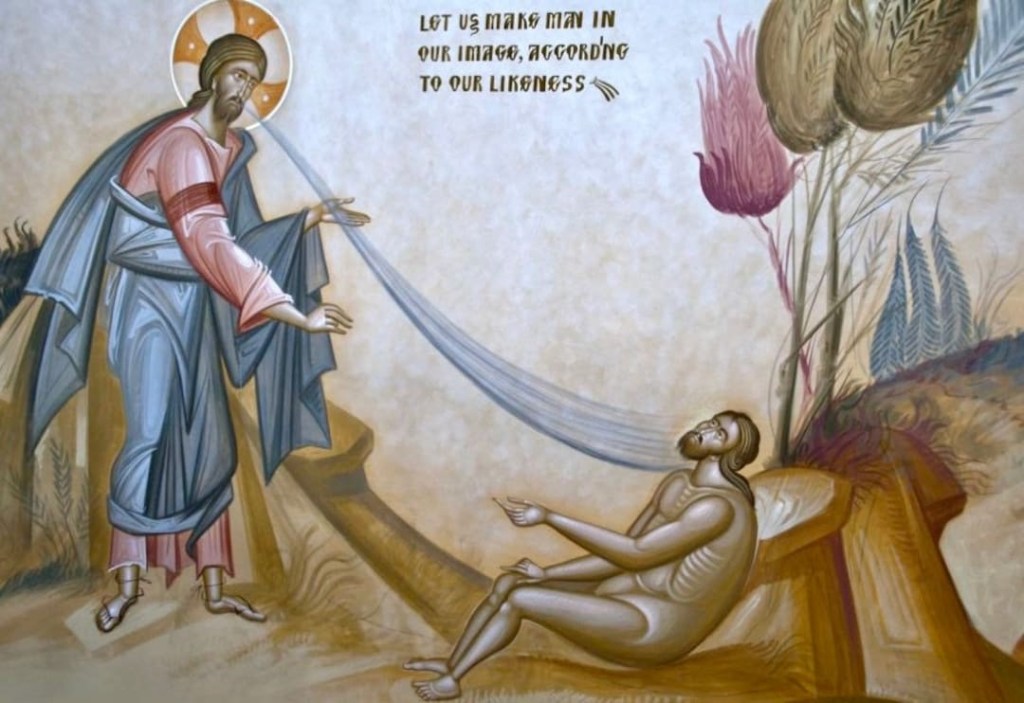
Being fruitful and multiplying — having and raising children — stem from man’s creation in God’s own image. God — whom we have come to know as the first Person of the Trinity and as Father — God simply Is; “I Am” is the Personal name by which he first revealed himself. God the Word, is eternally begotten of the Father, and God the Holy Spirit proceeds eternally from the Father. And that means, though it is beyond our language and even our comprehension, that God is essentially — God is by his very essence — generative, centrifugal (directed outward), expansive, not alone but in community. So, too, we human image-bearers are fashioned by God’s own hands, are inspired by his own breath, to be generative: to make art, to compose music, to build cities, to go to the moon — to create culture — and, yes, to have children. It is one of the most divine of all human enterprises; we create, we pro-create, to be like God.
We can take this reflection one step further by asking why God chose to create: why this universe? why this world? why these people? I can offer no better answer than this: to insist, along with St. John the elder, that God is love (1 John 4:8b) and that love is expansive. It moves outward. It creates: in the case of God, a world and a people; in the case of a husband and wife, children.
There is deep theology in the Prayer Book assertion that the union of husband and wife in heart, body, and mind was ordained by God for the procreation of children. At the heart of that deep theology is love. God, who is love, through love and for the sake of love created a universe, a world, and a species in his own image, and God gave his human image-bearers the mandate and the privilege of sharing in his love by their own co-creation of image-bearing children.
Yes. But, we must go deeper still, because love goes deeper still. Love plunges us headlong into the twin mysteries of humility and self-sacrifice, by which love is made manifest, by which love is known and by which its authenticity and purity are measured.
Babies are cute and sweet and they smell so good…until they don’t, until the stink of dirty diapers kicks in. Even thirty-one years later, I still remember it. I remember wondering how something as beautiful as my baby daughter could possibly create something that vile, pondering how pure milk could turn into…well, I’ll spare you the description. And that is when love demands — and teaches us — humility. Diaper by diaper we clean up the mess. Onesie by onesie we change the little one who spits up. And when the stomach bug strikes, we clean our shoes and the floor and the walls and the kid and everything else within projectile vomit range, again and again. Humble work, humbling work, the work that love demands. It is all part of being human. Love plunges us headlong into the mystery of humility.
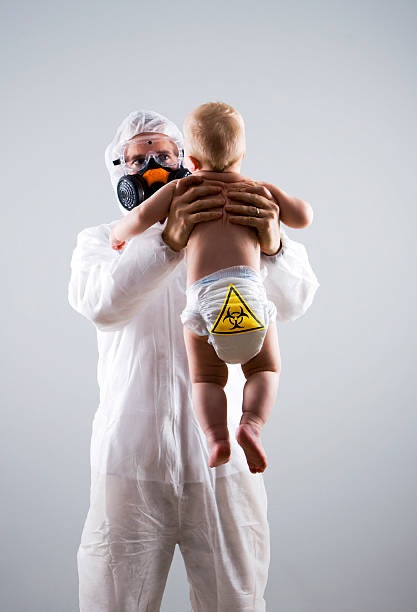
Love also plunges us headlong into the mystery of self-sacrifice. It starts with the mother-to-be who sacrifices her own body, in ways the male of the species can only faintly imagine, for the sake of the life growing in her. When the baby is born, there is the sacrifice of countless hours of parental sleep: proof that zombies are real and can hold down jobs and raise reasonably normal offspring. As the child grows there are hours sacrificed in carpools or in transporting the kiddo to practices or games or sleepovers. There is vacation money not used for vacation but sacrificially saved for college instead, new cars and homes not purchased so we parents can leave a little nest egg behind when we are no longer around. There is the sacrifice of peace as the child reaches the age where decisions have real consequences and can destroy lives. And, at some point, there is the sacrifice of letting go as the person you’ve raised your child to be goes away to be that person. Self-sacrifice, the price that love demands. It is all part of being human. Love plunges us headlong into the mystery of self-sacrifice.

Where have we gotten? So far I’ve said that we have children for the sake of love, because we are made in the image of the Creator God who is himself love. And, I’ve said that love plunges us headlong into the twin mysteries of humility and self-sacrifice, that it is humility and self-sacrifice that manifest love, that prove the authenticity and purity of love. And, I’ve said that all of this is just part of being human. Our discussion has proceeded quite reasonably and step by step and probably with little objection. But now, I am going to ask you to take the great leap of faith for which I can offer you no reason — no reason, but only story. Here is the great mystery that beggars our understanding: the humility and self-sacrifice demanded by love are not first and foremost just part of being human; they are part of being divine. If this strange night teaches us anything at all it is this: that the love of our God is made manifest in, shows its authenticity and purity in humility and self-sacrifice — not in our humility and self-sacrifice, but in God’s own.
Dirty feet — feet soiled with sweat and dust and the waste of man and beast — are little better, and maybe even a little worse, than a dirty diaper. And forget about Diaper Genies and warmed, scented wipes:
3 Jesus, knowing that the Father had given all things into his hands, and that he had come from God and was going back to God, 4 rose from supper. He laid aside his outer garments, and taking a towel, tied it around his waist. 5 Then he poured water into a basin and began to wash the disciples’ feet and to wipe them with the towel that was wrapped around him (John 13:3-5).
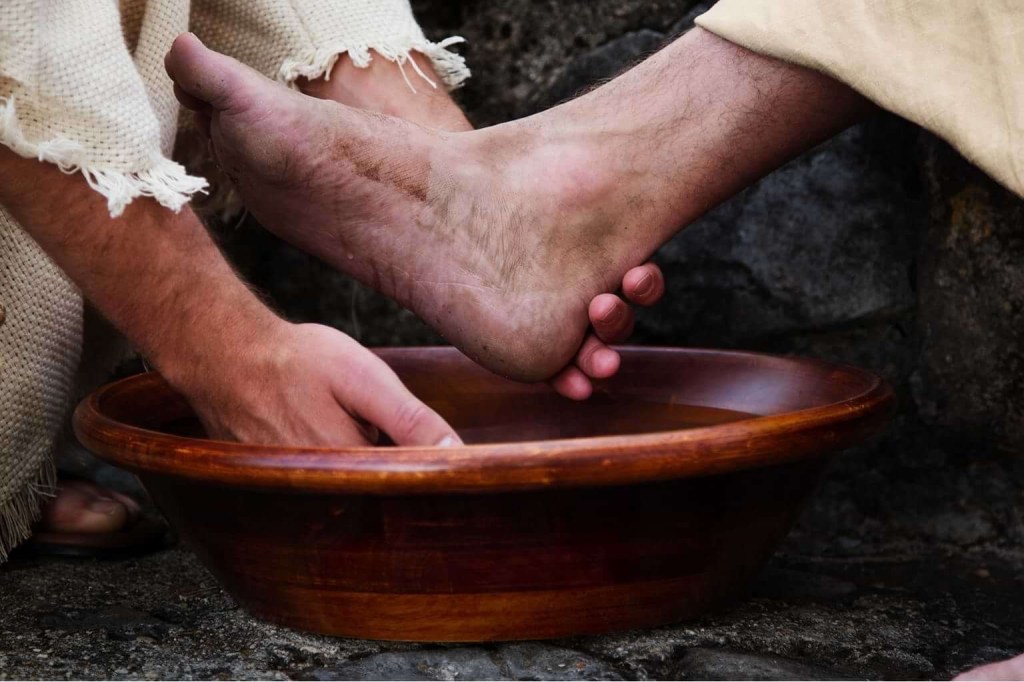
What a pitiful and poignant understatement this is: he laid aside his outer garments. St. Paul is more expressive. He opens the curtains to show us what Jesus really laid aside.
5 Christ Jesus, 6 who, though he was in the form of God, did not count equality with God a thing to be grasped, 7 but emptied himself, by taking the form of a servant (Phil 2:5b-7a).
Jesus not only laid aside his outer garments, he laid aside the dignity of Teacher and Lord, he laid aside the glory of the only-begotten Son of the Father, he laid aside the worship of angels and archangels shouting, “Holy, holy, holy!” And for what? For the humility of washing donkey and sheep dung off the feet of dull and dirty and bickering and prideful disciples. Look: that is our God kneeling there washing feet. And, make no mistake, it is our feet that he is washing — yours and mine — because love is made manifest in, shows its authenticity and purity in humility. This is where the story has come to. This is where we have brought the story: that to prove he loves us, God must strip and kneel before us and wash our dirty feet.
And his humility shows our pride:
Never, Lord! Never will you wash my feet!
But, if I don’t, you can have no part in me. To reject my humility is to reject my love.
Then not just my feet, Lord, but my head and my hands also.
Humiliate yourself even more for me, Lord, Peter said and we say in our prideful ignorance.
And our Lord does. If this strange night teaches us anything at all it is this, that the love of our God is made manifest in, shows its authenticity and purity in humility, but also in self-sacrifice.
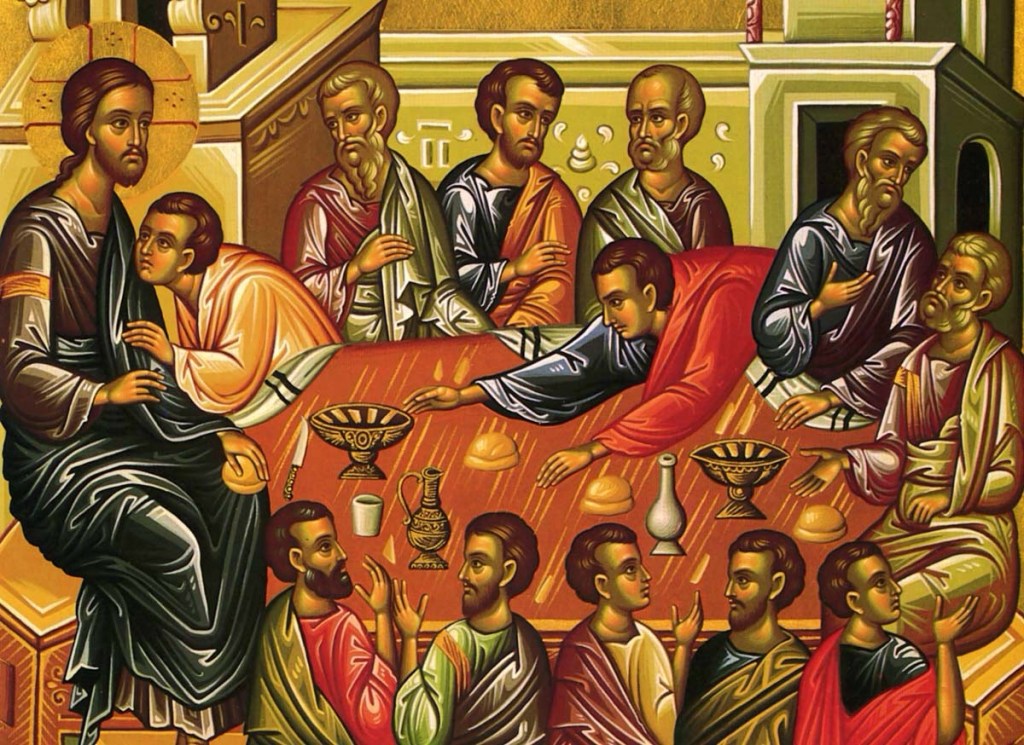
23 …the Lord Jesus on the night when he was betrayed took bread, 24 and when he had given thanks, he broke it, and said, “This is my body, which is for you. Do this in remembrance of me.” 25 In the same way also he took the cup, after supper, saying, “This cup is the new covenant in my blood. Do this, as often as you drink it, in remembrance of me.” 26 For as often as you eat this bread and drink the cup, you proclaim the Lord’s death until he comes (1 Cor 11:23b-26).
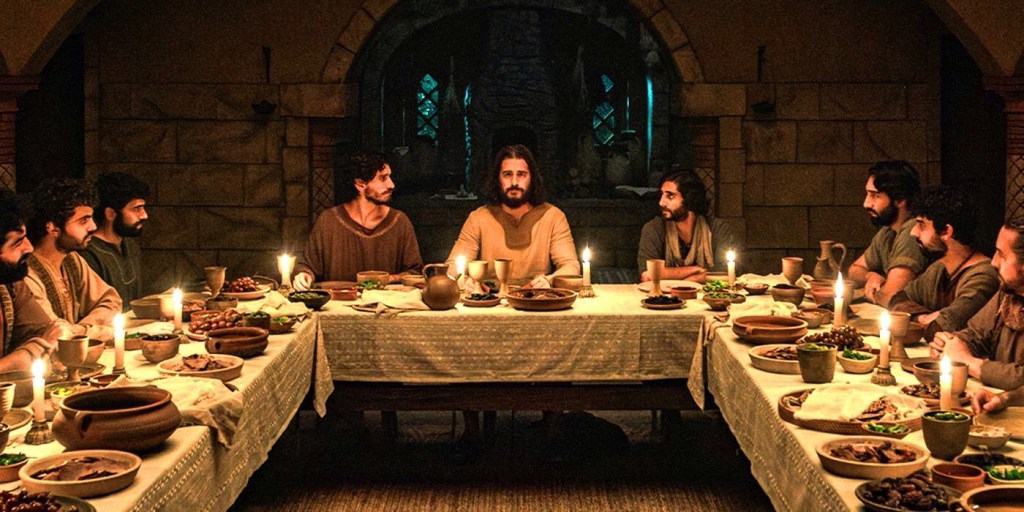
As scandalous as the washing of feet was and is — God humiliating himself before his creatures — this feast is even more shocking in the magnitude of divine self-sacrifice it proclaims and accomplishes. God the Son condescends to become man, to place himself fully in the hands of man — God submitting to the will of man — knowing that man will reject him and finally kill him: the love of God made manifest in, showing its authenticity and purity in divine self-sacrifice. And then God has the audacity to turn this most despicable act of deicide into a feast, into a cause of celebration so that as often as we eat this bread and drink this cup, we proclaim the Lord’s death until he comes.
Do you doubt I love you? Here, eat; it will help.
Do you fear I judge you? Here, drink this wine; you’ll feel better.
Do you dread death? Come to the table; there is nothing here but life.
This is a strange night. And, if this strange night teaches us anything at all it is this: that the love of our God is made manifest in, shows its authenticity and purity in humility and in self-sacrifice — the washing of feet and the institution of the feast of our salvation.
So, what are we to do with all this? There is no mystery there; Jesus told us.
12 When he had washed their feet and put on his outer garments and resumed his place, he said to them, “Do you understand what I have done to you? 13 You call me Teacher and Lord, and you are right, for so I am. 14 If I then, your Lord and Teacher, have washed your feet, you also ought to wash one another’s feet. 15 For I have given you an example, that you also should do just as I have done to you. 16 Truly, truly, I say to you, a servant is not greater than his master, nor is a messenger greater than the one who sent him. 17 If you know these things, blessed are you if you do them (John 13:12-17).
What are we to do with this foot washing? We are to wash feet, not just here once a year on this strange night; this is just a symbol, a good one, a good reminder, but just a symbol of the real thing. Follow your nose to the stink of the world. Strip off all outer garments of pride that hold you back. Kneel in the muck and the mess, and for the love of God that showed itself in humility, take some water and wash the feet of those whom he loves, of those who do not even know that he loves them. If you are Francis of Assisi that looks like kissing a leper. If you are Theresa of Calcutta that looks like helping the poorest of the poor die with dignity. If you are Andrew or Carol or Anthony or Missy of Knoxville, I don’t know what that looks like. But, follow your nose to the stink of the world and you will know.
What are we to do with this feast? We are to eat and drink. We have been invited, after all, and to turn down such an invitation would be boorish. But, notice that our invitation includes a plus-one, so bring someone with you whenever you can. And, in our eating and drinking we are to remember the divine self-sacrifice the feast entailed, and we are to heed the dismissal of the feast in which we are told to “go in peace to love and serve the Lord” (BCP 2019, p. 122), knowing that to love and to serve will require our own self-sacrifice.
This is a strange night. And, if this strange night teaches us anything at all it is this: that the love of our God is made manifest in, shows its authenticity and purity in humility and in self-sacrifice. The same is true for the love all who would take up their cross and follow him. Amen.


 First Blessings