Apostles Anglican Church
Fr. John A. Roop
Look again. What do you see?
(Ezek 37:1-14, Ps 130, Rom 6:15-23, John 11:1-44)
In the name of the Father, and of the Son, and of the Holy Spirit. Amen.
It is late; the day is past and deep darkness covers the land. A childless, old man from southern Iraq — the husband of a childless, old woman from the same land between the rivers — sits inside his tent pondering. For some time now he has been wandering a land not his own, surrounded by a people not his own. For some time now he has been wondering about the visions he sees and the voice he hears. Can this unknown god who called him make good on promises made, or is the covenant only a piece of parchment — not even that because nothing was ever written down and there were no witnesses? And then, in that pensive moment:
1 … the word of the Lord came to Abram in a vision: “Fear not, Abram, I am your shield; your reward shall be very great” (Gen 15:1).
Was it courage or desperation or disappointment or something else entirely that drove Abram to respond? Who knows? Only this time Abram leaned into the vision, pushed back in challenge of the voice.
2 But Abram said, “O Lord God, what will you give me, for I continue childless, and the heir of my house is Eliezer of Damascus?” 3 And Abram said, “Behold, you have given me no offspring, and a member of my household will be my heir” (Gen 15:2-3).
Abram accuses God — accuses God — of failure to keep his word, or at least of being slack about it.
4 And behold, the word of the Lord came to him: “This man shall not be your heir; your very own son shall be your heir.” 5 And he brought him outside and said, “Look toward heaven” (Gen 15:4a).
Now, what follows is the rest of the conversation as it plays out in my imagination.
“Look toward the heavens, Abram. What do you see?”

Then, looking upward into a darkness we can only imagine, at a panoply of celestial lights that were near blinding, Abram says, “Stars: I see stars.”
“How many?” the voice asks.
“More than I can count; I have no number,” the old man says.
“Look again, Abram. What do you see? Not stars, but children, your children, more than you can count, broadcast across the earth as the stars are broadcast across the sky. As my covenant stands with the stars — my law by which they burn and shine and praise — so, too, does my covenant stand with you and with your offspring.”
And to this, the old man has no reply except this: 6 And he believed the LORD, and he counted it to him as righteousness (Gen 15:6).
Look again. What do you see?
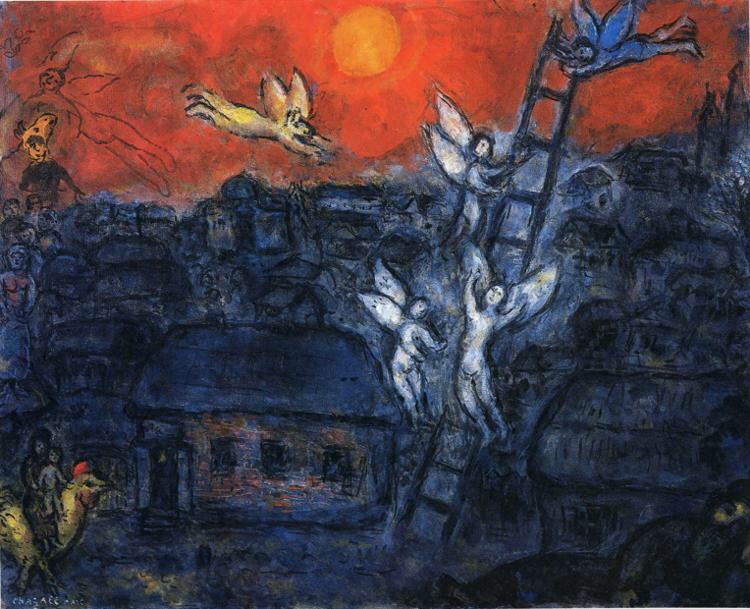
Two generations later, Abram’s conniving grandson Jacob is on the run from his brother, fleeing back to the old country from which Abram had come. As he beds down for the night, he takes “one of the stones of the place, he put it under his head and lay down in that place to sleep” (Gen 28:11). Before you drift off, Jacob, take a look around. What do you see? “A very uncomfortable pillow and a hard-packed dirt mattress,” he might have responded with a note of self-pity. But then, perhaps sleeping fitfully:
12 … he dreamed, and behold, there was a ladder set up on the earth, and the top of it reached to heaven. And behold, the angels of God were ascending and descending on it! 13 And behold, the Lord stood above it and said, “I am the Lord, the God of Abraham your father and the God of Isaac. The land on which you lie I will give to you and to your offspring. 14 Your offspring shall be like the dust of the earth, and you shall spread abroad to the west and to the east and to the north and to the south, and in you and your offspring shall all the families of the earth be blessed. 15 Behold, I am with you and will keep you wherever you go, and will bring you back to this land. For I will not leave you until I have done what I have promised you” (Gen 28:12-15).
So, Jacob. Look again. What do you see?
16 … “Surely the Lord is in this place, and I did not know it.” 17 And he was afraid and said, “How awesome is this place! This is none other than the house of God, and this is the gate of heaven” (Gen 28:16-17).
Not a stone pillow and a patch of dirt for a bed, but the very house of God, the gate of heaven, the land of the promise.
Look again. What do you see?
Generations come and go: past the Patriarchs, past the Exodus and the great wandering, past the conquest and settlement of the land, past the Judges, past the United Kingdom, well into the dissolution of kings and kingdoms. The king of Syria was warring against Israel and against Elisha, the prophet of Israel. Hearing that the prophet was in Dothan, the Syrian king sent horses and chariots and a great army and surrounded the town by night.
15 When the servant of the man of God rose early in the morning and went out, behold, an army with horses and chariots was all around the city. And the servant said, “Alas, my master! What shall we do?” 16 He said, “Do not be afraid, for those who are with us are more than those who are with them” (2 Ki 6:15-16).
Look around. What do you see, servant of the prophet? Syrians: enemy horses and chariots and a great army. Look again. What do you see?
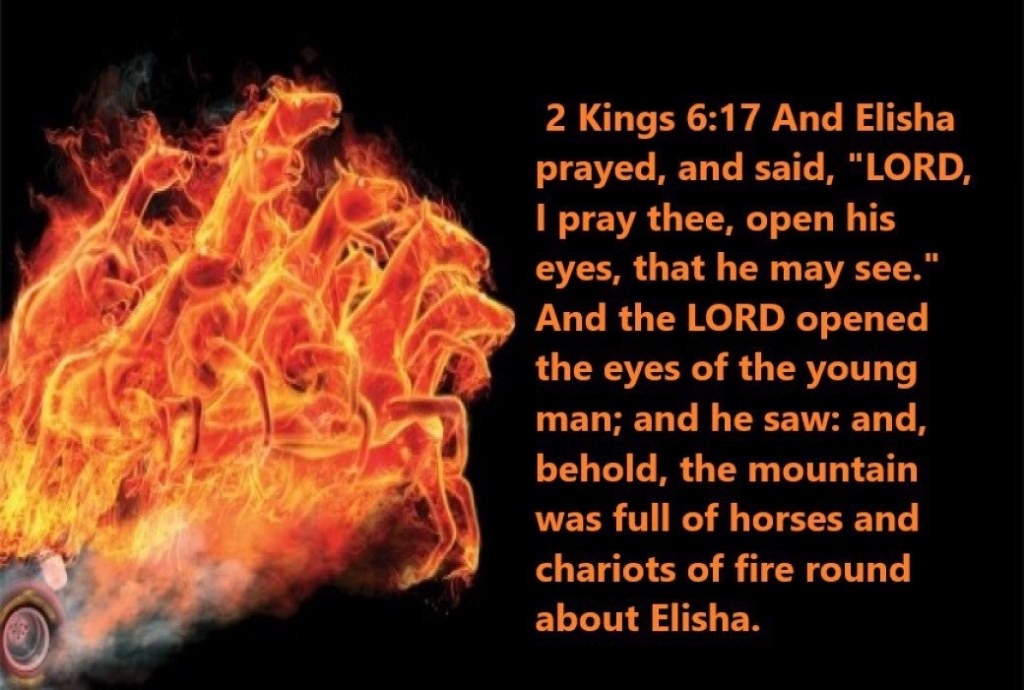
17 Then Elisha prayed and said, “O Lord, please open his eyes that he may see.” So the Lord opened the eyes of the young man, and he saw, and behold, the mountain was full of horses and chariots of fire all around Elisha (2 Ki 6:17).
Look again. What do you see? “Oh, my Lord, I see the fiery horsemen and chariots of God Almighty!” Yes. Yes, you do.
We could multiply examples — both Old and New Testaments — to show that this theme runs like the River Jordan throughout the whole of Scripture: things are not always — perhaps not even usually — what they seem. Look again. What do you see?
The prophet Ezekiel lived in the sixth century B.C. among the Judean exiles somewhere near the Chebar Canal in Babylon; the whole of his twenty year priestly and prophetic ministry was spent away from the land of promise, away from the Temple, away from any semblance of covenant fulfillment. Look around, Ezekiel. What do you see?
I see the end of all things. I see death and destruction. I see the glory of God leaving the Temple: abandoning his holy place, abandoning his people to the curse of the Law. I see — I hear of — the destruction of the Temple and the city. I see wave upon wave of exiles in forced march toward a foreign land, toward a slavery not in Egypt this time, but in Babylon. I see my people and their hopes slain and scattered on the ground. I see a valley of dry bones, the bones of the whole house of Israel — hopeless, cut off, very dry.
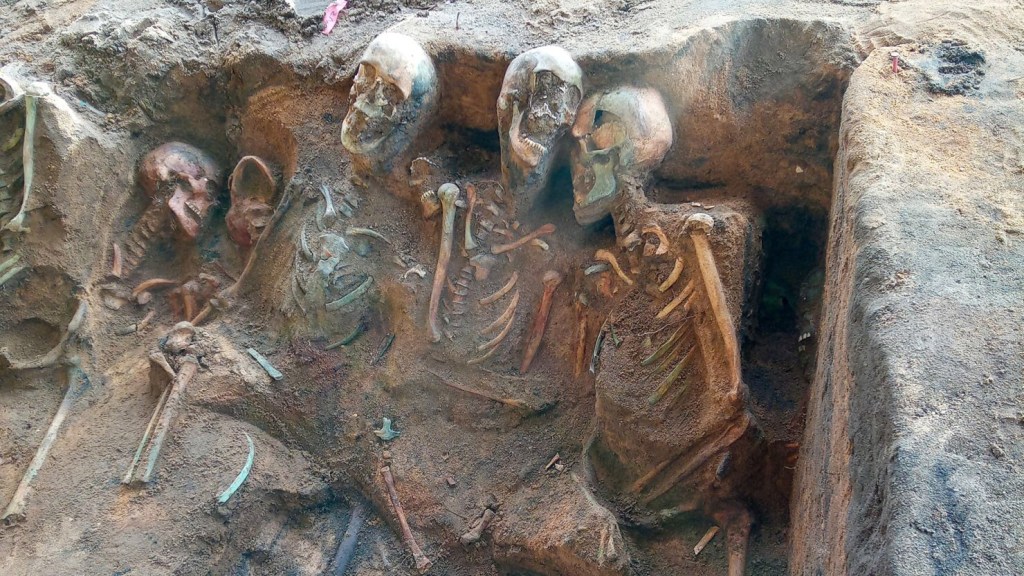
Are you not a priest, Ezekiel? Are you not a prophet? Have you no prophetic word to speak to these bones? Then the LORD said to Ezekiel:
4 …“Prophesy over these bones, and say to them, O dry bones, hear the word of the Lord. 5 Thus says the Lord God to these bones: Behold, I will cause breath to enter you, and you shall live. 6 And I will lay sinews upon you, and will cause flesh to come upon you, and cover you with skin, and put breath in you, and you shall live, and you shall know that I am the Lord.”
7 So I prophesied as I was commanded. And as I prophesied, there was a sound, and behold, a rattling, and the bones came together, bone to its bone. 8 And I looked, and behold, there were sinews on them, and flesh had come upon them, and skin had covered them. But there was no breath in them (Ezek 37:4-8).
Look again, Ezekiel. What do you see? I see bodies: bone to bone, sinews, flesh, and skin. But there is no life in them.
Are you not a priest, Ezekiel? Are you not a prophet? Have you no prophetic word to speak to these bodies? Then the LORD spoke again to Ezekiel:
9 …“Prophesy to the breath; prophesy, son of man, and say to the breath, Thus says the Lord God: Come from the four winds, O breath, and breathe on these slain, that they may live.” 10 So I prophesied as he commanded me, and the breath came into them, and they lived and stood on their feet, an exceedingly great army (Ezek 37:9-10).
Look again, Ezekiel. What do you see? Dry bones, hopeless, cut off? No, I see an army, an exceedingly great army.

Yes, but look again. There is more. What do you see?
11 …“Son of man, these bones are the whole house of Israel. Behold, they say, ‘Our bones are dried up, and our hope is lost; we are indeed cut off.’ 12 Therefore prophesy, and say to them, Thus says the Lord God: Behold, I will open your graves and raise you from your graves, O my people. And I will bring you into the land of Israel. 13 And you shall know that I am the Lord, when I open your graves, and raise you from your graves, O my people. 14 And I will put my Spirit within you, and you shall live, and I will place you in your own land. Then you shall know that I am the Lord; I have spoken, and I will do it, declares the Lord” (Ezek 37:11-14).
Look again. What do you see? Graves opened, bodies rising: this is the great day of resurrection. This is Spirit and life. This is end of exile. This is the Lord’s doing, the fulfillment of the covenant, the end of death, the renewal of all things.
Prophesy, Son of man. Look again. What do you see?
Six centuries come and go until another Son of Man receives word from dear friends, Mary and her sister Martha, about their brother Lazarus: “Lord, he whom you love is ill.”
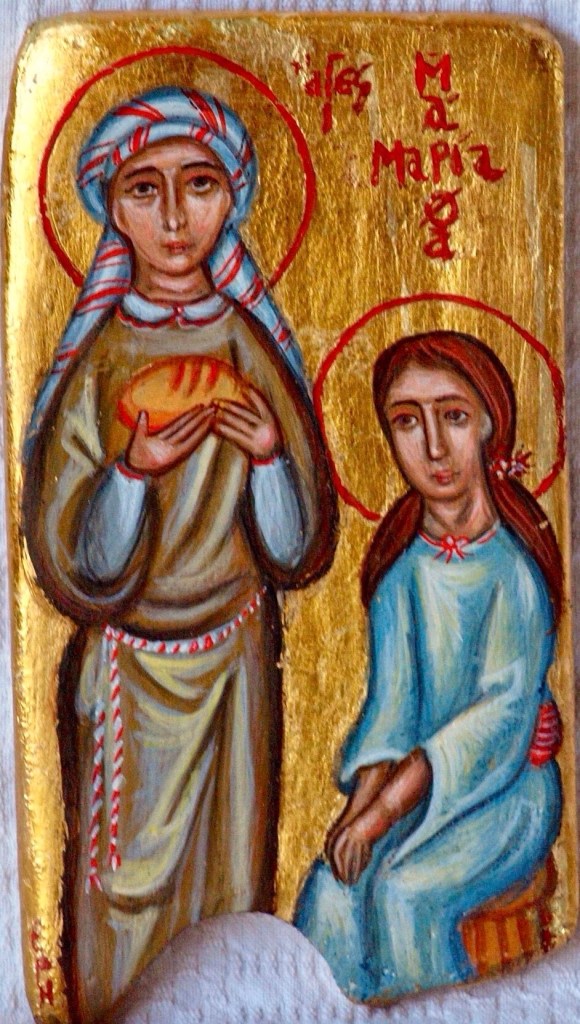
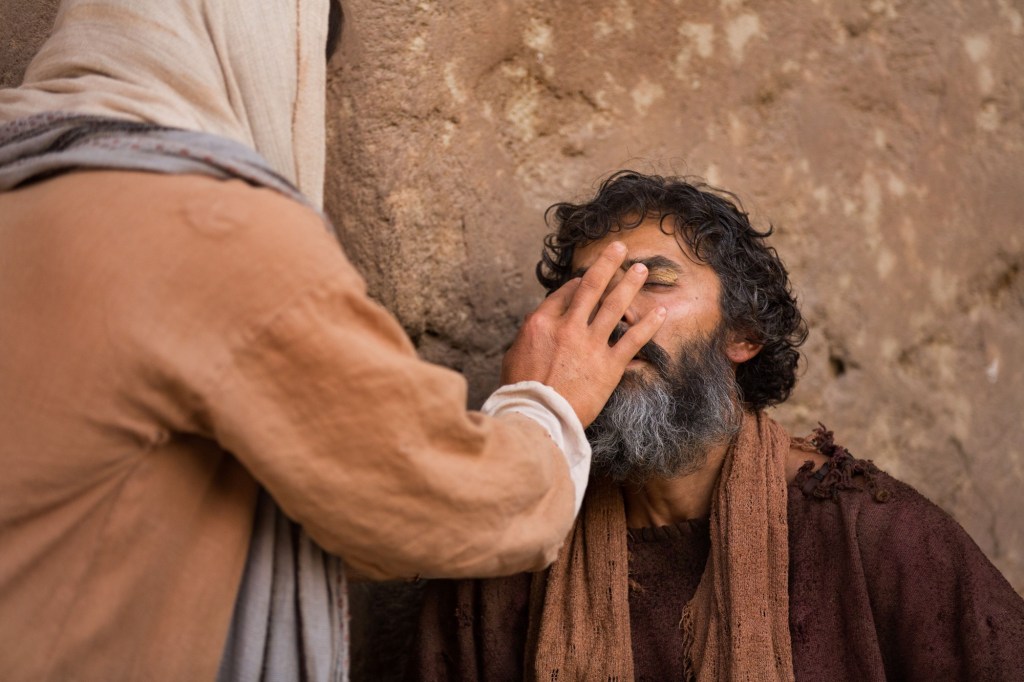
Jesus could have spoken a word to the messenger, “Go, tell the sisters that their faith has healed their brother.” Had he done, Lazarus would surely have been healed from that very moment; his followers had seen him do this before. But he did not speak that word. Jesus could have left immediately and headed for Bethany; his disciples — and the sisters — likely expected him to do. Had he done, he might have arrived in time to place his hand on Lazarus’s head and rebuke the fever. But he did not leave. He waited: one day, then another — long enough for Lazarus to die.
Four days after the sisters’ message had first arrived, Jesus himself finally arrived in Bethany. Martha came out to meet him; Mary did not. What did she see? An enigma? A disappointment?
21 Martha said to Jesus, “Lord, if you had been here, my brother would not have died. 22 But even now I know that whatever you ask from God, God will give you” (John 11:21-22).
Does Martha speak a rebuke or merely the facts? If you had been here….
Look again, Martha. What do you see? A friend who has disappointed you? A wonder worker who had healed others but not his own friend, not your brother? A prophet of God whom you thought you knew well, but who now has left you puzzled and confused?
Look again. What do you see?
25 Jesus said to her, “I am the resurrection and the life. Whoever believes in me, though he die, yet shall he live, 26 and everyone who lives and believes in me shall never die. Do you believe this (John 11:25-26)?
Martha says she believes, but her later actions shows that she does not fully understand, not yet.
This encounter is repeated a bit later with Mary: if you had been here. And then they all wept together: the Jewish mourners, the sisters, Jesus.
“Take me to the tomb,” Jesus said, and they escorted him to a cave with a stone sealing its entrance. It is tempting to stop the narrative here to say, “Look, Jesus. What do you see?” But we know the answer. He sees his own tomb just a few days hence. He sees his own body, cold and lying in a stone-sealed cave. He sees the two sisters and his own mother weeping once again and more bewildered than ever.
39 Jesus said, “Take away the stone.”
And here Martha, ever the pragmatic one, betrays her lack of understanding.
Martha, the sister of the dead man, said to him, “Lord, by this time there will be an odor, for he has been dead four days” (John 11:39).
Look, Martha. What do you see? A grave with the decaying body of my brother. His distraught friend come too late for a healing. A futile gesture of…what? What does Jesus think he’s doing?
Look again, Martha. What do you see?
40 Jesus said to her, “Did I not tell you that if you believed you would see the glory of God?” 41 So they took away the stone. And Jesus lifted up his eyes and said, “Father, I thank you that you have heard me. 42 I knew that you always hear me, but I said this on account of the people standing around, that they may believe that you sent me.” 43 When he had said these things, he cried out with a loud voice, “Lazarus, come out” (John 11:40-43).
Now look again, Martha. Look again, Mary. Look again you mourning and skeptical Jews. Look again, you confused disciples. Look again, Judas. What do you see?
44 The man who had died came out, his hands and feet bound with linen strips, and his face wrapped with a cloth. Jesus said to them, “Unbind him, and let him go” (John 11:44).
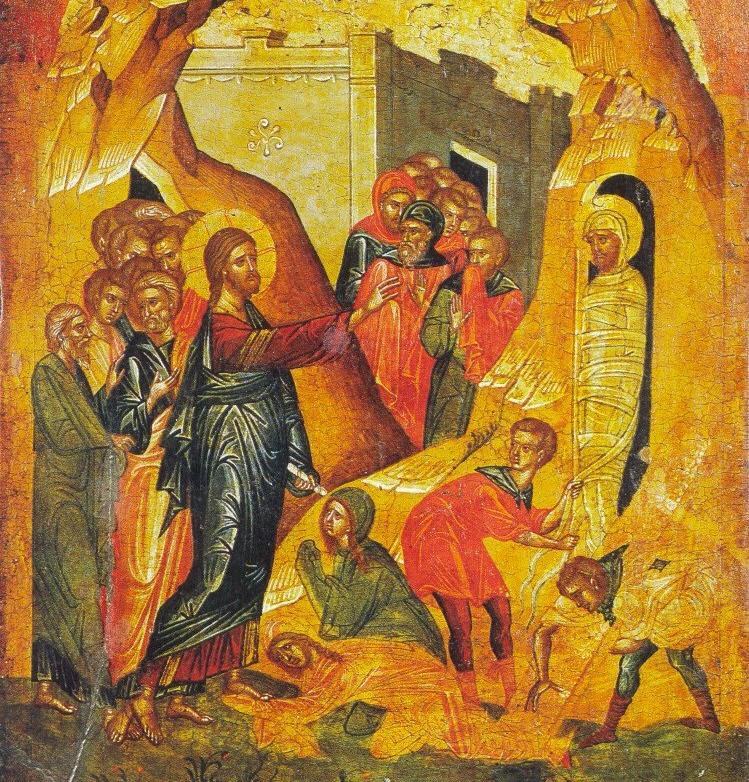
Look again, all. What do you see? This is a sign of resurrection. This is a sign of life. This is a foretaste of the whole house of Israel — a valley full of dry bones — becoming a mighty army.
Look again, all. What do you see? This man, this friend, this rabbi, this puzzle standing before you is the resurrection and the life; is the Christ; is the Son of God who has come into the world; is the fulfillment of every covenant, every promise made by God to his people; is the Lamb of God who takes away the sin of the world; is the victor over death and hell; is the redeemer of all and the one who will renew all things.
Look again, all. What do you see?
If we are honest — and we might as well be — it is hard to see. It is hard to see when our hearts are broken by promises unkept or delayed. If it hard to see when our eyes are filled with tears of grief. It is hard to see when our minds are clouded with doubt or confusion or disappointment. What will open our eyes? What will help us look again? A prophetic voice like Ezekiel’s calling for dry bones to live again. A prayer like Jesus’s in the full assurance that the Father — his Father and our Father — already knows and already has heard. A fear shattering and death defying Gospel proclamation, a shout of “Come forth!” spoken into the maw of an open tomb. This is what we need to look again: prophetic voice, faithful prayer, Gospel proclamation.
And for this we need one another. I cannot speak that prophetic voice to myself in the midst of my own valley of dry bones. I need your voice speaking the prophetic word, the word of God. I may not be able to pray in full assurance when I am facing down my own death or the death of one I love — whether the death of hopes and dreams and expectations or of body. I need your prayer. I may not be able even to whisper or stammer a proclamation of the Gospel when facing my own dark abyss. I need you to shout to me in the bold foolishness of faith, “Come forth!” I need you, and you need me, and we need one another to say, “Look again. What do you see?”
And the world needs our prophetic voice, our faith-filled prayer, our Gospel proclamation — our shout of victory, the victory of Christ. The world is, at this moment, as blind as I have ever seen it. Look, world. What do you see? Enemies on every side. Threats within and without. Distrust and suspicion. Wars and rumors of wars. A creation groaning and coming apart at the seams. A social order straining under the weight of careless neglect and abuse of power, of social covenants made and broken. Fools and despots and foolish despots running the world headlong toward the precipice.
Where is our prophetic voice? Where is our faithful prayer? Where is our proclamation of the Gospel, our cry of command and victory? The truth has not changed. By God — by God — the valley of dry bones can rise again into an exceedingly great army. It is only awaiting the prophetic voice. The Lord Jesus is still praying — not outside his friend’s tomb but at the right hand of his Father — and is uniting our prayers to his own, if only we will pray. And we still have something to proclaim — do we not? — good news to those still in the grave: “Jesus is Lord! Come forth!”
So, look again. What do you see?
Amen.


 First Blessings