Apostles Anglican Church
Fr. John A. Roop
Introduction to St. Paul’s Letter To the Colossians
The Lord be with you.
And with your spirit.
Let us pray.
You are Jesus Christ, Word of God. Begotten before the light, creator together with the Father. You are the fashioner of man, all in all.
You are the bridegroom of the church, the charioteer of the cherubim, and captain of the angels. You are God who is from God, Son from the Father, Jesus Christ the King forevermore. Amen (abbrev. from Melito of Sardis (+AD 180), Fount of Heaven: Prayers of the Early Church, ed. Robert Elmer, Lexham Press (2022), pp. 38-39).
INTRODUCTION
Over the past several weeks we have been reading St. Paul’s epistles in the Daily Office and our formation classes have focused on broad overviews of those letters. Some of them, like Romans, consist of a carefully crafted argument, so we had to tackle the entire letter step-by-step — quite a feat in just one or two sessions per letter! The epistle we consider today, Colossians, is a bit different in structure; it is front loaded. By that I mean that the core of the letter is presented first and the rest of the letter follows directly on from that. So, rather than an overview of the whole, we will do a deeper dive into the first chapter. With that firmly in place, it is relatively straightforward to see how St. Paul develops those main ideas. First, a bit of background on the correspondence.
BACKGROUND
In the early to mid-50s of the first century, Colossae sat as the smallest of a trio of cities — Colossae, Laodicea, Hieropolis — about 100 miles east of Ephesus, up the Lycus River valley.
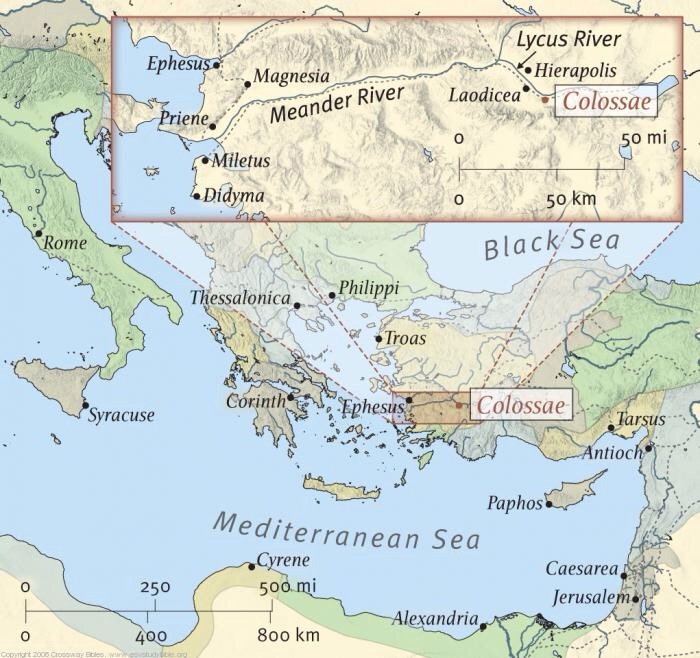
That location and that timing are significant because they bring the Colossians within the orbit of St. Paul’s ministry in Ephesus which began circa A. D. 52 and continued for some three years. Paul did not found the church in Colossae, and there is no evidence that he ever visited the city. It is more likely that a resident of Colossae — and here we know his name, Epaphras — encountered Paul in Ephesus, heard the Gospel from Paul, embraced it and spread the good news about Jesus when he returned home. Perhaps it was Epaphras who sent others to hear Paul in Ephesus, notably Philemon and Apphia, possibly Philemon’s wife. These became the nucleus of the Colossian church which met in Philemon’s house. Sometime later — and there is scholarly debate about when and where — Philemon’s slave Onesimus fled his master, made his way to Paul, and became Paul’s son in the the faith. It was for the sake of Onesimus that Paul wrote to Philemon; these two letters, Colossians and Philemon, belong together and should be read as a pair.

Paul wrote the letter to this small church in Colossae while he was in prison. But, where and when this imprisonment was is a matter of some debate. Traditionally, it has been held that Paul wrote from Rome in the early 60s. But, there is a strong and growing minority opinion that Paul was actually imprisoned in Ephesus during his three years there; there are hints of it in the Corinthian correspondence (1 Cor 15:32, 2 Cor 1:8-11), and we know from Acts that there was “no little disturbance” concerning Paul and his preaching of “the Way” in Ephesus — a riot stirred up by Demetrius and the devotees of the goddess Artemis (Acts 19). Paul’s preaching threatened both religion and commerce in Ephesus and those two powers conspired against him. It is not unreasonable to think that opposition might have led to his imprisonment, and, frankly, an Ephesian imprisonment makes more logistical sense of Paul’s ministry and correspondence relative to Colossae than does the Roman imprisonment. But, I will gladly leave that dispute to the scholars. It really doesn’t affect our discussion at all.
Much of this background information can be gleaned from the Letter to the Colossians, particularly from the salutation (Col 1:1-8) and the concluding greetings (Col 4:7-18). In summary, St. Paul writes this letter to a church at one remove — founded not by Paul but by Paul’s converts — to people some of whom he knows quite well and in whose spiritual lives he has been very influential. Though he writes from prison, this is a letter of hope, and joy, and encouragement. It is also — like most of Paul’s letters — an occasional letter: something prompted it; he is responding to some issue. In the case of Colossians, it seems that Paul is responding to one or more doctrinal challenges — heresies — that are troubling the church and attempting to gain footholds there. These false doctrines are not identifiable with any singular known heresy. There seem to be elements of the Judaizers, possibly elements of proto-gnosticism (though this letter predates the origins of gnosticism proper), elements of pagan religion, and possibly of some syncretistic blend of several of these elements with a corresponding relativizing of Jesus.
Here are some of the textual hints about the nature of the problems the church faces.
Colossians 2:1-4, 8
1 For I want you to know how great a struggle I have for you and for those at Laodicea and for all who have not seen me face to face, 2 that their hearts may be encouraged, being knit together in love, to reach all the riches of full assurance of understanding and the knowledge of God’s mystery, which is Christ, 3 in whom are hidden all the treasures of wisdom and knowledge. 4 I say this in order that no one may delude you with plausible arguments (Col 2:1-4).
8 See to it that no one takes you captive by philosophy and empty deceit, according to human tradition, according to the elemental spirits of the world, and not according to Christ (Col 2:8).
Here the problem is empty philosophy, human traditions, and the elemental spirits/principles (στοιχειον) of the world — all things that are opposed to Christ. Philosophy might point toward proto-gnosticism with its emphasis on hidden knowledge available only to the adepts. Human tradition could nod toward Judaism. And then there are the elemental spirits (principles) of the world, an unusual term that will appear again in the letter. It might refer to a type of paganism in which elements of the natural world are worshipped as spiritual beings; think of the gods of Egypt, e.g. the god of the Nile, which God judged in the Exodus. Or, it might actually refer to principles in the Jewish Law. Or, it might be more along the lines of the spiritual principles behind the fallen world: power, sex, money, honor — what we might called the zeitgeist, the spirit of the age. The details matter little, because the remedy is the same for all these possible meanings.
Colossians 2:16-18
16 Therefore let no one pass judgment on you in questions of food and drink, or with regard to a festival or a new moon or a Sabbath. 17 These are a shadow of the things to come, but the substance belongs to Christ. 18 Let no one disqualify you, insisting on asceticism and worship of angels, going on in detail about visions, puffed up without reason by his sensuous mind (Col 2:16-18).
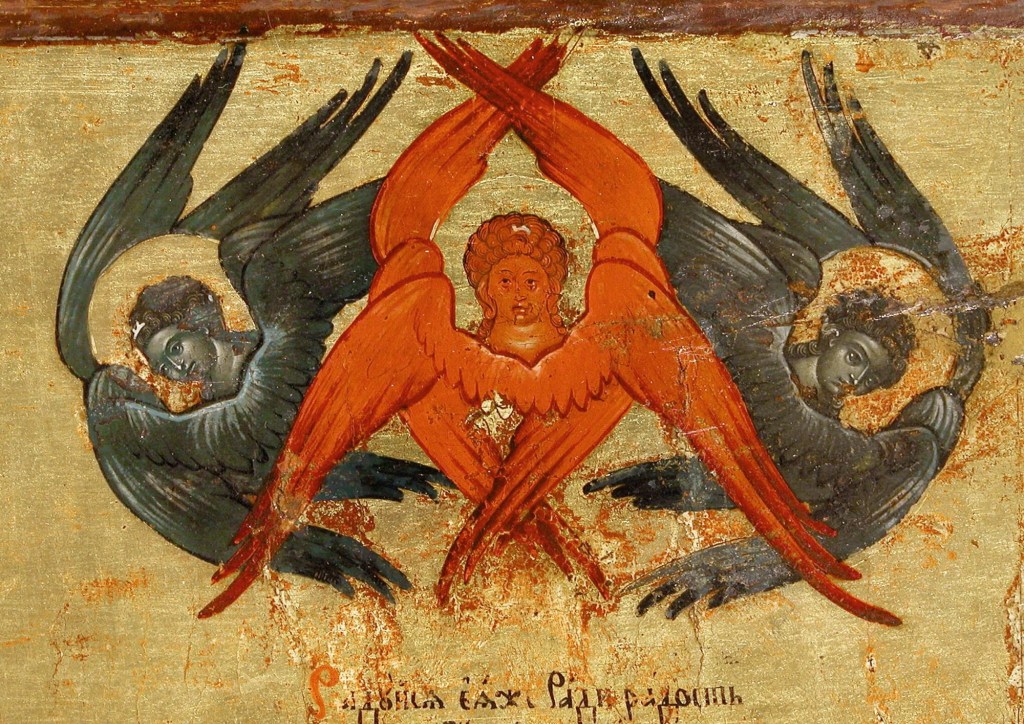
The first part of this — food and drink; festivals, new moons, Sabbaths — seems to indicate pressure from Judaizers much like Paul addressed in his Galatian letter. The latter part — visions, angels, sensuous mind — could again be proto-gnosticism or even a form of paganism. But again, the remedy is more significant than the individual symptoms, and it is the same for all.
With this background, let’s turn to the text.
COLOSSIANS 1
St. Paul’s Prayer (Col 1:9-14)
St. Paul opens the letter in his characteristic manner, with a greeting that includes (1) his identity as author, (2) the identity of the recipients, (3) sometimes a brief description of their relationship, and (4) a blessing, often with a prayer. It is the prayer in verses 9-14 that I would like to focus on.
9 And so, from the day we heard, we have not ceased to pray for you, asking that you may be filled with the knowledge of his will in all spiritual wisdom and understanding, 10 so as to walk in a manner worthy of the Lord, fully pleasing to him: bearing fruit in every good work and increasing in the knowledge of God; 11 being strengthened with all power, according to his glorious might, for all endurance and patience with joy; 12 giving thanks to the Father, who has qualified you to share in the inheritance of the saints in light. 13 He has delivered us from the domain of darkness and transferred us to the kingdom of his beloved Son, 14 in whom we have redemption, the forgiveness of sins (Col 1:9-14).
How often do we pray for the church? Certainly, we “pray for the Church and for the world” (BCP p. 128) during the Prayers of the People at each Eucharist, so, weekly at a minimum. Paul says that he has not ceased praying for the church at Colossae from the day he first learned of it.
What do we pray for the church? There are some profoundly good prayers for the local congregation in the BCP (p. 649) which may be incorporated into the Daily Office. Here is one:
Almighty and everlasting God, you govern all things in heaven and on earth: Mercifully hear our prayers, and grant that in this Congregation the pure Word of God may be preached and the Sacraments duly administered. Strengthen and confirm the faithful; protect and guide the children; visit and relieve the sick; turn and soften the wicked; arouse the careless; recover the fallen; restore the penitent; remove all hindrances to the advancement of your truth; and bring us all to be of one heart and mind within your holy Church, to the honor and glory of your Name; through Jesus Christ our Lord. Amen.
What prayer did Paul offer for the local congregation at Colossae? He prayed that the church might: (1) be filled with knowledge of God’s will, a filling that would require spiritual wisdom and understanding, (2) walk (live) worthy of the Lord (Jesus), (3) bear fruit (of the Spirit?), demonstrated by works and knowledge, (4) be strengthened with power and might for endurance and patience with joy, (5) give thanks for God’s deliverance of them from the dominion of darkness to the kingdom of his Son.
Both of these prayers — our Anglican prayer and St. Paul’s prayer — are very good, and I encourage you, perhaps as part of your Lenten discipline, to pray for the local congregation, for Apostles, daily. Perhaps that is already your habit; if so, thanks be to God. In looking at St. Paul’s prayer, there are some key notions:
St. Paul is interested in knowledge: not the knowledge that the world gives, but the knowledge of God’s will that is discerned spiritually. The world has its type of knowledge and its ways of knowing, which, of course, we have too. But the church has a different way of knowing; we discern matters spiritually.
St. Paul is interested in behavior: how we walk (what we do), what kind of fruit we bear (see Gal 5:22-24). Paul simply does not pit faith against works; what we do, how we live, matters, and it must be compatible with the faith we profess.
St. Paul is interested in power: not in the kind of power that dominates others, but in the kind of power that gives us endurance in trials.
St. Paul is interested in grounding us in our identity. We were once slaves to the fallen powers of the kingdom of darkness, but now we are free citizens in the kingdom of God’s Son because of the redemption and forgiveness of sins we have in Jesus.
These are the characteristics the Colossian Christians must have to deal with the problems facing them. I can’t see that anything has changed.
St. Paul’s Hymn to Christ (Col 1:15-20)
Now, St. Paul moves quickly from prayer to praise, to an early Christian hymn to Christ. Here, at the outset, I want to make what may appear to be just a “picky” detail, but which is really essential. Col 1:13 makes clear that Paul is speaking of “the beloved Son” of God. That beloved Son, at a given point in human history, became flesh in the person of Jesus of Nazareth and fulfilled a vocation as the Christ/Messiah. The Son is co-eternal and consubstantial (of one essence) with the Father. Jesus, the incarnate God-man was born in time and became the Messiah of Israel. When we describe Col 1:15-20 as the Hymn To Christ, that is really short hand for the “Hymn To the Son, who took on flesh as Jesus of Nazareth and became the Christ.” All of this matters for a right understanding of Christ.
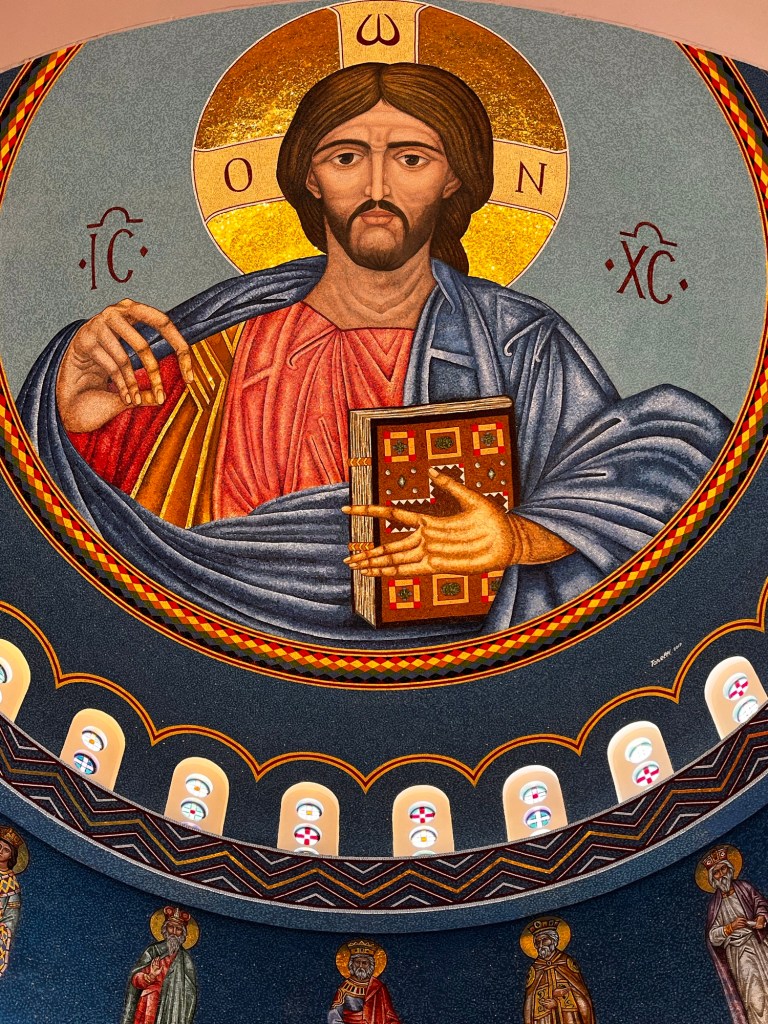
Whether St. Paul is quoting a hymn well-known to the church or composing one under the inspiration of the Holy Spirit is a matter of some debate. But these few verses are the heart of the letter. There is not a single problem facing the church in Colossae whose solution is not found in this hymn, because the solution to every problem is found in Christ himself.
Stanza 1
15 He is the image of the invisible God,
the firstborn of all creation.
16 For by him all things were created, in heaven and on earth, visible and invisible,
whether thrones or dominions or rulers or authorities —
all thing were created through him and for him.
17 And he is before all things, and in him all things hold together.
Stanza 2
18 And he is the head of the body, the church.
He is the beginning, the firstborn from the dead,
that in everything he might be preeminent.
19 For in him all the fullness of God was pleased to dwell,
20 and through him to to reconcile to himself all things, whether on earth or in heaven,
making peace by the blood of his cross.
Notice that the first stanza addresses the Son’s identity relative to creation: Who is the the Son and what is his position relative to created things? The second stanza addresses the Son’s identity relative to salvation: Who is the Son and what has he done relative to our salvation? The two stanzas parallel each other in their structure and content: compare (1) vs 15 to vss 18 and 19, (2) vs 16 to vs 20.
Now, let’s consider some of the details of the hymn.
Col 1:15-17 Christ and Creation
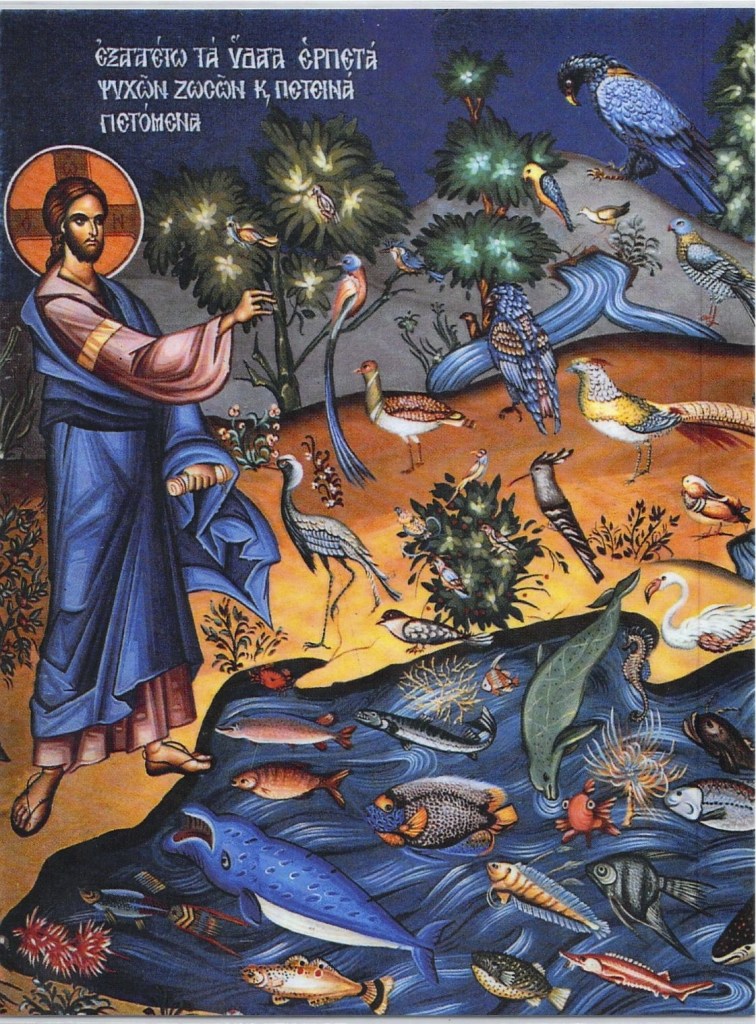
We have icons here at Apostles and have done from very early on. Some of our founding members were instrumental in forming an icon guild that painted icons and taught the spiritual craft to others. Have you thought much about how icons are used in prayer and worship? Consider an icon of a saint. When we look at that icon we are not meant to see so much the historical figure, but rather to see Christ manifest in the life of the saint. We look through the image on the board to see the face and character of Jesus as Jesus was present in the saint. Every image on every icon is flawed in this sense; the saint only very imperfectly imaged Jesus.
Why this talk about icons? In the Greek of Col 1:15, St. Paul calls Jesus εἰκὼν τοῦ θεοῦ, the icon of God, which we translate as the image of God. The Son, incarnate as Jesus, is the icon of God, the man in whom God is present, revealing himself, the perfect image of the Father. To see Jesus is to see the Father. And that icon is not flawed. That icon perfectly shows forth the image of the Father, “for in him all the fullness of God was pleased to dwell” (Col 1:19). When St. Thomas wanted to see the Father, Jesus told him, “If you have seen me, you have seen the Father.”
St. Paul goes on to say that the Son is the firstborn of all creation. Let’s start with what this does not mean. It does not mean that the Son of God was born in time, the firstborn, in that sense, of all created things. That is the heresy of Arius who said, “There was a time when the Son was not!” That heresy was condemned at the first Council of Nicea in A. D. 325. We reject it every time we say the Nicene Creed.
Firstborn, as used by Paul, is not a statement of order (first, second, third, etc.) but rather a positional title of authority and role. It is a matter of primogeniture: the right of the eldest child to inherit the property and authority and responsibility of his father. So, Paul maintains that Jesus is the firstborn of all creation in that sense: Jesus exercises the Father’s authority over all creation and inherits all creation as his own. And, that authority is more than a legal matter, more than something extrinsic; it is intrinsic to the relationship between Son and creation, just as the superiority of a creator is intrinsic in the creator-creation relationship. Paul explores that in 1 Col 1:16:
16 For by him all things were created, in heaven and on earth, visible and invisible,
whether thrones or dominions or rulers or authorities —
all thing were created through him and for him.
In summary, Paul says: all things in the physical realm and in the heavenly realm were created by, through, and for the Son. The Son is the active agent, the instrumental agent, and the receiving agent of creation. Let me offer an analogy. Suppose I decide to build a house. When it is complete, I can say — using passive voice — the house was built by me. Suppose further that I actually did the construction from top to bottom — a one-man affair. Then, I could also say that the house was built through me, that is, through my creativity, expertise, and effort. Lastly, since I plan to live in the house myself, I could say that the house was built for me. By me, through me, and for me: the house, in all respects, owes its existence to me. That is something like the relationship St. Paul envisions between the Son and creation. All creation owes it existence solely to the Son and owes its worship solely to the son.
St. Paul especially mentions that the Son created thrones and dominions and rulers and authorities. It is most likely that he is identifying specific ranks/choirs of angels as found in Jewish thought and later in Christian literature. Pseudo-Dionysius put forward a ninefold hierarchy of angels sometime in the 5th-6th centuries, and it became the standard scheme in much Christian thought:
• Seraphim
• Cherubim
• Thrones
• Dominions
• Virtues
• Powers
• Principalities
• Archangels
• Angels
If St. Paul is speaking of choirs of angels — as seems likely — he is asserting the primacy and superiority of the Son over the angels. Why? Remember that one of the heresies in Colossae was angel worship. We worship the creator of the angels, Paul says, and not the angels themselves.
To round out the relationship between the Son and creation, St. Paul says:
17 And he is before all things, and in him all things hold together.
Now, if you’ll allow, I’ll engage in a bit of anachronistic thinking. As sons of the Enlightenment, the prevailing religious notion of our Founding Fathers — at least of those who still believed in God at all — was deism, the notion that the Creator of the universe created a clockwork universe, wound it up to operate on its own, and then went away to do whatever it is that god does when not creating.
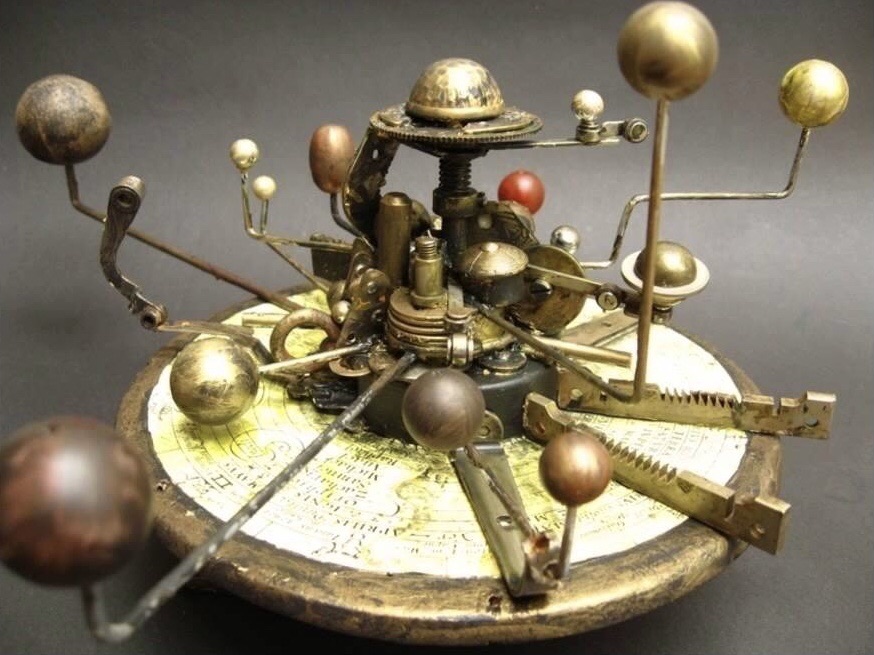
The notion of ongoing interaction between creator and creation was swept off the table. St. Paul really preempts that notion here by saying “in him all things hold together.” If the Son were absent from creation for an instant, if creation were ever out-of-sight-out-of-mind, then the center would not hold and all things would fly apart, dissolve. In St. Paul thinking, the sun rose today not due to pre-programmed natural laws but rather because once again God said, “Let there be light.” As the Psalmist said, “This is the day the LORD has made.” So, St. Paul insists that the Son is actively and personally involved in creation at every instant.
This is the first stanza which explores the Son’s identity relative to creation. The second stanza details the Son’s identity relative to salvation.
Col 1:18-20 Christ, the Church, and Salvation
18 And he is the head of the body, the church.
He is the beginning, the firstborn from the dead,
that in everything he might be preeminent.
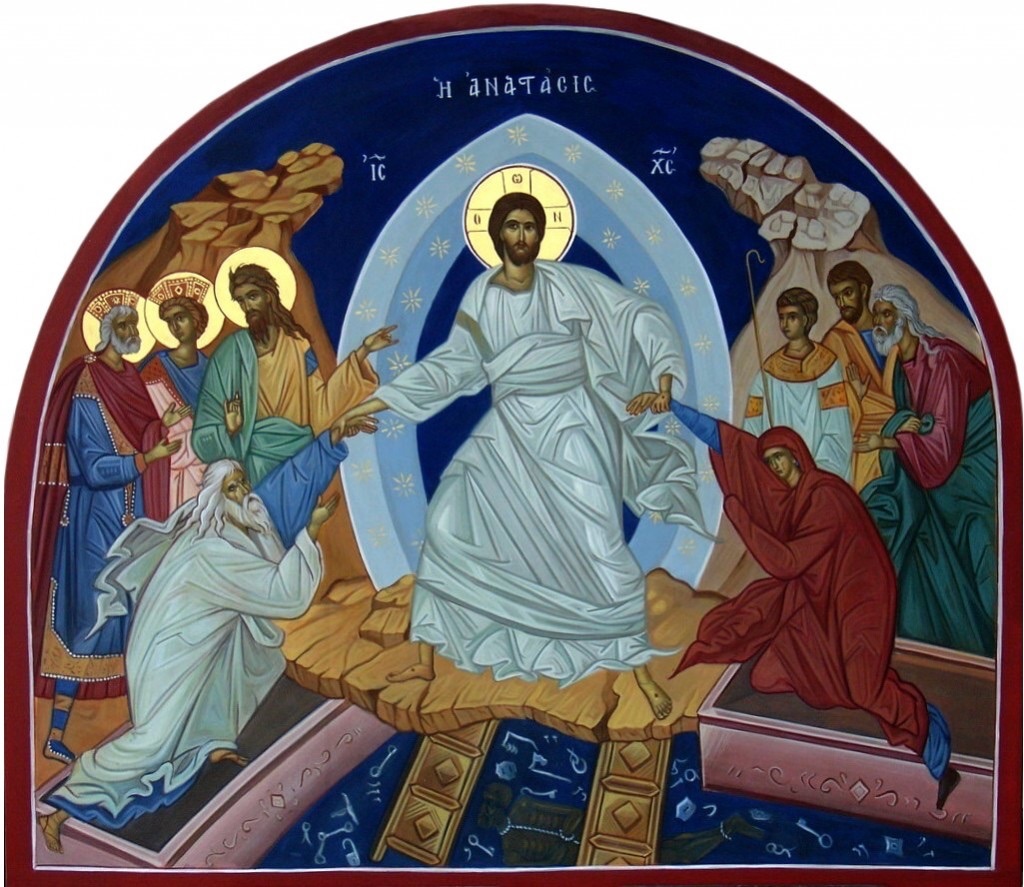
Notice that St. Paul begins this section on salvation with the Church, the body of Christ. In the 3rd century, the Christian Bishop Saint Cyprian of Carthage wrote, “Extra Ecclesiam nulla salus,” there is no salvation outside the Church. This is simply expressing the truth that salvation consists of incorporation into Christ, and that that entails incorporation into his body, the Church. St. Cyprian also wrote, “No one can have God for his Father, who does not have the Church for his Mother.”
The relationship between Christ and the Church is top-down, not bottom-up. Christ is the head, the sole and absolute authority in the Church , the one whose will the Church obeys. The Church is not some egalitarian club; it is an ordered, organic, hierarchy with Christ at its head. Christ is, in everything, and certainly in the Church, preeminent. Why is that true?
It is true because Christ is the beginning of all things, and certainly the beginning of the Church: no Christ, no Church. But, he is also head of the Church by virtue of being the firstborn from the dead. It is he who, by his resurrection, “broke the bonds of death, trampling hell and Satan under his feet” (BCP 2019, p. 133), who by his resurrection has become “the first fruits of those who have fallen asleep” (1 Cor 15:20). “For as in Adam all die, so also in Christ shall all be made alive” (1 Cor 15:22). And this shows the importance of Christ being head of the Church. What is true for the head, is true for the body. If the head is the firstborn from the dead, then, in due time, that body will follow.
Christ is also head of the Church by virtue of his nature, “for in him all the fullness of God was pleased to dwell” (Col 1:19). The Son is the perfect image (icon) of God in that there is no “transcription error” in going from Father to Son, but also in the fact that the icon is complete; there is nothing missing in the image.
At the right time, the Son became man, God incarnate. For what purpose? As we say in the Nicene Creed:
For us and for our salvation he came down from heaven,
was incarnate from the Holy Spirit and the Virgin Mary,
and was made man (BCP 2019, p. 109).
St. Paul is even more descriptive of the nature of our salvation here in Colossians:
20 and through him to to reconcile to himself all things, whether on earth or in heaven,
making peace by the blood of his cross.
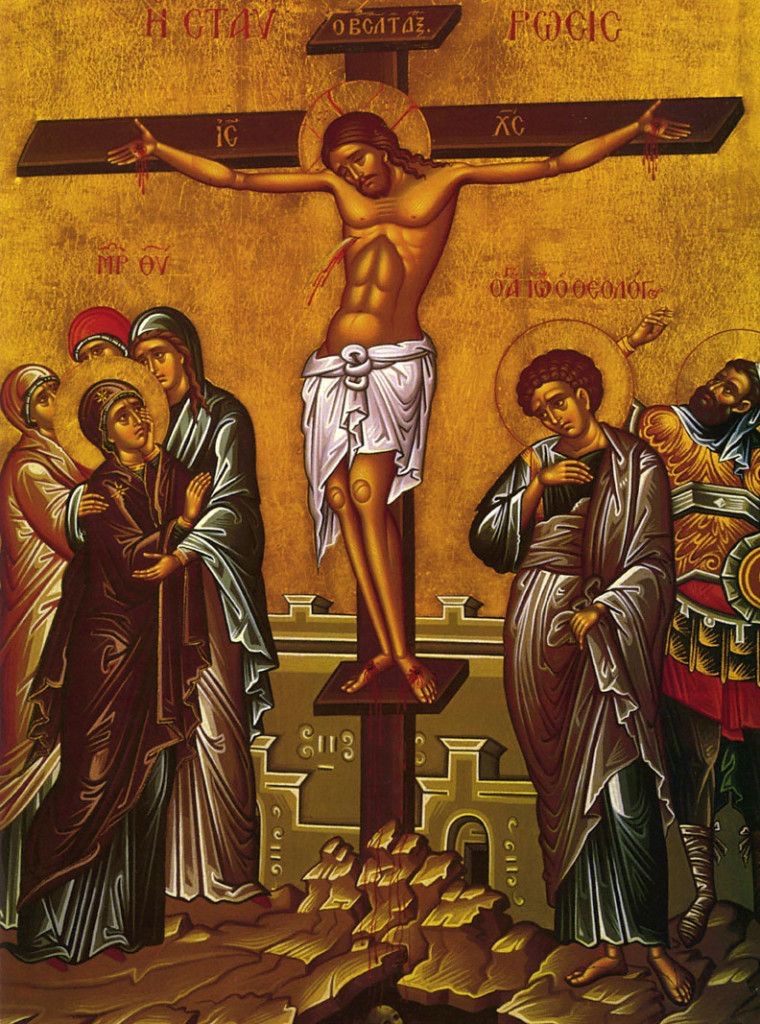
Through the Son — specifically through his sacrificial death on the cross — God reconciled to himself all things in heaven and on earth, and thereby made peace. We were — all of us — alienated from God, at enmity with him. But, through the cross, God took the initiative to reconcile us to him, to bring peace in place of enmity, to create a body of people for himself over which Christ would reign as head. God did this through Christ. God did this for us through Christ. This is how St. Paul sums this up as he concludes the great Hymn To Christ:
21 And you, who once were alienated and hostile in mind, doing evil deeds, 22 he has now reconciled in his body of flesh by his death, in order to present you holy and blameless and above reproach before him, 23 if indeed you continue in the faith, stable and steadfast, not shifting from the hope of the gospel that you heard, which has been proclaimed in all creation under heaven, and of which I, Paul, became a minister (Col 1:21-23).
STRATEGY
Now, having established — in this great Hymn To Christ — the identity of Christ and his essential roles in creation and salvation, Paul is ready to combat the various heresies faced by the Colossians. I think I need only mention them for you to see how Paul structured the Hymn to address them.
1. First there is the matter of hidden knowledge: mystery and philosophy that only the initiated know and which is only available through special ascetic and spiritual practices and teachings. We’ve spoken of this a proto-gnosticism, the beginning of a heresy that still plagues the Church today. To this Paul simply points to Christ as the image/icon of the invisible God, the one in whom the fullness of God is pleased to dwell. And that, dear friends, is not hidden. Christ came to dwell among us and to make God known to us. That fullness is precisely what is proclaimed openly to all people in the Gospel that Paul preaches. There is nothing hidden, nothing to do but hear and believe and then to live the truth. The good news is the answer to the gnostic hidden wisdom.
2. Then there is the matter of the worship of angels. But, Paul says, angels — whether thrones or dominions or rulers or authorities — were all created by, through, and for the Son. Worship the creator, not the creation.
3. St. Paul also addresses disordered regulations: do not handle, do not taste, do not touch. Our salvation does not depend upon these things, but rather the reconciliation, the peace provided by the blood of the cross.
And, so it goes. Building on the Hymn To Christ, Paul deals with all the nascent heresies threatening the church at Colossae. In the latter part of the letter, chapters 3 and 4, St. Paul explores the implications of all this for living out the faith in the church, in the family, and in the culture. These matters are not difficult to understand, but they are challenging to practice.


 First Blessings