
Galatians: Who’s in, who’s out, who gets to say?
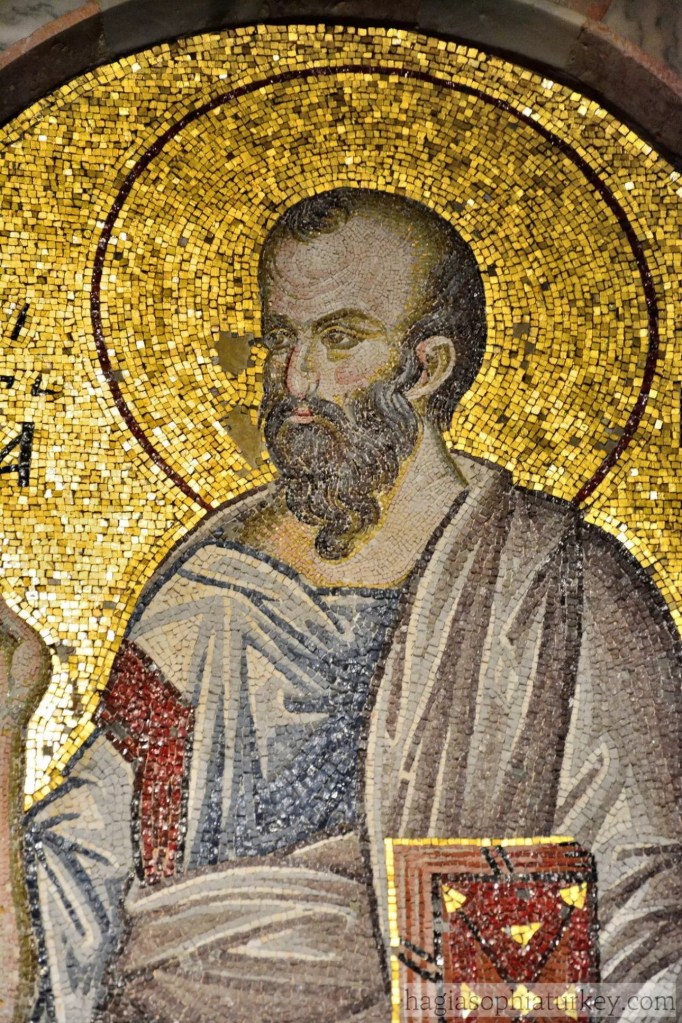
Apostles Anglican Church
Fr. John A. Roop
Galatians: Who’s in, who’s out, who gets to say?
The Lord be with you.
And with your spirit.
Let us pray.
Almighty God, whose blessed apostles Peter and Paul glorified you by their martyrdom: Grant that your Church, instructed by their teaching and example, and knit together in unity by your Spirit, may ever stand firm upon the one foundation, which is Jesus Christ our Lord; who lives and reigns with you, in the unity of the Holy Spirit, one God, now and for ever. Amen.
The Class
Over the next several weeks we will be flying over several of St. Paul’s letters at 20,000 feet — not a detailed exploration of everything in each letter, but a broad overview of background and themes to help you in your own reading and study of these letters as they are coming up in the Daily Office readings. You can see the syllabus/schedule in the handout and the Daily Office reading schedule either in the service bulletin or on page 739 in the BCP 2019 in the Second Lesson column.
Identity and Inclusion
Our parish is named Apostles Anglican Church, a name that our founding members attribute to answered prayer. Right there in the middle of the name is the claim that we are Anglicans: Apostles Anglican Church. Now, if someone wanted to be contentious — or maybe just curious — he might ask, “What makes you Anglican? By what virtue or criteria do you identify as Anglican?”

Well, there are many ways to answer our friend, but the simplest might be this: our parish belongs to the Anglican Diocese of the South (ADOTS); since the diocese is Anglican, so are all its constituent parishes. But, if our friend were “pushy” — and let’s assume he is — he might repeat his challenge: “Well, what makes the diocese Anglican?” At the risk of being accused of just kicking the can down the road, we might answer, “The diocese is part of the Anglican Province in North America (ACNA), so all dioceses belonging to the ACNA are Anglican.”

You see by now our friend’s next move. “But surely that just begs the question. By what virtue is the province, the ACNA, Anglican?” We have no choice now; we’ve started down this path, so we answer: “The ACNA belongs to GAFCON, the Global Fellowship of Confessing Anglicans, comprising the majority of Anglicans worldwide. We are recognized by and in full communion with GAFCON and thus with the majority of the other Anglicans in the world. They say we are Anglican, as Anglican as anybody, as Anglican as it’s possible to be! Surely, that’s good enough for you.”

It seems like we’ve finally backed our friend into a corner, that he must relent in his challenge. But then comes the sound of a clearing throat and a voice that says — in a British accent — “Not so fast. I object. Only those provinces in full communion with the Church of England — with the Archbishop of Canterbury — are authentically Anglican. Since we (note the royal “we”) as Archbishop of Canterbury do not acknowledge your province, you are not officially a member of the Anglican Communion and thus are not authentically Anglican.” Hmmm.

Well, there are good answers to this objection. And, it is not my intent to plant doubts in any minds about our Anglican bona fides. We are, indeed, as Anglican as any other Anglicans, and I can mount a good defense for that assertion, I think. My point is this: as long as religious groups have existed, there have been questions about and controversies around who’s is and who’s out. If you are Orthodox, everyone is out but you. If you are Roman Catholic, you and the Orthodox are in, but no others. If you are Anglican, the Orthodox and Roman Catholics are in as are many of our Protestant cousins, but the Mormons are out as are any groups who deny the authority of Scripture, the efficacy and necessity of the two dominical Sacraments, and the Creeds.
The issues of Christian identity and inclusion are as fresh as today’s newspapers and as old as the Church. They lie at the heart of St. Paul’s letter to the Galatians and are never far from his mind in his other epistles. If we miss this as the presenting issue and governing theme of Galatians we will misunderstand the entire epistle. St. Paul is not — as many of the Reformers assumed — talking about how individuals “are saved” — faith versus works — but rather about who’s in and who’s out, about the criteria for inclusion, and about who gets to say. Let’s see how St. Paul deals with these issues.

Context of Galatians
Galatians may well be St. Paul’s earliest epistle; it is, at least, very early in his corpus — probably written around 48/49 — which means that the problem of inclusion arose early in the life of the Church and has dogged it ever since. Paul wrote Galatians either shortly before or shortly after the Jerusalem Council (Acts 15) which was precisely about the ethnic identity of the Church and the inclusion of the Gentiles.
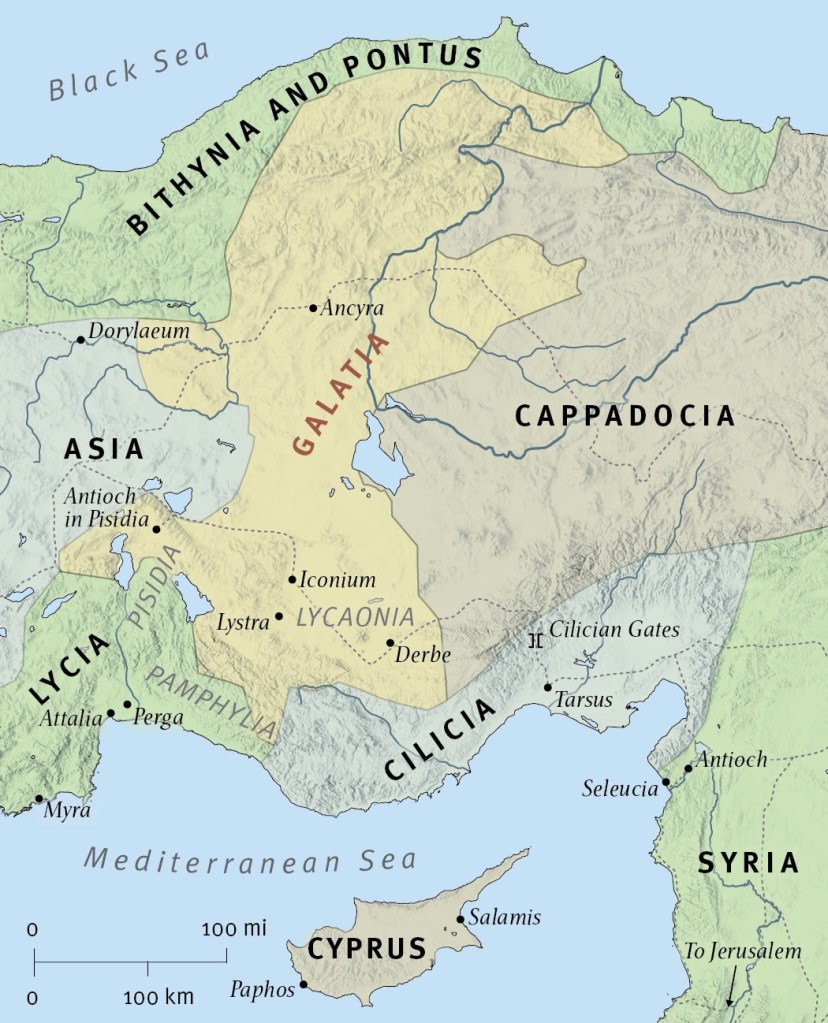
The epistle was written to the churches in Galatia, a region in central Turkey. The ethnic Galatians, settlers from Gaul (modern day France) lived in the northern part of the region, but the entire region, north and south, was called Galatia by the Romans. Paul and Barnabas visited the southern cities on their first missionary journey and certainly established some churches in those cities: Perga, Lystra, Derbe, Iconium, and Antioch in Pisidia. He and Silas revisited these cities and ventured north and west in Galatia on their second and third journeys. It isn’t clear to which of these churches the epistle to the Galatians was addressed; you will read about the “northern hypothesis” versus the “southern hypothesis.” This debate is largely concerned with dating the letter. For our purposes it matters little; we can consider it a circular letter to be shared throughout the region to whatever churches existed when it was written. But, importantly, it was not written to a single church; it was a circular letter of general importance to all Paul’s churches in the region, indicating the pervasiveness of the problem that Paul is addressing.
Nature of the Problems
Before we can tackle the Who’s In – Who’s Out problem we have to take one step back and ask, “In or out of what?” What is the group whose membership we are questioning? And to get that straight, we have to ask an even more basic question of identity: Who is Jesus?
Suppose we had asked the Jewish Christians in the Jerusalem Church that question: Who is Jesus? Note that I chose the Jerusalem Church because of its position as the “Mother Church” in which the pillars of the movement — Peter, James, and John — resided. In terms of the growing Church, Jerusalem was at least the first among equals and probably more in most people’s minds. I don’t know what these three pillars might have answered if asked to speak to the question — Who is Jesus? — formally by the Church. We can get some insight into their understanding by reading their letters. Still, they issued no creedal-type statement on the matter. But, from Paul we know what one group in Jerusalem thought, a prominent group at least in terms of the trouble they caused. These Jewish Christians, rightly or wrongly called Judaizers, considered Jesus to be the Jewish Messiah. Jesus is the one foretold by the prophets, the one to fully end the exile of Judah, the Davidic King who would usher in the Kingdom of God and sort out the nations under Israel. This was a thoroughly Judeo-centric understanding of Jesus. And it clearly answers our earlier question: In or out of what?
What is the group whose membership we are questioning? For the Judaizers the group is Israel so that the question is this: Who’s in or who’s out of Israel? And that is not a difficult question to answer. Israel is not a people constituted solely by ethnicity — biological descendants of Abraham — but also by covenant and Law. Even those who are not ethnically Jewish can become part of Israel through the covenant by submission to the Law. If you want to be part of the Messiah’s present and coming kingdom (renewed Israel), part of his righteous rule, you must become part of Israel through covenant (circumcision) and Law (Sabbath, Passover, keeping kosher, etc.). The Church, in this view, comprised those Jews and Gentile converts who recognized Jesus as Messiah. That’s who’s in. Everyone else is out. For the Judaizers, Jesus has come to Israel, for Israel and for all those who “become” Israel through embracing the covenant and keeping the Law.

There is a second part to this which is crucial for understanding the pressure campaign that the Judaizers wage upon Paul’s congregations. The work of the Messiah has begun, but it is not complete. And it will not progress toward completion until Israel — and all those claiming to follow the Jewish Messiah — demonstrate covenant faithfulness in part through fidelity to the Law. If you are a Jesus follower — or claim to be — but are not keeping the Law, then you are letting the side down and keeping the Kingdom at bay. This is important; it’s a matter of eschatology. The renewal of all things, the end of exile and the exaltation of Israel cannot be realized apart from covenant and Law.
Now, put yourself in the place of these Judaizers when they learn that Paul is going all around the Mediterranean basin starting mixed churches of Jews and Gentiles — Jesus followers all — and telling the Gentiles that they need not be circumcised or keep Sabbath or foreswear bacon. He is insisting that they are grafted into Israel — that they become the sons and daughters of Abraham — not by covenant and Law, but solely by faith in Jesus. And he is telling the Jewish Christians that in Christ there is no longer any distinction between the two groups, no Jews or Greeks, just one body in Christ. So, the Jews can associate freely with the Gentiles, eat with them, share Communion with them. The Gentiles are no longer unclean, they are no longer Gentile sinners.
What is Paul thinking? Why would he do such a thing? How would you answer this as a Judaizer? Well, there are a few possibilities. Paul was not one of the twelve. He hadn’t spent three years tramping around Galilee and Judea with Jesus, hadn’t heard the parables or the Sermon on the Mount, hadn’t learned from the source. Perhaps he was just confused; perhaps he had just misunderstood the Gospel. That is the most innocent explanation. But, the more suspicious among the Judaizers saw something more nefarious. Paul is a self-promoter, a self-appointed Apostle, who is out to build a following for himself, and so he is soft-pedaling the requirements of the faith to suck the Gentiles in. Don’t want to be circumcised? No problem — no need to. Don’t want to keep Sabbath? No problem — all days are the same. Don’t want to keep kosher? No problem — you can eat anything you like, even meat offered to idols, if you give thanks first. All that matters is faith in Christ. Of course a false apostle would water down the teaching in order to please men and to create a name and a following for himself.
So, the Judaizers begin to dog Paul’s missionary footsteps, coming in when he moved on, questioning the authenticity of his apostolate, questioning his motives, sowing doubts about his grasp of the Gospel, “correcting” his false doctrine by insisting that the Gentiles must be circumcised and keep the Law to be true followers of the Jewish Messiah and to be “in” the coming Kingdom. And, many of the churches in Galatia have begun to waver; the Judaizers are making inroads. That is the problem that St. Paul’s Epistle To the Galatians addresses: matters of identity and inclusion.
The Text: A Survey
If you were Paul, where would you start in making your defense? I might start with what I think to be a common sense principle of propaganda: If the messenger is not trusted, the message is not believed. The Judaizers have attacked Paul’s credibility, his authority to speak as an Apostle. Until that is defended, what he has to say is suspect. So he begins with an apology/defense of himself and his ministry.
1 Paul, an apostle—not from men nor through man, but through Jesus Christ and God the Father, who raised him from the dead— 2 and all the brothers who are with me…
He fires the opening shot: (1) I am an apostle, and (2) my apostolate does not depend upon authorization by other men, buts rest entirely upon Jesus Christ and God the Father. He will come back to this self-defense later, but he breaks off momentarily to discuss the seriousness of the problem that the Judaizers have caused.
6 I am astonished that you are so quickly deserting him who called you in the grace of Christ and are turning to a different gospel— 7 not that there is another one, but there are some who trouble you and want to distort the gospel of Christ. 8 But even if we or an angel from heaven should preach to you a gospel contrary to the one we preached to you, let him be accursed. 9 As we have said before, so now I say again: If anyone is preaching to you a gospel contrary to the one you received, let him be accursed.
There are some matters in the Church that we call adiaphora, indifferent; we can agree to disagree on them because they don’t cut to the core of the faith. I like chant, you like contemporary worship music: adiaphora, unless the difference creates a barrier to fellowship.

You use the KJV Bible, I use the ESV translation: adiaphora.

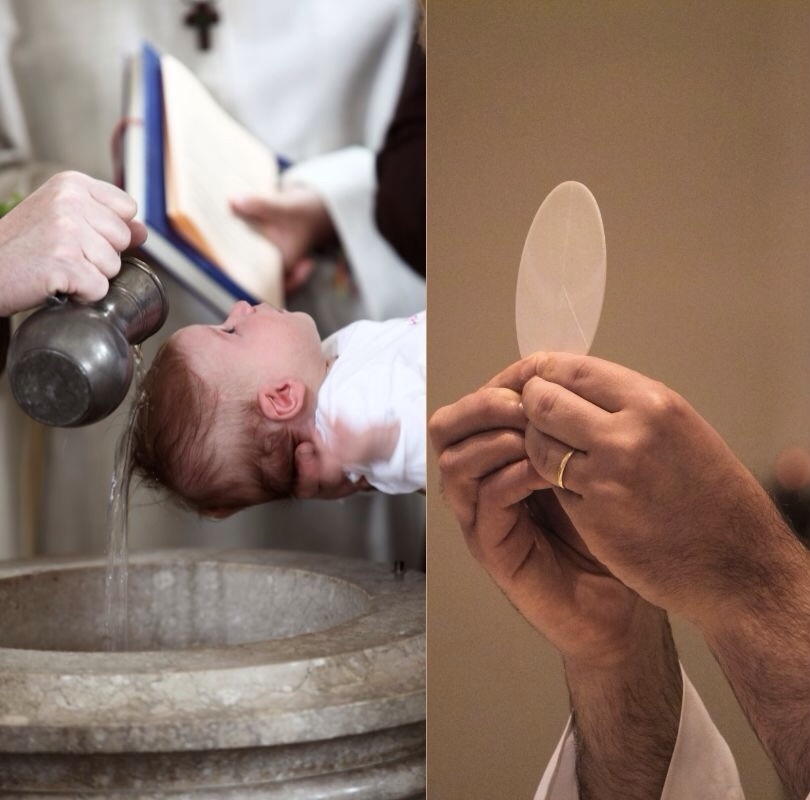
You do not recognize the Sacraments of baptism and Holy Communion, I recognize both: adiaphora? No, because the Sacraments cut to the core of the faith.
You believe the Bible is the inspired Word of God and the authoritative standard for faith and practice, I believe it is a human record of people’s best ideas about God that has some good insights but which is not binding on us today: adiaphora? No, not all all. So, what about this matter of Gentiles needing to convert to Judaism and to keep the Law if they are to be Christ followers: adiaphora or not? Well, Paul minces no words; this is not a matter on which we can agree to disagree. The Judaizers are preaching a false Gospel that is no Gospel at all. They are anathema; they are cursed. And Paul strengthens his denunciation. If an angel should preach a different Gospel, then let the angel be anathema. The mention of an angel might have some particular significance here. The Law was mediated/delivered to Moses through angels (Gal 3:19-20). Paul may be hinting at this: if even an angel tried to deliver the Law to you and you to Law now that the Gospel has come — which is exactly what the Judaizers are doing — then even the angel would be anathema.
Having completed this judgment, Paul returns to the defense of his ministry in Gal 1:11-2:14. It is a many-sided defense and time won’t allow us to explore it in detail, but we can summarize the charges against Paul and his responses.

Charge: You were not part of the Twelve. You didn’t hear the Gospel from Jesus, and you’ve muddled it either from ignorance or intent.
Defense: I received the Gospel directly through a revelation of Jesus Christ (Gal 1:12). No muddled human teaching or misunderstanding was involved.
Charge: You are teaching a different Gospel than the pillars of the Jerusalem Church — Peter, James, and John.
Defense: To the contrary, I submitted my understanding of the Gospel to those “pillars” of the Church and they added nothing to it; that is, they did not add circumcision and the Law to what I was teaching. Rather, they acknowledged that I had been entrusted with the Gospel to the Gentiles just as Peter had been for the Jews. They gave me — and those with me — the right hand of fellowship, full endorsement. And later, when Peter tried to backtrack on this at Antioch and please the Judaizers, I publicly rebuked him to his face; he was in the wrong and I was in the right (Gal 2:1-11).
Charge: You are just trying to please men, to make things easy for them and to make things easy for yourself.
Defense: If I were trying to make things easy on myself, I would just go along with the Judaizers since they are the ones making life hard for me. But that would be unfaithful to the cross of Christ (Gal 5:7-12).
There are more charges and defenses in the text — you can locate those — but these give you a good sense of how Paul views his own ministry vis-à-vis the Twelve and the Judaizers.
Now, we can move to the heart of Paul’s arguments against adding the Law to the Gospel as a requirement for Gentile inclusion. Here is his summary statement:
15 We ourselves are Jews by birth and not Gentile sinners; 16 yet we know that a person is not justified by works of the law but through faith in Jesus Christ, so we also have believed in Christ Jesus, in order to be justified by faith in Christ and not by works of the law, because by works of the law no one will be justified (Gal 2:15-16).
Here Paul is saying something along these lines. The Judaizers, those “Jews by birth,” are telling you that you can be justified — made right with God and brought into the covenant community — only by keeping the Law. That’s a good one! It never worked for them or for any of their forebears. The whole history of Israel testifies to the fact that the Law justifies no one — and those Judaizers know it. That is why — if they would just admit it — they, too, have come to believe in Jesus, because only faith in him, and not the works of the Law, justifies anyone.
And now Paul offers some tangible evidence to back up his contention. It is based on this observation: some — perhaps all — of Paul’s churches were what we might call charismatic; gifts of the Spirit were present and active. So, Paul challenges the Galatians with this question:
3:1 O foolish Galatians! Who has bewitched you? It was before your eyes that Jesus Christ was publicly portrayed as crucified. 2 Let me ask you only this: Did you receive the Spirit by works of the law or by hearing with faith? 3 Are you so foolish? Having begun by the Spirit, are you now being perfected by the flesh (Gal 3:1-3)?
Paul’s logic goes like this. It is the Spirit that unites you to God in Christ and makes you part of the covenant community. And you received the Spirit through faith. What can the Law add to that? Now, here, not realizing this is a rhetorical question, some of those persuaded by the Judaizers might dare to respond: The Law unites us to Abraham and makes us part of God’s people. Not so, Paul replies. Abraham and his descendants were God’s people before — without — the Law. They were his people by faith, which is precisely how you become his people in Christ. It’s all right there in the Scriptures:
5 Does he who supplies the Spirit to you and works miracles among you do so by works of the law, or by hearing with faith— 6 just as Abraham “believed God, and it was counted to him as righteousness”?
7 Know then that it is those of faith who are the sons of Abraham. 8 And the Scripture, foreseeing that God would justify the Gentiles by faith, preached the gospel beforehand to Abraham, saying, “In you shall all the nations be blessed.” 9 So then, those who are of faith are blessed along with Abraham, the man of faith (Gal 3:5-9).

Paul argues that the covenant was prior to the Law and is, in fact, primary over the Law. The Law, which was given four centuries after the covenant, did not abolish or even amend the covenant. Faith, by which Abraham entered into the covenant, is still what is required today — not the Law. Now, you can probably understand why the Gentiles might be getting confused by all this. If it’s all about the covenant and faith, what was the Law for? Paul anticipates this confusion and this question and has his response ready. It comes in a pretty dense passage in Gal 3:19-29, a passage you should read prayerfully and work out on your own. But here are the key points.

The Law was added because of transgressions (Gal 3:19). In other words, the Law was a sin management system. It revealed what was right for God’s people, both in their relationships to God and to one another; it ordered their society; it gave them a way to purify themselves and the whole people from sin — through the sacrificial system — so that God might live among them; and it served as a guardian to teach and to unite them until the coming of Christ “so that the promise by faith in Jesus Christ might be given to those who believe” (Gal 3:22b). The Law was never an end unto itself, but was always at the service of the covenants (Old and New), always pointing toward Christ. And that is why the Law is no longer needed: not that it was bad and must be done away with, but rather that it was good and has now completed its purpose in bringing people to Jesus.
24 So then, the law was our guardian until Christ came, in order that we might be justified by faith. 25 But now that faith has come, we are no longer under a guardian, 26 for in Christ Jesus you are all sons of God, through faith. 27 For as many of you as were baptized into Christ have put on Christ. 28 There is neither Jew nor Greek, there is neither slave nor free, there is no male and female, for you are all one in Christ Jesus. 29 And if you are Christ’s, then you are Abraham’s offspring, heirs according to promise (Gal 3:24-29).
Now, there’s always one student in every class that intentionally takes the instruction in the wrong direction, who just pushes every boundary. “Oh, Paul, so if the Law doesn’t matter, then, as long as we believe in Jesus, you are saying that we can behave anyway we want to?” After the facepalm, Paul responds:
16 But I say, walk by the Spirit, and you will not gratify the desires of the flesh. 17 For the desires of the flesh are against the Spirit, and the desires of the Spirit are against the flesh, for these are opposed to each other, to keep you from doing the things you want to do. 18 But if you are led by the Spirit, you are not under the law. 19 Now the works of the flesh are evident: sexual immorality, impurity, sensuality, 20 idolatry, sorcery, enmity, strife, jealousy, fits of anger, rivalries, dissensions, divisions, 21 envy, drunkenness, orgies, and things like these. I warn you, as I warned you before, that those who do such things will not inherit the kingdom of God. 22 But the fruit of the Spirit is love, joy, peace, patience, kindness, goodness, faithfulness, 23 gentleness, self-control; against such things there is no law. 24 And those who belong to Christ Jesus have crucified the flesh with its passions and desires (Gal 5:16-24).

How you live matters very much; in fact, it is the evidence of whether your faith is authentic and whether you actually belong to Jesus. If your life exhibits none of the fruit of the Spirit, but rather the passions of the flesh, take care; do not presume that by a mere statement of belief you are justified. Real faith produces real fruit. This is not just a caution for the Galatians, but for all of us.
So What?
I hope this class has given you some background and a better context with which to read and understand St. Paul’s letter. But, frankly, while interesting, this can all seem a bit far removed from us, can’t it? We are not in danger of being pressured into keeping the Jewish Law, are we? So, how might God speak to us through the text.
There is a danger in every time of someone or some group insisting on a Jesus-And Gospel: Jesus-And a particular political party or agenda, Jesus-And a particular social justice movement or cause, Jesus-And a particular church affiliation. I’ve even seen – far too often — Jesus-And a particular style of vestments or the renunciation of vestments entirely. Unless you are a Christian [fill in the blank] you are not a Christian at all. But, Paul keeps bringing his churches — and those churches we belong to today — back to Jesus, back to real faith in Jesus as the necessary and sufficient means criterion for inclusion in the people of God: a good lesson for us all.

And, with that, we’ll give St. Paul the final word:
14 But far be it from me to boast except in the cross of our Lord Jesus Christ, by which the world has been crucified to me, and I to the world.
18 The grace of our Lord Jesus Christ be with your spirit, brothers. Amen (Gal 6:14, 18).


 First Blessings