Apostles Anglican Church
Fr. John A. Roop
Eve of Thanksgiving, 26 November 2025
(Deut 8, Ps 65:1-8, James 1:17-27, Matt 6:25-33)
What Do You Say?
IN THE NAME of the Father, and of the Son, and of the Holy Spirit. Amen.
The ritual plays out wherever there are parents with young children. It was on full display just last month on All Saints’ Eve, otherwise know as Halloween, and I’ve seen it several times since in a host of circumstances. Father or mother bends down to eye level with the child and asks the age old question in sing-song voice: “What do you say?” Because we’ve seen it so many times, and because so many of us have asked it as parents ourselves, we know what is expected from the child. There are only two possible answers: “please” if the child wants something or “thank you” if the child has received something.

This training in etiquette, this enculturation in manners, doesn’t stop in the toddler years. We expect our growing children to show proper gratitude for gifts given them on birthdays and at Christmas and on other occasions. And, if those gifts are sent from afar, we might insist that our children write thank you cards or, at the minimum, acknowledge their appreciation with a phone call to their grandparents or godparents or aunts and uncles. Graduation gifts certainly require thank you cards as do wedding shower and baby shower gifts. It is just common courtesy; our parents raised us that way, we raise our own children that way, and we expect our grown children to raise our grandchildren that way. It is such an ingrained part of our cultural experience that few seem to question it. I had given it little thought myself until faced with preaching this Thanksgiving-eve sermon today. And then the question — once it presented itself — seemed obvious: Why do we teach our children to be grateful? The question seems obvious, the answer less so.

At one level I suppose we teach our children to be grateful because we don’t want to be embarrassed by their failure to conform to the social norms of etiquette. Here in the South we fear hearing anyone ever say about our child — behind our backs but loud enough for us to hear of course— “Well, bless her heart, her parents must not have raised her any better.” That is good Southern, two generational judgment probably said with a smile that would wither kudzu. No, we don’t want that. Nor is it simply concern for ourselves; we know our children will fare better themselves if the niceties are observed. Manners grease the skids of social interaction, open closed doors, and crack open doors even more widely open. I wonder how many opportunities I’ve had in life just because my mother taught me to say please and thank you.
That’s the most basic answer to the matter of manners: we express gratitude self-consciously, because it is in our self-interest. But, that’s a bit cynical and hardly satisfying; there has to be more to it than that. And, there is. The ”more” — the real why of gratitude — is found in familiar words from the Eucharistic prayer. That’s not surprising. Eucharist means thanksgiving, and the prayer we offer is called The Great Thanksgiving. So, here are the familiar words I have in mind, beginning with the Sursum Corda, the “lift up your hearts”:
The Lord be with you.
And with your spirit.
Lift up your hearts.
We lift them up to the Lord.
Now, here it is:
Let us give thanks to the Lord our God.
It is right to give him thanks and praise.
It is right, our duty and our joy, always and everywhere to give thanks to you, Father Almighty, Creator of heaven and earth (BCP 2019, p. 132).
There is the sacramental answer. Why do we teach our children gratitude? Why do we express it ourselves? Because is it right, because it is our duty, and because it is our joy to give thanks and praise to God. All other gratitude — gratitude expressed to our fellow image-bearers of God for gifts and services and sacrifices — participates in that primary gratitude to God and flows from it. We teach our children to say thank you to the adults in their lives, to their friends, and finally to strangers because we want them to know how properly and fully to show gratitude to God. How can you thank God whom you haven’t seen if you can’t thank your brother and sister whom you have seen, so St. John’s might ask.
Since all gratitude flows downstream from our gratitude to God, let’s start at the source: It is right, our duty and our joy, always and everywhere to give thanks to you, Father Almighty, Creator of heaven and earth.
It is right. Book One of C. S. Lewis’s classic Mere Christianity is entitled “Right and Wrong as a Clue to the Meaning of the Universe.” In it he argues that all people have “in mind some kind of Law or Rule of fair play or morality or whatever you like to call it, about which they really [agree]” (Kindle Edition, p. 3). He calls it the Law of Right and Wrong or the Law of Human Nature. Lewis develops this notion further and shows that the Law of Right and Wrong is both extrinsic — it comes from outside us and its authority lies beyond us — and at the same time intrinsic in that it is fundamental to human nature; while we may rebel against it, we all nonetheless recognize it and our responsibility to it. Cultures and individuals may disagree over some of the details of the Law, but none can escape from it. We may differ on whom we may kill and under what circumstances — war, self-defense, that sort of thing — but no culture and no sane individual would say we may kill whomever we please, whenever we please, for whatever reason we please. We all know that wanton murder violates the Law of Right and Wrong. Anyone who says otherwise is a sociopath or a psychopath lacking some fundamental aspect of humanity.

This means — at the very least — that some behaviors are right and we know them to be right beyond any doubt and beyond any need to justify them. They are moral axioms, convictions we all recognize as true without proof. It’s easy to see this by pairing some examples. Cowardice is wrong, bravery is right. Lying is wrong, truth-telling is right. Faithlessness is wrong, fidelity is right. Abuse is wrong, nurture is right. Deceit is wrong, fair-dealing is right. We could go on constructing these pairs all day. We know right from wrong and have no time to waste with those who might argue to the contrary.
Now, our Eucharistic liturgy recognizes this Law of Nature, too, when it has the priest say to God on behalf of all, “It is right…always and everywhere to give thanks to you, Father Almighty, Creator of heaven and earth.” Gratitude is part of this Law of Nature; we know — again, both extrinsically and intrinsically — that it is right to give thanks to God. In fact, St. Paul sees the failure to give thanks to God as something of a primal sin, the fountain of all evils. He explains this in his letter to the Romans:
18 For the wrath of God is revealed from heaven against all ungodliness and unrighteousness of men, who by their unrighteousness suppress the truth. 19 For what can be known about God is plain to them, because God has shown it to them. 20 For his invisible attributes, namely, his eternal power and divine nature, have been clearly perceived, ever since the creation of the world, in the things that have been made. So they are without excuse. 21 For although they knew God, they did not honor him as God or give thanks to him, but they became futile in their thinking, and their foolish hearts were darkened. 22 Claiming to be wise, they became fools, 23 and exchanged the glory of the immortal God for images resembling mortal man and birds and animals and creeping things (Rom 1:18-23).
The refusal to give thanks to him is the first step on man’s downward spiral into idolatry, lust, sexual immorality, covetousness, malice, envy, murder and all manner of wrongs. So, our liturgy calls us away from that first fateful step of ingratitude by reminding us that it is right always and everywhere to give thanks to God the Father Almighty. And, even as we say it and do it, we know it to be true.
But, our giving thanks to God is right in another sense. It is our right to give him thanks and praise. It is what we were made for as human image-bearers and we, among all creatures, have the unique right to do so. Listen to this excerpt from Psalm 98:
5 Show yourselves joyful in the LORD, all you lands;
sing, rejoice, and give thanks.
6 Praise the LORD with the harp;
sing with the harp a psalm of thanksgiving.
7 With trumpets also and horns,
O show yourselves joyful before the LORD, the King.
8 Let the sea make a noise, and all that is in it,
the round world, and those who dwell therein.
9 Let the rivers clasp their hands, and let the hills be joyful together before the LORD,
for he has come to judge the earth (BCP 2019, p. 397).

The seas can make a noise, the rivers can figuratively clap their hands, and the hills can be joyful in their fecund beauty. But only man can articulate his gratitude to God. Only man can sing, rejoice, and give thanks in psalms. It is our God-given right to gather up the inarticulate praises of creation and, as priest of creation, to offer those praises to God in words, we who were called into being by the Word of God, we who have been redeemed by the Word of God incarnate. And, because we were made for this, because we were given this unique vocation, it is both our right to do so and our duty to do so. It is our duty always and everywhere to give thanks to God, the Father Almighty.
Whatever else we might say about the sin of our first parents in the Garden, it was a failure to fulfill their vocational duty to give thanks to God their Creator. He had called them into being from nothing. He had given them each a human companion and complement. He had given them a home replete with all necessities and with boundless pleasures as well. He had given them meaningful work to do that participated in and extended his own creative activity. And, he had consented to dwell with them there. But rather than fulfill their duty of gratitude, they strayed into the way of discontent. Rather than fulfill their duty of gratitude, they lusted after the one thing that was forbidden. They failed in their duty to give thanks to God the Creator in the midst of his creation and all creation was subjected to futility. All creation fell from inarticulate praise to inarticulate groaning.
But thanks be to God for the redemption wrought in Jesus Christ our Lord who is even now making all things new. Through his incarnation, life, death, resurrection, and ascension, He has restored to us our priestly vocation and has called us once again to articulate the praise and thanksgiving of a creation that is being renewed in him. It is once again our duty to give thanks to God, the Father Almighty, Creator of heaven and earth. And, because it is a duty that we were made for, a vocation blessing we were given, it is also our joy to give him thanks and praise.
Let us get this straight. God does not need our gratitude. He is not a divine narcissist who, in his insecurity, needs constant affirmation. It is not that God needs our gratitude but that we need to give it: it is our joy always and everywhere to give him thanks and praise. To express our thanksgiving is to make the experience of receiving blessing complete. A blessing without thanksgiving is truncated, diminished. Thanksgiving makes our joy full.
I have mentioned this to some of you before. I want you to know that I know that I am repeating a story, one of the saddest stories I know. Bart Ehrman is a Biblical scholar who along the way lost his Christian faith. He became so focused on the pain and evil in the world, so unable to reconcile that with a good God, that he simply gave up on God altogether. I heard him interviewed once and the host asked an achingly good question: Having left your faith behind, is there anything about it you miss? To his credit Ehrman answered yes without hesitation. He explained, and here I will paraphrase his response in the first person:
I have had a good and beautiful life and I am filled with a profound sense of gratitude for it. But, without God, I have no one to thank, no one to whom it makes sense to express that gratitude.
This is a direct quote from Ehrman’s blog:
So when I’m “thankful” for the circumstances I was born into in the mid 50s in America, for excellent health, for a positive disposition, for talents I inherited, for good intelligence — Whom do I thank (www.ehrmanblog.org/thanksgiving-2019/)?
And that lack of someone to thank leaves the blessing incomplete, strips the experience of its full joy. That’s what Ehrman acknowledged in one unguarded moment, in one interview.
But we know whom to thank. And we know that it is our joy always and everywhere to give thanks and praise to God, the Father Almighty, Creator of heaven and earth. We know that God accepts our thanksgiving not from any divine need to be praised, but rather from his will to increase our joy.
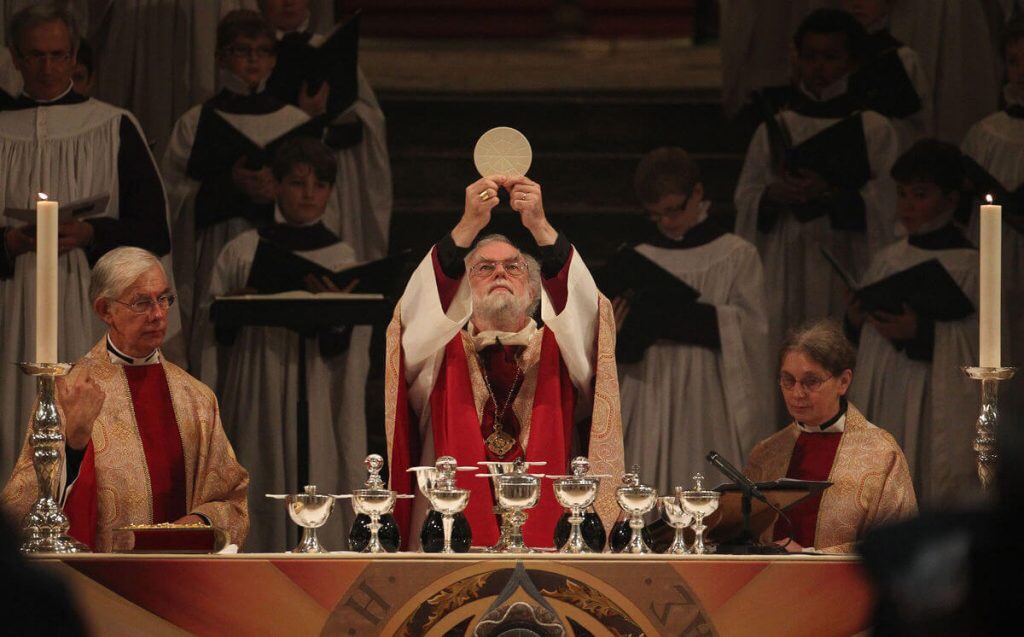
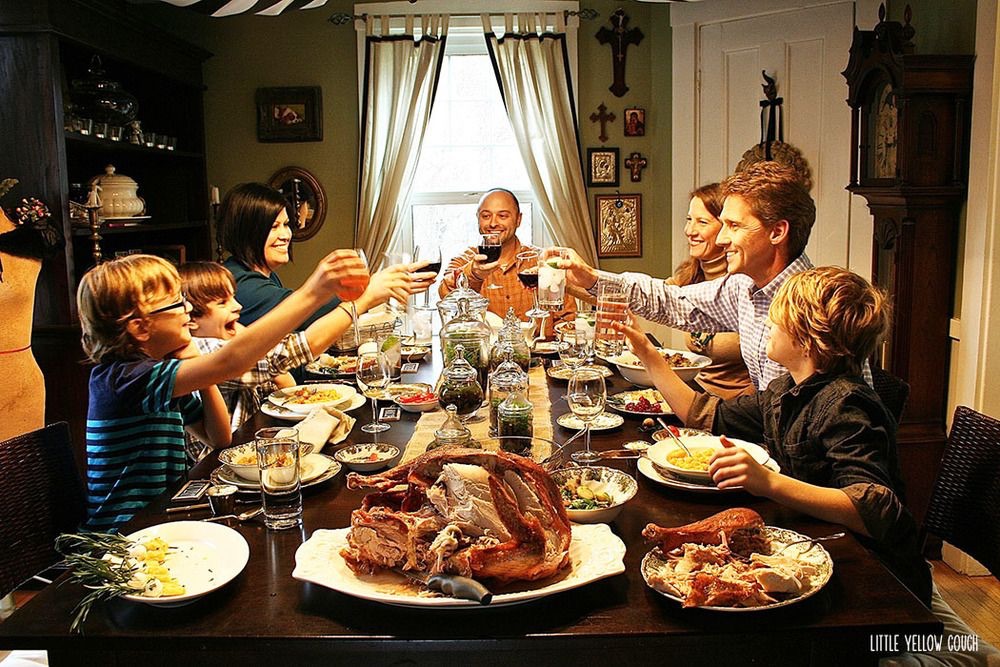
So, why do we teach our children to be grateful? Because we want to bring them here around the altar where they will find their fulfillment. Because we want to train them to join in the Great Thanksgiving. Because it is right, our duty and our joy always and everywhere to give thanks to God the Father Almighty, Creator of heaven and earth. So we teach them to say “thank you” for little gifts given, for little services rendered, for the every day acts of kindness and generosity that fill their lives, so they will not be tongue-tied when standing in the presence of the Lord. So we set aside one day each year in a sort of secular liturgy of Thanksgiving so that we may hallow every day by holy acts of Thanksgiving. We can give thanks at family tables tomorrow because we have first given thanks at this family Table whenever we gather for Eucharist.
The Lord be with you.
And with your spirit.
Lift up your hearts.
We lift them up to the Lord.
Let us give thanks to the Lord our God.
It is right to give him thanks and praise.
It is right, our duty and our joy, always and everywhere to give thanks to you, Father Almighty, Creator of heaven and earth. Amen.


 First Blessings