
Apostles Anglican Church
Fr. John A. Roop
All Saints’ Day, 1 November 2025
The Holy, Hot Mess Horde
(Ecclesiasticus 44:1-14, Psalm 149, Ephesians 1:11-23, Luke 6:20-36)
Collect
Almighty God, you have knit together your elect in one communion and fellowship in the mystical Body of your Son: Give us grace so to follow your blessed saints in all virtuous and godly living, that we may come to those ineffable joys that you have prepared for those who truly love you; through Jesus Christ our Lord, who with you and the Holy Spirit lives and reigns, one God, in glory everlasting. Amen.
IN THE NAME of the Father, and of the Son, and of the Holy Spirit. Amen.

Well, my friends, let’s take a journey together in the Wayback Machine, all the way back to 1544, to England. In 1544, Thomas Cranmer, Archbishop of Canterbury of the recently independent Church in England, published his first English language liturgy for the Church. It was the prayer we now call The Great Litany, and it became a cornerstone of the Book of Common Prayer, appearing in every edition since. It was not a fully original creation — more a compilation of ancient and contemporaneous litanies — but it was nonetheless classic Cranmer. The Archbishop began the prayer with an invocation of God:
O God, the father of heaven, have mercy upon us miserable sinners.
O God, the son, redeemer of the world: have mercy upon us miserable sinners.
O God the holy ghost, proceeding from the father and the son: have mercy upon us miserable sinners.
O holy, blessed, and glorious trinity, three persons and one God: have mercy upon us miserable sinners.

You might recognize the general form of that invocation from The Great Litany in our own Book of Common Prayer 2019: a little different wording, yes, but the same trinitarian structure and content.
Following immediately upon this invocation in The Great Litany of 1544 is another: an invocation of the saints.
O holy virgin Mary, mother of God our Saviour Jesus Christ. Pray for us.
All holy Angels and Archangels and all holy orders of blessed spirits. Pray for us.
All holy patriarchs, and Prophets, Apostles, Martyrs, Confessors, and Virgins, and all the blessed company of heaven: Pray for us.
At this point, I would expect an audible gasp from you. An invocation of saints?! In the Anglican Church?! Lord, have mercy upon us miserable sinners. Reformed Anglicans are aghast that such an invocation ever once defiled our otherwise beautiful litany. Anglo-Catholics are aghast that such an invocation was ever removed from our otherwise beautiful litany. All Anglicans are aghast over something, it seems.
But, the invocation of saints was removed, and quickly. Five years after the debut of The Great Litany, the first Book of Common Prayer was published and its use mandated; 1549 it was. And the invocation of saints had already been excised from The Great Litany, never to appear again. Whether Cranmer’s theology had radically changed in those five years or whether, with the passing of Henry VIII, Cranmer’s true theology was given more free rein than before, or whether he had gotten his writing hand smacked by his more Reformed contemporaries, I will leave for historians to debate. Regardless, the invocation of saints was gone forever. Just a few years later, with the publication of The Thirty-Nine Articles of Religion of 1571, the invocation of saints was not only absent — it was repudiated:
XXII. OF PURGATORY
The Romish Doctrine concerning Purgatory, Pardons, Worshipping, and Adoration, as well of Images as of Reliques, and also Invocation of Saints, is a fond thing vainly invented, and grounded upon no warranty of Scripture, but rather repugnant to the Word of God.

In a mere twenty-seven years the Church in England had gone from invoking the saints to pray for us to rejecting such an invocation as fond (foolish), vain (empty), biblically groundless, and even repugnant to Scripture. Such was the Anglican theological whiplash in the early years.
Why this “saintly” history lesson? Simply to show you that historically Anglicans have sat rather uncomfortably with the saints. We seem a bit muddled about how to regard them, about their purpose, about what intercourse — if any — we have with them and they with us. They are not unlike the cousin whom you feel obligated to invite to the family Thanksgiving dinner but who you really hope will have other plans.
We do have saints’ feast days on our liturgical calendar. The Blessed Virgin Mary has a day along with each of the Apostles, sans Judas but with Matthias and Paul. Stephen, the first Christian martyr is there, along with Mark and Barnabas and Joseph and John the Baptist and Mary Magdalene. The collects for these feast days generally focus on a characteristic of the given saint and ask the Lord that it might also be manifest in us. The saints are presented less as active participants in the ongoing economy of salvation and more as exemplars of the faith whose spiritual heroics we are to emulate. That seems to be the thrust of the collect for All Saints’ Day, as well: “Give us grace so to follow your blessed saints in all virtuous and godly living,” we implore God. We talk to God about the saints, but we don’t ask the saints to talk to God about us — at least not publicly in our common prayer.
I think Scripture hints at more than this pedagogical role for the saints, more than just teaching us how to live; but these are only hints, nothing to fashion a detailed doctrine around. The great Tradition of the Church insists on a significantly greater role, not only of mediation but also of intervention, based in part upon the Church’s experience with the saints. Make of that what you will; in Anglicanism it is not an article of faith required of any man as requisite or necessary to salvation (see Article VI, BCP 2019, p. 773).
As a good Anglican preacher — and note that “good” modifies Anglican and not necessarily preacher — I will stick with Scripture this evening and say what I know to be true rather than what I think may be true.
Let’s start here: look around; take a good look around. Embarrass the people behind you by turning around and staring at them. Some of these your fellow-parishioners may be or may become famous men and women, appointed great glory and majesty from the Lord — men and women who will leave a name, so that their praises are declared throughout generations (Sirach 44:1-8). Some will never be widely known, though their lives likely will have impact far beyond what they can begin to imagine; your life, too. Though their names will probably never appear in a liturgical calendar with an appointed feast day, these are the saints that Scripture knows: exceptionally ordinary and ordinarily exceptional men and women and children who have been baptized into the Lord Jesus Christ, who have been filled with the Holy Spirit, who are living lives of repentance and who are contending for the faith once delivered to the saints. These are the saints you see. These are the saints you are surrounded by. These are the saints you are stuck with. These are the saints you are blessed with. This is the Church: the nursery of saints, the school of saints, the proving-ground of saints, the hospital of saints, the temple of saints, the glory of saints.

Saint Paul’s greeting in his first canonical letter to the Corinthians tells their story:
1 Paul, called by the will of God to be an apostle of Christ Jesus, and our brother Sosthenes,
2 To the church of God that is in Corinth, to those sanctified in Christ Jesus, called to be saints together with those who in every place call upon the name of our Lord Jesus Christ, both their Lord and ours:
3 Grace to you and peace from God our Father and the Lord Jesus Christ (1 Cor 1:1-3, ESV throughout unless otherwise noted).
I wish I had a white board and some colored dry erase markers to make visible and clear some of the subtleties in these verses; I’ll do the best I can to describe them without visual aids.
In verse 1 Paul identifies himself as a “called” apostle: called by the will of God and sent out on mission for Christ Jesus. He parallels that in verse 2 by identifying his readers/hearers as “called” saints, implying that they, too, have been called by the will of God and sanctified in Christ Jesus. Not only those residing in Corinth, but all those in every place — and let’s add here “in every time” — who call upon the name of our Lord Jesus Christ: in other words, you and all these saints sitting around you here, all those saints who have gone before into the presence of God, all those saints who are yet to be so long as Christ tarries. These are the ones who have been sanctified, who are being sanctified, who will be sanctified — by the Holy Spirit, in Christ Jesus. And though you almost pick up the resonance in English, it is perfectly clear in St. Paul’s Greek: sanctified and saint come from the same root word; sanctified means “saint-ified” to coin a term, and both saint and sanctified pertain to holiness, to being set apart for God’s use and glory. Saints are not perfected masterpieces but are works in progress, the joint work of God and man, sometimes work in the very rough first stages of saint-ification.
Now, I’m not telling you anything new here: the saints in Corinth to whom St. Paul wrote were a hot mess. They were more tribal and fractious than even our politicians. Imagine your brothers and sisters here at Apostles forming constituencies around certain priests and dismissing others as second or third-tier. Imagine law suits breaking out between your brothers and sisters who every Sunday morning kneel at the same altar rail and share the same Body and Blood of Christ. Imagine open sexual immorality in the parish that is both paraded and accepted as a sign of advanced spirituality. Imagine everyone here insisting on displaying his/her own spiritual gifts in worship, leading to envy and chaos and inhibiting rather than fostering worship. Imagine our people holding grudges and refusing to forgive one another. Imagine gossip and rebellion against authority. Imagine modern day idolatry. Well, if you can image these things — and please, God, may they never be here among us — then you can imagine the state of the church of God that was in Corinth. You can imagine those in the church, those who, as Paul writes, are sanctified in Christ Jesus, called to be saints together with those who in every place call upon the name of our Lord Jesus Christ, both their Lord and ours. I don’t believe St. Paul wrote that sarcastically, ironically, or tongue-in-cheek, but rather with faith, with confidence, in the power of God and the grace of the Holy Spirit to actually make these people, in Christ, what he had called them to be: saints. And Paul was not ashamed to be numbered among them.
So, whatever else we may mean by “saint,” our definition must be broad enough to include these people — and those around you, and you, and me — in that holy, hot mess horde. Let us praise famous men and women, as Sirach exhorts, for their heroic holiness: yes. But let us not forget the ordinary saints, the hidden saints, whose flaws are so obvious to us but whose holy struggles are known only to themselves and God. Let us not forget our brothers and sisters who are fighting holy battles that we may never know. But neither let us make the definition of saint so broad that it becomes meaningless, that it includes all and sundry without distinction. Remember the excommunication at the heart of 1 Corinthians (1 Cor 5); no man practicing incest, no man arrogantly refusing correction, no man repudiating repentance has any place at the Table of the Lord, any place in the fellowship of the saints. He is to be turned over to Satan for the destruction of his fleshly behavior that his spirit might be saved. The church is to purge the evil one from among them; notice how St. Paul no longer referred to such a one as a saint, but as “the evil person.” St. Paul also reminds the saints in Rome that identity as saints and saintly conduct belong together:
6 [God] will render to each one according to his works: 7 to those who by patience in well-doing seek for glory and honor and immortality, he will give eternal life; 8 but for those who are self-seeking and do not obey the truth, but obey unrighteousness, there will be wrath and fury (Rom 2:6-8).
So, we dare not presume on our sainthood. I know a man who once earned a black belt in karate. For the past thirty years, though, he has not trained or maintained his skills. It would be presumptuous for him to call himself a “black belt” now; he has a black belt hanging in his closet, but he no longer is a black belt. And, if he presumed to be one now, the result might be disastrous. So, too, we dare not presume on our sainthood. Rather, we press into it: further up, further in as C. S. Lewis might say. We train. We discipline ourselves. We lay aside all that holds us back from fulfilling our identity. We do that by taking our place in the Church. There are no saints apart from the Church because there are no saints apart from Christ.
Now, contrary to what I told you earlier, I am going to say something that I don’t know with absolute certainty, but rather something I believe rather passionately. There are few saints apart from the parish; that is, there are few saints apart from a local worshiping, serving, repenting community of fellow believers striving and praying their way into Christlikeness, hermits notwithstanding. It is in the parish that one is birthed into sainthood at baptism, nourished into sainthood on Word and Sacrament, equipped for sainthood in teaching and correction, empowered for sainthood in confirmation, disciplined for sainthood in service, prayed into sainthood in the common prayer of the daily offices, absolved into sainthood in confession, anointed into sainthood in illness, buried into sainthood to the strains of “Alleluia! Alleluia! Alleluia!”
Do you want to progress in sainthood? And, we shouldn’t answer too quickly, too glibly. Do you want to progress in sainthood? Then, stay in the parish until you are hurt by someone there. Where better to learn to forgive? Stay in the parish until you hurt someone there and must ask their forgiveness. Where better to learn humility? Stay in the parish until you don’t get your own way. Where better to learn submission? Stay in the parish when you think the preaching is too long or too boring, or when the music is too traditional or too modern, or when the budget is not quite to your liking, or when your program doesn’t get off the ground. Where better to learn to love, to learn to wash the feet of others? You’ve heard it said that it takes a village to raise a baby. Perhaps: it certainly helps, at any rate. But, I think it is patently true that it takes a parish to raise a saint.
Becoming a saint is hard. St. Paul knew that and acknowledged it to the Corinthians:
24 Do you not know that in a race all the runners run, but only one receives the prize? So run that you may obtain it. 25 Every athlete exercises self-control in all things. They do it to receive a perishable wreath, but we an imperishable. 26 So I do not run aimlessly; I do not box as one beating the air. 27 But I discipline my body and keep it under control, lest after preaching to others I myself should be disqualified (1 Cor 9:24-27).

It is sobering — isn’t it? — to hear St. Paul describe his struggle toward sainthood, to hear him acknowledge the possibility that he might, in the end, fall short. Do not be discouraged or dismayed by that. Rather, take that as the half-time locker room pep talk of a coach whose team has the potential for a great victory but who, at the moment, needs to dig down deeply into their training and strengthen their resolve.
But the same St. Paul who wrote this cautionary exhortation also wrote this about our sainthood, which is, at its heart, simply being caught up into God’s grand drama of creation and redemption in and through our Lord Jesus:
3 Blessed be the God and Father of our Lord Jesus Christ, who has blessed us in Christ with every spiritual blessing in the heavenly places, 4 even as he chose us in him before the foundation of the world, that we should be holy and blameless before him. In love 5 he predestined us for adoption to himself as sons through Jesus Christ, according to the purpose of his will, 6 to the praise of his glorious grace, with which he has blessed us in the Beloved. 7 In him we have redemption through his blood, the forgiveness of our trespasses, according to the riches of his grace, 8 which he lavished upon us, in all wisdom and insight 9 making known to us the mystery of his will, according to his purpose, which he set forth in Christ 10 as a plan for the fullness of time, to unite all things in him, things in heaven and things on earth.
11 In him we have obtained an inheritance, having been predestined according to the purpose of him who works all things according to the counsel of his will, 12 so that we who were the first to hope in Christ might be to the praise of his glory. 13 In him you also, when you heard the word of truth, the gospel of your salvation, and believed in him, were sealed with the promised Holy Spirit, 14 who is the guarantee of our inheritance until we acquire possession of it, to the praise of his glory (Eph 1:3-14).
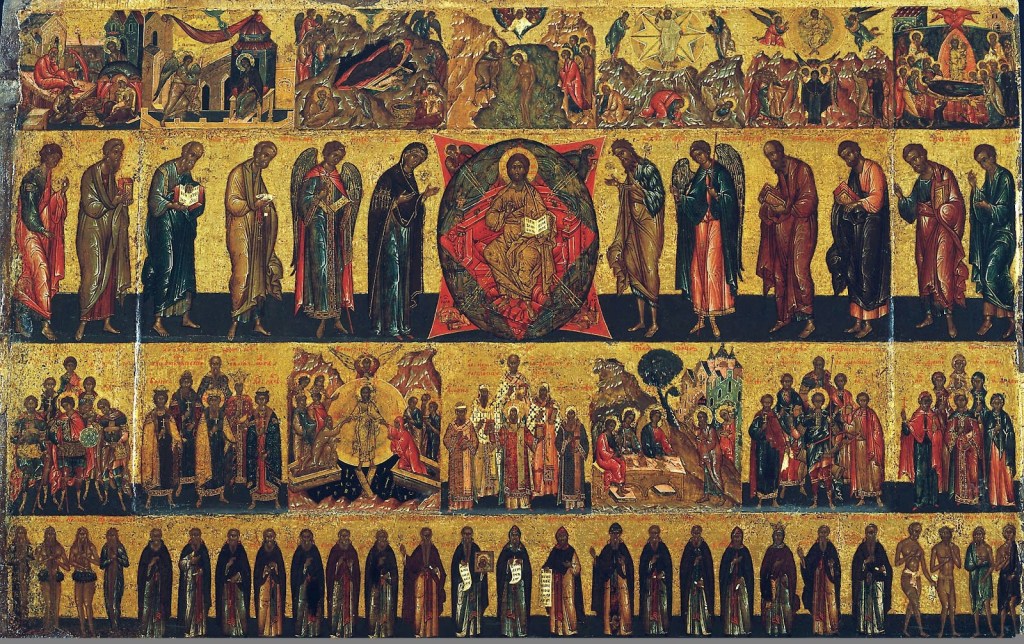
There is sainthood: being chosen by God to be holy and blameless, being predestined to be God’s son through Jesus Christ, being redeemed and forgiven through Christ’s blood, being sealed by the Holy Spirit as a guarantee of the fullness to come, being caught up into God’s plan to unite all things in Christ to the praise of his glory. I venerate the great saints of the past and of blessed memory, and their icons adorn my office and my home: the Blessed Virgin Mary, John the Forerunner, Peter and Paul, our guardian angels, George, John the Theologian, and others. But we are no less saints than they. St. Paul didn’t write to those luminaries on those icons, but to ordinary saints like you and me, saints struggling to be faithful, pressing on toward the goal for the prize of the upward call of God in Christ Jesus (see Phil 3:14), to whom, with the Father and the Holy Spirit, be honor and glory — in the saints — now and for ever. Amen.


 First Blessings