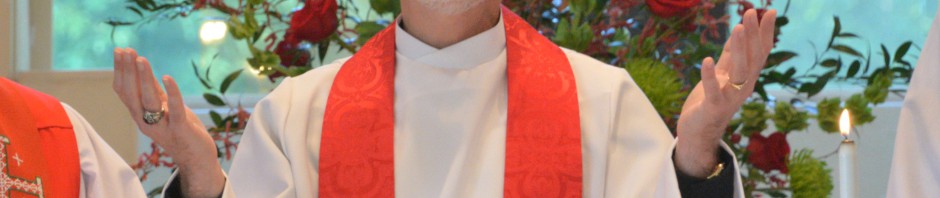
We meet together as an assembly and congregation, that, offering up prayer to God as with united force, we may wrestle with Him in our supplications. This violence God delights in (Tertullian, The Apology, Chapter XXXIX).
This excerpt comes from a description of early Christian worship by Quintus Septimius Florens Tertullianus (c. 155 – 220 AD) — Tertullian — a second and third century Christian apologist from Carthage, modern day Tunisia in Northern Africa. He was one of the earliest theologians, if not the first, to think and write in Latin, and is thus often considered the founder of Western theology. A caution is in order. While the Church honors his early writings, it is more circumspect regarding Tertullian himself and it eschews his later thought. The early, Orthodox theologian was seduced by the heretical Montanist movement and ended his life outside — informally if not formally — the catholic Church. The Apology is among his early works and is sure and safe ground.

The language of the excerpt is strange and wonderful to my ears. In the description of prayer we find this intriguing troika of descriptors: force, wrestling, violence. This hearkens back to the puzzling language of our Lord:
From the days of John the Baptist until now the kingdom of heaven has suffered violence, and the violent take it by force (Matt 11:12, ESV unless otherwise noted).
Even before this, there is the image of Jacob wrestling with God — violence as prayer, prayer as violence: Let me go. Not until you bless me.
24 And Jacob was left alone. And a man wrestled with him until the breaking of the day. 25 When the man saw that he did not prevail against Jacob, he touched his hip socket, and Jacob’s hip was put out of joint as he wrestled with him. 26 Then he said, “Let me go, for the day has broken.” But Jacob said, “I will not let you go unless you bless me.” 27 And he said to him, “What is your name?” And he said, “Jacob.” 28 Then he said, “Your name shall no longer be called Jacob, but Israel, for you have striven with God and with men, and have prevailed.” 29 Then Jacob asked him, “Please tell me your name.” But he said, “Why is it that you ask my name?” And there he blessed him (Gen 32:24-29).

Certainly, the grappling of Jesus in the Garden — unto the sweating of blood — stands as the ultimate example of forceful, violent prayer.

Today, we seem more likely to encounter centering prayer for making us whole rather than violent prayer for wresting blessing from God: prayer for “making us” but not for “breaking us,” prayer of sweetness and light but not prayer of wounding and martyrdom. Who or what teaches us to pray with force, with wrestling, with violence? The Psalms will teach us if we are faithful to their discipline, day in and day out, year by year. The Church Fathers will teach us if we submit to apprenticeship with them. But, it is perhaps the fallenness, the brokenness, the suffering of the world that is our best mentor: the hardships and losses of life, the headlong stumbles into sin, the heart-shattering abandonments and betrayals of friends-turned-enemies, the doctor’s diagnosis, the two o’clock in the morning worries and fears. And the cry is wrung from our lips and our hearts, “I will not let you go until you bless me!” from which we may limp away wounded but having seen God face to face.

I am an Anglican, and Anglicans do not “do” force and wrestling and violence in prayer, at least not in public. It simply is not done; it is not proper. But, I cannot help but wonder what might happen if the Prayers of the People just once turned into an all-out, no-holds-barred wrestling match with God Almighty, an encounter turned violent because we were praying as if our lives depend on it, which, of course, they really do. And not our lives only, but the life of the world.


 First Blessings