Apostles Anglican Church
Fr. John A. Roop
The Problem for the Rich Is the Poor : A Homily On James 5
(1 Kings 15:1-30, Psalm 5, James 5)
Collect
O merciful Lord, grant to your faithful people pardon and peace, that we may be cleansed from all our sins and serve you with a quiet mind; through Jesus Christ our Lord, who lives and reigns with you and the Holy Spirit, one God, now and for ever. Amen.
In the Name of the Father, and of the Son, and of the Holy Spirit. Amen.
I am now at that age where I generally preface every story with the disclaimer: “Now, if I’ve told you this before, please stop me.” I don’t want to be one of those old guys who runs out of stories before they run out of years. The problem is, I am going to tell you a story you’ve heard before. Fr. Jack told a version of it two Sundays past. I told a version of just last Sunday. This repetition is not our choice. We follow the lectionary and the lectionary is hammering this point home because Jesus and all of Scripture hammer this point home. So, here we go again.

We often speak of people groups as if they are monolithic, as if all the members of a group are essentially identical and interchangeable; if you’ve seen one, you’ve seen them all. We know that’s no true. We know that in any group there are common features and great variability. But it is easy and convenient to minimize the differences and to maximize the commonalities so that we can, for good or ill, speak of the whole group.
We speak of the homeless. Depending on who is speaking, all the homeless are either helpless victims of a neglectful or oppressive social structure or else lazy, shiftless products of their own irresponsible choices. We speak of immigrants. Depending on who is speaking, immigrants are the very backbone of American exceptionalism — what made America great to start with — or else violent, drug-dealing abusers of the largesse of this country. We speak of political parties as if all our compatriots are saints struggling mightily to drag this land back from the brink of destruction and our opponents are demons hauling us kicking and screaming into the maw of the abyss. And we all know this is all nonsense and yet we all do it to greater or lesser degrees. Lord, have mercy on us and forgive us this foolishness.

But, even Scripture does this from time to time — generalizes a group while admitting of some exceptions. All Moabites are bad, except for Ruth; Ruth is fine. Ninevites all deserve destruction; but even their animals repented in sackcloth at the preaching of Jonah, so there’s that in their favor. Samaritans are scum, and yet that one Samaritan was the hero of Jesus’ most famous parable.
It is the same with the rich in Scripture. As a group, they are generally warned or castigated if not condemned outright. They are probably up to something shifty that is very good for them and very bad for the common folk. But, as with other groups, there are exceptions; Lydia and Barnabas, maybe Philemon, come to mind as among the few righteous rich.
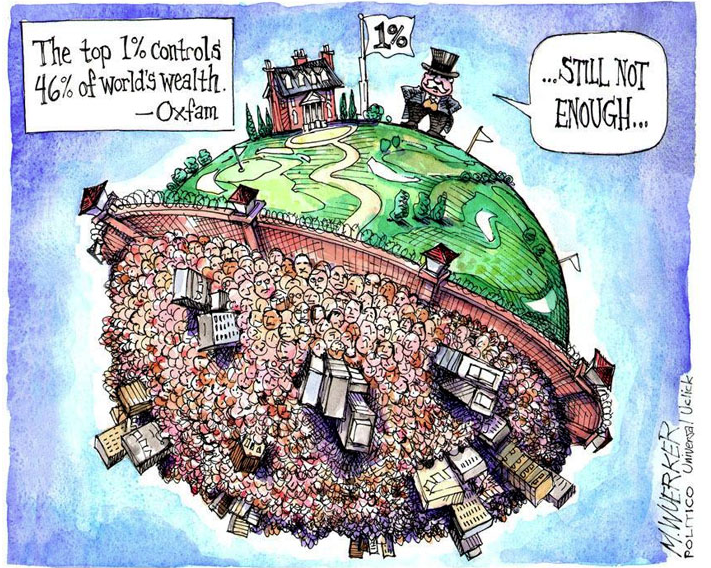
So, what is it that makes the rich so suspect in Scripture, so likely to hear the word “Woe!” shouted in their general direction? The problem for the rich is the poor. God had instituted a social policy in the Law that would largely mitigate poverty. There were gleaning laws that allowed the poor man access to the rich man’s over-abundance. There were laws of manumission that freed Hebrew economic slaves in the seventh year of servitude. There was a general economic reset every fiftieth year in which all property reverted to its hereditary owners. All of these laws kept the power and the greed of the rich in check and ensured that the rich could not forever prosper at the expense of the poor. But the law, as far as we can tell, was never observed in full. That the rich had not followed the law, that there were the destitute among them, is the indictment against the rich. There were no woes for the righteous rich — cautions, yes, but no condemnation — but judgment aplenty for the covetous and miserly rich.
And that brings us to James who has nothing good to say about the rich. Let’s consider James 5:1-6.
1 Come now, you rich, weep and howl for the miseries that are coming upon you. 2 Your riches have rotted and your garments are moth-eaten. 3 Your gold and silver have corroded, and their corrosion will be evidence against you and will eat your flesh like fire. You have laid up treasure in the last days. 4 Behold, the wages of the laborers who mowed your fields, which you kept back by fraud, are crying out against you, and the cries of the harvesters have reached the ears of the Lord of hosts. 5 You have lived on the earth in luxury and in self-indulgence. You have fattened your hearts in a day of slaughter. 6 You have condemned and murdered the righteous person. He does not resist you (James 5:1-6).

Harsh. Let’s look carefully at the text to see the specific charges against the rich. In verses 2 and 3 the problem is hoarding, specifically the hoarding of wealth: clothes, gold, silver — treasures in general. These rich do not use their wealth to make themselves happy — note the deterioration of their goods, the rottenness and corrosion — nor do they use their wealth to alleviate the suffering of the poor. They simply hoard it as testimony against them of their greed. These rich were surely the inspiration of Dickens’ Ebenezer Scrooge and his business partner Jacob Marley, men who made and hoarded money solely for the sake of making and hoarding money, good men of business. Marley realized only too late that, “Mankind was my business. The common welfare was my business; charity, mercy, forbearance, benevolence, were all my business.”

The rich are condemned because God had intended — had commanded them — to be a flowing stream of economic righteousness, but they had instead dammed up the stream to create a private reservoir of luxury solely for themselves. As St. Basil the Great (330-379) wrote:
When someone steals a person’s clothes, we call him a thief. Should we not give the same name to one who could clothe the naked and does not? The bread in your cupboard belongs to the hungry; the coat hanging unused in your closet belongs to those who need it; the shoes rotting in your closet to the one who has no shoes. The money which you hoard belongs to the poor.

But, James’s charge against the rich is actually worse than mere hoarding. They are hoarding not what they had rightly earned, but rather stolen wealth, wages fraudulently withheld from the poor. Look at verses 4-6.
4 Behold, the wages of the laborers who mowed your fields, which you kept back by fraud, are crying out against you, and the cries of the harvesters have reached the ears of the Lord of hosts. 5 You have lived on the earth in luxury and in self-indulgence. You have fattened your hearts in a day of slaughter. 6 You have condemned and murdered the righteous person. He does not resist you (James 5:4-6).
Not us — certainly not! But what about a society or a business or an individual that accrues wealth by routinely underpaying those who can least afford to be underpaid? What about my barista friends at a local café who have to work two jobs simply to have adequate food and clothing and who are praying that they do not get sick because neither job offers health insurance? What about the itinerate farm workers — the pickers — the immigrants who go from field to field doing back-breaking work for a mere pittance, and then are demonized for being here at all? What about the single adult, with no children, working full time for minimum wage in Knox County, TN? The minimum hourly wage is $7.25. The hourly poverty wage is $7.52. The minimum living wage is $23.30, four and a half times the minimum wage. Read James 5:4-6 again, and see if there is not just a little discomfort, a little concern that our society might have gone awry and might, Lord have mercy, be ripe for judgment. Then read the whole of Revelation 18. To be clear, I do not not know the solution. This is where we need Christian, Gospel-shaped politicians and businessmen and sociologists and a host of other professions to bring their expertise to bear to begin implementing the Kingdom of God vision.
Given this abuse by the rich, what are the poor to do? A better question might be, What can the poor do? because poverty also implies a certain powerlessness. James says this in verses 7-11; it may be a general instruction to everyone, but it certainly applies to the poor in this context:
7 Be patient, therefore, brothers, until the coming of the Lord. See how the farmer waits for the precious fruit of the earth, being patient about it, until it receives the early and the late rains. 8 You also, be patient. Establish your hearts, for the coming of the Lord is at hand. 9 Do not grumble against one another, brothers, so that you may not be judged; behold, the Judge is standing at the door. 10 As an example of suffering and patience, brothers, take the prophets who spoke in the name of the Lord. 11 Behold, we consider those blessed who remained steadfast. You have heard of the steadfastness of Job, and you have seen the purpose of the Lord, how the Lord is compassionate and merciful (James 5:7-11).
The ultimate remedy for poverty and the suffering it causes is the coming of the righteous judge who will put all things to rights. In the meantime, the poor, the abused, the suffering are to be patient, to guard their own hearts from bitterness and grumbling, to remember that the Lord sees and knows their plight and is compassionate and merciful. It seems perhaps too little, but both our Lord and his brother James assure the poor that there is blessing for them in what they are called patiently to endure, that their poverty is not the end of their story. We have to be careful here not to mistake James’s call for the poor to be patient for permission for us who are not poor to be negligent in our responsibility. Remember Matthew 25 and the corporal acts of mercy incumbent upon all Christians: feed the hungry; give drink to the thirsty; shelter the homeless; visit the sick and those in prison; bury the dead; give alms to the poor. That is how we can avoid the miseries that are coming upon the heedless rich on that day when the first are last and the last are first.

One more word about patience: we can mistake patience for passivity, for simply biding time and doing nothing. That is more akin to sloth, one of the deadly sins; but it is not Christian patience. Patience is a Christian discipline that must be exercised. Patience is a Christian virtue that must be practiced until it become second nature. Patience is a fruit of the Spirit that must be cultivated. Patience is not passivity; it is askesis, discipline that transforms one into the likeness of Christ. James mentions a key to moving beyond passivity and into askesis:
13 Is anyone among you suffering? Let him pray (James 5:13a).
For what are the suffering poor to pray? Well, that brings us back to the Sermon on the Mount, as James so often does. Hear Jesus:
44 “But I say to you, Love your enemies and pray for those who persecute you, 45 so that you may be sons of your Father who is in heaven” (Matt 5:44-45).
And again, in the words Jesus taught us all to pray:
11 “Give us this day our daily bread” (Matt 6:11).
In the midst of their patient, prayerful suffering, there comes this word from Jesus, a call to trust:
25 “Therefore I tell you, do not be anxious about your life, what you will eat or what you will drink, nor about your body, what you will put on. Is not life more than food, and the body more than clothing? 26 Look at the birds of the air: they neither sow nor reap nor gather into barns, and yet your heavenly Father feeds them. Are you not of more value than they? 27 And which of you by being anxious can add a single hour to his span of life? 28 And why are you anxious about clothing? Consider the lilies of the field, how they grow: they neither toil nor spin, 29 yet I tell you, even Solomon in all his glory was not arrayed like one of these. 30 But if God so clothes the grass of the field, which today is alive and tomorrow is thrown into the oven, will he not much more clothe you, O you of little faith? 31 Therefore do not be anxious, saying, ‘What shall we eat?’ or ‘What shall we drink?’ or ‘What shall we wear?’ 32 For the Gentiles seek after all these things, and your heavenly Father knows that you need them all. 33 But seek first the kingdom of God and his righteousness, and all these things will be added to you.
34 “Therefore do not be anxious about tomorrow, for tomorrow will be anxious for itself. Sufficient for the day is its own trouble” (Matt 6:25-34).

Those are comforting words to those of us who already have adequate food and drink and clothes, for whom the anxiety over basic necessities is largely foreign. But it is a holy challenge, a holy discipline for those in real need — a struggle toward virtue. Generosity, faithful stewardship, active compassion: these are James’s call to the rich, to those with resources. Patience, prayer, trust: these are James’s call to the poor, to those suffering need. There is something for each of us to do here.
Of course, those of us with resources should also pray, because none of us have enough to remedy societal poverty. A good prayer to start with might be the conclusion of the suffrages from Morning Prayer, words I used last Sunday. May these words be our prayer and our call to action:
Let not the needy, O Lord, be forgotten;
Nor the hope of the poor be taken away.
Create in us clean hearts, O God;
And take not your Holy Spirit from us (BCP 2019, p. 22).
Amen.


 First Blessings