Apostles Anglican Church
Fr. John A. Roop
Temples and Prayer: A Homily on 1 Kings 8
(1 Kings 8:22-61, Psalm 86, Hebrews 8)
Collect for Ember Days
Almighty God, the giver of all good gifts, in your divine providence you have appointed various orders in your Church: Give your grace, we humbly pray, to all who are [now] called to any office and ministry for your people; and so fill them with the truth of your doctrine and clothe them with holiness of life, that they may faithfully serve before you, to the glory of your great Name and for the benefit of your holy Church; through Jesus Christ our Lord, who lives and reigns with you, in the unity of the Holy Spirit, one God, now and for ever. Amen.
In the Name of the Father, and of the Son, and of the Holy Spirit. Amen.
Construction on the Temple Expiatori de la Sagrada Família — the Basilica of the Holy Family — began in Barcelona, Spain in 1882; it is scheduled for completion in 2026: one hundred forty-four years of work on the church. There is no modern construction effort that rivals that level of devotion and commitment. Notre Dame Cathedral was begun in 1163 and completed one hundred eight-two years later, but construction techniques were slower and more labor intensive then. Chartres Cathedral was s work-in-progress — building, expansion, rebuilding after fires — from 743 until 1520, though work is always ongoing. I suspect all the ancient cathedrals were multi-generational affairs, a century or more in the making.

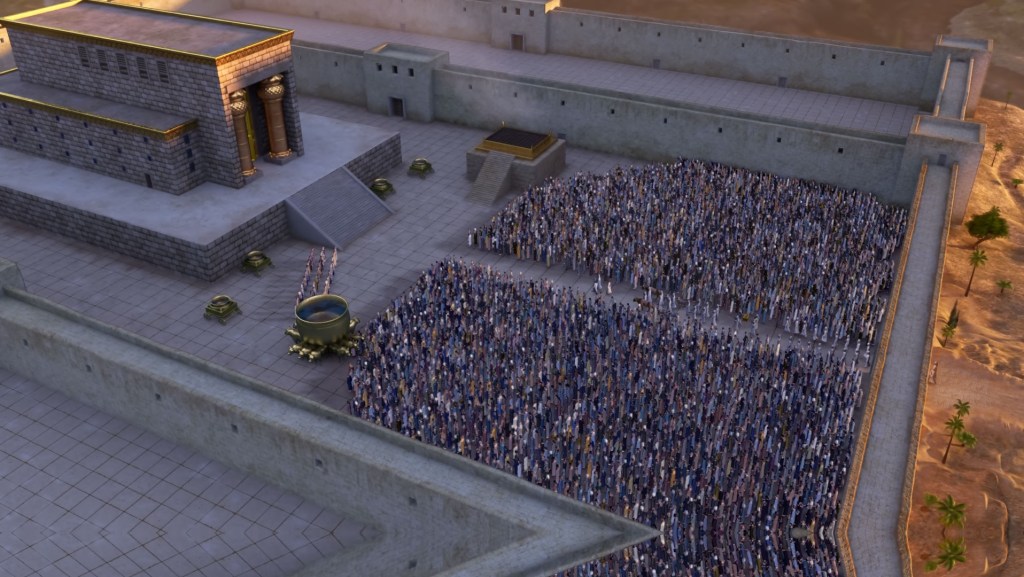
By contrast, Solomon’s Temple took a mere seven and a half years, which speaks to the modesty of that structure compared to the grand medieval cathedrals. But, whether humble like a tent in the wilderness or grand like Sagrada Família, we know that sacred space is important. Synagogues, mosques, churches, temples are important. So, today we come to the text of 1 Kings 8, the dedication of Solomon’s Temple, with a solemn sense of wonder and grandeur.
What is a temple? We might, without pausing for deep reflection, say that a temple is a place where a god dwells. I can’t speak for pagans and for their notions of their gods and temples, but when I was in India, there were Hindu temples seemingly on every street corner, much like Protestant churches in the United States. Whether those who visited the temples thought that Vishnu or Shiva or Ganesh actually dwelt in the temples, I don’t know. But, we do know that our God, does not. That conviction is the opening salvo of St. Paul’s defense before the Areopagus in Athens:
22 So Paul, standing in the midst of the Areopagus, said: “Men of Athens, I perceive that in every way you are very religious. 23 For as I passed along and observed the objects of your worship, I found also an altar with this inscription: ‘To the unknown god.’ What therefore you worship as unknown, this I proclaim to you. 24 The God who made the world and everything in it, being Lord of heaven and earth, does not live in temples made by man, 25 nor is he served by human hands, as though he needed anything, since he himself gives to all mankind life and breath and everything” (Acts 17:22-25).
Nor did the Jews — those who thought rightly about this matter — imagine that the God of Abraham, Isaac, and Jacob dwelt in the tabernacle or temple. That conviction is also central to Solomon’s dedicatory prayer:
27 “But will God indeed dwell on the earth? Behold, heaven and the highest heaven cannot contain you; how much less this house that I have built (1 Kings 8:27)!”
Solomon actually takes this matter further than St. Paul did: not only does God not dwell in temples made by human hands, he does not dwell on earth or in heaven made by divine hands/ divine word. St. Thomas Aquinas expressed the same notion: God is not one being among other beings who can therefore be localized to a place. Rather, God is the act of “to be;” God is being itself. So, it seems that we cannot, after all, say that a temple is the place where God dwells.
What then? How are we to think about a temple, and, in particular, about Solomon’s Temple? Let me suggest this, though I don’t think for a moment that it is a final, comprehensive, authoritative description: a temple is a place where God makes himself — his presence — known to his people, and where his people worship and entreat him. A temple is a place of God’s self-revelation and man’s worship and petition. A temple is a focal point of divine-human interaction. A temple is “God’s house” not in the sense of God’s dwelling place, but in the sense of a meeting place. A church building is God’s house in the same way: a place where God reveals his presence and where his people worship and entreat him.
There were temples long before Moses’ tabernacle and Solomon’s temple. The first temple is creation itself. God created something that was not himself, a place, and then he populated it with creatures, not least humans. So, this creation, this world, became the meeting place of God and man, the place where God revealed himself to his creatures and where his creatures worshiped him and fulfilled their God-given vocation. To impose language that only developed later, we might say that Eden was the Holy of Holies of the temple of creation, the place where God revealed himself uniquely to Adam and Eve, the prophets, priests, and kings of creation.
Later, there were other places where God revealed himself to those he called to be his people — often at specific geographical locations or at natural features like groves of trees or wells or mountains. For Abraham it was the Oaks of Mamre.
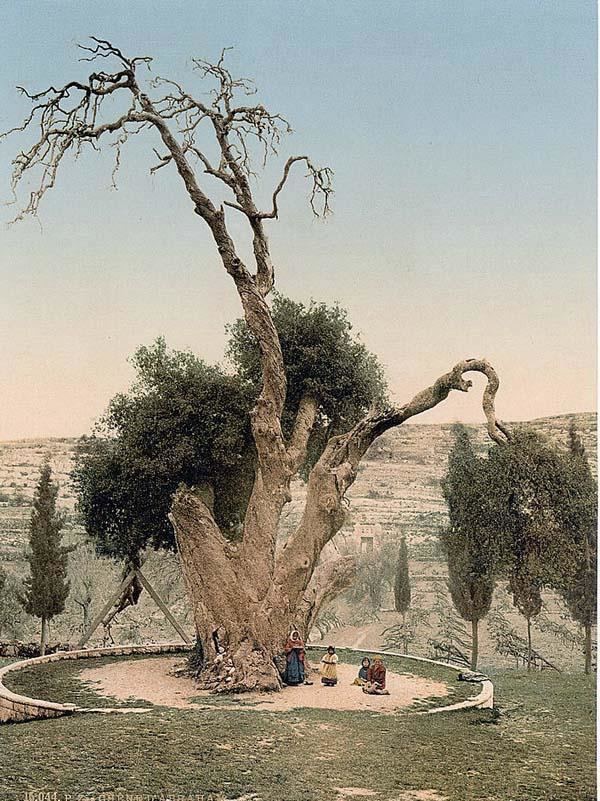
For Hagar it was a spring in the wilderness on the way to Shur and later at a well in the wilderness of Beersheba. For Moses it was on Mount Sinai.

These kind of natural temples come with a certain risk: that the people will form an image of “nature gods,” the gods of groves or wells or mountains. We even see Judah, as early as the reign of Rehoboam, son of Solomon, lapse into this error:
21 Now Rehoboam the son of Solomon reigned in Judah. Rehoboam was forty-one years old when he began to reign, and he reigned seventeen years in Jerusalem, the city that the Lord had chosen out of all the tribes of Israel, to put his name there. His mother’s name was Naamah the Ammonite. 22 And Judah did what was evil in the sight of the Lord, and they provoked him to jealousy with their sins that they committed, more than all that their fathers had done. 23 For they also built for themselves high places and pillars and Asherim on every high hill and under every green tree, 24 and there were also male cult prostitutes in the land. They did according to all the abominations of the nations that the Lord drove out before the people of Israel (1 Kings 14:21-24).
Even the Temple of the Lord — Solomon’s Temple — could be and was abused, being treated by the people as a good luck charm, a guarantee of God’s favor. That’s what Jeremiah said:
7 The word that came to Jeremiah from the Lord: 2 “Stand in the gate of the Lord’s house, and proclaim there this word, and say, Hear the word of the Lord, all you men of Judah who enter these gates to worship the Lord. 3 Thus says the Lord of hosts, the God of Israel: Amend your ways and your deeds, and I will let you dwell in this place. 4 Do not trust in these deceptive words: ‘This is the temple of the Lord, the temple of the Lord, the temple of the Lord’ (Jerusalem 7:1-4).”
Despite all that can go wrong with a temple, Cicero’s maxim holds true: Abusus non tollit usus — Misuse (abuse) does not negate proper use. And what does Solomon see as proper “use” for the temple as he dedicates this magnificent structure in Jerusalem?
27 “But will God indeed dwell on the earth? Behold, heaven and the highest heaven cannot contain you; how much less this house that I have built! 28 Yet have regard to the prayer of your servant and to his plea, O Lord my God, listening to the cry and to the prayer that your servant prays before you this day, 29 that your eyes may be open night and day toward this house, the place of which you have said, ‘My name shall be there,’ that you may listen to the prayer that your servant offers toward this place. 30 And listen to the plea of your servant and of your people Israel, when they pray toward this place. And listen in heaven your dwelling place, and when you hear, forgive” (1 Kings 8:27-30).
The temple is the place toward which God’s people will pray and the place from which God will hear and forgive. So, this text — 1 Kings 8, Solomon’s dedicatory prayer — is as much a primer on prayer as it is on temples. It is also a window into the character of God and God’s relationship with his people.

The first type of prayer that Solomon mentions is a plea for justice in the wake of sin:
31 “If a man sins against his neighbor and is made to take an oath and comes and swears his oath before your altar in this house, 32 then hear in heaven and act and judge your servants, condemning the guilty by bringing his conduct on his own head, and vindicating the righteous by rewarding him according to his righteousness” (1 Kings 8:31-32).
I am very hesitant myself to pray for God to condemn the guilty because I know only too well my own guilt. I find it easier to pray for God to reward the righteous; even though I may not count myself among them, there is something right about them being rewarded. I can’t begrudge them that. But the important implication of all this is that God cares about justice and will himself adjudicate between the guilty and the innocent. If he did not care, if he did not judge, then there would be no way to consider him good. The temple is not merely a place of mercy, but also a place of justice. In fact, if there is no justice, no final putting of things to rights, then there really is no mercy either. It is justice that ministers mercy to the aggrieved. Only God knows how to perfectly “balance” justice and mercy. It is only in God, as the Psalmist says, that “Mercy and truth have met together; / righteousness and peace have kissed each other” (Psalm 85:10).
The theme begun in this first petition for justice continues in several petitions that follow: the temple is the place to pray for forgiveness of sin. Solomon rehearses several calamities that might come upon the people and nation, and he assumes that sin is their cause. Then, naturally, repentance, confession, and prayer are the remedy:
“When your people Israel are defeated before the enemy because they have sinned against you…”(1 Kings 8:33).
“When heaven is shut up and there is no rain because they have sinned against you…” (1 Kings 8:35).
“If there is famine in the land, if there is pestilence or blight or mildew or locust or caterpillar, if their enemy besieges them in the land at their gates, whatever plague, whatever sickness there is…then hear in heaven your dwelling place and forgive…” (1 Kings 8:37-39, selections).
And then, worst of all, Exile:
“If they sin against you — for there is no one who does not sin — and you are angry with them and give them to an enemy, so that they are carried away captive to the land of the enemy, far off or near…if they repent with all their heart…and pray to you toward their land…then hear in heaven your dwelling place their prayer and their plea, and maintain their cause, and forgive your people who have sinned against you…” (1 Kings 8:46 ff).
Modern sensibility recoils from this, doesn’t it? When sickness comes we sometimes think first of physicians and “natural causes” and only later, if at all, of sin and Godly discipline. We generally want prescriptions and not penance. And, even if we think of the possibility of spiritual causes for our afflictions, we most likely think of an attack by the hate-filled enemy rather than of an admonition from a loving Father. Please don’t misunderstand. I am certainly not saying that specific, identifiable sin always lies at the root of all the difficulties we experience in our lives, though there may well be a causal relationship. We dare not look at another — at any other — experiencing illness or poverty or hardship of any kind and ask, “I wonder what his sin was that God is punishing him so harshly?” That is to make the same mistake the disciples made: “Who sinned that this man was born blind — the man or his parents?” No, it’s not that simple at all; the ways of God are not our ways and are often beyond our understanding. But, when hardship comes to me, it is appropriate that I do a thoroughgoing examination of my own life, that I ask God if this is correction, and that I repent for known sins and ask God to reveal to me my hidden sins.
There is one more prayer that I want to highlight, this one having nothing to do with sin. It is surprising on the lips of Solomon, a sign of the coming Gospel of the Lord.
41 “Likewise, when a foreigner, who is not of your people Israel, comes from a far country for your name’s sake 42 (for they shall hear of your great name and your mighty hand, and of your outstretched arm), when he comes and prays toward this house, 43 hear in heaven your dwelling place and do according to all for which the foreigner calls to you, in order that all the peoples of the earth may know your name and fear you, as do your people Israel, and that they may know that this house that I have built is called by your name” (1 Kings 8:41-43).
Solomon looks forward to an ingathering of the gentiles, so that all the peoples of the earth may know and fear the name of the Lord. That is a remarkable sentiment coming generations before the great prophets envisioned the same universal inclusion. It is, of course, a signpost pointing toward the fulfillment of the Temple, pointing toward the coming of the one who is himself the true Temple of the Lord, Jesus who is the “place” where God reveals his presence to man, Jesus who is the one to whom and through whom prayer is made, Jesus who is the one in whom all the peoples of the earth will come to know God. Solomon blessed God in his holy temple. We bless God in his only-begotten Son, to whom be glory and honor now and for ever. Amen.


 First Blessings