Apostles Anglican Church
Fr. John A. Roop
The Carmen Christi: A Homily on Philippians 2:1-11
(Phil 2:1-11, Psalm 103, John 16:16-end)
Collect
Keep your Church, O Lord, by your perpetual mercy; and because without you the frailty of our nature causes us to fall, keep us from all things hurtful, and lead us to all things profitable for our salvation; through Jesus Christ our Lord, who lives and reigns with you and the Holy Spirit, one God, for ever and ever. Amen.
Have this mind among yourselves which is yours in Christ Jesus.
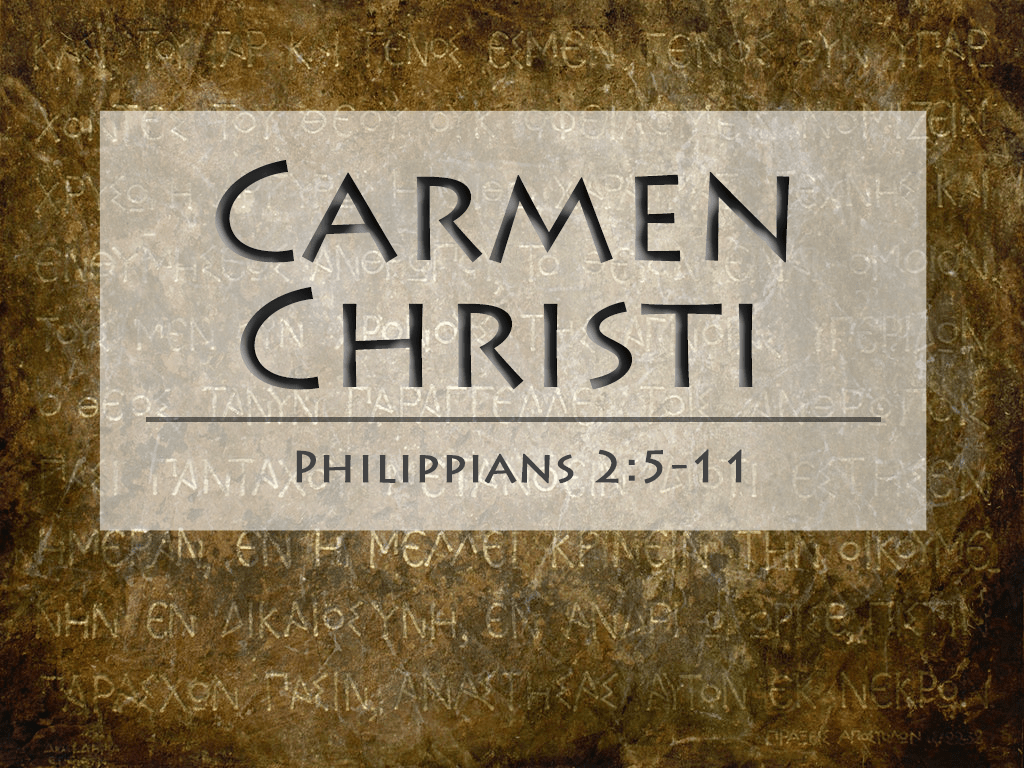
The Daily Office brings us this morning to St. Paul’s letter to the Philippian church, to one of the most exalted passages in that letter and indeed in the whole of Scripture: the Carmen Christi, the Hymn To Christ (Phil 2:5-11). Some scholars believe the Carmen Christi was a well-known hymn of the Church that Paul quotes in his letter much like a preacher today might quote the lyrics to Amazing Grace. It is an opportunity for St. Paul to sing with the church — though separated from it — the great, shared truths of the faith.
Other scholars think that St. Paul actually wrote these words under the inspiration of the Holy Spirit: a great act of poetry, doxology, and theology that became a great hymn of the Church.
It is a scholars’ debate, and the outcome matters little. What does matter is the hymn itself — what it tells us about Christ and what means for us. Before we reflect further on it, perhaps we should simply sing it, using one of the Psalm tones from Sunday worship.
Have this mind among yourselves, which is yours in Christ ‘Jesus,*
Who, though he was in the form of God, did not count equality with God a thing to be ‘grasped,
but emptied himself, by taking the form of a ‘servant,*
being born in the likeness of ‘men.
And being found in human ‘form,*
he humbled him’self
by becoming obedient to the point of ‘death,*
even death on a ‘cross.
Therefore God has highly ex’alted him*
and bestowed on him the name that is above every ‘name,
so that at the name of Jesus every knee should ‘bow,*
in heaven and on earth and under the ‘earth,
And every tongue confess that Jesus Christ is ‘Lord,*
to the glory of God the ‘Father.
Glory be the the Father, and to the ‘Son,*
and to the Holy ‘Spirit:
As it was in the beginning, is now, and ever ‘shall be,*
world without end. A’men.
This hymn stands on its own two feet; it can be extracted from St. Paul’s letter and sung or prayed or studied or preached on it own terms and merits. But, for St. Paul, it meant what it meant in the context of his letter, in the context of his history and relationship with the Philippian church. And that is a relationship bookended by suffering and prison.
You remember the founding of the church (see Acts 16) around 51 AD: St. Paul’s vision of the man of Macedonia, “Come over to Macedonia and help us;” St. Paul’s encounter with a group of Jewish women at their place of prayer down by the riverside, and the conversion of Lydia there, the first European to believe the Gospel; the exorcism of a slave girl possessed by a demon of divination and the outrage of her owners; the arrest of Paul and Silas, their unlawful beating and imprisonment; the hymns at midnight — Could one of them have been the Carmen Christi? — and the conversion and baptism of the Philippian jailer and his household; the forced apology of the city magistrates and Paul’s exit from Philippi. The church had witnessed, first hand, Paul’s suffering for the sake of Jesus and the exaltation of Jesus through Paul’s suffering.
Some ten years have passed when St. Paul writes this letter, and, as you might have guessed, he is writing from prison. The letter is, in part, a thank you note for a care package the Philippian church has sent him. That, too, engenders one of St. Paul’s most profound texts:
10 I rejoiced in the Lord greatly that now at length you have revived your concern for me. You were indeed concerned for me, but you had no opportunity. 11 Not that I am speaking of being in need, for I have learned in whatever situation I am to be content. 12 I know how to be brought low, and I know how to abound. In any and every circumstance, I have learned the secret of facing plenty and hunger, abundance and need. 13 I can do all things through him who strengthens me.
14 Yet it was kind of you to share my trouble (Phil 4:10-14).
It is out of suffering and prison that St. Paul writes a letter of encouragement and exhortation, including the Carmen Christi. He knows that the Philippian church will need strength. Listen to what St. Paul writes just before the hymn:
29 For it has been granted to you that for the sake of Christ you should not only believe in him but also suffer for his sake, 30 engaged in the same conflict that you saw I had and now hear that I still have (Phil 1:29).
St. Paul sees suffering in the Philippians’ story; whether past, present, future, or all three we do not know. But notice how he couches their suffering, not in terms of a burden to be borne, but rather as a gift to be received: it has been granted to you not only to believe but also to suffer. Both their belief and their suffering are free and lavish gifts showing God’s favor (έχαρίσθη).
This way of thinking — suffering as a gift — is contrary to my natural mind. When asked, “What you would like for your birthday?” I have never answered, “Oh, I’d like to suffer this year!” And, of course, that is not the kind of suffering St. Paul speaks of: self-chosen, self-imposed suffering. No: St. Paul is speaking of suffering imposed on us for the witness we bear for Christ — suffering for the sake of Christ. That is a gift.
You may think, then, that this has little to do with us, because in our place and time where we generally experience religious tolerance, we are not overtly persecuted for the sake of Christ. But, here’s the great mystery and truth: any suffering — even natural human suffering like illness or poverty or loss or broken relationships — any suffering borne well and rightly for the sake of Christ — because we are Christ’s — becomes gift: a difficult gift, a gift wrapped in barbed wire, yes, but a lavish gift showing God’s favor nonetheless. How are we to bear it well and rightly — how can we? In what sense is such suffering a gift? Here, we have to sing the hymn; we have to sing the Carmen Christi.
St. Paul introduces the hymn with these words:
2 So if there is any encouragement in Christ, any comfort from love, any participation in the Spirit, any affection and sympathy, 2 complete my joy by being of the same mind, having the same love, being in full accord and of one mind (Phil 2:1-2).
Notice the words St. Paul uses and their cumulative effect: encouragement in Christ, comfort from love, participation (fellowship/koinonia) in the Spirit; affection and sympathy. The Lord does not abandon us in or to our suffering, but comes to us, tends us, gathers us as a hen gathers her chicks, an image our Lord himself used. And the Spirit himself is, in our Lord’s own words, the Comforter. We need not fear suffering. We need not worry that we cannot endure it or that we will collapse under it. It is Christ himself who strengthens us. Remember Paul’s words: I can do all things through him who strengthens me.
But, there are some very real temptations caused by suffering, not least the turning inward on oneself, the myopic focus on one’s own afflictions. So St. Paul writes:
2 complete my joy by being of the same mind, having the same love, being in full accord and of one mind. 3 Do nothing from selfish ambition or conceit, but in humility count others more significant than yourselves. 4 Let each of you look not only to his own interests, but also to the interests of others (Phil 2:2-4).
St. Paul is speaking here of the opposite of self-absorption; he is speaking of a fellowship of suffering in which one’s gaze is turned outward toward the other, outward toward all the others in the community who are suffering. In the midst of suffering there is no room for selfishness, but only for humility and charity. Rightly borne, suffering can strengthen the Christian community in its faith, hope, and love. Our own suffering can awaken us to the suffering of others, and our prayers for one another can lift us all into God’s presence. Suffering is a gift granted to us, in part, because it draws us toward one another and strengthens the body of Christ.
With this foundation of unity in place, St. Paul plunges us into the heart of the Carmen Christi and into the heart of a great mystery. We are, the Apostle has said, to be of the same mind. Now he tells us that that mind is Christ’s:
5 Have this mind among yourselves, which is yours in Christ Jesus, 6 who, though he was in the form of God, did not count equality with God a thing to be grasped, 7 but emptied himself, by taking the form of a servant, being born in the likeness of men. 8 And being found in human form, he humbled himself by becoming obedient to the point of death, even death on a cross. 9 Therefore God has highly exalted him and bestowed on him the name that is above every name, 10 so that at the name of Jesus every knee should bow, in heaven and on earth and under the earth, 11 and every tongue confess that Jesus Christ is Lord, to the glory of God the Father (Phil 2:5-11).
There is deep theology here, deep beyond my ability to penetrate it, deep beyond anyone’s ability to fully grasp it. The theologians, using St. Paul’s own language, speak of kenosis, of the self-emptying of Christ. Listen anew to the words of the Nicene Creed as we ponder this:
We believe in one Lord, Jesus Christ,
the only-begotten Son of God,
eternally begotten of the Father,
God from God, Light from Light,
true God from true God,
begotten, not made,
of one Being with the Father;
through him all things were made (BCP 2019, p. 127).
This is the Logos, the Son, the second Person of the Trinity, very God, worthy of all worship, receiving eternal glory from the Father, receiving eternal praise from all the hosts of heaven. And, yet, he emptied himself of all the prerogatives of Sonship. Look at him again: the One by whom and for whom all things were created, nestled in the womb of a human mother; born in exile under a foreign power, born into poverty, laid in a feed trough; made a refugee to escape political extermination; raised in obscurity, working at St. Joseph’s trade to provide for his family; walking the Galilean hills teaching, healing, sleeping wherever he could find a place to lay his head; opposed by those who should have welcomed him; rejected by those who should have loved him; denied by one friend, betrayed by another; unjustly tried, convicted, tortured, and executed. Now, listen anew to the words of the Nicene Creed as we ponder this:
For us and for our salvation he came down from heaven,
was incarnate from the Holy Spirit and the Virgin Mary,
and was made man (ibid).
St. Paul sings it this way in the Carmen Christi:
5 Have this mind among yourselves, which is yours in Christ Jesus, 6 who, though he was in the form of God, did not count equality with God a thing to be grasped, 7 but emptied himself, by taking the form of a servant, being born in the likeness of men. 8 And being found in human form, he humbled himself by becoming obedient to the point of death, even death on a cross.
Christ Jesus plunged himself into the midst of human suffering and took the full burden of it on himself. He did it for us and for our salvation. He did it for the sake of love. This is the mind of Christ. This is the mind that St. Paul’s exhorts the Philippians to have among themselves, the mind he exhorts us to have among ourselves through his words to them: to empty ourselves, to serve one another, to plunge headlong into suffering if it be God’s will and if love demands. Through suffering, borne rightly and for the sake of Christ, we may be conformed to the likeness of Christ. And the Church teaches that such suffering rightly borne, united with the suffering of Christ, is redemptive, is gathered up into Christ’s own suffering and offered up for the salvation of the world. That is part of the great mystery of kenosis, of emptying oneself for the sake of Christ and for the love of neighbor.
All of this is hard; at least I find it so. Suffering is hard. But this assures us that there is meaning and purpose to our suffering, that we are not merely victims of chance. No: God is at work in and through our suffering to unite us to the body of Christ and to transform us into the likeness of his Son. And this is crucial: suffering was not the end of the story for Jesus; nor will it be for us. The Carmen Christi doesn’t end with suffering, but with glory:
9 Therefore God has highly exalted him and bestowed on him the name that is above every name, 10 so that at the name of Jesus every knee should bow, in heaven and on earth and under the earth, 11 and every tongue confess that Jesus Christ is Lord, to the glory of God the Father.
St. Paul writes that glory awaits us, too, all of us who have died with Christ, who have suffered with him. A bit later in the epistle, we read:
8 Indeed, I count everything as loss because of the surpassing worth of knowing Christ Jesus my Lord. For his sake I have suffered the loss of all things and count them as rubbish, in order that I may gain Christ 9 and be found in him, not having a righteousness of my own that comes from the law, but that which comes through faith in Christ, the righteousness from God that depends on faith— 10 that I may know him and the power of his resurrection, and may share his sufferings, becoming like him in his death, 11 that by any means possible I may attain the resurrection from the dead (Phil 3:8-11).
There is the end of suffering, even the end of death: to know the power of Christ’s resurrection. So, the Carmen Christi leads us into, through, and out the other side of suffering, and all in fellowship with Christ who endured all and conquered all for us. Therefore, have this mind among yourselves which is yours in Christ Jesus. Amen.


 First Blessings