Session 3: The Holy Spirit in the Sacraments

Apostles Anglican Church
Fr. John A. Roop
The Theology of the Holy Spirit
Session 3: The Holy Spirit in the Sacramental Life of the Christian
The Lord be with you.
And with your spirit.
Let us pray.
O God the Father, Creator of heaven and earth,
Have mercy upon us.
O God the Son, Redeemer of the world,
Have mercy upon us.
O God the Holy Spirit, Sanctifier of the faithful,
Have mercy upon us.
O holy, blessed, and glorious Trinity, one God,
Have mercy upon us (The Great Litany, BCP 2019, p. 91).
Introduction
Linda and I had very different approaches on how to start the school year and particularly on how to deal with the first unit of instruction and the first exam in our classes. We were both math teachers at a good high school and we both taught advanced mathematics to excellent students. Linda was a “motherly” type with a gentle approach: start slowly and make the first exam easy so that even the weaker students could score well on it. Her goal was to encourage her students, to prop them up. I was an “engineer” type with a more survival of the fittest approach: hit the academic ground running full speed and make the first exam very challenging so that everyone would struggle with it — not be crushed by it, but leave knowing they had been in a good fight. My goal was to motivate those advanced students with high expectations and to make those expectations clear from the start. It’s always easier to starts “tight” and loosen up than to start with low expectations and to try to raise them later. Never smile until Christmas was the advice a principal gave me once.
I have no idea who was right — Linda or me — or whether there even is a “right” in such things; we each had success with our own students and our own approaches. Honestly, our differences were more likely a matter of personal temperament than of pedagogical philosophy. But, you can probably see how that temperament still plays out in how I construct a course, even a spiritual formation course. We hit the theological ground running these past two weeks. To mix metaphors, we dove into the deep end, or maybe I just threw you into the deep end: Scriptural history, theological process, bats (epistemology — how we know things — and the limits of knowledge and perception), and the mysteries of the Trinity. Even I wouldn’t want to take a test on those first two classes!
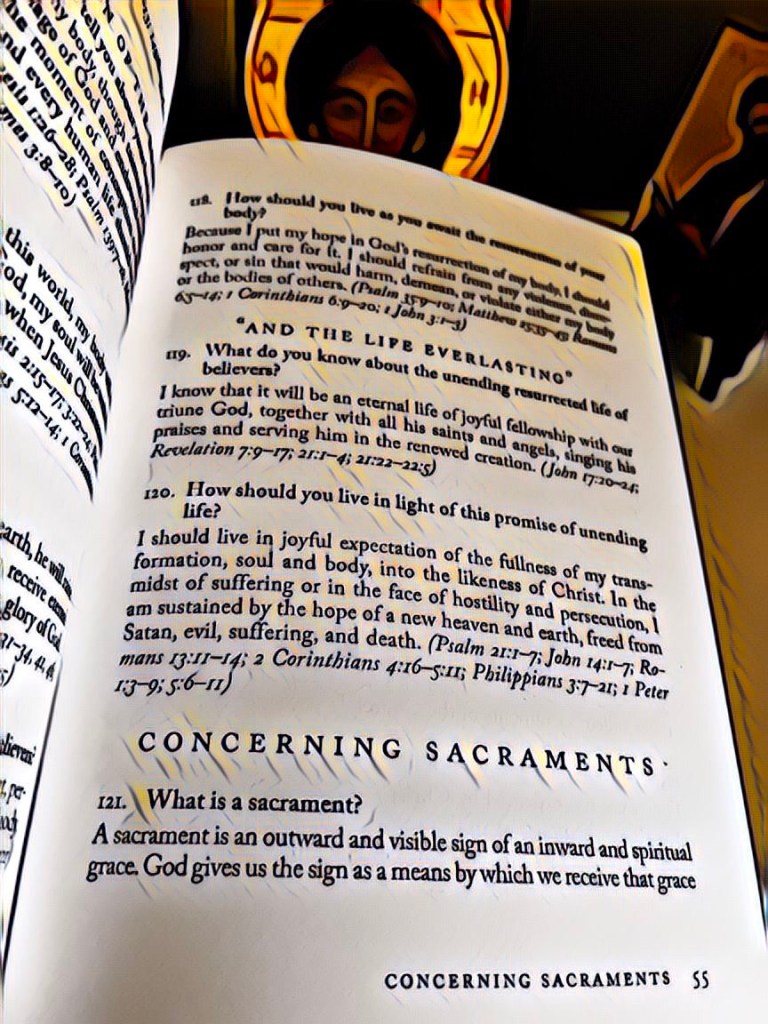
So, today, let’s take a breath, pun intended. Πνευμα (pneuma) is the Greek word for breath/wind and spirit. It’s time for something a little more tangible, perhaps something a bit more familiar: the Holy Spirit in life of the Christian and in the life of the Church — our engagement, individually and corporately, with the Holy Spirit throughout our spiritual life. Today we will see how that engagement with the Holy Spirit takes place — not exclusively but prominently — through the sacraments. So, it might be good to review what we mean by a sacrament. The ACNA catechism, To Be A Christian, poses this question:
121. What is a sacrament?
Would you like to “take a stab” at an answer before we get the “official” version?
A sacrament is an outward and visible sign of an inward and spiritual grace. God gives us the sign as a means by which we receive that grace and as a tangible assurance that we do in fact receive it (To Be A Christian, pp. 55-56).
In a sacrament, God is doing something inwardly (spiritually) and thus invisibly to the person receiving the sacrament in faith. The form of the sacrament — what we say and do and see — is both the outward sign of God’s inner work of grace, the means by and through which that grace is administered, and a tangible sign and remembrance of that inner work. What we will find is that the Holy Spirit is the divine agent acting in and through the sacraments throughout the whole of our lives in Christ.
Birth: Baptism
So, here is a question: Considering the Gospel as a narrative, where does the Holy Spirit first appear in the story chronologically? The Holy Spirit is first mentioned in conjunction with the conception of Jesus in the Gospels according to Sts. Matthew and Luke:
18 Now the birth of Jesus Christ took place in this way. When his mother Mary had been betrothed to Joseph, before they came together she was found to be with child from the Holy Spirit (Mt 1:18).
34 And Mary said to the angel, “How will this be, since I am a virgin?”
35 And the angel answered her, “The Holy Spirit will come upon you, and the power of the Most High will overshadow you; therefore the child to be born will be called holy—the Son of God (Lk 1:34-35).
Now: What is the second chronological appearance of the Holy Spirit in the Gospels? For that, we can refer to the remaining two Gospels, Mark and John, neither of which have a birth narrative of Jesus. In each of them, Jesus first comes on the scene in his baptism. And it is there that we see the Holy Spirit.
9 In those days Jesus came from Nazareth of Galilee and was baptized by John in the Jordan. 10 And when he came up out of the water, immediately he saw the heavens being torn open and the Spirit descending on him like a dove. 11 And a voice came from heaven, “You are my beloved Son; with you I am well pleased” (Mk 1:9-11).
29 The next day he saw Jesus coming toward him, and said, “Behold, the Lamb of God, who takes away the sin of the world! 30 This is he of whom I said, ‘After me comes a man who ranks before me, because he was before me.’ 31 I myself did not know him, but for this purpose I came baptizing with water, that he might be revealed to Israel.” 32 And John bore witness: “I saw the Spirit descend from heaven like a dove, and it remained on him. 33 I myself did not know him, but he who sent me to baptize with water said to me, ‘He on whom you see the Spirit descend and remain, this is he who baptizes with the Holy Spirit.’ 34 And I have seen and have borne witness that this is the Son of God” (John 1:29-34).
Now, we put down two dots on the paper: Jesus’ conception/birth and his baptism. I want to put one other dot on the paper and then connect all of them: Jesus’ discussion with Nicodemus.
1 Now there was a man of the Pharisees named Nicodemus, a ruler of the Jews. 2 This man came to Jesus by night and said to him, “Rabbi, we know that you are a teacher come from God, for no one can do these signs that you do unless God is with him.” 3 Jesus answered him, “Truly, truly, I say to you, unless one is born again he cannot see the kingdom of God.” 4 Nicodemus said to him, “How can a man be born when he is old? Can he enter a second time into his mother’s womb and be born?” 5 Jesus answered, “Truly, truly, I say to you, unless one is born of water and the Spirit, he cannot enter the kingdom of God. 6 That which is born of the flesh is flesh, and that which is born of the Spirit is spirit. 7 Do not marvel that I said to you, ‘You must be born again.’ 8 The wind blows where it wishes, and you hear its sound, but you do not know where it comes from or where it goes. So it is with everyone who is born of the Spirit” (John 3:1-8).
Now, let’s put all this together; let’s connect the dots:
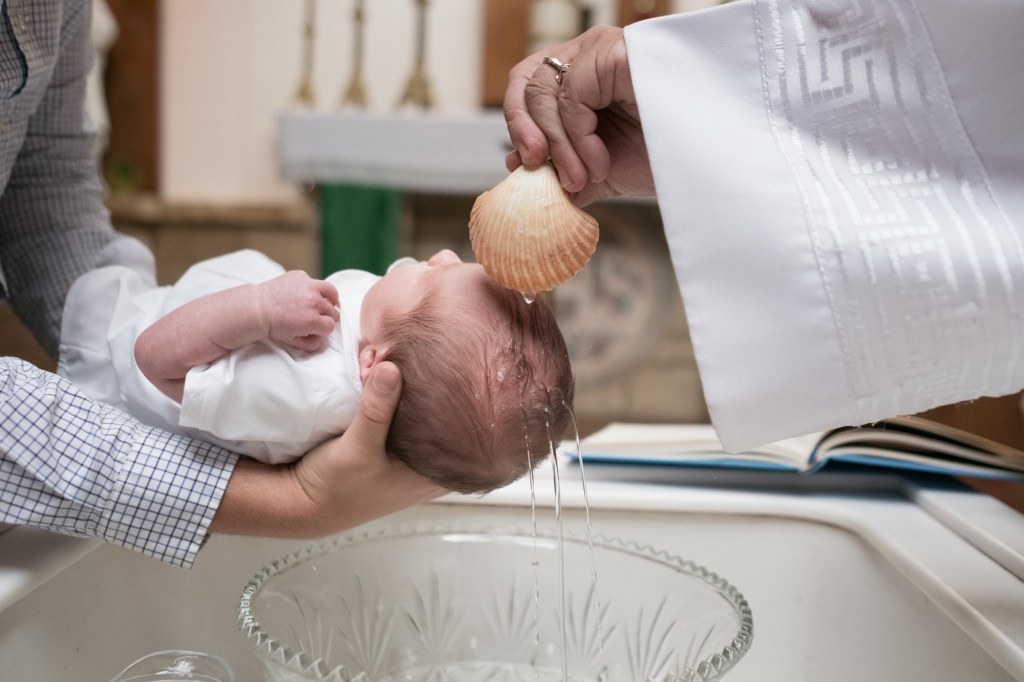
The Holy Spirit is the agent of spiritual conception and birth in the Christian life. Sacramentally, that occurs in baptism.
If the Holy Spirit does not convict us and draw us to the Father, we will never be spiritually conceived. If the Holy Spirit does not descend upon us in our baptism, we will never be spiritually reborn.
We do not — we cannot — know precisely what Jesus’ baptism meant for him and what the descent of the Holy Spirit entailed, but we can say, because Scripture says, what it means for us: it is new birth in Christ through the forgiveness of sins. Baptism is more than that, but it is, at the heart of it, new birth through the forgiveness of sins. The Holy Spirit is the operative agent of new birth in baptism. As St. Peter preached on the Day of Pentecost:
38 And Peter said to them, “Repent and be baptized every one of you in the name of Jesus Christ for the forgiveness of your sins, and you will receive the gift of the Holy Spirit” (Act 2:38).
To see how this is reflected in our sacramental life together, listen to The Exhortation in the Rite of Holy Baptism:
Dearly beloved, Scripture teaches that we were all dead in our sins and trespasses, but by grace we may be saved through faith. Our Savior Jesus Christ said, “Unless one is born of water and the Spirit, he cannot enter the kingdom of God”; and he commissioned the Church to “make disciples of all nations, baptizing them in the Name of the Father, and of the Son, and of the Holy Spirit.” Here we ask our heavenly Father that these Candidates, being baptized with water, may be filled with the Holy Spirit, born again, and received into the Church as living members of Christ’s body. Therefore, I urge you to call upon God the Father, through our Lord Jesus Christ, that of his abundant mercy he will grant to these Candidates that which by nature they cannot have (BCP 2019, p. 162).
In baptism, through the Holy Spirit, something happens to the individual: new birth. But, something also happens, through the Holy Spirit, to the Church: a new family member is added. The Church reproduces and grows by baptism through the Holy Spirit’s conception and birth of a new child of God. I said that today we would begin to look at the Holy Spirit in the life of the Christian and in the life of the Church. Here we see that the Holy is the life of the Christian and the life of the Church. But, there is more.
Growth: Eucharist
Romans were not known for the value they placed on human life. If an unwanted child was born — one too many, one from the wrong mother, one ill-formed including often simply being female — that baby was often exposed to the elements, thrown on a garbage heap, left to starve or perhaps even worse. Christians were known for saving those children, for adopting them as their own, because life — as a gift from God — matters to Christians. The idea of starving a child is inconceivable, abominable. As a bare minimum, we feed and nourish our young. And, we do that spiritually, sacramentally, as well. When a child of God is born in baptism, we feed that child sacramentally on the body and blood of Christ in the Eucharist. Everyone is welcome on equal terms to the family meal. Birth, nourishment, and growth go together.
Now, that was not always the case in the Anglican Church and is not universally the case today. In many parts of the Anglican Communion the church waits until Confirmation before admitting a young person to the Eucharist. And, though infants are invited to the altar in the ACNA, the decision to commune a given infant or child rests finally with the parent(s). It is a matter of prudential judgment discerned, ideally, with the rector or other priest of the parish. That doesn’t negate the point I am making, simply that as there is a sacrament of new birth (baptism) so, too, there is a sacrament of nourishment and growth and that the Holy Spirit is the active agent in each.
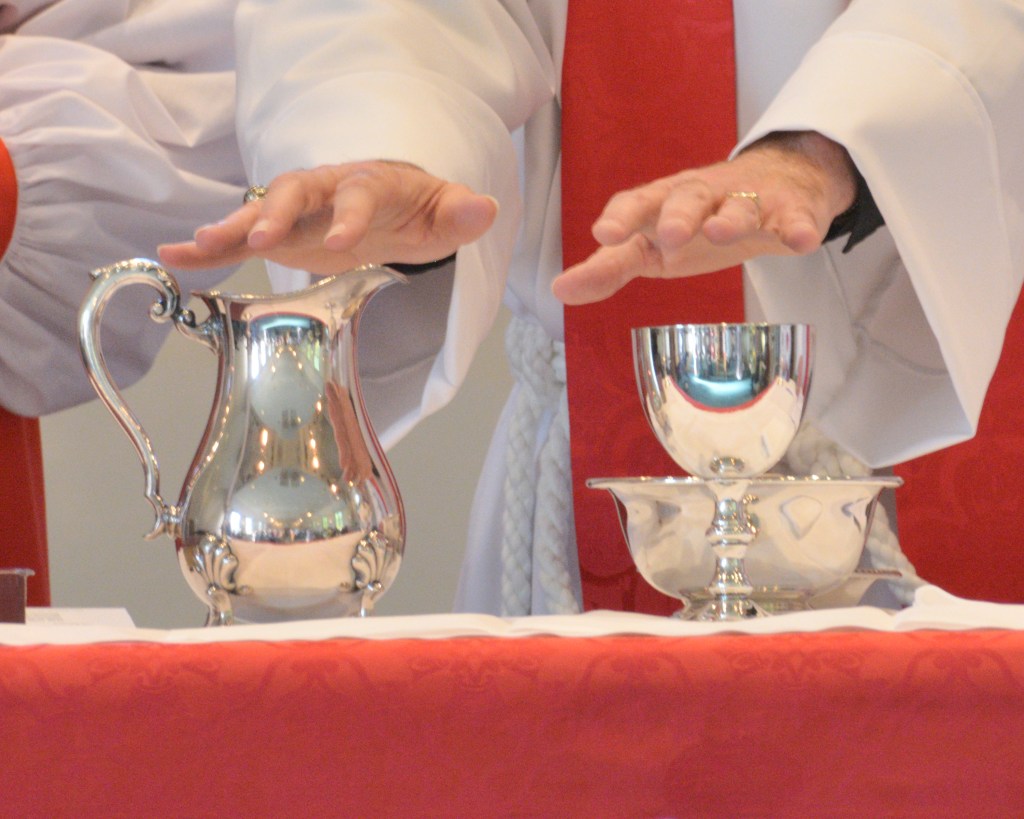
In the Eucharistic Prayer — The Great Thanksgiving — the priest offers a prayer of epiclesis, a prayer to call down the Holy Spirit upon the bread and wine to make them be for the faithful the body and blood of Christ. One of our Eucharistic liturgies has these words:
We celebrate the memorial of our redemption, O Father, in this sacrifice of praise and thanksgiving, and we offer you these gifts [of bread and wine].
Sanctify them by your Word and Holy Spirit to be for your people the Body and Blood of your Son Jesus Christ. Sanctify us also, that we may worthily receive this holy Sacrament, and be made one body with him, that he may dwell in us and we in him (BCP 2019, Holy Eucharist: Renewed Ancient Text, pp. 133-134).
It is the Holy Spirit, acting in conjunction with the Word — not least the Words of Institution given by Jesus himself — who makes Christ sacramentally present to us in bread and wine. As the Holy Spirit makes new birth possible in baptism, so He makes nourishment, growth, and life in Christ possible in the Eucharist. About this, Jesus said:
53b “Truly, truly, I say to you, unless you eat the flesh of the Son of Man and drink his blood, you have no life in you. 54 Whoever feeds on my flesh and drinks my blood has eternal life, and I will raise him up on the last day. 55 For my flesh is true food, and my blood is true drink. 56 Whoever feeds on my flesh and drinks my blood abides in me, and I in him. 57 As the living Father sent me, and I live because of the Father, so whoever feeds on me, he also will live because of me” (John 6:53b-57).
The Church understands this to speak of the Eucharist and of the essential role it plays in the life and growth of the faithful. And still there is more.
Maturity: Confirmation
Many traditional cultures have a rite of passage in which an adolescent member of the tribe or community assumes the responsibilities of adulthood. There is the Jewish Bar Mitzvah, the Hispanic Quinceañera, the indigenous Australian Walkabout, the Native American Vision Quest. In the United States of my youth, it was the first solo drive in the car with your new driver’s license or maybe the high school graduation.
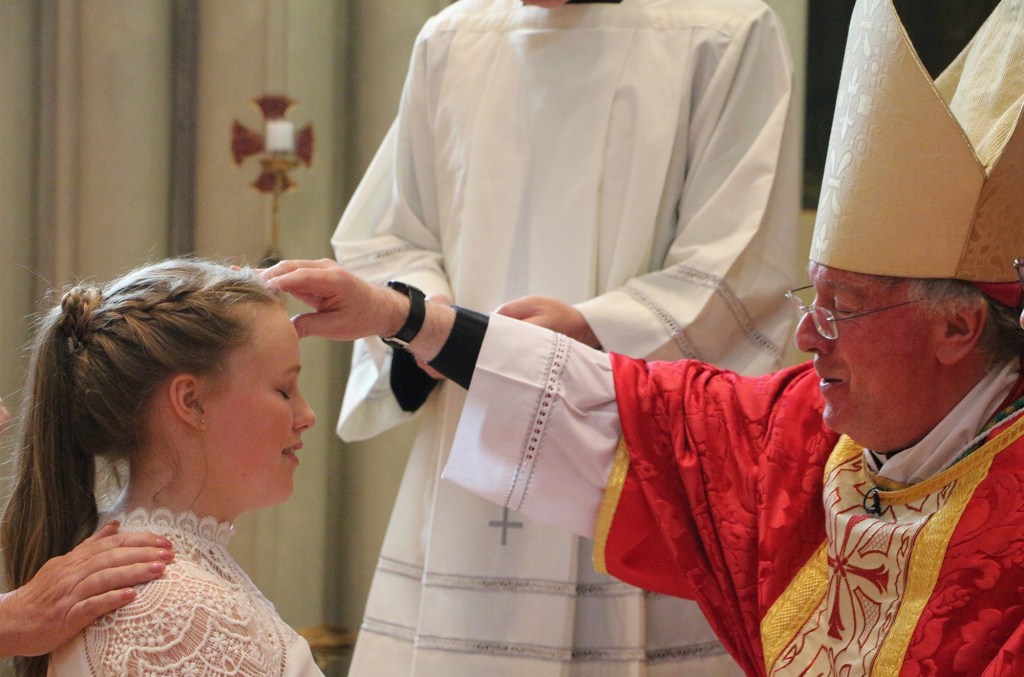
The Church is a traditional culture. A child of God is born in baptism, is nourished and grows through the Eucharist. What is the rite of passage to maturity? Confirmation is the Christian rite of passage from spiritual adolescence to spiritual maturity. It entails a mature, public affirmation of those baptismal vows taken by a parent(s) on one’s behalf as an infant. It is a public act of taking on oneself the adult responsibilities and ministries of the Christian faith. And, once again, the Holy Spirit — acting through the bishop in his prayers, anointing, and laying on of hands — is the active agent in this sacrament. Here is how the BCP describes Confirmation in the preface to the rite:
The Anglican Church requires a public and personal profession of the Faith from every adult believer in Jesus Christ. Confirmation or Reception by a Bishop is its liturgical expression. Confirmation is clearly grounded in Scripture: the Apostles prayed for, and laid their hands on those who had already been baptized (2 TIMOTHY 1:6-7; ACTS 8:14-17; 19:6).
In Confirmation, through the Bishop’s laying on of hands and prayer for daily increase in the Holy Spirit, God strengthens the believer for Christian life in the service of Christ and his kingdom. Grace is God’s gift, and we pray that he will pour out his Holy Spirit on those who have already been made his children by adoption and grace in baptism (BCP 2019, p. 174).
In particular, the Bishop prays that each Confirmand will be strengthened through the power of the Holy Spirit with seven virtues of grace: the spirit of wisdom and understanding, the spirit of counsel and might, the spirit of knowledge and true godliness, and the spirit of holy fear (see BCP 2019, p. 178). This rite acknowledges what should be an obvious truth: we cannot face the adult challenges of this world, we cannot live as mature Christians who continue to grow in Christ-likeness, without the empowering presence of the Holy Spirit, not statically, but dynamically — ever increasing.
These three — Baptism, Eucharist, and Confirmation — are the sacramental rites of initiation and inclusion: rites of birth, growth, and coming of age. And all three are utterly dependent upon the Holy Spirit.
Sickness and Healing: Confession
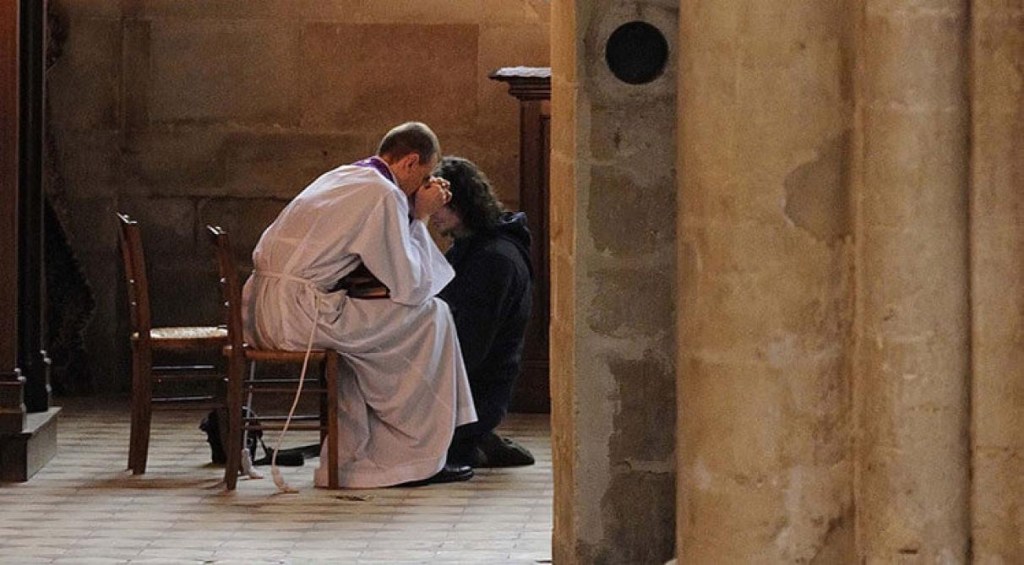
But human growth — physical, mental, emotional growth — is not an uninterrupted process of moving from good to better to best; there are setbacks along the way. We all get tired from time to time, ill or injured, depressed — perhaps not clinically, but just stuck and out of sorts. In such times, growth may slow or cease, or we may even regress to a prior state.
The same is true in the spiritual life. We generally move forward — please, God — but sometimes in a “two steps forward one step back” sort of way, and sometimes, if we are honest, in a “one step forward two steps back” sort of way. Sometimes we err and stray like lost sheep; follow too much the devices and desires of our own hearts; offend against God’s holy laws, leaving undone those things we ought to have done, and doing those things we ought not to have done. Sometimes we know, we really know, that, apart from His grace, there is no health in us, and we know that we need spiritual healing (see BCP 2019, p. 12). The word we put to that recognition is conviction and the process of restoration to spiritual health we call repentance. And the Holy Spirit is, once again, the divine agent active in this process.
In The Great Litany (BCP 2019, pp. 91-97) — which I most heartily commend to you as part of your personal rule of prayer — we pray:
That it may please you to give us true repentance; to forgive us all our sin, negligence, and ignorance; and to endue us with the grace of your Holy Spirit to amend our lives according to your holy Word,
We beseech you to hear us, good Lord (BCP 2019, p. 95).
The sacramental expression of repentance and restoration to spiritual health is the Rite of Healing called Reconciliation of Penitents, or, more commonly, Confession. And notice that the process depends on the grace of the Holy Spirit.
If you have never made use of sacramental confession, I know it may seem daunting or embarrassing or off-putting. Many people going into confession — especially for the first time — say, “I hate confession.” Coming out, it’s always, “I love confession.” Conviction by the Holy Spirit is never pleasant: I hate confession. But absolution and amendment of life by the Holy Spirit is pure grace: I love confession.
As a priest, I learned — from a novel of all places — and adopted as my own a simple rule: If anyone asks, “Father, will you hear my confession?” the answer is always “yes,” because the Holy Spirit is present and active in that request. No one truly seeks confession unless prompted by the Holy Spirit. And even if someone should come half-heartedly or with mixed motives, the Holy Spirit will be there to “ambush” them and the moment will become holy.
The Holy Spirit is not present only in the acts of conviction and repentance, but also in the absolution pronounced by the priest. We have this from Jesus’ own words on the day of Resurrection:
19 On the evening of that day, the first day of the week, the doors being locked where the disciples were for fear of the Jews, Jesus came and stood among them and said to them, “Peace be with you.” 20 When he had said this, he showed them his hands and his side. Then the disciples were glad when they saw the Lord. 21 Jesus said to them again, “Peace be with you. As the Father has sent me, even so I am sending you.” 22 And when he had said this, he breathed on them and said to them, “Receive the Holy Spirit. 23 If you forgive the sins of any, they are forgiven them; if you withhold forgiveness from any, it is withheld” (John 20:19-23).
There we have the πνευμα(pneuma) — the breath, the wind, the Holy Spirit — given by Jesus to those who will shepherd the Church for the express purpose of forgiveness of sins: not that the shepherds themselves have the power of forgiveness, but rather that the Holy Spirit works in and through them to accomplish the forgiveness that the shepherds — by the authority of Jesus — pronounce. There are several forms of absolution provided by the Book of Common Prayer. These two options from the Daily Office emphasize the role of the Holy Spirit:
Almighty God, the Father of our Lord Jesus Christ, desires not the death of sinners, but that they may turn form their wickedness and live. He has empowered and commanded his ministers to pronounce to his people, being penitent, the absolution and remission of their sins. He pardons and absolves all who truly repent and genuinely believe his holy Gospel. For this reason, we beseech him to grant us true repentance and his Holy Spirit, that our present deeds may please him, the rest of our lives may be pure and holy, and that at the last we may come to his eternal joy; through Jesus Christ our Lord. Amen (BCP 2019, p. 12-13).
Here the invocation of the Holy Spirit is directed toward empowerment to please God through our deeds in the present, to live the remainder of our lives in purity and holiness, and to arrive safely at last into God’s eternal joy: strength, empowerment, and hope.
The next option for absolution has a different emphasis:
The Almighty and merciful Lord grant you absolution and remission of all your sins, true repentance, amendment of life, and the grace and consolation of his Holy Spirit (ibid, p. 13).
Here it is the grace and consolation of the Holy Spirit that the absolution offers. It draws on the nature and role of the Holy Spirit as the paraclete: the helper, the comforter, the advocate, the spirit by which we know God to be not our judge, but our Father, our Abba as St. Paul writes:
14 For all who are led by the Spirit of God are sons of God. 15 For you did not receive the spirit of slavery to fall back into fear, but you have received the Spirit of adoption as sons, by whom we cry, “Abba! Father!” 16 The Spirit himself bears witness with our spirit that we are children of God, 17 and if children, then heirs—heirs of God and fellow heirs with Christ, provided we suffer with him in order that we may also be glorified with him (Rom 8:14-17).
From conviction and repentance to amendment of life and absolution, to empowerment and consolation, this rite of spiritual healing — confession — is a work of the Holy Spirit.
Healing: Unction
Over the past five centuries, Western culture has experienced a great redefinition and diminishment of what it means to be human. I start by blaming the 17th century mathematician and philosopher René Descartes, though the root of the problem probably goes as far back as the 14th century to William of Ockham, an English Franciscan theologian and philosopher. Descartes was a wonderful mathematician, but a misguided philosopher. You probably know his great proclamation on the existence and nature of man: Cogito, ergo sum — I think, therefore I am. St. Thomas Aquina described God as ipsum esse, the essence of being. As we said last week, to be God is to be. Descartes described man as cogito ens cogitans, as a thinking being. To be is to think, or to think is to be. There is man reduced to cognition; what is most essential about man is that he thinks. Gone is man as the image bearer of God. In subsequent years things went from bad to worse with the rise of scientific materialism. I think the physicist Richard Feynman gave this view its boldest and clearest expression in this quote from his famous series of lectures on introductory physics given at Cal Tech:
In other words, there is nothing that living things do that cannot be understood from the point of view that they are made of atoms acting according to the laws of physics (https://www.feynmanlectures.caltech.edu/I_01.html, accessed 06/07/2025).
Even though Feynman was one of the most brilliant physicists of the twentieth century, he was nonetheless ignorant in the spiritual sense. He was afflicted with the most fundamental of the spiritual illnesses of the heart: ignorance of God. The Fathers of the Church, the desert Fathers, the great saints, theologians, and mystics of our faith — male and female alike — concur on a holistic understanding of man’s nature consisting of body, mind, and spirit: not just body (atoms in motion) as Feynman concluded, not primarily mind (as Descartes emphasized), but a trinity of body, mind, and spirit. That is why, when the Church provides pastoral care, it cares for the whole person. That brings us to the pastoral rite of Ministry To The Sick.
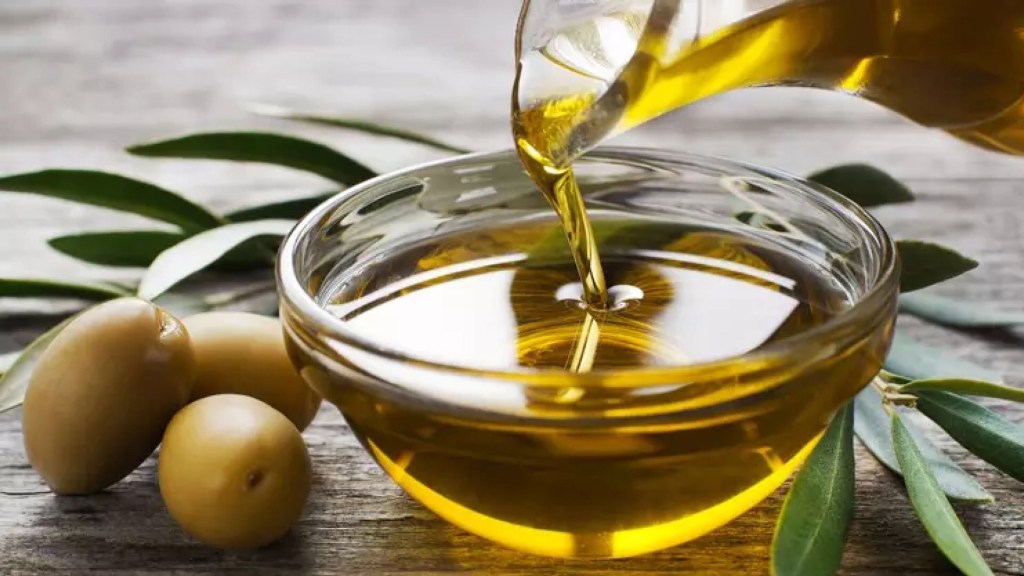
The outward signs of this sacramental ministry are the anointing with oil (unction) and the laying on of hands with prayer. Listen to what is said, and note the holistic understanding of human nature and the role of the Holy Spirit.
N., I anoint you with oil and I lay my hands upon you in the Name of the Father, and of the Son, and of the Holy Spirit. Amen.
Lord Jesus Christ, heal this your servant, sustain him with your presence, drive away all sickness of body, mind, and spirit, and give to him that victory of life and peace which will enable him to serve you both now and ever more. Amen.
As you are outwardly anointed with this holy oil, so may our heavenly Father grant you the inward anointing of the Holy Spirit. Of his great mercy, may he forgive you your sins, release you from suffering, and restore you to wholeness and strength. May he deliver you from all evil, preserve you in all goodness, and bring you to everlasting life; through Jesus Christ our Lord. Amen (BCP 2019, pp. 225-226).
Here, the Holy Spirit is presented as the divine active agent in the holistic healing of the human person: body, mind, and spirit. That healing includes forgiveness of sins, release from suffering, restoration of wholeness and strength, deliverance from evil, preservation in goodness, and ultimately, eternal life. I would like to say much more about each of these — about healing generally — but that is another course!
Death: Last Rites

At some point, will will die — all of us — unless Christ returns before that day. That is what our Ash Wednesday service proclaims: Remember that you are dust, and to dust you shall return. It is a great comfort and encouragement to me to know that, just as the Holy Spirit was present at my new birth in Christ, he will be present at my falling asleep in Christ. Here is the Commendation At The Time of Death that I have been privileged to speak over several saints and that I pray one day will be spoken over me:
Depart, O Christian soul, out of this world;
In the Name of God the Father Almighty who created you;
In the Name of Jesus Christ who redeemed you;
In the Name of the Holy Spirit who sanctifies you.
May your rest be this day in peace, and your dwelling place in the Paradise of God (BCP 2019, p. 240).
Now, I don’t want to make too much of the precise language used her, but I do find it interesting. The work of God the Father in my creation is past tense: who created you. The work of Jesus Christ is past tense: who redeemed you. But the work of the Holy Spirit is present and continuing: who sanctifies you. The work of the Holy Spirit will be past tense, if ever at all, only with my last breath. Until then, my sanctification is the ongoing work of the Holy Spirit, and that is a comforting and encouraging thought.
Summary
Today we have considered the ministry of the Holy Spirit in and through the sacraments of the Church: baptism (birth), Eucharist (growth), confirmation (maturity), confession and unction (healing), and last rites (death). The Holy Spirit is the divine active agent in all these sacraments which means that every aspect of our individual and corporate spiritual lives is absolutely dependent on the grace and ministry of the Holy Spirit. Next session — God willing — we will consider growth in the Spirit.


 First Blessings