Apostles Anglican Church
Fr. John A. Roop
21 June 2025
On the Wedding of Tyler Maybrier and Mary Kathleen Roop
A Divine Comedy
In the Name of the Father, and of the Son, and of the Holy Spirit. Amen.
ON BEHALF of Apostles Anglican Church, the Maybrier and Roop families, and Tyler and Mary Kathleen, I welcome you to this joyous celebration of Holy Matrimony. I want you to know that I know that none of you has come here today to hear me speak, nor are you likely to remember much, if anything at all, of what I will say. I am going to speak anyway, of course, but briefly. My role here is complicated a bit by overlapping relationships, so I have decided to speak as both father and father: as father of a most precious daughter and future father-in-law of a good man, and as a spiritual father — as a priest. I will say to Mary Kathleen and Tyler, in your presence, what I hope any faithful priest would say on the occasion of their marriage.
Those who know about such things tell the rest of us that there are two great, fundamental literary forms: tragedy and comedy. It is the ending of a story that determines into which category it falls. A tragedy ends with a funeral; a comedy ends with a wedding. According to the British poet Lord Byron:
All tragedies are finish’d by a death,
All comedies are ended by a marriage;
The future states of both are left to faith.
What about the great human story: is it tragedy or comedy?
The Gospel of our Lord Jesus Christ assures us that the human story is not a tragedy, that it does not lead us to and leave us at the grave, that it does not end as a funeral. Jesus said:
“I am the resurrection and the life. Whoever believes in me, though he die, yet shall he live, and everyone who lives and believes in me shall never die” (John 11:25b-26a, ESV throughout unless otherwise noted).
The great Gospel proclamation of Easter tells us that the human story is not a tragedy:
Alleluia! Christ is risen from the dead, trampling down death by death,
and upon those in the tombs bestowing life. Alleluia!
The Gospel Sacraments ensure that the human story is not a tragedy. Every baptism is a sacrament of new and unending life, a very earthy and physical signpost pointing away from tragedy, telling us that the story of this one dripping wet child of God will not end as a funeral.
So, the Gospel of our Lord Jesus Christ assures us that the human story is not a tragedy. But, what of comedy?
The Revelation of our Lord Jesus Christ given to St. John — the last word about the last things in the last book of Holy Scripture, the end of this present story and the beginning of the next — assures us that the human story, the story of all the redeemed in Christ, is a comedy, that it leads us to a feast, that it ends as a marriage.
6 Then I heard what seemed to be the voice of a great multitude, like the roar of many waters and like the sound of mighty peals of thunder, crying out,
“Hallelujah!
For the Lord our God
the Almighty reigns.
7 Let us rejoice and exult
and give him the glory,
for the marriage of the Lamb has come,
and his Bride has made herself ready;
8 it was granted her to clothe herself
with fine linen, bright and pure”—
for the fine linen is the righteous deeds of the saints.
9 And the angel said to me, “Write this: Blessed are those who are invited to the marriage supper of the Lamb.” And he said to me, “These are the true words of God” (Rev 19:6-9).

When God wants a symbol of the very best He has in mind for his redeemed people, of the very best he has in mind for new creation, he chooses a wedding as the figure for the joyful consummation of all things: the Church, the Bride, united with Christ, the Bridegroom. The story of God and his people, the story of God and his creation, is not a tragedy; rather the story is a comedy — the Divine Comedy — and its end is the Marriage Supper of the Lamb.

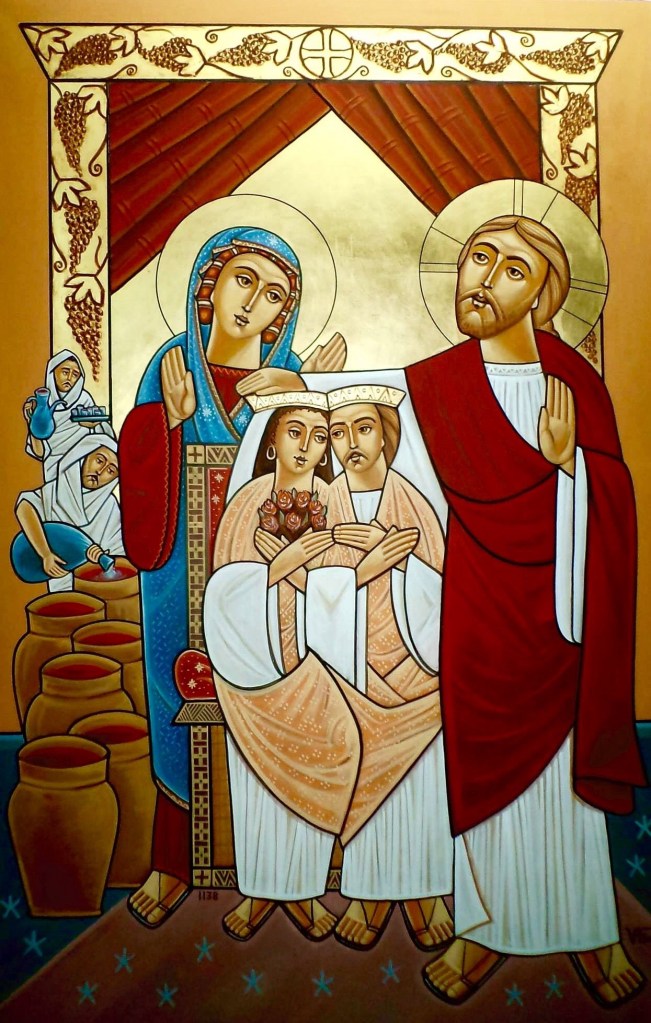
Dearly beloved: We have gathered together in the presence of God to witness and bless the joining together of Tyler Maybrier and Mary Kathleen Roop in Holy Matrimony. Why? They could have gone to the Court House to be married: a great savings of time, trouble, and money for everyone. Instead, they have come here and we have gathered here with them. Why? Because this wedding is not just a chapter in their story. Nor is it simply a chapter in the story of these two families represented, or of the host of friends who have graced us all with their presence. No: this is a chapter in the story of the people of God — the whole people of God. This wedding is a signpost pointing toward the Great Wedding Feast to come when the Church is united with Christ in what can only be described as a marriage. This wedding of these two dear people is itself a proclamation that God longs for every human story to be a Divine Comedy and not a human tragedy.
In a world filled with doubt and suspicion, this wedding is a proclamation of faith. In a world filled with disillusionment and despair, this wedding is a proclamation of hope. In a world filled with division and hostility, this wedding is a proclamation of love. Tyler, Mary Kathleen: just as your marriage begins with this holy trinity of faith, hope, and love, know this; your marriage must be nurtured, sustained, and preserved by those same graces.

In a tragic televised interview — now many years past — Diana, Princess of Wales, acknowledged that her marriage to Prince Charles was doomed from the start because there were always three present in it: herself, Charles, and Camilla Parker Bowles, Charles’s lover. In that case, three was one too many. But, Tyler and Mary Kathleen, there will be three present in your marriage; there must be three present in your marriage: each of you and the Lord Jesus. But he is present there not as an interloper, not in a destructive or competitive way. He is there to bless. He is there to bind you together. He is there to deepen your faith, hope, and love. This is a mystery, but it is nonetheless true. The greater your faith in the Lord, the greater your faith in one another. The fuller your hope in the Lord, the fuller your hope in one another. The deeper and richer your love for the Lord, the deeper and richer your love for one another. Cultivate your relationship with him, that he might bless and nourish your relationship with one another. It is only through union with Him that you can rightly and fully be united with one another. It is the Lord Jesus, who through his Holy Spirit, will make the two of you truly one. Your marriage can find its source and summit only in Him.
Tyler, know this: in a few minutes Mary Kathleen — along with all her stuff and her cats — will belong to you. But, before that, she belongs to Christ. Treat her as His beloved and all will be well. And Mary Kathleen, know this: in a few minutes Tyler — along with all his vehicles and toys — will belong to you. But, before that, he belongs to Christ. Treat him as a joint heir with Jesus and all will be well.
I told this to Tyler on the day he asked my blessing to propose to you, Mary Kathleen. Now I say it again to both of you. The true purpose of your marriage is not to be happy, though we all long to see both of you happy, and we pray — please, God — that it may be so. But, the purpose of your marriage is to be holy. Your marriage is the means by which God is calling each of you — calling both of you together — to holiness. Now, I know this is a joyous occasion — truly so — and I do not want to dampen that spirit, but it is also a time for challenging truth. And the truth is this: the way of holiness is the way of the cross, and the way of marriage is the way of martyrdom. Tyler, I have warned you all along that you are getting a glorious handful with my daughter. I suspect Tony and Anne Marie have shared similar sentiments about Tyler with you, Mary Kathleen. The truth is that two beautiful, wonderful, precious, messy, complicated, selfish, and prideful people — two redeemed sinners — come here to be married. That is true whenever two people — any two people — present themselves for Holy Matrimony. Your marriage is the means of your transformation, the means through which God will make you saints. And that involves a series of little personal deaths for the sake of a greater united resurrection. You must put to death the need to be right. You must put to death the need to have your own way. You must put to death the need to manipulate and dominate and change the other. You must put to death and bury deeply the assorted hurts and slights and rashly spoken words that are part and parcel of every marriage. And — this is a great act of martyrdom — you must learn to forgive, not just seven times as St. Peter hoped, but seventy times seven — again and again and again — as Jesus corrected him. And, just to be clear, both of you must do all these things. And in so doing, you will find something quite remarkable. Tyler, you will become the man that you have always wanted to be — the man God created you to be — and the husband that Mary Kathleen needs. And Mary Kathleen, you will become the woman you have always longed to be — the woman God created you to be — and the wife that Tyler needs. The two of you have it within you, by the grace of God, to become saints, and marriage is the context you have chosen in which to do that.
Most everything I have said here can be summed up in Jesus’ own words — far better words than mine. Hear what our Lord Jesus Christ says:
You shall love the Lord your God with all your heart and with all your soul and with all your mind. This is the first and great commandment. And the second is like it: You shall love your neighbor as yourself.
Of course, in this setting of marriage, I need to make clear that your closest neighbor is your husband or your wife. I also need to make clear that love is not romance and endorphins; love is willing and acting for the good of the other. So, love that neighbor — the one who shares life with you — as you love yourself. St. Paul says as much specifically to husbands, though I do not think he would object if we extend his thought also to wives:
28 In the same way [the way that Christ loves the Church] husbands should love their wives as their own bodies. He who loves his wife loves himself. 29 For no one ever hated his own flesh, but nourishes and cherishes it, just as Christ does the church, 30 because we are members of his body. 31 “Therefore a man shall leave his father and mother and hold fast to his wife, and the two shall become one flesh.” 32 This mystery is profound, and I am saying that it refers to Christ and the church. 33 However, let each one of you love his wife as himself, and let the wife see that she respects her husband.
First, this: love the Lord your God with all your heart and with all your soul and with all your mind. Second, this: love you husband, love your wife, as you love yourself because he or she is yourself; you are one flesh. You flourish or fail together. I am hopeful and confident in the Lord — all of us gathered here are hopeful — that you will flourish.
And so, dear ones, may the Lord write the story of your life together truly as a Divine Comedy.
In the Name of the Father, and of the Son, and of the Holy Spirit. Amen.


 First Blessings