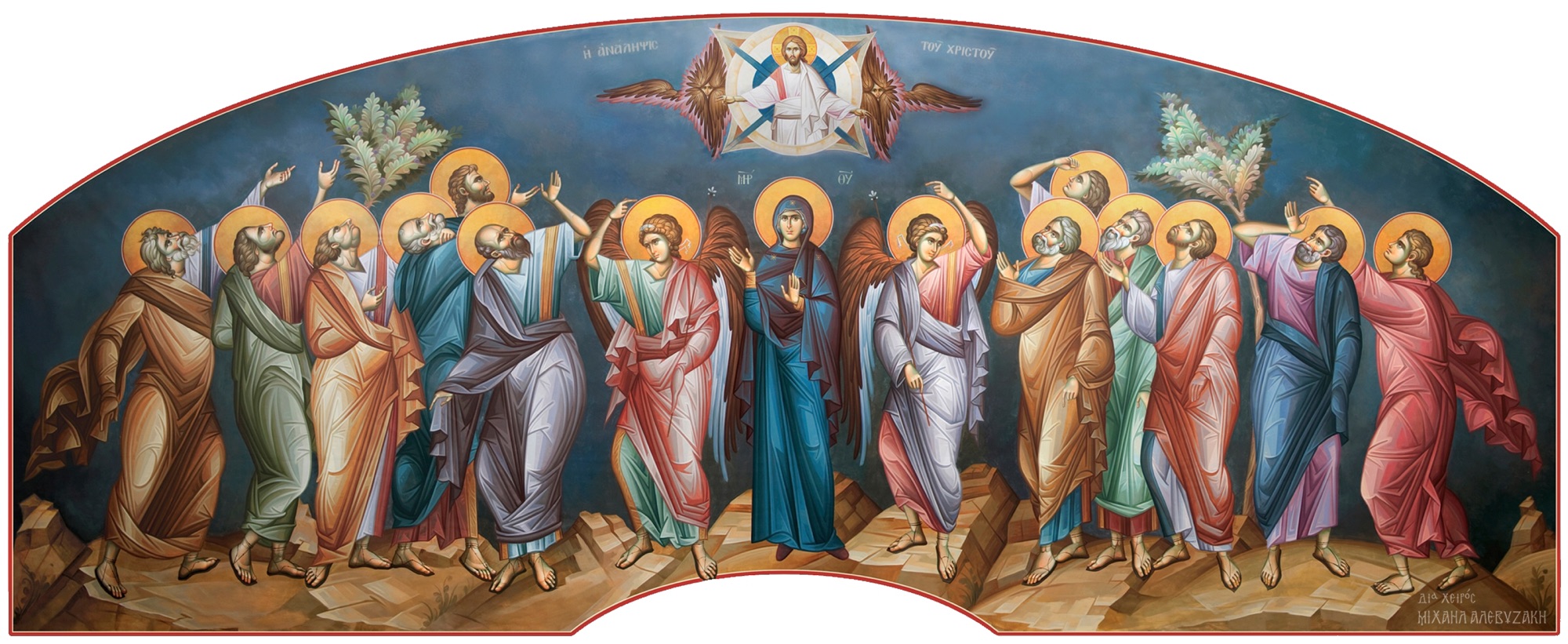
The Feast of the Ascension
(Acts 1:1-11, Ps 47, Ephesians 1:15-23, Mark 16:9-20)
Present in Power and Dominion
God has gone up with a shout of triumph,*
the Lord with the sound of the trumpet (Ps 47:5, BCP 2019).
Brothers and Sisters, the Word of God to us on this Feast of the Ascension is simple and true. The powers-that-be, the rulers and kingdoms of this world furiously rage against it, stand up and take counsel together to oppose it. But the Lord laughs; he holds them in derision. The wise of this world, the philosophers and debaters of this age consider it folly and scoff at it. No matter: the Lord has chosen the foolish things, the weak things through which to demonstrate his wisdom and his strength. The Church sometimes seems to doubt it or forget it or ignore it. My own hardened heart too often seems impervious to it. But, Brothers and Sisters, the Word of God to us on this Feast of the Ascension is simple and true. This one sentence is sufficient to speak it:
The message of the Ascension is not Christ in absentia — not Christ gone away and distant — but Christ in authority, present with us in power and dominion.
We proclaim that message in our liturgy as we worship our Lord not from afar but in intimate Communion with him.
Yours, O Lord, is the greatness, and the power, and the glory, and the victory and the majesty.
For everything in heaven and on earth is yours;
Yours is the kingdom, O Lord,
And you are exalted as Head above all.
The message of the Ascension is not Christ in absentia — not Christ gone away and distant — but Christ in authority, present with us in power and dominion.
Is that not what our Lord told us on the Mount of Ascension when he spoke to his disciples?
“All authority in heaven and on earth has been given to me. 19 Go therefore and make disciples of all nations, baptizing them in the name of the Father and of the Son and of the Holy Spirit, 20 teaching them to observe all that I have commanded you. And behold, I am with you always, to the end of the age” (Matthew 28:18b-20, ESV unless otherwise noted).
All authority. With you always. So I say again — not I but Christ:
The message of the Ascension is not Christ in absentia — not Christ gone away and distant — but Christ in authority, present with us in power and dominion.
Is this not what our Lord told us in the Upper Room when he spoke to his disciples?
15 “If you love me, you will keep my commandments. 16 And I will ask the Father, and he will give you another Helper, to be with you forever, 17 even the Spirit of truth, whom the world cannot receive, because it neither sees him nor knows him. You know him, for he dwells with you and will be in you.
18 “I will not leave you as orphans; I will come to you. 19 Yet a little while and the world will see me no more, but you will see me. Because I live, you also will live. 20 In that day you will know that I am in my Father, and you in me, and I in you. 21 Whoever has my commandments and keeps them, he it is who loves me. And he who loves me will be loved by my Father, and I will love him and manifest myself to him” (John 14:15-21).
This Helper, this Spirit of truth, is the Holy Spirit, whom Scripture calls the Spirit of Jesus Christ (Phil 1:19), the Spirit of Jesus (Acts 16:7), the Spirit of [God’s] Son (Gal 4:6). Let’s save the great depths of trinitarian theology for Pentecost and Trinity Sunday, two and three Sundays hence. But, whatever else we can and must say about such matters, this much is clear: this Helper, this Spirit of Truth, this Holy Spirit makes Jesus present with us, in us, and through us, now and unto the ages of ages. Jesus is not absent from us, not gone away and distant, but is present with us in power and dominion in the person of the Holy Spirit.
Where is Christ present today? He is present in his Church, so much so that, writing to the Church in Corinth, St. Paul equates the Church with the very body of Christ, saying:
27 Now you are the body of Christ and individually members of it (1 Cor 12:27).
Each of the faithful gathered here, having been washed in the water of baptism and sealed with the Holy Spirit as Christ’s own forever, is a member of Christ’s body: you, me, each one of us. In our unity with one another we comprise the body of Christ in this place. In our unity with our brothers and sisters across the world, we comprise the body of Christ throughout space. In our unity with our brothers and sisters across the generations, we comprise the body of Christ throughout time. Where is Christ present today? Look around this room. Look in the mirror. Christ is present in his Church. He always has been; he always will be.
Where is Christ present today? He is present, sacramentally, in the Eucharist, in Holy Communion.
16 The cup of blessing that we bless, is it not a participation in the blood of Christ? The bread that we break, is it not a participation in the body of Christ? 17 Because there is one bread, we who are many are one body, for we all partake of the one bread (1 Cor 10:16-17).
We need not linger long over precisely how we participate in the body and blood of Christ in the Eucharist to know him present when we do so. “Take, eat, this is my body,” our Lord said, not “Take, understand, and if you do, this is my body.” Christ is present with us when we gather at Table with him. Christ is present with us when we feast upon the sacrifice of his body and blood in the bread and wine of the Eucharist. Where is Christ present today? Come to the altar; taste and see that the Lord is good.
Where is Christ present today? The English poet and Jesuit priest Gerard Manley Hopkins writes that:
Christ plays in ten thousand places,
Lovely in limbs, and lovely in eyes not his
To the Father through the features of men’s faces (As Kingfishers Catch Fire).
Christ is present in ten thousand places in men’s faces that are not his and yet are his, but not always lovely in limbs and eyes and features.
Where is Christ present today in those ten thousand places? Christ is present in the hungry, in the thirsty, in the stranger, in the naked, in the sick, in the prisoner — in the least of these he calls his brothers: Christ present, as Mother Teresa was wont to say, in the most distressing disguise of the poor. Christ is also present in those who give them — who give Him — something to eat and something to drink, who welcome them and welcome him, who clothe them and clothe him, who care for them and care for him, who visit them and visit him. For in as much as we do it to the least of these his brothers, we do it to him. Where is Christ present today? Who needs you? Help him, help her, and you will find Christ present there. Refuse to help him, refuse to help her and you will miss the presence of Christ there.
The message of the Ascension is not Christ in absentia — not Christ gone away and distant — but Christ in authority, present with us in power and dominion.
Yes, Christ is present: in all the baptized faithful, in the Church, in the Sacrament of Holy Eucharist, in the least of these our brothers, and in ten thousands other ways and places some of which we know and some of which we have yet to discover. But what of Christ’s authority? What of his power and dominion? How is that exercised? Where is it manifest?
Let’s begin with Jesus’ own words to his disciples just before his ascension.
14 Afterward he appeared to the eleven themselves as they were reclining at table, and he rebuked them for their unbelief and hardness of heart, because they had not believed those who saw him after he had risen. 15 And he said to them, “Go into all the world and proclaim the gospel to the whole creation. 16 Whoever believes and is baptized will be saved, but whoever does not believe will be condemned. 17 And these signs will accompany those who believe: in my name they will cast out demons; they will speak in new tongues; 18 they will pick up serpents with their hands; and if they drink any deadly poison, it will not hurt them; they will lay their hands on the sick, and they will recover.”
19 So then the Lord Jesus, after he had spoken to them, was taken up into heaven and sat down at the right hand of God. 20 And they went out and preached everywhere, while the Lord worked with them and confirmed the message by accompanying signs (Mark 16:14-20).
Yes, I know that this text is not present in the oldest manuscripts of St. Mark’s Gospel. Some would exclude it from consideration because of that; some would exclude it, I suspect, because they are scandalized by it: demons and tongues and serpents and poison and healing and such like. Who but the most credulous, backwoods residents of southern Appalachia could embrace such a thing? Well, I do, for one, though you might consider me a credulous, backwoods resident of southern Appalachia. You might be right. Even so, there is enough similar language present in the best of manuscripts to legitimize this text, and it is in the canon of Scripture we have received from the Church. So let me suggest this reading of the text: Christ’s authority is demonstrated, he is present in power and dominion, whenever a demonic stronghold is breached, whenever the Gospel is proclaimed in a way that renders it truly heard anew, whenever the fangs of that ancient foe — that serpent in the Garden — are broken, whenever the poison of sin is rendered harmless by grace, whenever the sick — no, let’s say more — whenever the dead are raised to new life in Christ.
Demonic strongholds abound. There are dark, demonic powers behind and instantiated in all the structures of power, passion, and greed that corrupt and destroy the creatures of God: in every war that mocks the innocence of children and desecrates the sanctity of all human life; in every economic system that preys on the poor so that the luxury of the wealthy might increase; in every government that cares more for power than for justice and mercy; in every business and industry that treats human beings as cogs in the great machine of profit; in an all-pervasive plague of pornography that views every single person involved in it as an object to be used up and discarded. And on and on it goes. But with every baptismal renunciation, in every serious renewal of vows, demons are cast out and Christ’s authority is manifest. Every time peace is waged instead of war — on a personal level and on the international stage — demons are cast out and Christ’s power is demonstrated. Every time government power lust is exposed and repudiated and justice is demanded, demons are cast out and the dominion of Christ is witnessed. Whenever a Christian overtips a server in the name of Christ or gives money to the beggar on the Cedar Bluff exit ramp, whenever a captive is freed from pornography or drugs or alcohol, whenever any blow is struck anywhere in any way against the principalities and powers and structures that stand athwart the will of God and stand against his people, demons are cast out. Brothers and sisters, by your baptism, by your filling with the Holy Spirit, you are engaged in the battle against demonic strongholds; you are the frontline exorcists of the Church, the ones who act in the authority of Christ to make his power and dominion known.
Christ’s authority is demonstrated when his disciples speak in new tongues. In a world filled with lies, the truth is new tongue. In a culture hopelessly muddled about what it means to be an image bearer of God, about the meaning of human life, about what is good and true and beautiful, a discerning and godly word is a new tongue. In a relationship desecrated with bitterness and slander and envy and enmity and hurt enough to go around, “I’m sorry — please forgive me,” is a new tongue. Wherever God is forgotten or ignored, the Gospel is a new tongue. Brothers and sisters, not all of us have the spiritual gift of tongues. But we have all been commissioned to speak a new tongue. Open your mouth and speak in Christ’s name; that is a new tongue, a Pentecostal moment. Speak with the authority of Christ.
Do you want to take snakes in hand and drink poison without harm? The snake — the serpent — is none other than the satan, the accuser of the brethren, and his poison is the lies he tells, the passions he stirs, the sin he incites. You need not fear the serpent nor his poison. The head of the ancient serpent has been crushed under the heel of the Son of Eve, the Son of Mary, the Son of God. The serpent has no power but what we yield to it. We strip the serpent of its power, we neutralize its poisonous venom, we show the authority of Christ and his power over the serpent by fixing our eyes on the cross, by guarding our thoughts, by filling our hearts and minds with prayer and praise, by refusing to be an accuser of our brothers and sisters before God, and by getting up again and again every time we fall. We fall and we rise, we fall and we rise, we fall and we rise through confession, godly counsel, and absolution. We rise again through the authority, power, and dominion of Jesus Christ who himself defeated the serpent in the wilderness, in the Garden, on the cross, and in hell itself. We rise through him, and when do, Christ’s authority is on clear display.
The great adventure that is the book of Acts starts with this commission from Jesus:
6 So when they had come together, they asked him, “Lord, will you at this time restore the kingdom to Israel?” 7 He said to them, “It is not for you to know times or seasons that the Father has fixed by his own authority. 8 But you will receive power when the Holy Spirit has come upon you, and you will be my witnesses in Jerusalem and in all Judea and Samaria, and to the end of the earth” (Acts 1:6-8).
There it is again: presence — the Holy Spirit — and power. And notice that the presence and power are missional: when you have received power, when the Holy Spirit has come upon you, you will be witnesses. Witnesses are those who have seen things and heard things and know things and who then testify to the truth of what they have experienced. And that is what we see throughout Acts. Not just the Apostles, but deacons and prophetesses, a soldier and a business woman, a foreign court official and a jailer, tentmakers and “ordinary” folk witness Jesus and witness to Jesus and make Christ present in authority and power. They turn the world upside down. And so may we. We don’t have to be eloquent. We don’t need to be intellectual. We simply need to witness to what we have seen and heard and known of Jesus, and the Lord will be present with us in authority and power.
Acts gives us one more lesson, one more example of where Jesus is present in authority and power. When his witnesses are arrested and jailed, when his witnesses are beaten and stoned, when his witnesses are falsely accused and excluded, when his witnesses are bound and shipwrecked, when his witnesses are misunderstood and humiliated, when his witnesses join him in the fellowship of suffering for his sake, Jesus is present in authority and power.
Having recounted the suffering and hardship he had born for Christ and his prayer to be released from a particular thorn in the flesh, St. Paul concludes with this:
8 Three times I pleaded with the Lord about this, that it should leave me. 9 But he said to me, “My grace is sufficient for you, for my power is made perfect in weakness.” Therefore I will boast all the more gladly of my weaknesses, so that the power of Christ may rest upon me. 10 For the sake of Christ, then, I am content with weaknesses, insults, hardships, persecutions, and calamities. For when I am weak, then I am strong (2 Cor 12:8-10).
Where is Christ present with us? Where is his authority and power manifest to us and to the world? In weaknesses, insults, hardships, persecutions, and calamities. In all the sufferings of this world born with and for Christ. It is a strange way to manifest authority and power, but so was the cross.
So, there you have it, brothers and sisters. I started with this, and I will end with this. The Word of God to us on this Feast of the Ascension is simple and true.
The message of the Ascension is not Christ in absentia — not Christ gone away and distant — but Christ in authority, present with us in power and dominion.
God has gone up with a shout of triumph,*
the Lord with the sound of the trumpet (Ps 47:5, BCP 2019).
Glory be to the Father, and to the Son, and to the Holy Spirit. Amen.


 First Blessings