The Annunciation of our Lord Jesus Christ to the Virgin Mary
Fr. John A. Roop
(Luke 1:26-38)
On this Feast of the Annunciation of our Lord Jesus Christ to the Virgin Mary, let us pray.
O Lord, arise, help us, and deliver us for thy Name’s sake.
O GOD, we have heard with our ears, and our fathers have declared unto us, the noble works that thou didst in their days, and in the old time before them.
O Lord, arise, help us, and deliver us for thine honor.
Glory be to the Father, and to the Son, and to the Holy Ghost;
As it was in the beginning, is now, and ever shall be, world without end. Amen.
(from The Litany, BCP 1928)
These are words from The Litany in the Book of Common Prayer 1928 — full of implied questions and pleas, really.
WHERE IS THE LORD in the midst of all this? Why does he seem so far from our groanings and so deaf to our prayers? These words echo Psalm 77:
5 I consider the days of old; *
I call to remembrance the years that are past.
6 In the night I commune with my own heart; *
I meditate and search my spirit.
7 Will the Lord cast me off for ever, *
and will he no more show his favor?
8 Is his mercy gone for ever, *
and has his promise come utterly to an end for evermore?
9 Has God forgotten to be gracious, *
and will he withhold his loving-kindness in displeasure?
10 And I said, “Has his right hand become weak; *
has the hand of the Most High lost its strength?” (Psalm 77, BCP 2019)
The Psalmist was pouring out his heart personally. But his words capture the national longing of first-century Israel, as the Jews prayed these Psalms and pondered their plight.
Five hundred years earlier the Jews had returned from geographic exile in Babylon. But, in every way that really mattered, they were still in exile in the first century.
Contrary to God’s promise to David — or so it seemed — there was no king from David’s house sitting on the throne of Israel. Had God not promised David an everlasting house, an eternal kingdom?
Contrary to the hope of Israel, the temple — though it had been beautifully restored/rebuilt by Herod the Great — was an empty shell. The ark of the covenant was lost and the shekinah glory of God, the very presence of God, was absent from the Holy of Holies. Ezekiel had witnessed God’s exit from the Temple before its destruction, and God apparently had not returned.
Contrary to Israel’s longing, God was silent. For some four hundred years, no word of God had come to and through the prophets; there were no prophets left in the land. Amos had been right:
11 “Behold, the days are coming,” declares the Lord God,
“when I will send a famine on the land—
not a famine of bread, nor a thirst for water,
but of hearing the words of the Lord” (Amos 8:11, ESV throughout).
Where is the Lord in the midst of all this? Why does he seem so far from our groanings and so deaf to our prayers? Has he broken his covenant, the covenant he made with our Fathers: with Abraham and Isaac and Jacob, with David?
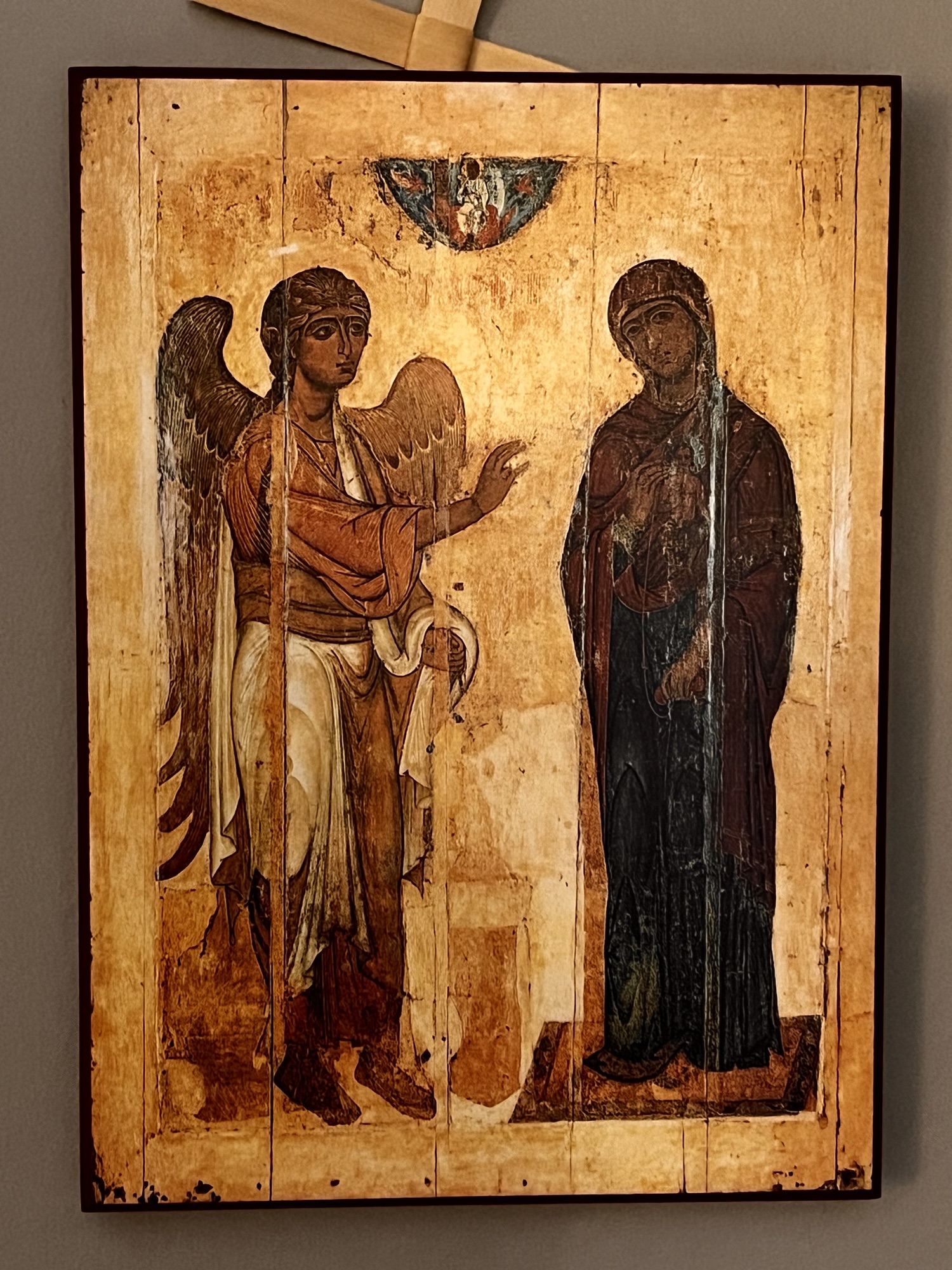
26 In the sixth month the angel Gabriel was sent from God to a city of Galilee named Nazareth, 27 to a virgin betrothed to a man whose name was Joseph, of the house of David. And the virgin’s name was Mary (Lk 1:26-27).
Has God forgotten Israel? No: this is his answer. Has God broken his covenant with Abraham, Isaac, Jacob, and David? No: this is his answer. Has the hand of the Most High lost its strength? No: this is his answer.
The story of the Annunciation is God’s answer to his people’s lament and longing. It is a lovely story. But it is also powerful and mysterious, and we cannot let its beauty obscure these great realities. God has come at last — after generations of faithful laments and prayers and longings — God has come at last to rescue and redeem his people: not as they expected, but as God knows and wills, as God has decreed from the foundations of the world.
28 And he [Gabriel] came to her [Mary] and said, “Greetings, O favored one, the Lord is with you!” 29 But she was greatly troubled at the saying, and tried to discern what sort of greeting this might be. 30 And the angel said to her, “Do not be afraid, Mary, for you have found favor with God. 31 And behold, you will conceive in your womb and bear a son, and you shall call his name Jesus (Lk 1:28-31).
We sometimes read the account of the Annunciation tentatively, as if holding our breath waiting for and hoping for Mary’s yes to Gabriel’s strange greeting. But look again. This is not an invitation; this is a proclamation of what God will do through Mary, his favored one, the one who is blessed among women, the one who is full of grace. God does not wait for or need Mary’s yes in this moment because he has blessed her, because he has filled her with grace, because her life has become a yes, because she could no more bring herself to refuse this blessing than God could break his covenant with Israel. God and Mary are in this together, each participating in the great mystery of the Incarnation. When Mary says to Gabriel, “Behold, I am the servant of the Lord; let it be to me according to your word,” it is more a statement of fact, this is who I am — it is more a summary of her entire life — than it is a yes to this one particular moment. God was not worried that Mary would say, “No, thank you; I’d rather not.” God does not stand helpless before his creation in that, or in any, way. As surely,
…as rain and snow fall from the heavens
and return not again but water the earth,
Bringing forth life and giving growth,
seed for sowing and bread for eating,
So is God’s word that goes forth from his mouth;
it will not return to him empty;
But it will accomplish that which he purposed,
and prosper in that for which he sent it (Quaerite Dominum, selected verses, adapted).
You will conceive in your womb and bear a son, and you shall call his name Jesus.
If Mary conceives in her womb and bears a son, this child will be a man, fully human. That is exactly what Mary expects. She is young, very likely, but she is not naive. She knows the ways of men and women. She knows of sexual relations. But she also knows that she is a virgin, and must remain so throughout her betrothal. And it is precisely that which confuses her. How shall this be? What shall I do?
But the Annunciation is not about what Mary is to do; it is a proclamation of what God is doing through Mary. It is a proclamation of prevenient grace.
35 And the angel answered her, “The Holy Spirit will come upon you, and the power of the Most High will overshadow you; therefore the child to be born will be called holy — the Son of God” (Lk 1:35).
God the Father, the Most High, is acting. God the Holy Spirit is being set loose in the world. God the Son is being made flesh to dwell among us. This is the answer not only to Mary’s questions. This is the answer to Israel’s prayers and longing. This is the answer to creation’s groaning for release. This is the answer to Adam’s sin and the bondage of all his sons and daughters under sin and death. This is the beginning of the gospel of Jesus Christ, the Son of God (cf Mk 1:1). Yes, the one to be conceived in Mary’s womb is fully human, but he is also fully God. He is Jesus, the one who saves. He is Emmanuel — God with us.
32 He will be great and will be called the Son of the Most High. And the Lord God will give to him the throne of his father David, 33 and he will reign over the house of Jacob forever, and of his kingdom there will be no end” (Lk 1:32-33).
And where does this annunciation lead? In the words of our liturgy:
In obedience to your will, he stretched out his arms upon the Cross and offered himself once for all, that by his suffering and death we might be saved. By his resurrection he broke the bonds of death, trampling Hell and Satan under his feet. As our great high priest, he ascended to your right hand in glory, that we might come with confidence before the throne of grace (Renewed Ancient Text, BCP 2019, p. 133).
The Annunciation is the beginning of the Gospel proclamation. There is a straight line from the Annunciation through the Crucifixion, Resurrection, Ascension, Reign, and glorious Return of the one to be conceived in Mary’s womb: son of man and Son of God, to whom be the glory, now and for ever, world without end. Amen.


 First Blessings