Apostles Anglican Church
Fr. John A. Roop
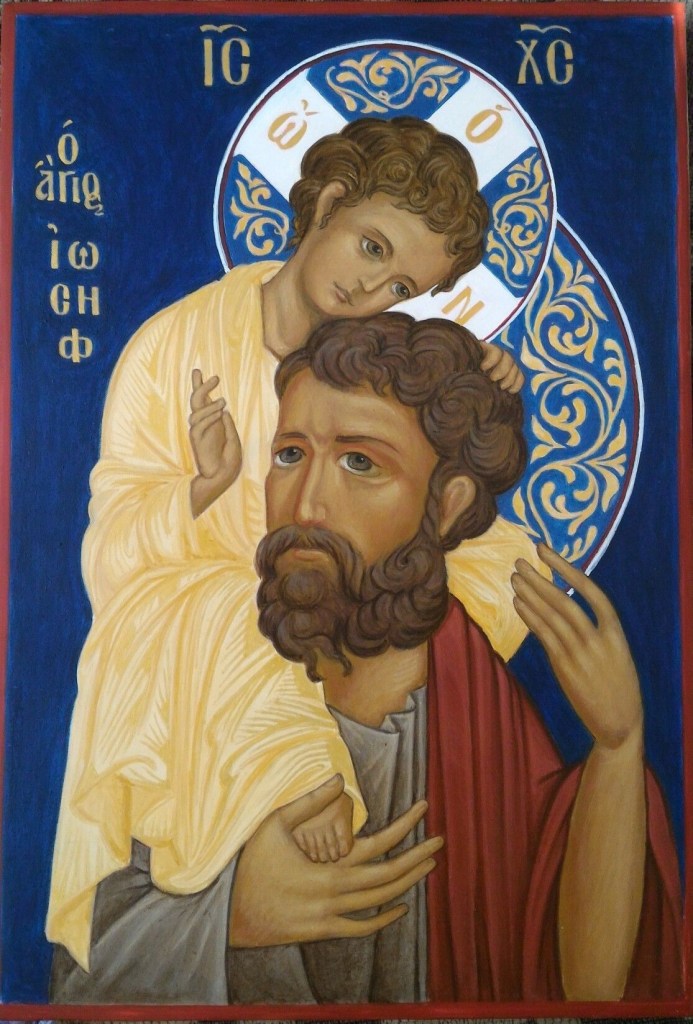
St. Joseph, Husband of the Virgin Mary and Guardian of Jesus
19 March 2025
(2 Sam 7:4, 8-16; Ps 89:1-4, 19-29; Rom 4:13-18; Luke 2:41-52)
Collect
O God, who from the family of your servant David raised up Joseph to be the guardian of your incarnate Son and the husband of his virgin mother: Give us grace to imitate his uprightness of life and his obedience to your commands; through Jesus Christ our Lord, who lives and reigns with you and the Holy Spirit, one God, for ever and ever. Amen.
In the Name of the Father, and of the Son, and of the Holy Spirit. Amen.
Anyone who has raised a child or who has spent significant time around children — perhaps nieces and nephews — has bumped up hard against the nature-nurture debate. First time parents may have an image of their child as a tabula rosa, a blank slate, an unformed mind upon which they may write only that which is good and true and beautiful. Such parents are quickly disabused of that notion. Biologists, psychologists, sociologists — a veritable host of -ologists — insist that much of human behavior is hardwired, present in our very genetic makeup, a matter of nature and not nurture. With this, even the theologians agree. We were created in the image of God, but something has gone wrong; there is now a problem with our nature: original sin or ancestral sin, we call it. We are, all of us, born slightly askew of spiritual true north: inclined toward selfishness, predisposed toward sin as an inheritance from our parents and their parents and so forth back to Adam and Eve and their first generation of offspring. While admitting the power of both nature and nurture, the Church considers nature primary. Yes, we were created in the image of God: nature. When our first parents disobeyed, sin deformed us ever after: fallen nature. When we are born again in Christ, we are freed from sin’s power: restored nature. From start to finish, nature is central to understanding our humanity.
So, in its theology, the Church has often — perhaps even primarily — focused on nature, not least as it tried to formulate and articulate an understanding of the nature of Christ. The Church set this down definitively, for all time, at the Fourth Ecumenical Council — Chalcedon — in 451:
Following the holy Fathers we teach with one voice that the Son [of God] and our Lord Jesus Christ is to be confessed as one and the same [Person], that he is perfect in Godhead and perfect in manhood, very God and very man, of a reasonable soul and [human] body consisting, consubstantial with the Father as touching his Godhead, and consubstantial with us as touching his manhood; made in all things like unto us, sin only excepted; begotten of his Father before the worlds according to his Godhead; but in these last days for us men and for our salvation born [into the world] of the Virgin Mary, the Mother of God according to his manhood. This one and the same Jesus Christ, the only-begotten Son [of God] must be confessed to be in two natures, unconfusedly, immutably, indivisibly, inseparably [united], and that without the distinction of natures being taken away by such union, but rather the peculiar property of each nature being preserved and being united in one Person and subsistence, not separated or divided into two persons, but one and the same Son and only-begotten, God the Word, our Lord Jesus Christ, as the Prophets of old time have spoken concerning him, and as the Lord Jesus Christ hath taught us, and as the Creed of the Fathers hath delivered to us (https://earlychurchtexts.com/public/chalcedonian_definition.htm, accessed 3/7/2025).
Clear? Well, it would take quite some time to tease all the meaning out of that definition. The main point here is that the Church was extremely concerned with the nature of Jesus, with the two natures of Jesus, fully God and fully man, united, but not confused/intermingled, in one person. What the Fathers at Chalcedon did not include in this definition was a discussion of nurture. In the great nature-nurture debate, they focused exclusively on nature, which raises the question: Can we say anything meaningful about Jesus’ nurture, and, by extension, about our own? How did his parents, his village, his culture, his environment, and countless other factors shape him? We have two tantalizing hints in St. Luke’s Gospel:
ESV: Luke 2:39-40, 52
39 And when they [Joseph and Mary] had performed everything according to the Law of the Lord, they returned into Galilee, to their own town of Nazareth. 40 And the child grew and became strong, filled with wisdom. And the favor of God was upon him.
52 And Jesus increased in wisdom and in stature and in favor with God and man.
Jesus grew up. He learned things. He developed good relationships with God and with his neighbors. All of this speaks of nurture. His nature — and here we should specify his human nature — was nurtured into fullness by all the forces that nurture and shape every human being: family, village, culture, environment and countless other intangible influences.
I mention this because today the Church observes the Feast of St. Joseph, the husband of the Virgin Mary and the guardian of Jesus. Surely, among all the other influences that nurtured Jesus in his humanity, Joseph — perhaps only Mary excepted — claims pride of place. It seems most likely to me that attentive, loving parents were and are the chief agents of nurture — at least into the adolescent years — of children in patriarchal cultures. Joseph, certainly, would have nurtured Jesus, would have formed him in what it meant to be a man, a second temple Judean man, in Galilee. We get some hints of that in Scripture.
We first encounter Jospeh, the genealogy excepted, in St. Matthew’s Gospel, in the birth narrative.
18 Now the birth of Jesus Christ took place in this way. When his mother Mary had been betrothed to Joseph, before they came together she was found to be with child from the Holy Spirit. 19 And her husband Joseph, being a just man and unwilling to put her to shame, resolved to divorce her quietly. 20 But as he considered these things, behold, an angel of the Lord appeared to him in a dream, saying, “Joseph, son of David, do not fear to take Mary as your wife, for that which is conceived in her is from the Holy Spirit. 21 She will bear a son, and you shall call his name Jesus, for he will save his people from their sins.” 22 All this took place to fulfill what the Lord had spoken by the prophet:
23 “Behold, the virgin shall conceive and bear a son,
and they shall call his name Immanuel”
(which means, God with us). 24 When Joseph woke from sleep, he did as the angel of the Lord commanded him: he took his wife, 25 but knew her not until she had given birth to a son. And he called his name Jesus (Matt 1:18:25).
Notice how Joseph is described in this text; notice his character. He was a just/righteous man and unwilling to put Mary to shame. Let’s deal first with Joseph as a just/righteous man. What would that description have meant in this context? That Joseph knew, kept, and honored the Law. And, in a case such as this incident with Mary, the Law was clear.
“But, if someone takes a wife and he lives with her, and it happens that she does not find favor before him because he found in her a shameful thing, then he shall write her a document of divorce, and he shall give it into her hands, and he shall dismiss her from his house” (Deut 24:1, Lexham LXX).
The language here is very pointed as applied to Joseph and Mary. If a man finds in his wife — and his betrothed would be in that category — a shameful thing, it is just to issue her a document of divorce. And what does Joseph find in Mary? A child conceived in unfaithfulness, in adultery, or so Joseph could only imagine: a shameful thing. And so Joseph’s righteous mind and heart would move him toward divorce. In a small village, such an “affair” — both in sexual and legal terms — would be a public scandal, a shame that would ruin Mary and her family. And right here, something other than justice comes into play: mercy. Joseph, while recognizing the justice in divorcing Mary, is unwilling to do so publicly, but instead plans to send her away privately. And in this dual intent of his heart, we see in Joseph the fulfillment of the Psalmist’s words:
10 Steadfast love and faithfulness meet;
righteousness and peace kiss each other.
11 Faithfulness springs up from the ground,
and righteousness looks down from the sky (Psalm 85:10-11).
Justice and mercy meet together and kiss one another in Joseph’s heart. There is a lot going on here, and I hope I can make my thinking about it clear. Joseph found a shameful thing — a baby conceived in unfaithfulness, he imagines — in Mary. He determines to act righteously in accordance with the Law in Deuteronomy; but he also determines to act with mercy to save Mary and her family from her “sin.” Now, notice how the angel addresses all these matters in his words to Joseph. The baby in Mary’s womb is not a shameful thing, but rather the Holy One, conceived by the Holy Spirit. There is no cause for divorce; righteousness/justice has been preserved. And the son to be born will be named Jesus — savior — because he will save his people from their sins, just as Joseph, in his mercy, had determined to “save” Mary and her family from her (supposed) sin. Righteousness and mercy: these lie at the heart of Joseph’s character, not in tension with one another exactly, but in embrace. And perhaps that is one reason — and not a small one — that God the Father selected Joseph to be the husband of Mary and the guardian of Jesus. Who better to nurture the human nature of Jesus than one in whom justice and mercy meet? And can’t we see this play out later in Jesus’ own encounter with the woman taken in adultery?
John 8:2–11 (ESV): 2 Early in the morning [Jesus] came again to the temple. All the people came to him, and he sat down and taught them. 3 The scribes and the Pharisees brought a woman who had been caught in adultery, and placing her in the midst 4 they said to him, “Teacher, this woman has been caught in the act of adultery. 5 Now in the Law, Moses commanded us to stone such women. So what do you say?” 6 This they said to test him, that they might have some charge to bring against him. Jesus bent down and wrote with his finger on the ground. 7 And as they continued to ask him, he stood up and said to them, “Let him who is without sin among you be the first to throw a stone at her.” 8 And once more he bent down and wrote on the ground. 9 But when they heard it, they went away one by one, beginning with the older ones, and Jesus was left alone with the woman standing before him. 10 Jesus stood up and said to her, “Woman, where are they? Has no one condemned you?” 11 She said, “No one, Lord.” And Jesus said, “Neither do I condemn you; go, and from now on sin no more.”
Thirty years earlier, this woman might have been Mary, had Joseph not shown both justice and mercy. Like father, like son. Sin no more, Jesus says: that is righteousness. Neither do I condemn you, Jesus says: that is mercy. Of course, it is the heart of God we see on display here. But, it is also the heart of Joseph, and perhaps it is an example of nature and nurture.
Joseph did the hard thing because it was God’s will. A few years later he had another dream.
13 Now when they had departed, behold, an angel of the Lord appeared to Joseph in a dream and said, “Rise, take the child and his mother, and flee to Egypt, and remain there until I tell you, for Herod is about to search for the child, to destroy him.” 14 And he rose and took the child and his mother by night and departed to Egypt 15 and remained there until the death of Herod. This was to fulfill what the Lord had spoken by the prophet, “Out of Egypt I called my son” (Matt 2:13-15).
A message in a dream: leave, flee, upend your life yet again. And the impressive thing to me is Joseph’s response: he woke from the dream, gathered mother and child, and left, perhaps even that same night. Apparently, there was no long deliberation, no fretful making of plans, just a steadfast commitment to act in obedience to the will of God.
And we see that same trait in Jesus, don’t we? In his great bread of life discourse Jesus says:
38 For I have come down from heaven, not to do my own will but the will of him who sent me (John 6:38).
And then, in the great moment of anguish in Gethsemane, Jesus prays to his God and Father,
42 saying, “Father, if you are willing, remove this cup from me. Nevertheless, not my will, but yours, be done” (Luke 22:42).
I wonder how many times in his life Jesus had seen obedience to God — even costly obedience — modeled by Joseph?
There are other hints in Scripture of the ways Joseph may have nurtured Jesus’ human nature. Joseph was a faithful Jew. We see him fulfilling the requirements of the Law in all the matters surrounding Jesus’ birth: the circumcision and naming, the purification of Mary in the temple. We see him taking his family to the temple for the Passover as required in the Law. And then there is this telling note about Jesus:
16 And he came to Nazareth, where he had been brought up (emphasis added). And as was his custom (emphasis added), he went to the synagogue on the Sabbath day, and he stood up to read (Luke 4:16).
Jesus went to the synagogue on the Sabbath as was his custom. Where do you think he learned that custom? There were certainly many factors at play, but not least the example of his father; Jesus had been brought up to be observant. Even today, studies have found a strong correlation between a father’s practice of the faith — church attendance is a typical measure — and the religious habits of the adult children.
We don’t know much about the dynamics of Jesus’ household, nor about how long Joseph lived; so, much of what I’ve said is speculative. But there are enough hints in scripture to make the speculation plausible. The picture that emerges of Joseph is that of a just and merciful man, a man obedient to the will of God, a religious/pious man: a good husband for Mary and a faithful guardian of Jesus, one who modeled these things for Jesus and helped form his human nature. So, it is fitting and proper for the Church to offer and celebrate Joseph as a model of holy masculinity, of what it means to be a righteous man, a good husband, and a faithful father. Amen.


 First Blessings