
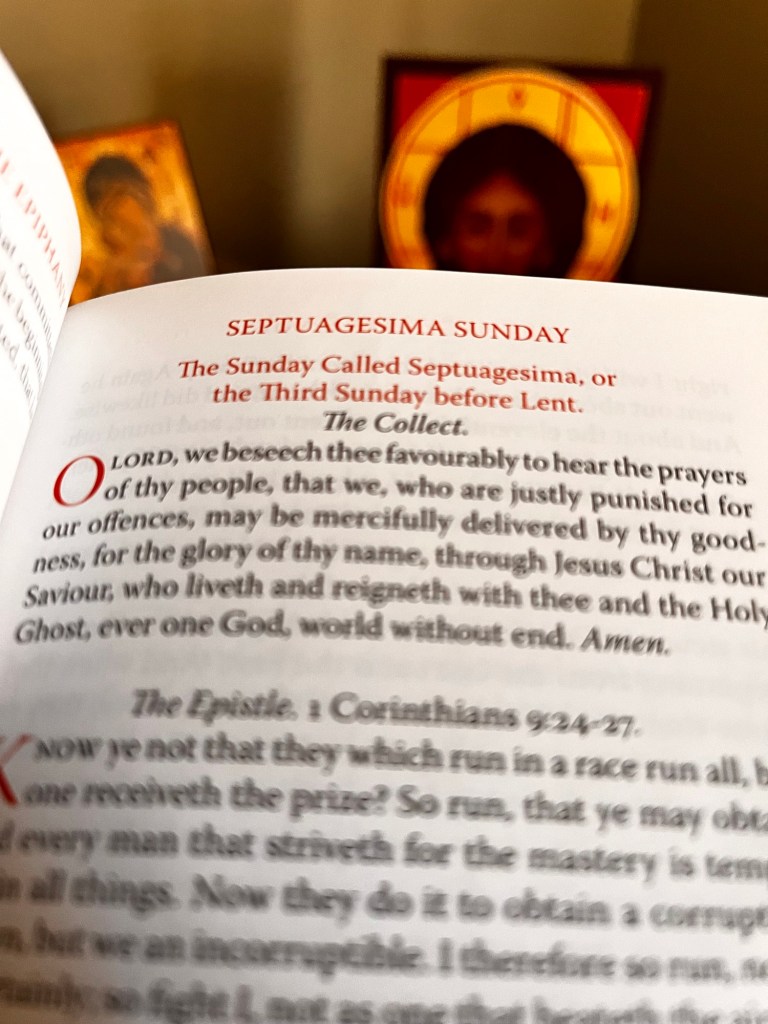
GETTING READY TO GET READY: THE PRE-LENTEN SEASON
The second shortest liturgical season of the year begins with the third Sunday prior to the beginning of Lent, this year on 16 February; it consists of three Sundays and the partial week leading to Ash Wednesday. The Sundays have “strange” names based (very) roughly on the number of days from each Sunday until Easter: Septuagesima (seventy days), the third Sunday before Lent; Sexagesima (sixty days), the second Sunday before Lent; and Quinquagesima (fifty days), the Sunday next before Lent.
This Pre-Lenten season was known at least as early as the 6th century and may have originated with St. Gregory the Great. Recently, however, it has fallen into relative obscurity among many Anglicans in America, not least due to modern revisions of the Book of Common Prayer (BCP). The season was a fixture in the normative BCP 1662 and also in the American revision of 1928. Ironically, with the recovery of some other ancient liturgical forms in the BCP 1979, the season fell out of use. It is mentioned in the calendar rubrics of the ACNA’s BCP 2019 (p. 689)— and observance is allowed — but no proper collect or lections are provided. Instead, Sexagesima Sunday has been replaced with World Mission Sunday and Quinquagesima with an extraneous and perpetually confusing Transfiguration observance. The “Gesimas” are, at best, vestigial and noted mainly by their absence in the BCP 2019.
Perhaps that reorientation is proper? After all, do we really need a season of preparation for the season of preparation for Eastertide: Pre-Lent to prepare for Lent to prepare for Easter? Could we enter a liturgical hall of mirrors with infinite regression of preparation? It is a reasonable concern. I was helped in thinking this through by a reflection on the monastic practice of statio in Sr. Joan Chittister’s book “The Monastic Heart:”
Statio is being where you are supposed to be before you need to go there. In monastic parlance, it is about being consciously committed to what you are there to do, so that your mind isn’t partially distracted by the thing you just left behind. It requires you to get ready for one of these central moments of your spiritual life, to concentrate on the things of God, to leave behind for a while the distractions of the day. It enables us to separate ourselves from one thing entirely before we start another one with half ourselves still concentrated on the thing we just left behind.
Monastic statio, going to chapel to get ready for prayer before prayer starts, is one of the important things in monastic life. Being prepared, conscious, alert, ready, centered, and there — early — is the lesson of a lifetime. We learn that to concentrate on words and phrases we’ve said for years is the beginning of spiritual maturity. It is a model of the manner of spiritual growth that develops a layer, an insight at a time (Chittister, 2021, Convergent, pp. 8-9).
Statio is getting to the party early so as to fully embrace the festivities. Statio is settling down in the nave or chapel ten minutes before the prelude to pray or just to sit in silence (on the off chance there actually is preparatory silence in any given nave) so that your heart is open to the mysteries when they begin, open and undistracted by the struggle of getting the kids fed and dressed before church or the “discussion” with your spouse on the way there, or even your “duties” in preparation for the upcoming service. Perhaps statio is the three Sundays of the shortest liturgical season: three Sundays to prepare your heart fully to receive the ashes on Wednesday and to enter the Lenten season with proper focus and devotion. Perhaps some don’t need that at all; perhaps many do but have neither recognized that need nor attended to it.
If you would like to reflect on the Pre-Lenten season a bit more, following are the collects and lections for Septuagesima, Sexagesima, and Quinquagesima Sundays taken from the BCP 1662.
SEPTUAGESIMA SUNDAY (16 February 2025)
The Collect
O LORD, we beseech thee favourably to hear the prayers of thy people; that we, who are justly punished for our offences, may be mercifully delivered by thy goodness, for the glory of thy Name; through Jesus Christ our Saviour, who liveth and reigneth with thee and the Holy Ghost ever, one God, world without end. Amen.
The Epistle. I Corinthians ix. 24.
24 Know ye not that they which run in a race run all, but one receiveth the prize? So run, that ye may obtain. 25 And every man that striveth for the mastery is temperate in all things. Now they do it to obtain a corruptible crown; but we an incorruptible. 26 I therefore so run, not as uncertainly; so fight I, not as one that beateth the air: 27 But I keep under my body, and bring it into subjection: lest that by any means, when I have preached to others, I myself should be a castaway.
The Gospel. St. Matthew xx. I.
1 For the kingdom of heaven is like unto a man that is an householder, which went out early in the morning to hire labourers into his vineyard. 2 And when he had agreed with the labourers for a penny a day, he sent them into his vineyard. 3 And he went out about the third hour, and saw others standing idle in the marketplace, 4 And said unto them; Go ye also into the vineyard, and whatsoever is right I will give you. And they went their way. 5 Again he went out about the sixth and ninth hour, and did likewise. 6 And about the eleventh hour he went out, and found others standing idle, and saith unto them, Why stand ye here all the day idle? 7 They say unto him, Because no man hath hired us. He saith unto them, Go ye also into the vineyard; and whatsoever is right, that shall ye receive. 8 So when even was come, the lord of the vineyard saith unto his steward, Call the labourers, and give them their hire, beginning from the last unto the first. 9 And when they came that were hired about the eleventh hour, they received every man a penny. 10 But when the first came, they supposed that they should have received more; and they likewise received every man a penny. 11 And when they had received it, they murmured against the goodman of the house, 12 Saying, These last have wrought but one hour, and thou hast made them equal unto us, which have borne the burden and heat of the day. 13 But he answered one of them, and said, Friend, I do thee no wrong: didst not thou agree with me for a penny? 14 Take that thine is, and go thy way: I will give unto this last, even as unto thee. 15 Is it not lawful for me to do what I will with mine own? Is thine eye evil, because I am good? 16 So the last shall be first, and the first last: for many be called, but few chosen.
SEXAGESIMA SUNDAY (23 February 2025)
The Collect
O LORD God, who seest that we put not our trust in any thing that we do: Mercifully grant that by thy power we may be defended against all adversity; through Jesus Christ our Lord. Amen.
The Epistle. I Corinthians xi. 11.
YE suffer fools gladly, seeing ye yourselves are wise. For ye suffer if a man bring you into bondage, if a man devour you, if a man take of you, if a man exalt himself, if a man smite you on the face. I speak as concerning reproach, as though we had been weak: howbeit, whereinsoever any is bold, (I speak foolishly,) I am bold also. Are they Hebrews? so am I. Are they Israelites? so am I. Are they the seed of Abraham? so am I. Are they ministers of Christ? (I speak as a fool,) I am more: in labours more abundant; in stripes above measure; in prisons more frequent; in deaths oft. Of the Jews five times received I forty stripes save one; thrice was I beaten with rods; once was I stoned; thrice I suffered shipwreck; a night and a day I have been in the deep; in journeyings often; in perils of waters; in perils of robbers; in perils by mine own countrymen; in perils by the heathen; in perils in the city; in perils in the wilderness; in perils in the sea; in perils among false brethren; in weariness and painfulness; in watchings often; in hunger and thirst; in fastings often; in cold and nakedness; besides those things that are without, that which cometh upon me daily, the care of all the churches. Who is weak, and I am not weak? who is offended, and I burn not? If I must needs glory, I will glory of the things which concern mine infirmities. The God and Father of our Lord Jesus Christ, which is blessed for evermore, knoweth that I lie not.
The Gospel. St. Luke xiii.8.
WHEN much people were gathered together, and were come to him out of every city, he spake by a parable: A sower went out to sow his seed; and as he sowed, some fell by the way-side, and it was trodden down, and the fowls of the air devoured it. And some fell upon a rock, and as soon as it was sprung up, it withered away, because it lacked moisture. And some fell among thorns, and the thorns sprang up with it, and choked it. And other fell on good ground, and sprang up, and bare fruit an hundred-fold. And when he had said these things, he cried, He that hath ears to hear, let him hear. And his disciples asked him, saying, What might this parable be? And he said, Unto you it is given to know the mysteries of the kingdom of God: but to others in parables; that seeing they might not see, and hearing they might not understand. Now the parable is this: The seed is the word of God. Those by the way-side are they that hear; then cometh the devil, and taketh away the word out of their hearts, lest they should believe, and be saved. They on the rock are they which, when they hear, receive the word with joy; and these have no root, which for a while believe, and in time of temptation fall away. And that which fell among thorns are they which, when they have heard, go forth, and are choked with cares, and riches, and pleasures of this life, and bring no fruit to perfection. But that on the good ground are they which in an honest and good heart, having heard the word, keep it, and bring forth fruit with patience.
QUINQUAGESIMA SUNDAY (2 March 2025)
The Collect
O LORD, who hast taught us that all our doings without charity are nothing worth: Send thy Holy Ghost, and pour into our hearts that most excellent gift of charity, the very bond of peace and of all virtues, without which whosoever liveth is counted dead before thee. Grant this for thine only Son Jesus Christ’s sake. Amen.
The Epistle. 1 Corinthians xiii.1.
THOUGH I speak with the tongues of men and of angels, and have not charity, I am become as sounding brass, or a tinkling cymbal. And though I have the gift of prophecy, and understand all mysteries, and all knowledge; and though I have all faith, so that I could remove mountains, and have not charity, I am nothing. And though I bestow all my goods to feed the poor, and though I give my body to be burned, and have not charity, it profiteth me nothing. Charity suffereth long, and is kind; charity envieth not; charity vaunteth not itself, is not puffed up, doth not behave itself unseemly, seeketh not her own, is not easily provoked, thinketh no evil, rejoiceth not in iniquity, but rejoiceth in the truth; beareth all things, believeth all things, hopeth all things, endureth all things. Charity never faileth: but whether there be prophecies, they shall fail; whether there be tongues, they shall cease; whether there be knowledge, it shall vanish away. For we know in part, and we prophesy in part. But when that which is perfect is come, then that which is in part shall be done away. When I was a child, I spake as a child, I understood as a child, I thought as a child; but when I became a man, I put away childish things. For now we see through a glass darkly; but then face to face: now I know in part; but then shall I know even as also I am known. And now abideth faith, hope, charity, these three: but the greatest of these is charity.
The Gospel. St. Luke xviii.31.
THEN Jesus took unto him the twelve, and said unto them, Behold, we go up to Jerusalem, and all things that are written by the prophets concerning the Son of Man shall be accomplished. For he shall be delivered unto the Gentiles, and shall be mocked, and spitefully entreated, and spitted on: and they shall scourge him, and put him to death; and the third day he shall rise again. And they understood none of these things: and this saying was hid from them, neither knew they the things which were spoken. And it came to pass, that as he was come nigh unto Jericho, a certain blind man sat by the way-side begging: and hearing the multitude pass by, he asked what it meant. And they told him, that Jesus of Nazareth passeth by. And he cried, saying, Jesus, thou Son of David, have mercy on me. And they which went before rebuked him, that he should hold his peace: but he cried so much the more, Thou Son of David, have mercy on me. And Jesus stood, and commanded him to be brought unto him: and when he was come near, he asked him, saying, What wilt thou that I should do unto thee? And he said, Lord, that I may receive my sight. And Jesus said unto him, Receive thy sight; thy faith hath saved thee. And immediately he received his sight, and followed him, glorifying God: and all the people, when they saw it, gave praise unto God.


 First Blessings