Apostles Anglican Church
Fr. John A. Roop
The Lord Rebuke You: A Reflection on Luke 4:31-end
(Isaiah 33, Psalm 52, Luke 4:31-end)
Collect
Stir up, O Lord, the wills of your faithful people, that bringing forth in abundance the fruit of good works, they may be abundantly rewarded when our Savior Jesus Christ comes to restore all things; who lives and reigns with you and the Holy Spirit, one God, for ever and ever. Amen.
In the Name of the Father, and of the Son, and of the Holy Spirit. Amen.
When I first started teaching there was a bit of professional folk-wisdom making the rounds, something passed down from veteran teachers to novices to help the newbies prepare and deliver a lesson. It went like this:
Tell them — the students — what you’re going to tell them. Tell them. And then tell them what you told them.
The Tennessee Department of Education couched that in fancy terms. The lesson should have a set, a preview to motivate the learning and to give a scaffold on which to hang the new content. Having told the students what you’re going to tell them in the set, the lesson moved to the body, the core content for the day. The lesson then ended with closure in which you led the students in summarizing the main points of the lesson. Essentially you told them or they told you what you had told them in the lesson. Fancy edu-babble aside, it all boils down to this:
Tell them what you’re going to tell them. Tell them. And then tell them what you told them.
It is really good, sound advice; there are many preachers — and their blessed and long suffering parishioners — who could benefit from it.
Purveyors of the written word have long followed this scheme also. Books have forewords, introductions, tables of contents. Academic articles have abstracts. Technical or business reports have executive summaries. All of these are ways of telling the reader beforehand what the author is going to tell them in the text following. Tell them what you’re going to tell them.
This is true not just in popular or technical writing. We see this play out in the Gospels, too. In some cases, the Evangelist offers the preview. In other cases it is Jesus himself who provides the executive summary of his coming ministry. The latter is the case in the Gospel according to St. Luke; at the beginning of his ministry, Jesus tells those in the Nazareth synagogue what he is going to tell the Jews, not in word only, but in sacred, prophetic action throughout his coming ministry. This is the beginning of Jesus’ first sermon as recorded by St. Luke.
Luke 4:14–21 (ESV):
And Jesus returned [from his temptation] in the power of the Spirit to Galilee, and a report about him went out through all the surrounding country. And he taught in their synagogues, being glorified by all.
And he came to Nazareth, where he had been brought up. And as was his custom, he went to the synagogue on the Sabbath day, and he stood up to read. And the scroll of the prophet Isaiah was given to him. He unrolled the scroll and found the place where it was written,
“The Spirit of the Lord is upon me,
because he has anointed me
to proclaim good news to the poor.
He has sent me to proclaim liberty to the captives
and recovering of sight to the blind,
to set at liberty those who are oppressed,to proclaim the year of the Lord’s favor.”
And he rolled up the scroll and gave it back to the attendant and sat down. And the eyes of all in the synagogue were fixed on him. And he began to say to them, “Today this Scripture has been fulfilled in your hearing.”
Here, quoting Isaiah, Jesus tells the hometown crowd — and Luke tells us — what Jesus is going to tell them and what he’s going to do in his ministry over the next three years: to proclaim good news — gospel — to the poor, liberty to the captives, and sight to the blind; to set free those who are oppressed; and to announce the Year of Jubilee in which debts are forgiven, slaves are emancipated, and the ancestral land is returned to its hereditary owners — in short, to redeem and renew Israel.
Did the people understand that set? Hardly, but that didn’t stop Jesus. He went about saying and doing exactly what he had said he would say and do. If some didn’t get it, so much the worse for them. But some, as we’ll see in today’s text got a glimpse, however faint and fuzzy, of Jesus’ agenda. And all heard it and saw it enacted again and again.
We begin hearing and seeing it fulfilled immediately as today’s Gospel lesson shows. It takes place hard on the heels of the sermon in Nazareth. I want to read a portion of the text again. There is a theme in it, a recurring word that is characteristic of Jesus’ ministry from the very start. Let’s listen for it.
Luke 4:31–41 (ESV):
And [Jesus] went down to Capernaum, a city of Galilee. And he was teaching them on the Sabbath, and they were astonished at his teaching, for his word possessed authority. And in the synagogue there was a man who had the spirit of an unclean demon, and he cried out with a loud voice, “Ha! What have you to do with us, Jesus of Nazareth? Have you come to destroy us? I know who you are—the Holy One of God.” But Jesus rebuked him, saying, “Be silent and come out of him!” And when the demon had thrown him down in their midst, he came out of him, having done him no harm. And they were all amazed and said to one another, “What is this word? For with authority and power he commands the unclean spirits, and they come out!” And reports about him went out into every place in the surrounding region.
And he arose and left the synagogue and entered Simon’s house. Now Simon’s mother-in-law was ill with a high fever, and they appealed to him on her behalf. And he stood over her and rebuked the fever, and it left her, and immediately she rose and began to serve them.
Now when the sun was setting, all those who had any who were sick with various diseases brought them to him, and he laid his hands on every one of them and healed them. And demons also came out of many, crying, “You are the Son of God!” But he rebuked them and would not allow them to speak, because they knew that he was the Christ.
Did you notice what Jesus did three times in this brief text? Twice Jesus rebuked demons and once he rebuked a fever. Let’s put these two Gospel texts together, the set and the body of Jesus’ lesson. It seems that in order to proclaim good news to the poor and liberty to the captives, to give sight to the blind, to set free all who are oppressed, to end Israel’s exile and to renew God’s people, Jesus must rebuke all those powers — specifically all those spiritual powers — that stood athwart the will of God.
This rebuke of the powers is a theme not just in the Gospels, but throughout Scripture. The flood was a rebuke of the evil powers that had subjugated the entire world, save one family. The confusion of tongues at Babel was a rebuke on the spirit of pride and idolatry that unified the people in their willful disobedience to God. The Exodus was a rebuke of the Egyptian gods who lent their power and legitimacy to the brutal dynasty that enslaved God’s people and refused to acknowledge God’s sovereignty. The conquering of Canaan and the destruction of some of its indigenous tribes was a rebuke of their idol worship, child sacrifice, and other acts of iniquity — a cup of evil full to overflowing. The exile was a rebuke of faithless priests, false prophets, wicked kings, idolatrous and self-absorbed people and the evil powers that stood behind them all. It seems that rebuke is an inherent first step in redemption and renewal.
So, we see Jesus engaged in a Gospel ministry of rebuke, not just in this passage, but throughout his ministry. In the midst of a storm on the Sea of Galilee, when roused from his nap by the terrified fishermen:
[And] he awakened and rebuked the wind and said to the sea, “Peace! Be still!” And the wind ceased, and there was a great calm (Mk 4:39).
When Peter rebuked Jesus for saying that he must soon suffer many things, be rejected, and killed, Jesus turned to the disciples and to Peter and,
…he rebuked Peter and said, “Get behind me, Satan! For you are not setting your mind on the things of God, but on the things of man” (Mk 8:33).
And though the word “rebuke” is not used explicitly in the woes that Jesus pronounces on the scribes and Pharisees in Matthew 23, it is rebuke nonetheless, rebuke of a corrupt religious system that serves itself rather than God.
It is true that Jesus went about healing and doing good. It is equally true that Jesus went about rebuking the powers, demonstrating his authority over them, and announcing that their days were numbered. Based on 1 John 3:8, the collect we prayed last week (Proper 27) gets the dual nature of Jesus’ ministry just right:
O God, whose blessed Son came into the world that he might destroy the works of the devil and make us children of God and heirs of eternal life: Grant that, having this hope, we may purify ourselves as he is pure; that, when he comes again with power and great glory, we may be made like him in his eternal and glorious kingdom; where he lives and reigns with you and the Holy Spirit, one God, for ever and ever. Amen (BCP 2019, p. 622).
Notice the order of things in the collect: destroy the works of the devil and make us children of God — rebuke and then redeem.
I want to suggest that it actually was the fallen powers that Jesus rebuked. That is clear in the case of the demons. But what about the fever, the storm, the scribes and Pharisees, Peter? I think we are intended to see behind all these things and perceive in them the work of the devil, just as Jesus saw through them. Anything that stands athwart the will of God is complicit with the devil, perhaps only as a pawn is complicit with the chess master wielding it, but caught up in the opposition to God nonetheless.
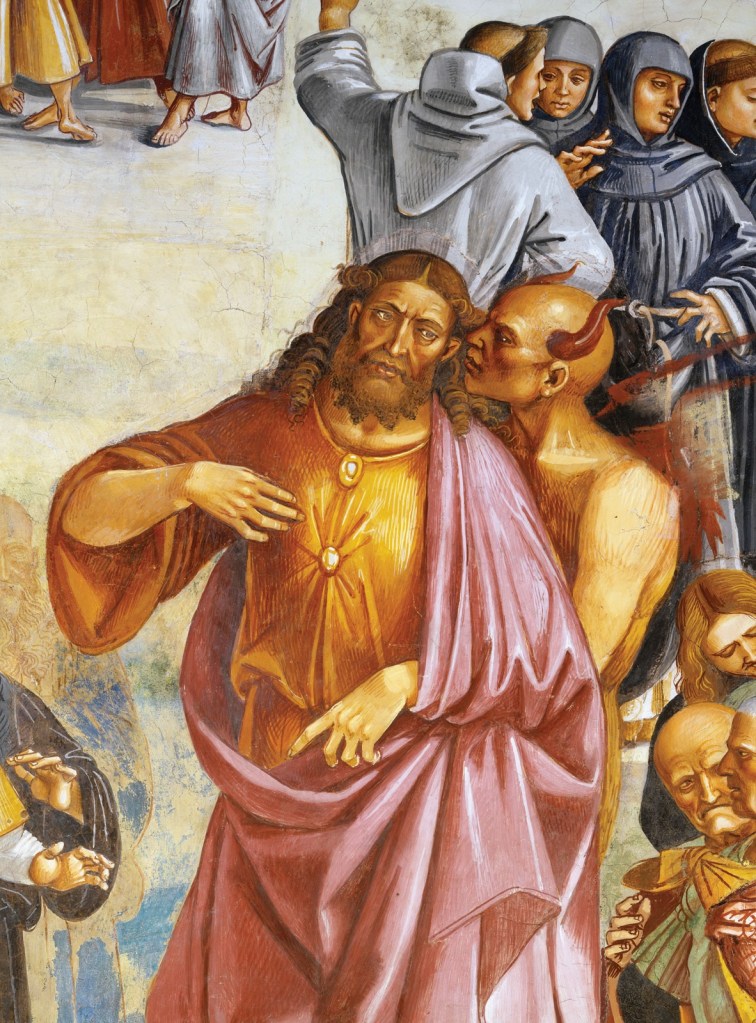
There is a fresco by 16th-century Italian artist Luca Signorelli called The Preaching of the Antichrist. In this outdoor scene, crowds are milling about a man elevated on a pedestal preaching to the them, the figure of the Antichrist. The devil is standing close behind the preacher. He is whispering in the preacher’s ear and his arm is inserted through a fold in the preacher’s robe, so that it is unclear whether it is the preacher’s hand or the devil’s hand emerging from the sleeve and pointing toward the people. So, what is the perspective of the painting and the point of it for us? Behind anything that stands in opposition to God, there lurks the power of the devil, and the devil and his influence are often cleverly disguised, hiding in plain sight and rarely noticed or questioned. And yet, that is what we are called to see and called to rebuke.
Our call to rebuke the powers comes with a caveat from St. Jude, servant of Jesus Christ and brother of St. James. He wrote to challenge the behavior of ungodly people, people who were perverting the grace of the Lord Jesus into sensuality, and even denying the Lord. It is tempting to feel our spiritual superiority over such people, to rise up in opposition to them and to say, “I rebuke you!” But hear what St. Jude says:
But when the archangel Michael, contending with the devil, was disputing about the body of Moses, he did not presume to pronounce a blasphemous judgment, but said, “The Lord rebuke you” (Jude 9).
If not even the archangel Michael would rebuke the devil by his own authority, then perhaps we should be cautious of over-zealous pride ourselves. It is the Lord who rebukes, sometimes through his agents like angels and humans, but always by his authority and in his name. Unless we know the Lord’s mind on a given issue, unless we can say with confidence, “The Lord rebuke you!” then we should guard our own tongues, as St. James cautions.
So, I want to suggest that the best way for us to rebuke the fallen powers is not necessarily through a verbal censure, but rather through the quality of our lives. Every remembrance of our baptism and the identity it conferred upon us as children of God is a rebuke of the fallen powers of tribalism, racism, nationalism, sexism or any other and every other “ism” that roots our identity in anything other than Christ. Every act of sacrificial giving is a rebuke of the power of Mammon. Every instance of repentance or forgiveness is a rebuke of the power of pride. Every act of true worship is a rebuke of idolatry. Every honoring of sabbath is a rebuke of the gods of usefulness and productivity. Every embrace of peace-making is a rebuke of Mars, the god of war and violence. Every act of marital fidelity or unmarried chastity in the face of temptation is a rebuke of Eros, the god of lust. Every proclamation of the truth is a rebuke of the father of lies. Every act of unity is a rebuke of the powers that would pit us against one another and divide us. Every act of neighbor-love and especially every act of enemy-love is a rebuke of hatred. And we could extend this list almost indefinitely. We are constantly being called to rebuke the dark powers that vaunt themselves against God and stand athwart his purposes. These rebukes are good and right because they are done with the authority of and in the name of the Lord Jesus Christ. And, if we rebuke the dark powers in this way, what is true of the Lord, will be true of each of us:
“The Spirit of the Lord is upon me,
because he has anointed me
to proclaim good news to the poor.
He has sent me to proclaim liberty to the captives
and recovering of sight to the blind,
to set at liberty those who are oppressed,
to proclaim the year of the Lord’s favor.”
Amen.


 First Blessings