Anglican Church of the Redeemer
FORMED Conference 2024
Fr. John A. Roop
Spiritual Life and Screen Technology
(Is 6:1-8, Ps 42, 2 Cor 5:17-6:2, Mt 4:1-17)
Hear this word from St. Paul:
1 Corinthians 7:25–26 (ESV): 25 Now concerning the betrothed, I have no command from the Lord, but I give my judgment as one who by the Lord’s mercy is trustworthy. 26 I think that in view of the present distress it is good for a person to remain as he is.
Now, we good Anglicans in the ACNA:
confess the canonical books of the Old and New Testaments to be the inspired Word of God, containing all things necessary for salvation, and to be the final authority and unchangeable standard for Christian faith and life (Fundamental Declarations of the Province (1), BCP 2019, p. 766).
But, here, in the midst of one of the canonical books of the New Testament, right here in the inspired Word of God — the fundamental and unchangeable authority for our faith and life — we see St. Paul give not a command from the Lord, but rather his own judgment, his own opinion about a matter of some importance to the Corinthians. What are we to make of that opinion and its authority, its status? What are we to make of St. Paul’s disclaimer? Well, about that, I have no command from the Lord, but I will give my judgment as one who by the Lord’s mercy…. See what I did there?
As one who speaks and writes I have often reflected on this question: Must I be able to say about a sermon, a lesson, or an article “Thus says the Lord,” or may I be permitted to say, similar to Paul, “I have no command from the Lord, but I give my judgment as one who by the Lord’s mercy struggles to be trustworthy”? I have reflected often on — and prayed often — the collect For Those Who Inform Public Opinion:
Almighty God, your truth endures from age to age: Direct in our time, we pray, those who speak where many listen and write what many read; that they may speak your truth to make the heart of this people wise, its mind discerning, and its will righteous; to the honor of Jesus Christ our Lord. Amen (BCP 2019, p. 661).
Not many listen to what I say, and not many read what I write. But, many or few, I want what I speak and write to express God’s truth to his glory and for the welfare of his people. By God’s grace, you are listening today. So, I want you to know that for what follows, I have no command from the Lord; I would not, at the end of this sermon, declare “Thus says the Lord.” I will offer you my judgment, my opinion. You should evaluate it in light of Scripture and the Apostolic Tradition of the Church as I have formed it in light of Scripture and the Apostolic Tradition.
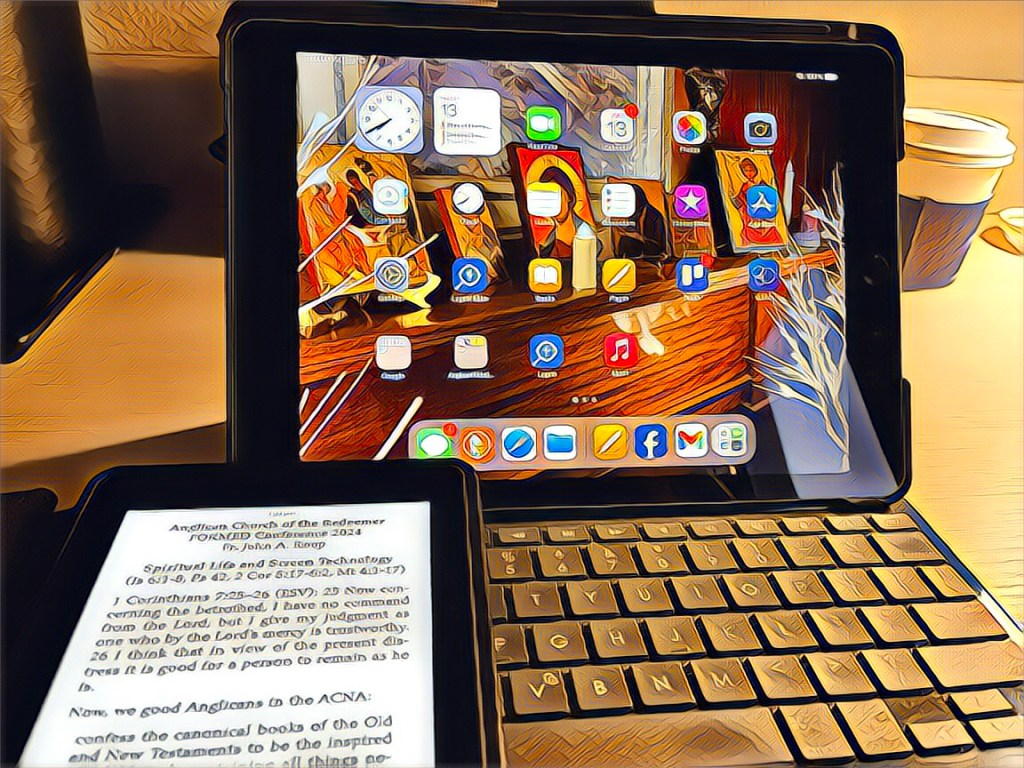
I have been asked to preach on “our spiritual life and our screen technologies.” And now you see the nature of the problem. There is no command from the Lord, in Scripture, about screens. Once, while enjoying an ice cream cone the thought struck me that Jesus never tasted ice cream. It is equally true that Jesus, in his humanity as a second temple Jewish peasant, could not have imagined the devices we take for granted — the iPhone or the iPad or the Mac or the Kindle or the television or any of the screens that light my life, demand my attention, and form, or deform, my spirituality. Nor could Sts. Paul or Peter or James or John or Jude or any of the other New Testament writers. So, we do not have, nor could we have, a direct command from the Lord about precisely such things. But we do have wisdom in the Scriptures and in the Church that may rightly inform our judgments about such things. That is what I can offer.
To begin, let’s narrow down the broad topic of “our spiritual life and our screen technologies” to a few more specific questions: Why are we so drawn to our screens? and, What might our attraction to them reveal about and perhaps portend for our spiritual life?
If we want to know — at the psychological and emotional levels — why we are so drawn to our screens we should ask the product engineers, the software developers, the advertisers, the psychologists, and the sociologists just why these devices are so attractive and so addictive. They are not incidentally so; they are designed, built, and marketed specifically to appeal to our fallen human nature and to take us captive. And that, alone, should give us pause: not just that it is our fallen nature that embraces these devices but that engineers, programmers, and advertisers know us better than we know ourselves and can manipulate our fallen natures so effectively.
But, the real issue for us concerns the spiritual — and here I struggle for the right word — spiritual maladies? deficits? disorders? immaturities? that allow us to fall prey to such manipulation. Perhaps it goes even deeper. Perhaps we should name it as sin or, in the language of our ascetic Fathers and Mothers, captivity to the passions. There are many spiritually profitable ways to approach this issue of spirituality and screens; I will suggest only three.
The first comes from the Old Testament wisdom tradition, specifically from Proverbs:
Proverbs 29:18 (ESV): 18 Where there is no prophetic vision the people cast off restraint, but blessed is he who keeps the law.
As good as the English Standard Version may be, that language is unfamiliar to me; I am old enough to remember, and in many cases to prefer, the King James Version:
18 Where there is no vision, the people perish: but he that keepeth the law, happy is he.
Where there is no vision, the people perish. Vision: what does that entail in a spiritual sense? Meaning, purpose, direction, goal: telos, the perfect fulfillment of God’s will and human flourishing for which we were created and toward which the indwelling Spirit longs and strives to move us. What is God’s vision for you, not just generically for all people, but specifically for you? When God called you into being from nothing, when God first spoke your name, what vocation, what purpose, what telos did he also speak into being and join to that name? You probably will not find the answer to that on a screen, although God gave a vision through Balaam’s donkey and can certainly use even an iPhone if he so chooses. No, your vision, your telos, lies at the intersection of your life with the grand narrative of creation, fall, Israel, covenant, law, prophets, exile, restoration, incarnation, ministry, crucifixion, resurrection, ascension, final judgment, and new creation. You are part of this story: not an incidental part, but a part worthy of a son or daughter of God. Each week in the final words of the Eucharist we say something like, “Go in peace to love and serve the Lord.” What we are really saying is this: “You have been here long enough to see the vision, to begin to grasp your telos in Word and Sacrament, to be strengthened for it. Now, get out of here and get to work out there for the Kingdom. Get out of here and live the vision, live your telos.” If we do not grasp this vision, we will perish, not all at once, but moment by moment as we are distracted by lesser things, by things with little meaning, little purpose, little direction, little goals — little screens. I wonder sometimes if we are looking there for a story, for a meaning, for a telos. Or perhaps it is simply that, having forgotten the grand narrative, the great vision, of which we are part we simply want to be distracted from a certain spiritual emptiness, to mindlessly “kill a little time.” It was Henry David Thoreau who in Walden wrote: As if we can kill time without injuring eternity.
Please don’t misunderstand. I am not saying that every waking moment must be a constant striving toward your telos or that relaxation and entertainment are somehow spiritually deficient or harmful activities. Hardly! St. Irenaeus of Lyons wrote in Against the Heresies (Book 4, Chapter 3, Section 7): “For the glory of God is the living man, and the life of man is the vision of God.” You may have heard this in a slightly different translation: “For the glory of God is man fully alive.” Being fully alive means being fully human. And we are fully human only in our relationships: with our family and friends, with our neighbors and our community, with our reading group or knitting circle, with our pickle ball team or civic organization, with our work and with our play. It is in these things — as well as in prayer and Scripture and fasting and almsgiving and service — that we find the vision of God and our telos. And it is from these very things that screens can distract us so easily. One cannot form a spiritually nourishing relationship with a screen. Where there is no vision, the people perish. Brothers and sisters, we must recover, we must embrace, we must live fully into this vision, this great narrative of God’s loving creation, redemption, and renewal of all things, because lesser stories, smaller screens, beckon us, clamor for our attention.
The second comment about spirituality and screens I draw from St. Ignatius of Loyola and his Spiritual Exercises. It begins with his definition of the spiritual state of desolation:
I call desolation … darkness of soul, turmoil of spirit, inclination to what is low and earthly, restlessness rising from many disturbances and temptations which lead to want of faith, want of hope, want of love. The soul is wholly slothful, tepid, sad, and separated, as it were, from its Creator and Lord (St. Ignatius of Loyola, The Spiritual Exercises of St. Ignatius (trans. Louis J. Puhl, S. J.), Loyola Press (1951), p.142).
St. Ignatius describes desolation in its acute form: “wholly slothful, tepid, sad, and separated, as it were, from its Creator and Lord.” We may experience this from time to time; many of the great saints have done as part of their sanctification. But, I suspect that a lower intensity, chronic form of desolation is more common than this — not crisis, but a muddling through — and that this low level desolation contributes to our “addiction” to screens. St. Ignatius describes the soul in desolation as slothful, a heavily freighted term in classical spiritual formation. Slothfulness is a distaste for, an avoidance of all things spiritual: prayer brings no particular joy or sense of God’s presence; Scripture seems dry like we are stuck in an endless loop of Leviticus; worship may be annoying — music too traditional or else too contemporary, preaching too long, children too noisy; contemplation makes us drowsy. We’ve all been there, haven’t we, just spiritually out of sorts? It’s not spiritual pneumonia: more like spiritual spring or fall allergies. Note how St. Ignatius describes some of the symptoms: inclination to what is low and earthly, restlessness arising from many disturbances.
Let me use a example that some of us, many of us, probably all of us can identify with. You are working at a tedious task that seems endless and endlessly boring. Suddenly you realize you are hungry. You are not, of course, since you had a very good meal only an hour ago. You are listening to your bored mind, not to your full stomach. But, you get up and go the the refrigerator, open it, and stand gawking at the contents. There are healthy, nutritious foods there that you could prepare, but you would have to prepare them. Then you remember the pint of ice cream in the freezer, and the spoons that are ever so handy. And, before you know it, you are knuckles deep in that pint bucket of Rocky Road and nearing the bottom. You’ve eaten it all and noticed not one bite of it. Now, replace Rocky Road with iPhone or iPad or any other screen technology and you get the picture. It is a mindless distraction from the real and tedious work that needs to be done, work like the Daily Office and intercessory prayer, work like checking on your annoying neighbor who has been sick lately, work like helping your kids with their homework or your spouse with those endless household chores — work like loving God with all your heart and with all you soul and with all your mind and loving your neighbor as yourself. And, let’s not kid ourselves: spiritual formation is hard and boring and repetitive and costly, not least because we have an enemy who tempts us to sloth and distraction, who wants little more than for us to live in a perpetual state of low level spiritual desolation. Brothers and sisters, this is where committed will empowered by the Holy Spirit and holy habit can be our salvation. Have you committed to praying the Daily Office? Then do it: in season and out of season; when the gentle wind of the Spirit stirs your heart and when the hot, dry, sirocco of the enemy scorches it; when you feel God near and when you feel God has absconded. The same holds for all other spiritual disciplines and good works to which you are committed. Go through the motions if that is all you can do; but keep going. If your faith at the moment seems nothing more than habit, then thanks be to God that it is a holy habit. Do not allow the enemy to distract you with smaller things, with smaller screens.
My third and final comment about spirituality and screens concerns a seldom voiced, entirely false presupposition, a willful blindness that most of us embrace: the myth of endless time, the false promise of tomorrow and tomorrow and tomorrow. Let me ask a deceptively simple question that we rarely think to ask: What are you here for? I am not asking why you are here at this FORMED Conference or even why you here at this Eucharist. I have something more fundamental in mind. Why are you here at all? Why has God given you this day, this moment of life? Ask an Orthodox spiritual father and he will respond quickly and decisively: Repentance. God has, of his great mercy, given you this day for repentance: for changing/transforming your mind, for turning again and again toward God, for working out your salvation with fear and trembling — today is the day of salvation — for confession and amendment of life. God has, of his great mercy, given you this day for repentance. The next question is as simple but as probative as the first: what will you do with it, with this day God has given you knowing that there may not be another? If this were your last day in which to make a good start toward repentance, how much of it would you spend on YouTube or Facebook or X or Instagram? How much of it would you spend with your face glowing from the nearness of a screen instead of with your face glowing from the nearness of God’s glory?
James 4:13–17 (ESV): 13 Come now, you who say, “Today or tomorrow we will go into such and such a town and spend a year there and trade and make a profit”— 14 yet you do not know what tomorrow will bring. What is your life? For you are a mist that appears for a little time and then vanishes. 15 Instead you ought to say, “If the Lord wills, we will live and do this or that.” 16 As it is, you boast in your arrogance. All such boasting is evil. 17 So whoever knows the right thing to do and fails to do it, for him it is sin.
None of this implies that Christians must be morose; to the contrary, we are called to joy. None of this implies a continual state of memento mori; to the contrary, we are an Easter people and Alleluia! is our song. But, brothers and sisters, it does mean that we are called to live intentionally, that we are called to recognize that our lives matter, that eternal significance lies in each moment, that we know that God has given us this moment for repentance which is joy and life.
So, there you have it, not a command from the Lord but a judgment from a fellow sinner, from one who struggles with these same temptations to distraction, desolation, and denial. What I say to you, I say first to myself. Return again and again to the great vision of God that eclipses all lesser stories. Cultivate holy habits and practice them, maintain them whether you feel like it or not. Remember that today is the day of salvation and that each moment in it has eternal significance and that God has given it to you for repentance. And when we feel an undue attraction to lesser things, let us pray:
Almighty and eternal God, so draw our hearts to you, so guide our minds, so fill our imaginations, so control our wills, that we may be wholly yours, utterly dedicated to you; and then use us, we pray, as you will, and always to your glory and the welfare of your people; through our Lord and Savior Jesus Christ. Amen (BCP 2019, p. 668).


 First Blessings