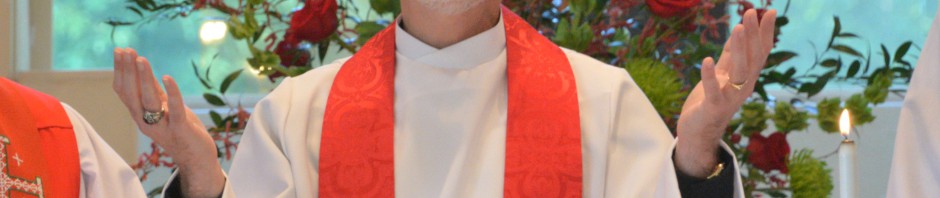

Yesterday I attended the funeral mass of my neighbor, a good man and a worthy deacon in the Roman Catholic Church. May his soul, and the souls of all the faithful departed, by the mercy of God, rest in peace and rise in glory.
On the eve of the mass, family and friends gathered at a funeral home to pay their respects, to reminisce, and to pray the rosary. As an Anglican, the rosary is not part of my personal piety as it is for some, though I do include the Hail Mary in my daily prayers. The sustained emphasis on the Blessed Virgin Mary in the rosary is foreign to me, and, frankly, in the conversations following the rosary I heard many more invocations of the Holy Mother than I did of the Lord Jesus; I find that balance a bit skewed. Issues of theology aside though, something profoundly significant is occurring in the rosary; in the veneration of one particular woman — a woman venerated by the angel Gabriel and blessed by the Lord himself — the Church is consecrating womanhood. That is an act of witness to and defiance of a culture that consistently desecrates womanhood: through pornography, through transgenderism, through abortion, through the entertainment industry, through the hyper-sexualization and — Lord, have mercy — the sexual exploitation of young girls, through the insistence that women must sacrifice family for career, and through a thousand other ways. To that, the Roman Catholic Church responds with the rosary, and that is a holy act of rebellion.
I have always thought that Anglicans “do” funerals up right, and I still do. But, there are a few things, perhaps, that we can learn from our Roman Catholic brothers and sisters. Just before the body is borne into the church from the entrance to the nave, the priest or bishop asperges the coffin with holy water, a remembrance and final re-affirmation of baptism: you were born into the Church in the waters of baptism and you die in the bosom of the Church through the waters of baptism. I hope the Church will do that for me when my time comes. Then, as a final act immediately before the dismissal, the coffin is censed to send off a brother or sister accompanied by the prayers of the saints, to send off a brother or sister as a fragrant offering of the Church to God. I hope the Church will do that for me when my time comes.
There were several Latin chants in the mass. As an interested outside observer, it seems to me that the Roman Catholic Church lost much when the Latin mass fell into disfavor; the preservation of these chants is a holy remnant. Two of them were particularly meaningful: the Panis Angelicus sung at Communion and the In Paradisum before the recessional.
PANIS ANGELICUS (St. Thomas Aquinas, English translation)
May the Bread of Angels become bread for mankind;
The Bread of Heaven puts all foreshadowings to an end;
Oh, thing miraculous! The body of the Lord will nourish
the poor, the servile, and the humble.
You God, Three In One, we beseech;
That You visit us, as we worship You.
By Your ways, lead us where we are heading,
to the light that You inhabit.
The notion that “the Bread of Heaven puts all foreshadowings to an end,” is sacramental theology at its best. The Eucharist is not a sign pointing toward something else; it is the Something Else.
IN PARADISUM
May the angels lead you into paradise;
may the martyrs receive you at your arrival
and lead you to the holy city Jerusalem.
May choirs of angels receive you
and with Lazarus, once a poor man,
may you have eternal rest.
There is a meme that I actually like: “The Apostle Paul entered heaven to the cheers of those he martyred. That’s how the Gospel works!” Yes, angels and archangels and all the company of heaven leading our brothers and sisters — and one day, please God each of us — into paradise.


 First Blessings