Apostles Anglican Church
Fr. John A. Roop
What has Jesus been doing all this time?
(Amos 2, Ps 119:153-176, John 17)
In the Name of the Father, and of the Son, and of the Holy Spirit. Amen.
In Book 11, Chapter 12 of The Confessions, St. Augustine reflects on this question: What was God doing before he made heaven and earth? He remarks, to start with, that he will not follow the path of another certain person who had answered the question somewhat facetiously along these lines: God was making hell for those who pry into mysteries.
Well, I certainly hope that was not what God was doing, because I am going to pose a similar sounding question: What has Jesus been doing since the Ascension, for these last two millennia?
The Creeds don’t help us much here. Both the Nicene and the Apostles Creed simply say in pretty similar words that following the Ascension, Jesus sat down at the right hand of the Father, and that he will at some unspecified moment in the future return to judge the living and the dead. As for the interim between ascension and judgment — as for what Jesus is doing now — the Creeds provide no details. Sitting at the Father’s right hand implies taking up a position of authority and rule, not merely resting, but no more is said about the nature of Christ’s rule.
When we turn to Scripture, we get a little more information. We could start with John 14:
John 14:1–3 (ESV): 14 “Let not your hearts be troubled. Believe in God; believe also in me. 2 In my Father’s house are many rooms. If it were not so, would I have told you that I go to prepare a place for you? 3 And if I go and prepare a place for you, I will come again and will take you to myself, that where I am you may be also.
Jesus is, in this interim, preparing a place for us. There is a lot of sentimental imagery and several campfire meeting hymns inspired by that statement, visions and verses of mansions on a hill and the like almost as if we think of Jesus plying his carpentry skills in heaven; but I think that is too small a thing. Jesus is preparing neither a tiny house or a mansion for us, but rather the Kingdom of God, the renewal of heaven and earth and their ultimate intersection when the New Jerusalem descends from heaven to earth and God and resurrected man finally dwell together. That is the place that Jesus is preparing for us. We are coworkers with him in that; the good and faithful work we do here in his name will become the raw materials he uses to build the Kingdom. St. Paul assures us that no good work we do here and now will be wasted there and then:
1 Corinthians 15:58 (ESV): 58 Therefore, my beloved brothers, be steadfast, immovable, always abounding in the work of the Lord, knowing that in the Lord your labor is not in vain.
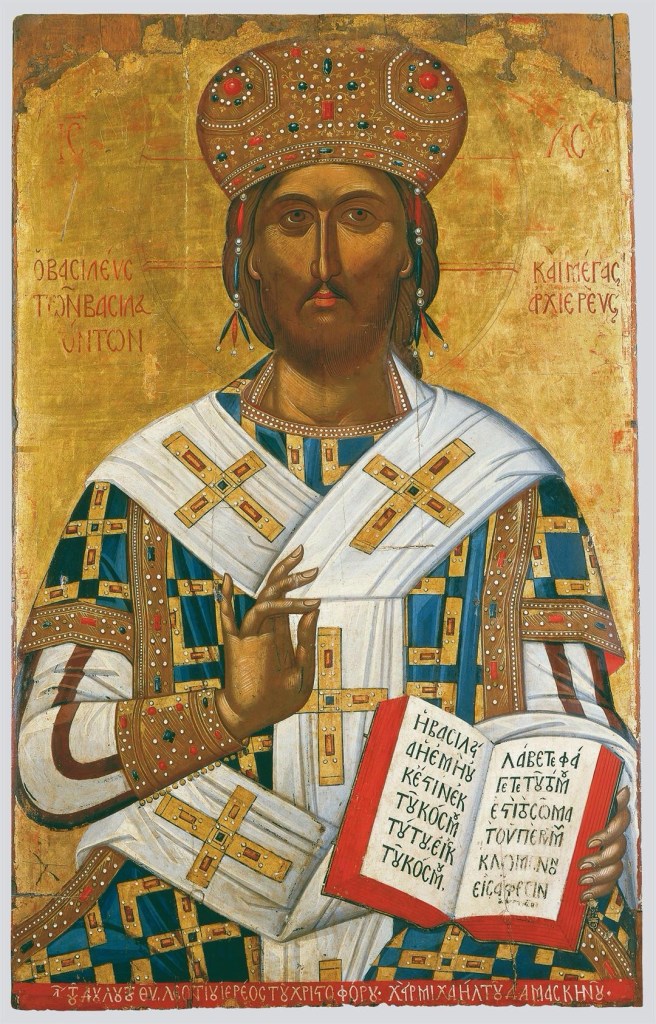
We might think of Jesus’ current reign, his current building of the Kingdom, as a meta-task, his overarching occupation; underneath that “umbrella” there are other occupations that contribute to it. Hebrews tells us that Jesus is even now serving as our great High Priest — on our behalf — in the heavenly Holy of Holies. His high priesthood does not consist of the repeated offering of daily sacrifices:
Hebrews 7:27–28 (ESV): 27 He has no need, like those high priests, to offer sacrifices daily, first for his own sins and then for those of the people, since he did this once for all when he offered up himself. 28 For the law appoints men in their weakness as high priests, but the word of the oath, which came later than the law, appoints a Son who has been made perfect forever.
So, if not to offer sacrifice, what does our High Priest do for us? He provides the way for us to enter the Holy of Holies into God’s presence through him, through the torn curtain that was his body. And, he lives to make intercession for us:
Hebrews 7:23–25 (ESV): 23 The former priests were many in number, because they were prevented by death from continuing in office, 24 but he holds his priesthood permanently, because he continues forever. 25 Consequently, he is able to save to the uttermost those who draw near to God through him, since he always lives to make intercession for them.
What has Jesus been doing these last two thousand years? He has been making intercession for all of us who draw near to God through him; he has been praying for us and for the Church. It is interesting to note — and this would take more time to explore than we have today — it’s interesting to note that this text doesn’t say that Jesus intercedes on behalf of the world, on behalf of those who don’t know him or who reject him, who don’t seek God. At least in this text, the focus of Jesus’ intercession is on his people, on those who bear his name.
Wouldn’t it be fascinating to know the content of Jesus’ prayers for us? What is on his heart for his people? To some great extent, we can know this, because we get to eavesdrop on one such prayer throughout the whole of John 17. This prayer, which is the culmination of the Upper Room discourse in St. John’s Gospel, is called the High Priestly Prayer of Jesus precisely because Jesus is interceding for us as Hebrews describes it. And we get to listen in.
The immediate context of the prayer is Jesus’ last supper in the Upper Room. Jesus has washed his disciples’ feet. He has predicted his betrayal by one of his own and has foretold Peter’s threefold denial. He has given his disciples the new commandment to love one another as he has loved them. He has identified himself as the way, the truth, and the life and as the true vine. He has promised the coming of the Holy Spirit. And now, knowing what will transpire in the next few hours, over the next three days, Jesus prays, not for himself, but for them and for us.
We can’t consider the entire prayer in detail here and now. We’ll instead peruse the text and select some of its main themes, especially those that focus on Jesus’ high priestly intercession.
John 17:6–11 (ESV): 6 “I have manifested your name to the people whom you gave me out of the world. Yours they were, and you gave them to me, and they have kept your word. 7 Now they know that everything that you have given me is from you. 8 For I have given them the words that you gave me, and they have received them and have come to know in truth that I came from you; and they have believed that you sent me. 9 I am praying for them. I am not praying for the world but for those whom you have given me, for they are yours. 10 All mine are yours, and yours are mine, and I am glorified in them. 11 And I am no longer in the world, but they are in the world, and I am coming to you. Holy Father, keep them in your name, which you have given me, that they may be one, even as we are one.
There are several points here that form the core of Jesus’ intercession and that are repeated throughout his prayer. First, there is a distinction to be made, one that I mentioned earlier. There is the world on one hand and there those who have received the word of God as the truth and have believed in Jesus on the other hand. It is only for the latter group — and, as we will learn, for those who will follow after them in the truth — that Jesus prays. This doesn’t mean that Jesus has no love for the world; his crucifixion in the next few hours is testimony to his universal love. But, there are strangers and there are sons and daughters; there are next door neighbors and there are family members. There is a different level intimacy and care for those to whom we belong and who belong in turn to us versus those who have not yet made our acquaintance or who have chosen not to accept our offer of hospitality. And so Jesus prays here for his own, but not for the world. What is his desire for them? That they may persevere in faithfulness and that they may be one with one another as the Son is one with the Father.
These two intercessions make sense, don’t they, given what the disciples will experience in the coming hours and days and years. As Peter will soon learn, the pressure to deny Jesus will be intense, and it will only increase throughout their lives. Church Tradition tells us that ten of the eleven Apostles for whom Jesus prayed here remained faithful under persecution and martyrdom: faithful unto death. The remaining one, John, suffered hardship and exile and remained faithful throughout his life. Persecution and apostasy was one danger. But another challenge was just as great: schism. Jesus had already seen the danger in the argument over who would be greatest among them, an argument that could have split the disciples into warring factions. So, who will lead when Jesus is gone? Will the others vie for leadership and leave when not selected for it? Will they be one in the faith, each teaching the pure truth as Jesus had given it to them or will heresies arise? What will happen when the group moves from Jerusalem to Judea and Samaria and the uttermost parts of the world, when Jews and Gentiles come clashing together in the fledgling Church? A prayer that they may be one is a tall order as the history of the Church shows. The Great Schism between the Eastern and Western churches in 1054 A.D., the Protestant Reformation in the 16th century, the proliferation of Protestant denominations from then to now, the creation of our own ACNA: no matter how we justify these as necessary separations to restore or preserve the faith, we cannot in good conscience see them as answers to Jesus’ prayer for unity. In fact, we have a prayer in the BCP 2019 that acknowledges our failure in this area.
The Lord be with you.
And with your spirit.
Let us pray.
O God the Father of our Lord Jesus Christ, our only Savior, the Prince of Peace: Give us grace to take to heart the grave dangers we are in through our many divisions. Deliver your Church from all enmity and prejudice, and everything that hinders us from godly union. As there is one Body and one Spirit, one hope of our calling, one Lord, one Faith, one Baptism, one God and Father of us all, so make us all to be of one heart and of one mind, united in one holy bond of truth and peace, of faith and love, that with one voice we may give you praise; through Jesus Christ our Lord, who lives and reigns with you and the Holy Spirit, one God in everlasting glory. Amen.
We keep praying and working that Jesus’ own intercession for us — for the unity of his disciples — might yet be answered. To see how important this prayer for unity was to Jesus, just scan the remaining text of the prayer to see it repeatedly emphasized:
John 17:20–23 (ESV): 20 “I do not ask for these only, but also for those who will believe in me through their word, 21 that they may all be one, just as you, Father, are in me, and I in you, that they also may be in us, so that the world may believe that you have sent me. 22 The glory that you have given me I have given to them, that they may be one even as we are one, 23 I in them and you in me, that they may become perfectly one, so that the world may know that you sent me and loved them even as you loved me.
How important is our unity? It is the witness to the world that the Father sent the Son. Our love for one another is witness to the love between the Father and the Son. Our disunity strikes against the credibility of our witness. I can only imagine that Jesus is still interceding for our unity, still praying for it as our great high priest.
I will mention just one more aspect of this prayer. We are still in a fallen world. Though our enemy has been defeated he has not yet been banished. He still stalks and strikes; he still harasses and wounds. And he is wiser far and stronger than we; we cannot withstand him alone. So, Jesus prays for us:
John 17:15 (ESV): 15 I do not ask that you take them out of the world, but that you keep them from the evil one.
When evil seems so near, so virulent, so strong, take heart: Jesus is praying for you — that you will not fall, that you will not be overcome, that you will not be a casualty of the great spiritual battle in which we are all engaged.
What has Jesus been doing for the last two millennia? Not preparing hell for those who ask such impertinent questions, but rather praying for his beloved brothers and sisters — for you and me and for all the faithful who came before and may come after: that we may persevere in faithfulness, that we may be one as the Father and the Son are one, that we may be victorious over the evil one. Amen.


 First Blessings