Apostles Anglican Church
Fr. John A. Roop
Transcription and Sacrament
(Prov 9:1-6, Ps 147, Eph 5:3-14, John 6:53-59)
Jesus said:
56 Whoever feeds on my flesh and drinks my blood abides in me, and I in him…58 whoever feeds on this bread will live forever.
In the Name of the Father, and of the Son, and of the Holy Spirit. Amen.
Listen to a great, expansive orchestral or choral work. Recall one even now, a personal favorite; hear it again in your memory: the lush strings, the emphatic percussion, the soaring brass, the haunting woodwinds. Now let the human voices add their color: the melodic sopranos cascading downward through the alto and tenor ranges until reaching the thundering basses which seem to ground the work on the pillars of the earth. Envision the great concert hall around you, designed perfectly for both visual and acoustic beauty. Or perhaps you are listening in a cathedral whose vaulted ceiling beckons you heavenward as modern day sons and daughters of Asaph offer their psalms of praise.
It is possible to take such a vast composition and transcribe it for humbler instrumentation and fewer voices. The Theme from Jupiter, the music for that glorious hymn O God Beyond All Praising, by Gustav Holst, meant for full orchestra, can be, and has been, transcribed for a single instrument; it can be played beautifully on the organ, a very expressive instrument in its own right. An organ, even a cathedral pipe organ, is not not an orchestra, of course, but its various ranks and stops are reminiscent of flutes and trumpets, of strings and voices. But, we can go even further. It is possible to transcribe Jupiter for solo classical guitar. Each step in this transcription process — from orchestra to organ to guitar — is an attenuation, not exactly a diminishment of original glory, but an accommodation of it to more limited instruments and faculties. Those who play the transcriptions — the church organist or the amateur guitarist in his den — do not mind, perhaps do not even notice the attenuation because they are caught up in the wonder of participation in that great music. And here is a profound mystery: the condescension of the music in transcription leads to the exaltation, to the lifting up, of the musician. And the musician knows it; he is playing a greatly simplified arrangement, yes, but he is playing that music. He is playing the great music that stirs his heart, and with the ears of his heart he hears the orchestra as he plays; he is caught up into the reality and wonder of it all. He has entered an enchanted concert hall which is larger on the inside than on the outside.
Something very like this process of transcription is going on whenever God makes himself known to man. There is, there must be, an attenuation, an accommodation, of the divine to the human, if the human is to survive the encounter. God wishes to reveal his glory to Moses in Midian, but Moses cannot bear it. So, God “transcribes” his glory — light unapproachable — into flame which does not consume and firelight which does not blind. At the burning bush Moses participates in the glory of God insofar as he can bear it. At the intersection of the divine and human, things are not always what they seem; things are not merely what they seem; things are very often more than what they seem. Meaning floods mere observation as the waters cover the sea. But — here is the wonder of it all — in taking off his shoes and bowing down before the bush, before God’s glory transcribed in the bush, Moses participates in the divine. He is taken up into it; he is elevated by the divine condescension. Let your mind roam through the pages of Scripture; you will find such divine “transcription” hiding everywhere there in plain sight in narrative and covenant and law and prophets and, of course, supremely in the Gospels.
St. John’s Gospel, especially, abounds with such divine transcription. So, it is rich and complex, difficult and rewarding, on another spiritual and intellectual level entirely than the synoptic Gospels: Matthew, Mark, and Luke. Very little in St. John’s Gospel lies on the surface; you have to plumb the depths, plunge in headlong to find its meaning. Things are not always what the seem; things are not merely what they seem; things are very often more than what they seem.
1In the beginning was the Word, and the Word was with God, and the Word was God. 2 He was in the beginning with God. 3 All things were made through him, and without him was not any thing made that was made. 4 In him was life, and the life was the light of men. 5 The light shines in the darkness, and the darkness has not overcome it (John 1:1-5, ESV throughout).
Here is the truth. This Word — this λογος — is the very expression of God, is God himself: creator of all things, life of all things, light for all men. And then comes the great divine “transcription.”
14 And the Word became flesh and dwelt among us, and we have seen his glory, glory as of the only Son from the Father, full of grace and truth (John 1:14).
Yes, we have seen his glory, but attenuated, “hidden” in the form of man, the second person of the Trinity transcribed and “played” on a human instrument: fully God and fully man as the Creeds proclaim, but accommodated to human sensibilities. Look at Jesus and what do you see? A Galilean of the peasant class, an erstwhile carpenter, an itinerant rabbi, a worker of miracles or else a charlatan depending on your point of view, a savior or a threat. But things are not what they seem, St. John insists; things are very much more than what they seem.
Follow St. John’s account and go to Cana, to a wedding there. When the wine runs out, Jesus has the servants fill water jars with water and then draw some water out. One would expect to find water in the ladle, but things are not always what they seem. It is not water, but more than water; it is now wine. And the surprised master of the feast expects it to be inferior wine, but things are not always what they seem; it is the good wine, the best of wines.
Jesus meets a Samaritan woman at Jacob’s Well in Sychar. What does she see? Only a weary Jewish man, albeit a very strange and forward one who breaches social convention to ask her for a drink, who dares to engage her in conversation. It seems as if the dialogue centers around water, but things are not always what they seem. She is speaking of water, surely; he is speaking of the Holy Spirit and of eternal life. The conversation would be almost farcical if it were not so important. This woman — an outcast to her own village and a dog to Jews — has a moment of insight when she perceives a higher level of meaning in Jesus than her eyes see: “Sir, I perceive that you are a prophet,” she says. Better, but not yet there. No, the tired, thirsty Jew sitting by the well asking her for water and offering her living water is the Messiah. Things are not always what they seem; things are not merely what they seem; things are very often more than what they seem. That is even true about the Samaritan woman herself. She seems to be a discarded woman with a checkered past, but the Church has named her Photini and canonized her as Saint Photini, whose name means “the luminous one.” Things are not always what they seem.
We come now to the sixth chapter of St. John’s Gospel: the feeding of the five thousand, the interlude of Jesus walking on the water, the Bread of Life discourse — all of it wonderful and disturbing and confusing for those who saw these things and heard these words. Last week’s lectionary reading ended with Jesus saying:
51 I am the living bread that came down from heaven. If anyone eats of this bread, he will live forever. And the bread that I will give for the life of the world is my flesh (John 6:51).
The first part of that statement is perhaps confusing, but not so disturbing; it can be taken as metaphor: “I am the living bread that came down from heaven. If anyone eats of this bread, he will live forever.” Bread, sustenance, life: all that is clear enough metaphorically speaking. Those who follow Jesus find his words, his presence, his way to be their sustenance and life, just like with bread. That is really no different than hearing someone like Yo Yo Ma say, “Music is my life,” or a poet saying, “Poetry is as needful to me as breathing.” We get it.
But, Jesus goes further: “And the bread that I will give for the life of the world is my flesh.” Listen to this part of the discourse again as if for the first time and allow yourself to be scandalized:
53 So Jesus said to them, “Truly, truly, I say to you, unless you eat the flesh of the Son of Man and drink his blood, you have no life in you. 54 Whoever feeds on my flesh and drinks my blood has eternal life, and I will raise him up on the last day. 55 For my flesh is true food, and my blood is true drink. 56 Whoever feeds on my flesh and drinks my blood abides in me, and I in him. 57 As the living Father sent me, and I live because of the Father, so whoever feeds on me, he also will live because of me. 58 This is the bread that came down from heaven, not like the bread the fathers ate, and died. Whoever feeds on this bread will live forever (John 6:53-58).
The language used here is very concrete, very physical language, not poetic or metaphorical at all; the eating and feeding is more akin to animals hunkered around a carcass growling than to genteel ladies gathered for cucumber sandwiches at afternoon tea. As you will see in next week’s Gospel selection, it was highly offensive language to the Jews, the grossest, the vilest infraction of the dietary law imaginable, reminiscent of the depravity of starvation and cannibalism during the siege of Jerusalem. “Unless you eat the flesh of the Son of Man and drink his blood, you have no life in you,” means just what it says; no softening of our Lord’s words will do.
But, what are we to make of them? As the Jews asked in that moment so we ask now, “How can this man give us his flesh to eat?”
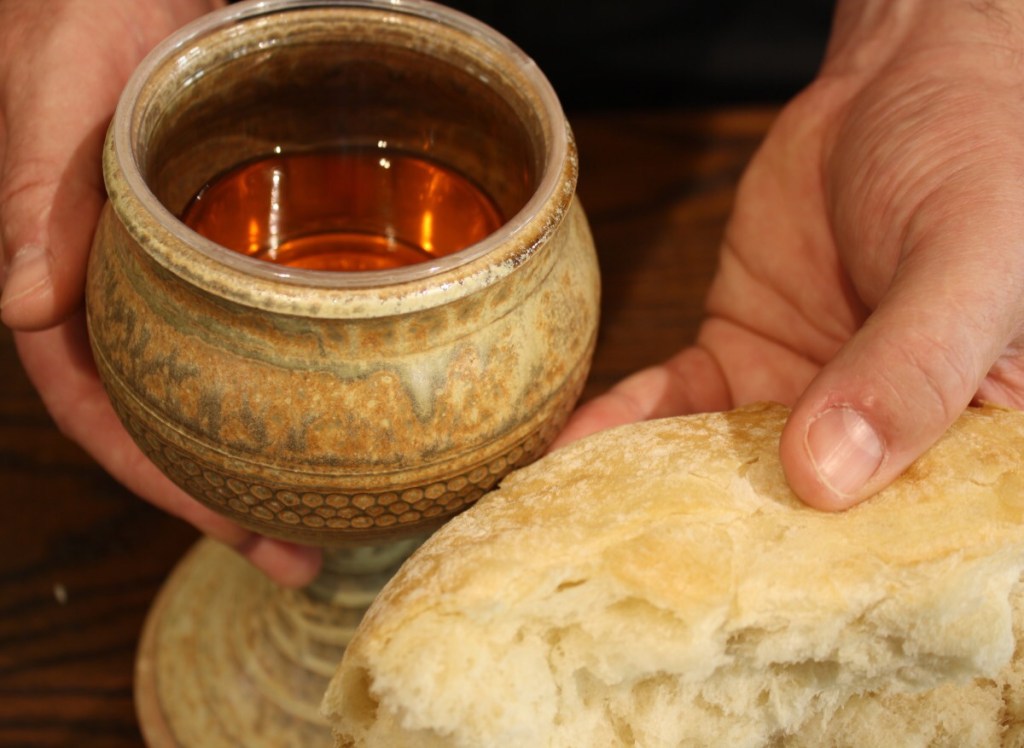
Well, the answer lies not in metaphorical language but in sacramental reality. And that brings us back around again to the notion of transcription. When God acted in these last days to make himself known to man, the Word became flesh and dwelt among us: a transcription, an attenuation, an accommodation to our human sensibilities so that we might see and hear and touch God without being incinerated by his glory, so that man might participate with the divine. And as glorious as that was, it was not yet enough for God. Remember St. John’s prologue: in the Word was life, and the Word became flesh. Life, eternal life, our life resides in the flesh of the Word incarnate, Jesus. In God’s economy, it is not enough that man gaze upon the divine life in the person of Jesus; God intends for man to have that divine life within himself, to participate fully in the life of the Trinity. But how? As Fr. Thomas noted so well last week, we are what we eat. We take life into ourselves by eating and drinking. So God transcribes himself yet again: the Word becomes flesh and blood; the flesh becomes bread, and the blood become wine. This is the first movement of the Eucharist, God accommodating himself to our humanity that we might participate in his life, God made manifest and truly present as and in bread and wine.
19 And he took bread, and when he had given thanks, he broke it and gave it to them, saying, “This is my body, which is given for you. Do this in remembrance of me.” 20 And likewise the cup after they had eaten, saying, “This cup that is poured out for you is the new covenant in my blood” (Luke 22:19-20).
I may be running roughshod over a thousand nuances and caveats and quibbles of Eucharistic theology here, but I’m not overly concerned about that just now; there is time to deal with all that later if need be. For now, just let the wonder of it wash over you! The God who called all things into being, the God in whom all things consist, that God in the Person of the Word became flesh to dwell among us; to make himself known to us; to manifest the divine, eternal life to us; to die for us in order to free us from death, sin, and the powers of darkness; to rise again that we might live with him. That God became flesh and that flesh became bread and we eat that bread and drink that wine so that we might have his divine life within us, so that we might be drawn up into and participate in the life of the Trinity. In the Gospel, things are not always what they seem; things are not merely what they seem; things are very often more than what they seem.
I mentioned the first movement of the Eucharist in which Jesus’ body and blood are transcribed to us as bread and wine. But, there is another essential movement when we enter that enchanted room — the Upper Room — the room that is far larger on the inside than on the outside, when the meaning of the bread and wine is made manifest as the priest says and the Spirit moves:
We celebrate the memorial of our redemption, O Father, in this sacrifice of praise and thanksgiving, and we offer you these gifts. Sanctify them by your Word and Holy Spirit to be for your people the Body and Blood of your Son Jesus Christ. Sanctify us also, that we may worthily receive this holy Sacrament, and be made one body with him, that he may dwell in us and we in him (BCP 2019, pp. 133-134).
The Word became flesh. The flesh became bread and wine. The bread and wine become the Body and Blood of Jesus Christ. We take and bless bread and wine. We feast on Christ himself, on his flesh and blood, just as he said to the Jews, so that we might have life in ourselves. It is the same sacramental mystery of transcription that St. John Chrysostom extols so eloquently in his Paschal Homily. Speaking of Jesus’ arrival into hell following the crucifixion, St. John Chrysostom says:
It took a body, and met God face to face. It took earth, and encountered Heaven. It took that which was seen, and fell upon the unseen.
We take bread and wine and meet God face to face. We take the stuff of earth and encounter heaven. We take that which is seen, and that which is unseen falls upon us bringing life.
Some of the great Eucharistic debates of the Protestant Reformation and the Roman Catholic Counter-Reformation seem to me to be a grand and costly exercise in missing the point. The real point of it all was expressed perfectly not by a theologian but by the American novelist Flannery O’Conner. As the story goes, O’Conner, while still a young, aspiring author was invited to a dinner party hosted by an accomplished writer and attended by other well-known authors. The host saw that O’Conner was intimidated by the group and tried to draw her out of herself and into the conversation. Knowing that O’Conner was a Catholic, the host made a comment about the beautiful literary symbolism of the Eucharist, to which O’Conner replied, “If it’s just a symbol, to hell with it.” That, brothers and sisters, is perhaps the best Eucharistic theology in so few words that I have ever seen. I might not cross the street in the rain for a symbolic meal of bread and wine, but I will stake my life on the Sacrament of the Body and Blood of our Lord Jesus Christ.
God attenuates himself, accommodates himself to our humanity in the Sacraments so that we might truly participate in the divine life of the Trinity. This is not symbol or metaphor; it is sacramental reality, the most “real thing” you will do this day or any day. And that makes the Words of Institution in the liturgy the holiest words you will ever hear. Bishop Robert Barron argues that the second most important set of words in the Eucharist is the dismissal, which we have in various forms:
Let us go forth in the Name of Christ.
Go in peace to love and serve the Lord.
Let us go forth into the world, rejoicing in the power of the Holy Spirit.
You have seen the Word become flesh. You have seen the flesh and blood become bread and wine. You have feasted upon the bread and wine become flesh and blood. You have been filled with the divine life of the Trinity. Now, get out of here! Go forth in the Name of Christ. Go in peace to love and serve the Lord. Go forth into the world, rejoicing in the power of the Holy Spirit to do the work that God has give you to do. Participating in the divine life of the Trinity means loving what God loves and doing what God is doing, and all of that out there in the world. And in doing this, you become a transcription of God: the Holy Spirit playing divine music on a human instrument.
Jesus said:
56 Whoever feeds on my flesh and drinks my blood abides in me, and I in him…58 whoever feeds on this bread will live forever.
Amen.
Notes:
To explore the notion of transcription or attenuation further, see the essay Transposition in the collection of essays by C. S. Lewis entitled The Weight of Glory.


 First Blessings