
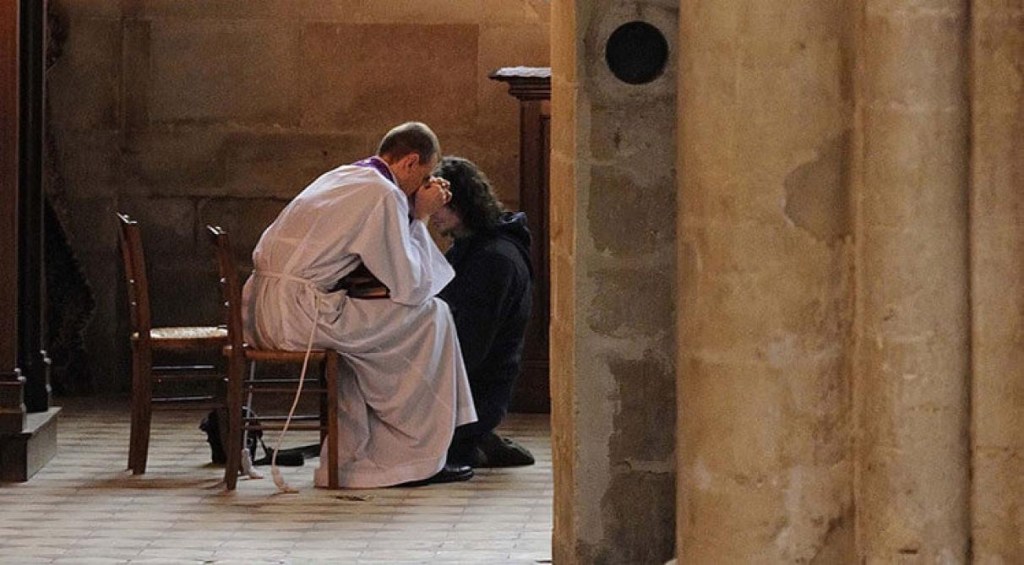
Being new to something, even to something you want or need to do, can be disconcerting, particularly if the “something” is personal. That is certainly true in the case of the Reconciliation of Penitents (Confession). From time to time I will have someone contact me to schedule sacramental confession only to have him/her express a certain anxiety about it: “This is my first time at confession, and I don’t really know what to do or what to expect. Can you help me?”
The last time that happened, I wrote a response that I realize might be generally helpful. A part of my response follows:
Your second question is a bit more complex due in part to the Anglican attitude toward confession: All may; some should; none must. In short, we are not Roman Catholics who think some sins — mortal sins — can generally be forgiven only through confession to a priest and the accompanying absolution offered. The Anglican assumption is that Anglicans are confessing their sins daily in the Daily Office, directly to God if the office is done privately, or to God in the presence of a priest who will offer absolution if it is done publicly. For some people — many people, actually — this seems to be enough; they have no further scruples and their consciences are satisfied. But, there are others whose consciences will not be quieted by such a general confession. To these people, the Exhortation makes particular appeal:
If you have come here today [to Holy Communion] with a troubled conscience, and you need help and counsel, come to me, or to some other Priest, and confess your sins, that you may receive godly counsel, direction, and absolution. To do so will both satisfy your conscience and remove any scruples or doubt (BCP 2019, p. 148).
This gives the Anglican rationale for Confession quite well: to satisfy a troubled conscience; to receive spiritual help, counsel, and direction; and to receive sacramental absolution (forgiveness from God administered through the priest). So, if you have offered the general confession in worship but still have a troubled conscience or doubts about whether you have been forgiven, then Confession is for you. If you are struggling with a persistent sin or with temptation before the act and need spiritual counsel about how best to resist the temptation or sin, then Confession is for you. If you are at enmity with another parishioner and need the priest’s help in moving toward reconciliation, then Confession is for you. If you simply need the assurance of forgiveness (absolution) spoken by a person ordained to speak for God in such a matter; then Confession is for you. If you need to unburden yourself of spiritual baggage or a sense of guilt or shame, or if you wish to cleanse yourself prior to a time of special devotion, then…. I think you get the picture.
How you prepare for Confession depends on why you desire it. If there is particular sin or temptation you are dealing with, you simply come prepared to open that up to the confessor. If there is a more generalized sense that perhaps not all is well with your soul, then I would suggest conducting a sort of spiritual inventory before coming to confession:
- Pray Psalm 139 and ask the Lord to reveal any hidden matters that need to be disclosed. We think we know ourselves a lot better than we actually do, and we need God’s revelation and perspective.
- Take a moral inventory based upon the Ten Commandments, The Sermon on the Mount, and the Summary of the Law. Sit with each of these in prayer for quite awhile and again ask for God to reveal what needs to be brought into the open.
- Consider your fidelity to the spiritual disciplines that you know are necessary for growth: regular participation in sacramental worship, prayer, Scripture, almsgiving, service, fasting (if that is part of your discipline), etc. Have you “let any of these slide?”
- Assess your fidelity to any vows you have made: baptismal vows, marriage vows, ordination vows — I am writing very generally now, professional commitments, etc.
- Take an “anxiety inventory.” What are you anxious about or afraid of? What is holding you back?
- Assess your cultivation of the virtues: are you growing in faith, hope, and love?
- Check your “attention to God.” Are you living in distraction, or are you spending quantity and quality time with God?
Well, I could go on, but this gives you more than enough to start with, I think — rather like drinking from a firehose. Lastly, I think it would be very helpful to read the introduction to the rite and the rite itself on pages 222-224 of the Book of Common Prayer 2019. If you do not have a hardcopy, you can access it online at http://www.anglicanchurch.net. Under the menu, select MORE, then RESOURCES, then BOOK OF COMMON PRAYER.
I hope you find this helpful. I am a Christian and a priest who thinks Confession is central to spiritual formation and growth into Christ-likeness. I will be happy to assist you in any way. Just let me know how you’d like to proceed.
For the sake of full disclosure, having written this out, I think there may be others who could benefit from it. I will likely post the pertinent parts of it, with all identifying material stripped out, of course.
Let me say, in closing, that you will never regret having gone to Confession, but you might well regret not having gone.


 First Blessings