Politics and the Kingdom of God
Fr. John A. Roop
Session One: The Nature of the Problem
The Lord be with you.
And with your spirit.
Let us pray.
O God the Father of our Lord Jesus Christ, our only Savior, the Prince of Peace: Give us grace to take to heart the grave dangers we are in through our many divisions. Deliver your Church from all enmity and prejudice, and everything that hinders us from godly union. As there is one Body and one Spirit, one hope of our calling, one Lord, one Faith, one Baptism, one God and Father of us all, so make us all to be of one heart and of one mind, united in one holy bond of truth and peace, of faith and love, that with one voice we may give you praise; through Jesus Christ our Lord, who lives and reigns with you and the Holy Spirit, one God in everlasting glory. Amen (BCP 2019, pp. 646-647).
Introduction
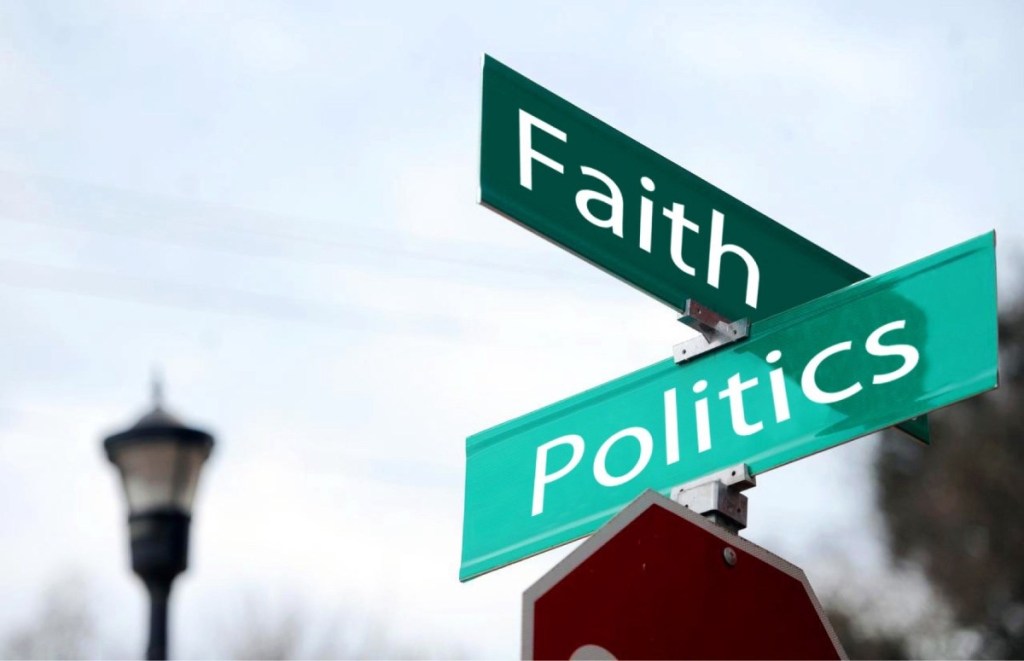
Over the next seven weeks we are going to explore Politics in the Kingdom of God, which is a clear violation of the old adage about the two things you must never discuss in polite company — religion and politics. And some might consider it an intersection, or collision, of two sphere that should remain separate: church and state, faith and politics. But, that won’t do. Christianity is by nature political because it is about the creation of a polis — a place, a city, a kingdom and the people who dwell in it — both of whom, place and people, embody the just and righteous rule of God. That’s not really controversial among Christians, is it? We pray for it each day in the Lord’s Prayer. And yet, discussions about politics and the Kingdom of God are fraught with tension, and often produce more heat than light. Why is that?
• Why is it so difficult to talk with one another – peaceably – about political issues, which are often really moral/ethical issues lived out in the public sphere? Why is it so difficult to bring together the Kingdom of God and the politics of man, not least to do so in the church?
• Why is it so difficult to find and agree on what the Kingdom of God looks like in the very practical matters of the political and social landscape?
Political issues are at their heart moral and ethical issues. For example, a Christian cannot deal with immigration — a hot topic political issue — without facing Jesus’ summary of the Law, the command to love our neighbors as ourselves, and the Parable of the Good Samaritan which tells us who our neighbor is. We cannot address war in Ukraine and Gaza — or anywhere — without first bending the knee to Jesus the Prince of Peace. We cannot address the politics of climate change without engaging creational theology. We cannot rightly vote so long as the blood of partisanship is thicker than the water of baptism. So, we have to deal with moral/ethical issues — faith issues — as we approach politics. That means we must and will consider:
• the sources of Christian moral/ethical authority (where we look for answers)
• the methods of appealing to those authorities (how we rightly understand them)
• the application of the Church’s understanding of the sources of authority to the pressing, practical affairs of life in the public sector
You may hear things that challenge you, that make you uncomfortable – things you may initially (and even finally) disagree with. We will not always agree on these complex issues. That is not what we should expect or hope for from this class. Here are the real goals:
• to promote the ability to discuss complex moral and political issues in the Christian community — in this parish — without rancor or division
• to encourage commitment to the Christian moral worldview
• to provide tools and resources for thinking through these moral and political issues Christianly
If we can do this, that is a significant accomplishment.
Just a note about format. I have quite a bit of information to present, but I also want to foster focused discussion. But, frankly, in this arena, it is very easy for discussion to veer off on all sorts of interesting but unfocused tangents. So, please don’t be offended if, in our discussions, I pull us back to the main topic. Please join in; part of our purpose is to learn to talk with one another as brothers and sisters in Christ when we disagree. But, respecting the limits of time, we will need to remain focused on the matter at hand.
The Nature of the Problem
If you live in Maryville, the chances are good that you are white, Republican, Protestant, educated, employed, and active in (addicted to) sports – particularly to Maryville High School football. Each Friday night home game, the football stadium – complete with blinding lights, artificial turf, and a jumbotron – is packed to overflowing and the surrounding streets are clogged with parked cars. It’s a fun place to be, but an intense place; people take their football very seriously – particularly the rivalry between Maryville and Alcoa. Both schools have outstanding programs, players, coaches, and records. Both communities come out in force for this rivalry game.
A few years ago, while I was still teaching at Maryville High School, ESPN offered to highlight this rivalry by broadcasting the game between Maryville and Alcoa: a big deal for both cities and schools. There was only one catch; ESPN wanted the game played and broadcast live on Sunday morning during prime time church hours. Now, the community found two of its deeply held values – faith and football – in tension, in conflict with one another. There was much public deliberation and hand-wringing as the administrators, coaches, pastors, and parents appeared to wrestle with this dilemma. For those of us who had been at Maryville for any length of time at all, this was good theater but nothing more; the outcome was a foregone conclusion: nothing trumps Maryville High School football. And, indeed, the decision was finally made to play and broadcast the game on Sunday. But what to do about the conflict with church attendance, with the exercise of faith? Many of the area churches held one-off Saturday evening services by way of compromise. Or was it by way of capitulation and accommodation to the sports culture? It depends on your viewpoint.
Suppose you had been the parent of a player or the pastor of a church or the administrator of a school? What would you have decided? As a parent, would you have let your child play? As a pastor, would you have accommodated the decision by holding a special, one-off Saturday evening service? As a member of the community, would you have attended the game and supported the schools’ decision or would you gone to church as usual? Upon what would you have based your decisions? There was a clash of values happening there on many levels, and playing out on a very public stage. It is not a stretch to see that as a moral/ethical issue because it deals with deeply held values. To the school board members it was also certainly a political matter. It may seem like a minor issue, but I still wonder if it really was minor.
The determination of whether this actually is a moral issue and, if so, whether it is trivial and easily decided or more complex and fraught, is itself part of the moral discussion and context. Determining whether an issue contains a moral element itself depends upon a certain understanding of morals and a framework for making moral decisions. How do we know? How do we decide? What informs us?
In the run-up to the 2016 presidential election — the contest between Hillary Clinton and Donald Trump — I was – here I struggle for the right word: Concerned? Worried? Terrified? – that some of you might come to me as a new priest to ask for pastoral guidance in making the complex political and moral decision of which candidate to support. Both candidates had some good ideas and both had some very bad ones. Both candidates were deeply flawed and morally compromised. Neither candidate was running on the Kingdom of God platform. So I prayed and I thought and I read and I worried.
You can imagine my relief in the aftermath of the election; no one – not one single person – asked for my pastoral guidance in my vocation as priest. The same held true for the 2020 election. Some of my friends and family wanted to know what I thought, but only as a citizen. No one seemed to care what I thought as a priest and as a student of Scripture. Yes, I was greatly relieved by that…but only for a brief time. Then the questions started:
Why did no one seek pastoral counsel from me on this issue?
Was it just me (my personal insecurity showing) or were all priests deemed irrelevant in this matter (my vocational insecurity showing)?
Had the Church really nothing of value to say on that matter, or was it simply that we have actually accepted as appropriate the strange notion of the separation of church and state?
Has the Church given the impression – unintentionally or otherwise – that some issues are simply off the table for discussion, somehow inappropriate, perhaps too divisive?
If people are not making moral — and, yes, political — decisions in the context of the church and the people of God, with the pastoral guidance of the church, how are people making such decisions? Around that time, a dear friend sent me a G. K. Chesterton quote:
I do not need the church to tell me I am wrong when I know I am wrong. I need a church to tell me I am wrong when I think I am right.
If not the church, then who? If not in the community of God’s people, then where?
If the Church is relevant and has truth to speak to moral issues, then how do we bring moral decision-making back into the context of the Christian community – where it belongs – and equip people to think Christianly and ethically?
The Maryville-Alcoa game was (perhaps) a trivial example of moral questions; the presidential election was more substantive. There are many other issues that are generally – though not universally – recognized as moral/ethical matters, and political issues, as well – weighty matters: abortion; homosexuality, transsexuality and gender identity, wokeness in all its manifestations; same-sex marriage; racism and sexism; capital punishment; euthanasia and end of life issues; redemptive violence (just war, self-defense, armed protection of others); immigration; social welfare, and now artificial intelligence. The list goes on. My conviction is that God cares deeply about these matters, that they are Kingdom of God matters, and that he has equipped his Church to deal with them effectively. And, it is not my conviction only; it is the conviction of Scripture and the Tradition of the Church. My further conviction is that we have an enemy who is the father of lies and deception and discord, and that he will use these same issues to confuse and neutralize the witness of the church and to divide and conquer the church, if possible.
To avoid such confusion and devision, it is good to focus first not on what divides us, but on what unites us, with a re-commitment to those unitive essentials. The collect that I began with reminds us that we share in common one Body, one Spirit, one hope of our calling, one Lord, one Faith, one Baptism, one God and Father of us all. Just a walk through the bulletin highlights these essentials for us each week.
• The Acclamation
• The Prayer of Preparation: The heart is but a small vessel, yet there are lions; there are poisonous beasts and all the treasures of evil. And there are rough uneven roads; there are precipices. But there also is God, also the angels, the life and the kingdom, the light and the Apostles, the treasures of grace — there all all things (St. Macarius the Great, Fifty Spiritual Homilies).
• The Summary of the Law: The Great Commandment
• Scripture
• The Creed
• The Confession
• The Eucharist
• Post Communion Prayer: Mission
Paul writes this to the Church at Ephesus:
I therefore a prisoner for the Lord, urge you to walk in a manner worthy of the calling to which you have been called, with all humility and gentleness, with patience, bearing with one another in love, eager to maintain the unity of the Spirit in the bond of peace. There is one body and one Spirit – just as you were called to the one hope that belongs to your call – one Lord, one faith, one baptism, one God and Father of all, who is over all and through all and in all (Eph 4:1-6, ESV throughout).
This is what unites us. With all of this to unite us, why are we still so often divided by moral/ethical issues, by political/social issues?
Perhaps more than any other New Testament writer, Paul was concerned with unity in the Church. He writes this in Romans:
I appeal to you therefore, brothers, by the mercies of God, to present your bodies as a living sacrifice, holy and acceptable to God which is your spiritual worship. Do not be conformed to this world, but be transformed by the renewal of your mind, that by testing you may discern what is the will of God, what is good and acceptable and perfect (Rom 12:1-2).
The essence of error, the essence of discord is this: we have been conformed to this world and we need to be transformed by the renewing of our minds.
Let’s begin with this: we are – all of us – children of the Fall. With a gracious nod toward our very Reformed brothers and sisters, that means that we are all subject to total depravity: not that we are as bad as we can possibly be – completely evil – but rather that we have been adversely affected by the fall in every part of our being – body, soul, and spirit. Our bodies are clearly subject to aging, sickness, and death. But, perhaps even more relevant, our bodily needs have become disordered bodily demands/passions. We need to eat, but we don’t need a continual feast while much of the rest of the world goes hungry. We need clothing, but, really, $1000 jeans? Our species needs sex to procreate, but not lust and perversity. Our souls – our will, our conscience, our emotions, our thinking – have become disordered. We listen to our “gut” – we act without thought – when we should listen to our renewed mind. Even if we engaged our minds our thinking has been so conditioned by the fallen world and its cultures that it no longer reasons as God reasons. The Second Song of Isaiah (Is 55:6-11) expresses this dark truth poetically. [Read Quaerite Dominum, BCP 2019 , p. 82.]
Our consciences have been de-calibrated, misdirected so that they no longer point toward true moral north. Our wills are weak. Our spirits, that part of man that can know God directly and can be in-dwelt by the Holy Spirit are dead, unless they have been born again in baptism. Man – apart from God – is totally depraved. And the corporate and individual effects of the Fall linger after baptism. The process of renewal into the true image-bearers of God is long and difficult. This class is one more step in that direction.
Not only are we children of the Fall, we are also the products of cultural and personal stories that stand as rivals to the Gospel. We are all formed by the stories we hear, by the stories we inhabit; they shape us in thought, word, and deed in ways large and small, in ways we don’t even notice, just as we never notice the air we walk through and breathe. Sometimes air becomes polluted and even toxic; sometimes our stories do too. This class will invite (challenge) you to examine your stories, to see how they have formed you, and in many cases deformed you. And it will challenge you to listen closely – with a view toward ethics and politics – to the Christian story, which is, in very many cases, quite different from our personal stories and from the prevailing cultural stories. Start with the most salient points of your identity, because each of those carries with it a story that has formed you. I’ll use myself as an example; you may well identify with several of my stories; some of yours may well be different. Consider how these might shape my moral understanding/leanings.
• White (I experienced the great civil rights movements of the 1960s and the transition from segregated to integrated schools.)
• Western
• 20th Century: Enlightenment, Modernism, Post-Modernism
• Affluent by global standards and middle-class by American standards
• Educated
• American
• Southern Appalachian
• Knoxvillian
• Product of a two-parent, working class family (nominally Democratic, definitely union)
• Husband and father
• Retired engineer and teacher
• Anglican Priest
We could go on, but perhaps the point is clear. I have been shaped by all these factors/stories in ways that are not always obvious to me, and certainly not obvious without reflection. And they have shaped my moral and political worldviews in ways that do not always align with the Christian moral and political worldview. The trouble is, I make moral/ethical judgments reflexively/automatically, based, without much thought, upon the stories that have formed me. My judgments feel right, because they accord with the stories that have formed me. Challenge my stories and you challenge me, my identity, and I get defensive. This is why we have conflicts and divisions over moral/ethical/political matters. But this is just what the Gospel does; it challenges me and my stories, you and your stories. It demands and creates a new identity by incorporating us into a different, larger, true story. That is key: we must not let any of these other stories take priority over the Gospel story. We cannot let the blood of ethnicity or party or family or cause or anything else run deeper than the water of baptism. And that transition between stories, that absolute commitment to the Gospel and our baptismal identity isn’t easy. It will be accomplished bit-by-bit through the transformative power of the Holy Spirit. Remember what St. Paul wrote:
I appeal to you therefore, brothers, by the mercies of God, to present your bodies as a living sacrifice, holy and acceptable to God which is your spiritual worship. Do not be conformed to this world, but be transformed by the renewal of your mind, that by testing you may discern what is the will of God, what is good and acceptable and perfect (Rom 12:1-2).
Our minds must be renewed, and we must learn to test and to discern what is the true will of God, what is good and acceptable and perfect. That is the challenge ahead of us. And, it is not an easy challenge; it is a battle. In 2 Corinthians Paul writes:
For though we walk in the flesh, we are not waging war according to the flesh. For the weapons of our warfare are not of the flesh but have divine power to destroy strongholds. We destroy arguments and every lofty opinion raised against the knowledge of God and take every thought captive to obey Christ (2 Cor 10:3-5).
Did you get that last part? “We destroy arguments and every lofty opinion raised against the knowledge of God and take every thought captive to obey Christ.” Usually the arguments that must be destroyed and the lofty opinions raised against the knowledge of God are our own – the results of our fallen nature and our rival stories. The thoughts that must be taken captive to obey Christ are our own. Next week we will begin to look at how to do just that, how we take these thoughts captive.


 First Blessings