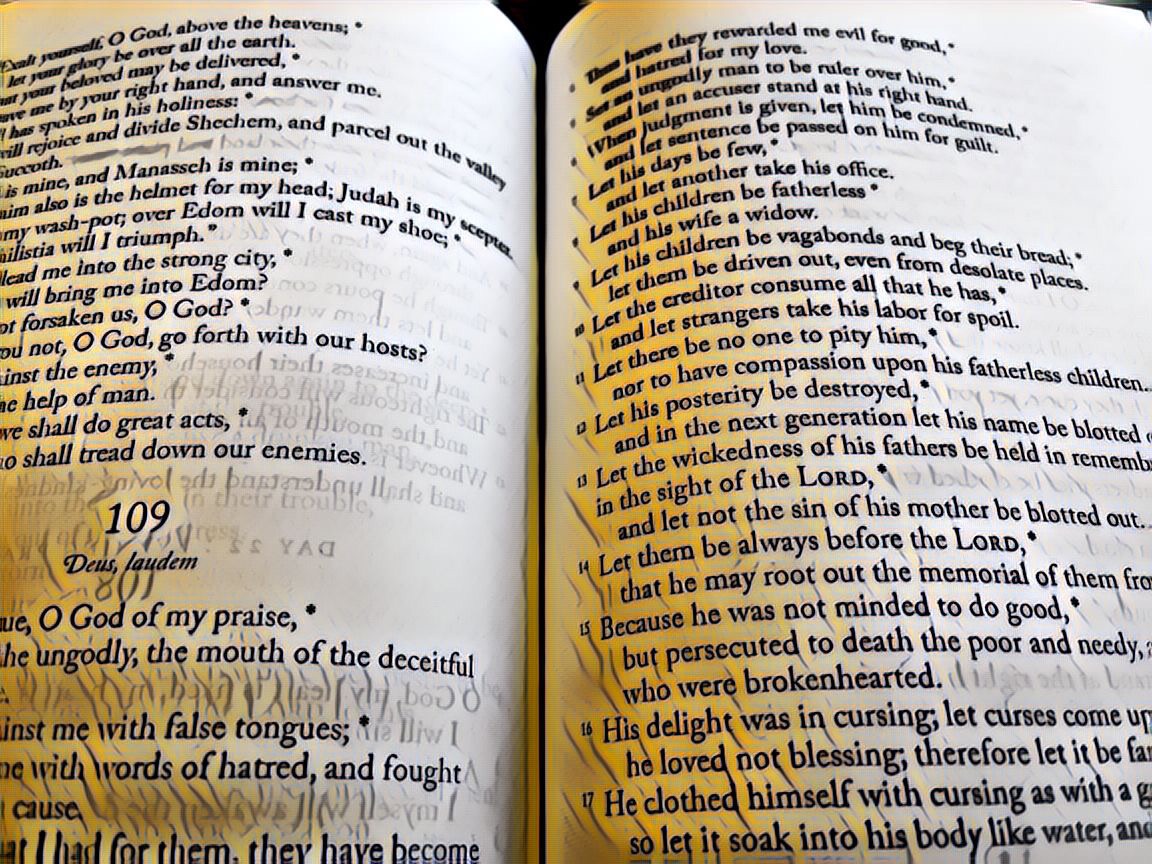
The Daily Office Lectionary appointed Psalm 109 for Evening Prayer recently, but I found that I could not, in good faith, pray it. It is a classic example of the imprecatory Psalms, those that curse one’s enemies, that invoke God to bring evil on another. Though there is much more, these verses give a good sense of the whole:
Psalm 109:6–15 (ESV): 6 Appoint a wicked man against him;
let an accuser stand at his right hand.
7 When he is tried, let him come forth guilty;
let his prayer be counted as sin!
8 May his days be few;
may another take his office!
9 May his children be fatherless
and his wife a widow!
10 May his children wander about and beg,
seeking food far from the ruins they inhabit!
11 May the creditor seize all that he has;
may strangers plunder the fruits of his toil!
12 Let there be none to extend kindness to him,
nor any to pity his fatherless children!
13 May his posterity be cut off;
may his name be blotted out in the second generation!
14 May the iniquity of his fathers be remembered before the Lord,
and let not the sin of his mother be blotted out!
15 Let them be before the Lord continually,
that he may cut off the memory of them from the earth!
How is it possible for one to pray this Psalm and the Lord’s Prayer — “…as we forgive those who trespass against us” — in very nearly the same breath? How can a follower of Jesus — who died to forgive his enemies — beseech the Lord to curse one’s own enemies?
Yes, there are metaphorical readings of such Psalms that make them more palatable, e.g., one’s enemies as one’s besetting temptations and sins. This is fine as far as it goes, and it has the weight of the Tradition behind it. But, this doesn’t seem to be the clear, grammatical meaning of the text, if that matters. No, this is a vindictive cry for punishment of very real, very human enemies. And, I simply cannot pray that against those who are possessed of a spirit of enmity against me.
But, perhaps they can pray it against me. Perhaps, either by what I have done or by what I have left undone, I have so embittered someone that he/she can pray and is praying this Psalm against me. Perhaps through my own sin I have driven someone to these depths of hatred toward me. If so, I have placed the soul of another in grave danger. Then, by placing these words in my mouth — by forcing me to speak them — the Lord is calling me to repentance and to prayer for the ones against whom I have offended. The evil invoked in the Psalm is the evil due not to the other, but to me. The vindication promised in the Psalm is promised not to me, but to the other.
This perspective made it possible — even necessary — for me to pray this Psalm.
Lord, have mercy on me, a sinner.


 First Blessings