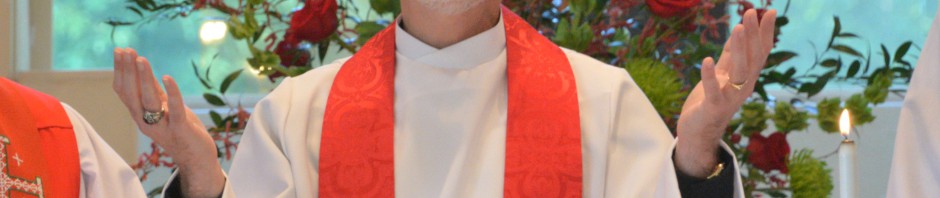

It is natural, I suppose, to grow reflective about the priesthood as one’s ordination anniversary approaches. To guide my meditations this year, I have chosen to re-read The Rule of Benedict and specifically the commentary on it by Sr. Joan Chittister. It is organized for daily reading, three times through in a given year. When I say I chose it, that is not quite right. I found recently that I needed to refer to a section in the Rule to guide me in a pastoral matter, and, having found the appropriate section, the thought occurred to me rather spontaneously that it might be good to read through the entire Rule just now. The Rule chose me in this instance; that is the limit of my Calvinism. Sometimes things choose us, or rather sometimes we simply become aware that God has chosen some thing for us.
I find the reading for this day speaks beautifully of the priesthood. Why am I a priest? For my salvation. Why am I a priest? I was the tenth sheep; read on and you will understand. What follows is from Sr. Joan.
Jan. 14 — May 15 — Sept. 14
The prioress and abbot must always remember what they are and remember what they are called, aware that more will be expected of one to whom more has been entrusted. They must know what a difficult and demanding burden they have undertaken: directing souls and serving a variety of temperaments, coaxing, reproving, and encouraging them as appropriate. They must so accommodate and adapt themselves to each one’s character and intelligence that they will not only keep the flock entrusted to their care from dwindling, but will rejoice in the increase of a good flock.
There are some interesting distinctions made in this paragraph. The abbot and prioress are to remember what they are and what they are called. What they and every other leader are is painfully clear: they are people just like everybody else in the monastery. They are not royalty. They are not potentates. They are only people who also struggle and fail just like the people they lead.
But what they are and what they are called — abbot, abbess, spiritual father, spiritual mother — are not unrelated. They are not called to be either lawgivers or camp counselors. They are not expected to be either rigid moralists or group activity directors. They are to be directors of souls who serve the group by “coaxing, reproving, and encouraging” it — by prodding and pressing and persuading it — to struggle as they have struggled to grow in depth, in sincerity, and in holiness, to grow despite weaknesses, to grow beyond weaknesses.
Abbots or prioresses of Benedictine monasteries, then, parents and supervisors and officials and bishops everywhere who set out to live a Benedictine spirituality, are to keep clearly in mind their own weak souls and dark minds and fragile hearts when they touch the souls and minds and hearts of others.
But there is another side to the question as well. It is not easy for honest people who hold their own failures in their praying hands to question behavior in anyone else. “There but for the grace of God go I,” John Bradford said at the sight of the condemned on their way to execution. Aware of what I myself am capable of doing, how can I possibly censure or disparage or reprimand or reproach anyone else? On the other hand, Benedict reminds us, how can those who know that conversion is possible, who have been called to midwife the spiritual life, for this generation and the next, do less?
The Hasidim tell a story that abbots and prioresses, mothers and fathers, teachers and directors may understand best. Certainly Benedict did:
When in his sixtieth year after the death of the Kotzker, the Gerer accepted election as leader of the Kotzker Hasidim, the rabbi said: “I should ask myself: ‘Why have I deserved to become the leader of thousands of good people?’ I know that I am not more learned or more pious than others. The only reason why I accept the appointment is because so many good and true people have proclaimed me to be their leader. We find that a cattle-breeder in Palestine during the days when the Temple stood was enjoined by our Torah (Lev. 27:32) to drive newborn cattle or sheep into an enclosure single file. When they went to the enclosure, they were all of the same station, but when over the tenth one the owner pronounced the words: ‘consecrated unto the Lord,’ it was set aside for holier purposes. In the same fashion when the Jews pronounce some to be holier than their fellows, they become in truth consecrated persons.”
Once chosen, it is their weakness itself that becomes the anchor, the insight, the humility, and the gift of an abbot or prioress, a pope or a priest, a parent or a director. But only if they themselves embrace it. It is a lesson for leaders everywhere who either fear to lead because they know their own weaknesses or who lead defensively because they fear that others know their weaknesses. It is a lesson for parents who remember their own troubles as children. It is a lesson for husbands and wives who cannot own the weaknesses that plague their marriage. We must each strive for the ideal and we must encourage others to strive with us, not because we ourselves are not weak but because knowing our own weaknesses and admitting them we can with great confidence teach trust in the God who watches with patience our puny efforts and our foolish failures (Joan Chittister, The Rule of Benedict: Insights for the Ages, Crossroad (1998), pp. 43-45).


 First Blessings