
Apostles Anglican Church
Fr. John A. Roop
William Law, Priest and Teacher of the Faith (1761)
(Philippians 3:7-14, Psalm 1, Matthew 6:1-6, 16-21)
Collect
O God, by whose grace your servant William Law, kindled with the flame of your love, became a burning and shining light in your Church: Grant that we may also be aflame with the spirit of love and discipline, and walk before you as children of light; through Jesus Christ our Lord, who lives and reigns with you, in the unity of the Holy Spirit, one God, now and for ever. Amen.
In the name of the Father, and the Son, and the Holy Spirit. Amen.
Here at Apostles, and really in the Anglican Church as a whole, we most often observe ecumenical feasts and fasts: holy days and holy men and women recognized by the one holy catholic and Apostolic Church, by the whole Church — Orthodox, Roman Catholic, and Anglican together. But, from time to time, we especially acknowledge our own: Anglicans who have exemplified a saintly devotion and service to the Lord and to his Church, who have contributed to the life and growth of the Church in profound ways. The Anglican Church has no mechanism for canonizing saints; but, if we did, these people would be on the list.
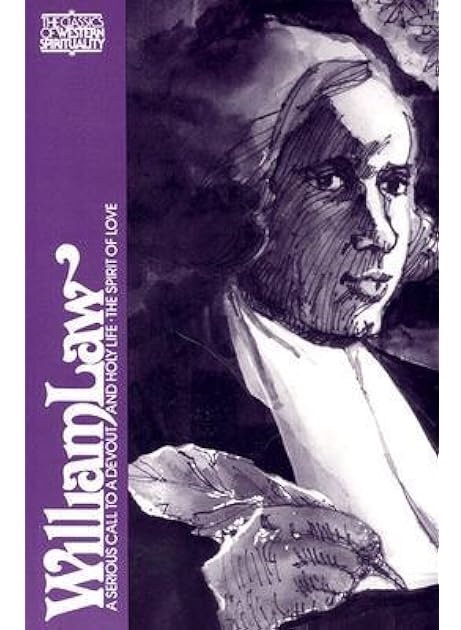
William Law (d. 1761) is a such a man, a good, faithful Church of England priest in the 18th century: a school master, a private tutor, the very image of a devout churchman.
Law noticed, in his time, a great disparity between the public and private devotion most people exhibited — church attendance, regularity of prayer, for example — and their manner of life in the world. The question that vexed him was this: Why does religious devotion seem to make so little difference in the Christian’s way of life? Why are religiously devout Christians, those who regularly attend church and say their prayers, so little different in their everyday pursuits and manners than those who exhibit no such religious devotion? That was an 18th century concern, but it seems to me as pertinent now as then, the primary difference being that in the 21st century, Christians have also begun forsaking even religious devotion in increasing numbers. The nones, those with no religious affiliation, represent the fastest growing “religious” demographic in our country. Even so, along with Law, I am concerned that of those who do profess the faith, who do attend church at least somewhat regularly, look so much like their secular counterparts. When I grow honestly introspective, I grow concerned that the Gospel has not made more impact on my manner of being in the world than it has.
In answer to these questions and concerns, and to propose a remedy for the problem, William Law issued a serious call to a devout and holy life. That was the title of the book he wrote in 1728: A Serious Call to a Devout and Holy Life (hereafter Serious Call). It was an influential work, and his was an influential life. Based on his life, teaching, preaching, and writing it is said by some that:
More than any other man, William Law laid the foundations for the religious revival of the eighteenth century, the Evangelical Movement in England, and the Great Awakening in America (Lesser Feasts and Fasts 2000, Church Publishing Incorporated (2001), p. 218).
Law’s great conviction, which he expresses repeatedly in his book, was this simple truth:
If we are to follow Christ, it must be in our common way of spending every day. If we are to live unto God at any time or in any place, we are to live unto him in all times and in all places. If we are to use anything as the gift of God, we are to use everything as his gift (Serious Call).
The practice of religion, Law knew and we know, is more than outward acts of religious piety like attending church and saying grace before meals. As important as those practices are, they alone do not make a person devout. Law writes this:
He therefore is the devout man who lives no longer to his own will, or the way and spirit of the world, but to the sole will of God, who considers God in everything, who serves God in everything, who makes all the parts of his common life parts of piety by doing everything in the name of God and under such rules as are conformable to His glory.
The short of the matter is this, either reason and religion prescribe rules and ends to all the ordinary actions of our life, or they do not. If they do, then it is as necessary to govern all our actions by those rules as it is necessary to worship God. For if religion teaches us anything concerning eating and drinking or spending our time and money; if it teaches us how we are to use and contemn the world; if it tells us what tempers we are to have in common life, how we are to be disposed toward all people, how we are to behave toward the sick, the poor, the old, and destitute; if it tells us whom we are to treat with a particular love, whom we are to regard with a particular esteem; if it tells us how we are to treat our enemies, and how we are to mortify and deny ourselves, he must be very weak that can think these parts of religion are not to be observed with as much exactness as any doctrines that relate to prayers (ibid).
In writing this, Law does little more than say amen to the Sermon on the Mount in which Jesus says:
Matthew 7:24–27 (ESV): 24 “Everyone then who hears these words of mine and does them will be like a wise man who built his house on the rock. 25 And the rain fell, and the floods came, and the winds blew and beat on that house, but it did not fall, because it had been founded on the rock. 26 And everyone who hears these words of mine and does not do them will be like a foolish man who built his house on the sand. 27 And the rain fell, and the floods came, and the winds blew and beat against that house, and it fell, and great was the fall of it.”
Everyone who hears these words of mine and does them, Jesus says. And the words he spoke were practical words covering the ordinary affairs of human life, not just that part of life we call “religious.” It was really Jesus who issued a serious call to a devout and holy life. Listen again, now, to William Law:
If contempt of the world and heavenly affection is a necessary temper of Christians, it is necessary that this temper appear in the whole course of their lives, in their manner of using the world, because it can have no place anywhere else.
If self-denial be a condition of salvation, all that would be saved must make it a part of their ordinary life. If humility be a Christian duty, then the common life of a Christian is to be a constant course of humility in all its kinds. If poverty of spirit be necessary, it must be the spirit and temper of every day of our lives. If we are to relieve the naked, the sick, and the prisoner, it must be the common charity of our lives, as far as we can render ourselves able to perform it. If we are to love our enemies, we must make our common life a visible exercise and demonstration of that love. If content and thankfulness, if the patient bearing of evil be duties to God, they are the duties of every day and in every circumstance of our life. If we are to be wise and holy as the newborn sons of God, we can no otherwise be so but by renouncing everything that is foolish and vain in every part of our common life. If we are to be in Christ new creatures, we must show that we are so by having new ways of living in the world. If we are to follow Christ, it must be in our common way of spending every day.
Thus it is in all the virtues and holy tempers of Christianity; they are not ours unless they be the virtues and tempers of our ordinary life…. If our common life is not a common course of humility, self-denial, renunciation of the world, poverty of spirit, and heavenly affection, we don’t live the lives of Christians (ibid).
So, having established that our devotion is not restricted to worship only but to all the affairs of daily life, Law then explores why most lives are not lived in keeping with the Gospel. Before we hear from Law on this, let me set the stage with an analogy.
I have made — who knows how many — New Year’s resolutions in my life. I can say with a fair degree of confidence that the percentage of those resolutions I’ve kept is fairly close to zero. Does that “ring true” to your experience? Why is that so? Well, the making of New Year’s resolutions is holiday tradition that no one takes very seriously; we all make them and we all joke about not keeping them, and often in the same breath. And really, the kinds of resolutions we make are more like common wishes that real resolutions, more on the order of “Wouldn’t it be nice if…” than “I am committed to …”. I’d like to lose twenty pounds this year. Well, who wouldn’t? I’d like to eat healthier and get in better shape. Check and check. I think it would be helpful to learn a second language. Probably so. But, what is lacking here in all these is an sense of real commitment, any resolution of the will, any plan for making these things happen. In other words, any real intent to amend one’s life. And that’s merely humorous when it comes to New Year’s resolutions, but not so humorous when it comes to living out the Gospel.
It was … intention that made the primitive Christians such eminent instances of piety, that made the goodly fellowship of the Saints and all the glorious army of martyrs and confessors. And if you will here stop and ask yourself why you are not as pious as the primitive Christians were, your own heart will tell you that it is neither through ignorance nor inability, but purely because you never thoroughly intended it. You observe the same Sunday worship that they did; and you are strict in it because it is your full intention to be so. And when you as fully intend to be like them in their ordinary common life, when you intend to please God in all your actions, you will find it as possible as to be strictly exact in the service of the church. And when you have this intention to please God in all your actions as the happiest and best thing in the world, you will find in you as great an aversion to everything that is vain and impertinent in common life, whether of business or pleasure, as you now have to anything that is profane. You will be as fearful of living in any foolish way, either of spending your time or your fortune, as you are now fearful of neglecting the public worship.
Now who that wants this general sincere intention can be reckoned a Christian? And yet if it was amongst Christians, it would change the whole face of the world; true piety and exemplary holiness would be as common and visible as buying and selling or any trade in life (ibid, emphasis added).
This is a serious call to a devout and holy life! It is not that we do not know what we should do. It is not that we are unable to do it. It is simply that we do not seriously intend to do it. G. K. Chesterton said something similar in his essay What’s Wrong with the World. He wrote:
The Christian ideal has not been tried and found wanting. It has been found difficult; and left untried.
Putting the two notions together — Law and Chesterton — we might say that because the Christian ideal is difficult, few fully intend to keep it, and, so, few keep it fully.
Law gives several examples of how this plays out in ordinary lives. This one is typical:
Again, let a tradesman but have this intention and it will make him a saint in his shop; his everyday business will be a course of wise and reasonable actions made holy to God by being done in obedience to His will and pleasure. He will buy and sell and labor and travel, because by so doing he can do some good to himself and others. But then, as nothing can please God but what is wise and reasonable and holy, so he will neither buy, nor sell, nor labor in any other manner, nor to any other end, but such as may be shown to be wise and reasonable and holy. He will therefore consider not what arts, or methods, or application will soonest make him richer and greater than his brethren, or remove him from a shop to a life of state and pleasure; but he will consider what arts, what methods, what application can make worldly business most acceptable to God and make a life of trade a life of holiness, devotion, and piety. This will be the temper and spirit of every tradesman; he cannot stop short of these degrees of piety whenever it is his intention to please God in all his actions, as the best and happiest thing in the world (ibid).
This gives the tenor of Law’s thought, of his serious call to a devout and holy life. I’ll close by emphasizing two ideas from this last quote. The first is this description of a tradesman who fully intends to lead a life pleasing to God: “It will make him a saint in his shop.” And that is the goal, isn’t it: to use whatever situation God has placed one in as the means by which to become a saint. The French novelist Leon Bloy reminds us in his novel The Woman Who Was Poor that:
The only real sadness,
the only real failure,
the only great tragedy in life,
is not to become a saint.
The second, and most fundamental of Law’s notions is this: holiness comes only to those whose intention it is to please God in all their actions, as the best and happiest thing in the world. There is no “accidental” holiness, only intentional. And that is a serious call to a devout and holy life. Amen.


 First Blessings