AUTHORITY, AUTONOMY, ANARCHY
This follows on from an earlier Facebook post, which will provide helpful context for what follows:
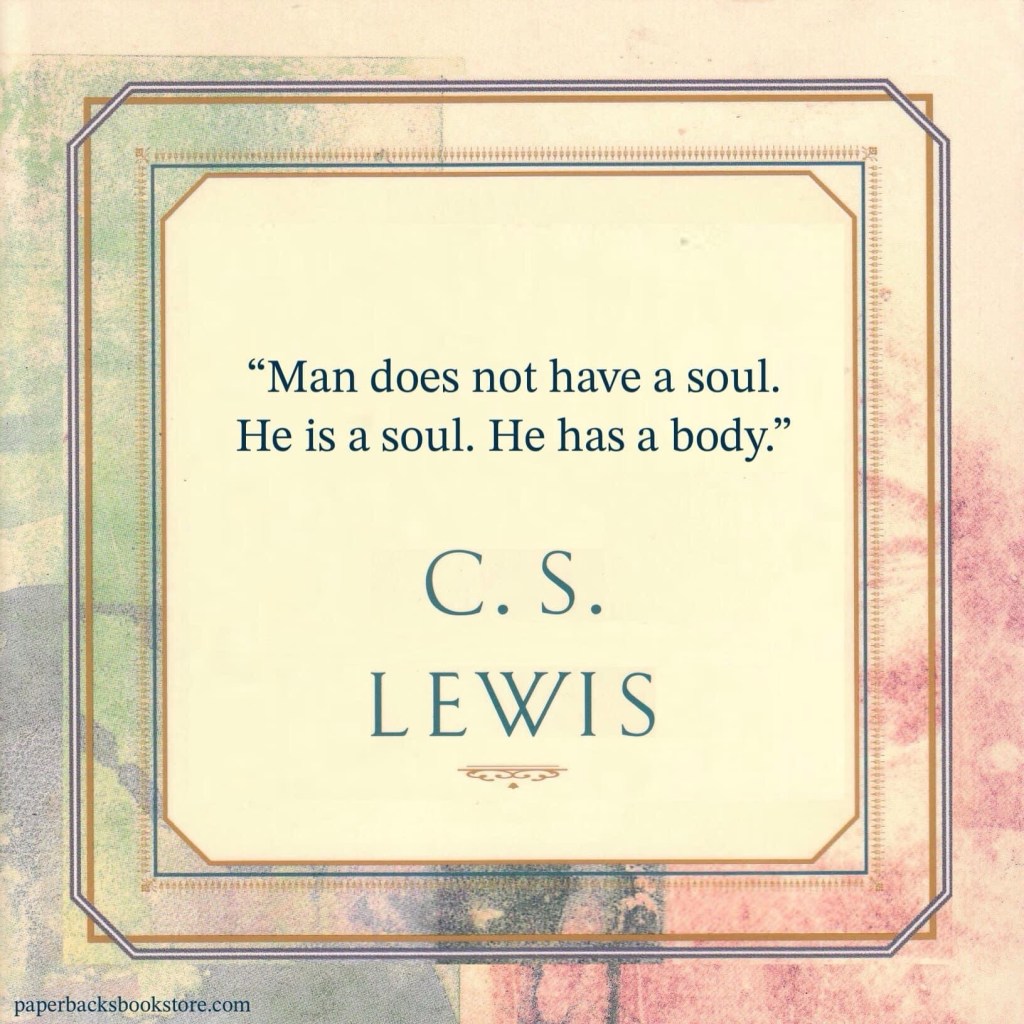
Please look carefully at the meme in the header. The quote purports to be — but is not — from C. S. Lewis. As an aside, be wary of any meme quoting a noted Christian author, perhaps especially Lewis — that does not include a detailed source reference. Treat it as you would an unsolicited email with spelling and grammar errors and a link that you must click immediately.
Now, back to the quote. I ask this of Christians: how does it strike you? It is, at best, sub-Christian anthropology and, at worst, gnostic. One would need more context to be certain. But, presented on its own, it is insufficiently orthodox to be embraced wholesale or even “liked” by Christians on Facebook. And yet many who self-identify as Christians did exactly that — liked it — probably in no small part because of the (false) attribution naming C. S. Lewis.
Rather foolishly, I weighed in on the quote, identifying a few of its deficiencies. This led to some interesting — and for the most part, congenial — discussions. Though I won’t try to reconstruct the meandering trail that led to this topic, one discussion made its way to the pre-existence of souls, the notion that all souls are pre-existent in the spiritual realm and are assigned to a body at conception or at some point before birth. I noted in a comment that this false doctrine was explicitly declared heretical at the Second Council of Constantinople (AD 553) and that the earlier condemnation of one of its teachers, Origen, was confirmed there. And what was the response of my interlocutor when informed that the doctrine of the pre-existence of souls had been formally declared a heresy by the fifth ecumenical council of the Church?
“I do believe in the pre-existence of spirit/soul and seeing (sic) no harm in doing so.”
I’ve heard that called “doubling down.” Perhaps she didn’t believe me? It is easy enough to check out my assertion. So, I can only assume that (1) she did believe me and didn’t care what the Church had determined or (2) she was uncertain of my assertion and didn’t care to determine the truth of it. The latter is willful ignorance. The former is, not precisely heresy, but the willing embrace of a heterodox and heretical doctrine.
There is a third option. She believes that she has the authority and the autonomy to decide such matters for herself regardless of what the Church has decreed. In short, she does not accept the authority of the Church speaking with one voice over nearly two millennia. I once read that the humility of orthodoxy is to remain with the Church unless absolutely convinced that the entire church — all its saints and theologians and faithful — have been wrong for two thousand years: a very high bar of certainty. In contrast, the arrogance of heterodoxy is to replace the consensus fidelium of the Church with one’s private opinion. To reject the authority of the Church and to insist upon one’s own autonomy to define the faith is to embrace theological anarchy.
So, as Anglicans, and specifically as Anglicans in the ACNA, what do we consider the rightful and trustworthy sources of authority in the Church? First this: all authority in heaven and on earth belongs to Jesus Christ (rf Mt 28:18). He then exercises that authority through dual agents: Scripture, Bishops, Creeds, and Counsels, all superintended in a manner appropriate to their nature, by the Holy Spirit. (For more on this, see https://firstblessings.blog/2024/01/13/christian-essentials-anglican-distinctives-3/.). These are the authoritative instruments and reliable ways in which truth is prayerfully and prudentially discerned in and by the Church. As orthodox Christians, we do not have the option of saying, “Well, I know what the Church says, but…,” or “I read Scripture in the way,” or “I do believe in the pre-existence of souls and seeing (sic) no harm in doing so.” Regardless of whether you see any harm in doing so, the Church — the whole Church speaking as one — did/does indeed see the harm in doing so, and to keep you safe has declared such doctrine heretical. Your choice is dichotomous: orthodoxy or heterodoxy, autonomy or submission, heresy or faithfulness?


 First Blessings