
Apostles Anglican Church
Fr. John A. Roop
(Genesis 3, Psalm 9, John 2)
…he shall bruise your head, and you shall bruise his heel (Gen 3:15c).
In the Name of the Father, and of the Son, and of the Holy Spirit. Amen.
Even if you were reading the Bible for the very first time with no background knowledge, even if you were reading it not as a religious text but as cultural history/myth, even if you were simply reading it as a fictional saga, you would certainly know trouble was coming by the time you reached the middle of the second chapter of Genesis:
Genesis 2:15–17 (ESV): 15 The Lord God took the man and put him in the garden of Eden to work it and keep it. 16 And the Lord God commanded the man, saying, “You may surely eat of every tree of the garden, 17 but of the tree of the knowledge of good and evil you shall not eat, for in the day that you eat of it you shall surely die.”
Why even mention the tree, why even warn about death — which was as yet unknown — if it weren’t intended to presage something dire? Cue the ominous music.
The very presence of the tree of the knowledge of good and evil in the midst of the garden raises questions, doesn’t it? Why didn’t God “human-proof” Eden the way new parents baby-proof their home by removing all potential hazards and by installing safety gadgets: cabinet locks, oven knob protectors, electric outlet covers. What good parent would put a box of rat poison on the coffee table and warn the toddler not to eat it?
There are a couple of responses to this comparison. First, Adam is young — immature according to the Church Fathers — but he is not a toddler without understanding. He has both the knowledge and will to choose obedience to God’s single restriction. We are — each of us to this day — asked to demonstrate and exercise our faith and our faithfulness through our obedience. This is all that was asked of Adam, and that in a single act, a single law. Second, the tree of the knowledge of good and evil was not poison. According to the Fathers, humans were always intended to have access to that tree and the knowledge it represents, but only in due time when man had matured enough to use the knowledge wisely. Then, and only then, could man have eaten of it safely. And isn’t this paradigmatic of humankind? We seek after knowledge prematurely, before we have the wisdom to use it to our benefit, and death often results. One of last year’s — doesn’t it feel odd to say that? — one of last year’s blockbuster movies gives a modern version of the story: Oppenheimer. Scientists broke the code of atomic fission, and what is the first thing their political and military overlords used the knowledge for? To construct an unprecedented weapon of mass destruction that was unleashed on a civilian target and which killed the majority of Christians in Japan: but of the tree of the knowledge of good and evil you shall not eat, for in the day that you eat of it you shall surely die. It is the human story.
We should also note before moving on that only Adam received the instruction/warning directly from God. As far as we can tell, the woman got it secondhand — hearsay — from Adam. There was even some loss — or, in this case, gain — in the transmission.
And now, with that, we are ready for today’s text, Genesis 3. It begins with a creature we have not met before.
Genesis 3:1 (ESV): 3 Now the serpent was more crafty than any other beast of the field that the Lord God had made.
He said to the woman, “Did God actually say, ‘You shall not eat of any tree in the garden’?”
A sly, talking snake: what are we to make of that? Well, if this our first time through the story, we will likely be at a loss. We need more of the story, details that only come later, and we need to be able to hear those details with ears attuned to Ancient Near Eastern cultures. We need the prophets, particularly Isaiah and Ezekiel, and we need to hear these prophets on their own terms.
Isaiah tells of a rebellion in heaven, of a pretender to God’s throne:
Isaiah 14:12–15 (ESV): 12 “How you are fallen from heaven,
O Day Star, son of Dawn!
How you are cut down to the ground,
you who laid the nations low!
13 You said in your heart,
‘I will ascend to heaven;
above the stars of God
I will set my throne on high;
I will sit on the mount of assembly
in the far reaches of the north;
14 I will ascend above the heights of the clouds;
I will make myself like the Most High.’
15 But you are brought down to Sheol,
to the far reaches of the pit.
And Ezekiel connections this rebellion to Eden:
Ezekiel 28:12b–17a (ESV): “You were the signet of perfection,
full of wisdom and perfect in beauty.
13 You were in Eden, the garden of God;
every precious stone was your covering,
sardius, topaz, and diamond,
beryl, onyx, and jasper,
sapphire, emerald, and carbuncle;
and crafted in gold were your settings
and your engravings.
On the day that you were created
they were prepared.
14 You were an anointed guardian cherub.
I placed you; you were on the holy mountain of God;
in the midst of the stones of fire you walked.
15 You were blameless in your ways
from the day you were created,
till unrighteousness was found in you.
16 In the abundance of your trade
you were filled with violence in your midst, and you sinned;
so I cast you as a profane thing from the mountain of God,
and I destroyed you, O guardian cherub,
from the midst of the stones of fire.
17 Your heart was proud because of your beauty;
you corrupted your wisdom for the sake of your splendor.
I cast you to the ground.
Why is there a sly, talking snake in Eden? Well — don’t be scandalized by this — there isn’t, at least not as we typically think of snakes. This is an angel, a throne guardian angel, a cherub who had rebelled against God, who had sought to usurp God’s authority, who had sought to elevate himself, a mere creature — though a highly exalted one — above the Creator. Once he was in Eden in beauty, on the Holy Mountain of God. Eden was a garden on a mountain. It was the throne room of God and this cherub guarded it. But he was cast out for his sin, cast into the earthly Eden, where he sought to strike back at God in the only way he knew — by enlisting God’s human creatures in his rebellion.
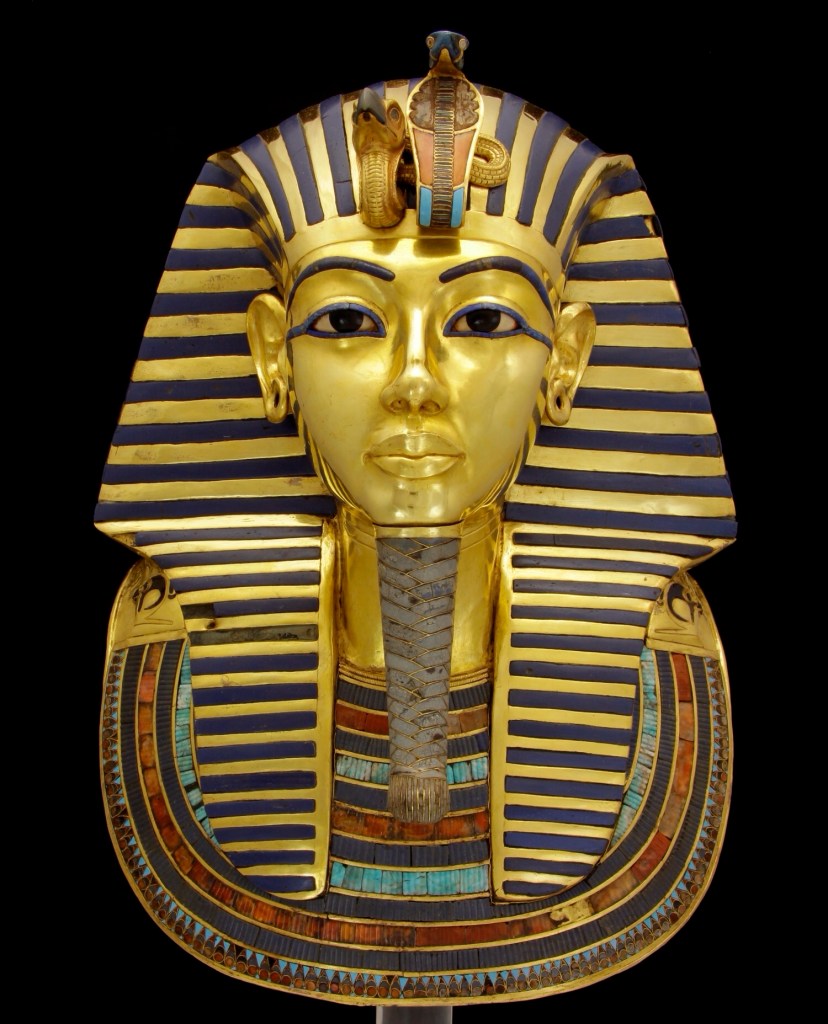
So, why the form of a snake? Because that is how throne guardian angels were depicted in Ancient Near Eastern literature and art. No one in the culture from which this tale originated would have imagined this to be merely a rat snake or even a viper. No, this is an angelic being, a divine being. Perhaps the best visual image I can offer of this is the funerary mask of King Tutankhamen — the most ornate, golden one. On the crown on his forehead there is depicted a cobra with its hood spread, a sign of divine protection of the king — a throne guardian. That’s the ancient understanding. No one would have mistaken this snake in Eden for an ordinary snake in the grass. This was a angel, and a fallen one at that.
And he continues his assault upon God, this time through subtlety and misdirection. He attacks God’s “flank,” by using God’s creatures — our first parents — against God.
Genesis 3:1a–6 (ESV): He said to the woman, “Did God actually say, ‘You shall not eat of any tree in the garden’?” 2 And the woman said to the serpent, “We may eat of the fruit of the trees in the garden, 3 but God said, ‘You shall not eat of the fruit of the tree that is in the midst of the garden, neither shall you touch it, lest you die.’ ” 4 But the serpent said to the woman, “You will not surely die. 5 For God knows that when you eat of it your eyes will be opened, and you will be like God, knowing good and evil.” 6 So when the woman saw that the tree was good for food, and that it was a delight to the eyes, and that the tree was to be desired to make one wise, she took of its fruit and ate, and she also gave some to her husband who was with her, and he ate.
There is so much of importance to explore here, but so little time. First, note that the temptation to disobey God was not internal to the woman, but external. The thought did not originate with her; rather, she was assaulted with this thought by the serpent. We sometimes kid ourselves that we generate our thoughts, that our mind is a “thinking machine,” and that we are in control of it. Whether that is true at all, I will leave to others. But this text, and our experience, shows us that our minds are also receptive organs, just as our eyes. Our eyes don’t generate the sights they see; they receive light from external sources. The same is true with our ears…and with our minds. We receive thoughts from external sources. And not all those sources are good. You see the thoughts that the serpent is planting in the woman’s mind and heart: God is a liar. God is not to be trusted. God is selfish and wants to keep you “down” as a mere creature when you can be so much more, when you can be like God himself.
Isn’t that your experience, too? It certainly is mine. Thoughts, temptations, horrible things arise and you are dismayed that such darkness resides in you. Well, take courage; it doesn’t. You are being assaulted; you are under attack as the woman was under attack in Eden, as Jesus was under attack during his temptation in the wilderness and later in Gethsemane. Temptations — thoughts — will surely come. The issue is what we do with them.
The Desert Fathers, who were experts in the wiles of this ancient serpent and his use of thoughts against us, tell us simply to ignore such thoughts — just ignore them: pray, sing a Psalm, refocus yourself in worship or busy yourself with productive work. Do anything except engage with the thought. Down the path of engagement, of pondering and mulling over the thought, lies a fall. And that engagement, to mankind’s great harm, is exactly what the woman did. She gazed at the tree. She saw that it was good for food, that it was a delight to the eye, and she desired by it to be made wise: all acts of engagement with the temptation. And she ate. Moreover, she gave some to her husband — she became a temptress herself, she enlisted with the serpent in his rebellion — and he ate.
This is neither the place nor the time to apportion blame; the enemy deceived Eve and used her to spread the rebellion to Adam, and the consequences of that rebellion spread to all sons and daughters of these fallen parents. But, before the text gets to that, there is this word of God’s judgment to the serpent:
Genesis 3b:14–15 (ESV): “Because you have done this,
cursed are you above all livestock
and above all beasts of the field;
on your belly you shall go,
and dust you shall eat
all the days of your life.
15 I will put enmity between you and the woman,
and between your offspring and her offspring;
he shall bruise your head,
and you shall bruise his heel.”
Now, again, we need to beware a simplistic and literal reading of this. This is not about how snakes “lost their legs” or the power of speech. This is about the debasement of the throne guardian angel who sought to elevate himself about God. Instead, he finds himself as low as it is possible to go: not standing defiantly, but cowering on the ground, eating dust. We know that snakes don’t eat dust, so what does this mean? The answer lies ahead in the text, when God speaks to Adam:
Genesis 3:19 (ESV): 19 By the sweat of your face
you shall eat bread,
till you return to the ground,
for out of it you were taken;
for you are dust,
and to dust you shall return.”
Man is dust, and at his his death he returns to dust. And it is that — the dust of death and decay — that will be the food of the serpent. He will eat death; he will consume the world in death. He will reign over the dead, but his kingdom will be only dust and ashes.
There are more consequences to Adam and the woman. She will have pain in childbirth, though being fruitful is still her vocation. She will be at odds with her husband and will find herself subservient to him. As for Adam, the food which once came easily and freely as a gift from the earth, will henceforth come only grudgingly with toil and sweat, and, as we’ve noted, he and all those he will come to love, will die.
It all seems pretty harsh, doesn’t it, the punishment disproportionate to the crime: especially a death sentence on every human to be born? And yet the Fathers assure us that this was an act of grace and mercy and not of revenge or punishment. St. Athanasius, in his work On the Incarnation, writes that God gave us mortality, gave us death, to spare us from living eternally in our fallen state — a great mercy. St. John of Damascus, in An Exact Exposition of the Orthodox Faith, asserts that mortality is a requirement for repentance and return to God. He goes so far as to state that lack of mortality is precisely why the angels cannot repent. Death is God’s gift to man to bring us back to him in repentance. Notice in the text that while Adam and the woman were yet immortal — before God’s pronouncement to Adam — they were each given an opportunity to repent, and, instead, each excused himself and blamed another. I find that in my own life, the reality and the growing nearness of death spur me to greater repentance.
Well, all in all, Genesis 3 tells a pretty dismal story but for one glimmer of light, a word of prophesy and doom that God speaks to the serpent about this relationship he has initiated with the woman:
Genesis 3:15 (ESV): 15 I will put enmity between you and the woman,
and between your offspring and her offspring;
he shall bruise your head,
and you shall bruise his heel.”
The Fathers see in this the first hint of the Messiah, the offspring of the woman who will bruise/crush the head of the serpent, who will spell the end of his dominion over the dead. We are familiar with that, aren’t we, because we are still in the great twelve days of celebration of the fulfillment of that prophecy:
Fear not, for behold, I bring you good news of great joy that will be for all the people. For unto you is born this day in the city of David a Savior, who is Christ the Lord (Luke 2:10-11, BCP 2019, p. 27).
The serpent will — as the story moves toward its climax — bruise this Savior’s heel at Calvary. But the Savior will crush the head of the serpent there and will harrow the serpent’s dusty domain and bring all the dead to life. Man who fell in Eden was raised at the cross.
…he shall bruise your head, and you shall bruise his heel (Gen 3:15c).
Amen.


 First Blessings