Apostles Anglican Church
Fr. John A. Roop
Christmas Eve, 24 December 202
(Isaiah 9:1-7, Psalm 96, Luke 2:1-20, Titus 2:11-14)
For unto us a child is born: unto us a son is given.
1 And it came to pass in those days, that there went out a decree from Caesar Augustus, that all the world should be taxed.
2 (And this taxing was first made when Cyrenius was governor of Syria.)
3 And all went to be taxed, every one into his own city.
4 And Joseph also went up from Galilee, out of the city of Nazareth, into Judaea, unto the city of David, which is called Bethlehem; (because he was of the house and lineage of David:)
5 To be taxed with Mary his espoused wife, being great with child (Luke 2:1-5, KJV unless otherwise noted).
Caesar Augustus, Cyrenius, the first of the taxations: these are historical details, to be sure, a locating of St. Luke’s narrative within a certain world order of space and time and authority. This is history, not myth, St. Luke insists; this is fact, not fable. But the sheer fact with which St. Luke begins the nativity account is significant and sets the tone for much to follow. And this is the fact: Caesar speaks and the world moves. Caesar speaks and Joseph moves. Caesar speaks and Joseph has no choice but to take his wife — who is ready to deliver at any moment — on a grueling journey to his ancestral home, simply because Caesar speaks. That is the brute, and brutal fact: Caesar speaks and the world moves. That is power, power founded upon the threat of violence and upon the actual use of violence by the host of Roman soldiers under the command of the one who speaks. The story of Jesus starts with Caesar speaking, with the world moving, with Roman power, with the specter of Roman violence.
1 And it came to pass in those days, that there went out a decree from Caesar Augustus, that all the world should be taxed.
St. Luke does not tell his readers how the decree was disseminated; they were probably all too familiar with how Rome “got the news out” about such things. The Empire had good roads and a host of soldiers to travel them. It is not unreasonable to speculate that soldiers made their way throughout Galilee and all other subject territories proclaiming — none too gently — the news of the registration. Perhaps they pressed the local tax collectors into service to help. One way or another, the word spread. Caesar speaks and the world moves.
About this much we can be certain: this decree was not good news for any but the powerful in Rome and for their coffers. Since when has taxation ever been good news for the poor? Since when has compulsory registration for the “draft” ever been good news for the powerless? Since when has coming to the attention of the dictatorial powers-that-be ever been good news for the disenfranchised and the refugees?
Caesar speaks and the world moves: keeping its head down, keeping to the shadows, having seen the Pax Romana, the peace of Rome up close and personal — the brutal wasteland that Rome calls peace. Caesar speaks and the world moves. Caesar speaks and it is not good news.
But, even as Caesar’s voice reverberates, life goes on; “life finds a way” (Jurassic Park). In the midst of natural disasters, war, famine, poverty and the full range of human ills, in the midst of an imperial decree, life goes on and babies are born.
6 And so it was, that, while they were there, the days were accomplished that she should be delivered.
7 And she brought forth her firstborn son, and wrapped him in swaddling clothes, and laid him in a manger; because there was no room for them in the inn (Lk 2:6-7).
Caesar speaks from his palace and the world moves. A Jewish baby gasps in its first breath, squeezes out its first cry among the animals in a home or a stable or a cave — the tradition is not definitive on the location — and only the parents notice. Caesar is splendidly arrayed in royal robes and inhabits a palace. The baby is wrapped in swaddling clothes and laid in a manger, a feeding trough for the livestock. In solidarity with poor mothers throughout all the world then and now, Mary did the best she could with what she had.
We do not know for certain how news of Caesar’s decree spread — who first spoke it, who first heard it, and how it moved outward from those initial few. But, St. Luke does tell us who first proclaimed this news of the baby, who first heard it and how it traveled.
8 And there were in the same country shepherds abiding in the field, keeping watch over their flock by night.
9 And, lo, the angel of the Lord came upon them, and the glory of the Lord shone round about them: and they were sore afraid.
10 And the angel said unto them, Fear not: for, behold, I bring you good tidings of great joy, which shall be to all people.
11 For unto you is born this day in the city of David a Saviour, which is Christ the Lord (Lk 2:8-11).
The angel of the Lord — Gabriel, perhaps? So far in his narrative, St. Luke has mentioned no other angel by name but Gabriel alone, so his identity is a reasonable conjecture. Certainly the angel uses Gabriel’s familiar greeting: Fear not. There is no need to say that so routinely unless the angelic presence and the glory of the Lord are awful and terrible. Shepherds were tough, hardened men, afraid of little; remember that David fought the bear and the lion — not to mention Goliath — while he was still a shepherd. To say that this group was “sore afraid” is saying something.
The angel is pronouncing the words, but it is God speaking. God, too, it seems, has a decree for all the world: not that the world is to be taxed, but that it is to be saved. Caesar’s decree was good news for the very few and a heavy burden for the masses. God’s decree is good tidings of great joy for all people provided only they receive it as such.
The angel uses evocative language in this decree: city of David, Saviour, Christ, Lord. The ancestral city of David is the hamlet of Bethlehem, not terribly important either then or now. But, there was another city of David, and the angel’s double entendre cannot be ignored: Jerusalem, the city of the great king, the city on the hill that boasts the temple, the meeting place of God and man. Saviour: and what good Jew could fail to think of Moses when Saviour is mentioned, Moses who liberated God’s people from a brutal and idolatrous nation? Christ — christos in Greek and moshiach in Hebrew — the anointed one in any language. And who were the anointed ones in Scripture? Prophets. Priests. Kings. And finally, perhaps the most confrontational word of all: Lord. The central, non-negotiable Roman creed was “Caesar is Lord.” The great Caesar who speaks and the world moves. The great Caesar backed by the might of Rome. The great Caesar in royal robes in a splendid palace. Caesar — this Caesar — is Lord. No, says the angel. This baby who cries while only his parents notice, this baby whose parents lack the power to procure even a proper place for his birth, this baby wrapped in swaddling clothes and placed in a feeding trough — this baby, and not Caesar — is Lord.
Well, these are provocative words, dangerous words, “fighting words.” Caesar has all the armies of Rome at his command to validate and enforce his claim to lordship. What does the baby have?
13 And suddenly there was with the angel a multitude of the heavenly host praising God, and saying,
14 Glory to God in the highest, and on earth peace, good will toward men (Lk 2:13-14).
We must be careful not to let sentimentality, or familiarity with this beautiful language, or the gentle piety of Renaissance art mislead us here. The heavenly host does not refer to a small group of androgynous humanoids with fragile-looking feathery wings and beatific smiles singing Christmas carols in perfect four-part harmony. This is an army. This is God’s angel army any one of which, with a single act of intent, could lay waste Rome and all its world-feared might. And this host, perhaps myriads of myriads filling the sky, lifts its voice as one and proclaims that which brings to nought the pompous and pretentious claims of Caesar: Glory to God in the highest. The great Roman historian Tacitus said about Rome and its empire: They make a desert and call it peace. But of God — to whom be glory in the highest — the great prophet Isaiah said:
3 The voice of him that crieth in the wilderness, Prepare ye the way of the LORD, make straight in the desert a highway for our God.
4 Every valley shall be exalted, and every mountain and hill shall be made low: and the crooked shall be made straight, and the rough places plain:
5 And the glory of the LORD shall be revealed, and all flesh shall see it together: for the mouth of the LORD hath spoken (Is 40:3-5).
On this night, this word is fulfilled in the hearing of the shepherds as the angels give glory to God in the highest and proclaim not Rome’s peace, but God’s peace, not the Roman Emperor, but the true Prince of Peace: Glory to God in the highest, and on earth peace, good will toward men.
Caesar speaks and the world moves. God speaks — through the angels — and the shepherds move.
15 And it came to pass, as the angels were gone away from them into heaven, the shepherds said one to another, Let us now go even unto Bethlehem, and see this thing which is come to pass, which the Lord hath made known unto us.
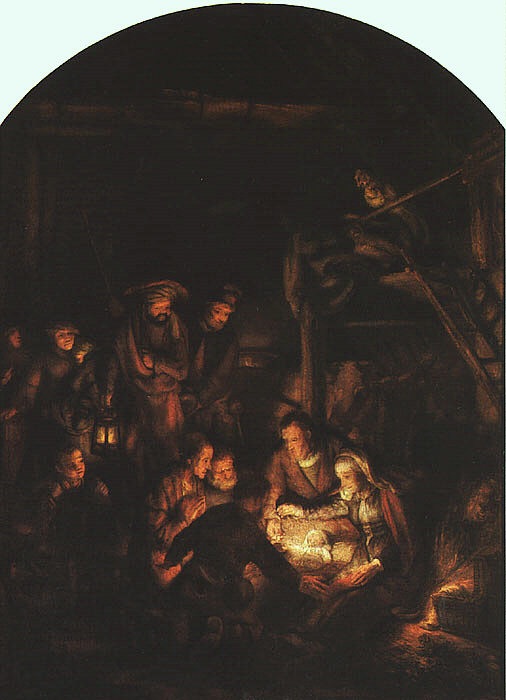
16 And they came with haste, and found Mary, and Joseph, and the babe lying in a manger (Lk 2:15-16).
Caesar speaks and the world moves. At the end of the journey waits a tax man, a faceless, nameless bureaucrat just doing his duty in service of the Empire. God speaks and the shepherds move. At the end of their journey is a weary peasant couple in less than ideal surroundings — a weary peasant couple with a baby wrapped in swaddling clothes lying in a manger, a baby who is the Saviour, Christ the Lord.
17 And when they had seen it, they made known abroad the saying which was told them concerning this child.
18 And all they that heard it wondered at those things which were told them by the shepherds.
20 And the shepherds returned, glorifying and praising God for all the things that they had heard and seen, as it was told unto them (Lk 2:17-18, 20).
So, it is back to work for the shepherds. Flocks have to be gathered and moved to new grass and fresh water. Predators have to be dissuaded. Ewes have to be delivered of their lambs. Wool has to be sheared. Nothing has changed. Everything has changed. Rome will speak and the world will move, yes. But the shepherds have heard another voice; they have seen another king. They have traveled to Bethlehem and have seen this thing which the Lord made known to them through the angels; they have glimpsed the Saviour, the Messiah. They have, perhaps, just come to believe in a different kind of peace wrought not through violence but through this baby who is and will be prophet, priest, and king for all people. Though the shepherds almost certainly do not fully grasp it yet, they have seen the end of Rome, the end of empire and the dawning of the Kingdom of God.
18 And all they that heard it wondered at those things which were told them by the shepherds.
19 But Mary kept all these things, and pondered them in her heart (Lk 2:18-19).
There are Caesars still: empires that stride rough shod across the world, philosophies that demand absolute allegiance, charismatic figures that beguile and seduce, technologies that addict, sin that enslaves. These Caesars still speak and the world still moves. And so we come, year after year, generation after generation, to this story of Caesar and Cyrenius, of shepherds and angels, of Mary and Joseph and the babe wrapped in swaddling clothes, lying in a manger because we need to hear spoken the great good news:
10 …Fear not: for, behold, I bring you good tidings of great joy, which shall be to all people.
11 For unto you is born this day in the city of David a Saviour, which is Christ the Lord (Lk 2:10-11).
There are Caesars still, vaunting themselves in their pride and vain-glory, exulting in their power, shouting their names to the heavens, not realizing that their time is nearly up, that they will be debased, that their power is illusory, that their names are even now being forgotten. And so we come, year after year, generation after generation, to this story of one such Caesar, long gone, of one such empire which exists now only in its ruins. We come to shepherds and angels, to Mary and Joseph and the babe wrapped in swaddling clothes, lying in a manger, to the one whose kingdom is from everlasting and unto the ages of ages. We come to hear the words of the prophet Isaiah:
6 For unto us a child is born, unto us a son is given: and the government shall be upon his shoulder: and his name shall be called Wonderful, Counsellor, the mighty God, The everlasting Father, The Prince of Peace.
7 Of the increase of his government and peace there shall be no end, upon the throne of David, and upon his kingdom, to order it, and to establish it with judgment and with justice from henceforth even for ever. The zeal of the LORD of hosts will perform this (Is 9:6-7).
There are Caesars still who speak and expect the world to move, who stand and expect the world to bow, who survey all the kingdoms of the world and demand obeisance. And so we come, year after year, generation after generation to gather with God’s people, to take our stand with the angels, and to say: Glory to God in the highest, and on earth peace, good will toward men.
Amen.


 First Blessings